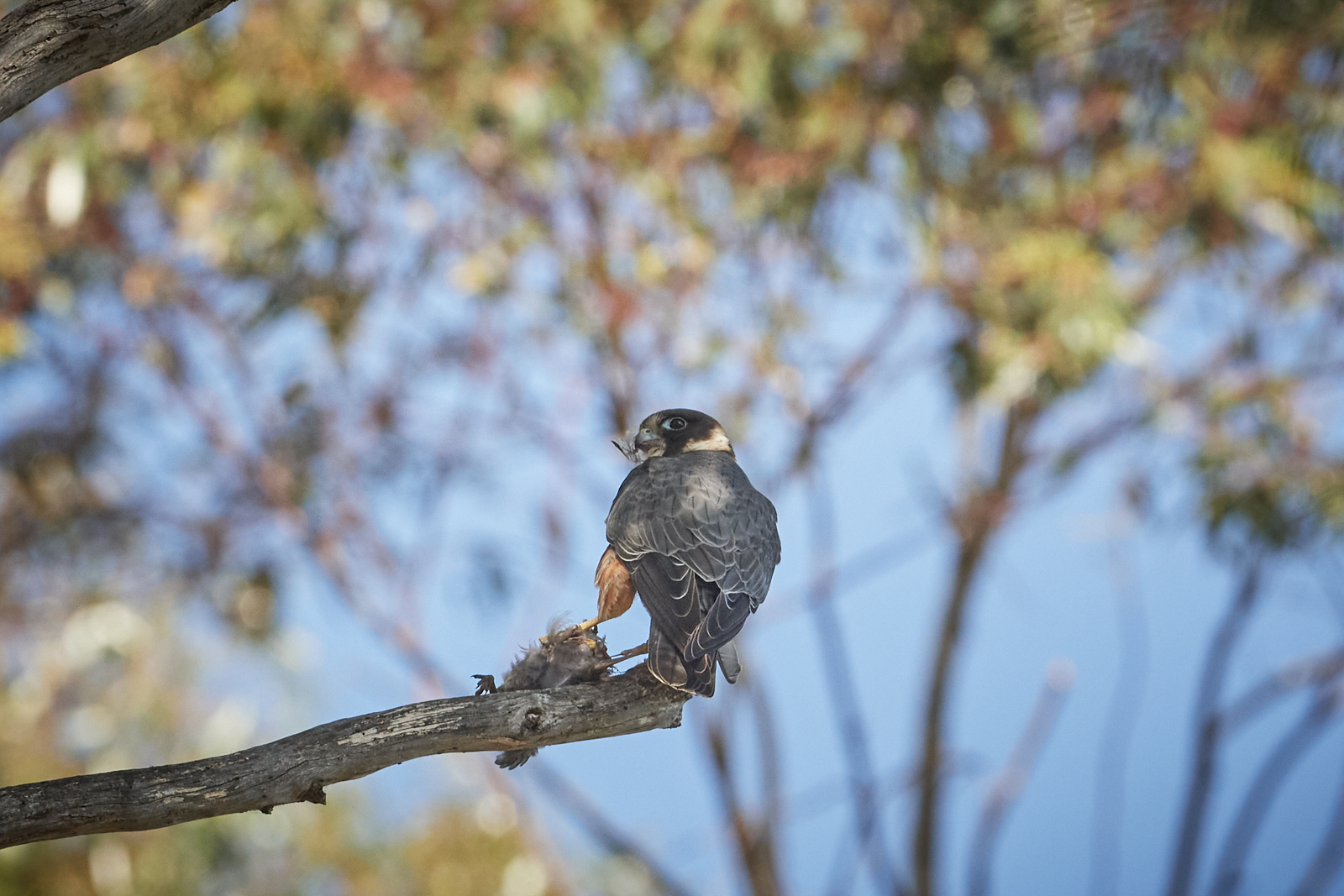
Field-Notes Book: Meet the Neighbours

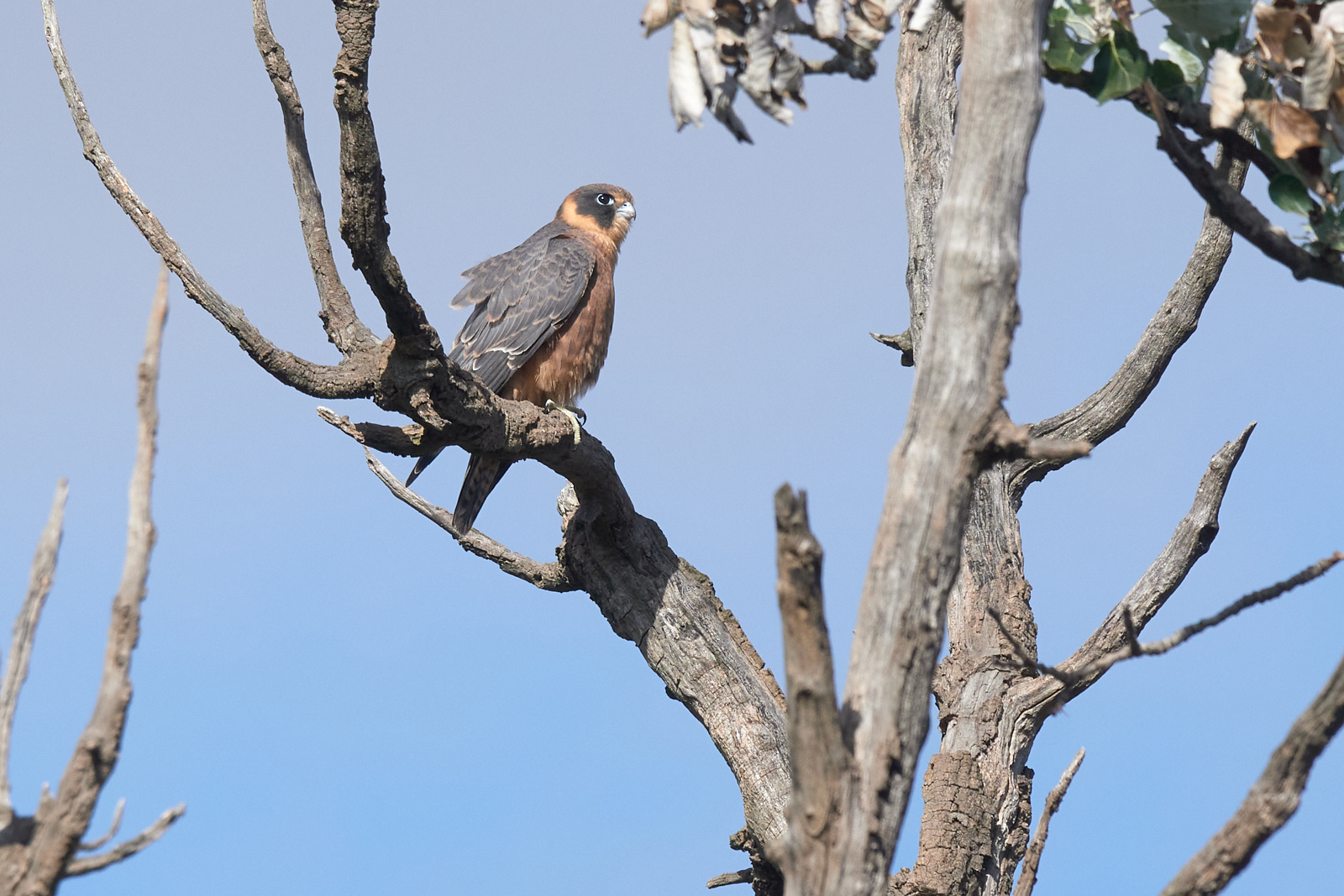
When new neighbours arrive, birds are as inquisitive as the next one.

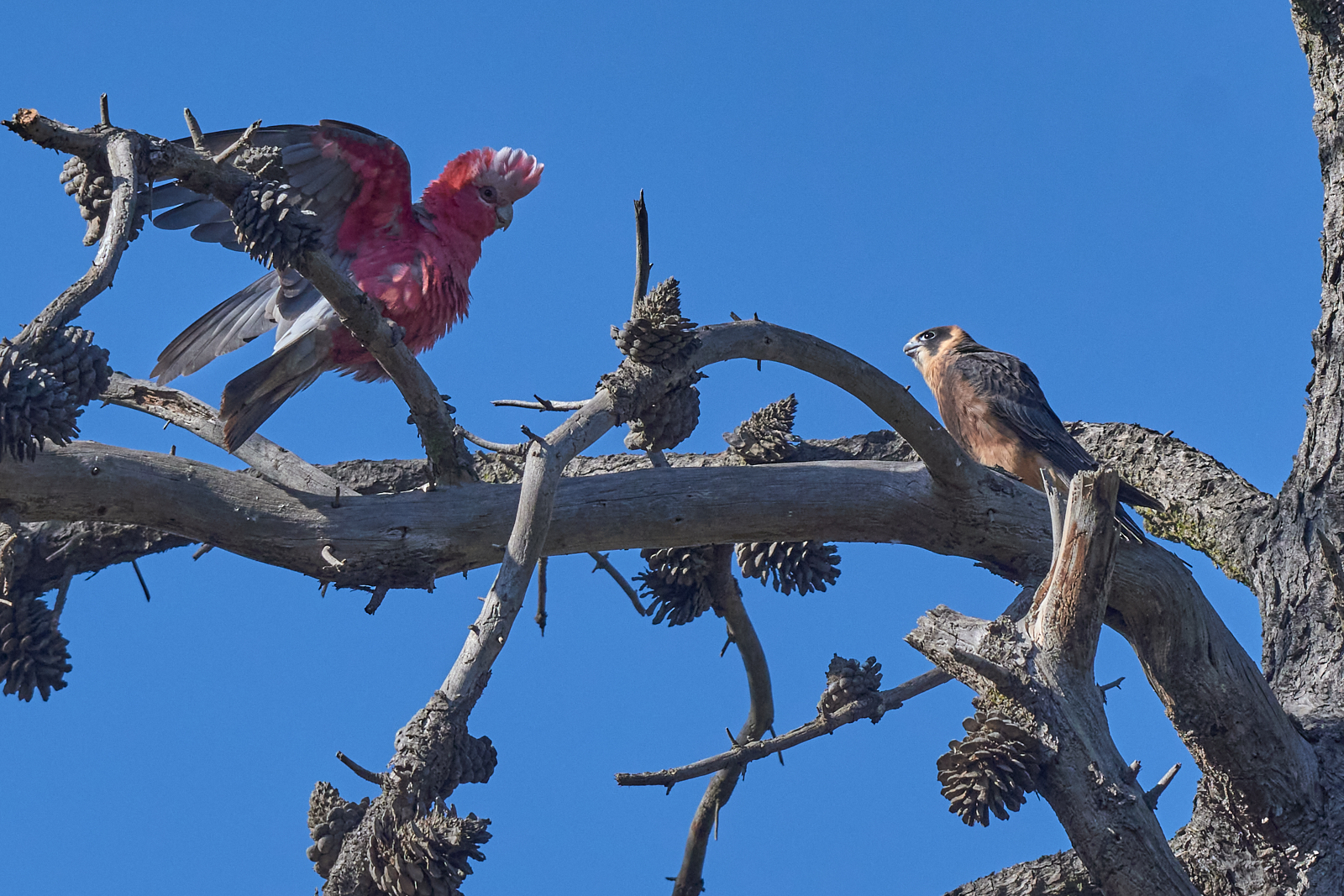
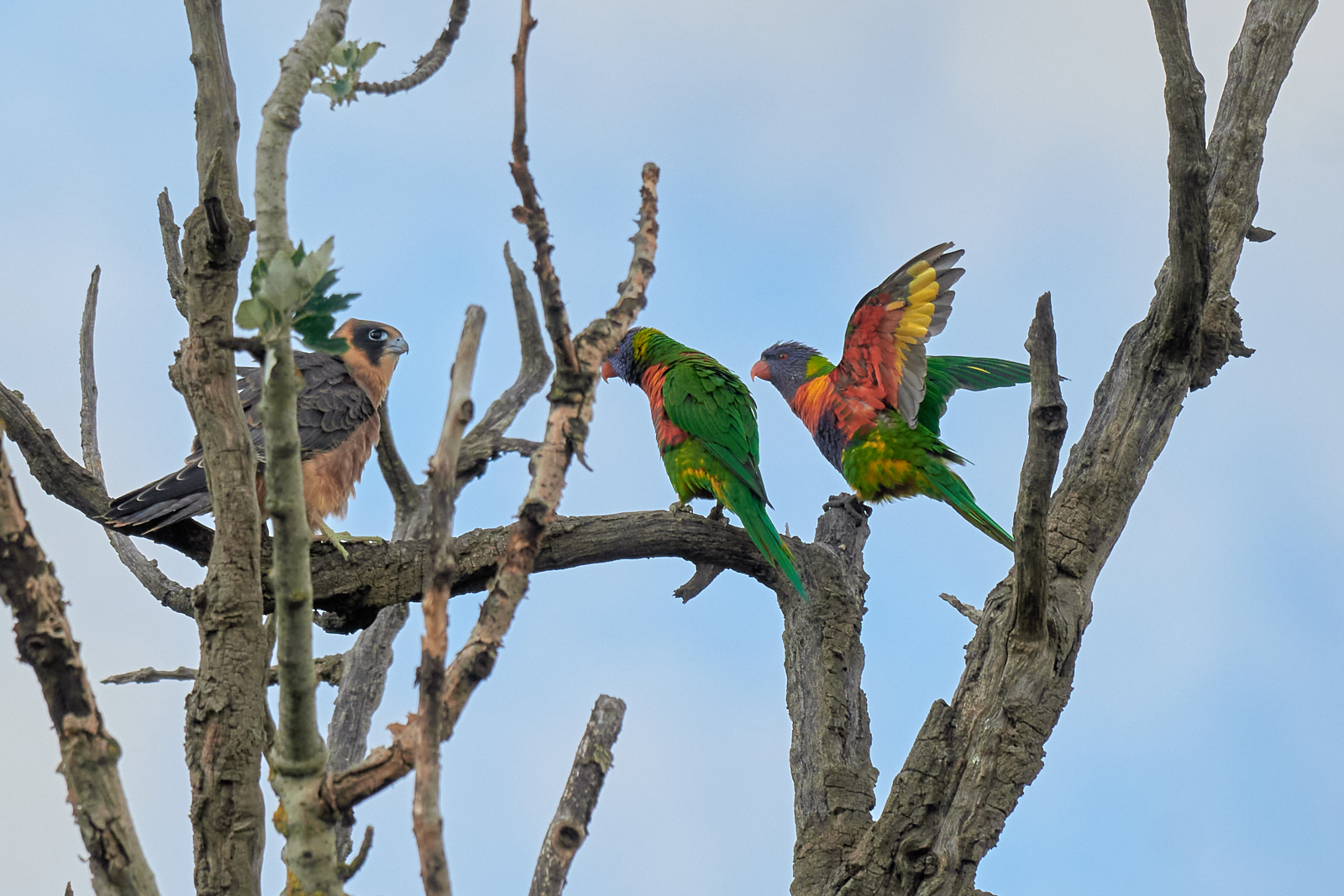
However it didn’t always go well for the young Hobbies as some of the neighbours have a distinct dislike for raptors, small, large, young or old.

A constant source of interaction was with the Galahs in the area.

Here is one such event.

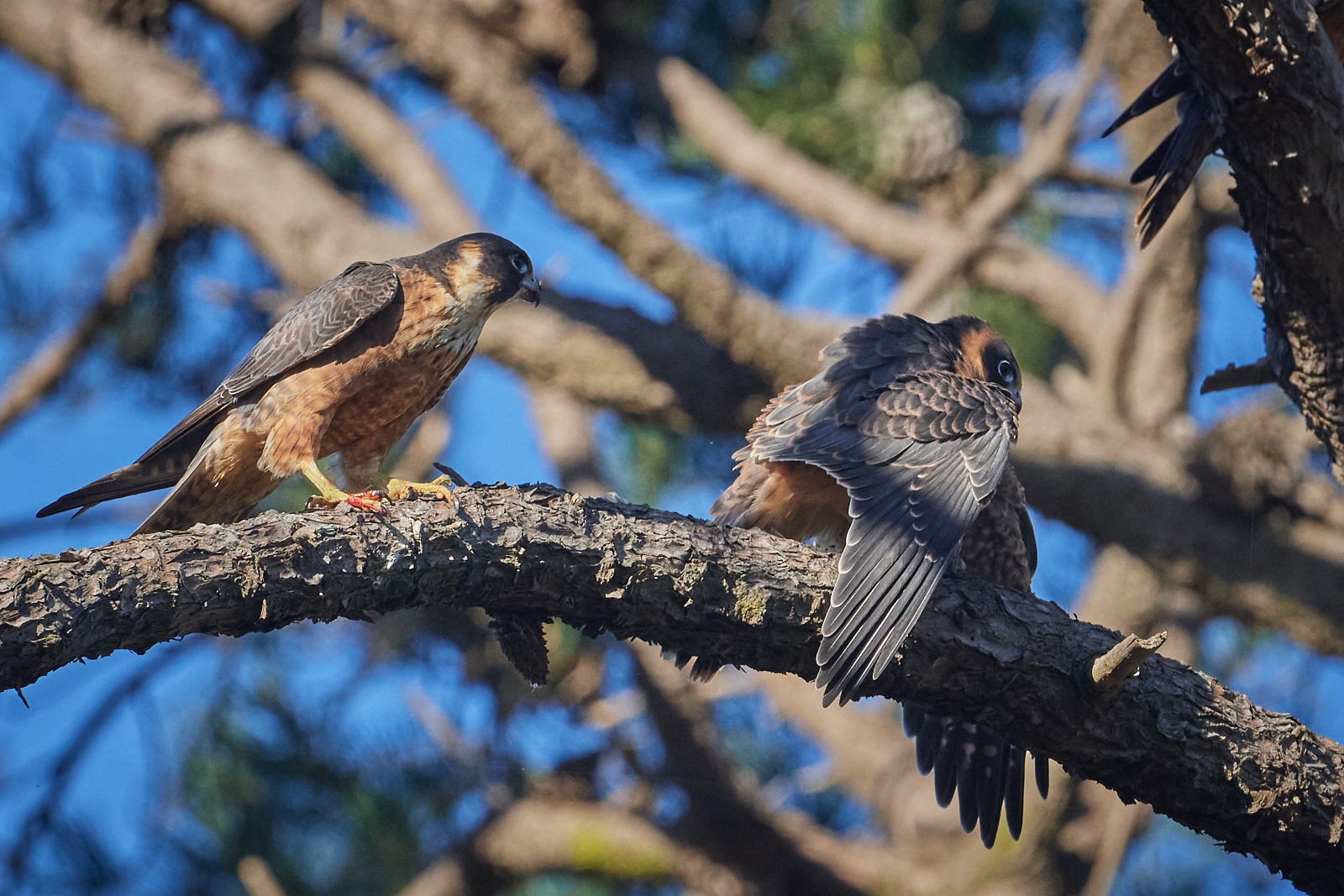
Ahh, new kid on the block. I don’t like you.
Wing flaps and crest raising begin the confrontation
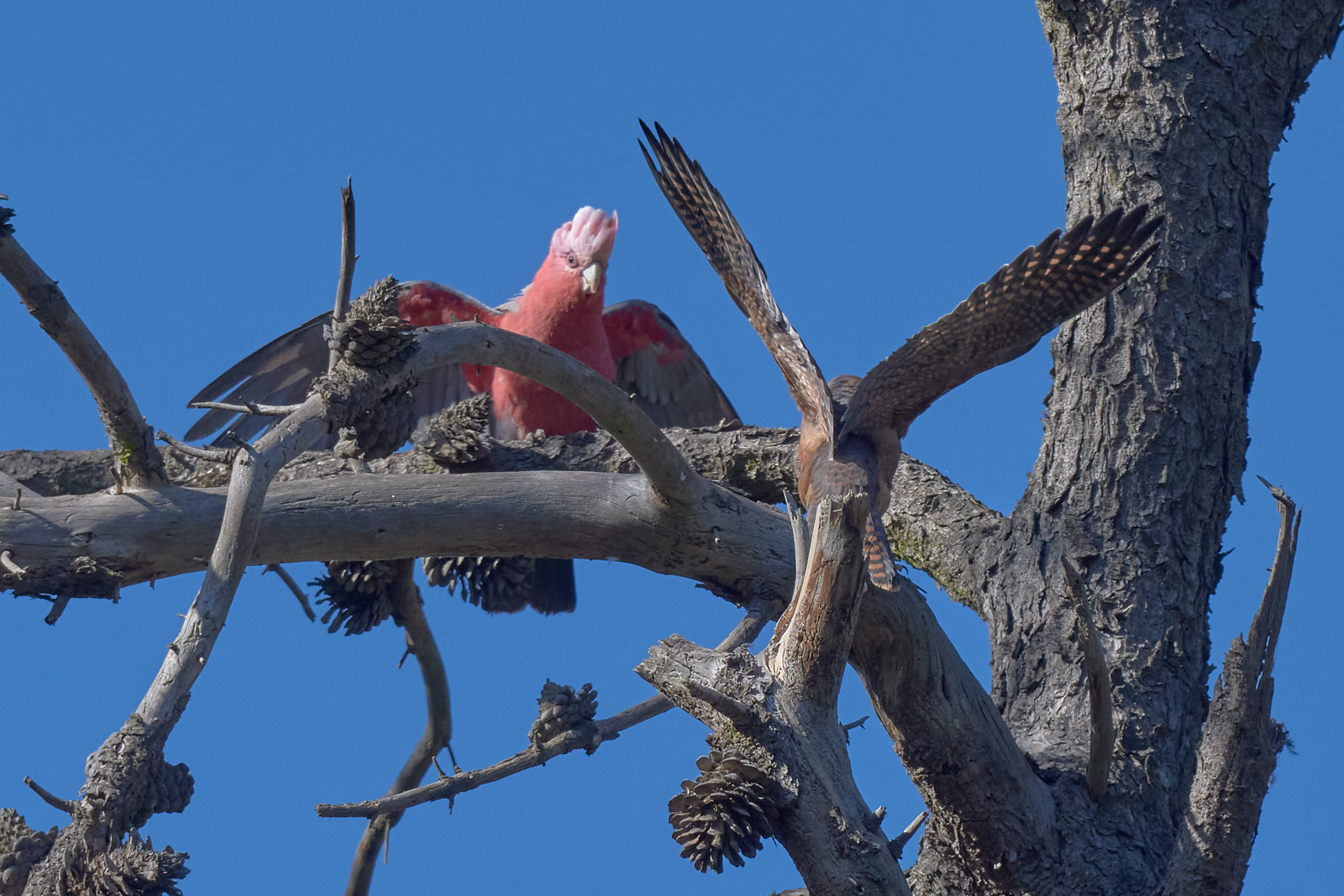
Slowly but surely the Galah moves closer, crowding the young bird to another branch
In the end, the little Hobby departs

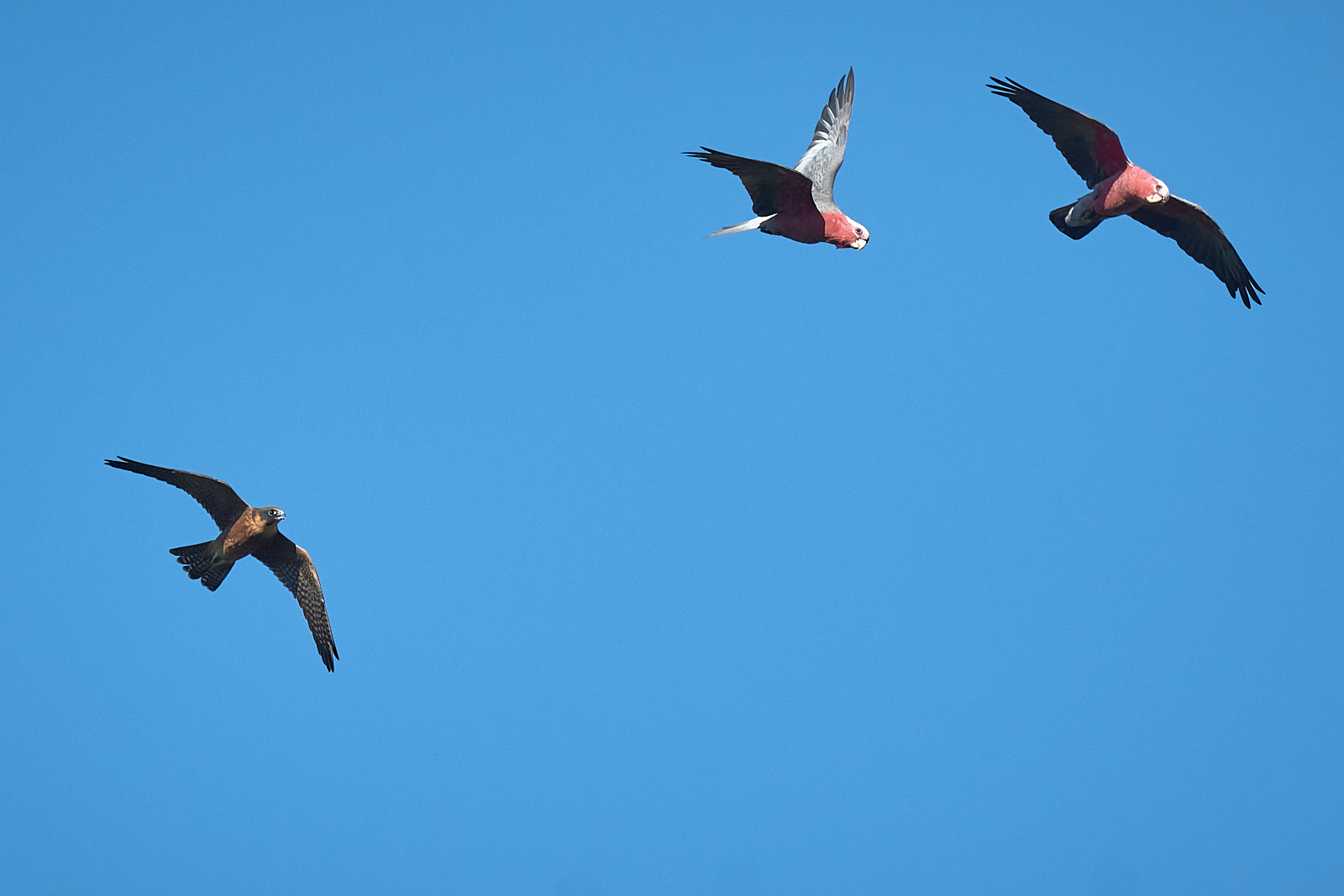
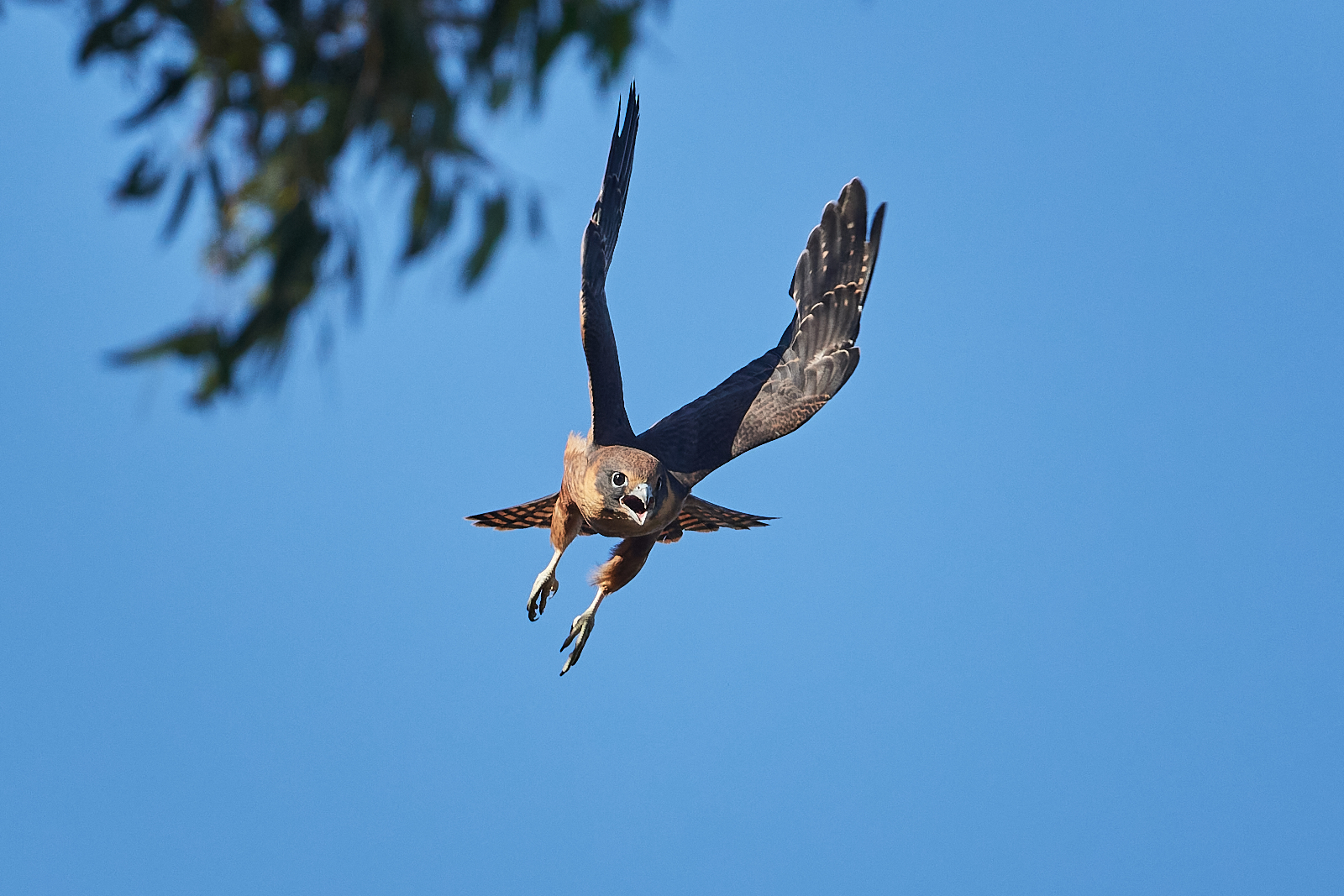
Next in line, several more turn up and chase the young Hobby about the sky.  The little dudes still don’t have real flying skills, so it’s a pretty much one way competition.
Here the galahs have outpaced and out-turned the Hobby, but give the impression of being chased.  Not so.

Just because they could.

The two Galahs thought it would be fun to harass one of the recently fledged Hobbys. 
The pair were ready to hunt it off its perch and then chase it about the sky. 
Just for fun, they let the young bird chase them once in a while as well. 

A week or so later with the young Hobby experienced enough to clip along at over 100kph, it would have been a much more dangerous game.

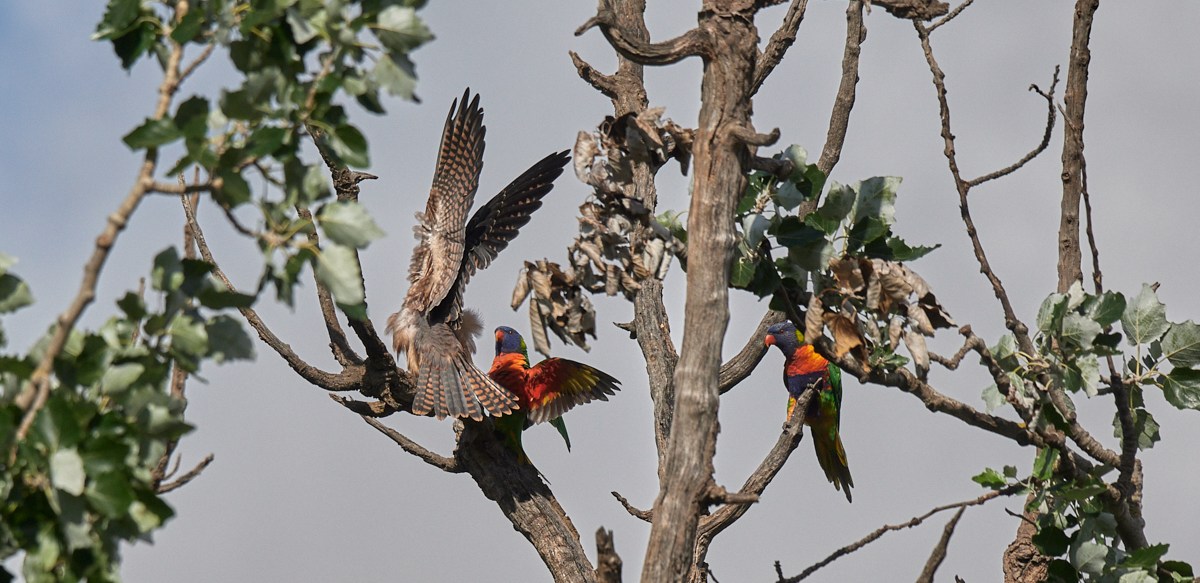
Early morning and one of the young was having some quiet time in the sunshine when a pair of Rainbow Lorikeets dropped by for a looksee.  Much more robust in their attack, and working as a team, the young Hobby in the end had to abandon its rest spot.


They will never forget you ’til somebody new comes along :-  The Eagles.

   Young Hobby still having trouble coming to an understanding with the local Lorikeets.
It has much to learn, they have determination on their side.


Close to the last pages in the field notes.
The Hobbies quickly gain flight experience and then were off to explore the world around the nesting location.  A week on and they could disappear almost at the blink of an eye, and quickly reappear breaking all records in a sharp dive descent.

Their next adventure was learning to hunt along the tree-line nearby, but for a photographer there was not chance of keeping up with the action.

Field-Notes Book: Sharing a Meal

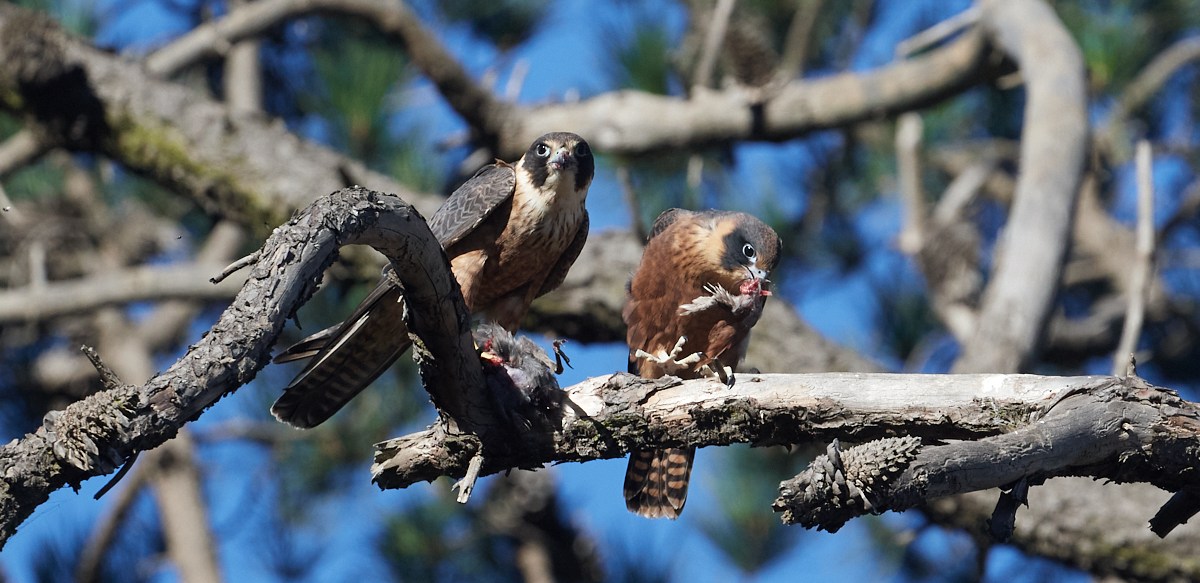
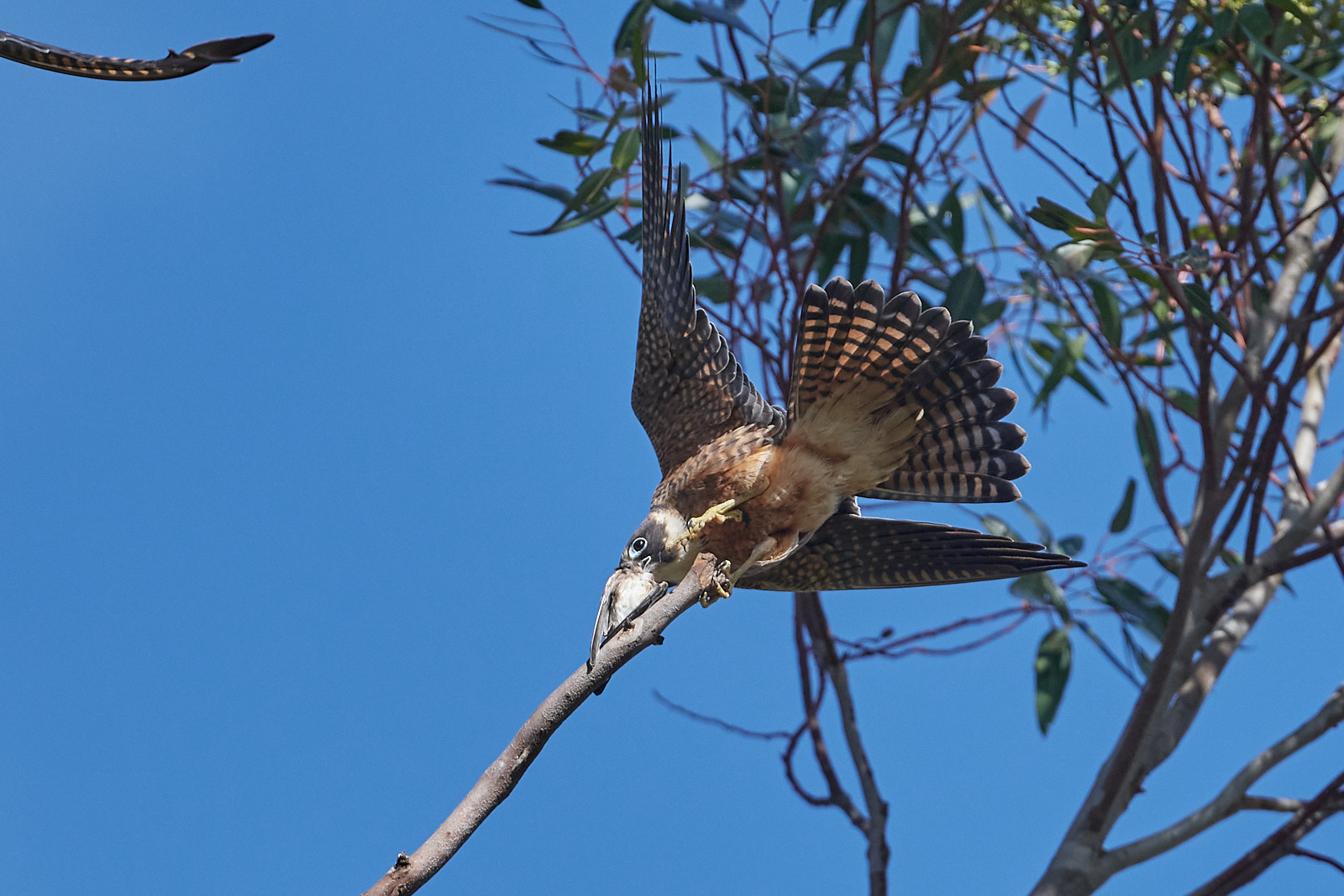
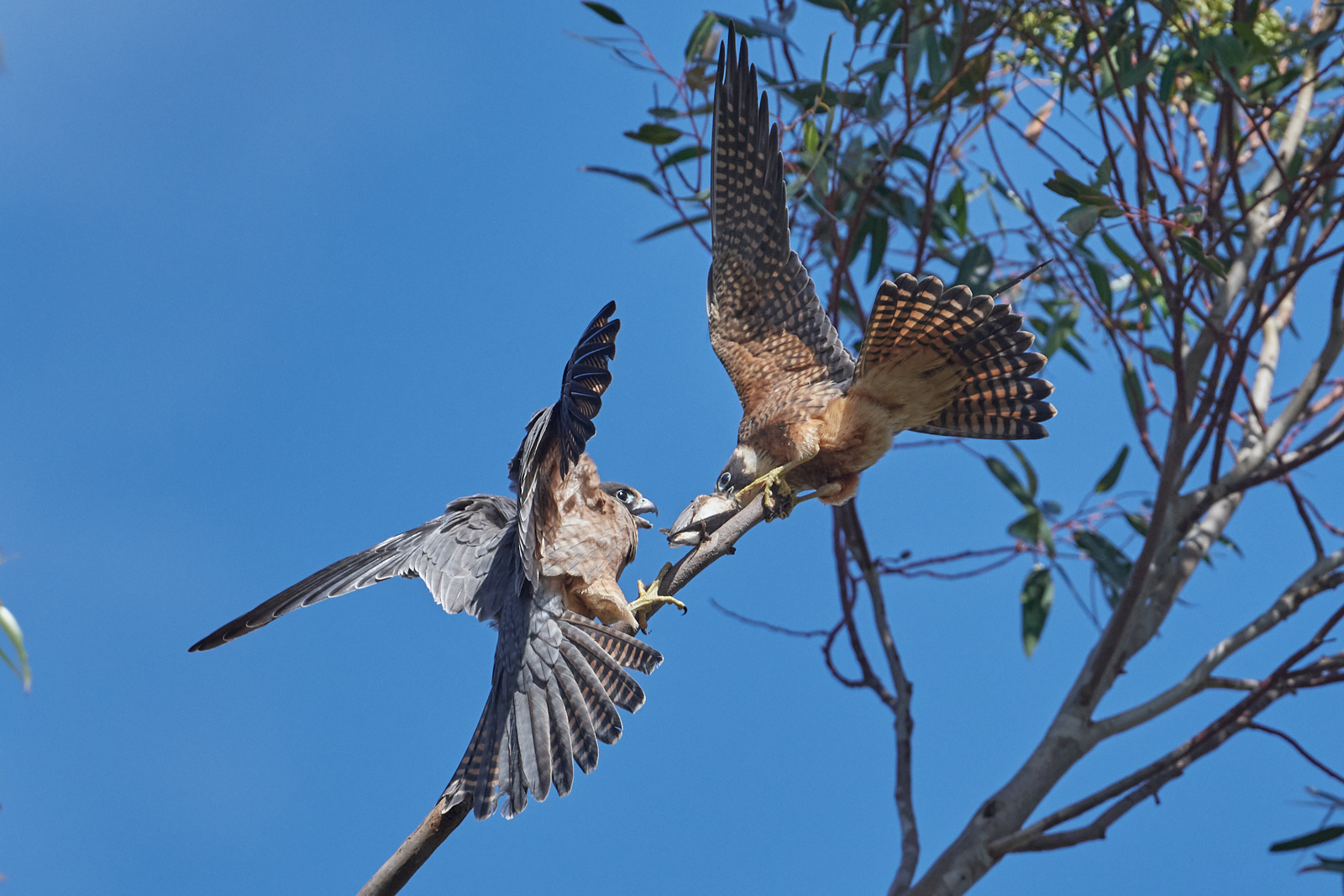
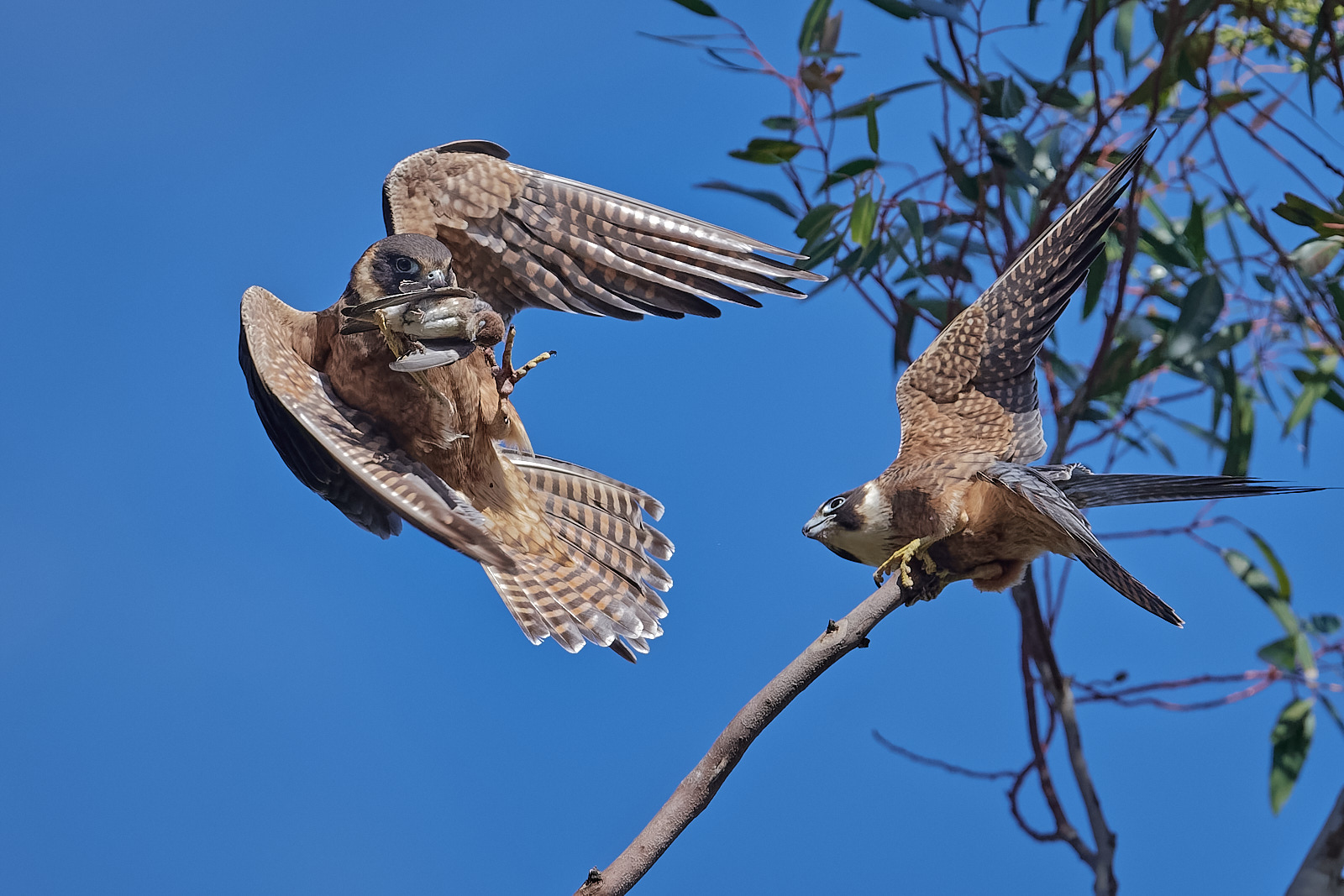
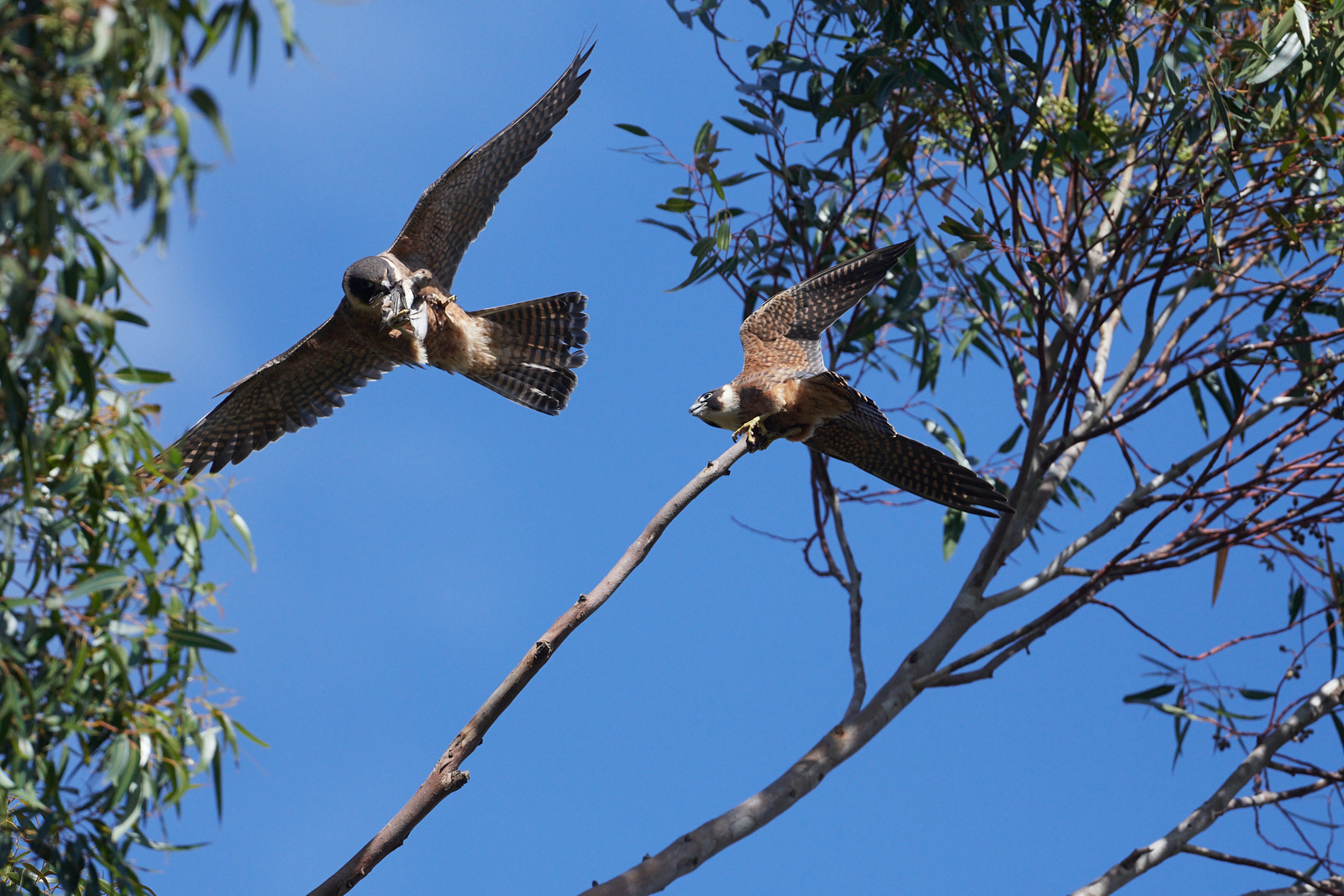
The young Hobbies were well established but still needed to be feed by the female.
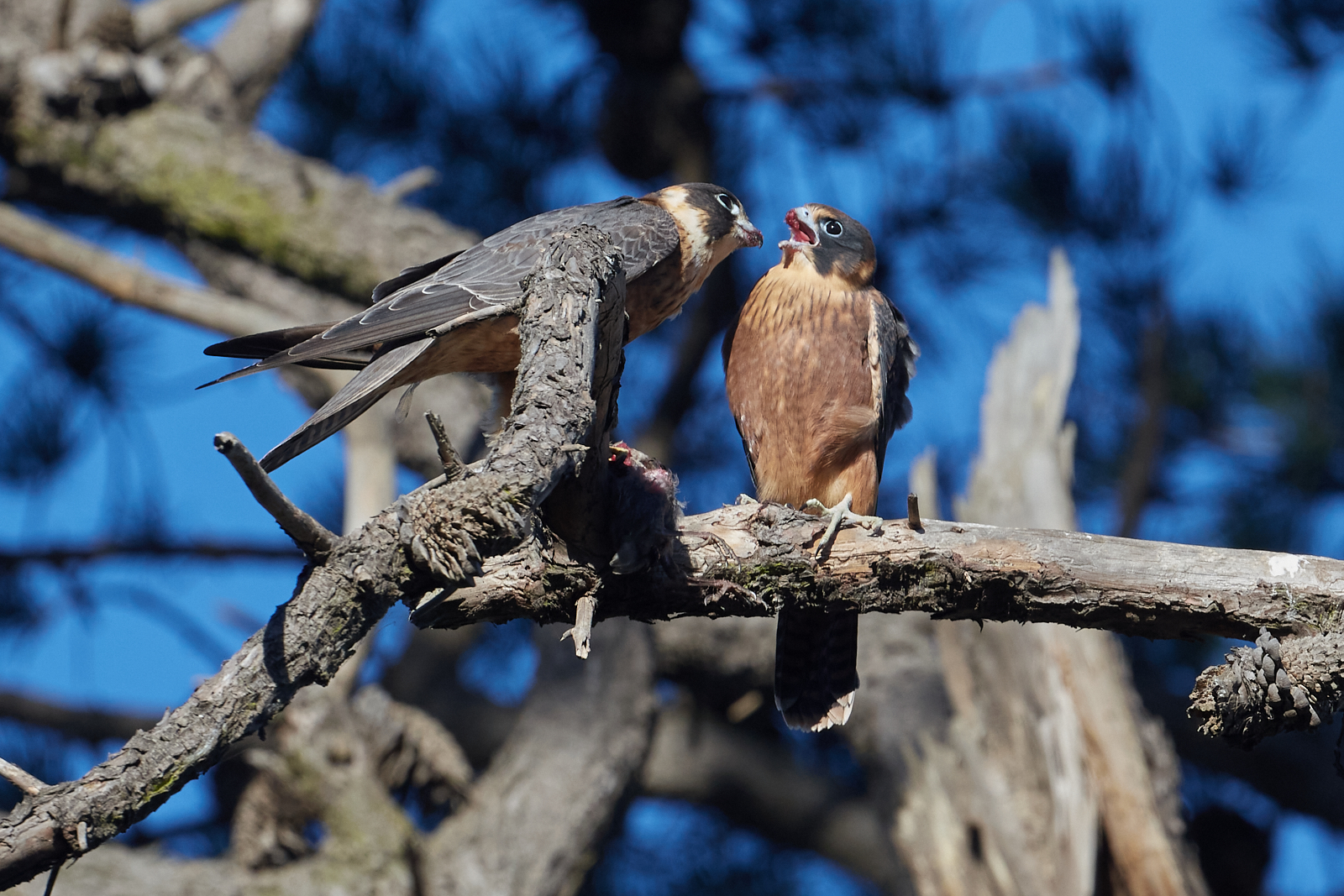
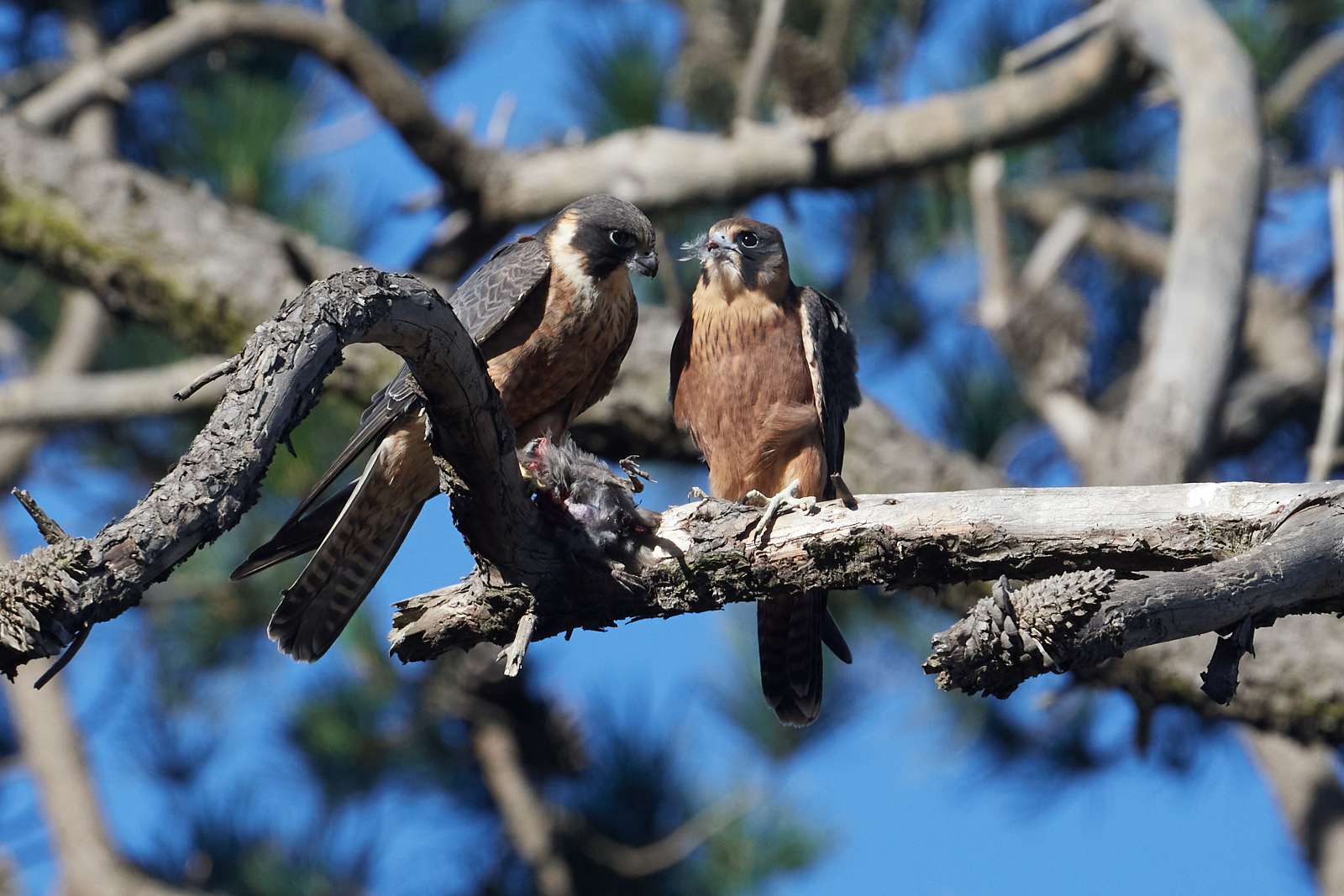
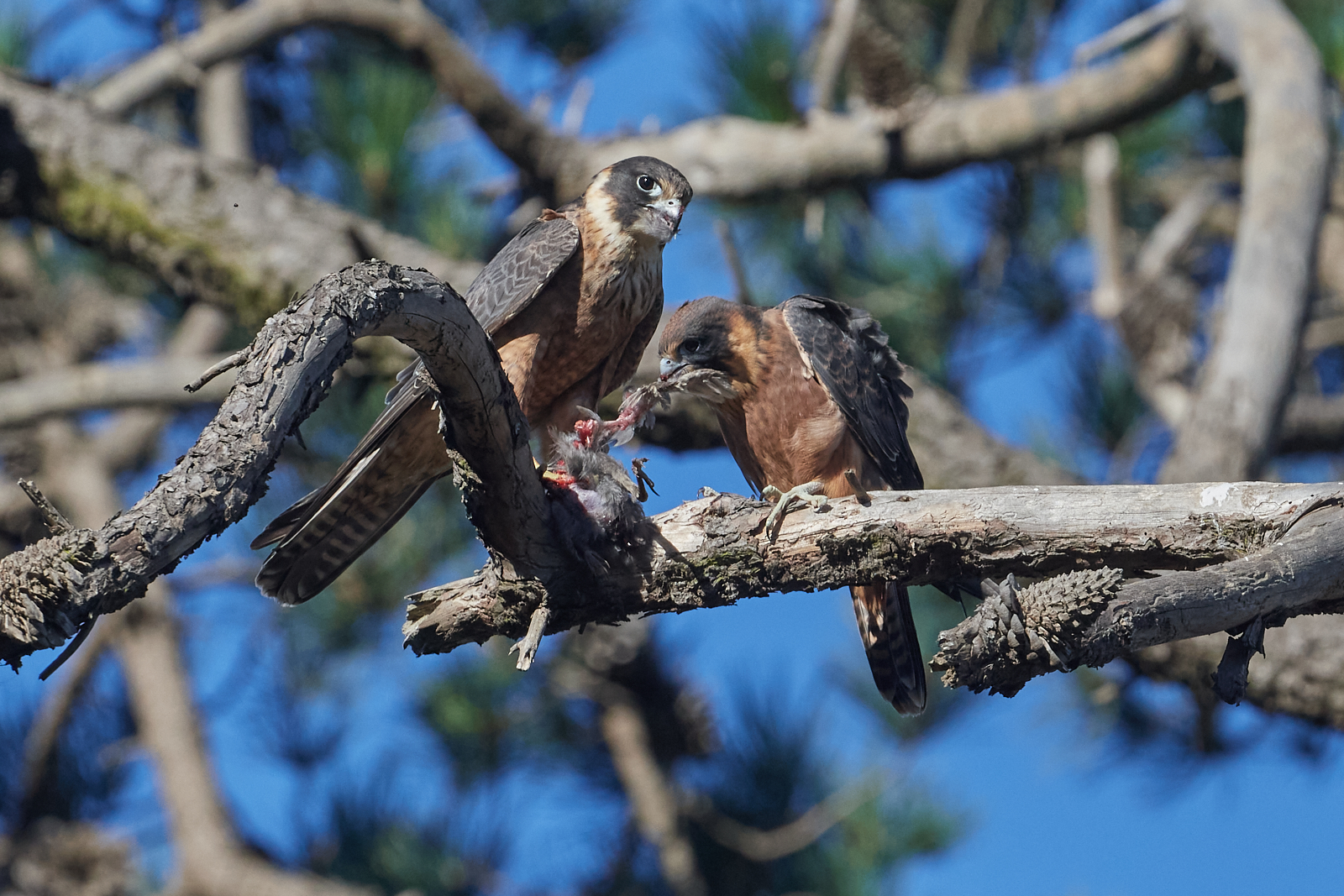
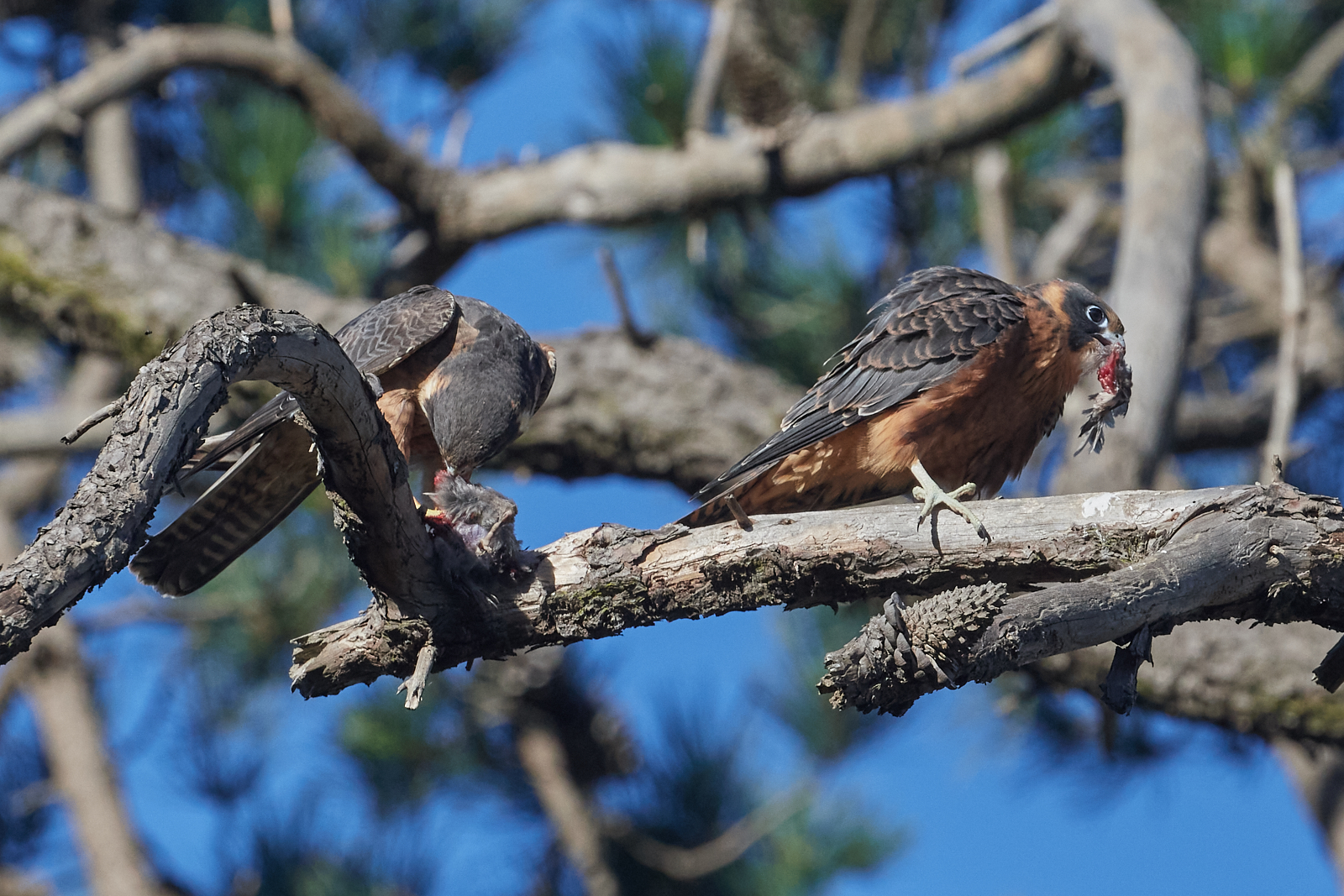
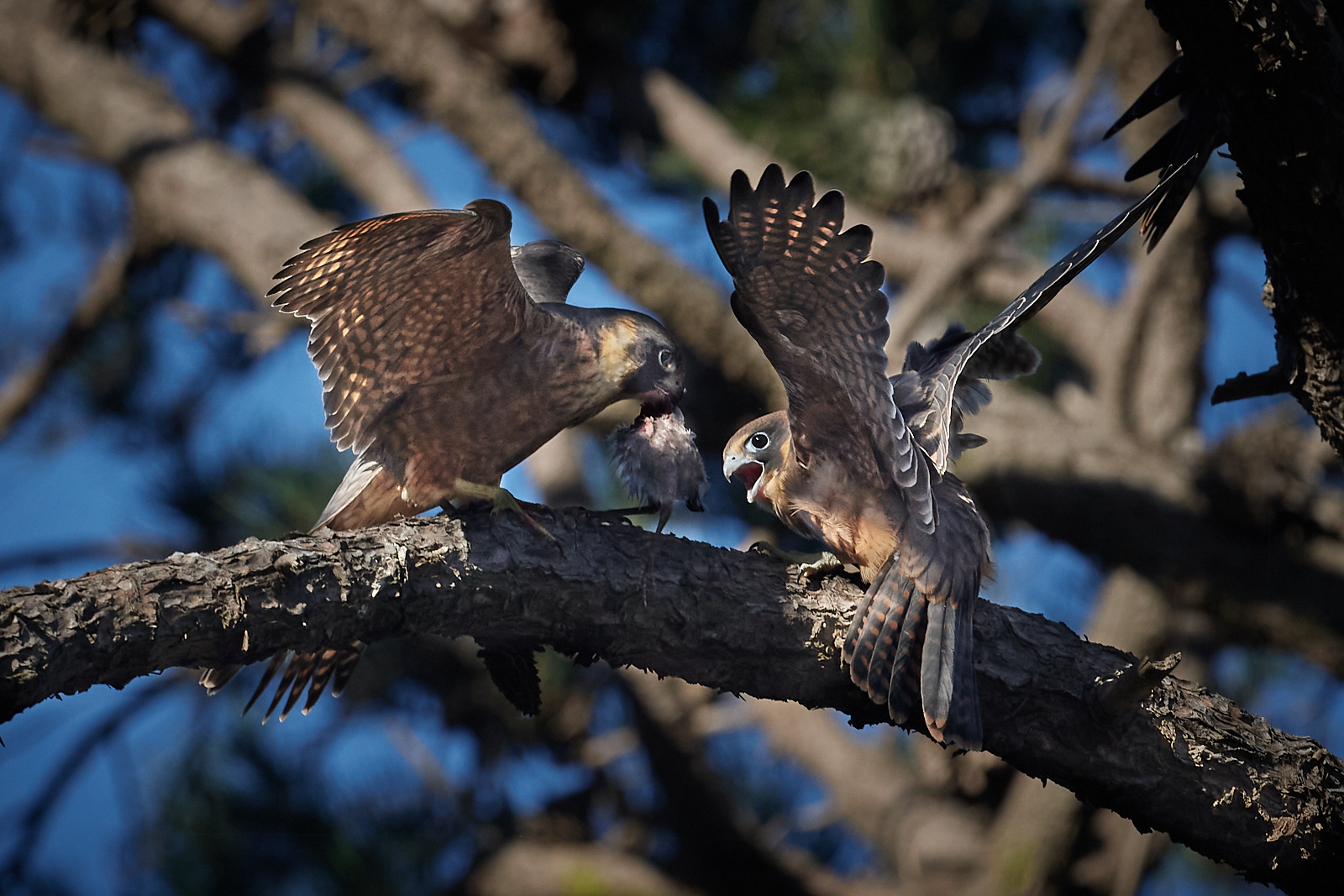
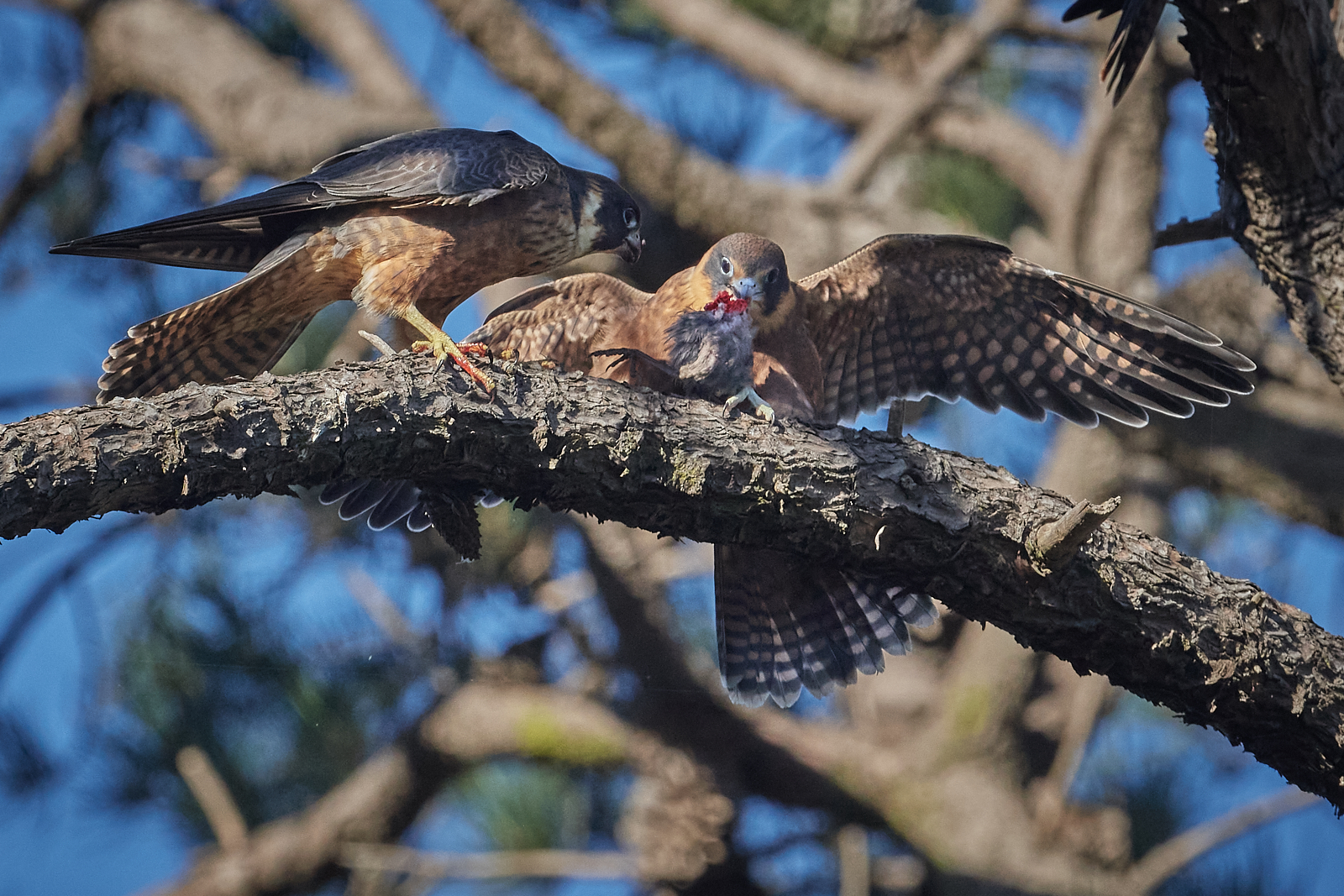
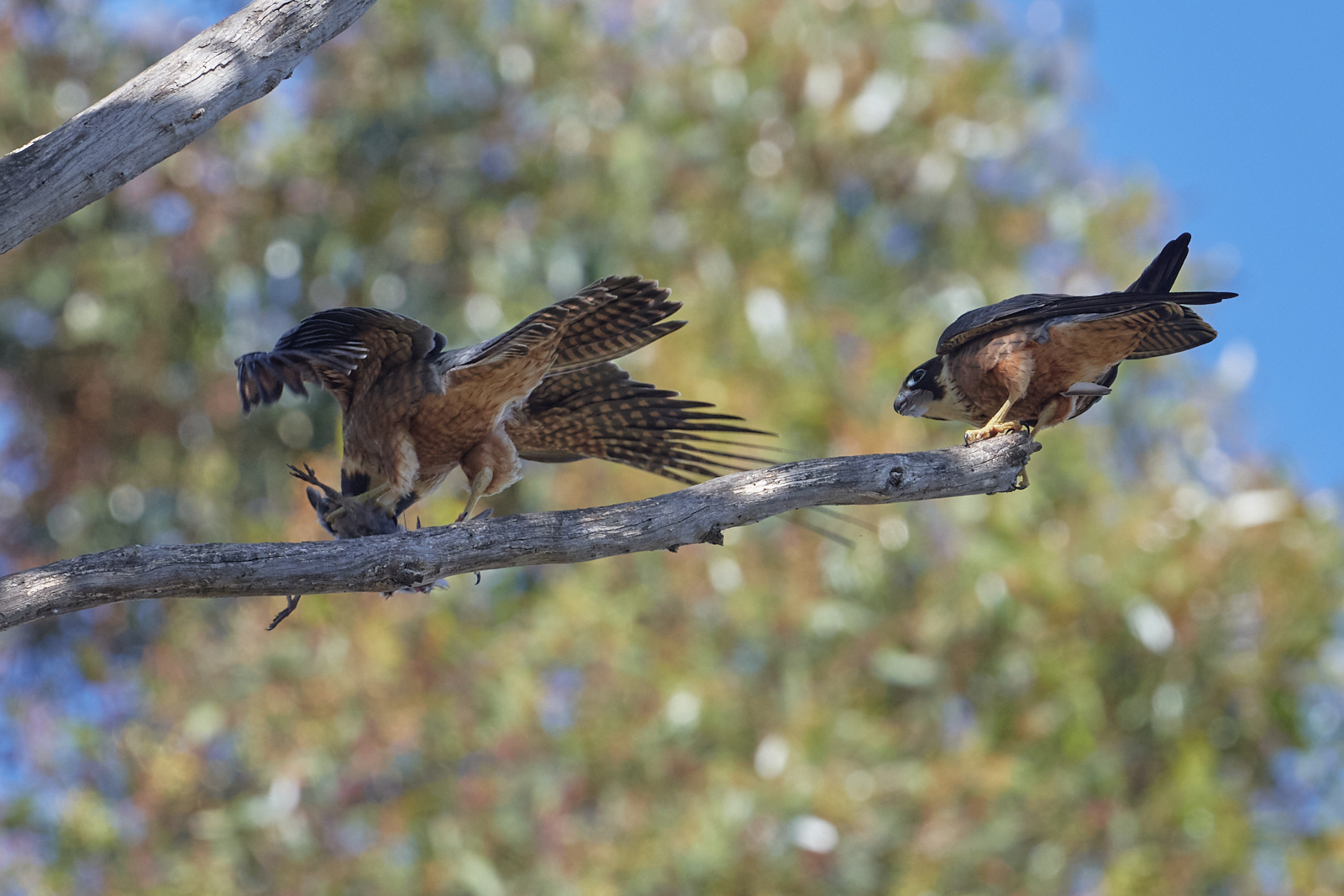
In this sequence she divides up the catch among two of the young. The other would not miss out, as another meal was certainly on the way.

Mum is still carefully tearing off small pieces for the young,
Only a few days out of the nest, it is happy to patiently wait for each morsel
A big moment. “Can I choose a piece?”
It hurries off to a quiet spot on the brach to settle into both enjoying and learning
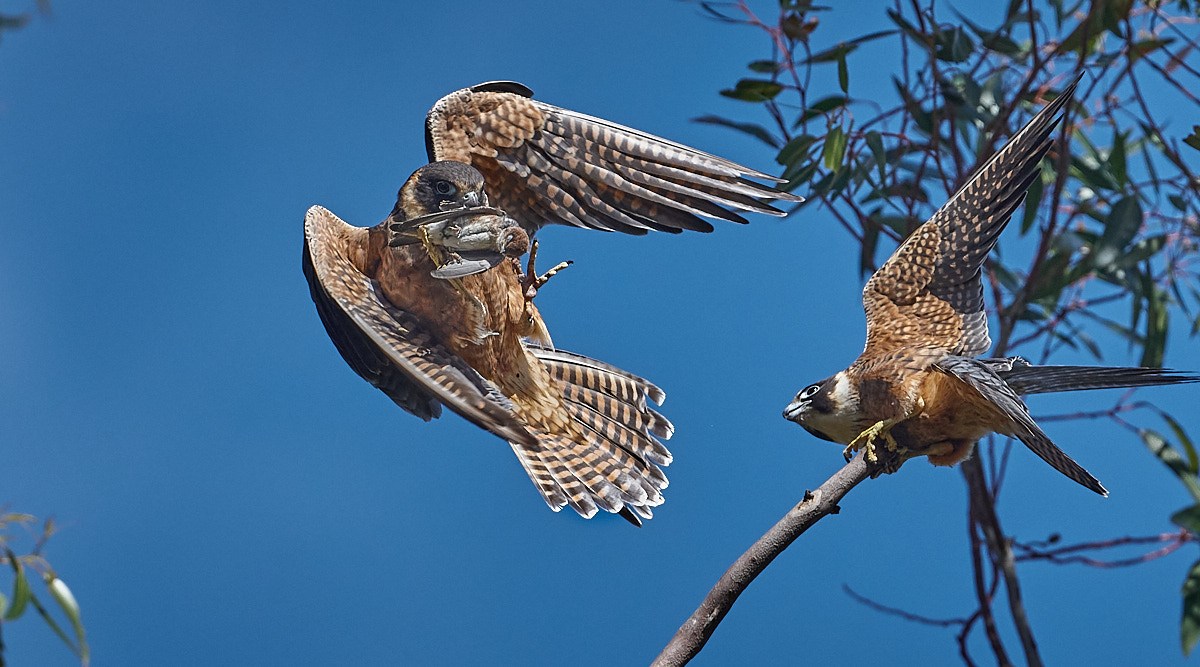
Number two arrives with much wing flap and calling to ensure that some of the goodies are still available
After a bit of juggling for position, it takes charge of the offering
So typical of a raptor, mantling over the prey with spread wings.
And it too takes off to begin its own feeding routine.

Field Notes Book: On the Wing

Had this ready to go and then got side-tracked last night and overlooked the Publish button.

The young Hobbies had flown. Three hungry mouths on the wing.
It is interesting to observe them in the nest. Too big to just settle down, too young to actually be out and about.
After lots of wing practice, hanging on to the nest, and exploring the close branches, they seem to have full knowledge of what is required, but the connection between flapping and letting go is not made.
Then, it’s seems, almost on a whim, they turn, flap, and are aerial.  Not that it’s great flying, mind you,  straight lines mostly, and of course the challenge of slowing down enough to grab onto a branch for security.

Presumably they were airborne the day before we arrived, as they seemed to have settled to the jobs at hand.  Dad was still bringing in food, Mum organising it and distibuting in an even manner.
Three perfect little carbon copies.

Two sitting in the open in the early morning sunshine
Although now free of the nest, they still have a close bond and peck and preen each other
Looks like food is on the way, and it might be first in best fed.
Working hard at getting the wings digging in to the air and righting the balance
Food attached, time to seek a quiet spot to enoy it.
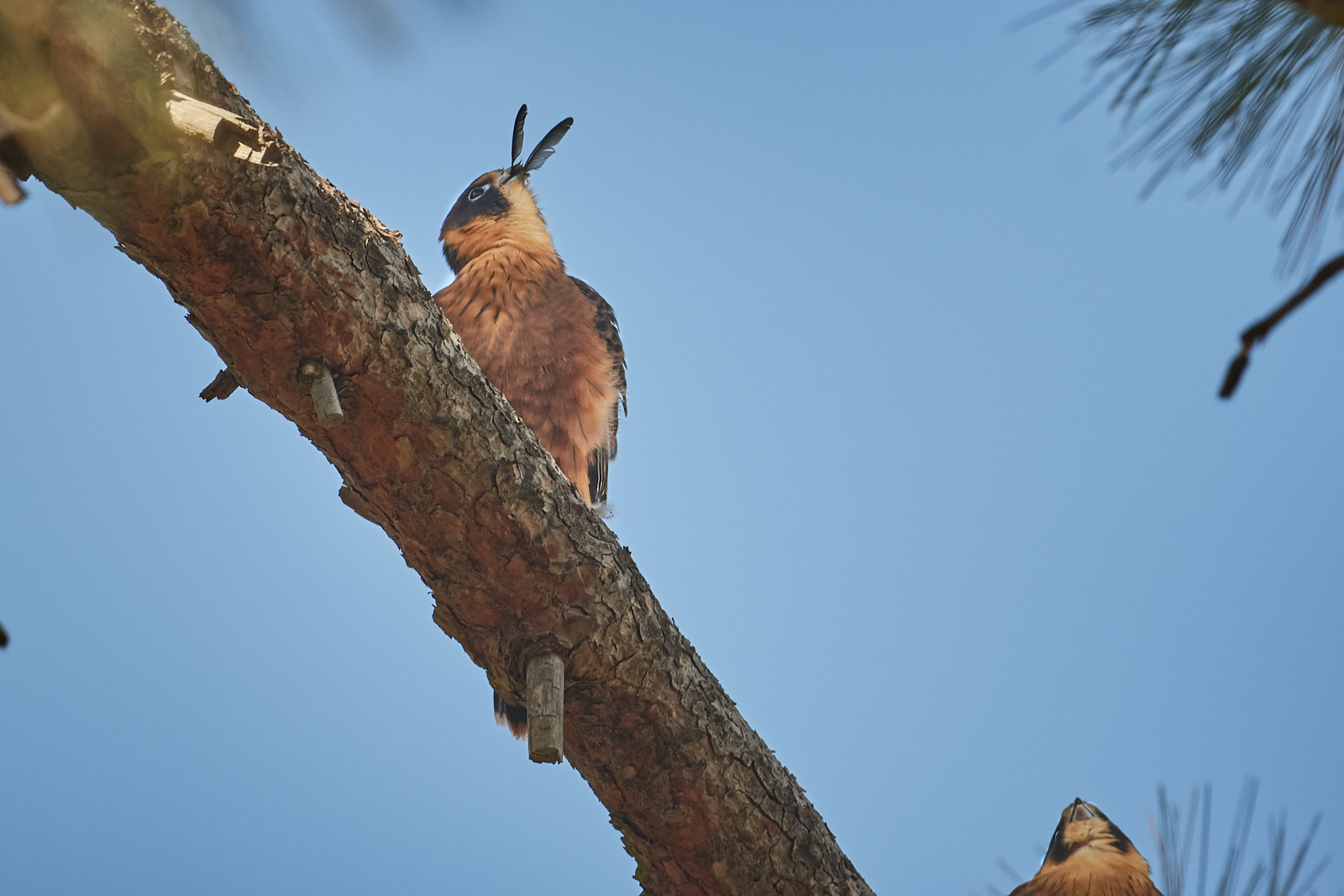
Pfffh feathers. Now they have to prepare their own repast.
With all the skills ahead yet to learn, they still are able to turn on an impressive speed when required.

From the Field Notes Book: The Serious Business of Feeding a Hobby

We had, about a month back, one of those beautiful days that make photography not only a pleasure, but also a chance to nail some great detail.

The Hobby pair were still feeding the young, and the male was providing a steady assortment of snacks.

Here is one delivery from the series

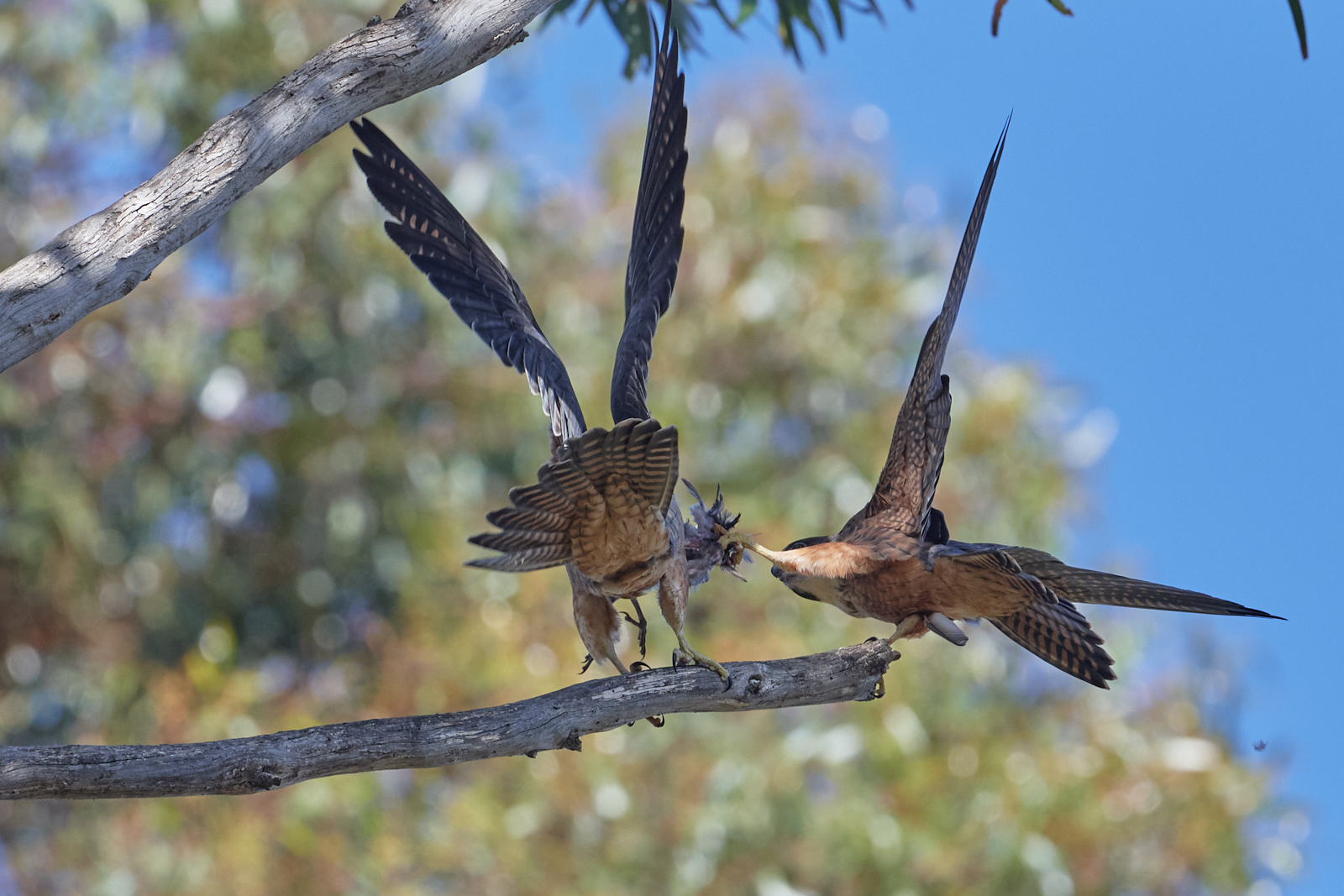
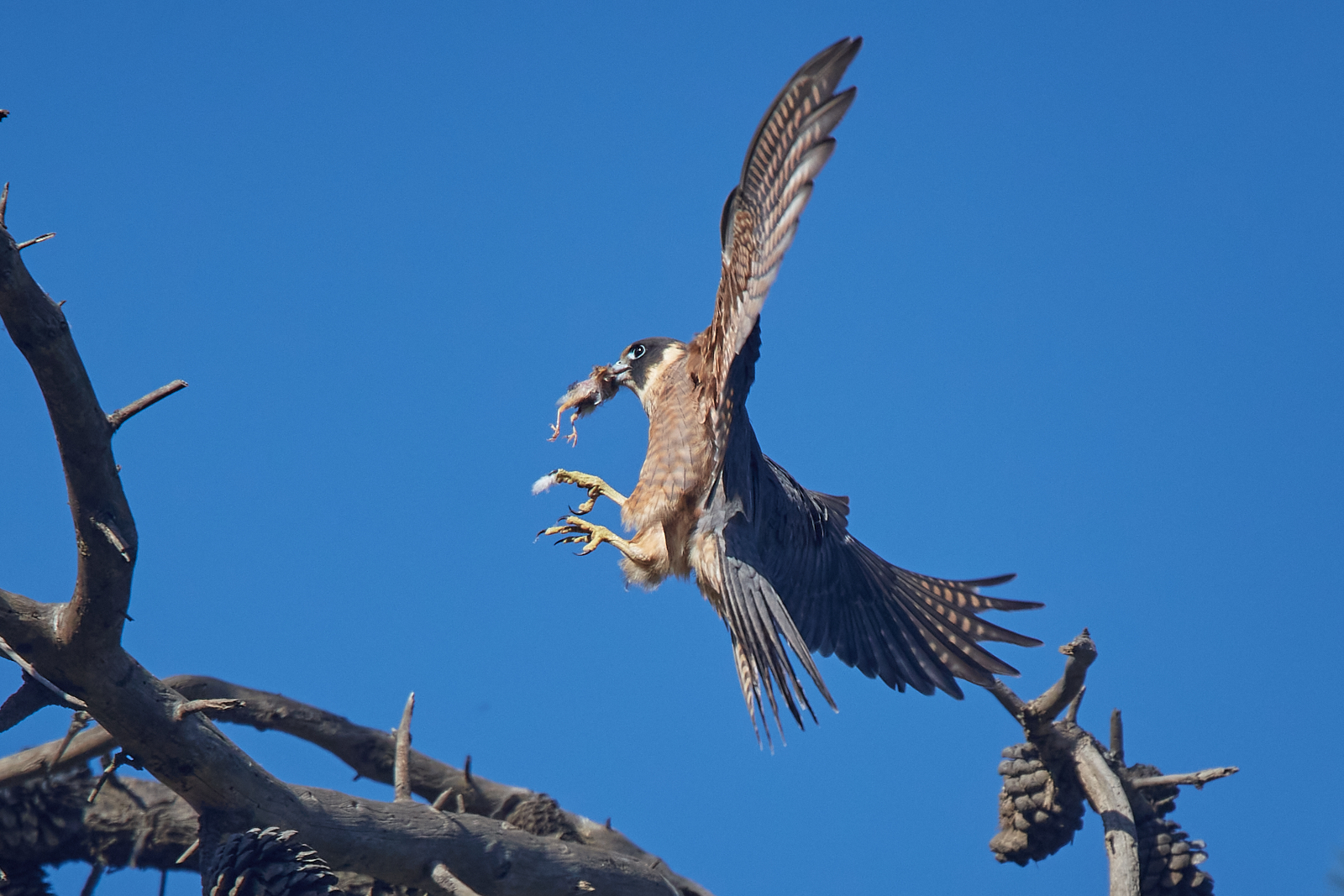
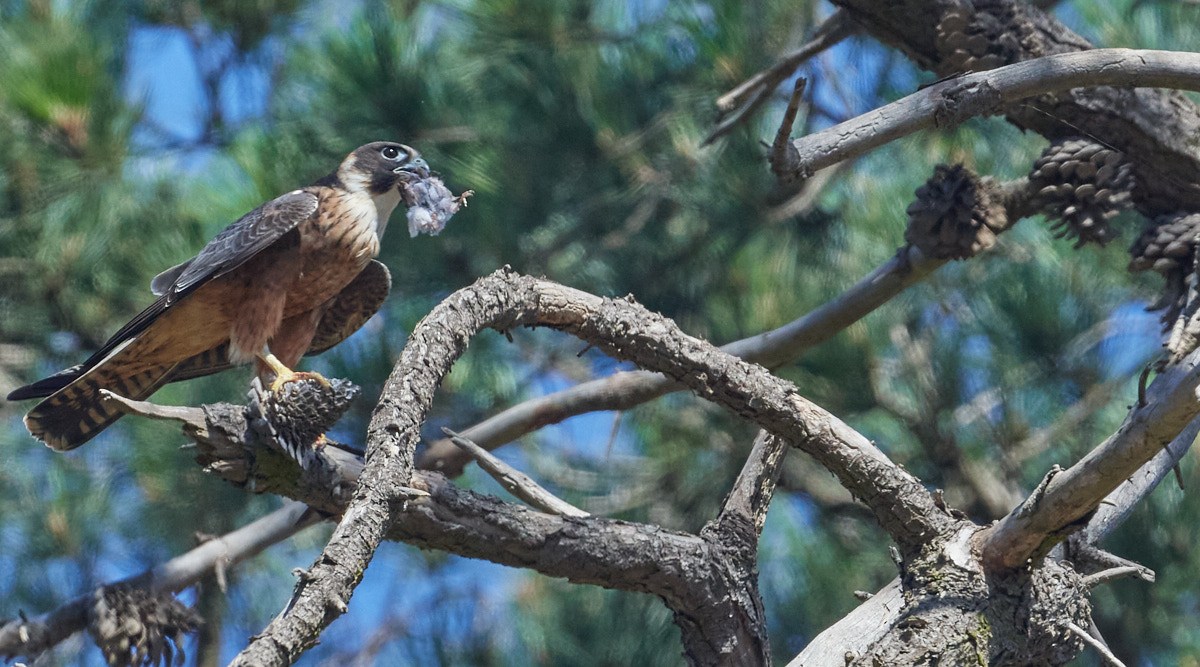
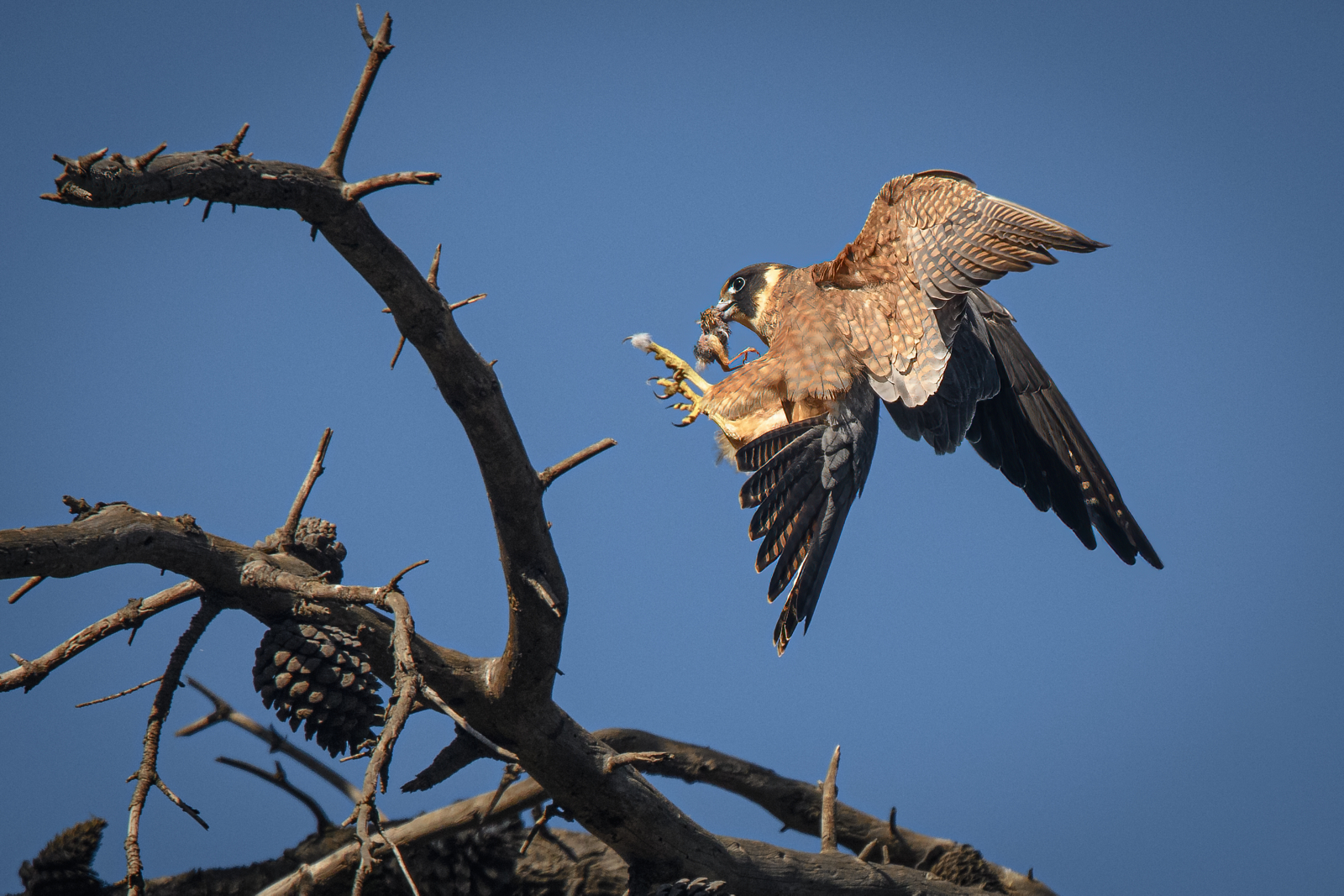
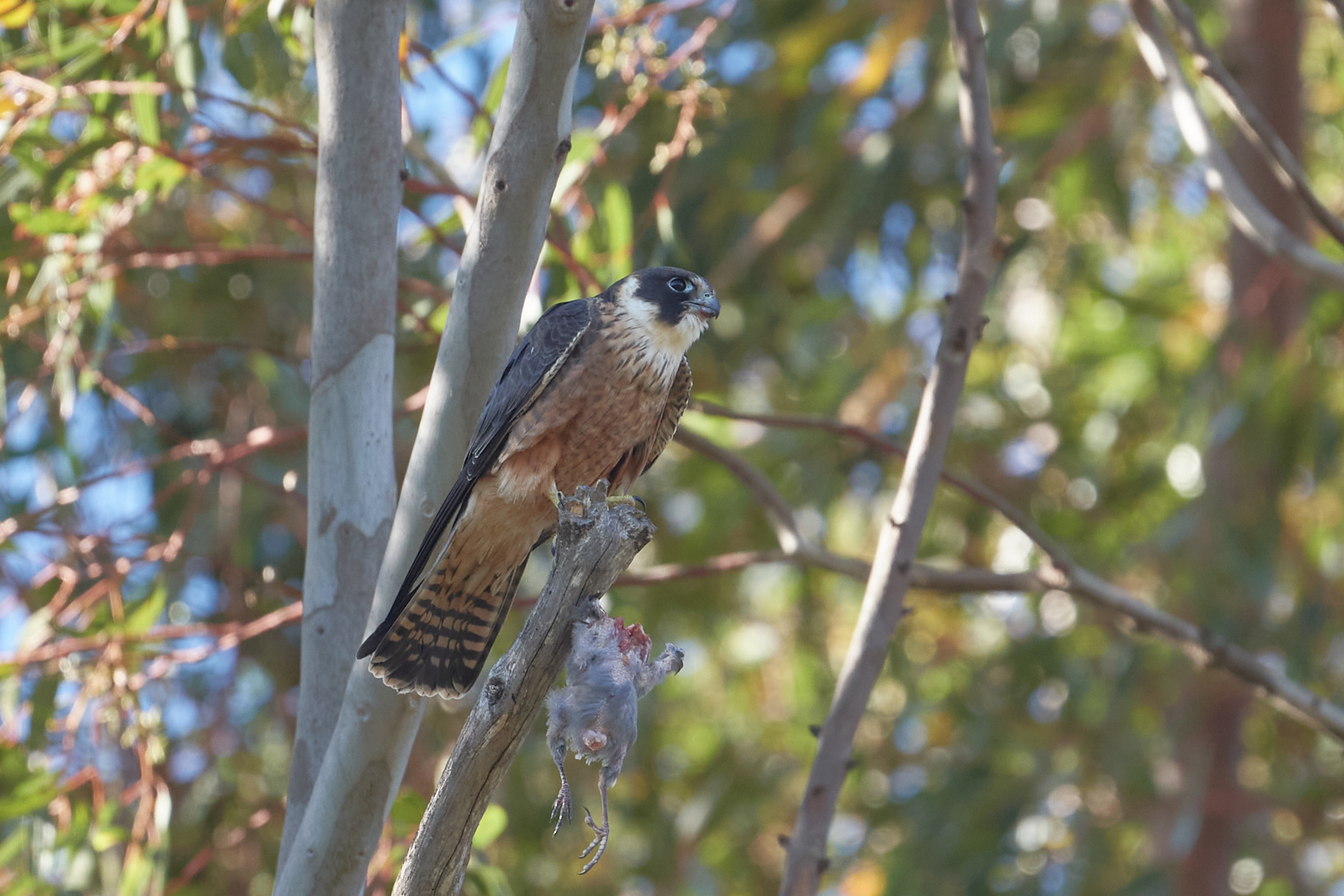
  • The male flies in and sets on a well used exchange branch. He then calls, softly, and she has been sitting high of the nest on another tree.  Without hesitation she glides to meet him. You can just see her wing in the top of the frame.
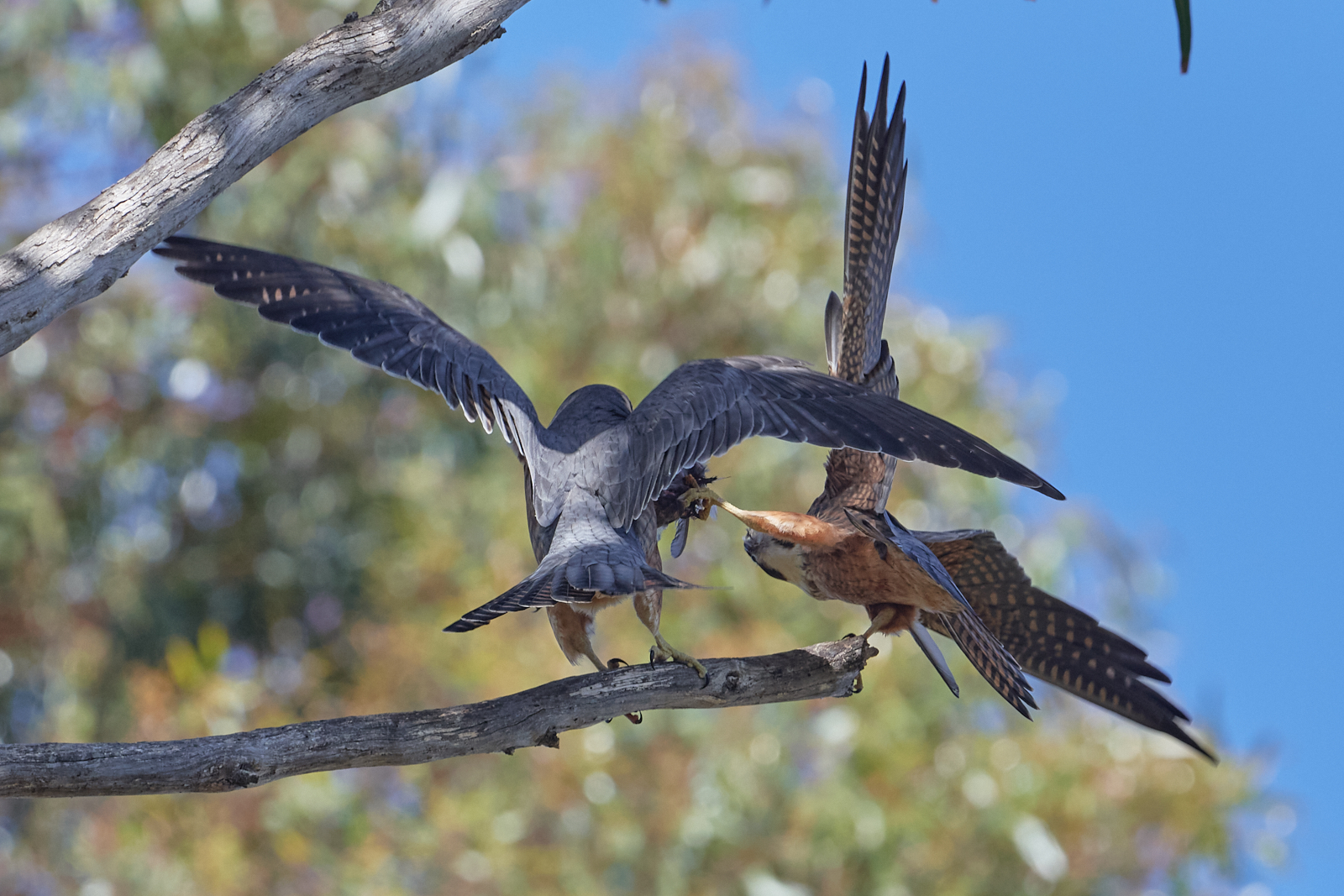
  • With a minimum of fuss she quickly acquires the prize

    • In barely the  blink of an eye and she is on her way. As usual he is intent of watching, I assume to be ready to quickly pickup if she slips (not likely)
    • Securely tucked up, she is on her way

    • And a quick look at one of the young, now only a few days from flying.

From the Field Notes Book: Care and Feeding of a Hobby

Some more moments from feeding habits of Hobbys.

This is a single event.

  • The Male flies in with his latest acquisition.  He calls quietly to announce his presence and then just sits and waits.

  • With barely a wing-flap she sweeps out of the nest, circles and lands beside him.

  • He is always wary about letting go of the prey until he is certain that she has complete control.

    • Every time there is a food transfer, he is always so intent on watching that it has transferred correctly. He always seems ready to slip of the branch should she lose grasp.  I’d guess that it would only fall a metre or so before he was on it.  Still, I have never seen her miss.

  • Away to prepare it for the young.

  • This is not from the same sequence, but fits into the story line here well.

More to come.


A Fascinating Hobby

All the usual warnings of images that contain material that may ‘offend’ some viewers, and the plea to be sure to contact the appropriate helpline.

Ahh, political correctness.


I have, it must be told not ever thought about Falconry as a pasttime.
Not the sport of the rich and regal, but rather the Falconer, and their intimate relationship with these amazing birds of prey.

That such a bird could in fact be domesticated in itself seems hard to grasp.

It is also true that I’ve never spent any more than a few glancing seconds with any of the falcon family (exception being Brown Falcons, but let’s face it, they don’t have the same mystic of the Peregrine or Hobby.)

So, to have a close encounter with a pair of Australian Hobbys (sic—my spelling of the plural) and their resulting young has been quite a thought provoking experience.  Over the past few weeks EE and I, Mr An Onymous, and Neil  A. have clocked up quite a few hours learning a little about their habits, character and approach to life.

In no particular order some bullet points from my field-notes.  I must stress this is not scientific research, and is quite anecdotal-bordering on the anthropomorphic. (Again the usual warnings also apply)

  • Hobbys seem to like to sit on the highest branches available. If there is a higher one, they will move to it.
  • Hobbys seem to favour nesting in the tallest tree in the area.  And they don’t build new nests, but rather inhabit existing, mostly magpie, nests.
  • They have a wariness of humans, but at the same time seem to have developed an awareness of human habitation and used it for their benefit.  We regularly see a pair hunting through a supermarket carpark. Hard not to be impressed with a bird at over 70kph skimming over the parked vehicles.
  • This pair have used the same area, and I think the same nest for at least the past three seasons.
  •  The female sits the nest. The male brings in food.  Unlike other raptors she does not complain until he arrives. She is usually quiet.
  • He too is quiet on arrival.  A couple of short croaky calls, and he then sits on an conspicuous branch and she quietly comes and removes the catch.
  • They are both masters of efficiency.  A glide will do instead of a wing-flap. The change over is precise and almost instant.
  • He always carefully watches after she takes the food, I have concluded that if she were to slip and it fell away, he would be on it before it had dropped more than a metre.
  • This pair have feasted on Wattlebirds, Starlings, occasional Welcome Swallows and quite a parade of young Fairy Martins.  Also other larger birds that were unidentifiable as he had pre-plucked before arrival.
  • Any passing raptor, or raven is chastised from afar, and if it still persists then one, or usually both, will take close quarter action. It consists of gaining height and rolling over into awesomely fast stoops on the interloper(s).
  • I can’t find a reliable reference, but it seems they can clip along around 85-90 kph in a straight flight.  In a stoop, the speed might be as much as 150kph  or more. They are only short bursts, not the long running dive of the Peregrine.
  • In Falconry, the male is called a “Tiercel”and Old English word meaning Third. Perhaps because he is as much as one third smaller than the female. Or is it she is one third larger?

From a bird I have had only the briefest of encounters with, it has given me quite an insight into why they could be trained and how much skill a falconer must have accumulated.

Here is an a couple of days activity before the young were flown.

Click on the Gallery for larger view and slide show.

Saturday Evening Post #113: With Gratitude

Simple Post—With Gratitude.
When I was very much a young bloke, I was a member of a speaking club.  Mostly a social thing as I recall, and of course, a few business contacts never went astray.

One of the points that I recall from all that is the reviewer saying over and over.
“Make sure that you state the purpose of your message up front, early and clearly. So no one has to ponder what or where you are going. No one wants to listen for twenty minutes and then finally discover what the topic, and your point of view actually is”.  He probably didn’t end with a verb, but hey…

Magazine editors make the same demand of feature writers. If the lead is buried 5 paragraphs down, its either rewritten, or returned.

And So I find myself as we approach the end of the year, scarcely able to grasp where we have come this year, not only  physically and emotionally, but photographically.

And it lead me so far to be Grateful that I’m even here to write about it.

I’m also grateful to everyone who has kindly ‘Liked’ the blog, and to those special people who’ve taken a few moments to add their thoughts on the subject.
Me writing a blog does not make me the expert, and really it only exists if people take the time to read, and view the photos. Thanks to your all.

My gratitude to all those on the front line who have stressed and strained under the most dreadful conditions to keep us safe. What else can we say. Thank you.

To the coffee dudes in the local coffee shops who’ve struggled to keep their businesses afloat, to provide food and also a social meeting point that has helped to relieve some stresses.  Thanks.  And thanks to my plastic card that has tapped and gone so many times on cups of coffee to go.

Thanks also to the lockdown, yes I mean that.  As its given me the chance to sort out my runaway photo library. Now a svelte shadow of its former bulging self, I think I am confident the dross has been discarded.

And to the software manufacturers who have plied me with ways to “Bring out the Picture within my Photo.” with their special sauces and blends of technology. At least this year I’ve been able to play with them, and actually laid out money for one.

Thanks to EE, Mr An Onymous, Dave T David N, Len T, Chris L and so many others whom I have had the pleasure of sharing the bush, and the birds and their special patches.  It’s been a thrill each time.

And thanks to the birds. Without them ….asPoetry wouldn’t be as exciting to work on.

The Australian Hobby here is the female of a nesting pair.  She has just been delivered a meal for her young. Time to prepare it and feed her growing brood.

The eternal struggle to maintain the species goes on. Ohh ending on a preposition.(Be grateful I ended)

Photograpahic Essay: I’ve got a Hobby

Well actually we (EE and I) are monitoring a pair of Hobbys. (Haven’t concluded if it should be Hobbies, or more realistically in this case, Hobbys—but you can see where I’m going with this)
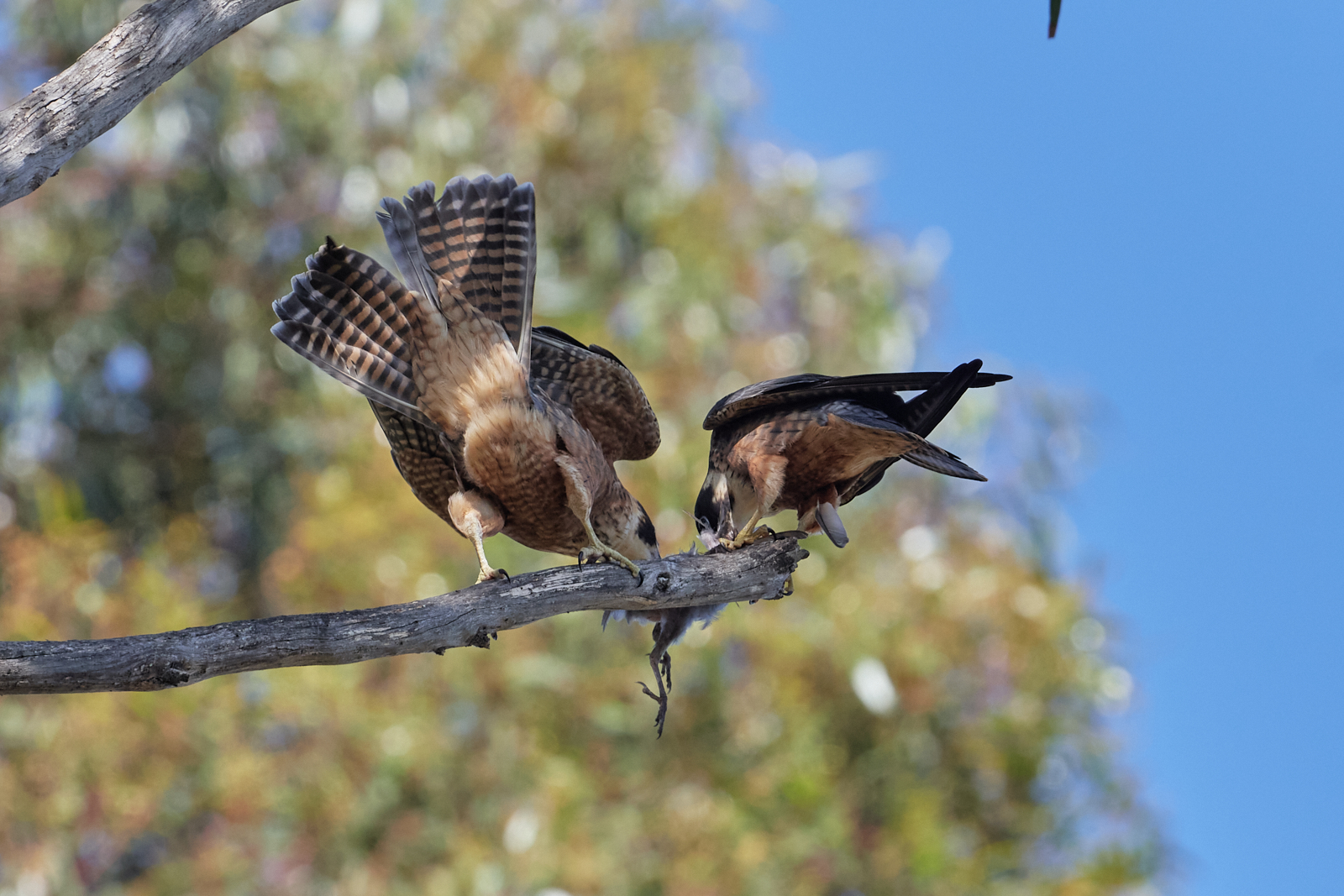
A close cousin to their much more impressive and better documented relative, the Peregrine Falcon, it is easy to spot the similarities once they get into the air.

Speed and manoeuvrability being high on the comparison list.  I’ve had the chance to watch them a couple of days in some high winds, think 70-80kph. They fold back the primaries and run on very closely tucked wings, at speeds that are almost impossible to follow in the viewfinder.  A side-different to working with say, Black-shouldered Kites, that are by comparison, quite sedate.

They have a nest. And it’s high up in one of the tallest gums in the area. Cleverly placed in the multiple “Y” that gums sometimes make with 8-10 thin branches reaching out crownlike, and she has placed her nest securely in the little fortress.

Hard to gather how far advanced they are, but the past couple of days we’ve found her sitting less on the nest, so I’d be guessing her young are beginning to take on their first feathers.

Feeding appears to have its own rules.  He comes in laden with a catch. Sits on a particular branch and calls quietly to her.  After a suitable pause in events he moves to another tree, sits and waits.

Then the express train bursts out of the nest, or from the high-up perch where she has been surveying the scene, snatches the catch and sits on a branch just near him to consume her well earned meal. So far I think the count is mostly Red Wattlebirds, but today it was a Welcome Swallow.

She is head and shoulders bigger than he. Pretty typical among raptors, but really noticeable when they sit close-by.

After helping herself, she then flies directly to the nest and seems to be feeding small pieces from her beak, so another clue the young are not that advanced.

Lastly the thing that has impressed me is the super efficiency of them both. There are no wasted wingflaps, they glide from one tree to another, hardly using any energy.  But, when needed, the wings dig in and they are gone.

Warning: Photos contain some graphic feeding moments.

The female approaching the waiting male
She has several perches that she uses while she waits. Here the flying gear is getting a work out
Arriving for her meal

The food transfer is super efficient and fast
Even though he is sitting a bit forward the size comparison is obvious.
Off to the nest to feed the young
Softly calling with the latest kill
This looks like Welcome Swallow on the menu. She is taking it straight to the nest.
The Werribee River runs behind the nest area and he explodes of the tree, disappears over the edge of the cliff and with about 3 more wing flaps is back on the tree.

Little Journeys: On the Road Again

Life I love is taking pictures with my friend.

Here we are a week or so out of a nearly 4 month lockdown. Depends of course where you start counting, but we were in one of the ‘naughty’ suburbs, so our privileges were removed a bit earlier than the rest of the city.

For EE and I, a run down to “The Office” was always going to be high on the must do first list.

So given a halfway decent burst of sunshine and we were off.

The one thing that we noted first was the amount of grass that covered normally bare areas.  A distinct lack of large kites, Black and Whistling, and how well some of the smaller scrub birds had done getting an early nesting in.

So in no particular order.

Purple-crowned Lorikeet
Purple-crowned Lorikeet pair.
Sad to report that the old branch has since parted from the tree trunk, exposing the nest, and they have moved on somewhere else. They have been loyal to this spot for at least the past four seasons.
Purple-crowned Lorikeet. Protecting its nest from marauders
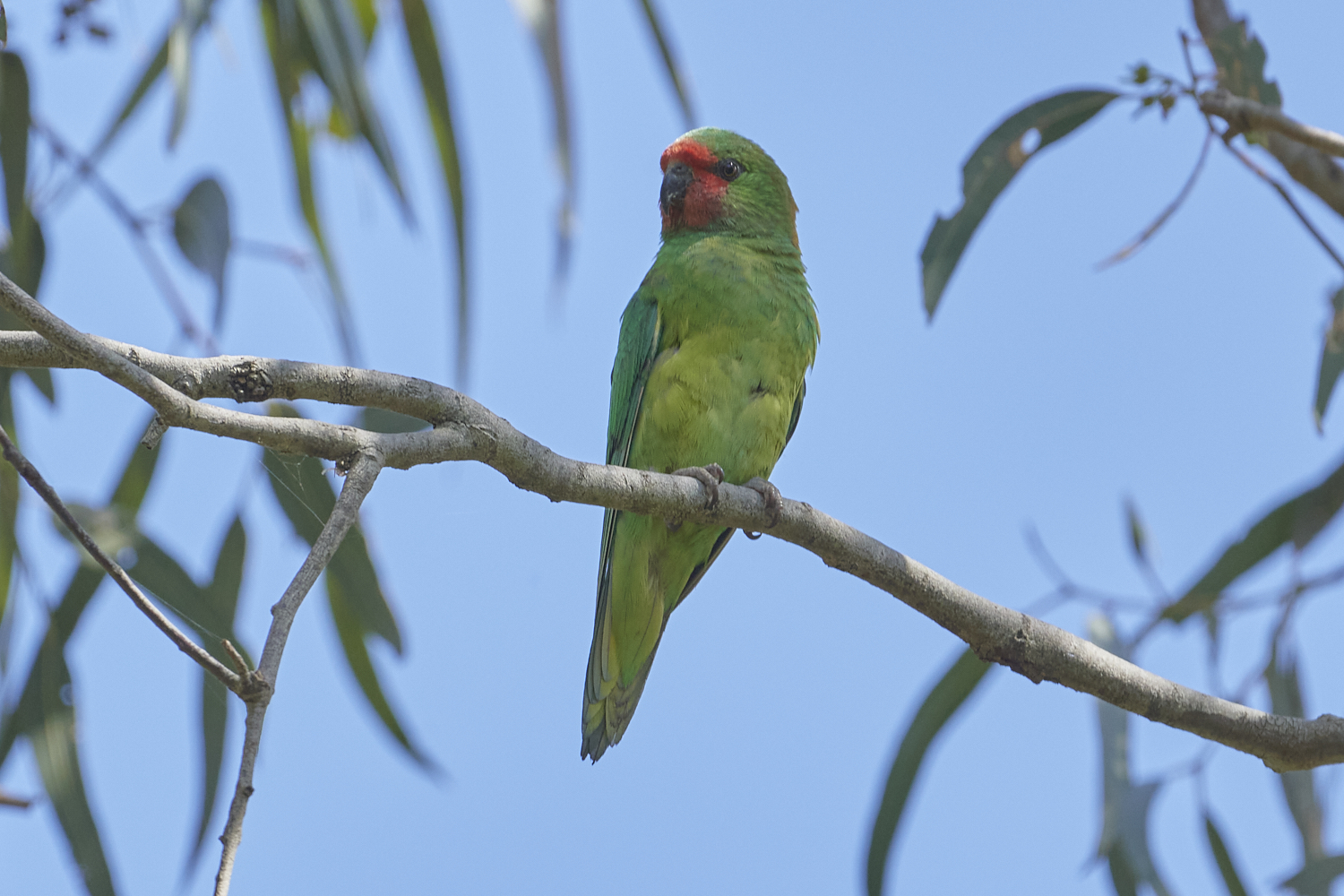
Little Lorikeet. This one led me a merry chase through the leaves. I could hear it, but it just wasn’t easy to see.
Happiness is… A White-browed Scrubwren with tucker for its young.
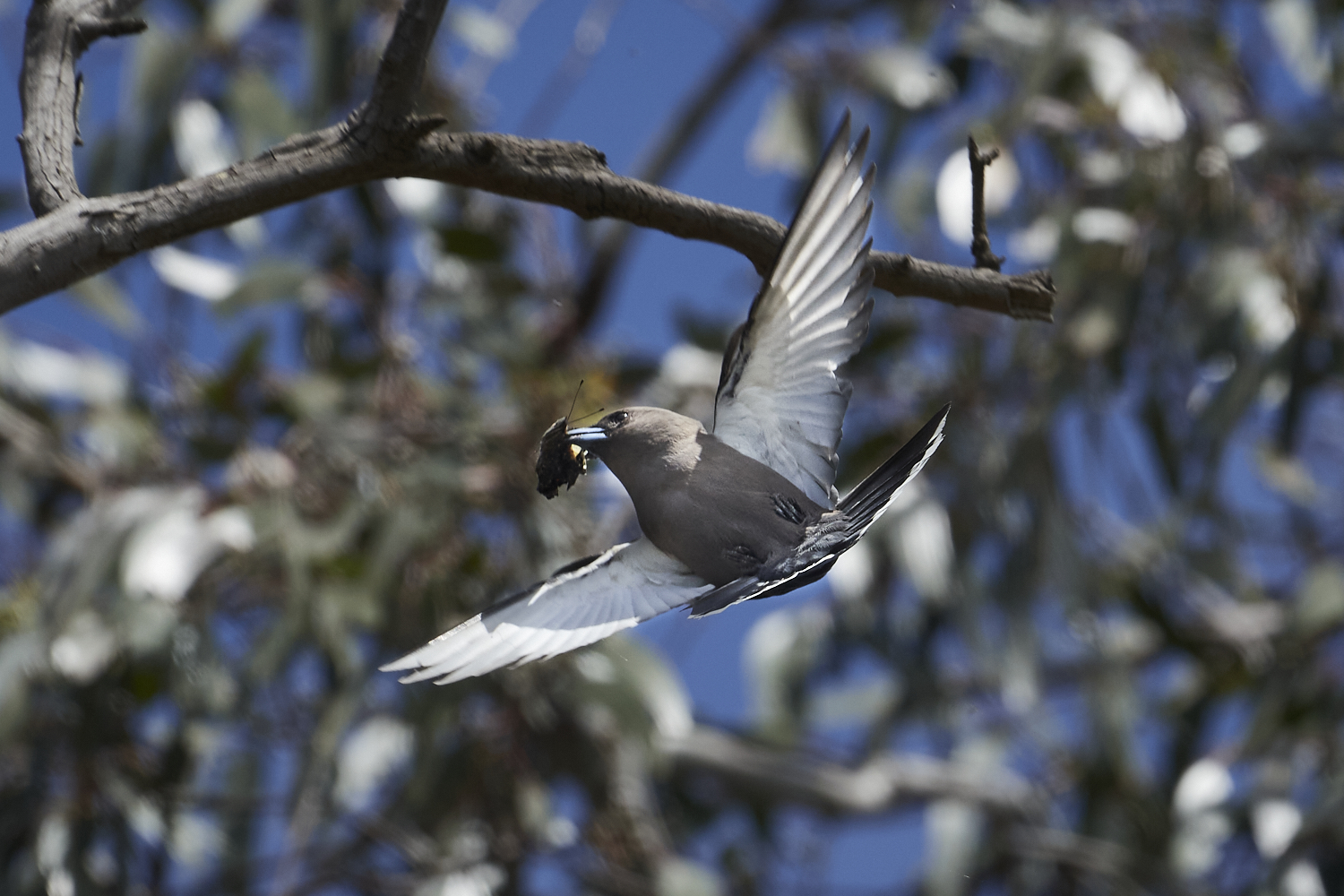
Looks like the Dusky Woodswallows has swept in while we were in lockdown and already had a clutch of young on the wing
Most interesting find of the day. Juvenile Fantail Cuckoo waiting to be fed.
Fantail; Cuckoo and its hosts, White-browed Scrubwrens.
The adult Cuckoo must have been very clever as I always find these little birds among the most wary.
Higher up the track on the cliff line, a pair of Australian Hobby are re-nesting in a familiar spot. More to come on their progress I think.
The age old battle of David and Goliath. The immovable object v the irresistible force.
Both have much at stake with young to be fed.


Photographic Essay: On the Road Again

Our first real day out after 4 months of Lockdown.

The title of the blog says more to my hairstyle than it does to the fact we were out and about.

At the moment, Willie Nelson and I have similar hairstyles. 🙂
So hum a few bars of “I’m on the Road Again, life I love is making photos with my friend, and I’ can’t wait to be on the Road Again.”

Where else would we have started than a trip to “The Office”.

As it turned out not a bad choice for a day out.  We loaded up IamGrey and with a sandwich and a cuppa it looked to be a good day.

Here is a quick selection from the day.

First up for the day. Purple-crowned Lorikeets. Each time I find these little birds I always come away feeling better about life and the world in general. They have such calming attitudes
This pair have a nesting site that is regularly used. I was really happy to find them out enjoying the sunshine
Another pair of Purple-crowned have a solid branch for their site. This one is blocking the hole so that marauding Rainbow Lorikeets will not bother its young.
There has always been a steady number of Little Lorikeets at the Office.
I was hoping they might be nesting, but this one did not seem to be interested.
It took me quite awhile to find it amongst the canopy. For all their bright colours they are muted in the shadows of the leaves and blend in so well.
White-browed Scrubwren busy with lunch
A recently fledged Fantail Cuckoo. Another score for EE.
It sat for quite a time, as we ate our sandwich and enjoyed the Earl’s good blend.
It no doubt has been hosted by some unfortunate thronbill or wren.
It took off to a bush, and I followed to see where it had gone.
Not the best photo I ever made, but does show the activity.
The young bird quite happily called in “Scrubwrenese” and within a few moments a White-browed Scrubwren arrived with food, followed immediately by a second one.
So perhaps the Scrubbies have been host to this rather large youngster.
After following a lot of calling noises we located a pair of Australian Hobby that have settled into nesting. The local Red Wattlebirds have taken exception to the visitors and kept up a running battle with both birds.
No doubt their numbers will diminish when the young Hobbys are hatched.
The never ending battle.
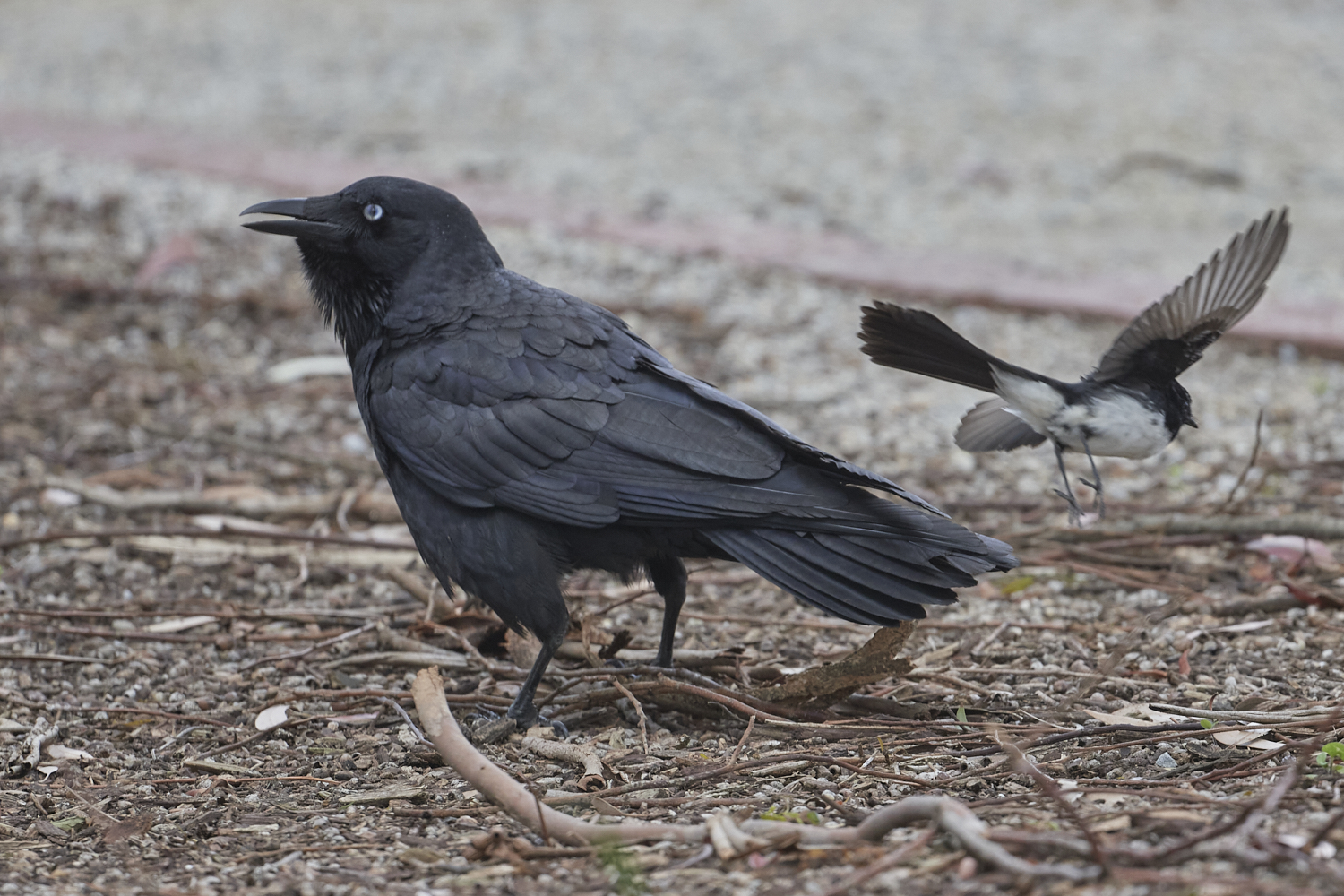
Wagtail on Raven


And so humming a few more bars of Willie Nelson’s tune, we headed back to IamGrey and home.


Surprise! A Hobby at the Office

Hope you survived the little tirade in the last post. All is forgiven.

EE and I thought, based on the last couple of adventures to The Office, that we needed to make a quick looksee if the Black-shouldered Kites had settled.
Many will remember Kitty and Kalev (The Brave), and their nesting attempts over the last couple of seasons.
They are fairly tolerant, and as she makes some of the best, most secretive nests, the chances of interrupting her on nest are pretty slim. And he has no problems about bringing mice in for her virtually above our sit spot.

So it was with a bit of an expectant parent  looksee, that we turned up on a mostly cloudy day and looked around the carpark. And there they were, clever pair, way down the range, and out of camera reach.

“Perhaps he’ll come over to hunt along the river edge,” says she. So we meandered on along the river bank.

DWJ_2972.jpg

Continue reading “Surprise! A Hobby at the Office”

What a Difference some Sunshine Makes

Been beavering away here at the Website trying to find ways to improve the overall look and experience of visiting, and trying to give expression visually to the site’s dedicated title. “Birds as Poetry”.

Sometimes its easy to find clever words to describe a moment in time with the birds, or to cover over the fact it was just another day on the job making images of very fine birds. But that is not the visual feel.  And above all I guess my main goal for the web pages.

Been doing as you’ve probably gathered a bit of introspection on what the bird stories should show, how relevant that is to those who have graciously signed up to follow along here and at the same time not making it so esoteric that even I find it hard to reach those heights of expression.

And at another level, the pure old photographic know how and application needs to still satisfy both viewer and creator.  And of course in this day and age wrestling with the ever-advancing technology that so readily leads us onward with banners waving from one vantage point to the next, without even taking the time to notice the journey across the plain.

Along with photography, poor writing and a love of Russel Coight’s All Australian Adventure tv shows (skits please), I also offer Tai Chi as another of my dizzying weaknessess.  What I like most about this ancient (art) is the definiteness of purpose and deliberateness of movement. And in that is the edge of my photography with the birds, and hence the constant need to find expression of Birds  as  Poetry.

Continue reading “What a Difference some Sunshine Makes”

Fire, smoke, an open paddock, simply add birds for action

One part of the family was off to Sydney for a holiday.  So how about we leave our car with you and go to Avalon airport?  Now the cool thing about saying yes to the request of course is that Avalon is but a mere 5 minutes from the WTP.  And well, we’d have to come back that way after all the farewells, and book ins and security checks, and stuff.

So we found ourselves on the Beach Road in the middle of the afternoon on a not too brilliant for photography day.    The folk at the farm had taken the opportunity of the change in the weather to conduct some control burns in some of the bigger fields.    And off course the raptors simply couldn’t resist the chance of fried or roasted or bbq locusts, mice, grasshoppers, lizards and the like.

As we travelled down the Beach Road, the sky was awash with larger birds.  Perhaps as many as 20 Whistling Kites, twice that number of Black Kites, at least two Australian Kestrels, and an assortment of Ravens, several squadrons of Australian Magpie and innumerable Magpie Larks.

From a photography point of view, the light was wrong and the birds too far away, but the old D2xS on the 300mm f/2.8, stepped up to the challenge. So the big birds swept over the still smouldering ground, or made a landing and picked up a morsel or two. Their friends sat on the fence line and the Whistling Kites kept up a constant call.   In the end, we just watched, and enjoyed them enjoying themselves.
A Black Kite became a target for a rather aggressive Whistling Kite and a sky wide battle ensued.   At first the Whistling Kite was much faster, could turn quicker, gain height faster and generally outfly the Black Kite. Quite a number of direct hits from above, below and the side ensued.    In the end, I decided that perhaps the Black was just taking it all and wasn’t really concerned by the output of energy by the Whistling Kite.   It ended by the Black gaining height and just sailing away.  The Whistler settled down for a rest on the fence.

On the other side of the road a Black-shouldered Kite busied itself in finding mice for its evening snack.

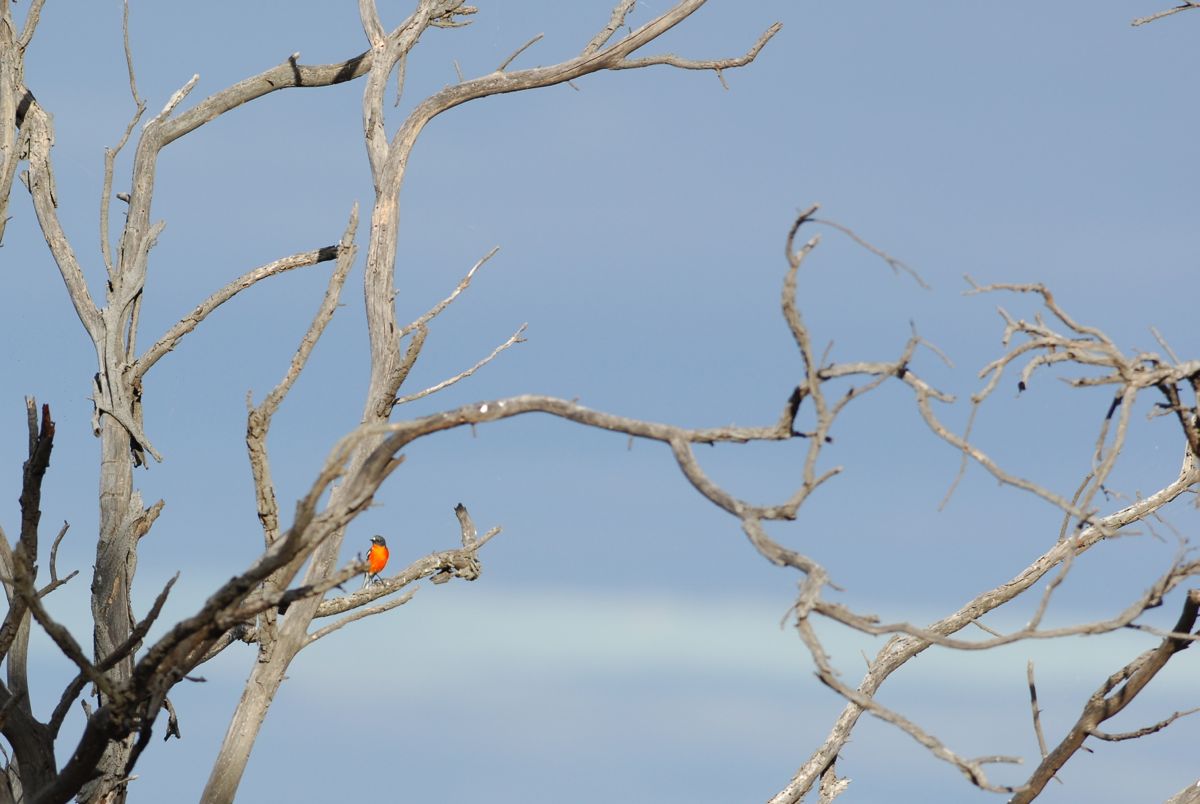
We also found a large family of Flame Robins.  The males looking a treat in the sunshine.  But far too far away to do them justice.
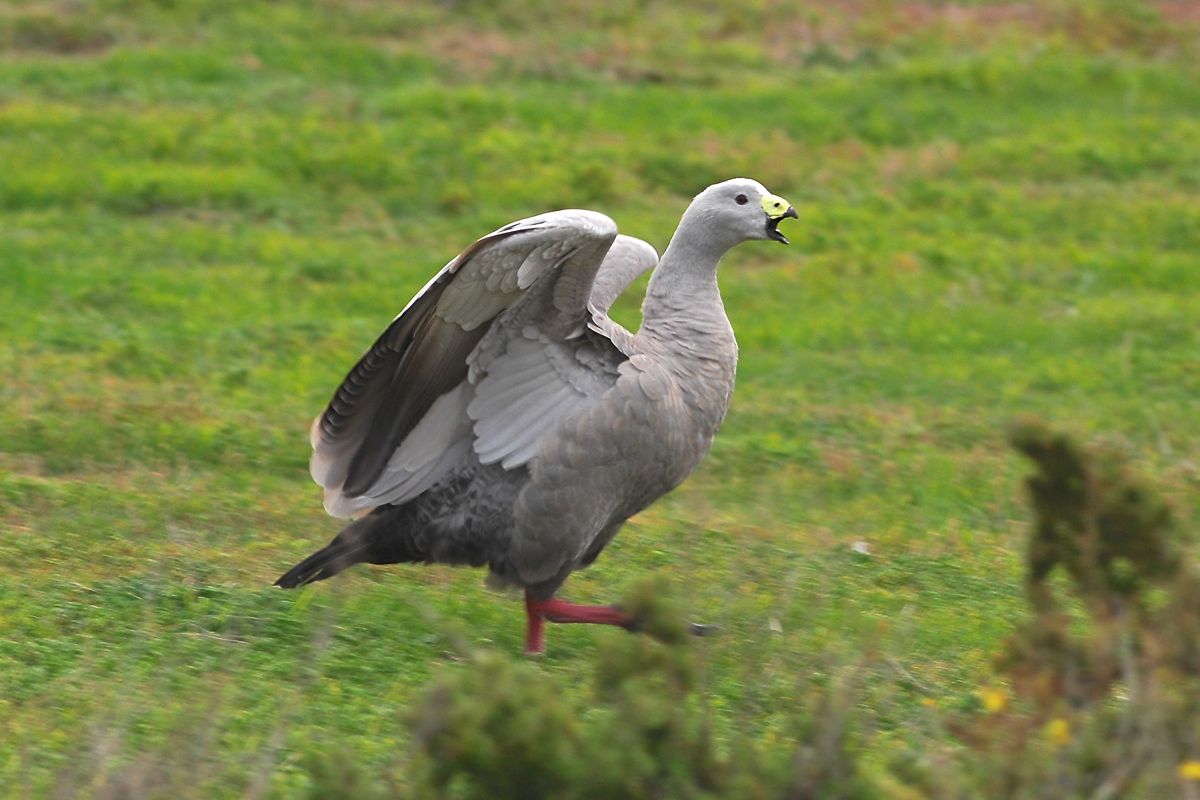
As we drove around Lake Borrie on the return home a pair of Cape Barren Geese were feeding in an open area.  Really perturbed by our audacity to encroach on their feeding spot, the male gave me a lecture and wing-waving display.  I apologised and we parted in good company.     Just have to be more careful about sneaking up on him.

With the light finally drifting into greyness, it was considered time for home.


A burst of late evening sunlight highlights the maize against the brilliant dark sky.
Red burst from a Flame Robin male, one of 4 males and about 6-8 female/juveniles in the area.
Two Black Kites.  They are at completely different heights.
Two Black Kites. They are at completely different heights.
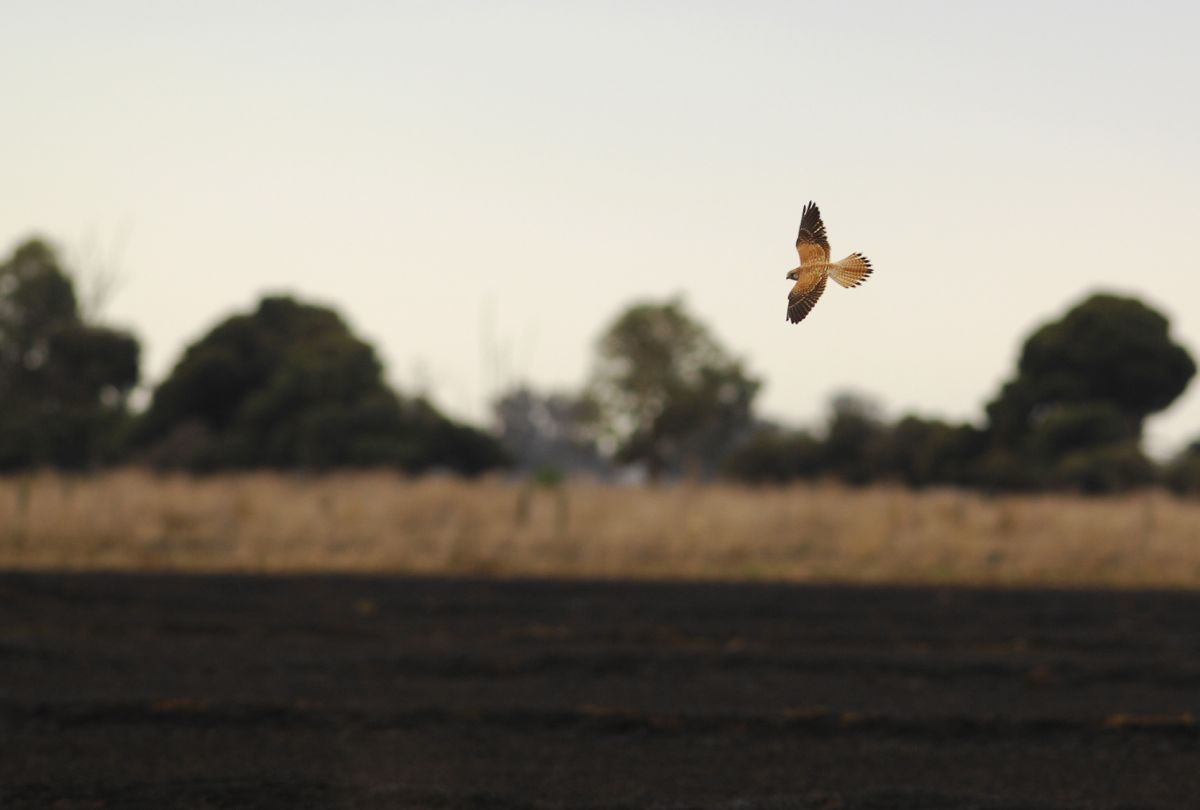
Australian Kestrel turning  for another sweep over the still smouldering paddock.
Australian Kestrel turning for another sweep over the still smouldering paddock.
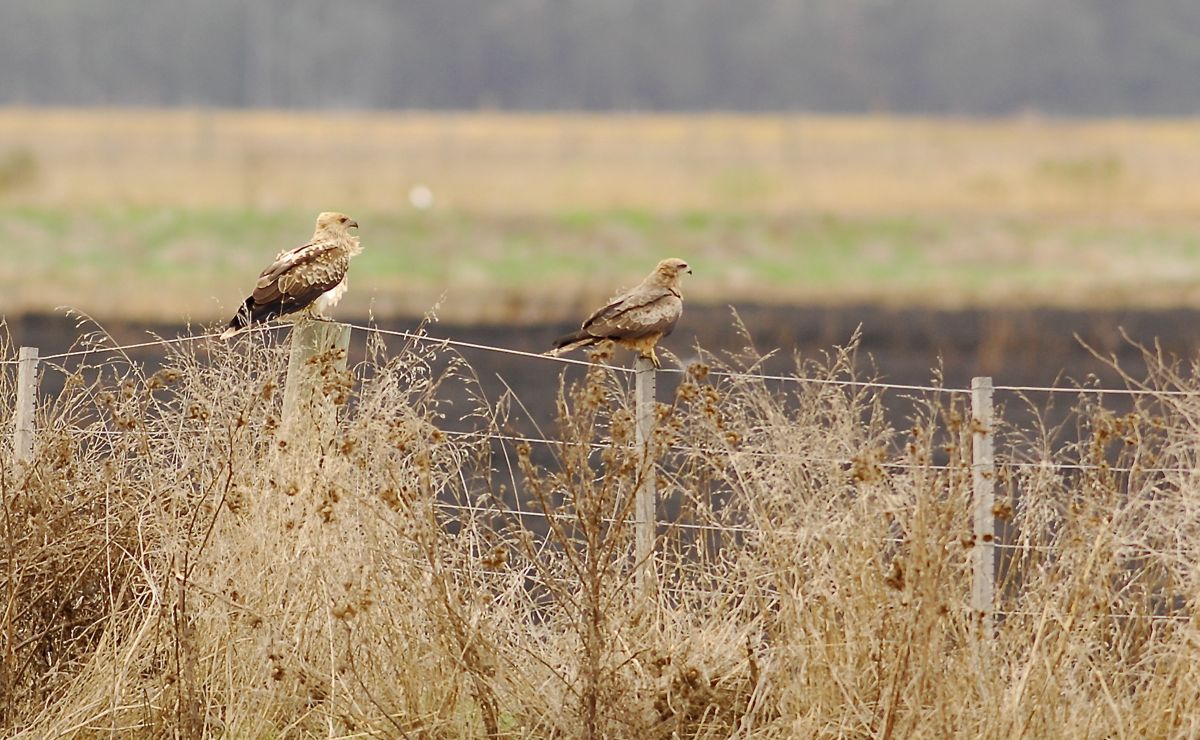
One post one Kite
One post one Kite
In times of plenty everyone is friends
Whistling Kite, vs Black Kite.  Probably not as one sided as it at first appeared.
Whistling Kite, vs Black Kite. Probably not as one sided as it at first appeared.
Completely uninterested in the bbq, this Black-shouldered Kite stuck to its larder.  A mouse.
Completely uninterested in the bbq, this Black-shouldered Kite stuck to its larder. A mouse.
Cape Barren Goose.  He is giving me a lecture on my tardiness in being in his territory.
Cape Barren Goose. He is giving me a lecture on my tardiness in being in his territory.
Late evening light over the You Yangs

Evening around Werribee Treatment Plant

It only took a glance at the weather map in the paper, while I was at the coffee shop to conclude, “Golden Light Night Tonight”.

So a quick chat with EE and we were ready to go by mid afternoon.  I think the gear being loaded in the car was about as much persuasion as it took.

True to form the sky was a beautiful blue, the light was golden and the birds in the late evening light were active.  

I could go on about it, but the pictures probably are better at telling the story.

Enjoy. We did.

Brown Falcon about to launch.
A very well fed Brown Falcon was enjoying the quiet while its meal went down.
Swamp Harrier has just seen me and swung around to fly away.
On Beach Road, an Australian Hobby has taken up residence for the moment.
On a beach full of waders I found some Red-capped Plovers hard at work.
See, this is why we used to call them 'Spur-winged Plovers'
See, this is why we used to call them ‘Spur-winged Plovers’
A Whistling Kite in brilliant yellow light.
From the Bird Hide. Extreme low tide meant a huge feeding ground for the hungry waders.