Saturday Evening Post #162 : On the Wall

It’s  funny thing in someways.  We don’t have many photographs on the walls of our unit.  It is not that space is limited so much, as that we have chosen not to fill it up with photos.

All the family memories and moments are in carefully curated Photo-books that are the result of one of us having  flirted with the Scrapbooking era.

For our bird encounters I  produced numerous Photo Books, first using Apple’s remarkable, and never copied, Aperture photo management programme, and Apple’s Book publishing service, and of late using Blurb, both directly and via the connection with Adobe Lightroom.

But every-so often, I make an image that above all others of recent times really cries out to me for a print on the wall.

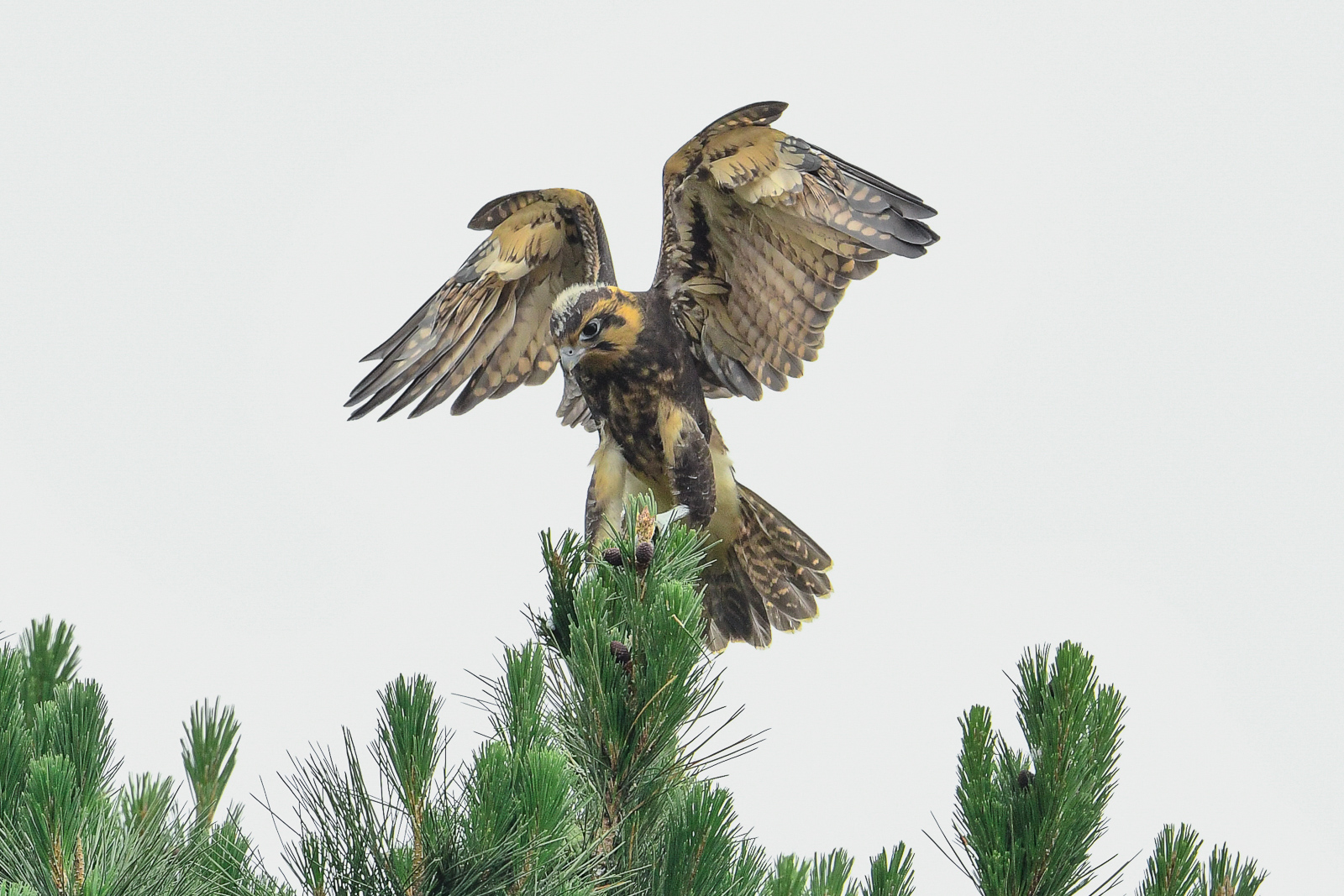
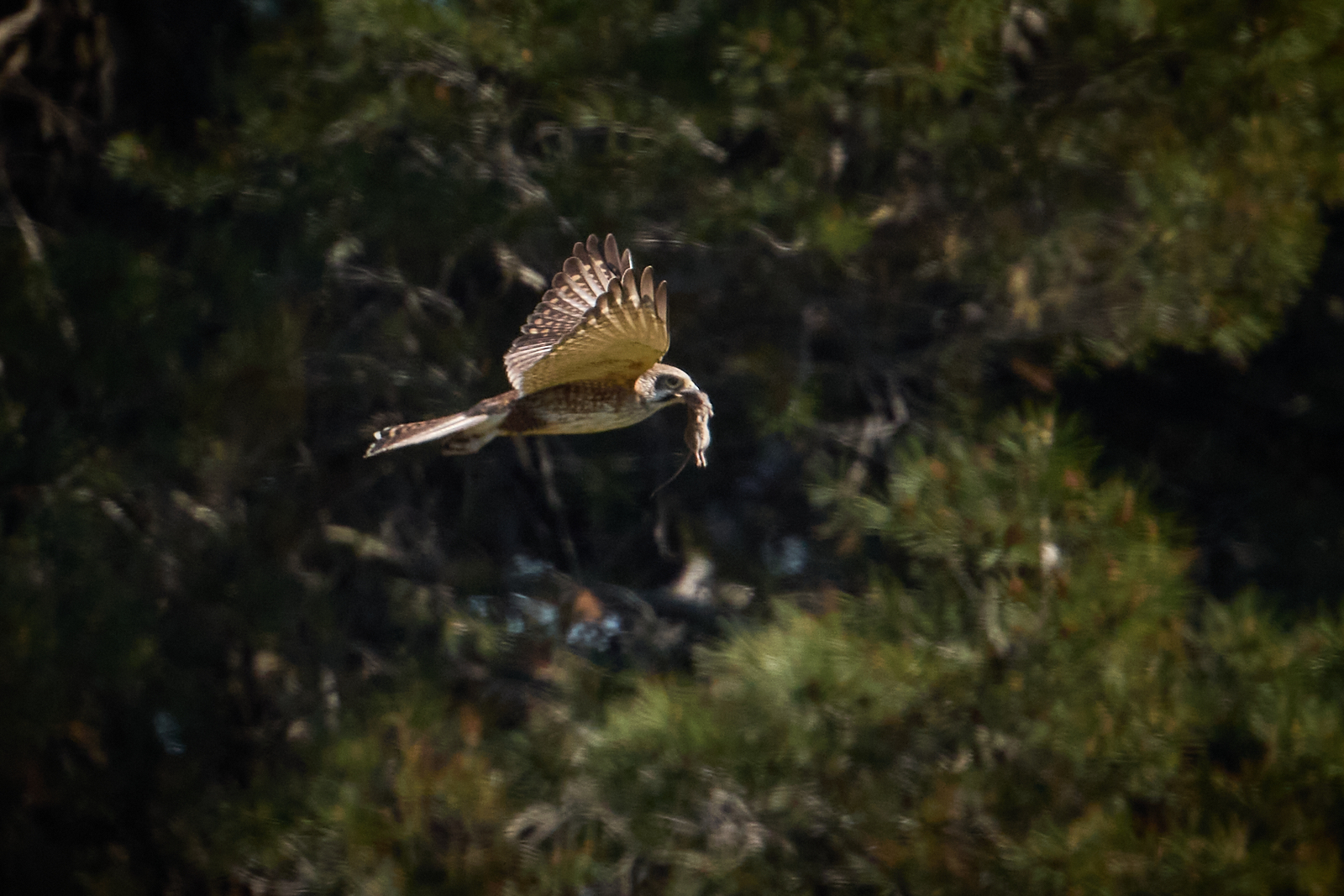
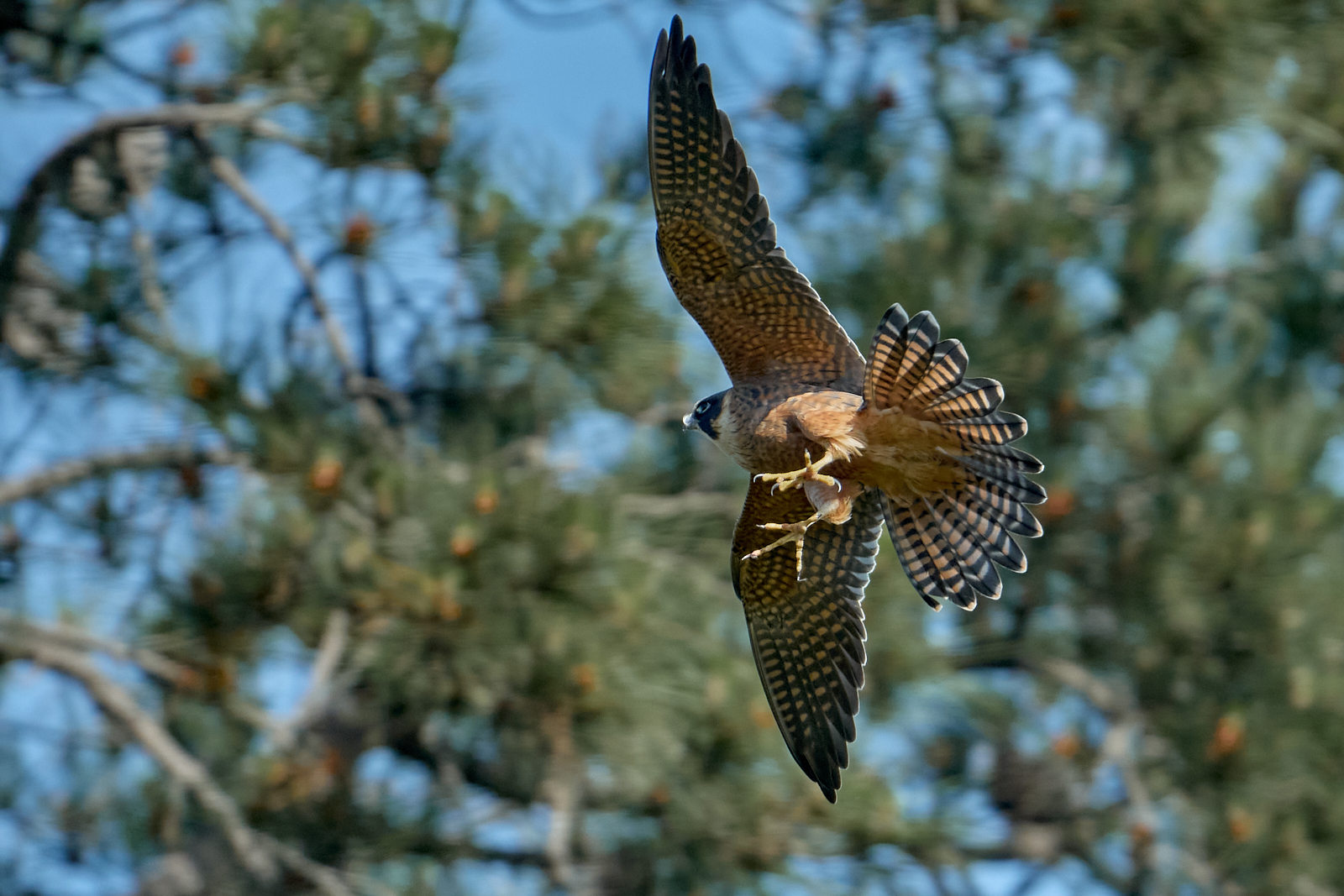
Such is the Brown Falcon header for this blog.

The bird, or course, is Cassia, of Cinnamon. She has left a perch some 200 m from her fledged young, (they are in the tree behind me) and is making her way over to—in a motherly way—check on the kids.  Well isolated from the trees in the background, the focus on the D500, attached and held for her flight across the paddock,  at about head (mine) height.

I’ve sat with this bird through, now, four nesting seasons, and while she is not that enamoured by my presence it is fair to say that I am no longer considered a threat, and her approach is not an attack, but rather the simplest way to move to her young.

The one thing I’ve noted this time, and I have to say, I’ve missed it before, is that she ‘talks’ to the young when up close.  It is a very quiet, but distinct, ‘cluck-cluck-cluck’ very soft and very ‘motherly.’ Much in the same we humans interact with our offspring.  Cooing and Mumma and Dadda are just a few examples.
What ever she is saying seems to be done in a very warm and if I can anthropomorphise, passioned way.
Brown Falcons are more noted for their raucous calling as they barrel across the sky. Easy to pick, even when they are a long way off.

So with all of that, it really struck  me that her ‘mother’ intentions are much more than at first might be thought of for a hard working raptor.
A time for me of enlightenment.
Worthy of a place on the wall.

Here tis.

Enjoy


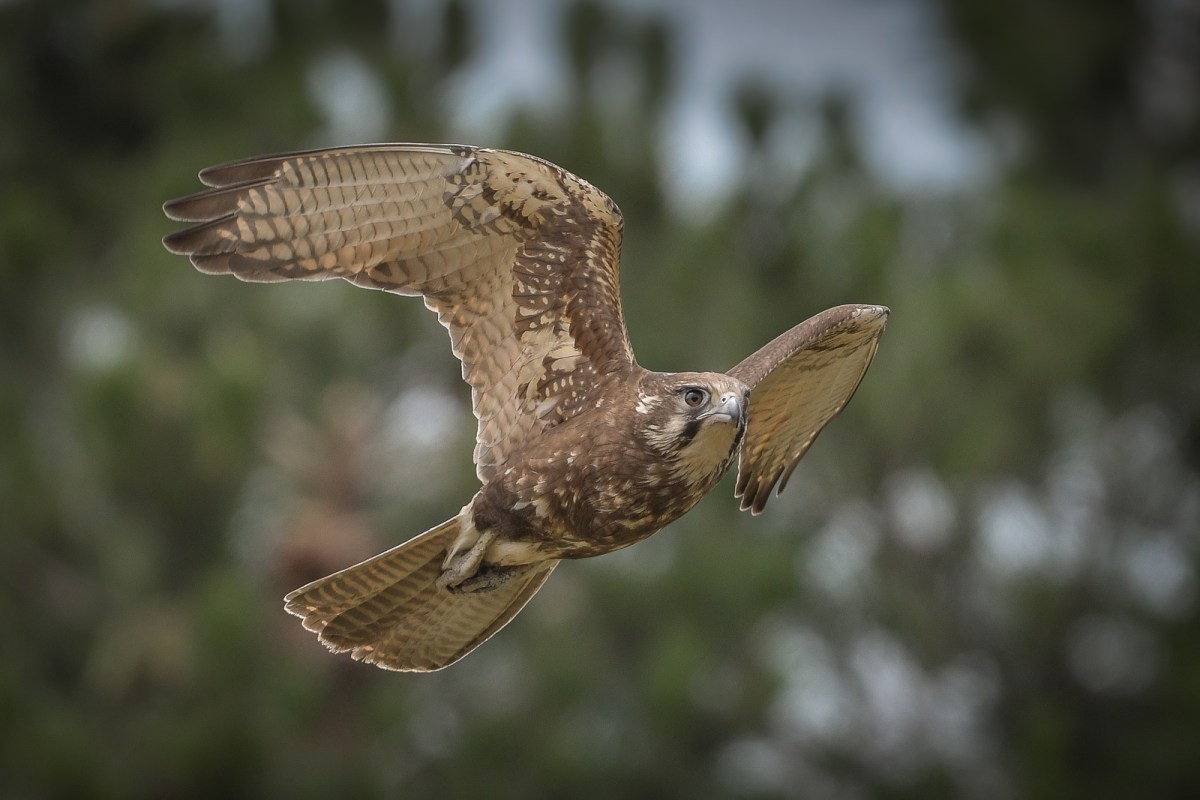
And for extra points here is another one from a much closer viewpoint from that run across the field.

Little Journeys: Three to Go

The weather has to coin a phrase, has been less than kind of late.  Cold, windy, rain, overcast and just plain miserable and stay-at-home-able.

It is nearly Summer, but here we are with the heaters turned on and thick clothes, shivering in the cold.
We had decided to go to the River and have another look for the elusive Sacred Kingfishers.   It has become a task that rivals the search for Tutankhamen’s Tomb.

As we travelled to make yet another morning attempt, we decided at the last moment to abandon the project for the day, and instead travel on to see how Cassia, of Cinnamon’s young were doing.

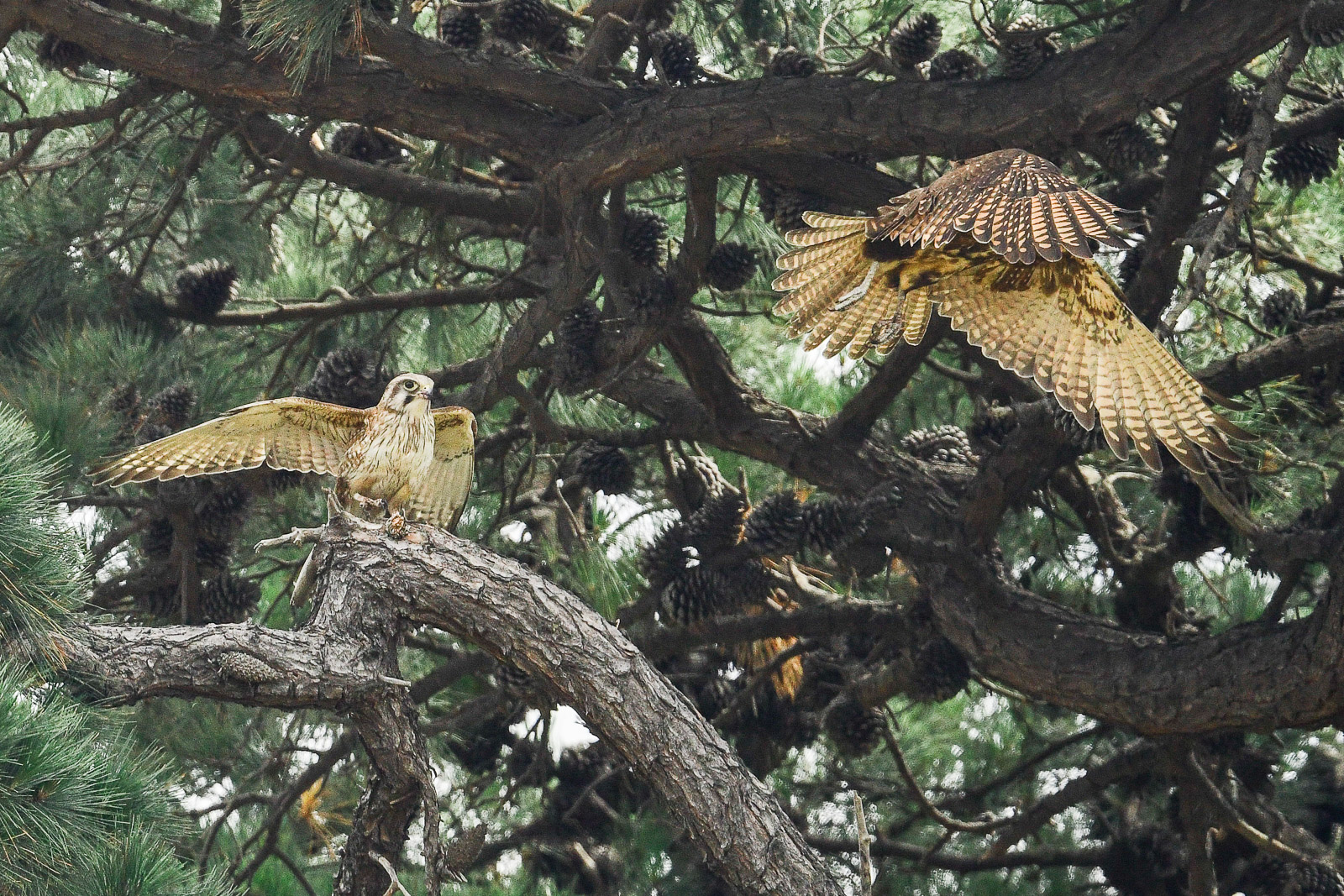
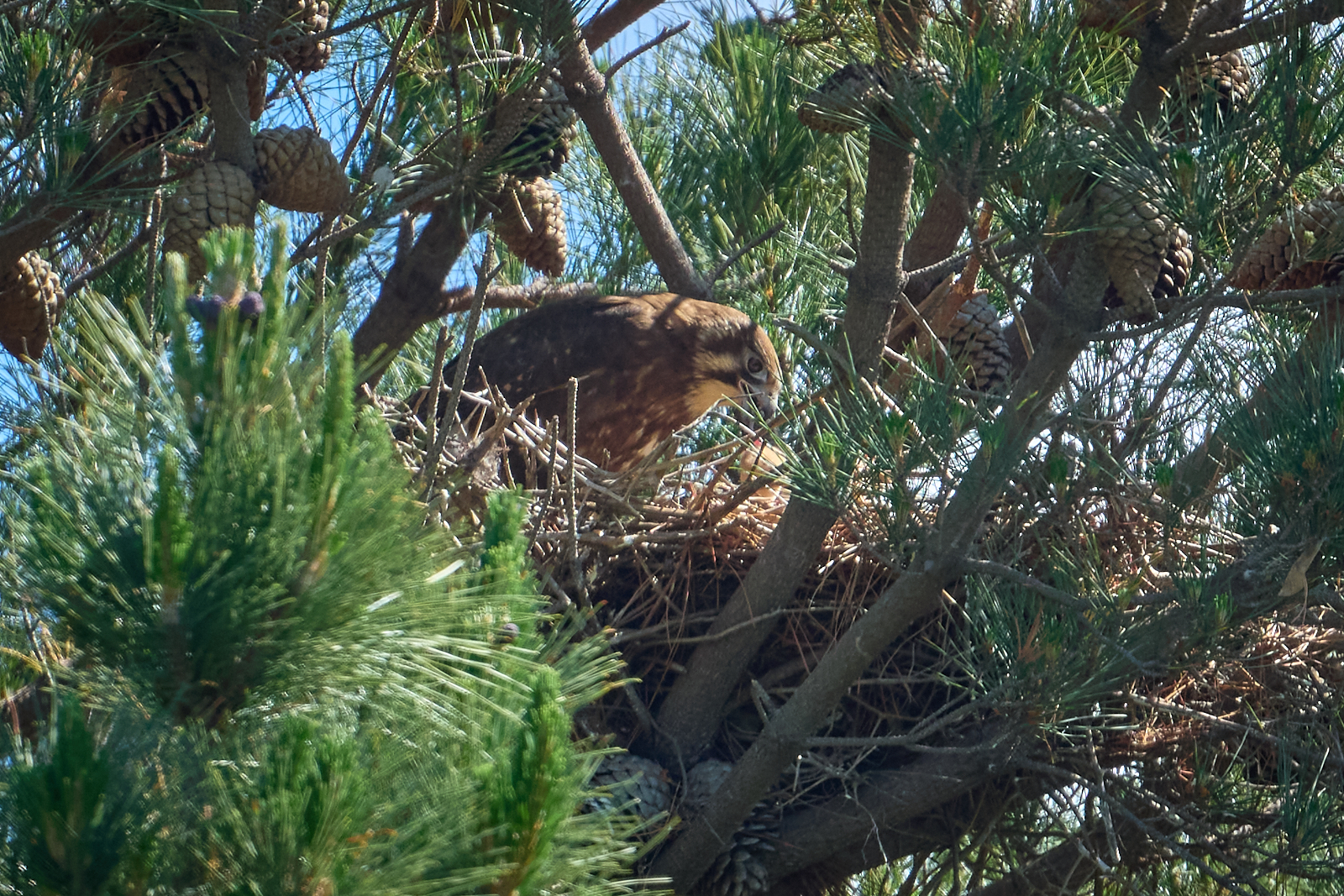
At first sight of the nest we could only see one little rich ginger brown head bobbing about.  Then, looking further over the tree, right at the very top stood the other two young.  Looking very confident, and balancing precariously on the top most fronds of the pine tree.  No mean feat for a well developed bird I would have thought.

While we were there we managed to see two food exchanges and a number of wing-flap trails by the young birds.  No doubt they will be on the wing in the next few days.

Here is a small selection from the morning


A food exchange as Cassia slips aside to prepare the meal
The male moves on for a quick rest before heading out again
All prepared and now to deliver to hungry mouths.
Is there any for me!
Rested and ready to hunt again, the male heads out. He is a much lighter marked bird.
Just a little too cheeky.
Cassia had found the nest of either a Wattlebird or perhaps even a Magpie. But she was hunted off very quickly by the local Neighbourhood Watch.
While they wait for the next round of food, there is plenty of time for some wing exercises.
I found this series interesting as it shows the ‘rowing’ action that is typical of Brown Falcon flight. No doubt by our next visit they will be on the move.


Saturday Evening Post #161 Surprised by the Ordinary

I have of recent days been ‘repairing’ some damage that I inflicted upon my photo library.

Now before we all spring to ‘backups’ and backup strategy, and ‘don’t leave home without it’, the backup actually eventually became part of the problem as it literally was a copy of the error in thinking I’d made some weeks earlier.

However all was not lost, as I had an off-site copy of the original files, so it was simply a matter of reclaiming them.  But then the work of getting them back into order, curated, and settled became the marathon journey.

Of course the good side of that was I have been forced to revisit the photos of 2019 and 2020, and relive some of the outings we had enjoyed in what seems post lockdown, so, so long ago.

Those that follow along on Flickr will have seen some of those being posted more regularly as they emerge from their cocoon on the master drive(s)

None more so than the time we spent with Cassia, of Cinnamon and her two young. So instead of a disaster, it has turned into a rather pleasing journey.

Sitting with a very relaxed Brown Falcon, reminded me of some words from Henry Thoreau.

The old naturalists were so sensitive and sympathetic to nature that they were not surprised by the ordinary events of life. It was an incessant miracle to them, and therefore gorgeous gorgons and flying dragons were not incredible to them. The greatest and saddest defect is not incredulity, but our habitual forgetfulness that our science is ignorance.
March 8, 1860 Journal Entry.

One of the amazing things with this bird was her lack of concern about my presence.
I could sit by one of the trees or perches she regularly used, and just wait until her arrival.  I am convinced they know where they are going to land before they leave the perch, and will follow a course that takes them to that spot. (Not necessarily directly). I  can’t recall her shying away because I was near the landing spot. So much so, that it was no longer incredible to me, more an endless miracle.


Saturday Evening Post #160: Walking the Walk

It is reported that J. R. R. Tolkein,  once said, “It is a dangerous business… going out your door. You step onto the road, and if you don’t keep your feet, there is no knowing where you might be swept to.”

I wonder, like dog owners, am I taking  the camera for a walk, or is the camera taking me?
Some dog owners seem so detached from their dog as they walk about, I am convinced that the dog is indeed walking them.
Dogs seem to be easily distracted.  A smell here, a sight there, a movement over there. All needs to be carefully examined and if time permits to be explored.
No matter how long or short a lead, a dog will always run at the limit. (Locked down bird photographers are no different)

The problem, if it is indeed a problem, of walking with a camera is that I lose track not of where I am, so much, as to time and place.  A few minutes planned stroll becomes an hour or more in one location.

All sorts of shapes, and tones and picture possibilities hijack me and I am, as Chris Orwig says, “Swept away by it all” (Visual Poetry, p 208)

You can, as Elliott Erwitt once remarked, “You can find pictures anywhere. It’s simply a matter of noticing things and organising them visually.”

Working with birds the ‘organising them visually’ is quite the challenge. Small birds flee, others chose to simper in the deepest of bushes, knowing that any attempt at a photograph is useless.  Larger birds sulk and turn away. It’s easy to develop the ‘Oh, if only I was…” attitude.

We have after nearly 18 months been given the freedom to move about again.  For some it’s a trip to the shopping mall, a coffee in a piazza, new shoes, a haircut, or a visit to an art gallery.  For most of us it’s time with family and friends who’ve been similarly isolated.

So as we begin to take our first tentative steps back out into the field, so many opportunities seem to present themselves.
To quote Elliott again, “It has little to do with the things you see, and everything to do with the way you see them.”

Time to step out and enjoy the sunshine, the rain, the wind and the wonderful things that will grace our lenses.

Enjoy

Saturday Evening Post #159:

I’ve spent the past couple of days mentoring a young, beginner bird photographer.

It’s funny, I think, if you ask someone what they do, you might get I am (was) a Chemist, or perhaps and Accountant, or Motor Mechanic, Banker, or School Teacher.
But
Say “I’m a Photographer’, and its well, kind of ho-hum, yeah, but what do (did) you do for a living.
Anyone  with a mobile fone can be ‘a photographer’.

I usually answer these days, “By (pause), Training and Background, (pause), I’m a Photographer.
Not Iphoneography in there to confuse.
Still, it does lead to some interesting side discussions.

Bruce Barnbaum in his book The Essence of Photography, tells the story of two art teachers.
The first looks at the stick figure drawings of a child and asks, “Oh is that your Mum, or Sister or is it You?”  A question bound to enhance the creative expression of the budding artist.
The other will ask, much more bluntly, “Is your family really green?” And there goes creativity.

I personally can speak loudly to that, as an art teacher, in my year 8, dismissed my attempt, at a subject, as it did not fit the template or paradigm she had set.  But, I still think it was creative.  However that was, as they say, the end of my budding art career. 🙂

One of my Tai Chi masters says of learning the various forms, “Art is always changing and growing. If not, its dead”  He is quite ‘hot’ on not just completing the form the same way, each time, but allowing room for personal expression.

I’ve said here before, get a bunch of photographers together and very soon the discussion will turn to “Whatchabeendoinlately?”

And it’s not just about what work/client or style.
It usually enters into the area of what new ideas have you been exploring.

In his book, The Art Spirit Robert Heri says, A tree growing out of the ground is as wonderful today as it ever was. It does not need to adopt new and startling methods”

Flowers it has been said, don’t get all bent out of shape, and go off to seek their personal freedom.  They don’t plan to move to another location for better opportunities or bewail the climate where they are growing. They simply get on with the task.

Which leads, me hopefully to the point of the moment with Cassia, of Cinnamon.
One of the challenges I often face is getting correct exposure for a light bird on a dark backdrop or a dark bird on a light background.   Or an inflight, where the bird moves from light to shadow and the poor old camera meter just can’t keep up.
One of the reasons I shoot such work with the camera in “M”anual. There are of course a number of ways to hold that exposure, but I’ve adopted the “M” method.

Yet working with my young friend, and not wishing to ask are his birds really green (or over or under exposed), we have been discussing and practicing ways to keep exposures under control.  You may laugh, but I’ve had him shooting Aperture priority, JPEG for the past few days. It offers less room for error, keeps him behind the camera and doesn’t wander into the fantasy of the ‘digital darkroom’.

Too much light. Make corrections.
Too little light.  Make corrections.

The next few weeks will find him reaching further into the crayon box and finding he can select a colour other than green. !

Cassia was waiting for the next food delivery.  Impatiently, if Falcons do such an emotion.  She flew from one perch in the open, to another in the shade. From front lighting to backlighting and all the way through.

As Bruce  says, “Its not about technical ideas and methods… nor about making images simply because you can with the tools and apps at your disposal… It’s about, because you love photography,  putting in the time and effort necessary. ”
(In Tai Chi we call that Kung-it refers to any study, learning, or practice that requires patience, energy, and time to complete)


Little Journeys: Passing Visitors

I had, finally, thanks to lockdown restrictions easing, journeyed over to Camera Exchange. My trip was to complete a deal we’d commenced back in July, and had been forced by luck of lockdown to put on hold as I couldn’t get over with my gear to exchange nor pickup any goods that were part of the exchange.  I mean, that is how exchange works. (isn’t it)
So after exchanging some of the Queen’s Legal Tender, (is it the Queen’s? or the Australian Government?) either way, Ryan was happy to relieve the bulge in my wallet and gave me a shiny new carry case to put in iAmGrey to transport home again.

Thinking it would be nice to see in the shiny case, and to give its contents a bit of a test run, I had to pass by Point Cook Coastal Park, and decided that a quick trip to the beach should be enough to see put the contents of the shiny case to good use.

However when I arrived at the beach area, the birds had different ideas and only a few gulls and a lone White-faced Heron were in residence.   But I got to play with the kit, and as time was of the essence, I moved on.

Partway back to iAmGrey, I heard a familiar call, but not one I’d ever  heard at Point Cook before.  So it was time to investigate.
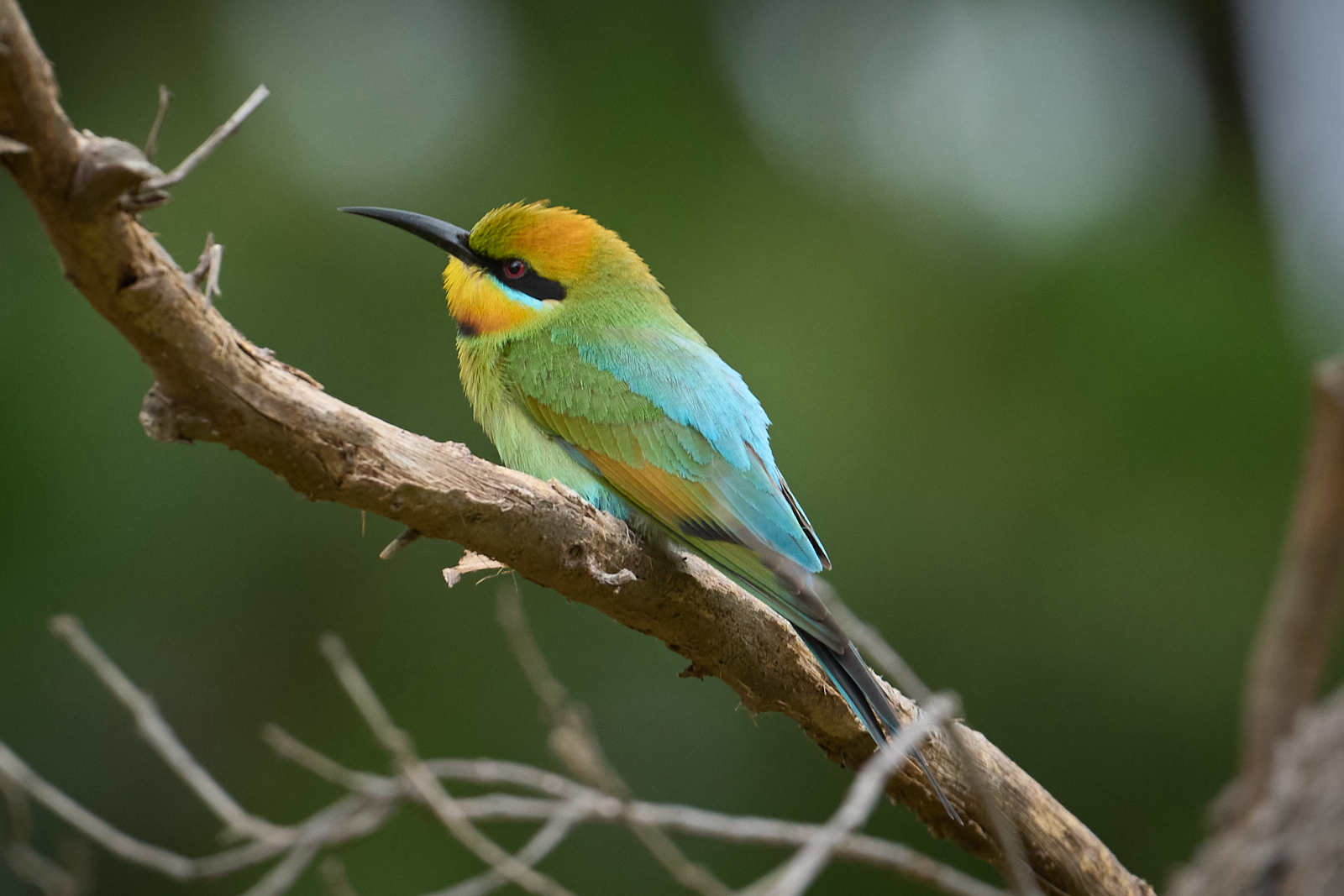
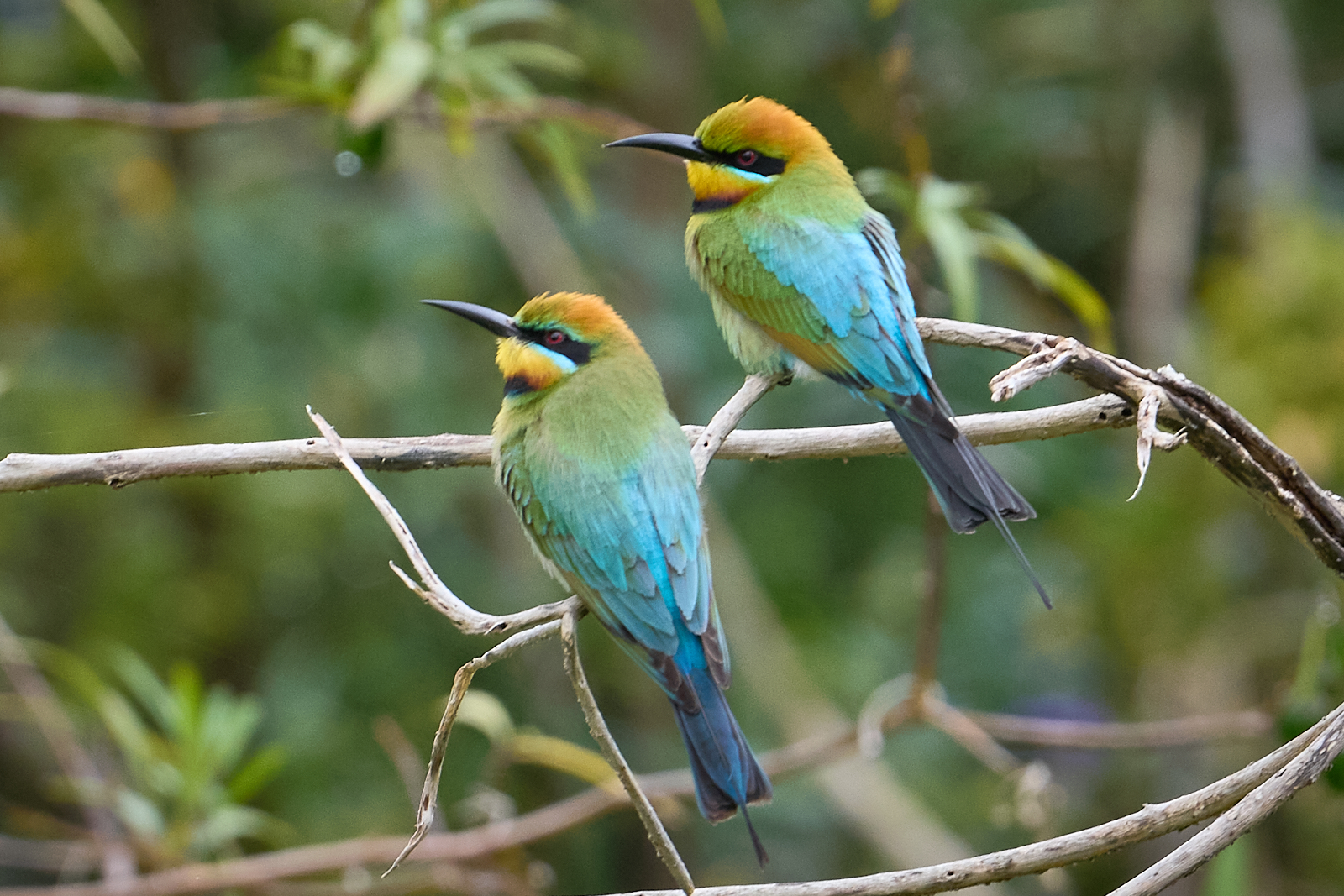
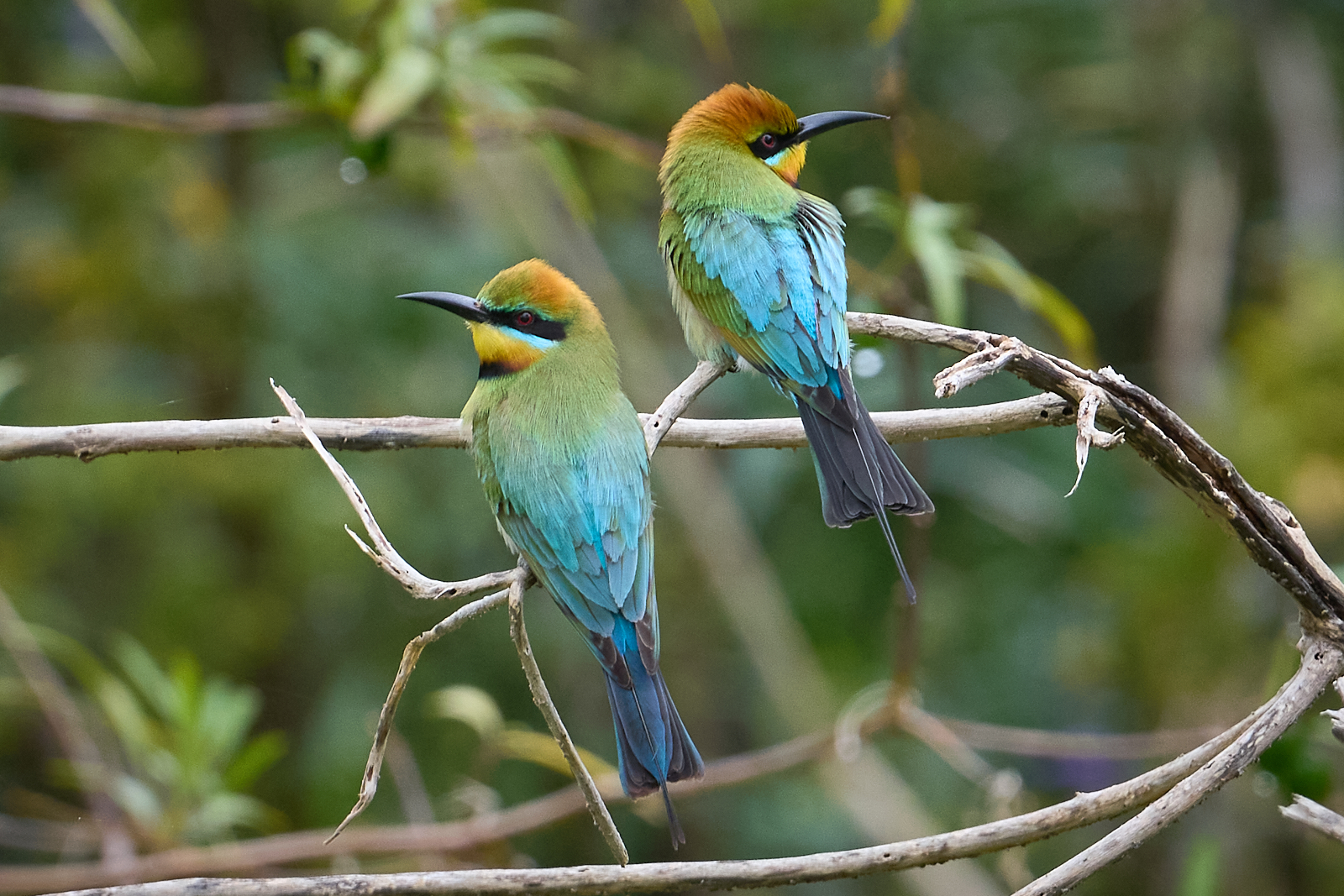
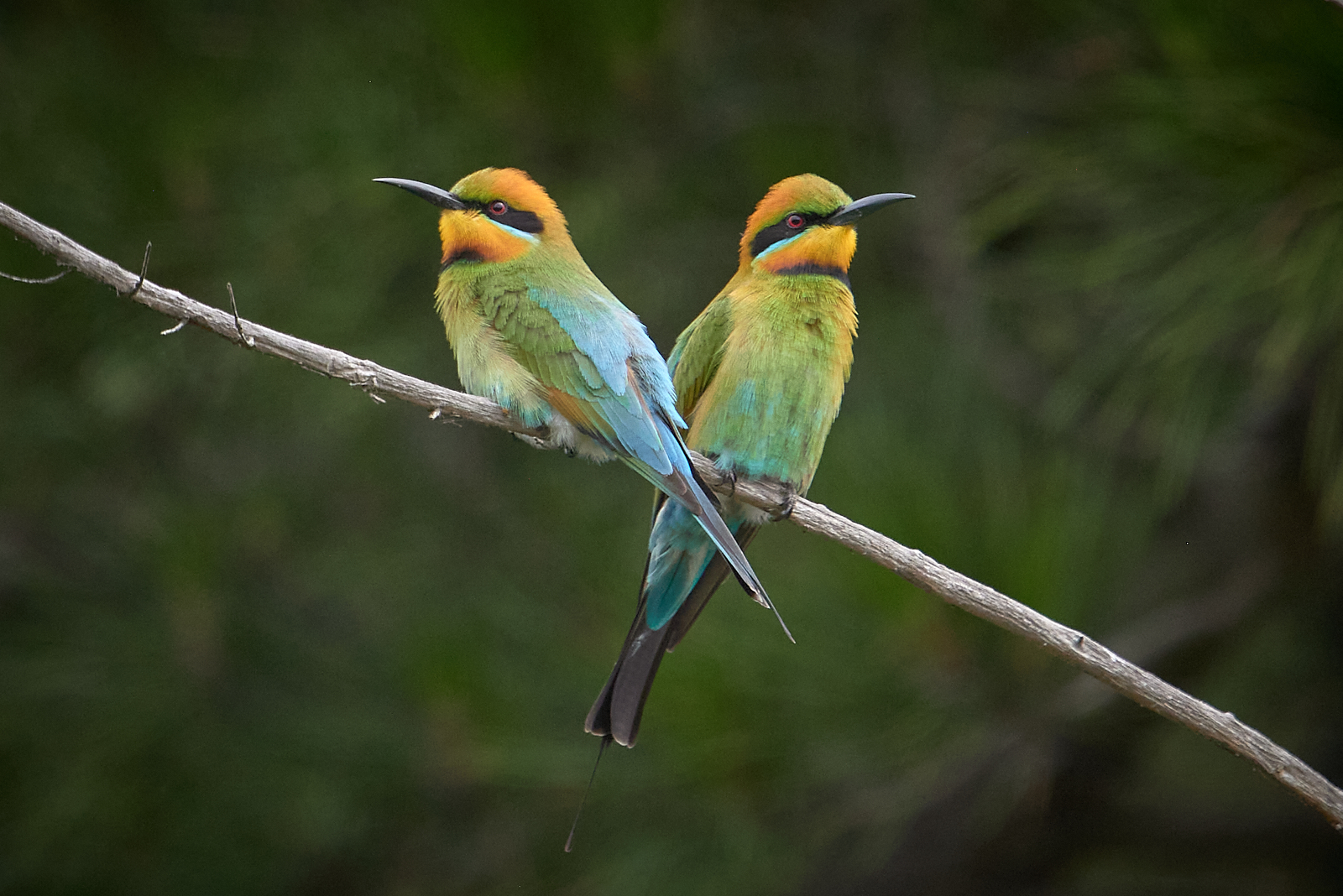
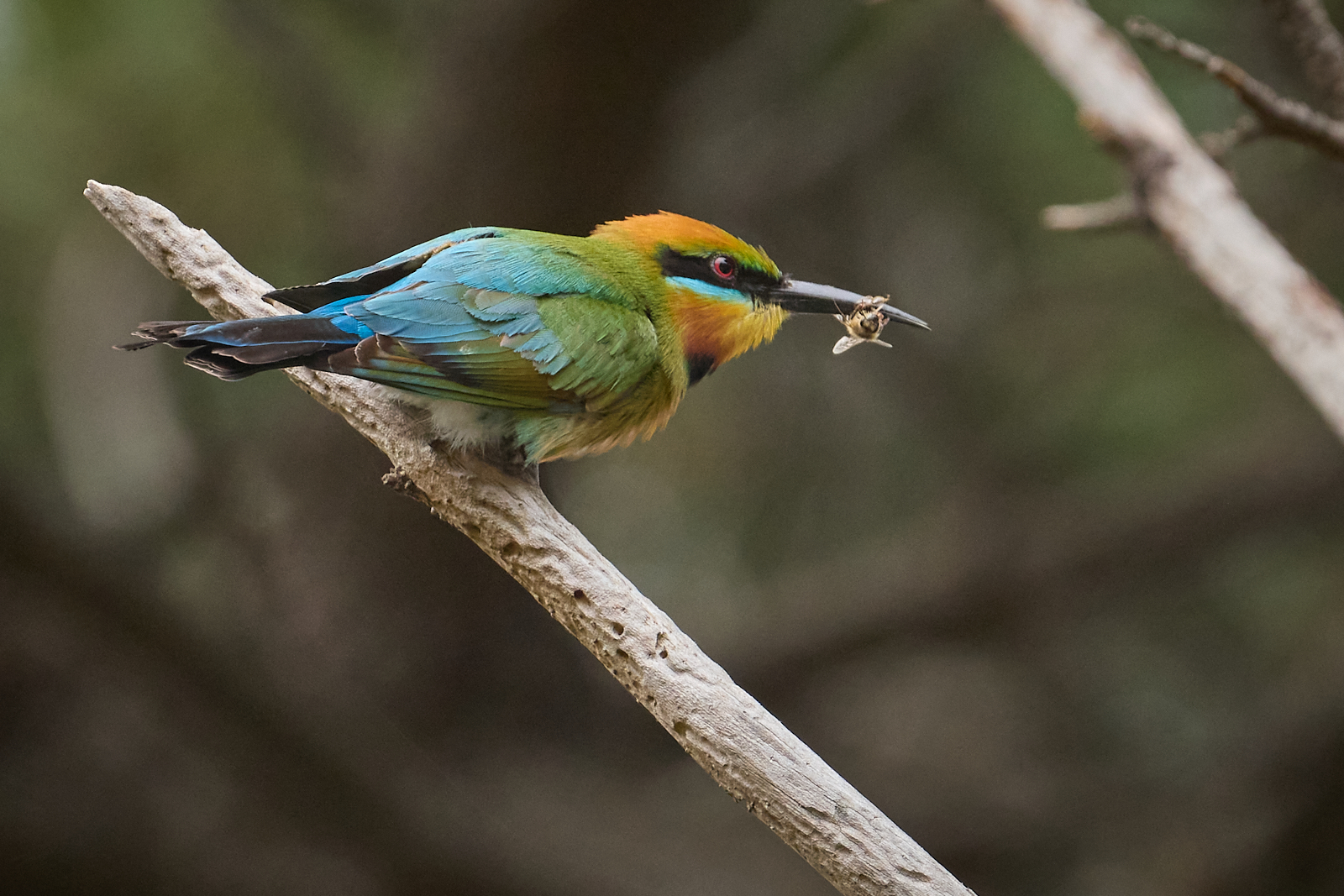
The noises increased and I suddenly could count, not two, nor five, but 14 Rainbow Bee-eaters. Not a bird we’ve seen at Point Cook before.

No doubt they were not moving in, but were simply topping up with fuel on their annual trip down the coast to a suitable nesting location.  Just behind the You Yangs is one of the closest I know of.

Rainbow Bee-eaters in our area generally nest in dry creek-beds burrowing into the sandy banks to form their nesting chambers.  Most of the sites I know of are either on restricted access parks, or on private property farms. So it’s not unusual to go the whole season and not see or photograph them.

No doubt they were not going to move into the park here, but would be on their way over the next couple of days.  So I had to make the most of what I has available.

A few days later,  Mr. An Onymous, and Ms. In Cognito, EE and I stopped by for another look, and of course not a bee-eater to be found.
Such is the Karma of birding.  I’m thinking of a note to Ross to tell him the shiny case is a good piece of kit, and more importantly it attracts birds 🙂

At least the bee-keeper who has some hives in the area would be happy that they had travelled on.

Enjoy.


Saturday Evening Post #158: Pair Bonding

I had most of this blog written last week, and was happy with the draft.

When my blog friend Eleanor mentioned on Flickr, a book by Gisela Kaplan called “Bird Bonds” I was very interested and found a copy on Amazon Aust.  I’ve several of Gisela’s books and find them full of both researched data, and also anecdotes of birds she has observed.
I often find myself sharing on this blog about anecdotes of our time in the field, and the various birds we work with, so I enjoy Gisela’s work.

Thanks to Amazon, the book arrived quickly during the week, and as EE said, “It’s the kind of book for an early to bed night in the cold of winter.” Plenty to read and ponder.

We all follow or enjoy birds for a variety of reasons.  None more important or sensible that another.  For some its the number of birds seen on a day out. For others a desire to see as many species as possible during a year.  For others the chance to find a vagrant or rare bird among hundreds on the beach. (a skill I have to say that has not even a shadow in my gene pool, all I only ever see are a large flock of birds).  For others, a chance to document the comings and goings in their particular ‘back yard’.  And of course for photographers the chance to get that one definitive image.

I have an acquaintance who used to have a folio or folder for each species.  There was only one photo in each.  If he managed a better shot, than the older one was replaced.   So a trip though his library of images would only have one of each.

I guess I don’t fall into any of those categories.  I take most of my birding ethos from Jon Young, and his book, “What the Robin Knows”, and as I’ve said before its about building links with just a few birds.  I tend not to chase numbers, or species or even wayward vagrants.
I’m much more the sit and work with just one bird or pair.

I sometimes get asked about the things I write both here and on Flickr about individual birds, and it comes from following a pair as often as we are able.  I find the enjoyment of watching the antics of a pair one of the most satisfying things I do.   Adam asked the other week, why I don’t show a lot of Rainbow Lorikeet pics and  I do have several reasons,  one is that others are always able to show some great photos of these cantankerous birds and their antics, and sometimes, I just get so involved in watching that I forget to photograph them. :-

Some of the most enjoyable times in the field  is with pairs, as they attend to one another, wrestle with setting up home, raising young and the busy-ness of being a bird.

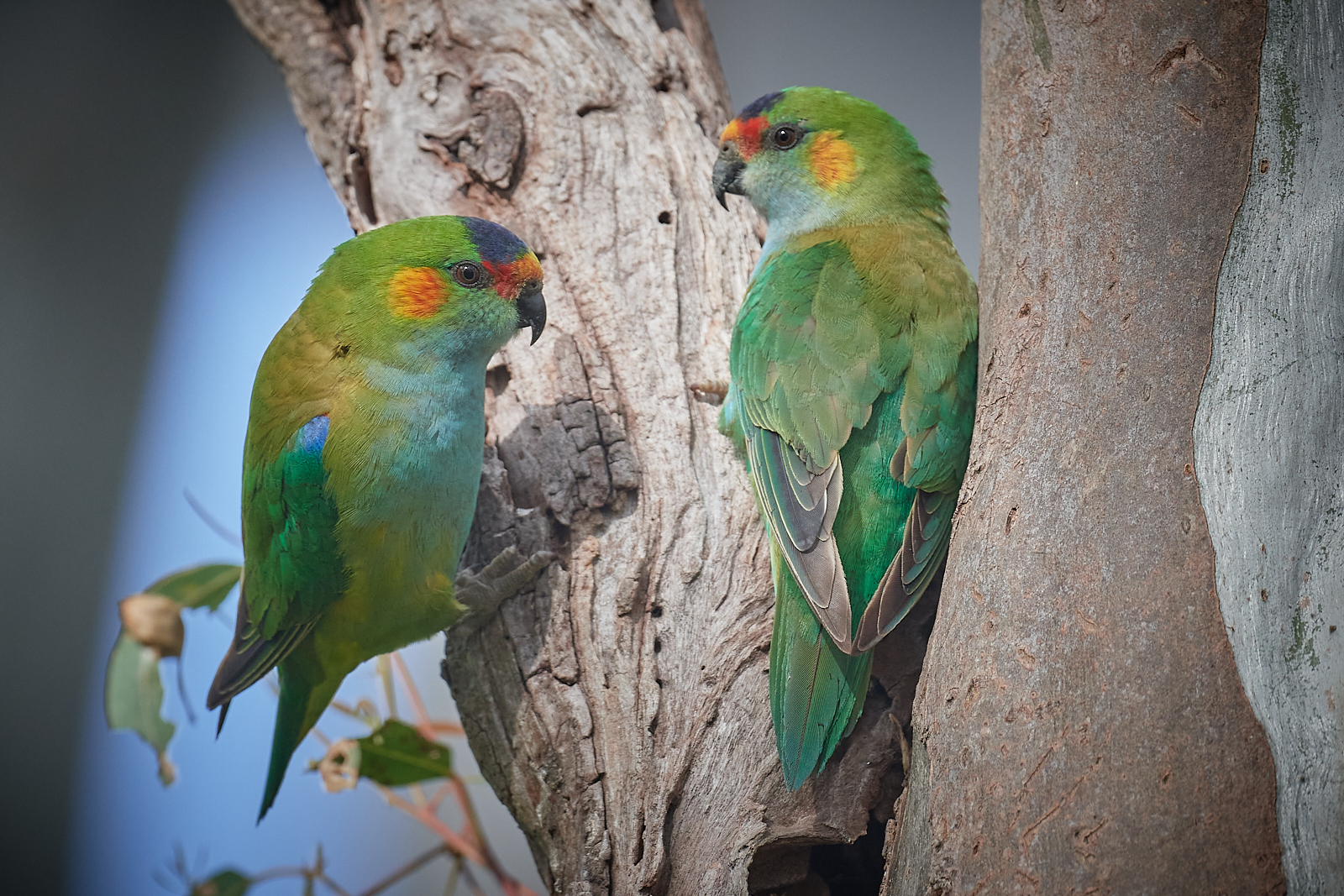
We have followed this pair of Purple-crowned Lorikeets for at least three seasons.  This is from  the beginning of the season last year.  We missed the main event due to lockdown, and when we retuned the old branch of the tree had fallen, exposing their nest and so they abandoned that area.  Not sure if I’ve ben able to find where they have set up this year.
As the nest hole was low down on the tree, it was quite a delight to be able to get up close and personal. They were completely unperturbed by my  presence and that took the strain of them, and me, as we sort of settled in together without any stress.

No doubt as I get through Gisela’s book there will be some of her wisdom I can share on the blog.

With lockdown now lifted in our area, it will be interesting to ponder where we can travel, but wherever a lot of the time will be sitting and soaking up the wisdom that pairs have to share.

Interludes: Wings Out

We stopped briefly this morning at the Black-shouldered Kite nest in a pine on a now disused piece of road.

The last few times we’ve visited it was apparent that the young birds were getting close to fledging, however as it turns out we were pretty much completely wrong.

When we arrived they were already sitting high up on the tree and one moved from one branch to another with a skill of a seasoned flyer.
And not long after two of them took to the air and circled about the paddock around the tree, eventually returned and settled in.
A third one came by just as we were leaving so it must have been resting in a tree further down the road.

On return the young kite had to run the gauntlet with an enraged Australian Magpie. Unfortunately it happened all so fast and so close in that we didn’t get much of a result, and to it credit the young kite was easily able to avoid the attack. Which further shows they have been airborne a few days at least.

The female turned up and spent quite a bit of time ‘tail flicking’, which I’ve always taken as either a pair-bonding  or a territory maintenance movement. Given a second pair of Kites have a nest somewhere further down the main road, it might be safe to assume she was giving warning that her young were out and about and not to be messed with.

Here are a few from the excursions around the nest.


Young Kite defending against the Magpie attack. The feathers might look out of control, but I suspect it has set up the feathers to give it both control and the ability to avoid the magpie. A good indication they have been out for a few days.

Saturday Evening Post #157 : Roll up, Roll up, the Circus is in Town

We have finally been able to break out of our 5km border restrictions.
Not big mind you, we only needed about 7km to get to The Office.
Along the River Park walking track the bush is alive, as they say to the sounds of parrots, lorikeets and smaller bush birds, including Wagtails, all busy either defending a nesting location or challenging for better accommodation.

None, it seems, more so, than the large number of Rainbow Lorikeets that have descended on the park area.  Over the years their numbers have grown to what can only be plague proportions.  Each hollow in every tree seems to be a Rainbow chosen location, much of course to the chagrin and detriment of the smaller birds that simply can’t compete with the noisy, brash and boisterous Rainbows.

But they do have some advantages for the photographer, besides their brilliant colour scheme.

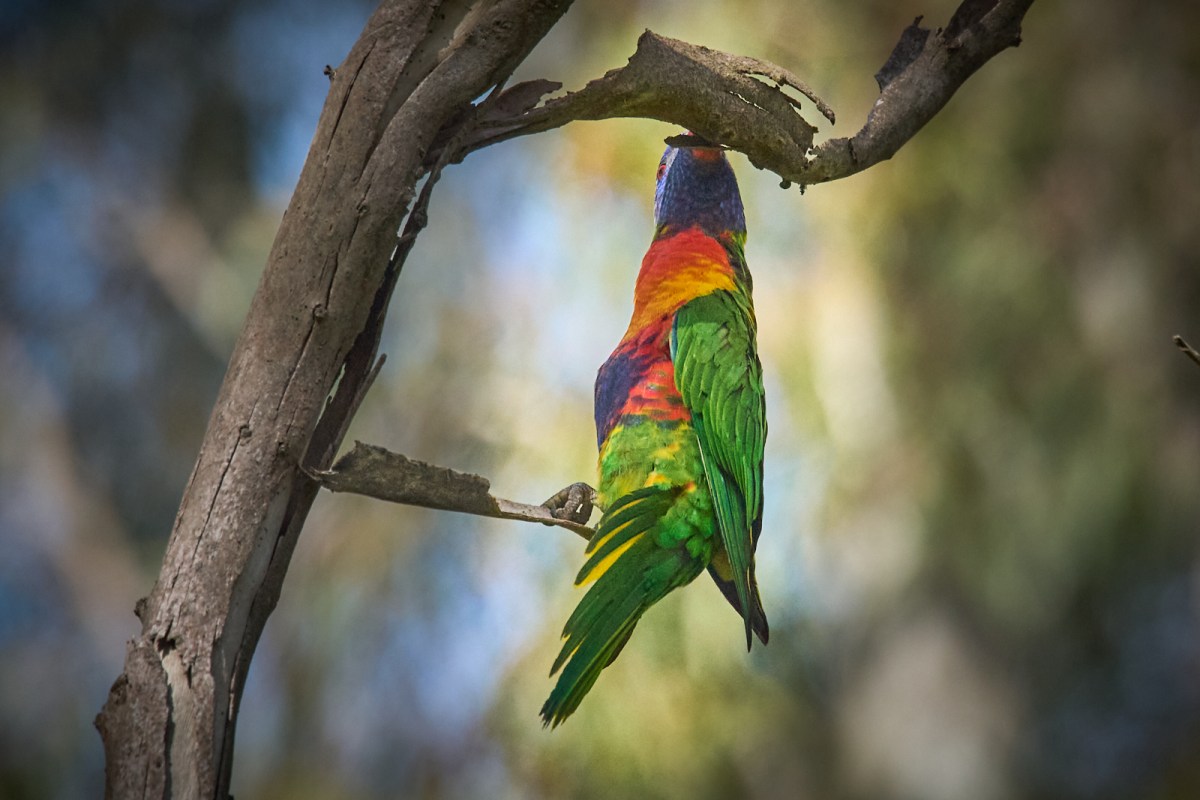
As EE commented as we walked down the track with the calls of the Rainbows ringing through the trees, “They are  bit like a single bird circus, each one has its own act.” Perhaps its partly bravado, partly the need to show-off to their peers and partly to intimidate other species.  But there is no doubt that a pair can provide hours of entertainment, as they talk, preen and dance together.

We were a bit late for the opening of this bird’s performance.
Two options I think:

It had been holding on to the bark on the branch and it had given way under the weight and it had desperately grasped the bark above with its beak,

or

It was using the bark and the balancing act to impress its mate.

Either way, as it waved the bark about with its foot, was it trying to gain balance or simply attention.

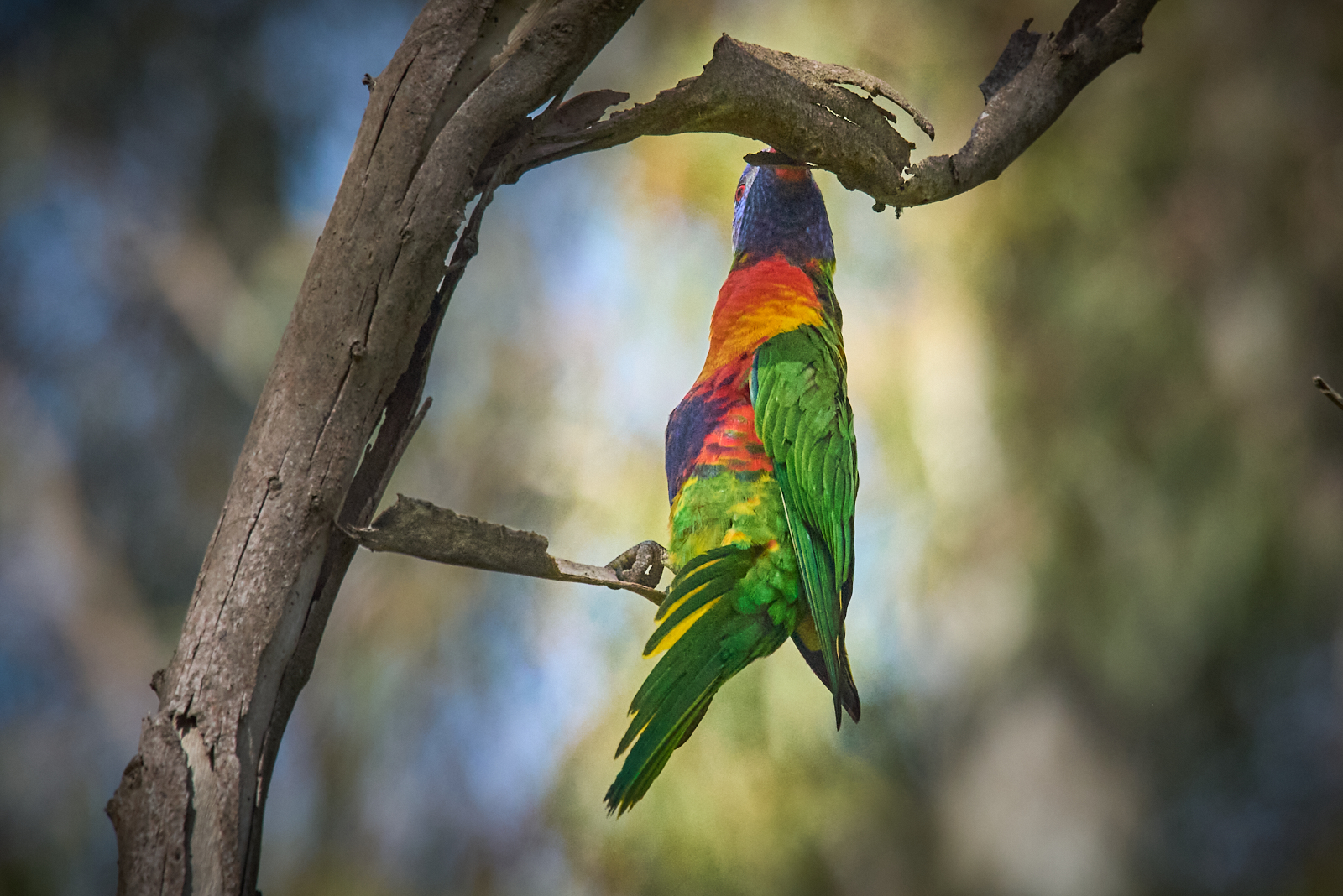
Easily able to support its weight by the beak, it didn’t seem to be in any hurry to recover and rolled around for quite a long time.  In the end, dropping the bark, it did a ‘chin up’ grasped the bark near its beak with first one, then both legs and swung up onto the branch.

Hard to say, but the crowd threw popcorn and cheered at the performance. 🙂

You can tell we’ve been locked up too long when such simple things form such great amusement.

Enjoy


Interludes: Let’s Be Careful Out There

The title is a quote from a tv show of the 1980s.

The Duty Sergeant would remind his team as they left the daily briefing, ‘Let’s be Careful Out There.”

In these days of rampant pandemic it still seems like good advice.

However being careful out there applies to some birds as much as it did to the police in “Hill Street Blues

Longer term readers may recall that two years ago we spent quite a bit of time with a Brown Falcon pair as they nested.  Cassia, of Cinnamon, provided us with some excellent insight into the nesting and feeding habits of their lives.
Unfortunately we were unable to follow up with them last season due to travel restrictions.

However with a change in limitations we have now been able to revisit the park, and after a couple of futile attempts,  EE pulled the proverbial Brown Falcon Nest out of a Hat.
He had been hunting close into the nest in the open paddocks and seemed to be having some success, however we missed the food exchanges and were unable to determine a possible nest site.
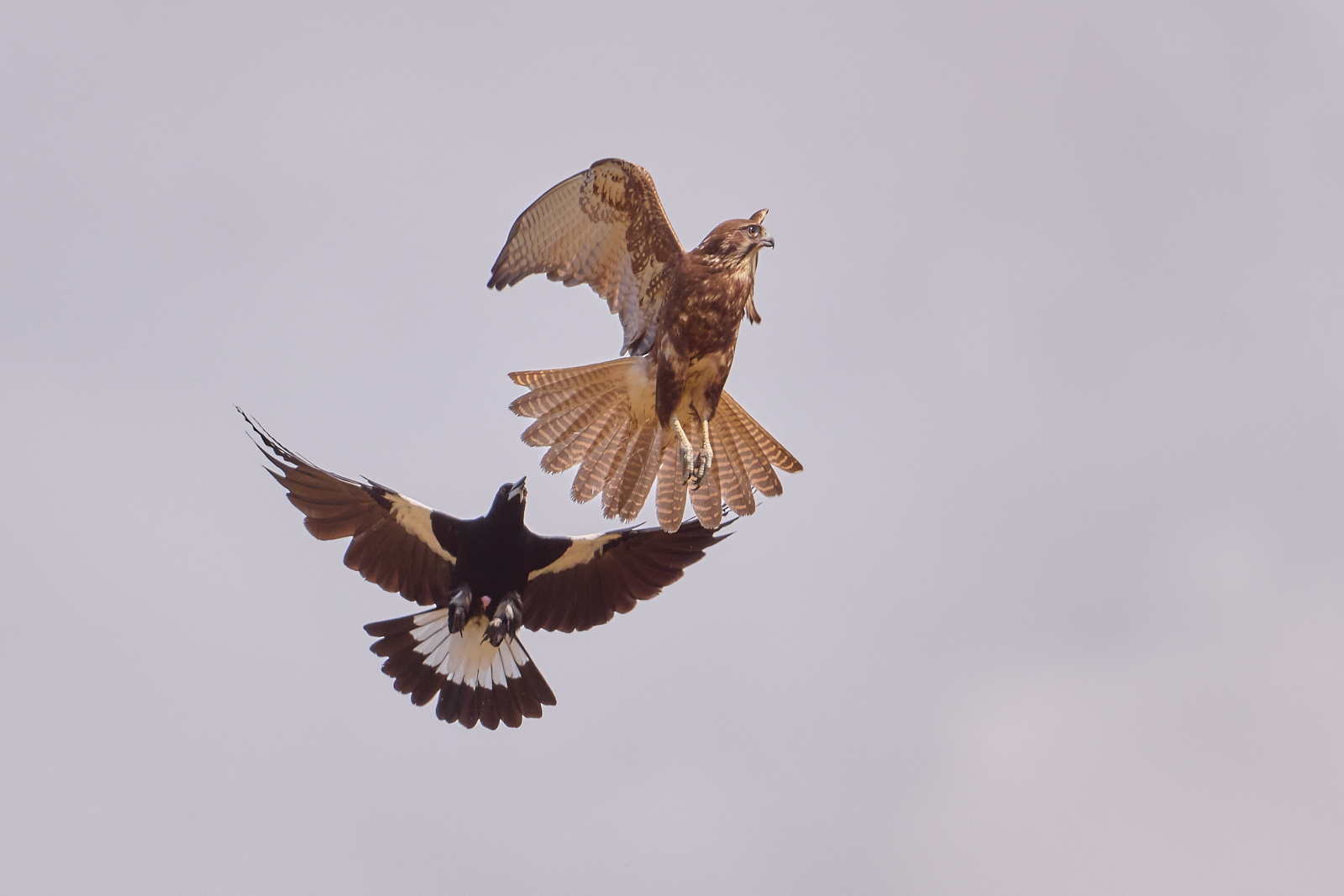
It was not only us that were taking an interest in the falcon’s presence.  Australian Magpies took them as ‘easy’ targets and each time one of the birds flew, a flotilla of maggies were in hot pursuit.
Mostly the magpies are fast enough, and the falcons don’t put in that much effort to get away, but today it was quite obvious that the falcons were not going to broach harassment, and each time the magpies drew in close, the falcons put effort into the wing strokes and powered away. Not something I usually see.

Cassia does indeed, Need to be Careful Out There.

Here is a small selection of the morning’s activity.

This is the male, he is lighter in colour. He is doing his best to hover over the grasses
Action TIme. A quick drop on to some prey below
Mouse delivery. Unlike Black-shouldered Kites, he carries the prey in his beak.
The male: Time for a scratch on the wing.
Sitting waiting for an opportunity to pounce. His yellow cere and eye ring are noticeable id markings. HANZAB notes that yellow cere may be a sign of age and is more prevalent in males. This bird might be at least 15 years old as we’ve seen him over a number of seasons.
Heading out for another catch
This is Cassia, of Cinnamon and her nest with at least two young. They are only recently hatched, perhaps in the past few days.
The magpies decided that Cassia was not going to sit quietly anywhere in their territory.
Maggie closing in.
She is well aware of the challenge, and is about to power away.
This is the first time I’ve seen a falcon put in the effort to evade the charging magpies. I think she has the better of them in a vertical climb
Stretching out. The magpies might have the advantage on a downhill run or across a level field, but in this case she just lifted up faster than the magpie could manage.
The male avoiding two enraged Little Ravens

Saturday Evening Post #156: A Jewel

I’ve often commented on Flickr and Facebook and other online groups, and of course here on the blog that I consider the Australian Hobby to be our most beautifully marked raptor.

It’s steel-blue-grey wing and back contrasts with the rich  chest and underwing colours and the light and dark underwing patterns all make for an impressive show.

David Hollands writes, in “Eagles, Hawks and Falcons of Australia“, in his chapter on Australian Hobby

If there is a jewel among Australian hawks,  it is the hobby. Smaller than the Peregrine, it  is lithe and slim and incredibly fast. At rest, sleek and polished with a silhouette that tapers rapidly from its slim shoulders, it has the look of pent-up brilliance waiting only for the trigger to transform potential into action. In flight the promise becomes reality, it seems hardly to have left its perch before it is travelling at dazzling speed. The wings are long, narrow and swept back in a sickle-shaped curve that is particularly noticeable when gliding. … Of all the falcons I know it is the most graceful and there are few more exhilarating sights than one that is stooping, wings curved back, eyes fixed on its target: everything taut and totally controlled:wavering not one fraction from its course and travelling at remarkable speeds for its size. (p.156)

Somehow I suspect that most of us never get to see the bird at much more than a distance, or at high-speed in a high wind, or perhaps sitting on a open perch or fence post.

But to appreciate this bold little bird requires a lot of time working with just one bird or pair, and due to their rather nomadic and social isolation, it is not often we get the chance.
I have featured a pair at nest at the Werribee River Park precinct a couple of years now on the Flickr and here on the blog.  We have had at least three previous seasons with them, and were highly anticipating getting out of our 5 km bubble to see if they had returned for another year.
And.
They have!

We have the good fortune of being only a 15 minute and 5 minute walk from their nesting area.   So it’s possible to arrive early and watch the comings and goings of both the tiercel (male) and falcon (female) and learn a little about their ability in the air.

The nest is being reused and is high in a sugargum, the multi-branching of the tree has produced substantial eight to ten branches that form a ‘cup’ and the previous owners had filled it with sticks, and as Hobbies don’t build but rather reuse, its probable that they have not refurbished the nest since its last use.

The nearby Werribee River run between some quite steep, and high sand ‘cliffs’ and Fairy Martins and Welcome Swallows among others use the area over the water to hunt for food.  It makes an easy food source for the tiercel, he sits on a branch overlooking the water, and when opportunity presents itself, with barely a feather flick he is airborne off the branch down into the river area and because the cliffs on either side give the target little hope of avoidance, is usually back up out the other side of the river in his first swoop. If he misses, I’ve not seen it happen yet.
Which brings me to another point that David points out about it travelling at both incredible speed and with unwavering trajectory.
It is hard to put to words, but on return he flies far out and then on a perfectly designed and executed arc, circles back to land without making any adjustment to his travel that I can detect. It is like a beautiful Tai Chi move.  Smooth, controlled and effortless. (In Tai Chi, the term, “Sung” would be appropriate)
At first I thought it was just a one off, but each time he came in it was pretty much a carbon-copy of previous returns.
The falcon does the same thing when she leaves the nest and returns. It’s a long arc at speed, and just as she approaches the nest, she throttles back and lands though the tree branches as light as a feather.

It’s early days in the cycle at the moment as they are still mating, but not doubt she is sitting on some eggs as he is quite the busy provider.

It is worth contemplating that over the next two months, he will bring in daily about 12-15 kills. Mostly small birds, from Martins, Swallows, Sparrows, Honeyeaters and the like.  Not so much Mynahs and Starlings. (Although they are quite plentiful). That will be somewhere around 700 dinner invitations that the invitees can’t refuse.

This shot is the tiercel, he has just passed over the food supply to the falcon and is going to take a quick rest in a tree opposite until she has eaten and is ready to return to the nest.

Covid Lockdown Restrictions not withstanding there will be more to see of this pair and their progress with the clutch.

Interludes: A Sky full of Kites

With a touch of sunshine, and a free morning, EE and I decided it was time to followup on a lead we’d been given about the possibility of a Little Eagle’s nest along the Werribee River.
Now it was hardly an expedition that would rival Bourke and Wills, or even the great Major Thomas Mitchell.  It was more likely the ‘expotition’ of Winnie the Pooh in search for the North Pole.

Still any day out with good weather, good company and a flask of the good Earl’s finest, was looking better than another locked down day in our four walls.

We set off to find that the access gate we were hoping to use was locked, and as Arlo Guthie sings, “With a big chain, and a lock and a sign saying “Closed for Covid”.”  (Alice’s Restaurant)

So off to plan B. Not sure Bourke and Wills and certainly not Pooh Bear, ever had a plan B.

We parked and walked in. Well it was a sunny day.
And just as well, for to be honest.  If there was a Little Eagle’s nest along the roadway I missed it. And if EE missed it, well, it wasn’t there.  If it had been in Argentina, she would have spotted it anyway.  It is a 6th Sense, or at least borders on some kind of extra-sensory perception.

However as we walked the track, what came to visit us was several squadrons of Black and Whistling Kites.  First just a few but as quickly as we could count the numbers grew to about twenty five birds filling the sky.
Among some of the interest was a Black Kite that had a rabbit carcass tucked up, and was not giving it up for any of its ‘friends’.
And a bit of an aerial duel between some Black and Whistling Kites.
Next several Ravens decided that having so many free-loaders in their nesting area was not going to happen and another battle ensued.

A good day out for with some bonus Australian Hobby secrets discovered as well, but that is certainly for another post.
Enjoy.

Saturday Evening Post #155: Shadow Opportunity

Deng Ming-Dao writes,” Times of oppression and adversity cannot last forever. In the midst of great difficulty, a tiny opportunity will open—if only by chance.
You must be sharp enough to discern it, quick enough to catch it, and determined enough to do something with it.  Stick to it like a Shadow.”

“It is like a bird. If you try to catch it, you will miss. If you are always with it, moving at its speed, as much a part of it as its own shadow, then it is easy to seize.”

We have, tis fair to say, had our fill of lockdownitis. One of several pairs of Black-shouldered Kites that we’ve worked with over the years has flown several clutches of young while we’ve been at home with our four walls.

The sad thing is that the 5km limit we  have been forced to work to, just gets us to the turn-off to the road where the Kites territory begins. So it was possible to drive, and park, and like a kid looking in a lollyshop window droll on the glass.

But. Not able to get close enough to see what was going on.

The road runs off a major access road, so parking on the side, (within our limit) is fraught with its own challenges.  Myriad passing traffic, difficulty of parking on the side of the road, not to mention, standing about with a long camera lens  is likely to bring the wrath of some ‘public concerned individual” as to why we would be doing such a thing. And of course the inevitable visit from the long arm of the law.
So, we stayed away.
This particular pair, and really its the female, as we are pretty certain she has had two male companions over the past couple of years, have done their bit to keep the Kite species alive and well supplied.
Working backward, with the few clutches we had photographed without interruption and the number of clutches that were started and then we lost track of, or had begun and we came back on the end of the season with the young well and truly on the wing, we think in the past 3 years, they have had somewhere around 8 clutches.  Maybe 9.  On average she brings out 3 young, so given one known clutch failure, and one that only produced two young, it would be fair to say they have flown around 25 young birds.

Now we have a little more travel space, EE and I ventured out, among other places to see what the kites were doing, (If anything)   Parking well off the mainroad and scanning about, eventually we found one of the pair sitting high on a tree.  Not long after the female emerged from the top of a tree, and with much sqarrking encouraged the male to go hunting.
Bingo.  They have a nest.
That would be perhaps number 10 so far.  She is a bit of a workaholic.

Shadow time!  Hopefully the next few weeks will give us a chance to follow the progress.

The weather wasn’t all that kind, but here she is coming in with a fresh prize to prepare for the young, which must only be hatched for a week or so.

And just in case you’ve not seen a link before
The Peregrine Falcons high up on 367 Collins Street in Melbourne have hatched a clutch of three.
Here is a link to their video feed.

https://367collins.mirvac.com/workplace/building-overview/falcons-at-367-collins

Enjoy.


Saturday Evening Post #154: Is that Light at the End of the Tunnel—Or, A Train Coming Toward Me!

When the night has been too lonely
And the road has been too long
And you think that love is only
For the lucky and the strong
Just remember in the winter
Far beneath the bitter snow
Lies the seed that with the sun’s love
In the spring becomes the Rose

Amanda McBroom
From the movie “The Rose”, sung by Bette Midler.

======================================================================

And a friend sent me this link
Hope you find it interesting

https://www.theguardian.com/commentisfree/2021/sep/25/melbourne-is-suffering-a-reverse-groundhog-day-only-bill-murray-can-save-us-now