Friday dawned all lovely and still, with plenty of blue sky and none of the rain of the previous few days. I was getting a bit tired of pacing the floor and finding other things to do, so it was good to get back into the bush and see if the storms had diminished the robins activities. I needed not have worried, as they were soaking up the sunshine and on the hunt everywhere.
The Brown-headed Honeyeater aerial trapeze team came by for a visit and I’ve put up a page here with their antics on display.
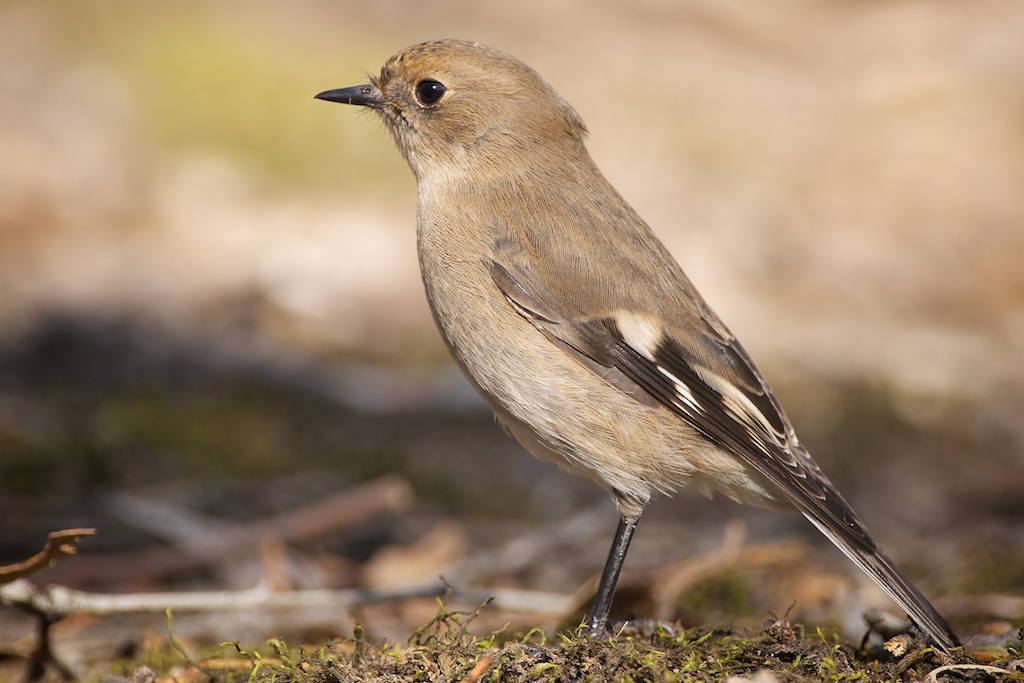
This young lady spent a lot of the morning with serveral other females hunting on their own. They seem to have a different call, a Cheep, Chip, Chip, which must be a location thing. This one seemed to be the noisiest or most persistent caller. Perhaps it was “C’mon girls, let’s go over here.”Another one from the hunting party
After a couple of days of what can only be described as ‘typical’ Melbourne weather, the clouds eased off a bit, and the biting chill was gone from the wind. So we both ventured out to see what the rain had done in the park.
We quickly found a number of Thornbills and Pardalottes who were enjoying hunting in the sunshine.
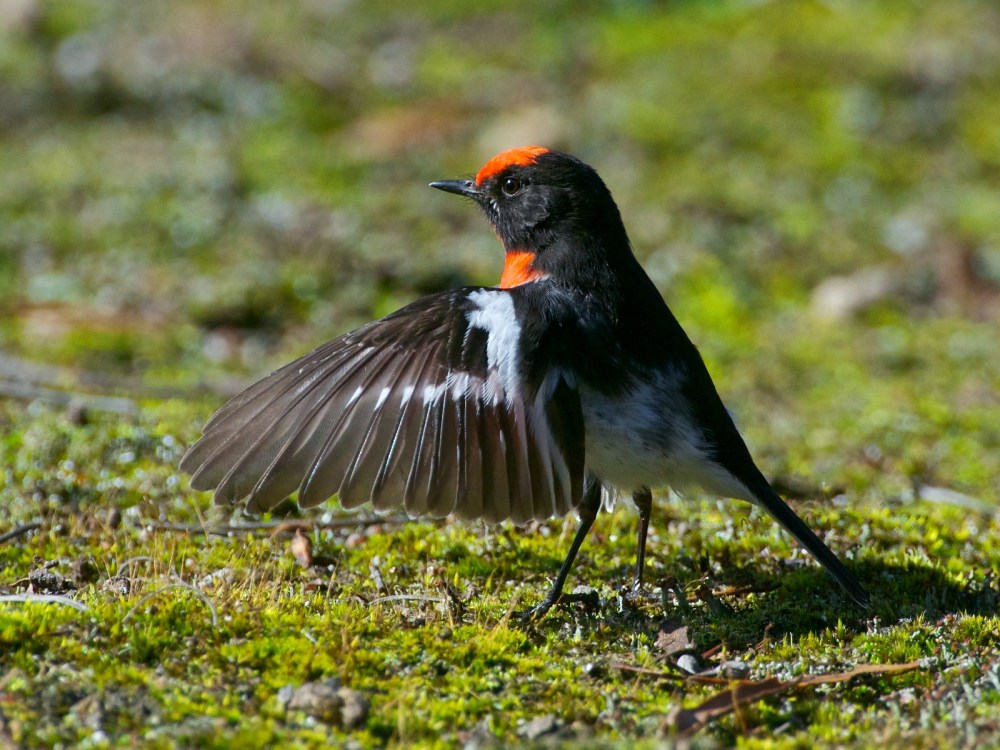
Also found a few robins Scarlet is still there and his Red-capped consort has taken on a particularly brilliant orange/rust coloured cap.
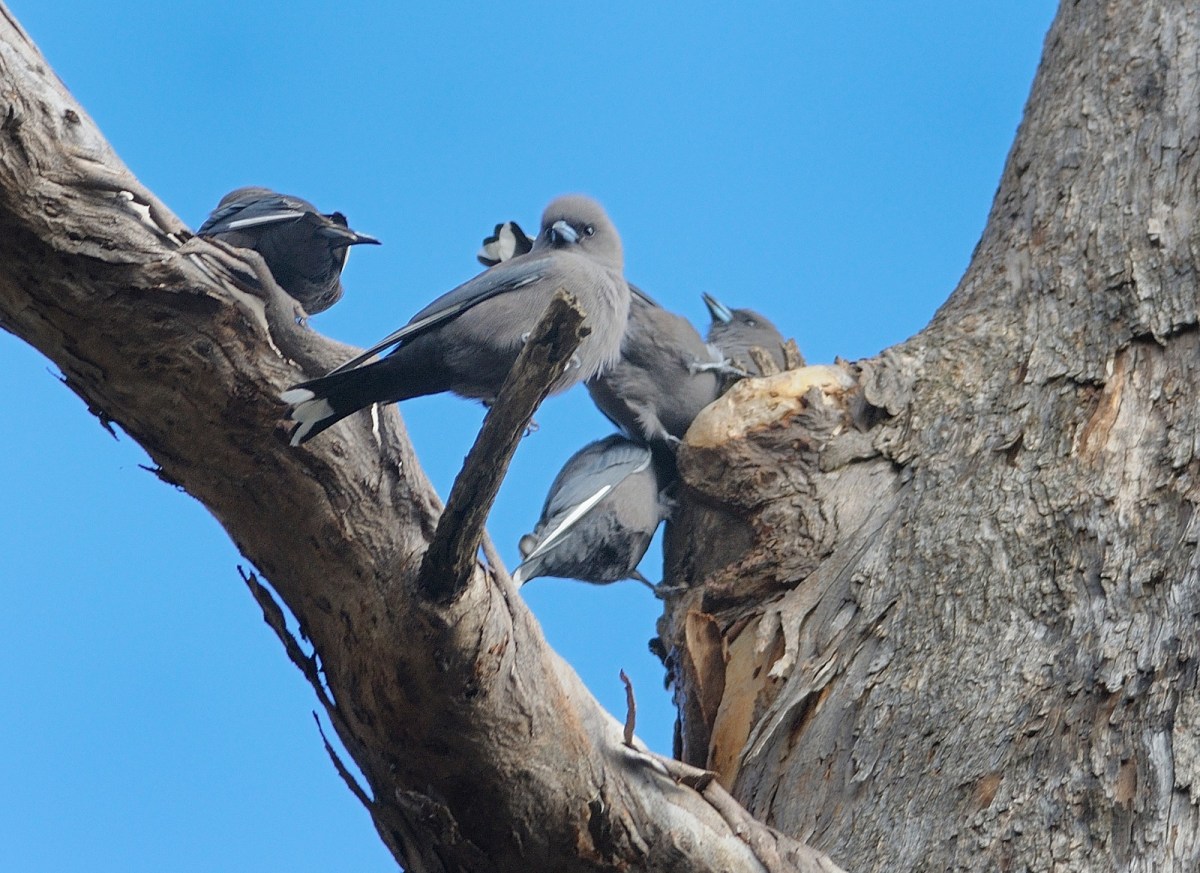
A small group of Dusky Woodswallows were enthralled with a small lump on a tree high up and spent a lot of time squabbling and mobbing one another, for what we suspect was a pool of water built up in the node on the tree.
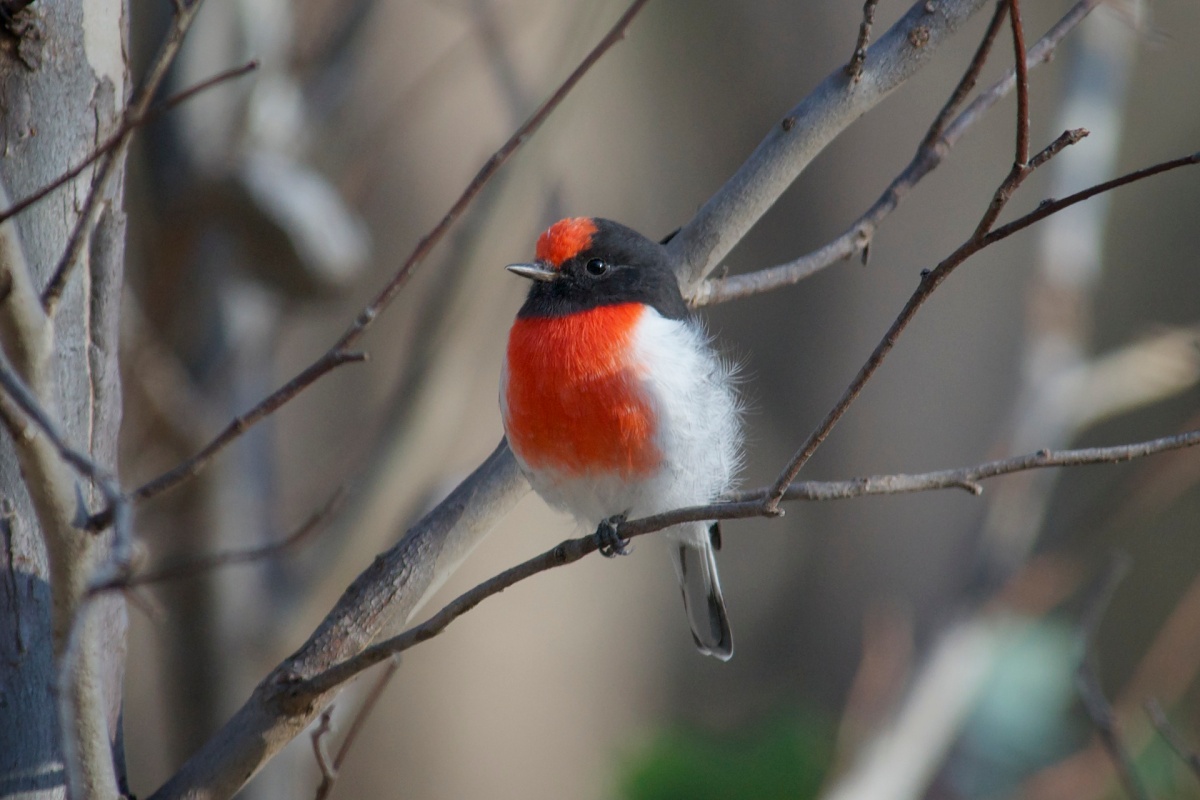
And a lovely Redcapped Robin male danced by and posed against a freshly built spider-web. Pity the light was just overcast at the time as the web would have glistened in the sunlight.
Red-capped Robin male and a spider web contrast.Dusky Woodswallow flock taking a drink from a small pool of water high up in a tree.
Over the past few days I have been out and about on other things than birds at Woodlands. Including a day up at Murrindindi with the Midweek Bird group. It is the first time I have been there since the horrific fires, and I was a bit hesitant about going. Tragedy is not something I am readily drawn to. It is as they say nice to see the amount of regrowth, and in some cases along the river the understory has taken on jungle proportions. Which made it hard to find birds, but none the less we managed between us about 40 species. Highlight of the day were some Scarlet Robins in the carparking areas. I think they appreciated the open area for their wait and pounce hunting. One seemed quite unconcerned and approached quite easily to with 4-5 metres. So some good shots were acquired.
This morning the sun was up bright and clear and I went for a look at Woodlands. Down at an area rapidly getting the name “Three Ways”. It is where tracks T junction. After some time waiting, eventually a number of Flame Robins appeared. There are two males and females, and a few immatures. They worked over the area for about an hour, which was a good way I reckon to spend my time. Then like always, a turn of the wing, and they were gone. Not to be seen again.
Feeding very close to my camera position.RIght at the end of my focus on the camera, I had to pull back a bit to get focus.
After a week of fairly average weather, it was nice to see the sun beaming through this morning. That was enough to put all other jobs on hold, load the car and head for Woodlands.
The forest had a lovely smell after the rain, and it was looking quite crisp.
To add to the enjoyment within about 5 minutes, we had our first Flame Robin Male, and followed it up very fast with another male, a female, and some juveniles. They didn’t seem in any particular hurry and cruised around an open area feeding as they went. Then the local Scarlet Robin popped by, and he is still with his red-capped escort, although she spent a lot of time preening while he flew about in ever broadening circles. Henny and Penny two redcaps in the area popped by for a visit, and Penny does look the part in her new winter dress and a distinct orange/red cap.
The pair from down near the three-way junction also put in an appearance, but a lot further away, too far to pursue. Time just seemed to stand still as the birds hunted and chased around the stump area we propped on. Then off course it was back to the real world, so we went by the powerline area near the dam and found another pair of co-operative Red-capped Robins. All in all over four hours had gone by, we had collected our share of vitamin D for the day, a nice collection of images and a collection of good spots to check in the future.
Flame Robin male. He has an interesting red feather just under his chin that breaks the sharp black line on his mask.
The local male. He was as busy and as vocal as usual. His consort spent most of the hour or so in a nearby tree tic'ing at him and ignoring his circle flights.A juvenile (perhaps). There are several similar birds already in the park.
This Grey Shrike-thrush came to find a space to pulverise its insect prey and to enjoy the meal.
So many places to go, so much to do, so little time.
When I first started looking at birds at Woodlands, I ran into a birdo, Ray, who shared with me a lot of his knowledge of the area. One bird he pointed out was the White-throated Treecreeper and its distinctive call. It is alway such a pleasure to hear them, and find them among the trees. The one Ray and I would find was a female, and for several seasons she didn’t seem to have a mate, then last season she turned up with a mate and eventually produced two young. But since then I have only be only to find the female.
I heard her calling in the long creekline off Gellibrand Hill, and after a few minutes was able to find her hard at work. After following her about for about 15 minutes, I didn’t find any mate or young, so she might be back on her own. But nice to see her again.
Also ran into a family of White-winged Choughs. Or more accurately they found me and sped off with great alarm calls. But then they settled down to feed and I was able to get within lens distance. Lighting wasn’t so good, and I was hoping to get some pics of them with the lovely wings spread out. But no such luck. They are such a a dumpy looking bird, yet they seem to glide about as if on gossamer. They have an elegance about the way they touch down for landing.
First day of April and the weather just keeps getting better. Dorothy and I had taken the morning to visit Westgate Park, right near the huge bridge over the Yarra. It used to be a city dump, and has been reclaimed, and with lots of volunteer work it is being turned into a little wilderness Oasis just a short trip from the CBD. More power to those who thought it a good idea and all those who worked to bring it back to such great shape.
In the afternoon I needed some retail therapy and on the way back stopped at the Providence Road carpark and met Peter Tompson who is a great contributor to the Victoria Birdline. We have a good chat about the Black Falcons at WTP, and another birdo friend, Richard turned up, and even more discussion ensued. Richard has a very extensive and annotated bird list going back about 20 years for the area, it even includes sightings from one of the park rangers at the time.
We walked down to the Backpaddock, and found our taxes had been at work, and the old gate had been repaired and now actually closes. Good work team.
Richard went off further down the range, and I did a quick scout about and found a pair of Red-capped Robins in the sunshine. This pair are starting to reclaim their territory. At the moment I haven’t been able to find most of the other pairs. Hopefully they are still about, just hiding. No sign of Flame Robins yet, but with the amount of food available everywhere, perhaps they will only pass through this year.
Red-capped Robin Male in his new winter attire. Pretty much full moulted and beginning to become vocal again.
This little male has just about completed the moult. He is showing the last of the white-sheathed new feathers. He keeps hiding in bushes and behind branches. It seems like he doesn’t want to display until the moult is over. This male’s lady has already taken on her winter outfit, and he is just starting to ‘tic tic’ at her. But there are no territorial shows now.
Red-capped Male, showing moulting in of new red cap.
Scarlet Robin at Woodlands, moulting into a dapper bird.
First time back at Woodlands since the long Goschen trip.
Within a few minutes I had heard a familiar chirrup of the Scarlet Robin and went to investigate. I saw it in the distance, and it continued to come closer landing in a tree across the track from where I was. It is a male for sure. Has a lovely black head, really strong red colour, and that wonderful white spot above its beak.
It has grown quite bold as the week has gone by, and now patrols quite an extensive territory inside the Back Paddock fenced of area.
It does not seem to have a mate, but it is still in attendance with a female Recapped Robin. It is also moulting through and looks a bit of a sight at the moment. They sit together, hunt together and move about together, although it has to be said that the poor little redcaps wings whir quite bit trying to keep up with the speedy Scarlet. But they ‘tick’ call at one another.
Also saw today; three black swamp wallabies, so they have managed to get inside the fence in the new area. They seemed very relaxed. So that is good.
Out in the forest this morning and came across a mixed flock of wagtails, thornbills and a number of redcapped robins.
First time I have been able to locate them all together since the nesting season. Two males were particularly interesting as one smaller one, seemed to want to try its luck on the larger (older) bird. Where they were was sort of at what I think is the border of two territories. And while it is hard to tell who is who, I suspect that the larger bird is the male of the territory. He was in the company of the only female present a bit earlier.
There is an excellent series of article on the net. Papers by Damien K. Dowling, of Melbourne University. And in the paper “Breeding biology of the red-capped robin”, AJZ 2003,51,533-549 he describes the behaviour of males in territorial conflict. His work was done around Mt Terrick Terrick Park, and is a great read on details of nesting and behaviour and success rates.
Today’s males preformed lots of dancing back and forward on a branch, it looks a bit like it is choreographed, and they seem to know their parts well. In the end, one did the fly away, by slow retreat and in the eventually I lost sight of it completely. Hopefully it will find a reasonable amount of space in the forest, and at least one new territory will be established.
The pair in the area seem to have finalised this year’s breed. Both birds are beginning to look worse for wear feather wise and the moulting probably is only a month to six weeks or so away.
Red-capped Robin males in territorial discussion. Dominate male in rear.Male Red-capped Robin territory dispute resolution
Found this little fellow out and about looking for tucker. He was in an area that has not been a redcap territory for a couple of years. However I think the rain, and the long grass is the large open areas has made his hunting a bit difficult on the ground and he has moved operations into the lighter grey box forest areas where there is quite a bit of open forest floor. Once he spotted me, we went on a bit of a round circuit of the area, so I am pretty sure his lady has a nest in the area as well.
But to assure me that there were no nests he did a lot of elaborate cleaning and constant moving about. His feathers seem now to be getting a bit worn for wear and he is looking a bit on the scruffy side.
Be interesting to see if he maintains the new territory or moves back when the grass dies down over summer.
Well he actually hasn’t been away, just been busy with nesting duties I suspect.
Also haven’t able to get into the Fenced off Backpaddock because of “Park Maintenance Operations”. But today the gate was unlocked and I sallied forth.
This is the Map shelter bird. He has been conspicuous by his absence – or lack of showing- the past 5-6 weeks, but he seemed to be on food duty today, and I found him about 3 times, so that was good.
In this shot he has just helped himself to a rather large bug and after beating the stuffing out of it, he flicked it down in one gulp. I think he is licking his beak with his tongue.
One of the things the Parks folk have done is re-set the fence line up near Gellibrand, taking it right through some Swamp wallaby territory. The little wallabies are now on the outside of the secure fence and open to predators and what not. All except this little one, who seems to now be cut off from its family in the rocks on the outside. Not sure how many are affected.
This is a female Red-capped Robin on her nest. I have been trying to find some sign of them over the past few weeks, without much success. Which is probably a good thing as they have been busy at work.
By a little bit of chance I heard the distinctive call of the male, and followed up to find both male and female on the side of a track, and he was feeding her. It stopped me in my tracks, and as it happened the nest was in the tree next to where I stopped.
It took me a few minutes to work out that she was trying to get back into the nest, and then I moved away about 50 metres. She immediately settled down on her clutch.
This is her second brood this year, and she successfully got 2 chicks off in late October.
This a female red-capped robin hard at work on her next litter
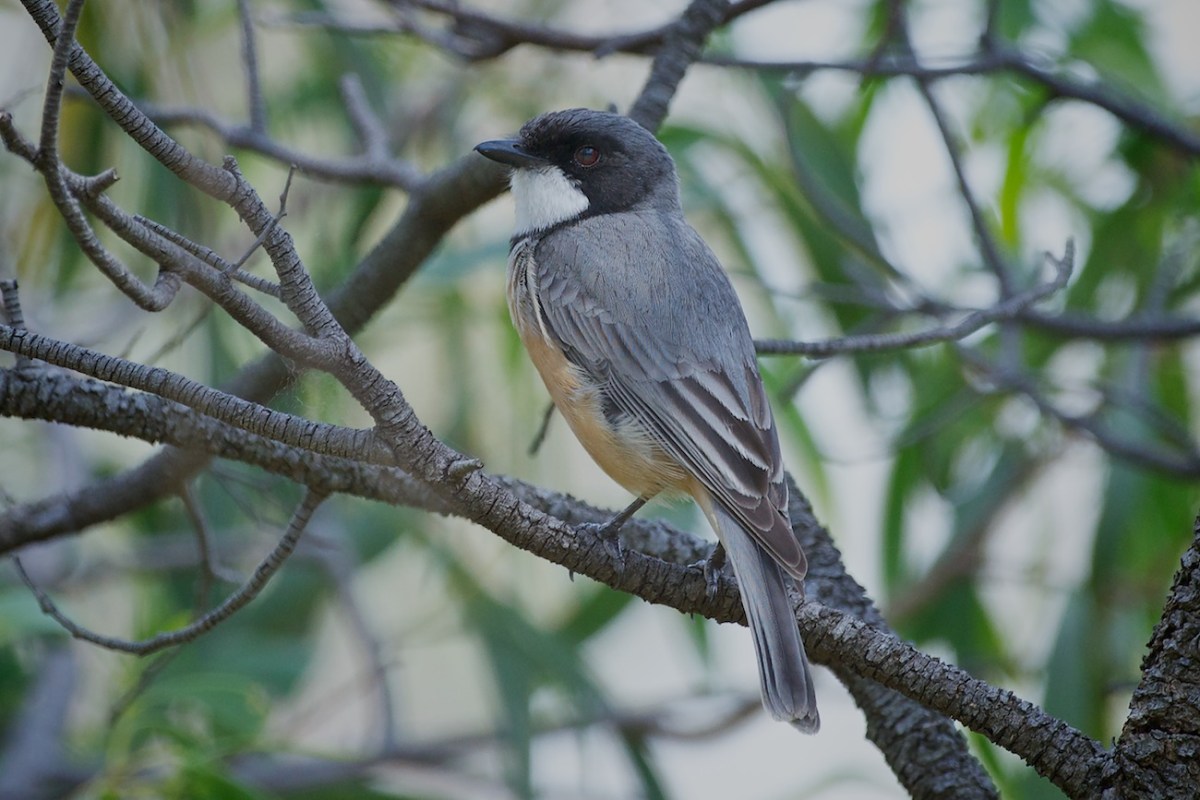
This dapper looking chap is a male Rufous Whistler.
There are quite a number of pairs of birds in the Woodlands area this year. Their piercing cry reverberates all around the park. Most times they are quite furtive, but this fellow let me follow him about until he got into an open area so the light was fine and I could get a clear shot.









 Birds as Poetry —— Just because I WANDER doesn't mean I'm LOST