On a very hot February evening we headed on down to the Western Treatment Plant. Because of other commitments, it was now or not until a few weeks time.
The day was hot, the birds were hot, and scarce and who could blame them.
Found this Black-shouldered Kite on a limb near the boat ramp and moved the car into a good position for a shot. Its wings were spread out from its body in an endeavour to keep cool. But it also attacted attention from the local Willie Wagtail harassment team.
As if it wasn’t hard enough now it had to endure constant bombardment from the wagtails. As a team they are pretty relentless, one distracting while another dives or pulls tail feathers or in this case lands on the back.
Not sure if it was the harassment, the heat or the closeness of the car, but in the end it moved off to the tree line along the road to sit in the shade with another kite that was smart enough to avoid the wagtails and sit in the shade.
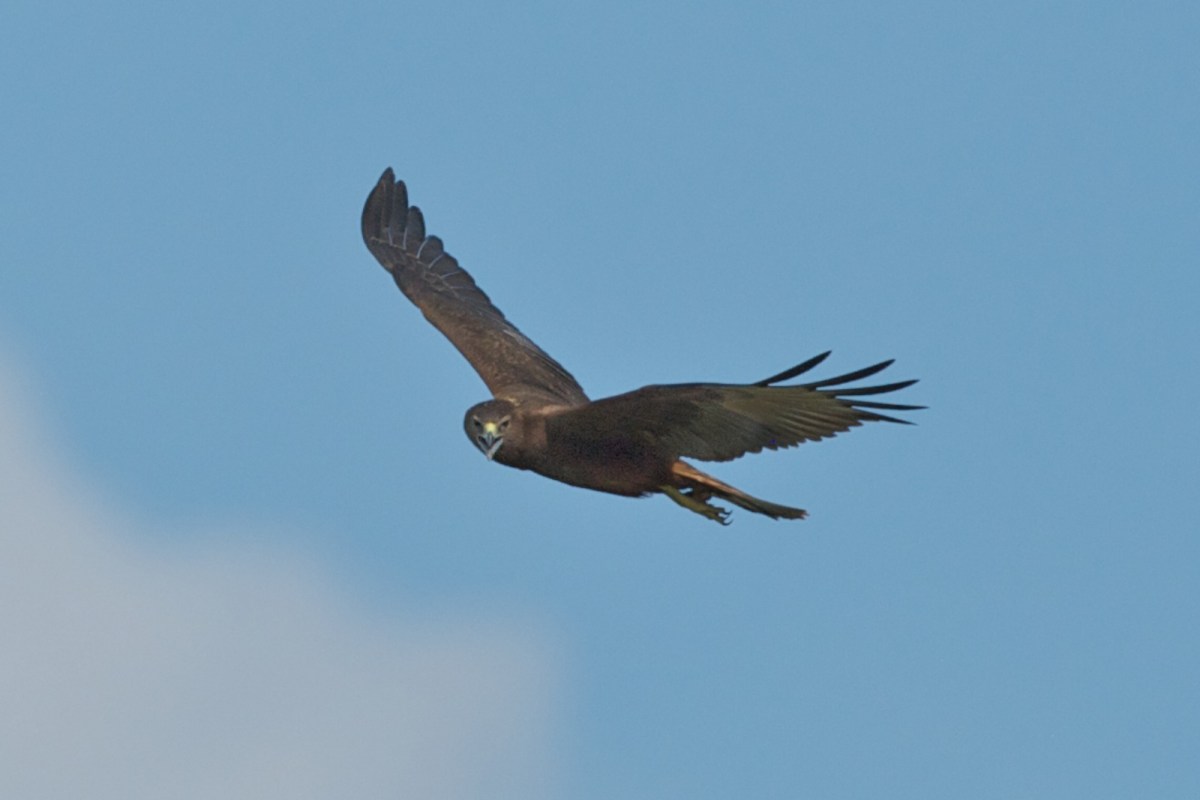
Also found a Swamp Harrier working along the river with its beak open scooping in air, and its tongue handing out.
A Black-shouldered Kite being harassed by a Willie Wagtail. This one had just landed on the back of the kite.Swamp Harrier flying down the Little River, with its beak wide open and its tongue out. Perhaps trying to keep cool
Had a pleasant morning in the forest today, plenty of sunshine and not too hot.
The Scarlet and his friend the Redcapped Robin are still in the forest. He is very active and covers such a lot of territory. She doesn’t have the same power, and is quite content to rest on a tree, preen and hunt. He comes back and flies circles around her, and occassionaly she will fly off with him. This morning he made a sweep across the paddock and called from about 500 metres away, but she chose not to follow, after about 5 minutes, he came back directly across the field and landed on a branch above her and there was a few “tick” calls, and he tried again. She looked like she was counting feathers. 6345 to clean and counting. He returned and they hunted on the ground for awhile.
I am not sure what will happen when they discover they are different types of birds.
Scarlet Robin at Woodlands, moulting into a dapper bird.
First time back at Woodlands since the long Goschen trip.
Within a few minutes I had heard a familiar chirrup of the Scarlet Robin and went to investigate. I saw it in the distance, and it continued to come closer landing in a tree across the track from where I was. It is a male for sure. Has a lovely black head, really strong red colour, and that wonderful white spot above its beak.
It has grown quite bold as the week has gone by, and now patrols quite an extensive territory inside the Back Paddock fenced of area.
It does not seem to have a mate, but it is still in attendance with a female Recapped Robin. It is also moulting through and looks a bit of a sight at the moment. They sit together, hunt together and move about together, although it has to be said that the poor little redcaps wings whir quite bit trying to keep up with the speedy Scarlet. But they ‘tick’ call at one another.
Also saw today; three black swamp wallabies, so they have managed to get inside the fence in the new area. They seemed very relaxed. So that is good.
It’s a long drive to Goschen, but it has a great reputation among birders for being a bit of a honey-pot.
Our schedule meant we were going in early February, amongst the hottest times of the year and late in the breeding cycle, so we didn’t have much hope of being overwhelmed with birds.
But even though it was windy, hot and humid, with a little bit of patience we were rewarded with a number of interesting birds.
Bee-eaters, Yellow-plumed Honeyeaters, White-browed Scubwrens in abundance, Brown Falcon, Nankeen Kestrel, White-plumed Honeyeaters, and a bunch of the usual suspects. The Black Honeyeater was a dipper, so perhaps next time.
Heard lots of quail but didn’t see a single one. Also heard a Red-capped Robin but only a few bars of a song and searching led to another no show. Perhaps I just imagine them now?
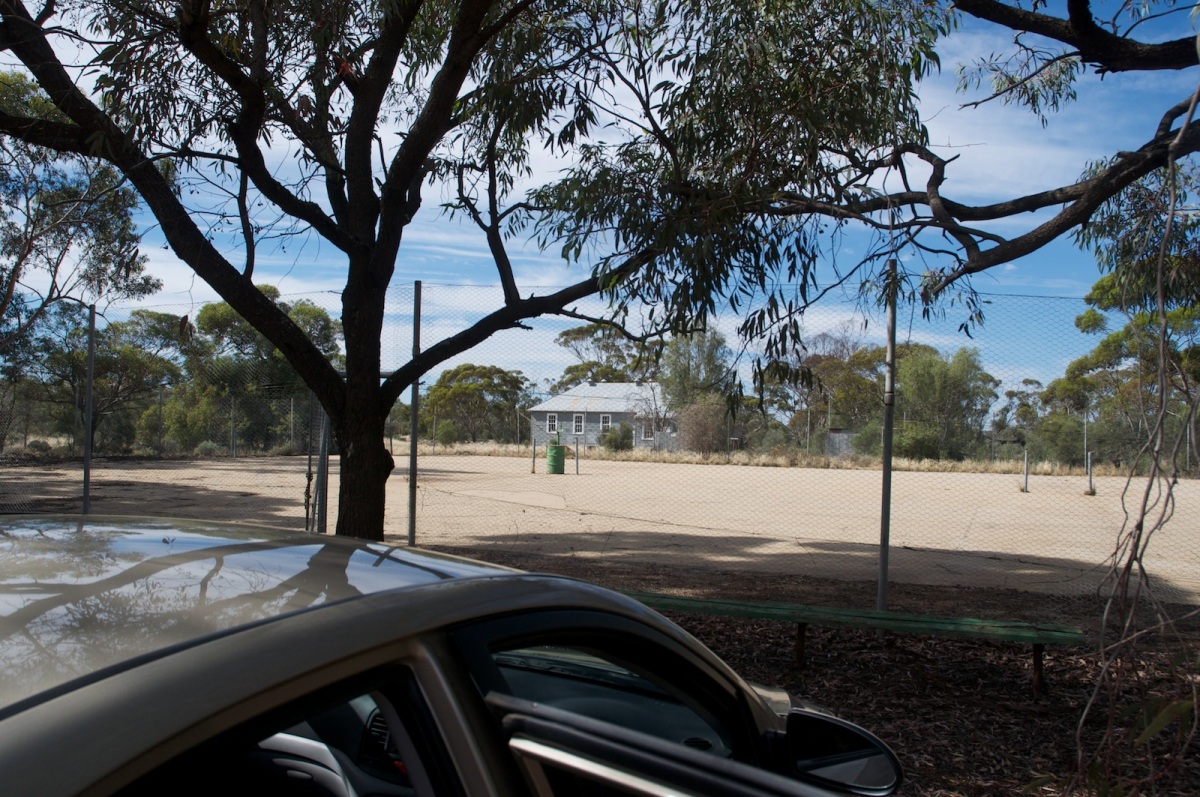
The Goschen hall held two live Welcome Swallows flitting about inside, and around the inside area and the old stage areas, over a dozen dead birds. Pretty recent, as they had not deteriorated. There didn’t seem to be any sign of damage to them. Lots of teacandles on the floor, but no patterns, so the coven weren’t there. Strange about the swallows though.
While we were driving about, we startled two very large Grey Kangaroos, who in turn startled us by their sheer size and their speed in going away. Needless to say by the time I had uttered some anglo-saxon expletives, the photo moment was gone. As were the ‘roos.
Here is a Singing Honeyeater. It seemed to interested in the ‘beeping’ noise from the car when the seatbelt warning was going.
I have been spending some time in the morning looking for the Scarlet Robin. I am pretty convinced that the calls are from at least two birds. But. I haven’t been able to find both birds to confirm.
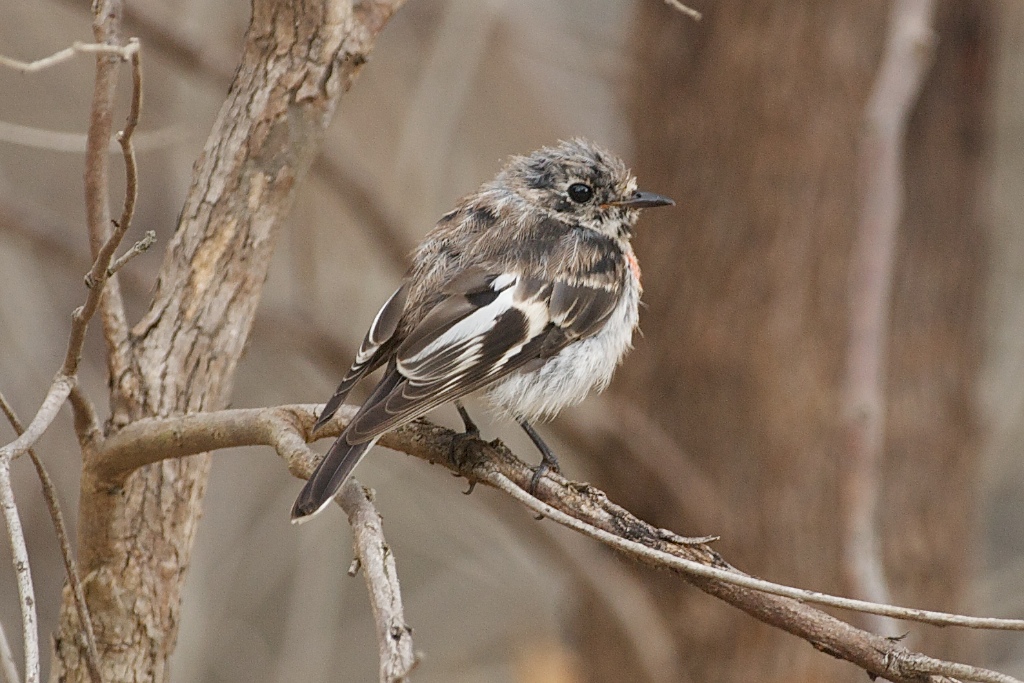
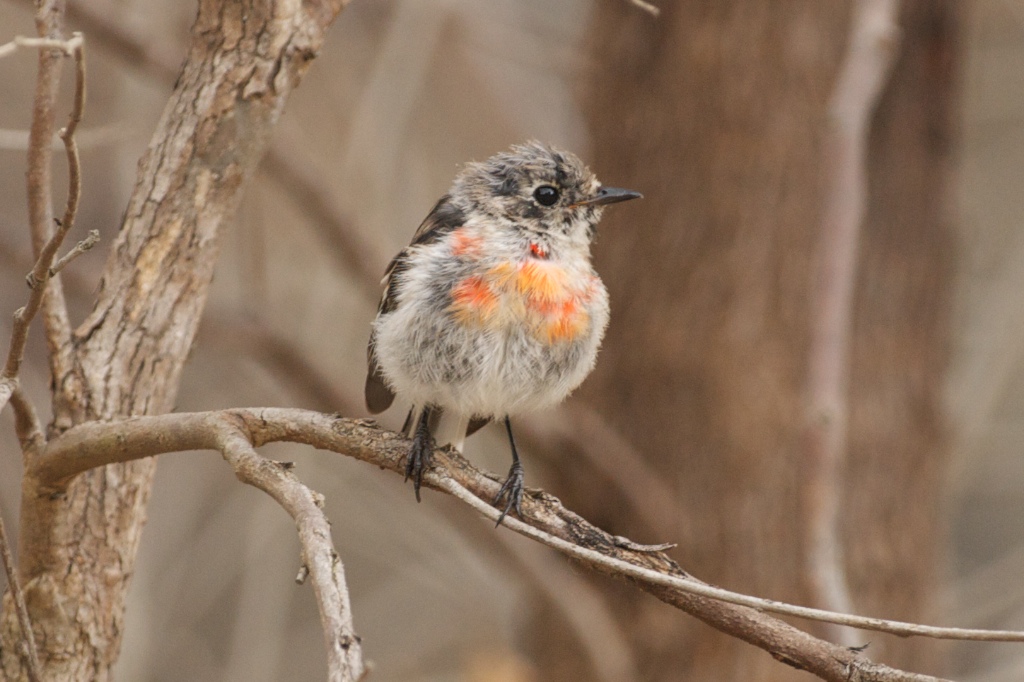
This bird seemed not to fussed this morning, and with a bit of sunlight to help things along I managed a few reasonable shots. But look at those black feathers, I am going to suggest it is a Male moulting through. A few more days and we will have a very dapper looking fellow I think. Now all I need to do is confirm that the female is there and it will be an interesting summer.
Scarlet Robin in moult. The really dark black feathers are making it most possible this is a male bird.
I am really beginning to like the light at the Treatment plant in the late afternoon. Sun sets way round to the south west and it gives a great cross light along many of the access roads. Particularly where there is a line of trees.
For some reason this evening, the raptors seemed to be at every turn and on just about every tree, post, or fence. Here is a youngish brown falcon, but click the link, for some Spotted Harrier, Brown Falcon, Swamp Harrier and Whistling Kite shots as well.
Many of the young falcons seem to be hanging around together, and we found 5 in just one corner on Paradise road.
We both are pretty certain that a Black Falcon was in a clearing down along 29 Mile Road past the access gate 1. But by the time we had: 1. Noticed it, 2. Stopped the car, 3. got over the oohs and aahs, and then 4. Got serious, it was but a mere black spec in the sky speeding toward Avalon.
Went back to check on the Scarlet Robin, and was pleasantly surprised to hear her early morning call in the forest. Despite a lot of looking, I was not able to locate her, as she was moving about in among the denser grey box undergrowth.
I continued on to an area I have reported on ealier, where a Redcapped Robin male went to a lot of trouble to convince me there were not nests up in that area. See here
After locating a small flock of Yellow-rumped Thornbills, I was settling to to photograph them when off to my left a Redcapped Robin male, turned up. And in a few moments a very young juvenile. All lovely striated waiting to be fed.
It didn’t take the male to long to fulfil that request, and then the young bird was left in a dead, fallen wattle, and the male disappeared. The young one amused itself taking food off the ground and generally exploring the branches. After about 10 minutes the male returned and offered up a nice looking orange coloured bug. Then they both flew over my head, and away. I scouted round for a few minutes and then found a second juvenile, this one seemed to be a bit more advanced. The male turned up, shared some food, and then gave a call and the two juveniles followed him across a clearing. And so did I. There was another old wattle there and again he left them and disappeared, coming back occasionally with food.
He seemed to have a scheme on feeding as the first young on the scene did not get the goodies, but he seemed quite particular about which one should be fed.
Then with another call they followed him to the next tree, and a third young one joined them! So they have had a very successful time. Now he was as busy as a one-armed paper-hanger as he tried to keep them together, find food and move them about the clearing. No sign of the female. Perhaps she was off shopping? Or perhaps she has taken the challenge of another clutch. Time will tell.
This morning while we were out looking for the elusive, but very vocal Scarlet Robin, we were entertained by a pair of Little Eagles in the air. It would be nice to think that they were at play, but it seemed a very dangerous game they were engrossed in.
The pair are a light morph and a dark morph. Each seemed to be about as aggressive. It just depended on who got the height. There was lots of crossing one another’s paths, plenty of frontal attacks and several passes with long claws extended. This shot is about half way through the confrontation and shows the darker bird on its back talons extending up.
It might be courtship, or the two young at play, or perhaps a younger bird being chased away. In the end the lighter one took a thermal to a height and then speared away to the south. The darker bird circled a little longer, and then we lost it among the trees. However it did show up at the carpark later, but on its own.
Much to learn.
Two Little Eagles that are hard at work vying for best position for attack.
I have been looking for redcapped robins at Woodlands Park for the last few weeks, there is still a little activity, but they are quite furtive at the moment.
On a very overcast Friday, heard a familiar redcap “tic” and went to look. To my surprise I found not only a female Redcap, but a Female Scarlet Robin, in moult. Her distinctive call took me a few minutes to figure out, as I would not expect them for another 6-8 weeks at the earliest. So It was great to see this one bird. It stayed close to the recapped robin and they ‘tic-ed’ at one another to stay in contract.
What I am unsure of course, is it a visitor, or did it stay over in the park for summer, (I haven’t heard it previously), or is it a juvenile that is on the move to a territory. Things I guess I’ll never know.
The only pair that wintered over did have a juvenile with them initially in May last year, but I only saw it for a few weeks.
A subsequent trip out on Sunday, confirms it is still there, and as vocal as ever, so that is a good sign.
On a bit of a spur of the moment decision we decided on a trip to the WTP.
We left a little later in the afternoon and the cloudy old morning gave way to lovely filtered sunlight and it was one of those times when it is a joy to be a photographer.
We made a quick detour down through 29 Mile Road and Avalon airfield and were impressed to find a Whistling Kite making its way along the tree lined fences.
We went back up to the 15 W roadside, and after a little bit of hunting about, found not one but two Spotted Harriers in the late evening sunshine.
One took off to harrass the Australian Shelduck populations, the other continued to hunt in the nearby paddocks.
A number of Ravens took exception to this and harassed it mercilessly. Then all of a sudden, it turned what can only be described as a cartwheel, long legs swinging out to pendulum around and attack the ravens. Now we have used the word “languid” to describe its usual flight, but this was far from that and would best be described as “Rapid”. In moments it closed the gap to the ravens, who, clever creatures that they are, sensed a change of fortune and with tail between legs headed for the nearest shelter. A casuarina just across the road. They all arrived just about the time the harrier did, and it made a near vertical ascent to the top of the tree,and hovered in the breeze for a minute or two before wheeling about, and using the breeze, landed on a fence post just opposite the casuarina. If the distance had been a little further, no doubt the Harrier would have caught up with them. No noise from the ravens It preened for a few minutes and the took off to resume its hunt. The ravens slipped quietly out the other side of the tree and went off to find other things to do.
Had we been a few minutes earlier we might have placed ourselves with the light behind us rather than having to shoot into the light, but the spectacle was worth it anyway.
In a few minutes a prey was located and there was merry dance around the bushes and finally it settled in to eat.
After a bit of a preen this Harrier took to the evening air to continue its hunt
Over the past few months it has become one of my challenges to find where a pair of Little Eagles had nested this season. I had a rough idea, but heavy chain fences and hard to get to locations had pretty well extinguished any chances of finding the location. Over the past few weeks things have changed a bit as the young are now on the wing.
Lots of activity in the air today, and we spotted 4 birds. One was definitely an older bird with lighter colouring and a tail that looked in need of a few feathers. One other bird was a bit more elusive and could well have been a young bird or perhaps the other of the parent pair.
Two of them were young birds, lovely rich cinnamon and ginger colours. They are masters of the air already and in a good breeze, they manoeuvred over our location in fine style. The camera says that the closest I recorded was 35 metres, like it just passed overhead. One made a pass over some small dense scrub at the end of a dam, and went down to just over the scrub height. All hell broke loose as the various inhabitants including ducks, grebes, cormorants and a few assorted cuckoos, wagtails and the like took off in all directions with honks, squawks and chatter. It took a trip around the dam to gain height and had a second go, fluttering down like a leaf swaying from one side to the other just loosing height, but this time the wagtail contingent were ready and it got a right royal chattering and dive bombing from the squadron.
Mostly Pelicans get ignored. Big bird that they are, but after all, seen one, seen ’em all.
Or so I thought. Now, the question is if we have a ‘flock’ of sheep, and a ‘murder’ of crows, what collective noun do we use to describe a number of pelicans. Well search as I might, it is one of those things that no-one has ever gotten around to.
Till now. So I pondered pelicans sit on posts, so a Post of Pelicans? Or you find them near the beach, how about A Port of Pelicans? And so I’ve taken a step into the universe of naming things and chosen “Port” Sort of fits ah?
Which brings us to photographing them. Well, first, as Mrs Beeton would say, “Find your Pelican”, and Western Treatment Plant has more than its fair share of the great lumbering feathered comedians.
Here is one image, but hit the link, you need to see a Port to get a view of their antics.
They may be ungainly on land, but given just the slightest of breezes, these big behemoths of the air make it all look too easy. A wing twist and a turn, drop the legs and water ski to a stop. If its done right, end up on dry land with out getting a feather wet. And all with that big long beak hanging out the front.
Keep a low profile, we could be mistaken for magpies
I was woken this morning by a clap of thunder, and looking out – the sky could only be described as dark and gloomy. But, I had planned a trip to Woodlands, and I started to get the gear into the car and rain fell. Not that pitter patter raindrops of the songs, these were great big blobs, that went not gently on the car, but sounded like hail. And created great big pools where they landed. “Might put the rain jacket in,” I thought.
As I drove toward the park, it started to rain, not drizzle or occasional shower, but serious-soak the ground-rain. And it didn’t look like it would let up anytime soon. By the time I got to the last roundabout near the park the road was awash. But I pushed on.
At the park it wasn’t much better and the idea of sitting in the car was the go. Twenty minutes or so and it let up, and the sky just looked leaden. No point in coming all this way and not at least having a look.
The park along the road is very quiet at the moment, hardly any bird activity, and I wanted to go down through the fenced off “Back Paddcok” to have a look a kilometre or so in as last year many of the fledged robins ended up down there for awhile.
By the time I got into the area, the rain was over, the sky even looked like it might clear up, and so I found a spot near a likely feeding area and waited.
A few freshly fledged Willie wagtails kept me company and amused with their chasing games antics. A flock of Yellow-rumped Thornbills fed their way through and a large group of Weebills all chattering away. And about then the sun emerged and so did all the young Superb Fairy Wrens, so they have had a good year, I stopped counting after about 10, and mostly because I had lost track of who was who.
Then to my complete surprise and delight, a whirr of feathers and a juvenile Redcapped Robin landed on the branch about 5 metres away. All in is lovely striated white, brown and grey. It was completely unconcerned by my presence or the shutter going crazy. And then the sun came out.
It also had a friend, and they preened and fed and did bird things on the bush for about 10 minutes and then it was all over. The news from all this of course is that all the hard work of the past few months has paid off for the robins and mum and dad can take a well earned rest knowing they have done their bit for the species.
Rather glad the weather improved.
Juvenile Redcapped Robin
D200, 500m F/4, ISO400, F/4.5, 1/250, WB Auto
And a very busy little Fairy Wren. I think it wanted to show off its catch more than anything else.
Out in the forest this morning and came across a mixed flock of wagtails, thornbills and a number of redcapped robins.
First time I have been able to locate them all together since the nesting season. Two males were particularly interesting as one smaller one, seemed to want to try its luck on the larger (older) bird. Where they were was sort of at what I think is the border of two territories. And while it is hard to tell who is who, I suspect that the larger bird is the male of the territory. He was in the company of the only female present a bit earlier.
There is an excellent series of article on the net. Papers by Damien K. Dowling, of Melbourne University. And in the paper “Breeding biology of the red-capped robin”, AJZ 2003,51,533-549 he describes the behaviour of males in territorial conflict. His work was done around Mt Terrick Terrick Park, and is a great read on details of nesting and behaviour and success rates.
Today’s males preformed lots of dancing back and forward on a branch, it looks a bit like it is choreographed, and they seem to know their parts well. In the end, one did the fly away, by slow retreat and in the eventually I lost sight of it completely. Hopefully it will find a reasonable amount of space in the forest, and at least one new territory will be established.
The pair in the area seem to have finalised this year’s breed. Both birds are beginning to look worse for wear feather wise and the moulting probably is only a month to six weeks or so away.
Red-capped Robin males in territorial discussion. Dominate male in rear.Male Red-capped Robin territory dispute resolution







 Birds as Poetry —— Just because I WANDER doesn't mean I'm LOST