Saturday Evening Post #74 :A New World

“A Solitary Crow
In Winter snow
Needs no jewels”
Deng Ming-Dao

As a young lad, I watched, “Disaster Movies”, or read books that one way or another predicted, or pretended the “End of the World”, the lone hero/ine stranded, alone.  “War of the Worlds”, “The Day of the Triffids, “Panic”, “On the Beach”.
But never dreaming that perhaps one day, I would, with those around me, live in times of significant social, community and national change. On a scale that is impossible to grasp.

When I was a little lad, Neville Shute’s novel, “On the Beach” carried on its dust jacket a quote from
“The Hollow Men” by T.S. Eliot.

In this last of meeting places
We grope together
And avoid speech
Gathered on this beach of the tumid river
This is the way the world ends
Not with a bang but a whimper.

It would be many years later, that I would be able to appreciate the depth of Eliot’s work.
As a country lad, our family would travel to Melbourne over the summer school holidays, and as best my young memory can recall is that somewhere or other in Frankston, or thereabouts part of the movie was filmed.  It was the talk of the dining table of our extended family at the time.  We used to swim at Frankston Beach, and explore along the cliffs toward Mount Martha.
And if I’m not stretching the memory too far, the making of the movie would have featured on the then fledgling tv news.
So much so that I recall our collection of kids, played at “Making Movies” that summer.
The female lead, Ava Gardener is  purported to have described Melbourne as “the perfect place to make a film about the end of the world.” However it seems it was an enthusiastic Sydney copywriter who made up the quote.

It’s hard then as we face, “Self-Isolation”, “Social Distancing”, our personal hell of “4 metre square”, and the impossible task of finding Toilet Paper to grasp the huge changes thrust upon us. Perhaps not the end of the world, but I hope we all manage to come out the other side, safe, secure and with minimal loss.

Which brings me back to the Crow in the Snow.

Meng writes ,”A single crow standing unconcerned in the falling snow is the very image of independence. It needs, no clothing, no wealth, nor status.”

Readers will know I have quite the affinity for White-winged Choughs.  Not the independent bird of Meng’s meditation, but rather a community dependent bird. Their feeding as a group, their closeness with their young birds, the difficulties they face keeping their young together, and not losing to the family in the next territory, and their patient purposeful feeding always bring a smile to my face whenever I get to enjoy an encounter.

This bird, I’d guess to be a female, it and half a dozen or so of its  family were working along the downed logs foraging, but not eating.  Then when it seemed all had full beaks, they turned and all flew off.
“They have a nest somewhere and are feeding young”, EE observed.  And no doubt she was right.  We might on other occasions taken the time to follow them and see, but other duties called, and we left with their calls ringing through the Grey Box Forest.

Remain


Moments: In a Class of their Own

EE and I had a week away around the Bellarine Peninsula.
We had several bird species in mind, and to get the ball rolling, Australian Gannets, were the first order of the series.
Queenscliff is the closest town to “Popes Eye”, a man-made structure, that was designed to be a gun emplacement to protect the Queenscliff fort area.  As it turned out we ran out of enemies before the emplacement was complete, and it languished as a small bluestone reef.
However the Gannets that inhabit Port Philip Bay used it as a rookery, or is that a Gannetry, and the birds patrol up and down the coast from their home.

You can actually watch them on-line at Reef Cam, on this link

For us, working the shoreline, things such as the weather, wind, tides and fish all work for, or against, and in the few hours we had in the rain, it was, well, against.
Score, John Wayne 0 Gannets 1.

Queenscliff was a very important tourist destination in the late  19th century, and to help set the olde worlde them the parks and foreshores were planted with exta-ordinary  stands of pine and cypress.

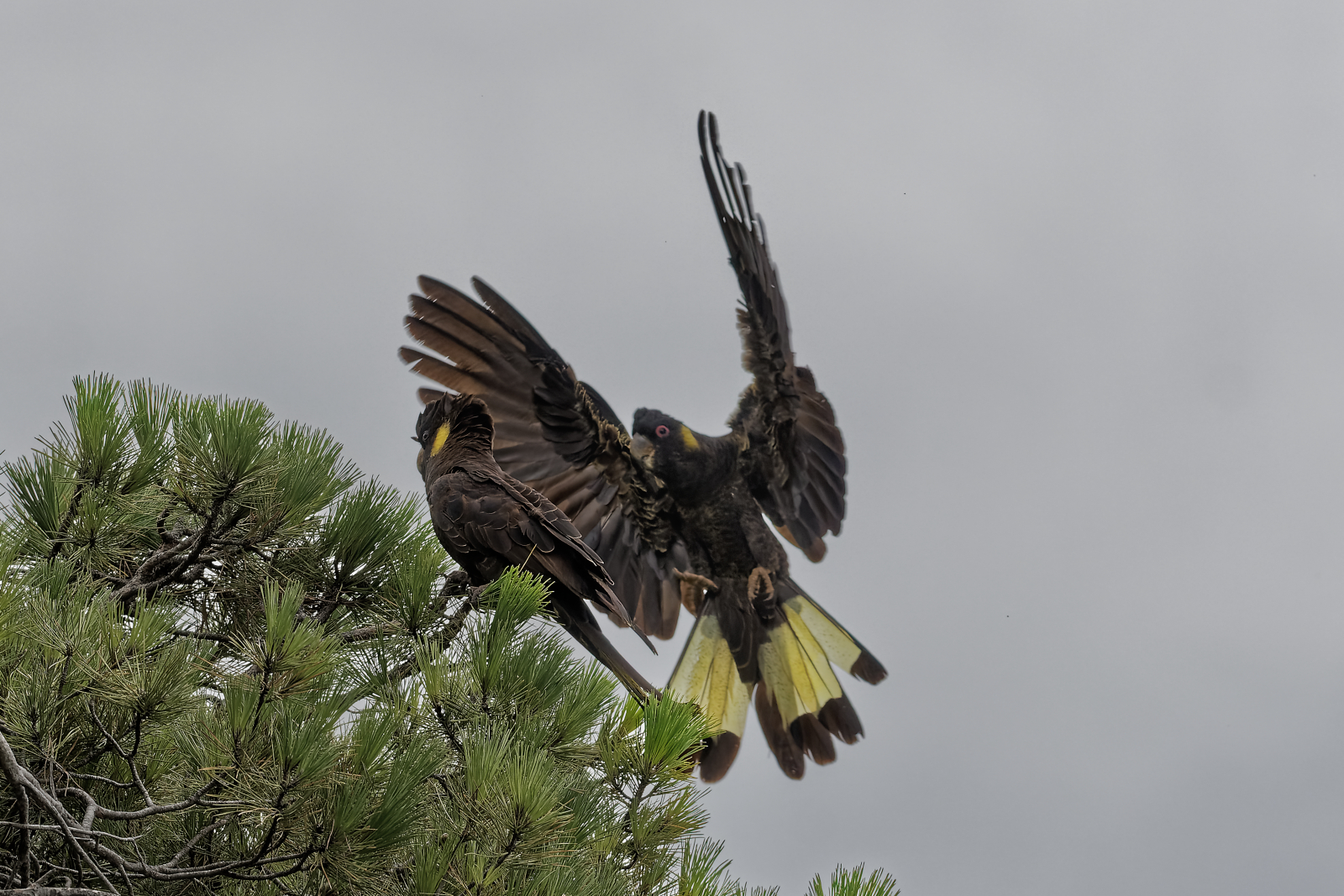
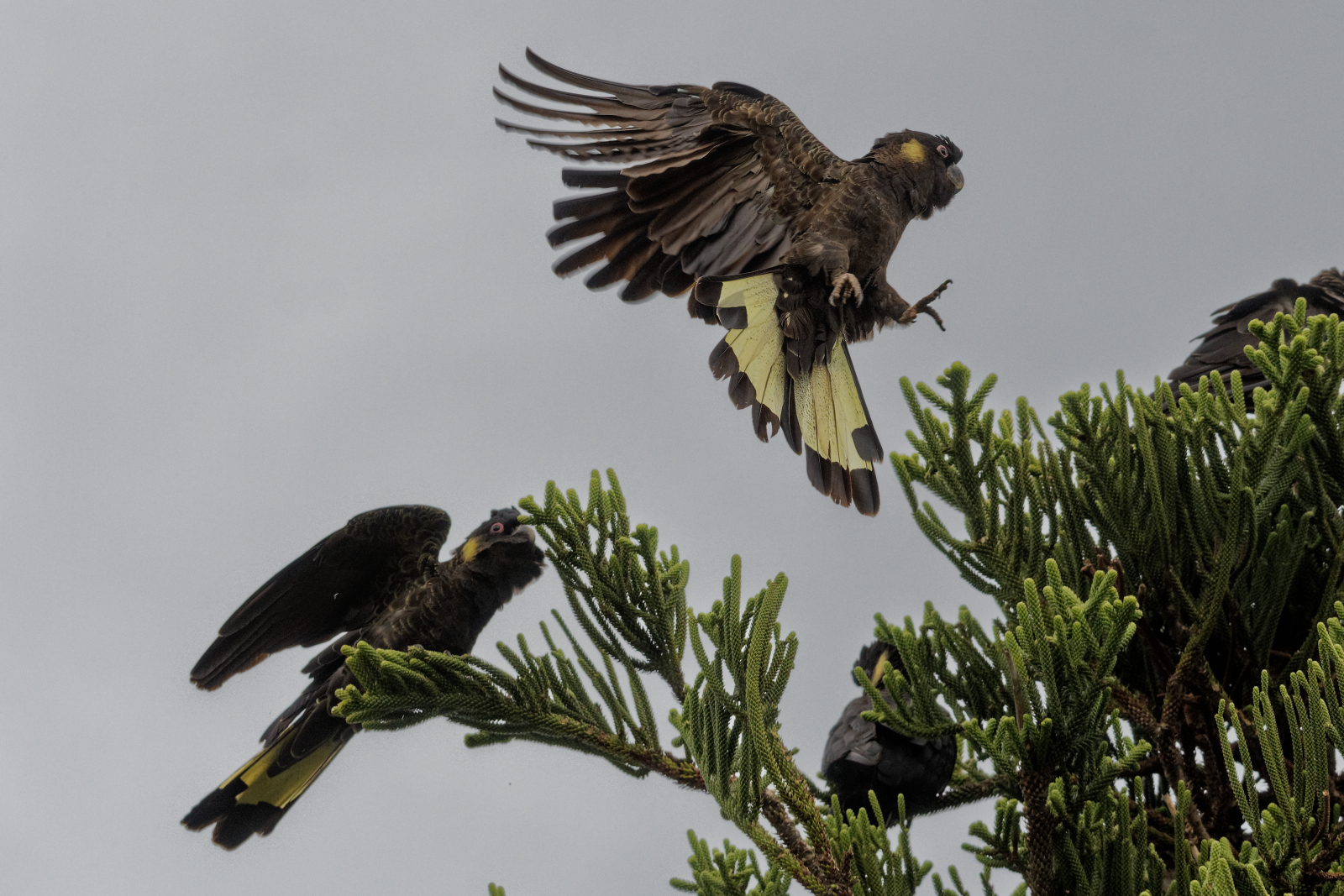
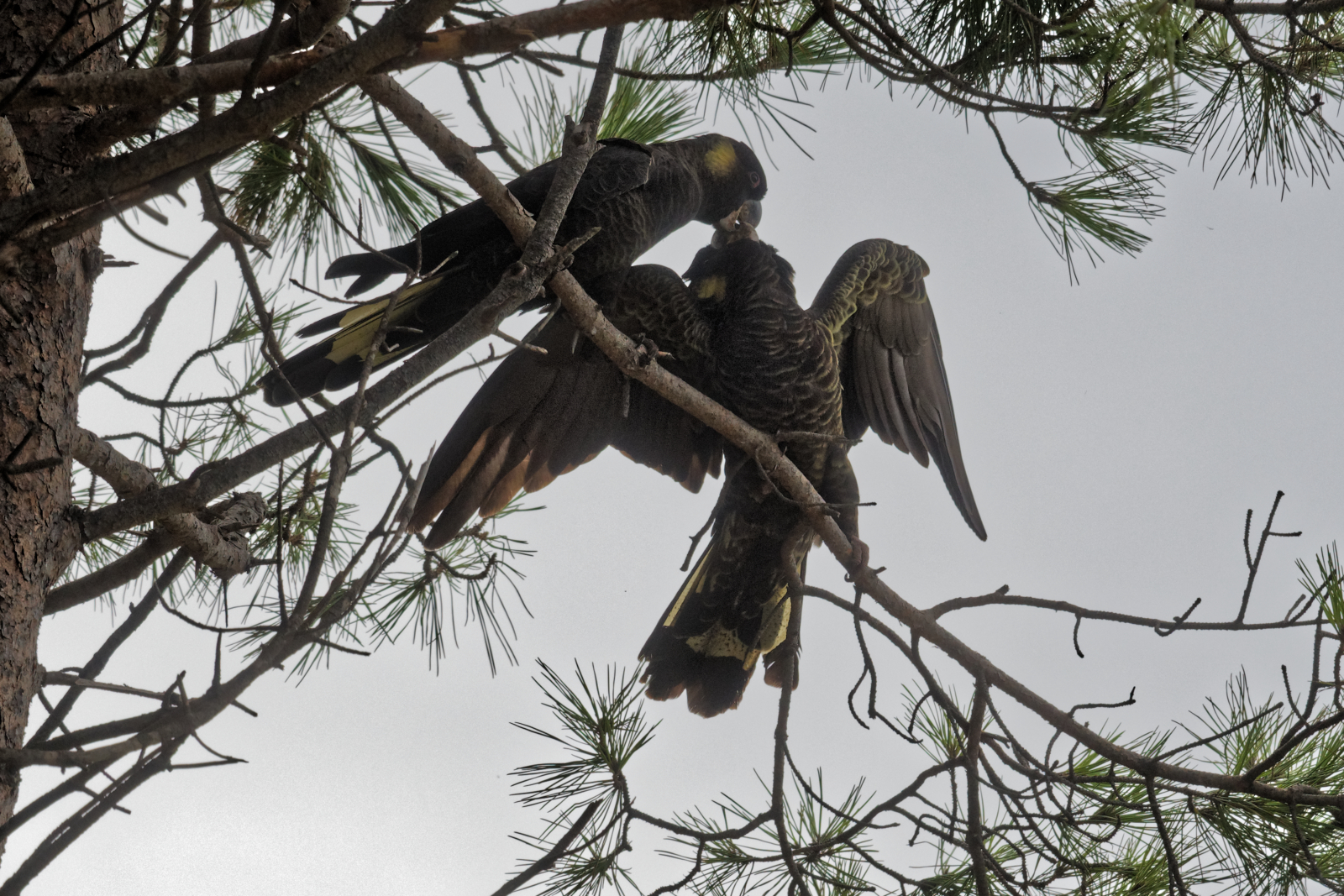
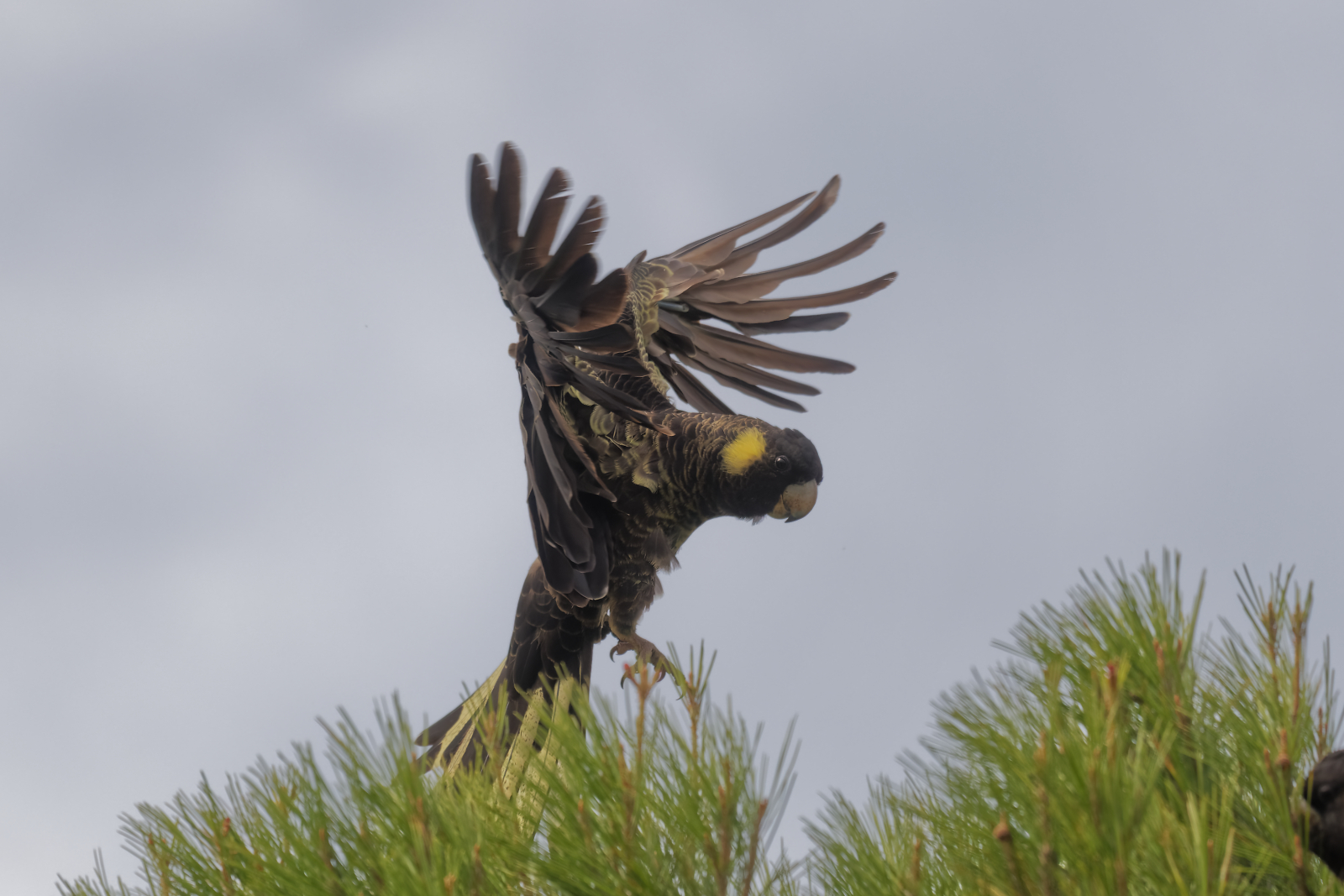
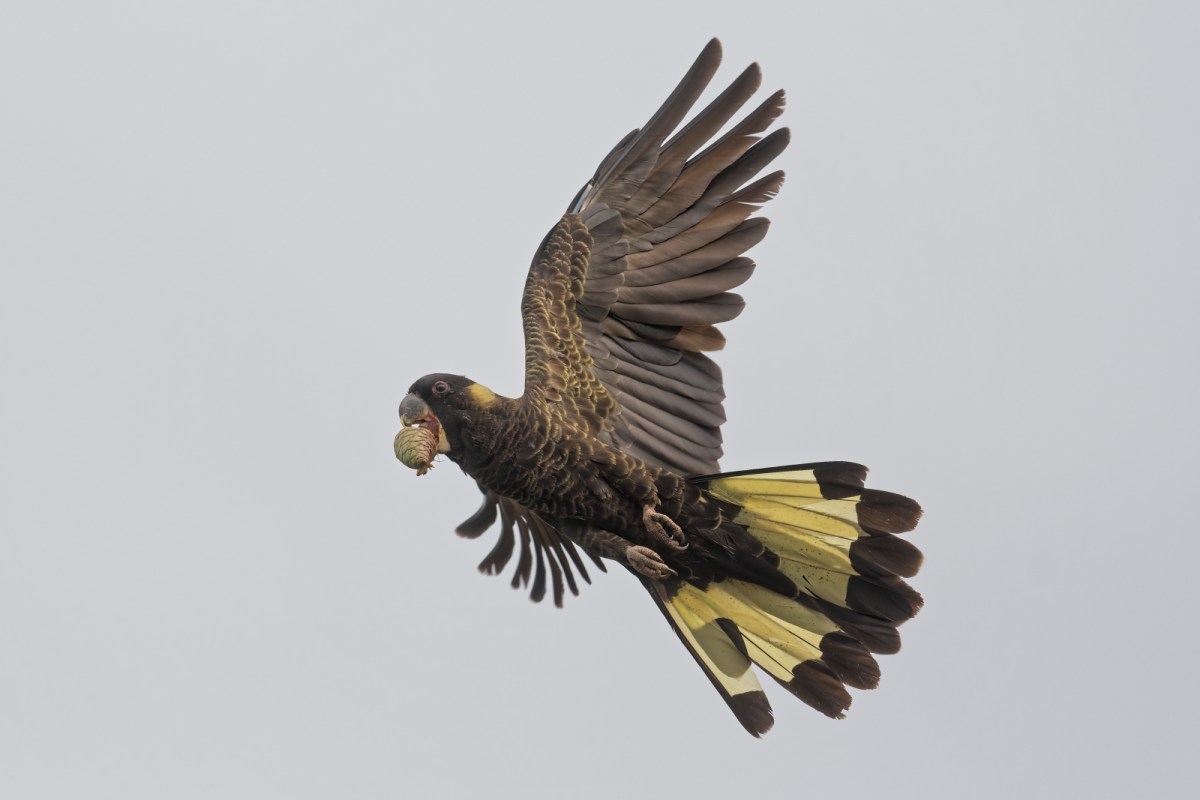
In the early part of the year these all produce loads of pine-cones, all rich, green and fresh.  A regular takeaway for Yellow-tailed Black Cockatoos.
With their highly distinctive call, and family disposition, they can be followed around town as they help themselves to the best of the ‘cones.

Again we managed an overcast day, and had difficulty really getting the rich colours, but we were able to keep the contrast a little under control, so wins all round.
John Wayne 20, Yellow-tailed Black Cockatoo, 50+

Our third target was the Latham’s Snipe at Lake Lorne, so next week, I’ll  explore that area.

Enjoy

Hello Cocky!
Incoming

Feeding Young. Like all cockatoos and parrots this is accomplished with a lot of noise and wing-flapping

2003-04_DWJ_25446_DxO
Takeaway Food

Saturday Evening Post #73: Riders of the Storm

Apologies to Jim Morrison-et al-, for changing “Riders on the Storm”.

EE and I were out and about along the local beach, with a storm offering just on the horizon.  The question of course, was how long?

We were enjoying the antics of a few beach birds, the usual suspects, Silver Gulls, a couple of loafing Pacific Gulls, and some noisy hungry young Greater Crested Terns.

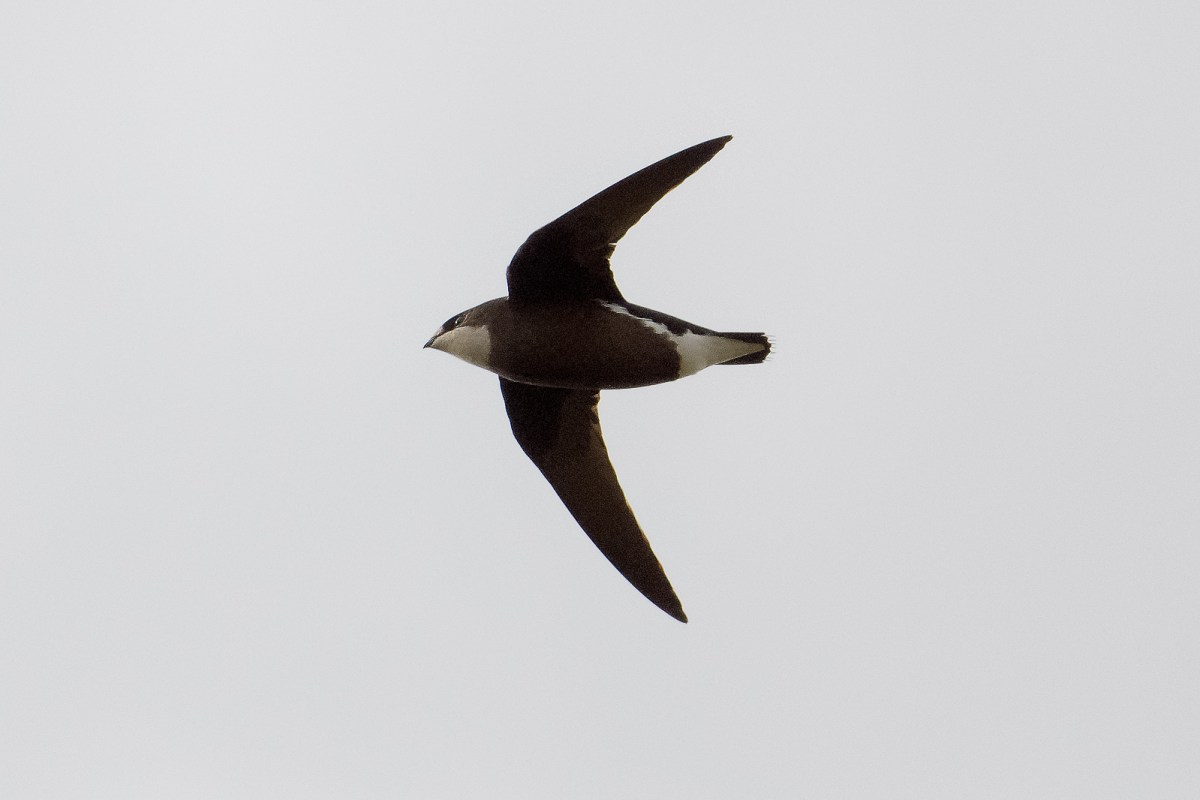
Suddenly, as in literally out of nowhere, a flock of fast moving birds, swallow-like appeared, and I have to say that was my first reaction, and I looked back at the terns. Then the first of the flock approached, must too bulky for swallows, and those long narrow knife-like wings took me back to my youth, and I called, “Swifts”, because in those days, that is what we called them.

There was little light, but still, it was an opportunity.

These days they are called ‘White-throated Needletails”. And as they sped past, the white throat and inner tail marks were obvious. First it was only one or two, but they kept coming and in the end, boyscout count, there was around 40-50 fly by. Just that  little too high up for detail, and they didn’t make any variation in their travel line.

As kids on the open Mallee plains, we would often see them flitting about ahead of an impending weather event.  A fancy name for wind, rain, and thunder.  The air could be electric.
So it was no surprise they had been riding on the edge of the incoming squall.

On checking my Morecombe Fieldguide, they are described as:

Largest swift in Australia, … one of the fastest of all birds, …often gathers over headlands in humid unsettled weather preceding thunderstorms.

That sounds about right to me.  Simpson and Day add:

Wings swept back curved, anchor-like, tips pointed.

And by the time we had checked to see if there were any more, the first ones no doubt were approaching Footscray!

We took the hint and went back to the carpark, arriving just as the first few spots of rain came down, and the road was awash on the way out.

“Into this world we’re thrown…
An actor out on loan
 Riders on the storm.”

Enjoy


Little Visits: A Field Day

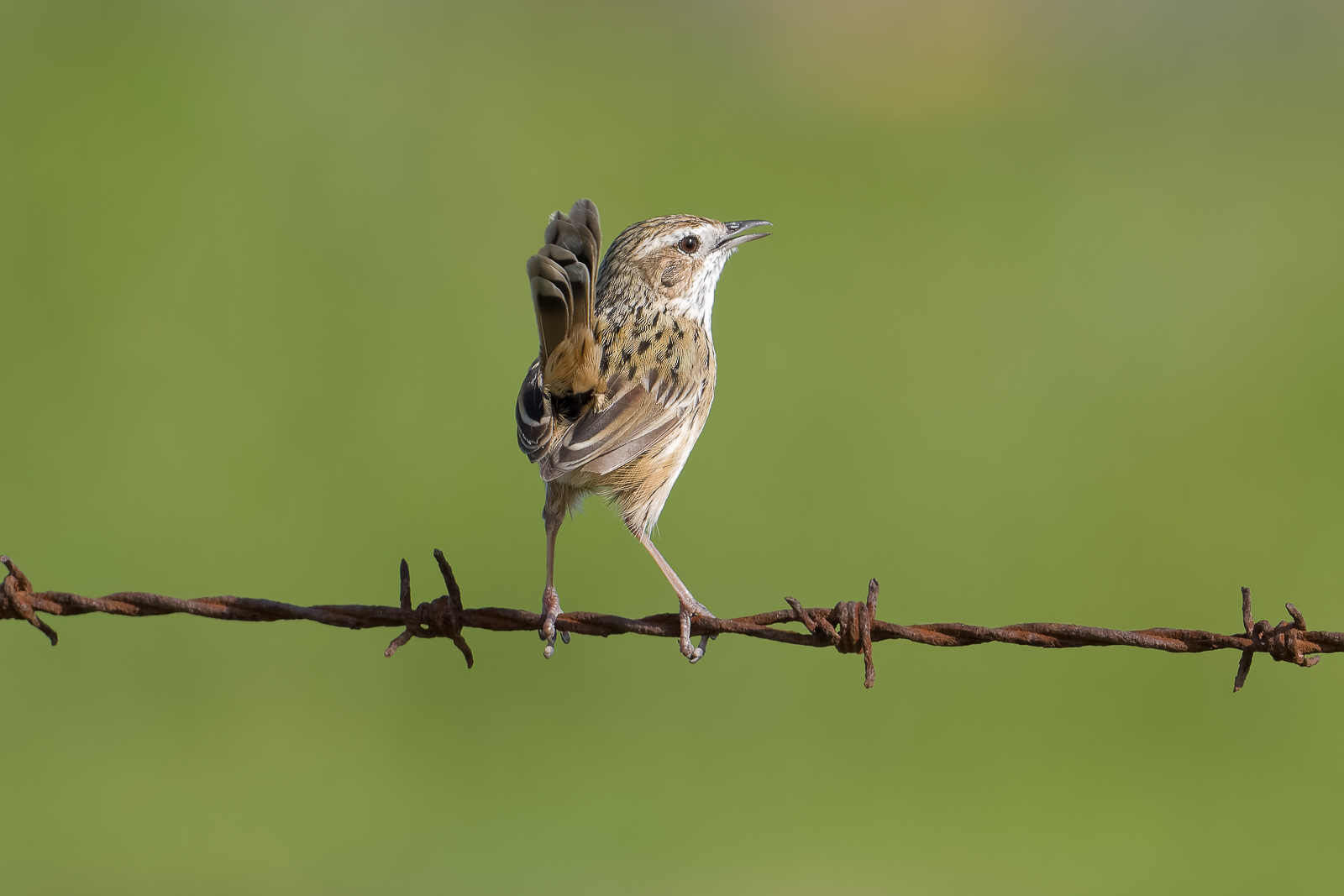
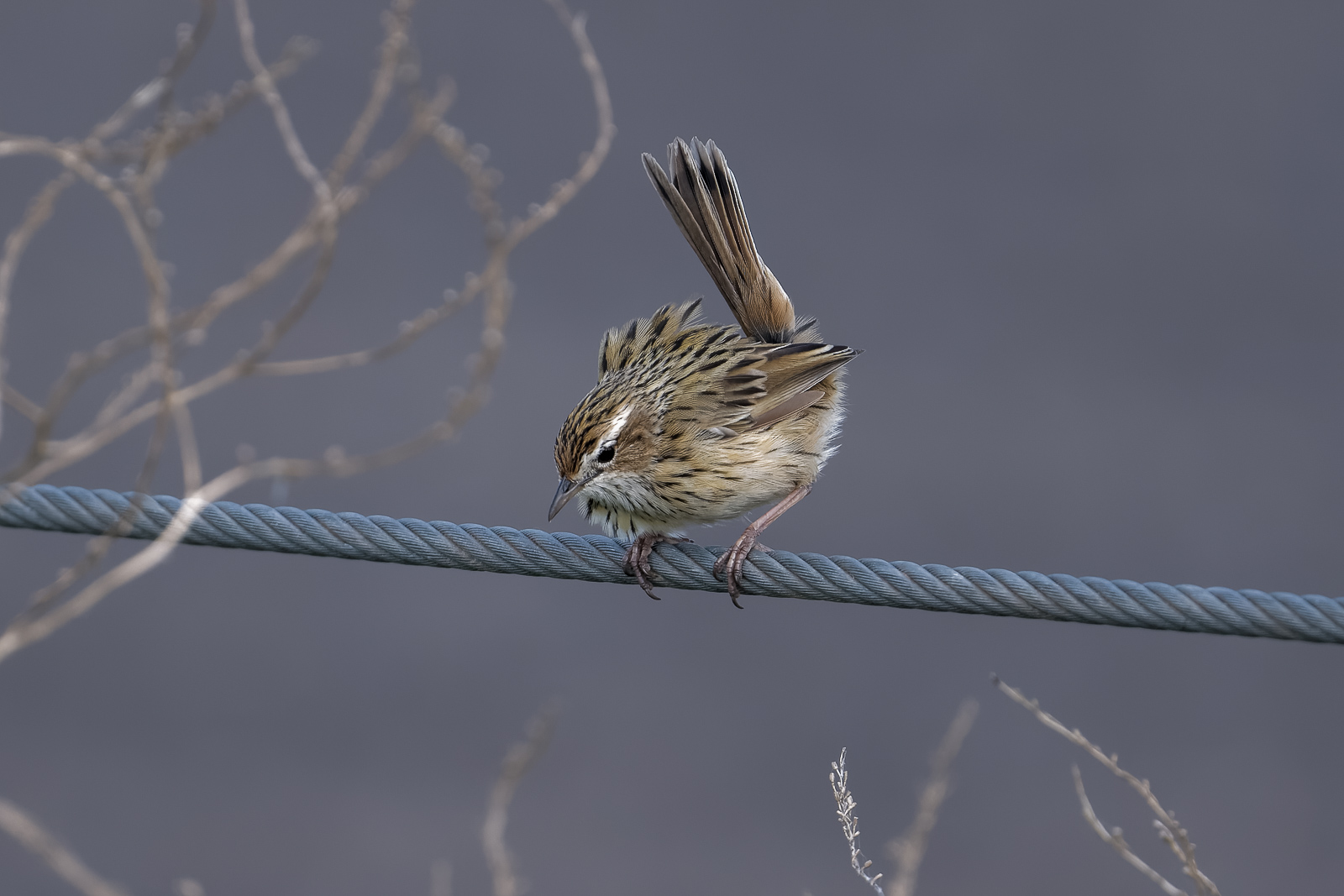
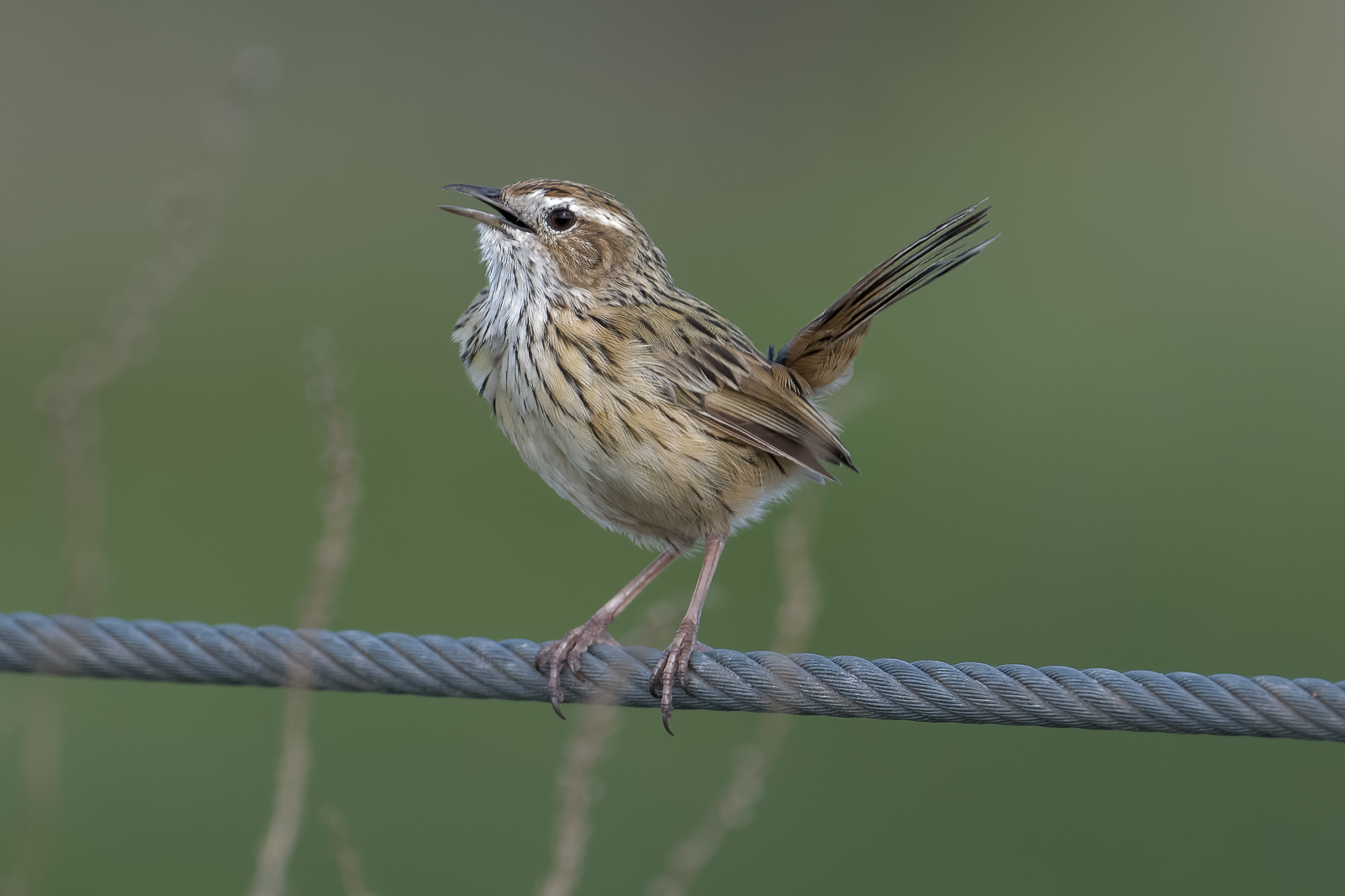
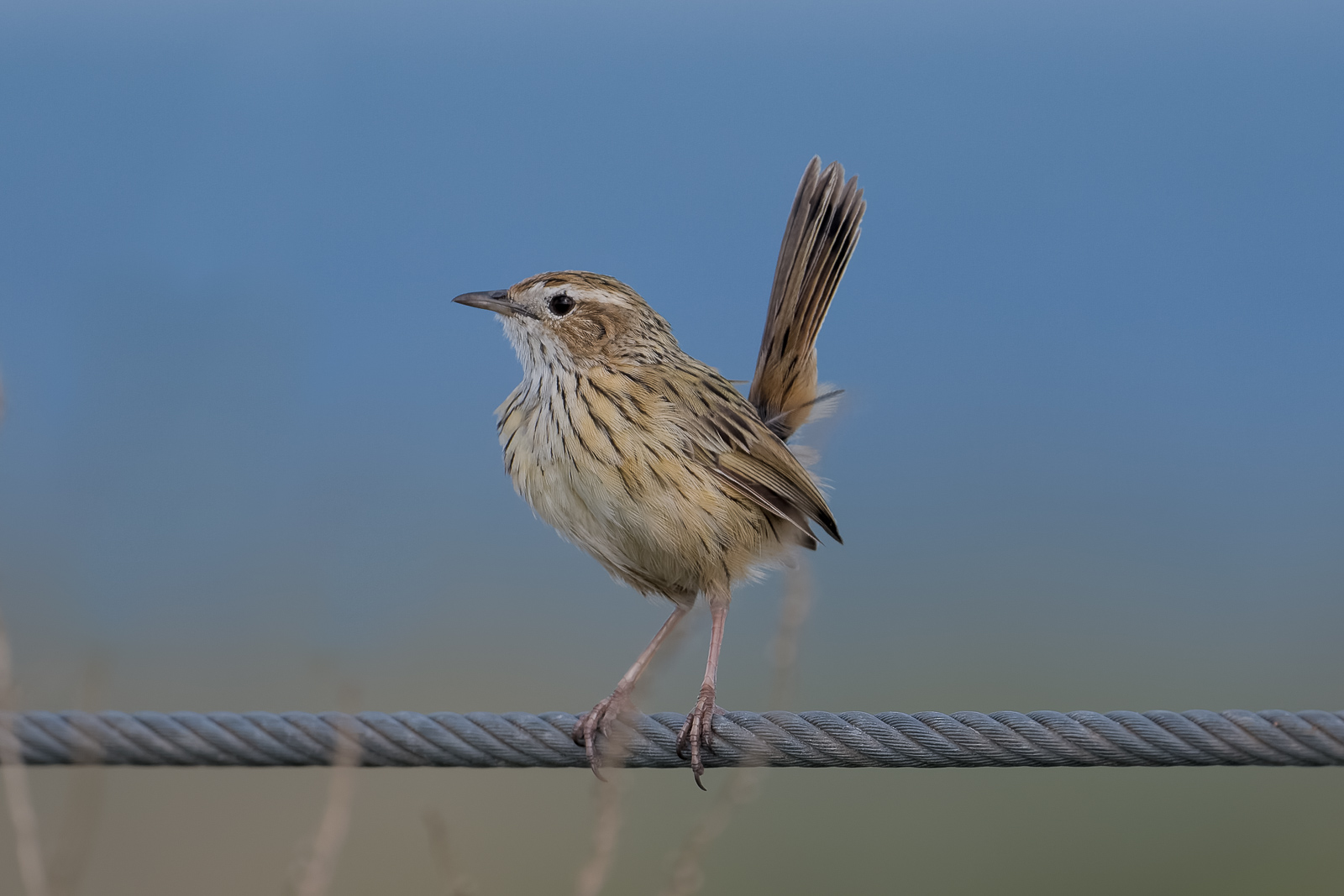
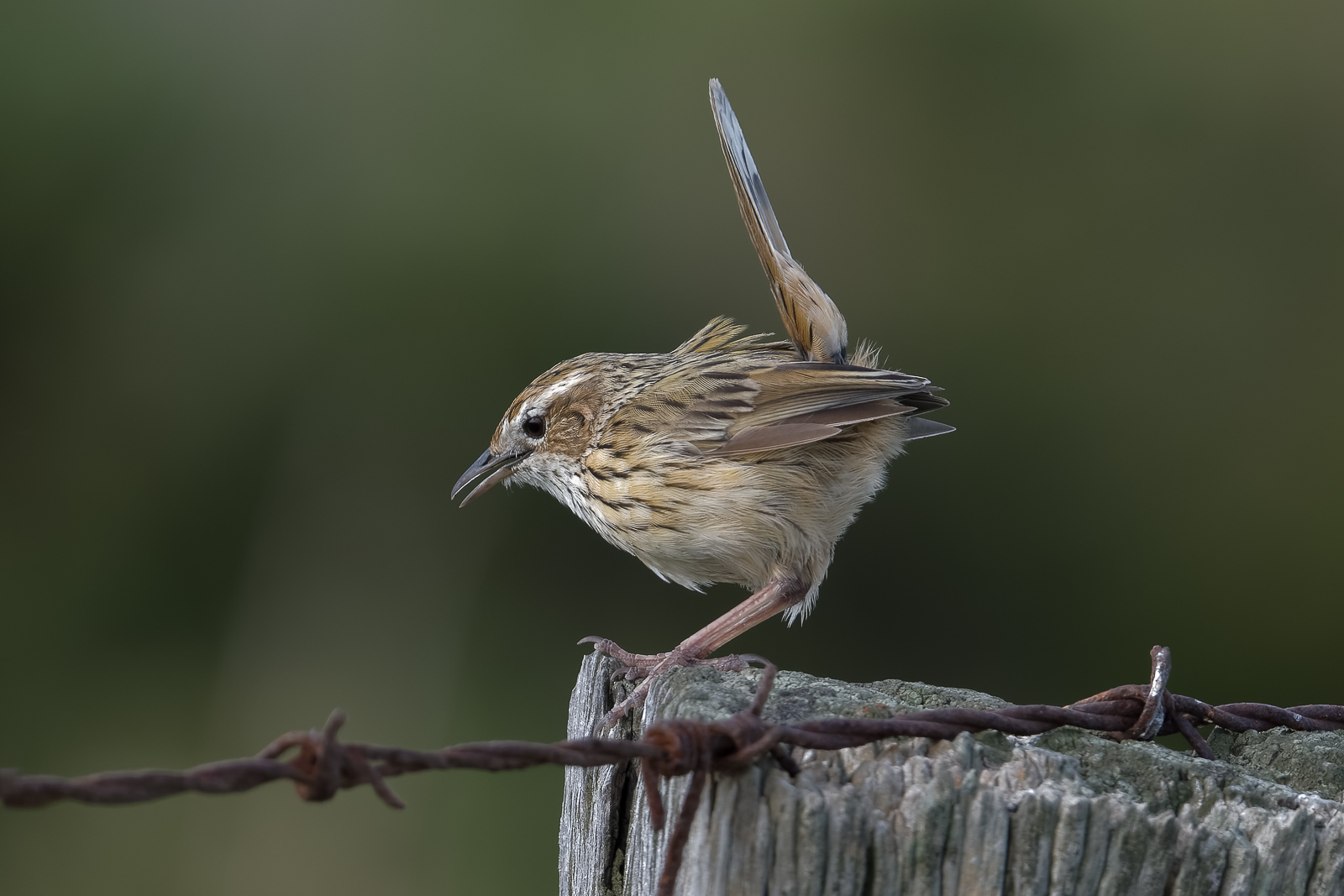
“Striated Fieldwrens”

When out and about at the Western Treatment Plant, often I’m asked, “What are you looking at/photographing”.
Which is an interesting question in an area of such a multiplicity of bird species.

Usually the question is only an introduction to a more meaningful question.  “Have you spotted something I should look at, or have you located my target bird for the day”.

Not always, but often times the question comes after one or two fourwheel drives have arrived at great speed, like the devil hisself was after them. Wind down window, “What have you seen…”

Or after having driven past where I was sitting several times, curiosity overcomes and the “What have you seen…” is often asked.
The second part of the question really is, “Have you seen the bittern, or pehaps the plentiful pec sandpipers, or maybe even the long-toed stint, or the black-winged bluetailed rock-eater.” As surely its been mentioned on spaceblock or elist, or someone’s text message.

So I generally respond, “Striated Fieldwrens”.  Oh, -quickly checks bird list, no don’t need one, Safari of vehicles disappears in proverbial cloud of dust.
Or, “Have you seen any?”, to which usually, truthfully, I can say, “Oh, not yet, but I’ve only been waiting thirty minutes so far”, Eyes glaze over, window winds up, dust indicates the vehicle has moved on.

Now to be fair, not every encounter is like that. Often good birding discussions take place and the cloud of departing dust is tolerable.

However on a fine sunny evening as we were negotiating some areas of said Treatment Plant, EE and I saw on a number of occasions, Straited Fieldwrens.  We saw more in one afternoon than in the past three years.
And they were all out, and about, and calling, and displaying. Easy to approach, great light, in the open. Photography doesn’t get any easier.
Enjoy. We did.

Against the Green
The backdrop is bitumen roadway
Tail display is the order of the day

I dropped down low enough to include the blue of the sky behind

My Territory. You’d better believe it.
This one preferred the more secure bushes.

Saturday Evening Post #72 :Joy

“Do your devotions make you happy?
Is your life a joyous song?”
Deng Ming-Dao

It’s an interesting thought for a creative photographer.  A simple fact really.  Do you enjoy it?

Does it make you happy? Sometimes, the pressures of conforming, the need to make images that meet certain standards, or the complexity of striving with a subject in the wrong light, the wrong place or the wrong time, means we struggle to make the photo with a feeling of joy.

Then for its own reasons, it can become a drudgery.

At other times, the light is right, the subject cooperative and a feeling of joy is replaced by celebration when you gaze at the LCD and there it is.  Just as you saw it.

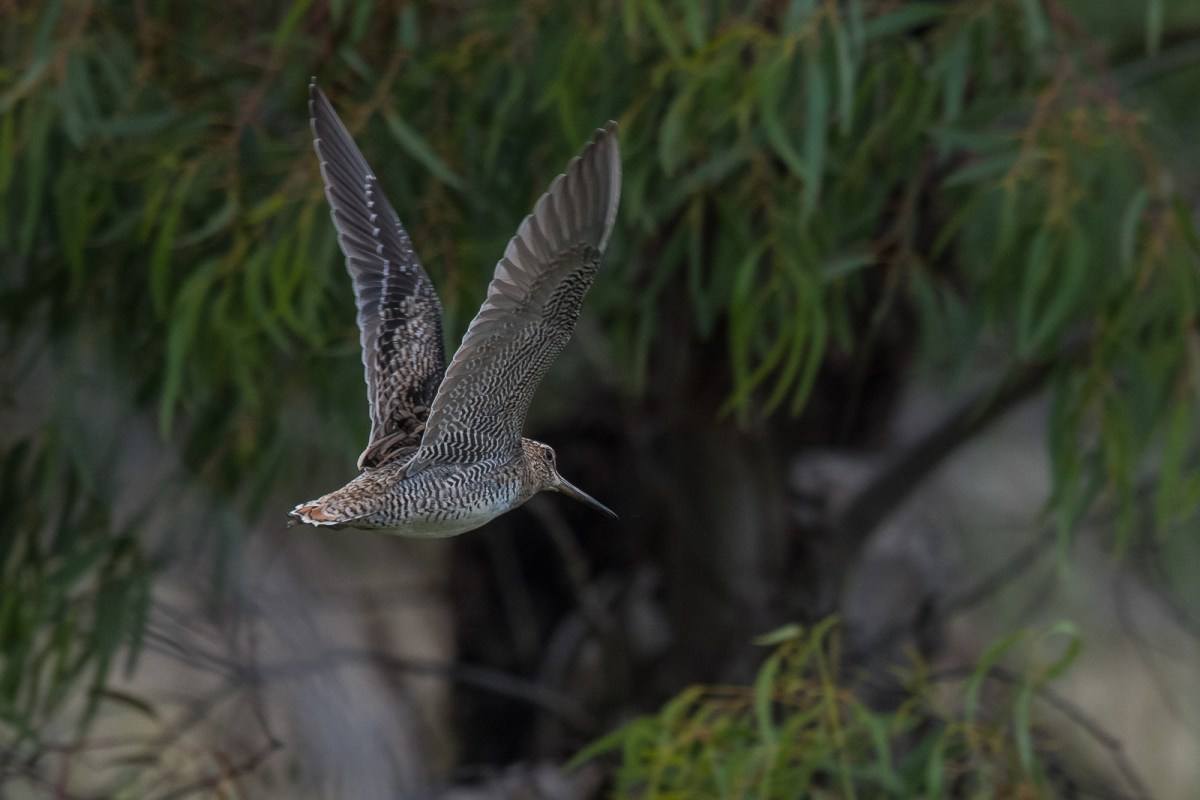
A morning at Lake Lorne looking for Latham’s Snipe, could be just a drudgery, or it could be thrilling.

EE and I had made the trip out just after sunup, and had a chance to look through a number of areas where the birds might have been resting up.  Finding a Snipe is truly like finding the sixpence in the Christmas pud.   The trouble is finding them, and then getting close enough for a good shot.

I had been using the 500mm PF on the D500, but the speed of the little birds, the complexity of the background and the slowness of the operator, meant I was missing  many a shot. By mid-morn I changed back to the 300mm f/4.  Need to be closer, but the wider angle of view meant I could get the bird in frame quicker.

I saw the bird poke its head out of the thick grass, and had a fair idea of its location. Closer, pause, closer, pause.  No head poking out. Perhaps it scampered through the grass further away.
“Scrassrckh”
Airborne in front of me, raise camera press shutter, first one blurry, focus locks, nailed it.  Bird is away,  but its the closest I’ve been to one so far.
Time to sing a joyous song.


Werribee Wag-Tales: The Baker’s Dozen + Two

Screen Shot 2020-02-06 at 11.08.02 am

EE and I were on our way down the Bellarine Peninsula for a spot of R&R, not sure what R&R meant in this decision, but rest and relaxation were never going to be high on the list.

On the way down we decided to visit a couple of places along the way and Fyansford Common was a good place for an early start.
Imagine if you will, our surprise when we spotted Mr An Onymous in the carpark.  How co-incidental.  And not long after, we were joined by others of the now, non-affiliated Former Werribee Wagtails.  Isn’t life just full of those serendipitous moments.

So, as a Non-group, we set off our our individual paths around the Common.
A Pied Currawong, a tree full  of Brown Thornbills, and some Red-browed Finches were a good start to the day.

EE and I then set off for Balyang Sanctuary on the Barwon River.  Ideal spot of a cup of the Earl’s finest. Again we were fortunate to find our birding friends had also decided on morning tea here, and Kathy’s sultana cakes provide by husband, Mark, were are welcome treat.
Balyang area proved to be quiet, (nearly wrote quite quiet, but on re-reading_), a few Australasian Darters, and various cormorants with young.  A  rather handsome Sulphur-crested Cockatoo was happy to pose for photographers and watched our meanderings with interest.

Then we drove on to Drysdale Railway Station for lunch, stopping, as usual at the Cinnabar Bakery and Pie Shop in Drysdale and a choice of fine pie delights.  Some might wonder if we go birding and stop for pies, or go for Pies and do the odd bit of birding while we’re out.   You, alone dear reader have all the evidence needed for a conviction.
So our non-group settled in around the steps and seats at the railway station, and enjoyed the some great food, I had the Plain Meatpie (traditionalist that I am), while others had a range of Chicken and Leek, Beef and Mushroom, and Curry.  Great pastry makes a great pie.

The main reason for EE and I to go to Lake Lorne, next to the station, is that it has a good reputation for Freckled Duck, Blue-billed Duck, and Latham’s Snipe.

We began to circumnavigate the lake,  and I dropped off the track into an area near the water’s edge, then with a sharp, “SCHHRAARKH”, the first Latham’s Snipe for the day, exploded out of the grassy edge of the lake, rocketed down about 300 metres and dropped into the edge of the grass.  It was easy to spot as it worked its way, feeding along the edge.
I moved 50m along the edge, and One, then Two, then Three more flushed.  Now it was getting serious.

An area that I’d had some success previously was bare of snipe, so Mr An and I moved further along the edge of the lake until we came to a jumble of branches that required careful negotiation.  Almost across the last one, and Wham!!! Four Snipe were in the air in front of us.  And we were off-balance, so only managed a couple of grab shots.  By the time I was stable of foot, they were across the lake.

We flushed another three and the total for the circuit was a creditable 15, not counting the ones we might have counted twice.
So Baker’s Dozen folk walking the lake, and two extra snipe—actually I’m reliably informed that there was only 12 of us out and about, but as I don’t count birds, I’m hardly likely to number people. 🙂
Especially those who just ‘happen’ to turn up to go pieing/birding with us.

A few fond farewells, and EE and I were off on the next part of the trip.  Gannets and Yellow-tailed Black Cockatoos, being our targets.

Wonderful day out with some great people, good birds, fine discussions and great food.  Werribee Wagtails Lives On

Enjoy.


Click on photo for a larger size of each shot

Moment: Getting that Old De Javu Feeling—Again

Yogi Berra, a baseball coach for the New York Mets was famous for his ‘apparent’ contradictive language. Malapropisms and the like
“It ain’t over till it’s over”.
Giving directions on how to travel to a location, “When you come to a fork in the road, take it.”
“You can observe a lot, by watching.”

And “It’s Like Deja Vu all over again!”

We were down near the old nest site of Cassia-of Cinammon, and her young, now long abandoned, as the young have been on the wing the best of three months.

When on a sudden across the paddock a brown form came ‘rowing’ toward us.

What makes this memorable moment, is not that it’s a Brown Falcon, nor that it’s about to take off, nor that I managed some sunlight, nor get about the right exposure.

No.

It’s probably going to go down a one of my most heartwarming shots of the year, and so it has more to do with the moment than simply pressing the shutter.

The bird was one of the young Browns from the season. While Mum and Dad seem to have moved their winter territories, this young one has stayed on in the area.  Those who bravely follow the blog will have seen several shots of the bird as it’s been growing up.

What made it special for me is that the bird landed on the top of a tree, and not just any tree.

A tree that Cassia had used repeatedly over the season. From this tree she could keep a lookout over her nest, and its special inhabitants.

Seeing her strong young gun sitting on the same tree, gazing, as Browns do, just like its mother, made me think of Yogi’s Deja Vu quote.

Now, with a full set of tail feathers and much of the orange of youth has been replaced by more common straw.  It sat on the tree for a few minutes, and then because of the strong wind, it simply raised the wings and drifted off the tree and dived through the scrub and was away at a fearsome pace.  Low level, stealth-fighter like.

Enjoy.  I did.


Saturday Evening Post #71 Wings Out

One of the most sought after inflight poses for birds is the “Heraldic” form.

The doyen of the craft was an Englishman named Eric Hosking.  It is hard to appreciate the complexity and technical difficulties that Eric had to overcome, in this day of High ISO values, Ultra fast f/2 and f/2.8 lenses and long focal lengths, electronic flash and electronic release systems.  Yet some of his earliest and most influential work was made with a glass plate or sheet film camera.  Each darkslide had 2 exposures.
Yet, if you take the chance to view the EricHosking Gallery online or obtain a copy of some of his books, the work still is modern, fresh and extremely well detailed.

In any discussion of his work, several points will always be made.
1 His meticulous attention to detail.  His field note books contained observations and details that  advanced our understanding enormously.
2. His care for the subject he was working with. No photograph was worth endangering the bird. He went to great care to work in the bird’s world at its pleasure.
3.His endless enthusiasm for the subjects, their surrounds, the technical issues and opportunities to share his work with others.

It is so difficult to think of sitting in a hide, with just one piece of film (a glass plate of ISO less the 10) and having to prefocus where the bird ‘should’ be at the time of exposure, and then making just the right judgement to press the shutter. No burst at 16fps for Eric.

He had a most unfortunate accident early in his career with a Tawny Owl.  A hide had been built to photograph a Tawny Owl family, but late one night he had to return to the hide as he thought poachers were at work.  On entering the hide, the Tawny flew in, and and to quote from “Any Eye for a Bird”
There was not a sound, not even the whisper of a wing. But out of the silent darkness a swift and heavy blow struck my face. There was an agonising stab in my left eye.  I could see nothing. The owl, with its night vision, had dived-bombed with deadly accuracy, sinking a claw deep into the centre of my eye.”

Eric would lose the eye.

But he soon went back to work.

One of his greatest images is the heraldic owl.

This was made in 1948, and Eric describes it as a “One in a Million Pose”.

The basis of the shape of the image is the typical heraldic form of family crest.

That such a pioneer was able to give us so many fine images and be an inspiration to so many people, not just photographers, but naturalists and the general public is part of the tribute to his skills, and concern for his subjects.

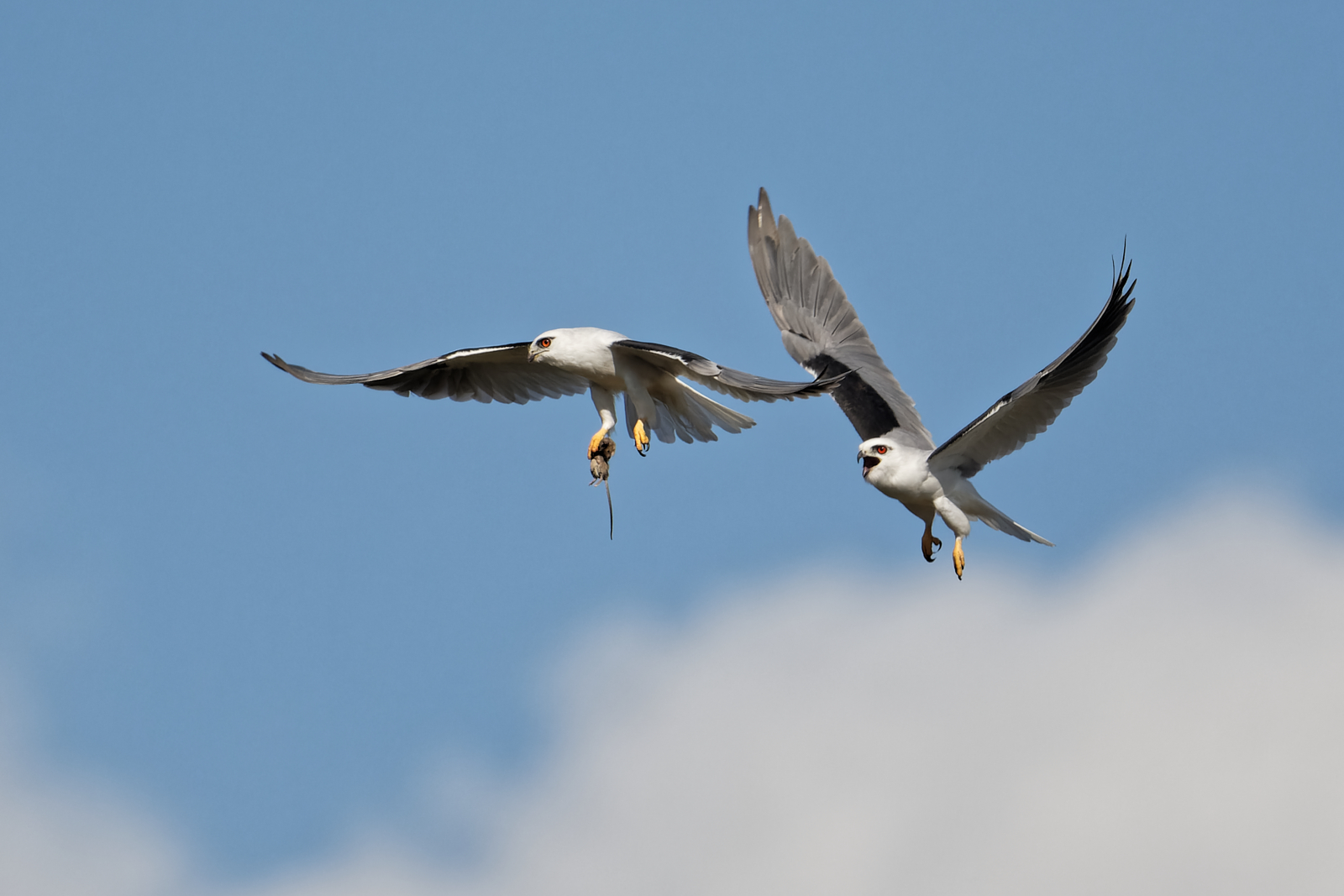
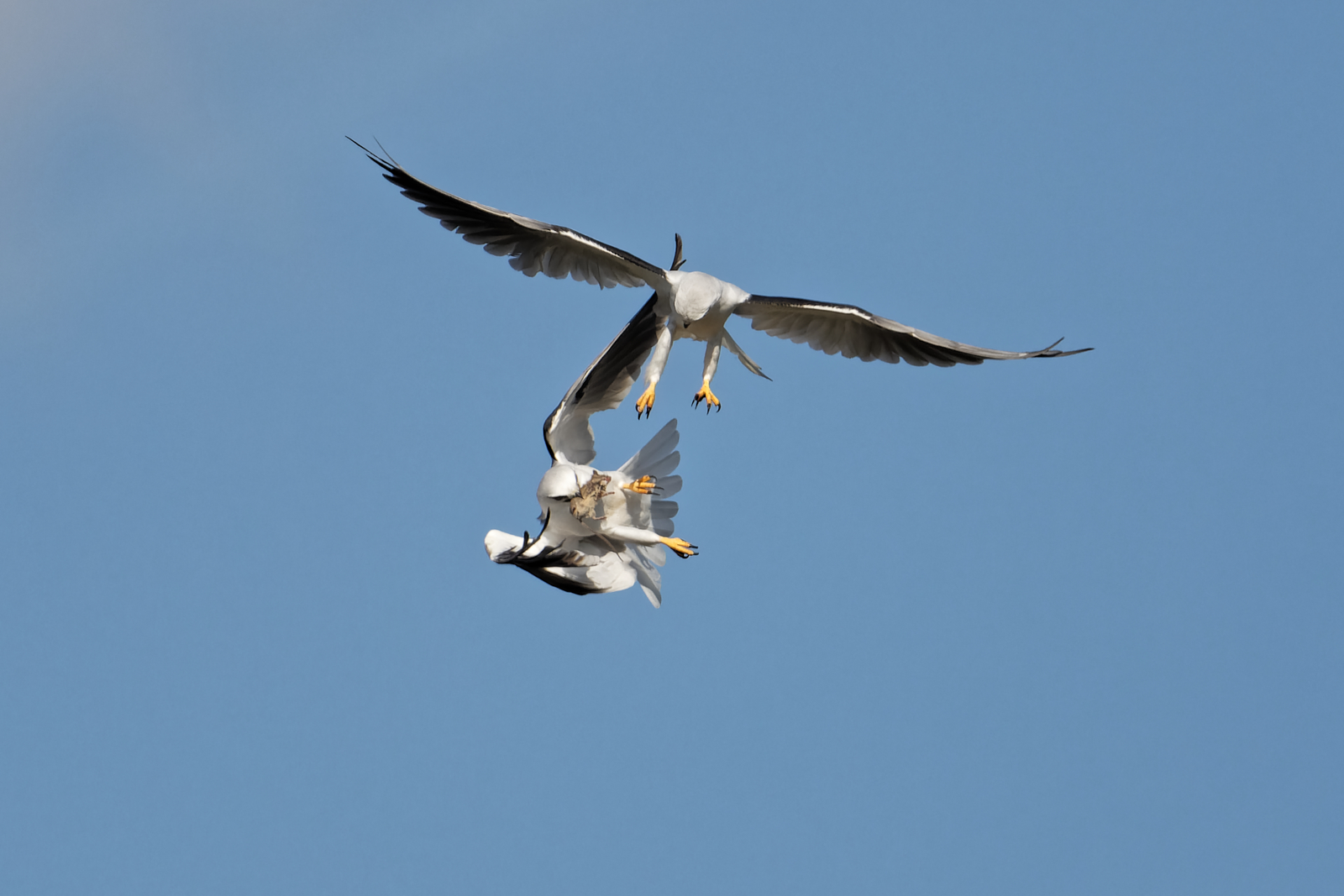
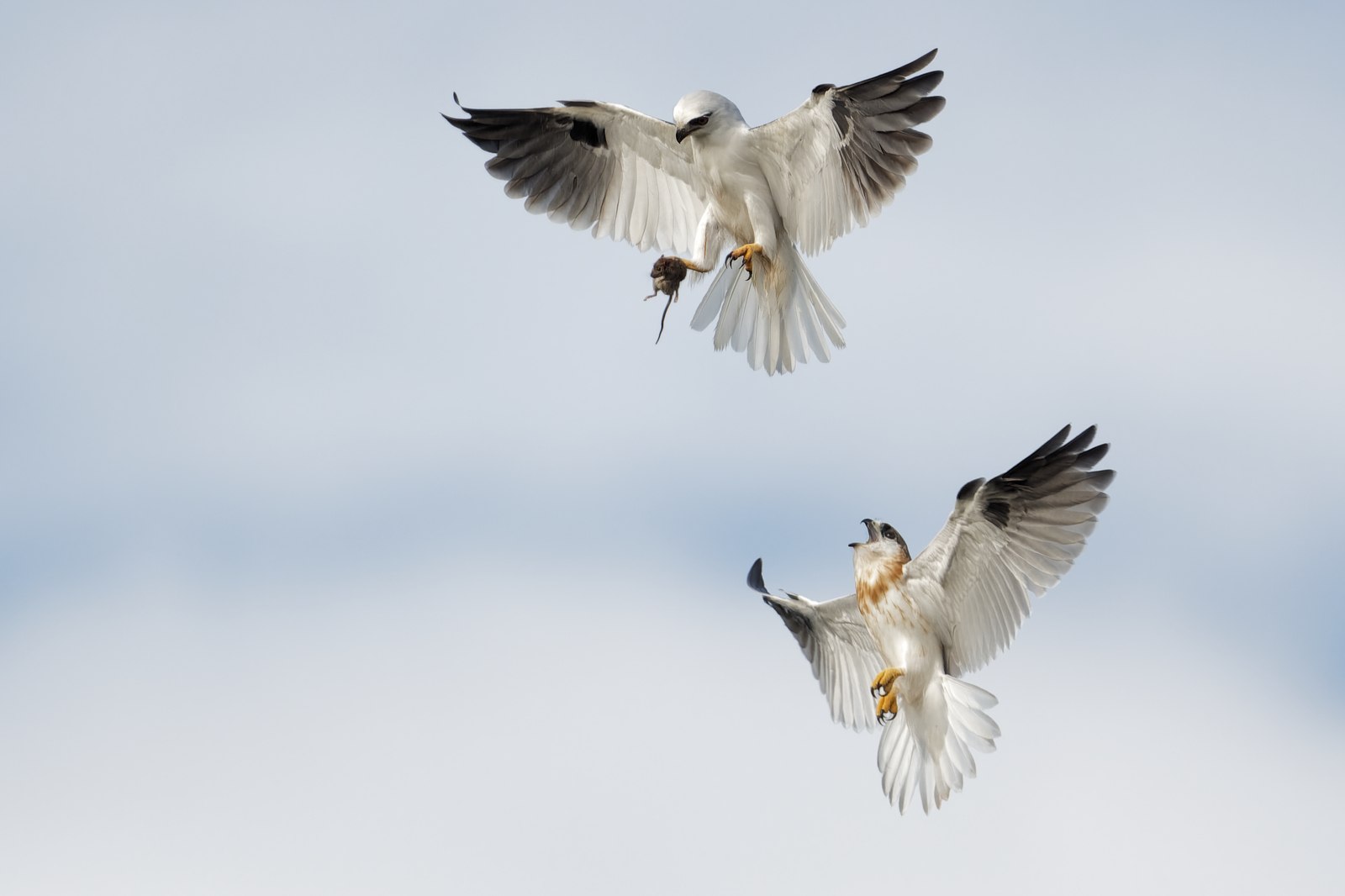
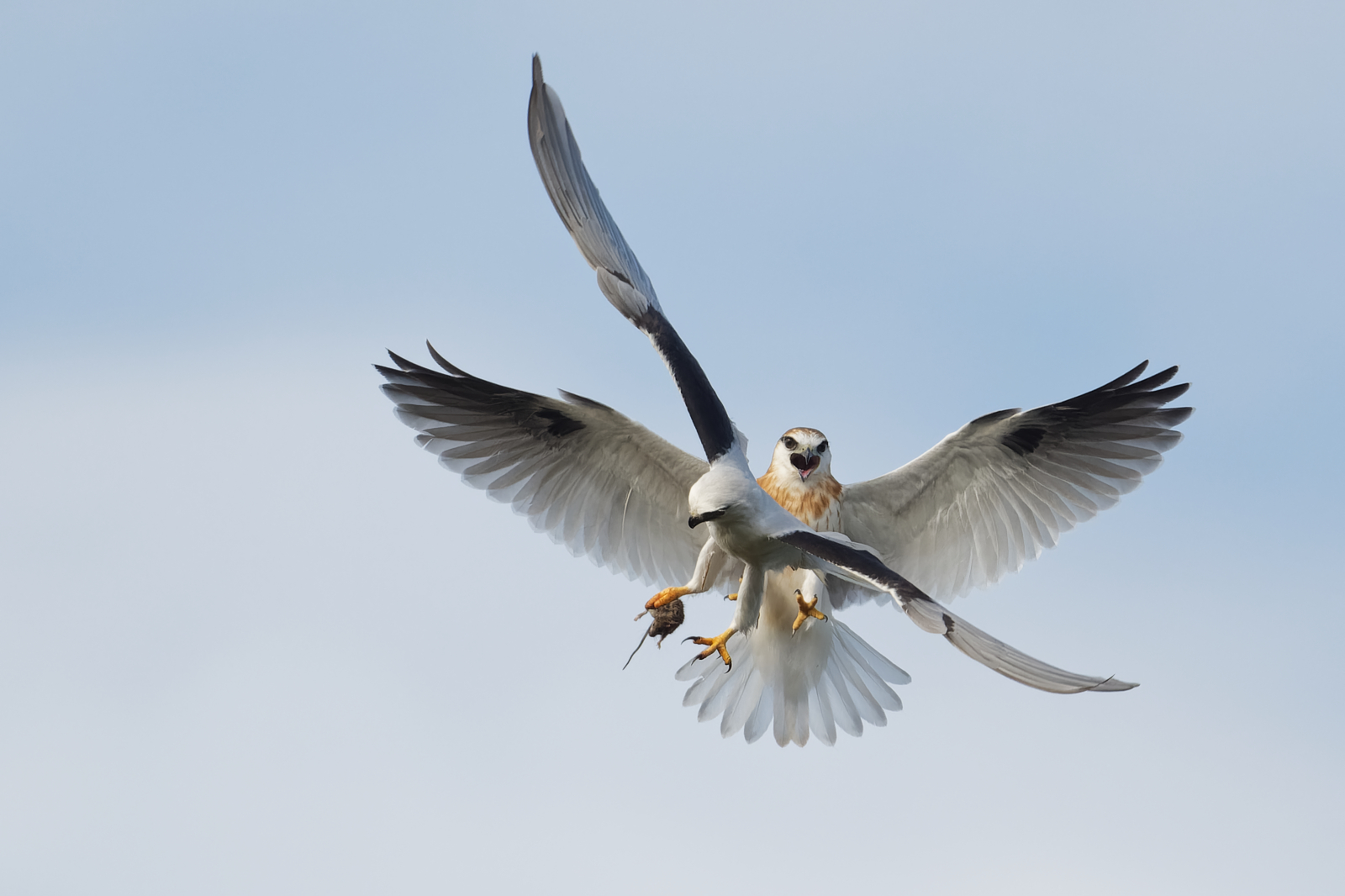
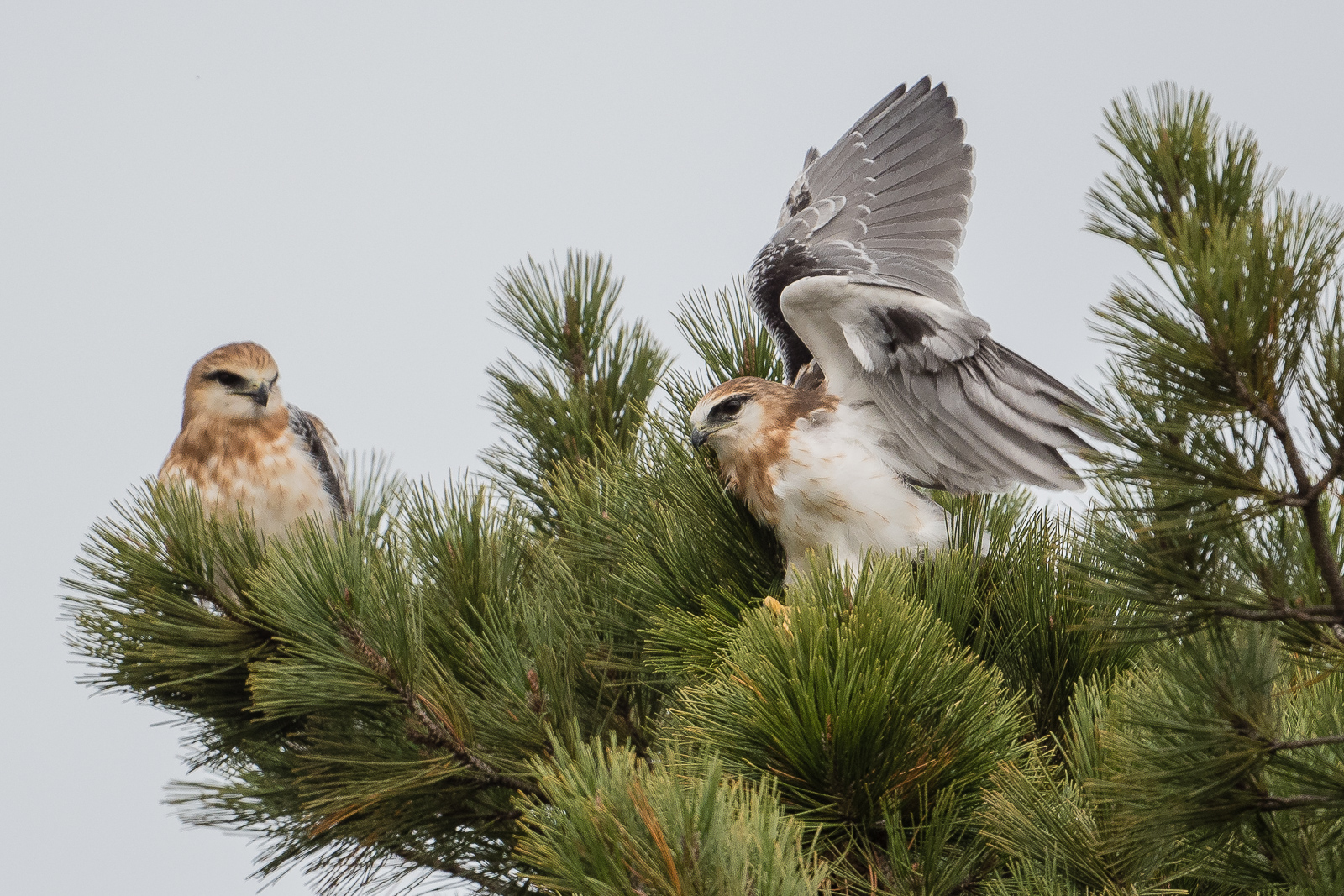
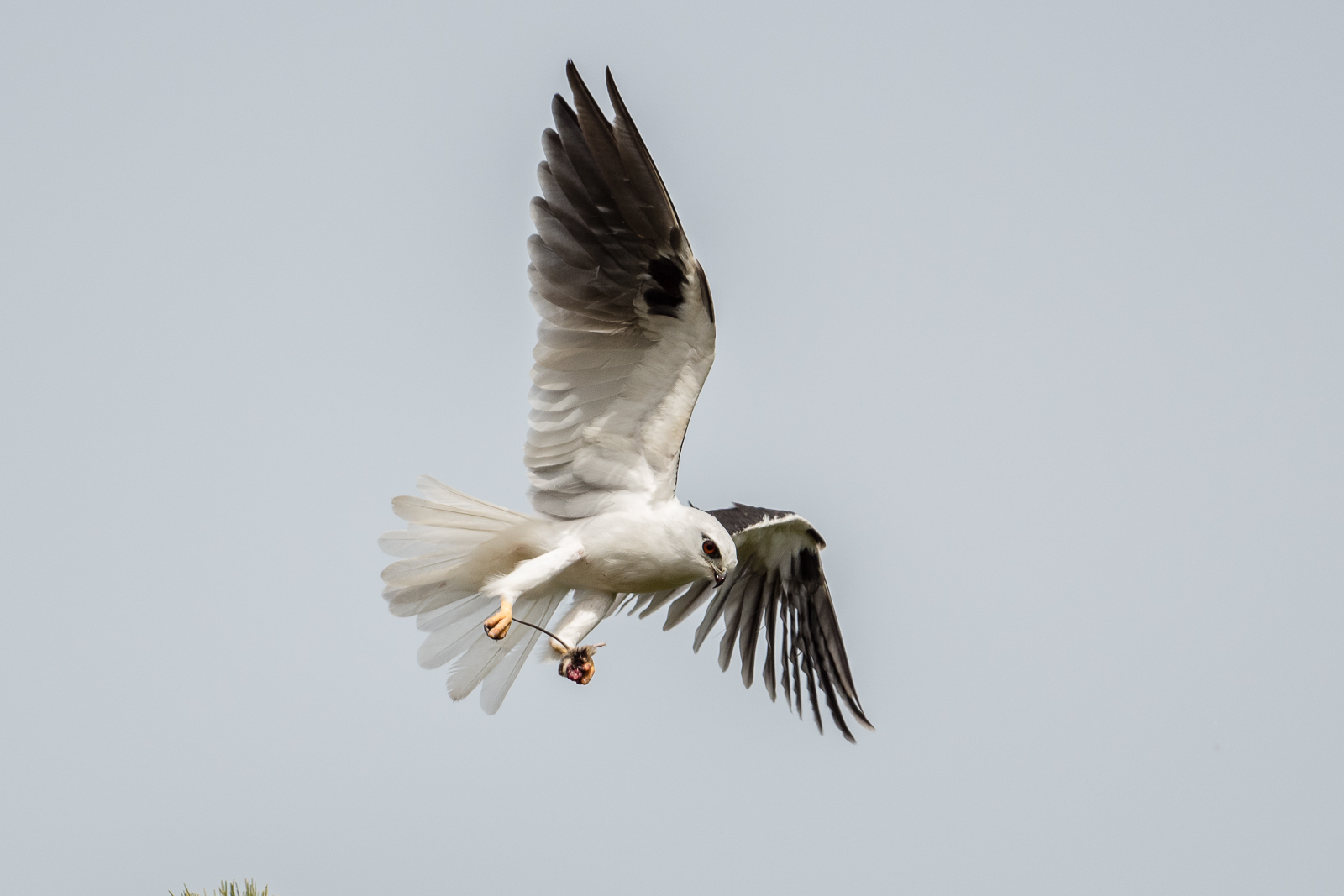
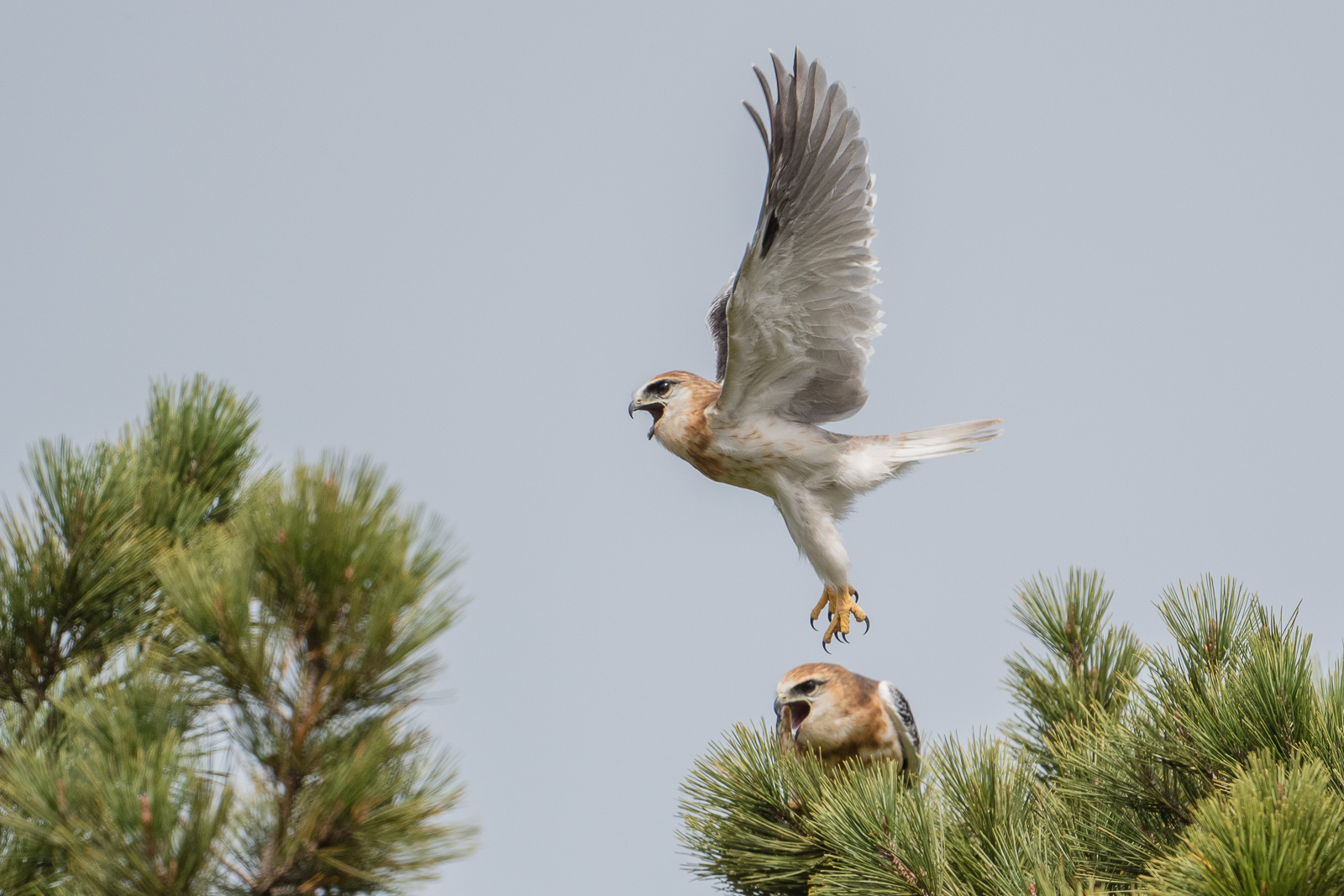
I was working with a pair of Black-shouldered Kites.
The male lifted off the tree, and soon after the female took off along the track.
He was back in less than 30 seconds flat with a mouse.  And he immediately began work on devouring it. She turned up a minute or so later, carrying a freshly plucked stick, no doubt intending to do some work on a nest.
On seeing him, she changed direction, swung in, expecting I guess, to get a share of  his dinner, and wings out dropped the stick. (the header photo)
Then in a million to one moment, the wings were out in the heraldic fashion, and I heard Eric say, “Well done!”

Both shots have been through Nik Silver Efex Pro, just to keep the historic theme going.

Enjoy.

Moments: Enterprising Grebe

A headsup for anyone making the trek out to Eynesbury Grey Box forest at the Golf Club.

In the main lake an enterprising pair of Australasian Grebe have taken advantage of a downed sapling with its branches in the water, and have setup home among the twigs and leaves.

I only managed one shot of the eggs, and I suspect there are four.  Everytime the sitting bird leaves the nest, it pulls the loose green weed over the eggs for security.

Hopefully we’ll get a couple more visits to see how things progress.


A secure home with a view
They take turns in sitting
Hard at work keeping the nest it top working order
Hard to get a clear shot among the branches.
Making sure the eggs are well concealed before taking a dip
They seem to be quite large eggs for such a little bird


Happy Birthday Photoshop

It seems that the 19th of February was the anniversary of the release of Adobe Photoshop 1.0.

Now a full 30 years old. And still going strong, unlike so many software programmes that hit the wall.
Now you may, or may not be a Photoshop fan.  You may be quite the Photoshop luddite, or you may even despise the very name, and would never inflict your harddrive with the hint of an installation.

But none the less, it is one of two programmes I’ve got an intimate working knowledge of, that turned both the photographic and graphic arts industries on their collective head.  Formally two entirely different streams, both bought together by several pieces of software that alterered for ever both streams.

If you really want to get some background on Photoshop, and John and Thomas Knoll and their industry contribution, may I suggest clicking over to Jeff Shewe’s blog. https://photopxl.com/happy-birthday-ditital-imaging/ 

If you ask, “Who is Jeff Shewe?”, then its a fair bet that you’re a relatively new digital worker. Check out the link for the full story.
And for extra bonus, get to see Jeff do a quick video demo of

DAH DAH!!!

The first Adobe version of Photoshop the original, unvarnished, never to be repeated  Version 1.
And imagine how far we’ve come.

And here is a link to Photoshop’s very own John Knoll demoing version 1.07, Now you’ll know about Jennifer.
https://www.theverge.com/2020/2/19/21128404/adobe-photoshop-30-years-version-1

My own relationship goes back beyond Adobe’s ownership and involves a product called Barneyscanner.  For its time, (1989) this was a revolutionary 24 bit film scanner. (mostly transperancy). At first they didn’t have a real software solution, just large unmangable, (read unviewable) files.  John and Thomas struck a deal with their little Mac programme that not only could read the files, but actually make some modest adjustments.
By the time Tennis Australia’s Victoria Open was run in Jan 1991, scanning of film was still the major go to working pro tennis photographers.  Generally time frames were impossibly long, with processing and drum scanning and slow transmission, but with Barneyscan and the new Adobe version, time could be reduced significantly for shot to press time.
Co-incidentally that was also the first year that digital photofiles were transmitted directly to the newsdesk. All from a wonderous 1.3megapixel chip. Gasp!, Shock!, Horror! Amazement!

One of the biggest things about demos of Barneyscan and its software was, nobody was interested in the scanner, like, man, what is the programme you’re using and where can I get it???!!!!

Enjoy Jeff’s demo with Jennifer, its a not to be repeated moment.

Enjoy


s

Saturday Evening Post #70 : Exposure by Cat’s Eye.

If you are like me, and let’s hope that is not in too many ways, 🙂 then no doubt you’ll have pondered from the day you first picked up a camera,
“What is Correct Exposure?”

And… haven’t there been any number of ‘friends, family, websites, blogs, books, faceblot pages, and courses to set you on the right road.

Luckily this is not going to add to the incessant chatter.

I think, “What is correct exposure?” is about as useful as asking, ‘What colour should I wear?’ Because of so many variables.

T’would be easy to offer advice, such as, “Oh for my bird shots I use the fastest shutter speed, blah, blah.”

The great New York newspaper, Wegee,  is reputed to have said, “f/8 and be there!”

So let’s go at this another way.  How to you-royal plural-determine correct exposure?

Well in this modern day and age, you point the camera, press the shutter and all is well. (most of the time, with the exceptions of the critical moments, when its wrong!)
No doubt modern camera design is at pains to get it as close for most general picture making as possible.  Else people wouldn’t buy the cameras. So hats of to the manufacturers for their great work.

All sorts of hand-held exposure meters have been used in the past, and each had their adherents. And if you think camera blog discussions get heated and verbose, you’ve never heard the disciples of one sort of meter lampooning the other less informed individuals of lesser choice meters. 🙂
When I started, the choice was pretty simple, English company Sangamo Weston had a Weston Master meter. I confess to owning several during my lifetime, and have just purchased one from ebay, as much for sentimental as much as practical reasons.

As time went on and studio requirements changes, so did my choice and Sekonic meters came (and went)

Note I’m not into, here, whether fast shutter, or large or small aperture are the creative issue.
And don’t start me on the poorly defined “Exposure Triangle”.

Just a lighthearted stroll through the thorny subject of how we determine from the light available, and our photographic intention, what settings might best bring out our intent and feel for the subject.
Simply, how to measure the amount of light off the subject. (Or just for completeness for the Incident Method die-hards, how much is going to strike the subject)

What is the average reflectance of a scene has also bought in its wake, a host of disagreements.

For the record, Kodak scientists in the early 1900s arrived that in bright sunlight about 13.4% And then based their recommended exposure settings for their filums upon that basis.
Not good enough cried Fred Picker and St. Ansel, and they  cajouled Kodak into making their measurements at 18%.
Dah Dah, enter the great Kodak 18%-90% reflectance Card. Kodak Publication No. R-27.  Cat 152 7795.  Which, distinctly says on the outside of the package.
Designed for use with and exposure meter in artificial light. For use with Kodak Ektacolor and Vericolour Films.

Makes me smile when I see the card recommended for use in daylight by some controversial exposure determining system. And also in camera reviews that say—Oh, the manufacturer has set the basic exposure wrongly as it overexposes by 1/3 stop. Sure does. It’s easy to speculate when you don’t grasp the theory.

Then there’s the Sunny Sixteen Rule. Used to be on the leaflet inside each roll of filum.
Set the shutter speed to 1/ISO and aperture to f/16 and in bright daylight you’ll get correct exposure.
And if you’ve never done this, then next time your out in bright sunshine, set the camera to Manual. Dial in 100ISO, set the shutter to 1/125 (closest to 100) dial in an aperture of f/16, and sun over-your-shoulder. Bet is so close  to acceptable as to be scary. 🙂 But who wants to shoot at f/16. Not me.

You could try the Nicéphore Niépce method:  8 hours out the back window of the house. Yep, first recorded exposure ever! And no shadows in the scene. Give you HDR folk something to ponder. 😉 Actually there is more recent research that suggests it might have been several days exposure!   Think about that the next time you choose 1/4000th.

Which brings us to Exposure by a Cat Eye.

Enter: Oscar Gustav Rejlander, the year is 1857, and he is embarking on a rather risque work called, “Two ways of Life”. Here’s a link

To quote from Rodger Cicala over at LensRentals.com,

“Rejlander’s photographic career was remarkable. It wasn’t possible to practice “street photography” in those days, so Rejlander would use models to recreate scenes he observed of the poor in Britain at that time, producing haunting photographs that are collected in museums around the world today.
 He was also the first to use a light meter— sort of, anyway. He would bring his cat into the studio: if the cat’s eye’s were like slits he used a short exposure, if more open a long exposure, and if the cat’s pupils were wide open he knew there wasn’t enough light to photograph!”

So there you are.  The next time you struggle with “Should I add or subtract EV for this shot?” Just remember there is a long history of incorrect exposures littering the photographic biosphere.
And take heart, I’m responsible for a good many of them 🙂

Here’s a visiting Black Kite, just back to re-establish its breeding territory I think.
Guess which exposure method I used?  Oh, and to help, I don’t own or have access to a cat;-)
Enjoy


Little Journeys : A Rainbow on a Gloomy Day

The season for the Rainbow Bee-eaters visit to the southern end of the country is drawing to a close.  Time for them to journey back to more tropical locations.
Each year we have been fortunate enough to enjoy their company, and cheery calls, in a number of locations.
They come to breed, and steepish creeklines are among their favourite spots.  This season however, partly because of the dry winter, and partly because of unyielding high temperatures, which no doubt affected their food supply, we did not see the same numbers in the normal places.

One area in particular out near Bacchus Marsh, normally would support perhaps 15-20 pairs, this year it was a much lower number.

Surprisingly at first they arrived in quite good numbers, and we saw at least 50 or more birds in one day at Mt Rothwell, but they soon dispersed further afield. Also the River Red Gums cooperated and for the first time in awhile had excellent blossom cover, and attracted not only bees, but a wide variety of nectar seeking insects.  So it looked like the season could be good.

However we soon noted that the birds were having a very hard time finding a suitably soft  riverbank clay to open up their nests.  The ground was bleached bone dry, and little beaks and tiny feet can only do so much.  As the hole has to be around a metre or more inside the bank, it appears the work was just too hard and many pairs abandoned the site.

We did find an enterprising pair, that had persevered and in the end they got down to the business at hand.  Later on in late January we walked several kilometres along the creek and did locate several more pairs that had been able to establish in a more favourable location.

And given that at the same time we were working with the Brown Falcon,  Cassia-of Cinnamon, and her young on the other side of town, we didn’t spend much of the season with the Rainbows.  However in the end, they seemed to have gotten on quite well without our overseeing. 🙂

Mating is quite a sustained event. And begins when he comes in with a food offering.
The question is what to do with tails.
Success!
With a large butterfly or moth.
I’ve always been fascinated by the way they are able to flip the bee and catch it the right way round to go down easily


Saturday Evening Post #69 : Awareness

Last week I started the essay about “Distraction”, and in one of the unique turns of events, was immediately distracted.

As Deng Ming-Dao writes,

“Today is the ideal moment between yesterday and tomorrow”

The observation seems so trite, yet if we could observe the simple, how much would we see.

more from Deng,

“Cat sits in the sun,
Dog sits on the grass,
Turtle sits on the rock,
Frog sits on the lily pad.”
Why aren’t people so smart? ”

He comments: When you next see a cat or a dog sitting still, and admire the naturalness of their actions think then of your own life. Don’t meditate because it’s part of your schedule, or a demand of some particular philosophy.  Rather Meditate because it is so Natural.

I finished last week’s blog bemoaning missed opportunities.  Indulge me if you will, but Brown Falcons don’t bemoan missed opportunities.

EE and I were making our way back toward the vehicle, and came to an opening in the forest, and there, just along a bit, in the open Brown was sitting. Again it took a while to get round past the bird and be able to position it against a leafy backdrop, rather than a porridge sky.

I positioned myself, you better believe it so I also had good views of the around.  I’m left-eyed dominant, and most DSLR designs are for right-eye dominant folk. That way you lucky people can look through the viewfinder and also use your left eye to check the surrounds.  My unused eye is buried behind the dials, knobs and buttons on the back of the camera, and I don’t have the luxury of staying intouch with the around.  It’s why I’d never make it as a army sniper, have to lean over the weapon to aim. Recoil plays havoc on the cheekbones. 🙂

I even spent years trying to train myself to use my right-eye, but all that did was induce vertigo. 🙂

Brown was obviously well fed, and not in a hurry to go anywhere, and didn’t perceive us as a threat.  Twenty minutes went by and neither of us moved. Deng’s thoughts were playing out. Meditation is not to be separated from life.

As it preended out the feathers, it eventually arrived at the tail, and it was possible to see its three new tail feathers and the two outside growing in.
It must have been pretty pleased with its new wardrobe, as it was a very slow, precise and gentle interlocking of the feather edges.


Saturday Evening Post #68 : Sight and Vision

A lot these days in photo circles is talked about Vision. What they are wrestling with is; why I photograph birds, someone else photographs cars, while another does street, and yet another is ‘creative’ and someone else is  ‘general purpose’. No matter, the issue is the same.  Is the way I photograph the subject an expression of ‘me’.  And to a lesser extent, “Oh, and what I think if the subject”.  And if it gets me more “likes’ on spaceblock, then I know I’ve arrived.

And the discussions go off the rails as defining ‘me’ is not so much about photographic topics, but rather about becoming a ‘fulfilled’ person.

The thing that seems ‘obvious’ to me in going down that maze, is we begin to lose the benefit of the right language to find ways to extend the photographic vision.

People, say, “Oh, I’m not a creative person.” ” I don’t have much imagination”. But its not so much I think being ‘creative’ as having insight into the subject.  What do you want to say, how should it look, what is the right approach.

Sight is such a precious gift, so is in-sight. If I close my eyes and think of something, I’ll say, “Oh, I see.”  When I’m out and about with fellow photographers, I’m often conscious that they are too involved in their immediate ‘around’, and are at the mercy of impulses.  Point something out, and the response is, almost always, “Oh, I didn’t see that!”.

Others are hungry, and point things out that I miss
Part of that I think is the lack of language to identify ‘the photographic possibilities’ in front of us.
Form, Tone, Texture, Shape, Pattern, and all the rest are the building blocks of our creativity.

Had Jane Austen written “Pride and Prejudice” without a knowledge of word flow, sentence structure, grammar and description, we might have ended up with:-

Want acknowledged  is a man truth  , that a possession single good in  wife of a  universally fortune    ,  must be in of a it.  —Sorry Jane  I apologise profusely.

A client steps into the the studio to have their new whizz-bangery product photographed for a brochure.  A full brief is provided, Simple Set, Highlight the Product, bring out the best features. Make it appealing.
The photographer makes the shot, then says, “Oh, that is not creative enough, it doesn’t say anything about me, and my skill and my vision”
Next step, into Photoshop, download some Preset, turn the subject into HDR, blur out the company logo, make a drop shadow around the product name, give an ‘artistic’ wash to the final result.
Client says, “That is not what I asked for”
Photographer says, “No, but look how creative I’ve been”.
Client says, “I’ll look for another photographer.

or.

Client comes in with new  whizz-bangery product.
“I need a photograph for our new brochure.”
Photographer, “Sure, what is it about the product you want to emphasise. What kind of feel do you want to give it. How should the final look”
Client, “Oh, I don’t know. But. I’ll know it when I see it.”
Photographer, “Sorry, Look for another photographer!  If you can’t see it, I can’t photograph it.”

EE and I were searching for the young Brown Falcons. They are near full grown, so it was not going to be easy, and so we strolled along a track looking for a table for morning tea.  When there on the tree in front, sat, Brown. The weather was foggy, 100% humidity, and smokey still from the bushfires. The light was impossible. First shot is black shape on a black shape tree. Hardly inspiring. So I moved into the scrub a bit, and eventually managed the bird against a distant pine tree, but with so many light patches coming through the branches, it was not that much better.
Re-assess. I told EE I was going to backtrack about 50m, head across the road and hook around in a “U” to be opposite the bird on the other side of the road, at least it would be against a supportive background.
Brown, was in no particular hurry. Patience is their watchword. After a few minutes I was in position, and while not perfect at least I could see the bird.
And we entered Brown Falcon Time. Twenty minutes or so of preening, watching, changing leg positions, preening, watching.  Perhaps the fog and smoke gave it little option.
I’m nailed to the viewfinder.  After a suitable look around, the bird became active, stretched, preened out the wing feathers and was probably getting ready to leave.  Should be a good inflight I’m convinced.

But.

What I didn’t realise, from my position just off the track,  was that two people were walking down toward us. Then ‘crack’—a broken stick, and I made the absolute beginner’s mistake, I looked away. Milliseconds at most. Brown had dropped and was away. One wing flap-just about got it in viewfinder, second wing flap-on target, but out of focus, third wing flap-focus locked,— here’s a Flickr Link,  fourth wing flap-angle of bird is now away from me, and tail feathers aren’t that exciting.
“Expletive deleted”.
“Oh’, said the passersby, “Nature Photographers.  Sorry, hope we didn’t spoil your shot.”
“I’ve had better days,” I snap.
Both went on mumbling about rude nature photographers…

Here is the perched shot.
Again I’m going to show it vertical as that is how I envisioned it.

This young Brown is beginning to moult out of of juvenile colours, the rich orange is now being replaced by the more normal creamy colours. The tail has three long new feathers and on each edge of the tail, short growing new feathers, they grow fast so it should be good  in a week or so.