Photographic Essay: Mother Duck Said…

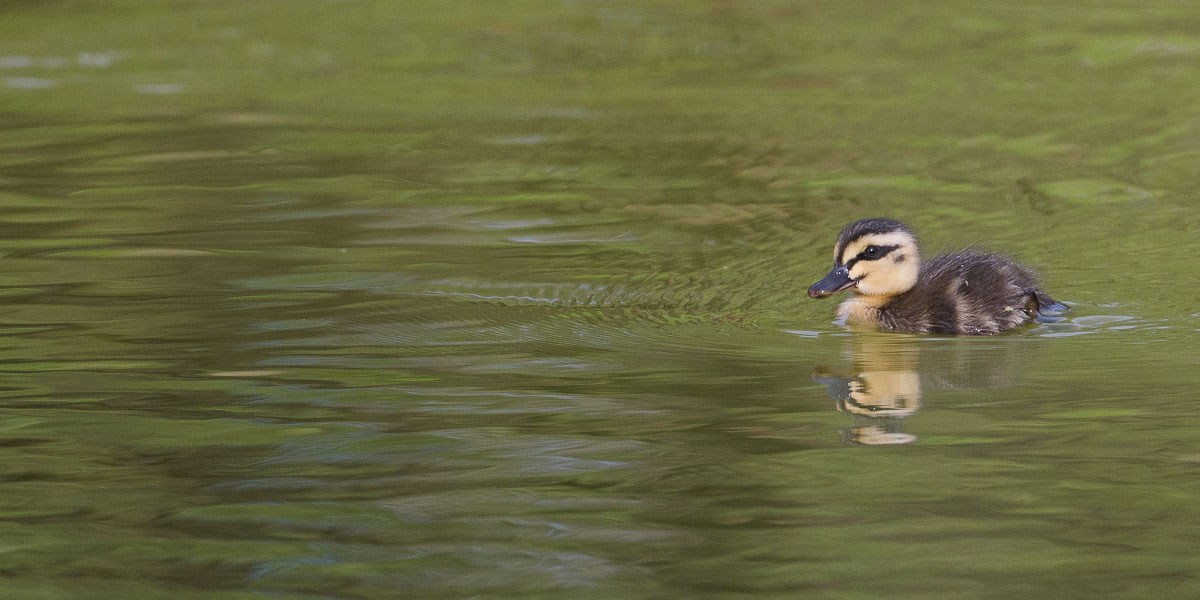
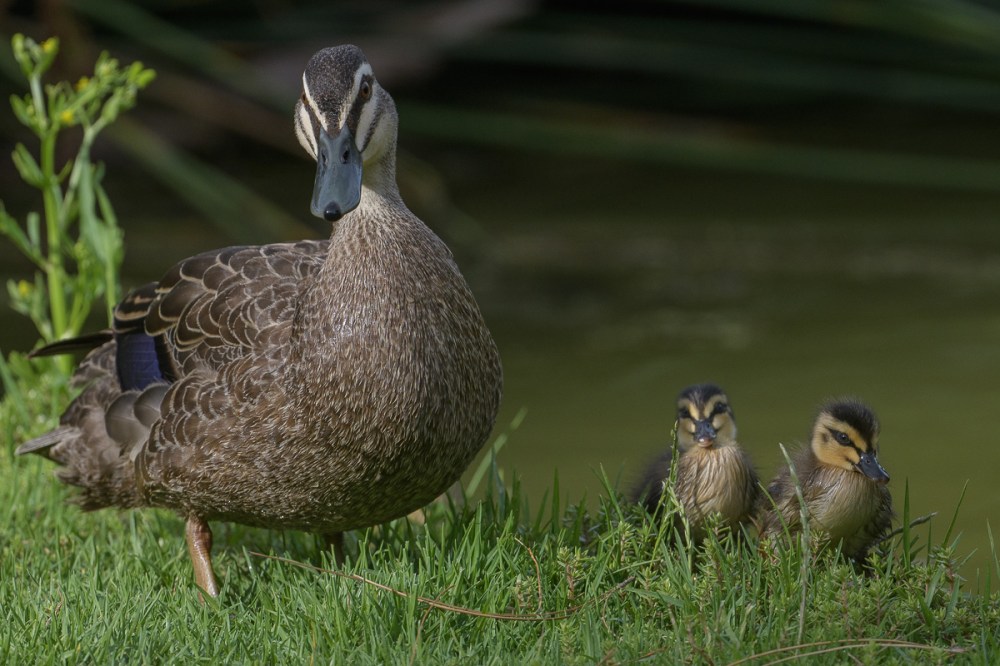
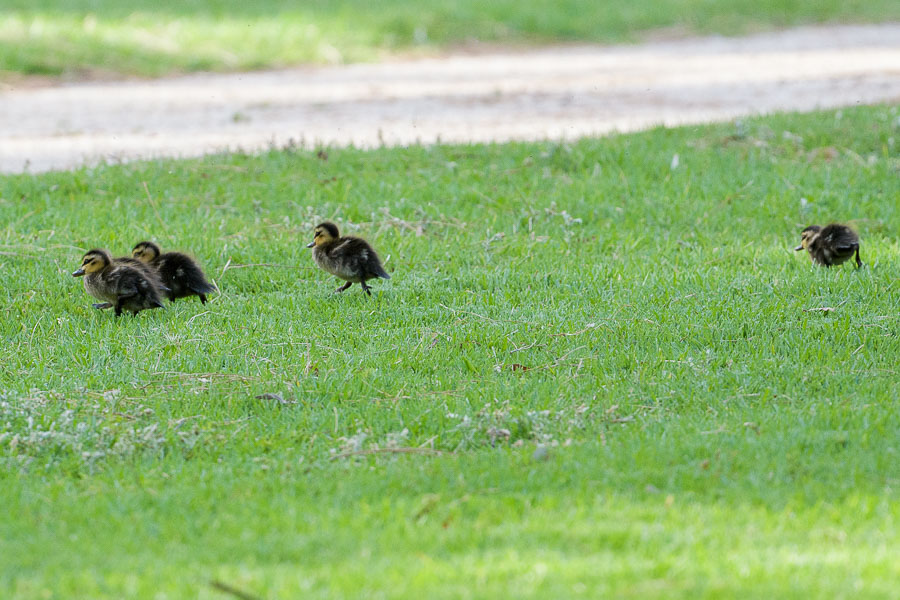
There is cute and then there is really cute, and then.  There is Pacific Black Ducklings.

EE and I had spent an evening in the formal gardens at Werribee Mansion in the warm afternoon sunshine.

The gardens support an ornamental lake, that on occasions has quite an eclectic mix of waterbirds.  But not so much at the moment.  I think the water is a little too ‘fresh’ because of all the rain run off, and the high water level doesn’t have much opportunity for wading birds.

Not so of course for your enterprising Pacific Black Duck.  These birds are quite the masters of adaption to the around.  While everyone else has been in lockdown or away from the area, we found a mother duck and her precious little bundles enjoying the lake practically to themselves.

At first we watched three or four scoot around on top of the water. Then another one among the reeds, then another further down the pool, and then another…

Mum decided all this water activity was good, but it was time for a sit in the dry on the grassy side of the pond.
So out she jumped and the little yellow bundles all followed behind. 1, 2, skip a few—10.

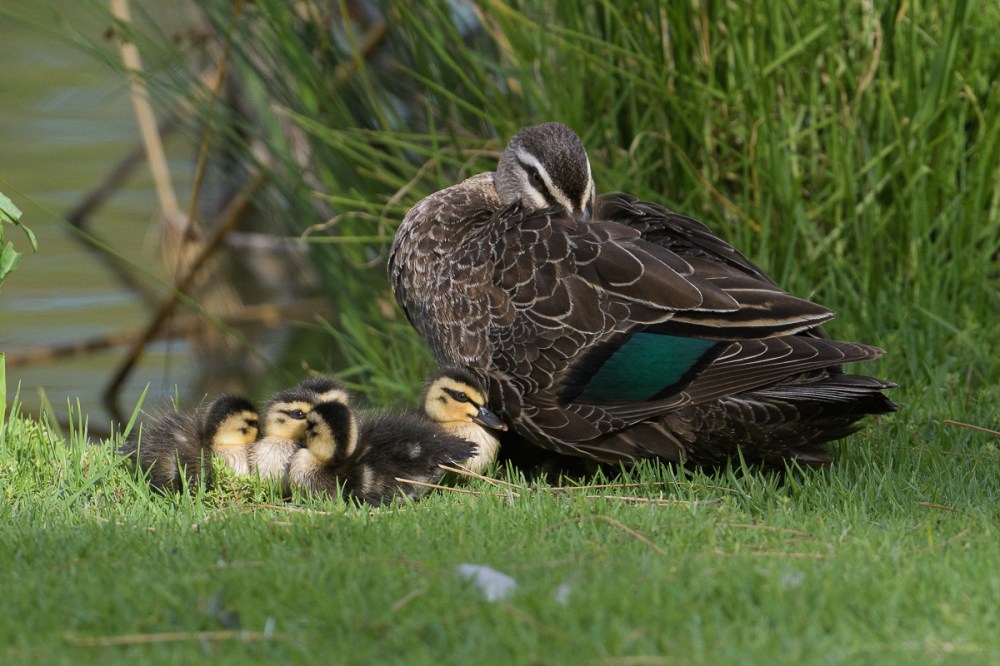
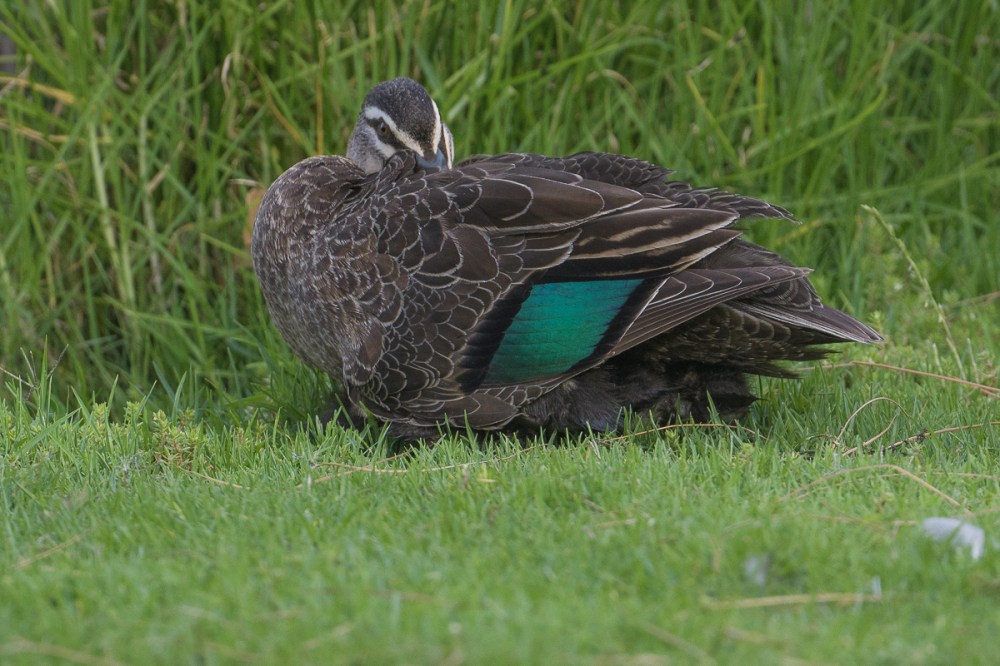
A little bit of preening, mini wing stretches and Mum decided a nap was on the list.  So she settled down, and they began to position themselves under her bulging wings.

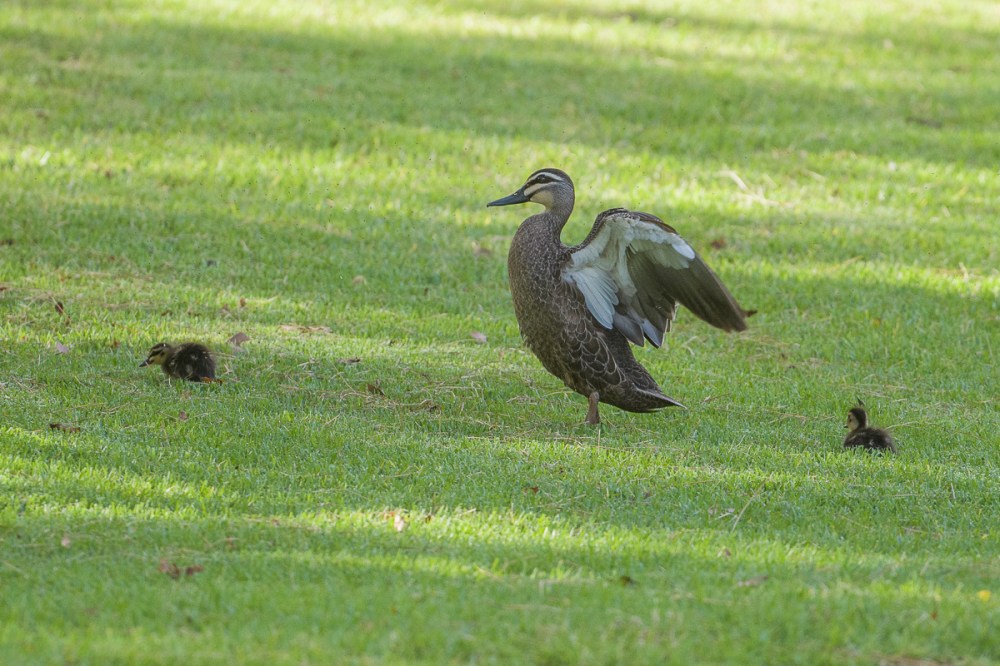
We moved to the other side of the lake, and about 20 minutes later on the way out, found that it was time for the fluff balls to take a walk over the freshly mown lawns.  Funny to see them tumble about across the grass.


Click on a galllery pic for a larger view

Saturday Evening Post #110: Living the Dream

Often in response to ‘How’s things?” my coffee dude friend Steve replies, “Oh, I’m livin’ the dream!” Steve is Irish and it takes a bit to unravel his meaning as it depends on who has asked the question.

Sometime the emphasis is on, “Oh”, other times “livin'” and more often than not, “dream”.  Makes a huge difference in the message the enquirer takes away.

Sometimes, when we are out and about, waving long lenses and tripods and things, a passerby will ask, usually innocently, “Ah, are you out to take photographs,” to which my good natured response will be something along the lines of, “Yes, its such a lovely day to be out.”
Other times, as the question really is loaded, in that it infers, “What are you doing here taking photographs?” my response can be a little more obtuse.
Usually, “No, I’m actually cleaning out the guttering!, or, I’m really here cleaning the windows so you’ll be able to see out that little bit better!”

When the enquiry turns to a demand about, “Why are you taking photographs here?”, in a more aggressive manner, I have a legally prepared statement that I will respond with. It always ends with an abrupt, “I’m minding my own business.”

Just occasionally when we are out and about and a birdo or bird photographer drops by for the usual chat, which almost always begins with “Have you seen much, or what are you photographing”, I have a pretty standard reply,
“Oh, I’m photographing Striated Fieldwrens.”  It they are interested in fieldwrens the conversation goes further, but usually it swings to, “Have you seen my …. (target bird)”. and that sort of ends the encounter.

To those that ask, “Oh, how many fieldwrens have you seen”, I usually can answer truthfully, “None, it’s been very quiet today.”

However just occasionally, the Striated Fieldwrens are on the move, vocal and out and about.  Sometimes it’s just a matter of luck, because these little dude spend a lot of time in the bushes and grasses and with their superb markings disappear from view.

This one was out and about early in March this year, the last day we had an adventure at the Western Treatment Plant.
At least I could answer unequivocally about the fieldwrens, “Living the Dream!”

Little Journeys: Strollin’

One thing our lockdown for the CovidCrisis has highlighted for us, is the chance to enjoy a walk around some of our local areas. Normally we’d be out and about in regular birding locations.

And of course, being local, there is not likely to be much in the way of highly sought out birds in the area.

Or
So we thought.

Not much more than a stroll from home is a new housing estate. It has been built on what, of course, was old farming land. And in our area, that would have been vegetable farming. A small, seasonal creek runs through the area, and because it is of environmental significance because of among other things, the habitat of  Growling Grass Frogs (Litoria raniformis) a fairly wide verge has been created, and partly sculptured with a well formed footpath and open grass.

The rest of the creek proper, thanks to the developers, the local council and Melbourne Water, has been turned into runoff water retarding basins. As the creek was originally a set of water holes rather than a flowing creek, they have used the natural lay of the land to develop the area.

The past few days we’ve had a good amount of rain. In our gauge alone  showed over an inch and a half  (about 39mm).   The new development with its sealed roads, footpaths, lawns and of course house roofs has indeed provided plenty of run off.  As we walked today there was plenty of evidence of at least a metre or more water having recently been through the reed beds. But thanks to clever Melb Water development, the water level has subsided quite quickly.

About half an hour walk from home is an aptly named coffee shop, The Little Growling, and it makes a good spot to turn around and return.  With a freshly brewed coffee to go, thanks very much.

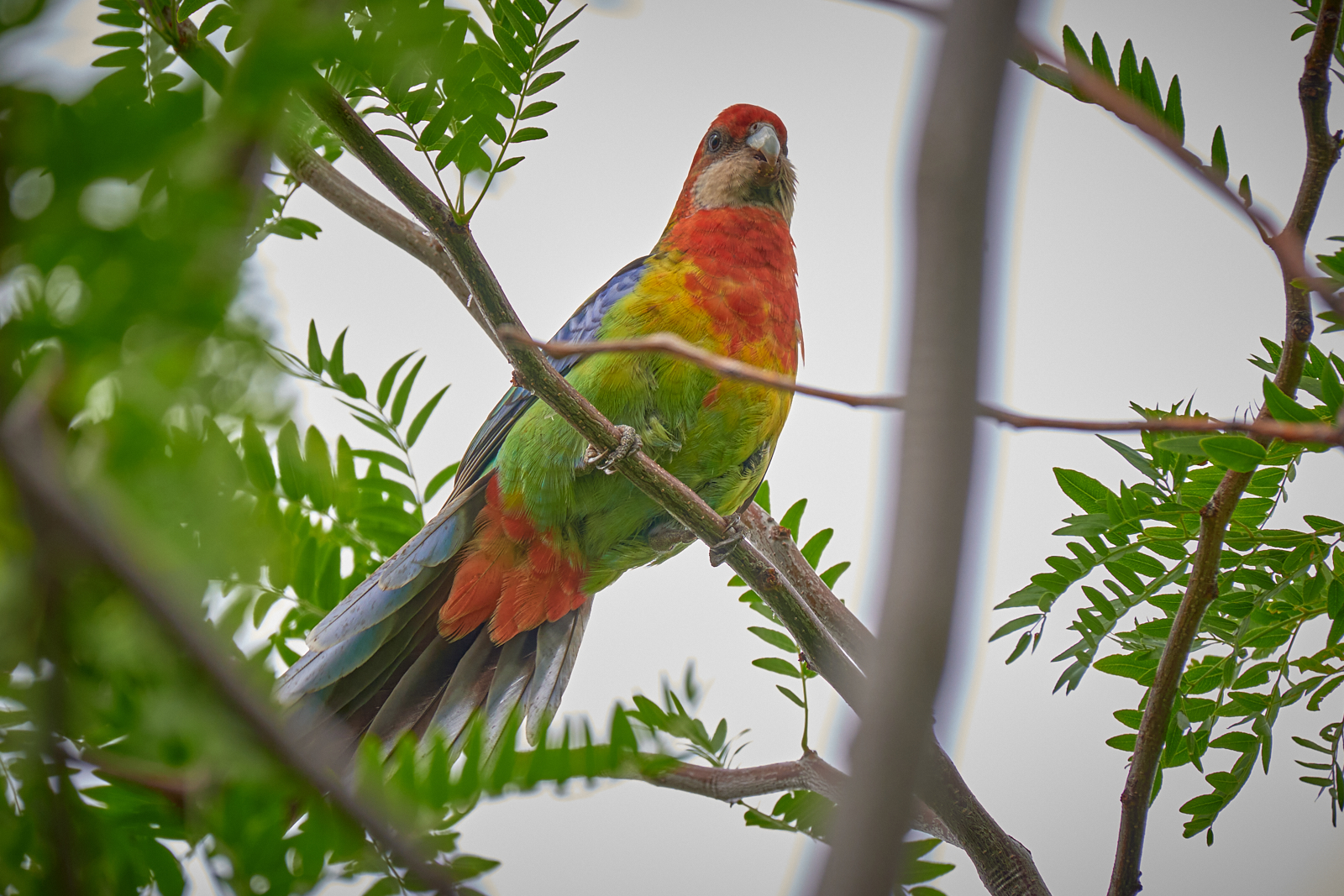
As we walked out of our village at the start of our stroll, I heard the call of a Rosella, I’ve been hearing it occasionally over the past few weeks, and had even spotted it on a fence-line a couple of times. This time it was in one of the street trees, and to my surprise, a Crimson juvenile was with it, so there was much calling.  (Whether they nested locally or not is still open to supposition). I am beginning to have my doubts about the Eastern id, perhaps it is a hybrid?

Not a bird we’d normally see locally, so it was not only a pleasant surprise, but quite enchanting.

Enjoy.

Eastern Rosella, or a hybrid with buff cheeks.
Juvenile Crimson Rosella.
The last of our local Black Swans. The rest of the family seems to have moved on. Perhaps this one is reluctant to leave a good feeding location
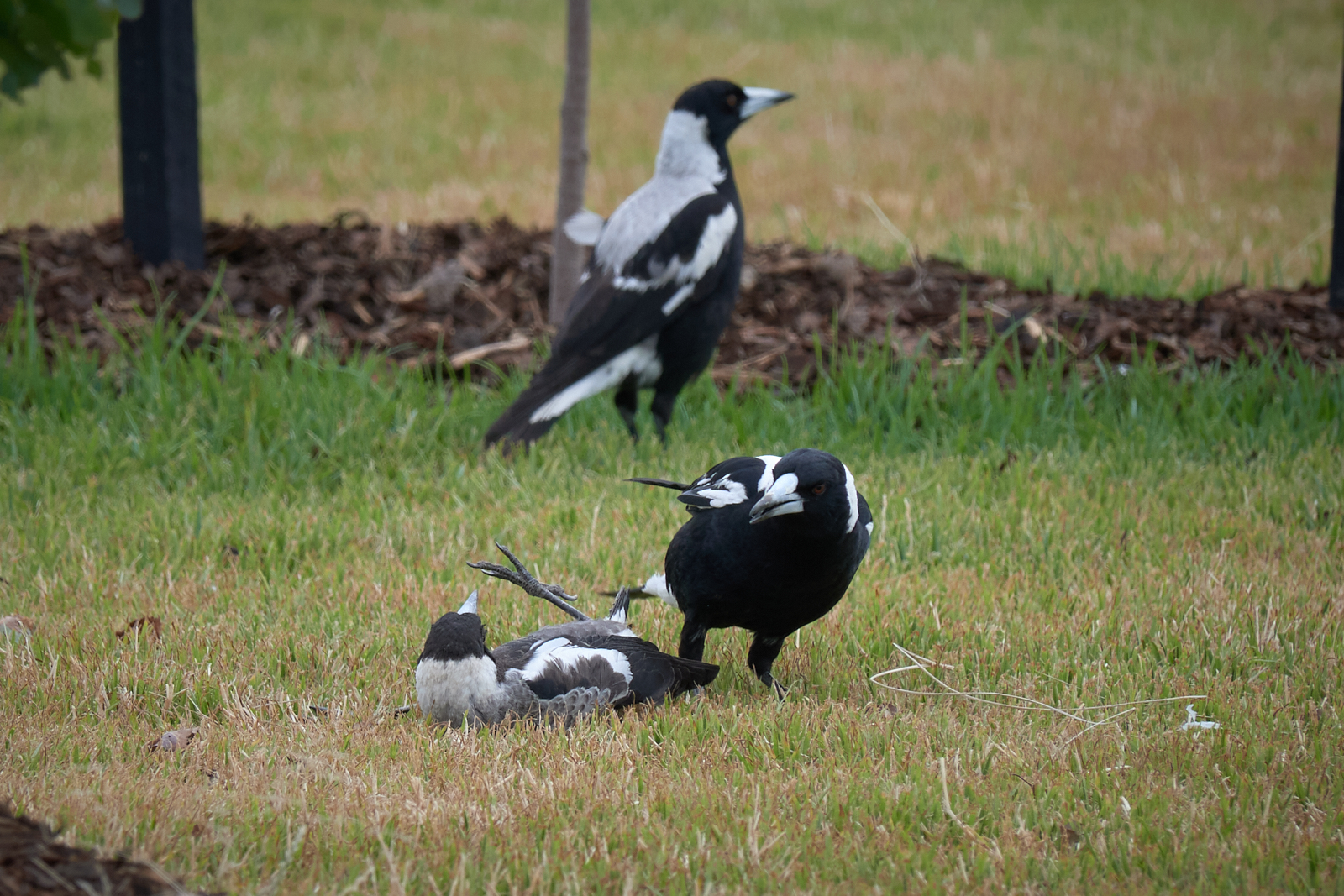
Magpie Drama. For reasons I’ve never been sure of the adults seem to single out one of the young and peck away at it. No one seems to be hurt and the young one will pickup and move on as if nothing happened.
Enjoying breakfast together.
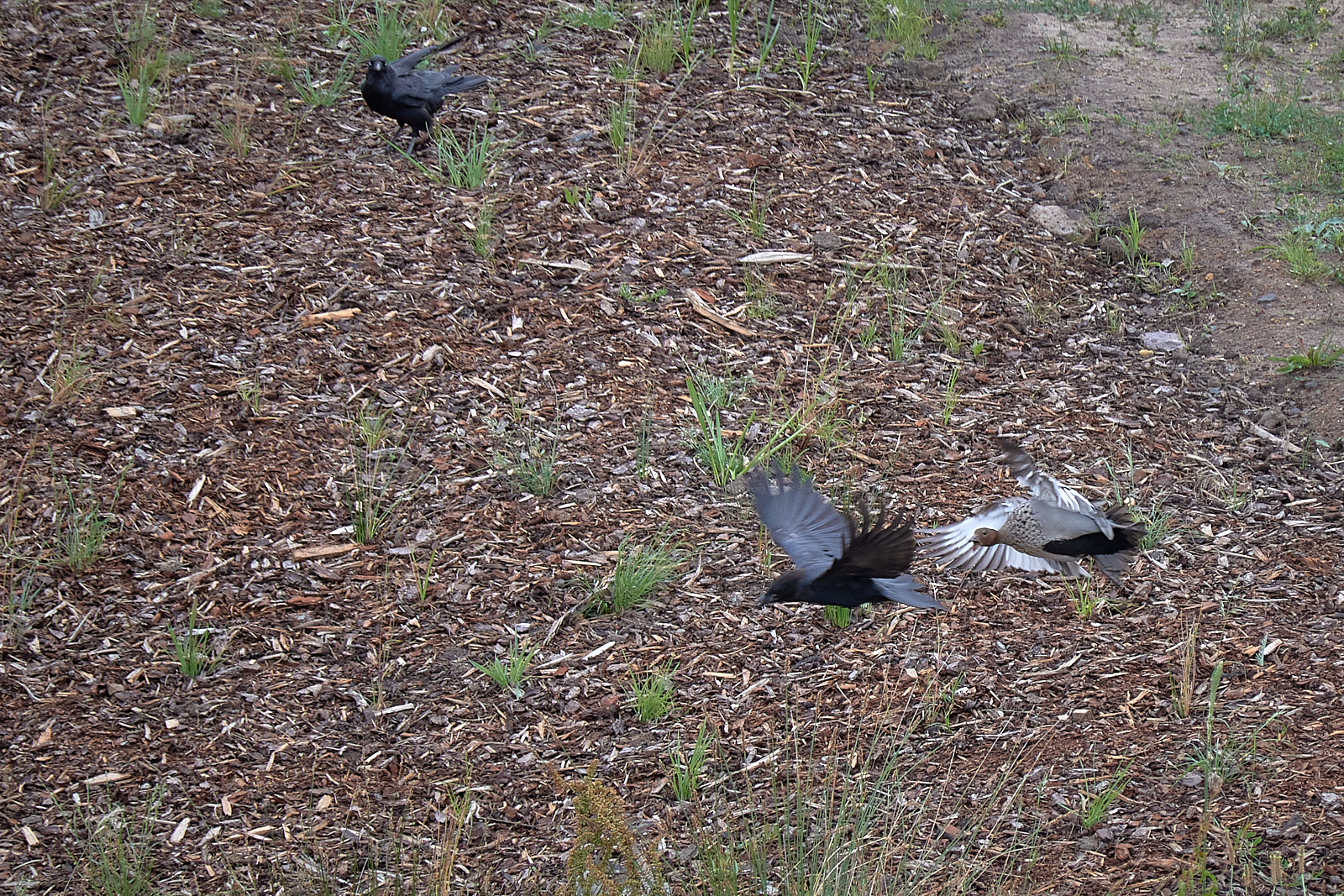
Maned Duck Drama. This male has a family of 5 trying to move across open ground. About 20 ravens thought there might be a quick snack or two for an enterprising attempt.
In the end, EE and I moved down the paddock and put the ravens to wing. Not that it would last for long, but sufficient to get the little ones safely to water.
The little family made it safely to the water, and were able to paddle away.
Australian Reed Warblers are either feeding young or building new nests.
Food delivery
Now that is something you don’t see in the average housing estate. Fortunately it was in no hurry to stop and chat
Like all housing estates, there are plenty of opportunists.
And this is why they call her EE.
“Buff-banded Rail,” she cried. True to form, it was. A most unusual find in a housing estate. We have been known to drive around the Treatment Plant for hours and never see one.

Saturday Evening Post #109: On the Edge

Rim Lighting: The technique gets its name from the fact that lighting a subject in this way produces a thin line or ‘rim’ of light which appears to cling to the subjects outline. Using rim light lifts the subject from the background in images rendered predominantly in shadow.

Another from the old “Lighting” notebook.

Rim lighting at its very simplest, isolates the subject from the background. It has the wonderful ability to bring out and emphasise the shape of the subject.

A light source is always behind the subject, a fine line of light following the subject’s shape.
It can be a mood of drama, mystery, strength and isolation.

An instructor I worked with early in my photo journey used to say of studio work, “First we put in a rim light, then keep adding lights to bring out the quality of the subject.  When that balance is correct, we stop and make the exposure.”

For outdoor portraiture, or product photography, that light is almost always the sun. It’s one of the reasons we work early in the morning with hard raking light to give long shadows, or in the late afternoon as the light dances through the dust and atmospherics at the end of the day.

Then, exposure is always something to contemplate.  Not always easy to add light to a bird in shade, or in deep shadow of full sun. Enter fill-in flash, or even a reflector of some sort, and by the time it’s all setup, the bird has either flown, or died of old age. 🙂

Willie Wagtail was out and about in the early morning sunshine.  To my delight it chose to stop on a nearby limb with the light streaming toward me.  Against the shady darker backdrop, the ideal setup for rim lighting made me stop and take notice.

I love this light enough to share a second image for Saturday Night.

Different lighting indeed.  Early morning, but overcast. My little hero, of the broken nest, was encouraging the girls in their rebuilding of a new nest.

He was under some overhanging branches and the light was pretty close to non-existent. So it meant  slower shutter, larger apertures and greater ISO. But in one of those lovely quirks of nature, as he turned on the old branch,  enough light came from the open areas behind him to trickle just a little light through his translucent fluffed-out feathers. Who said photography is difficult.

Photograpahic Essay: I’ve got a Hobby

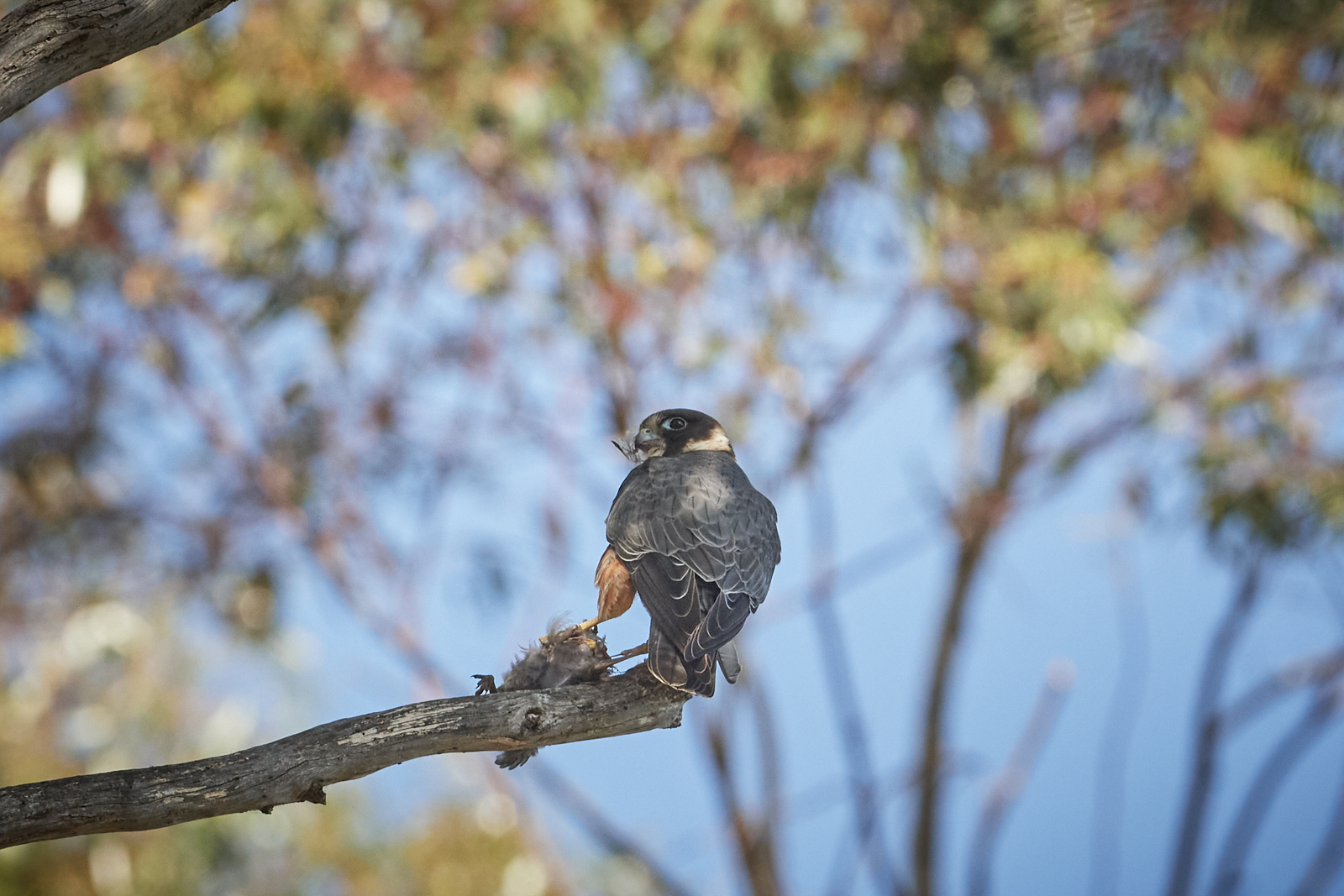
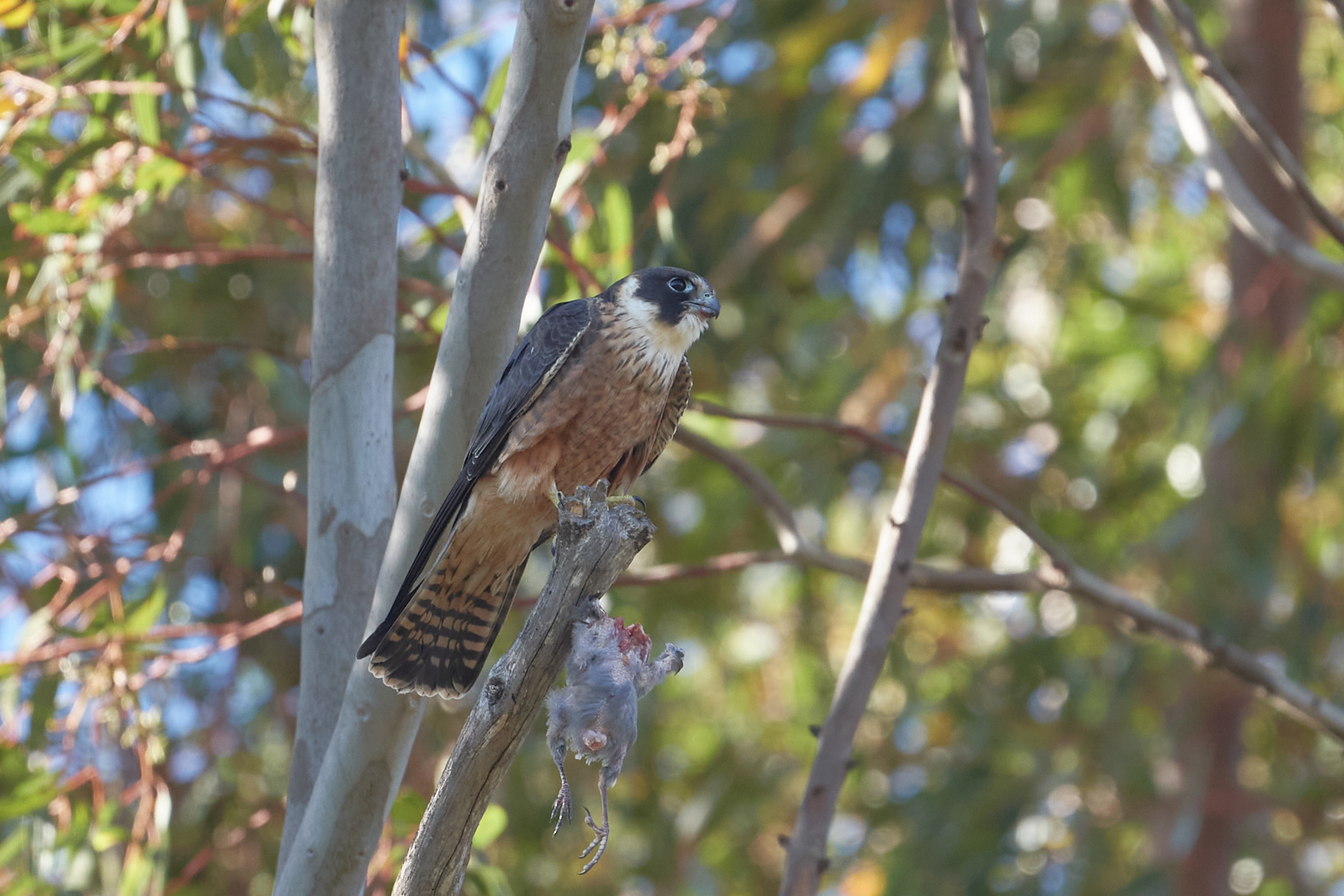
Well actually we (EE and I) are monitoring a pair of Hobbys. (Haven’t concluded if it should be Hobbies, or more realistically in this case, Hobbys—but you can see where I’m going with this)

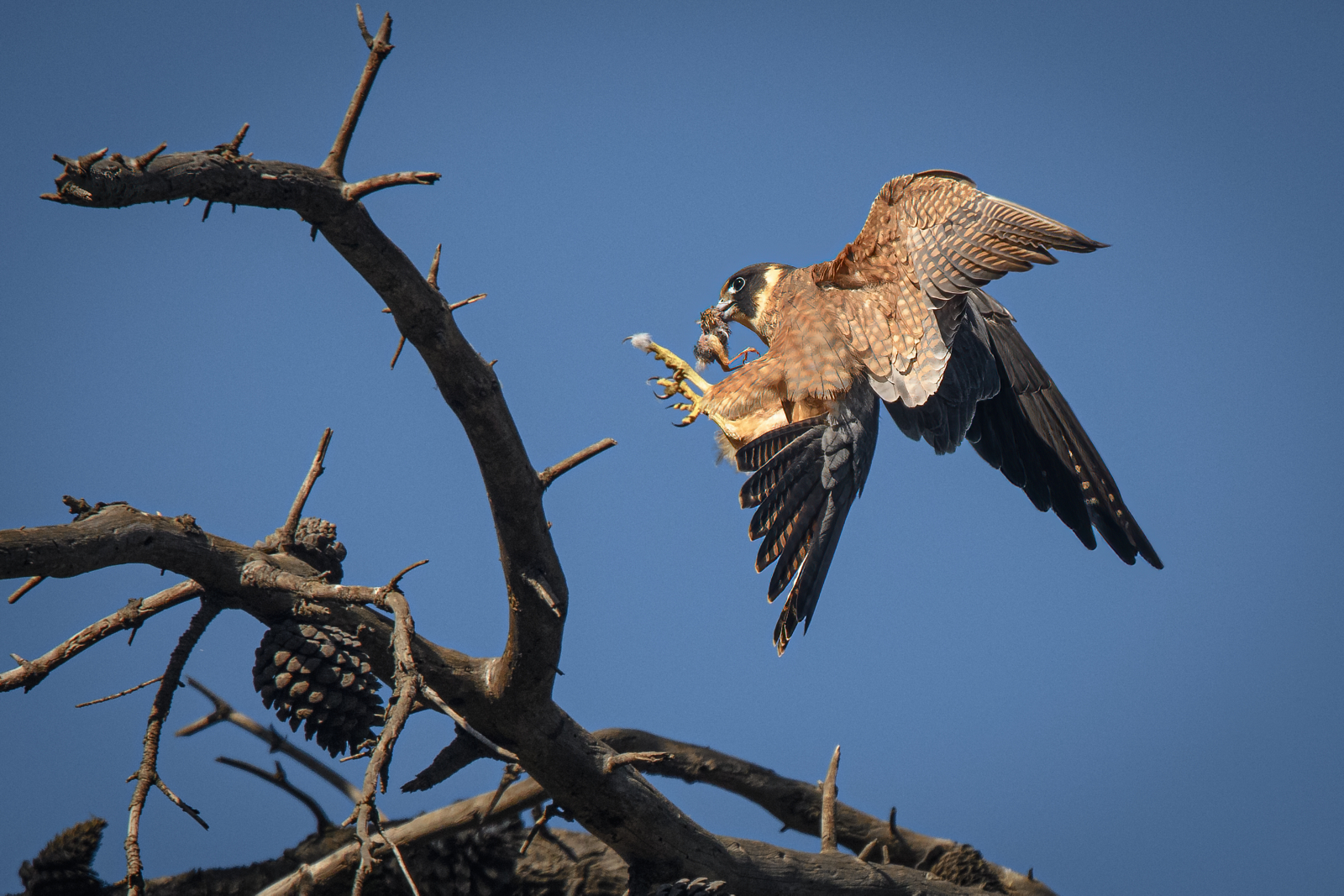
A close cousin to their much more impressive and better documented relative, the Peregrine Falcon, it is easy to spot the similarities once they get into the air.

Speed and manoeuvrability being high on the comparison list.  I’ve had the chance to watch them a couple of days in some high winds, think 70-80kph. They fold back the primaries and run on very closely tucked wings, at speeds that are almost impossible to follow in the viewfinder.  A side-different to working with say, Black-shouldered Kites, that are by comparison, quite sedate.

They have a nest. And it’s high up in one of the tallest gums in the area. Cleverly placed in the multiple “Y” that gums sometimes make with 8-10 thin branches reaching out crownlike, and she has placed her nest securely in the little fortress.

Hard to gather how far advanced they are, but the past couple of days we’ve found her sitting less on the nest, so I’d be guessing her young are beginning to take on their first feathers.

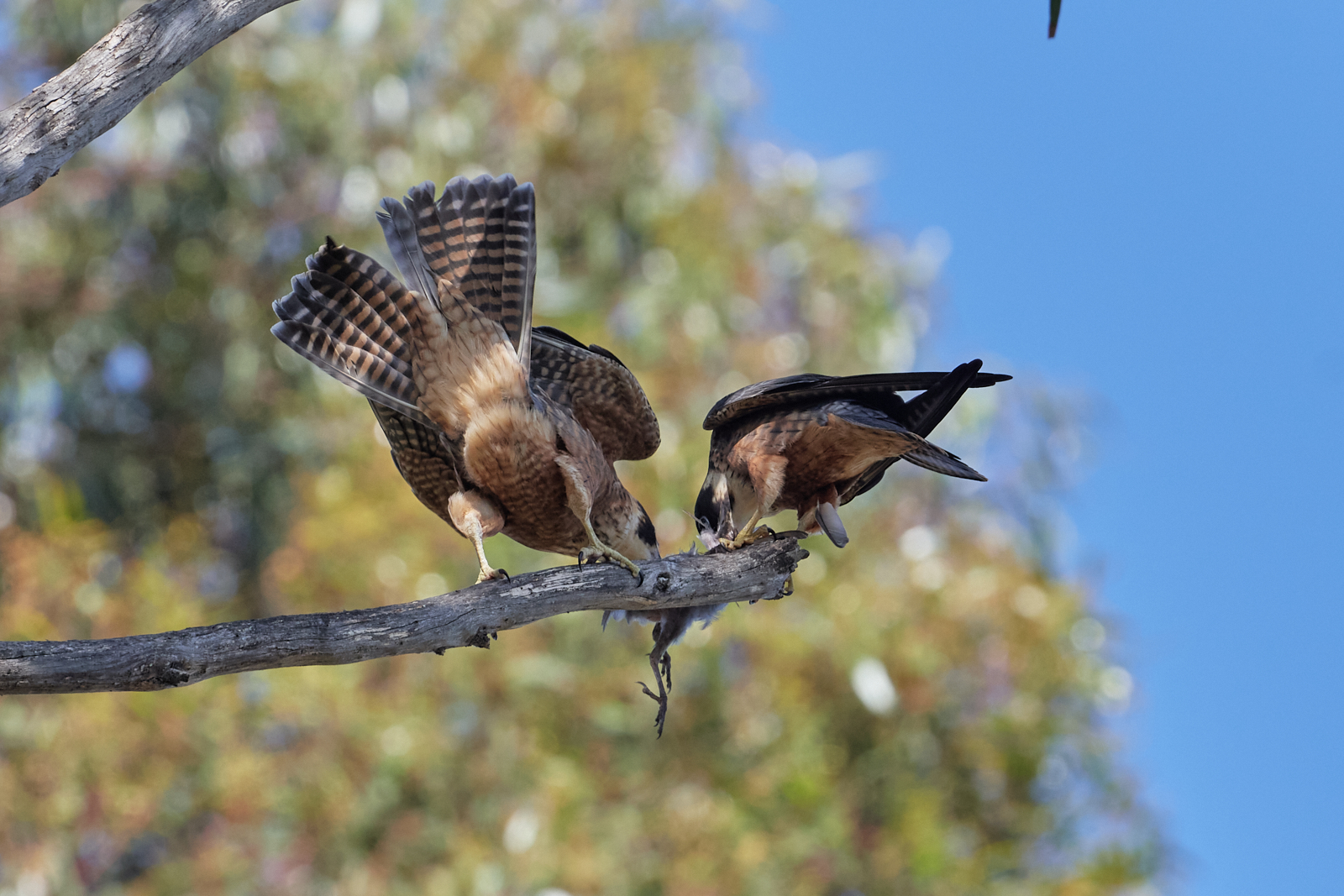
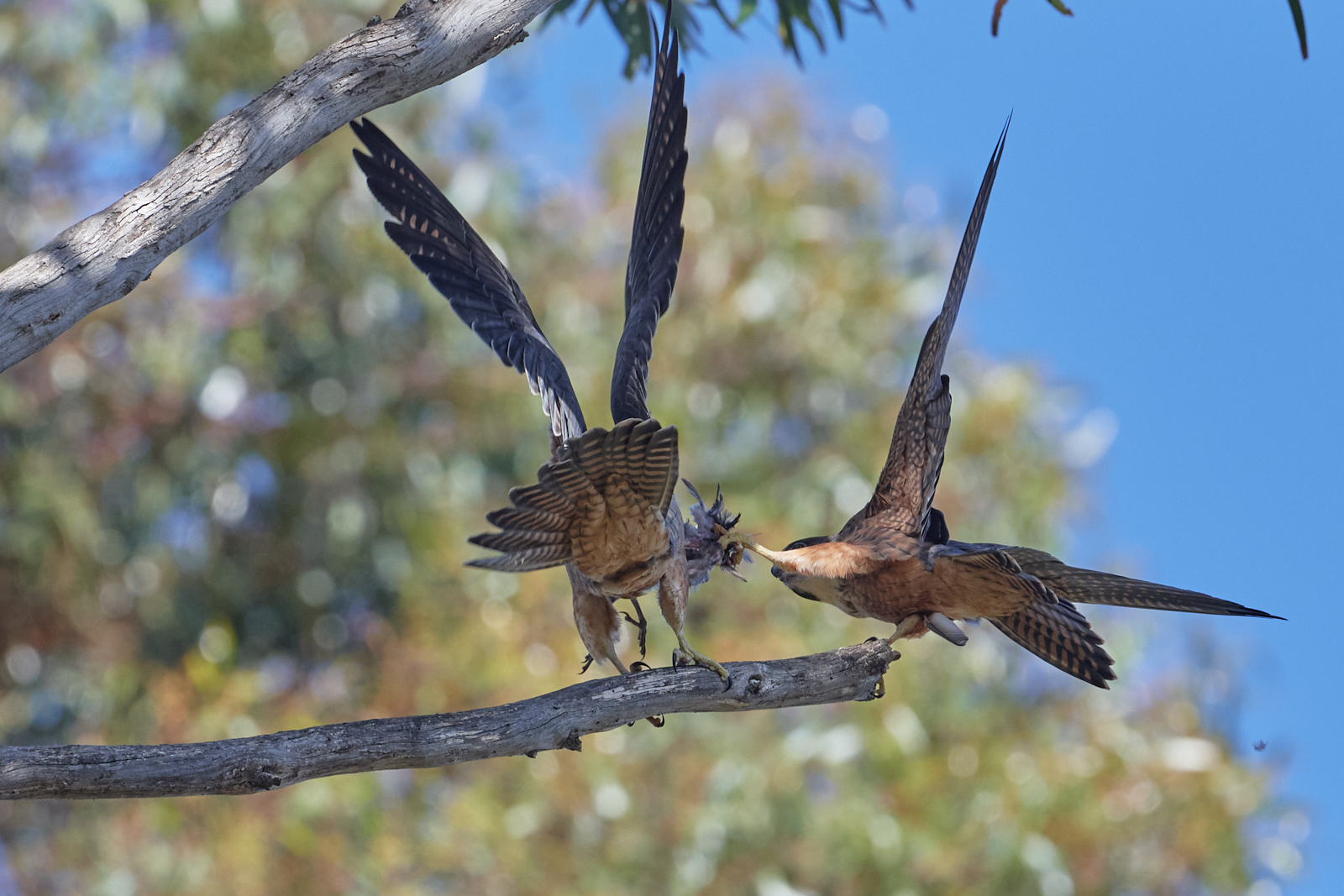
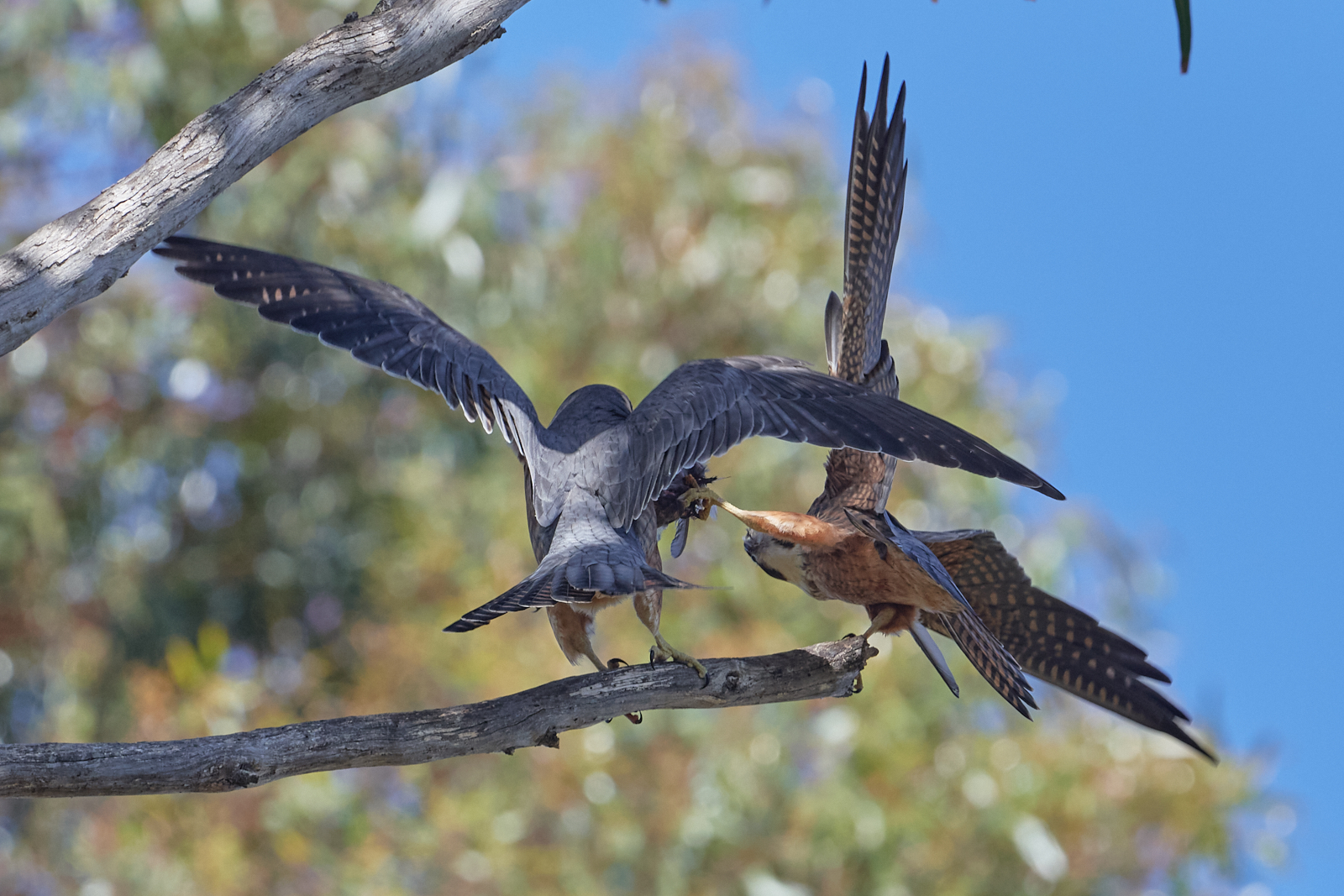
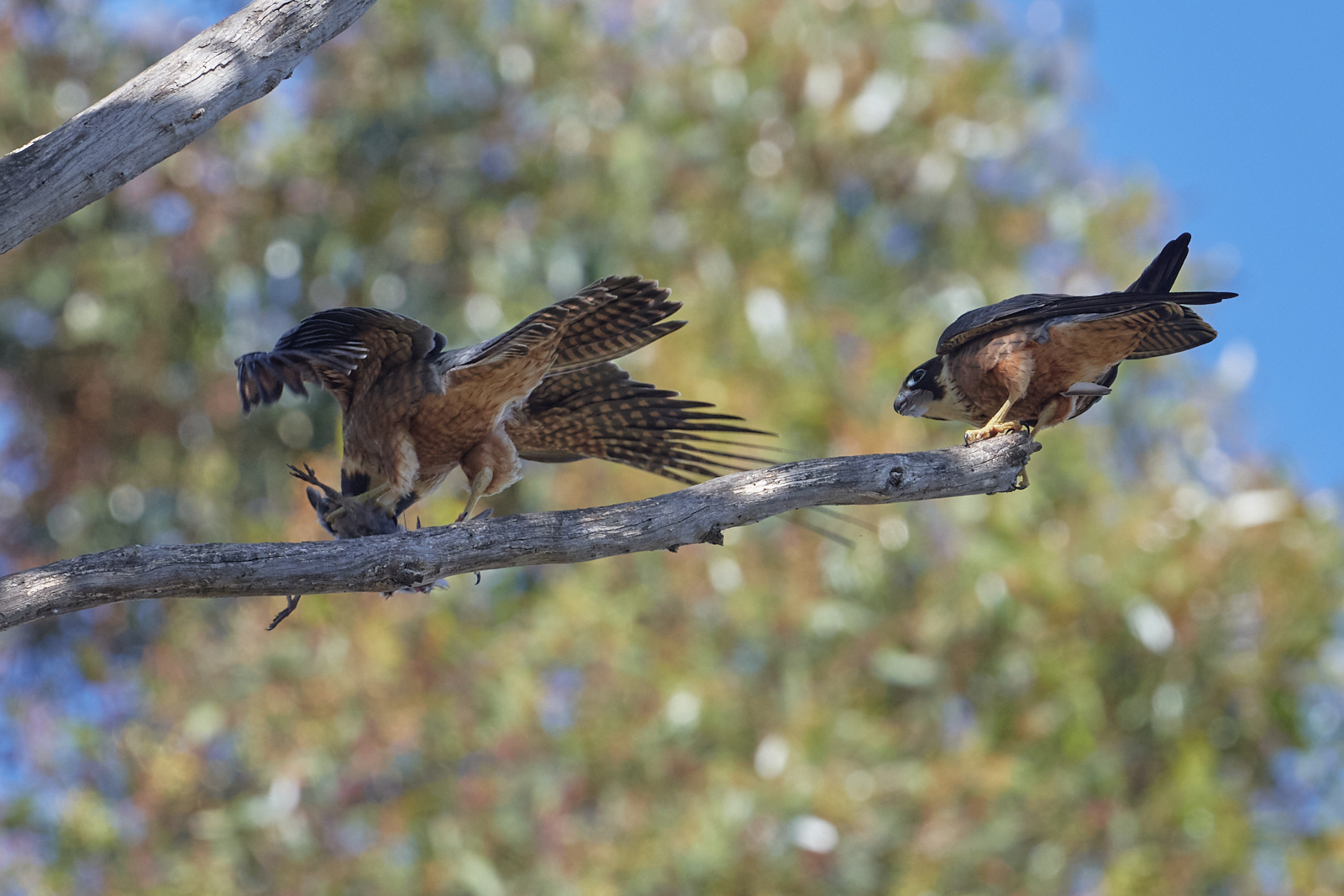
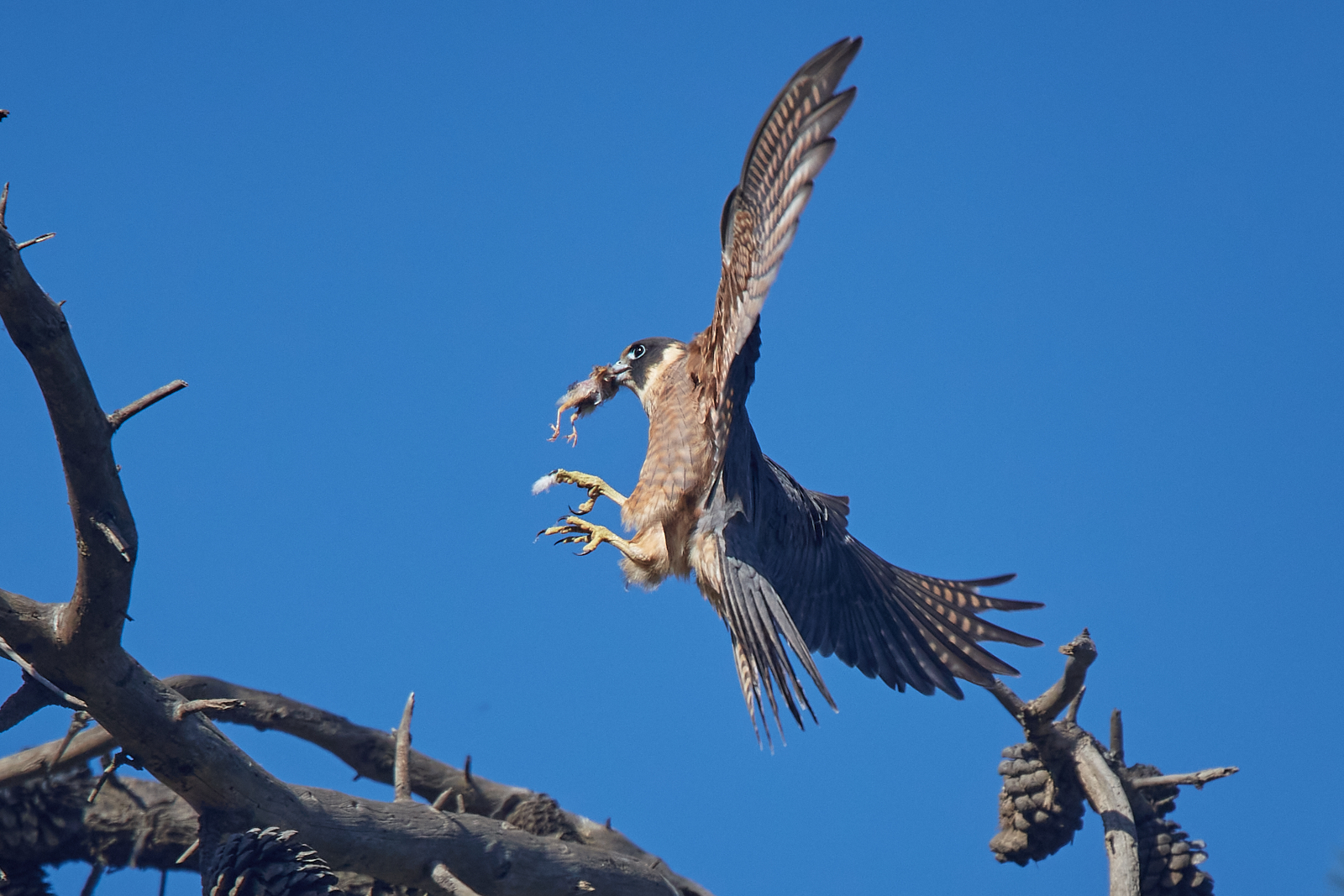
Feeding appears to have its own rules.  He comes in laden with a catch. Sits on a particular branch and calls quietly to her.  After a suitable pause in events he moves to another tree, sits and waits.

Then the express train bursts out of the nest, or from the high-up perch where she has been surveying the scene, snatches the catch and sits on a branch just near him to consume her well earned meal. So far I think the count is mostly Red Wattlebirds, but today it was a Welcome Swallow.

She is head and shoulders bigger than he. Pretty typical among raptors, but really noticeable when they sit close-by.

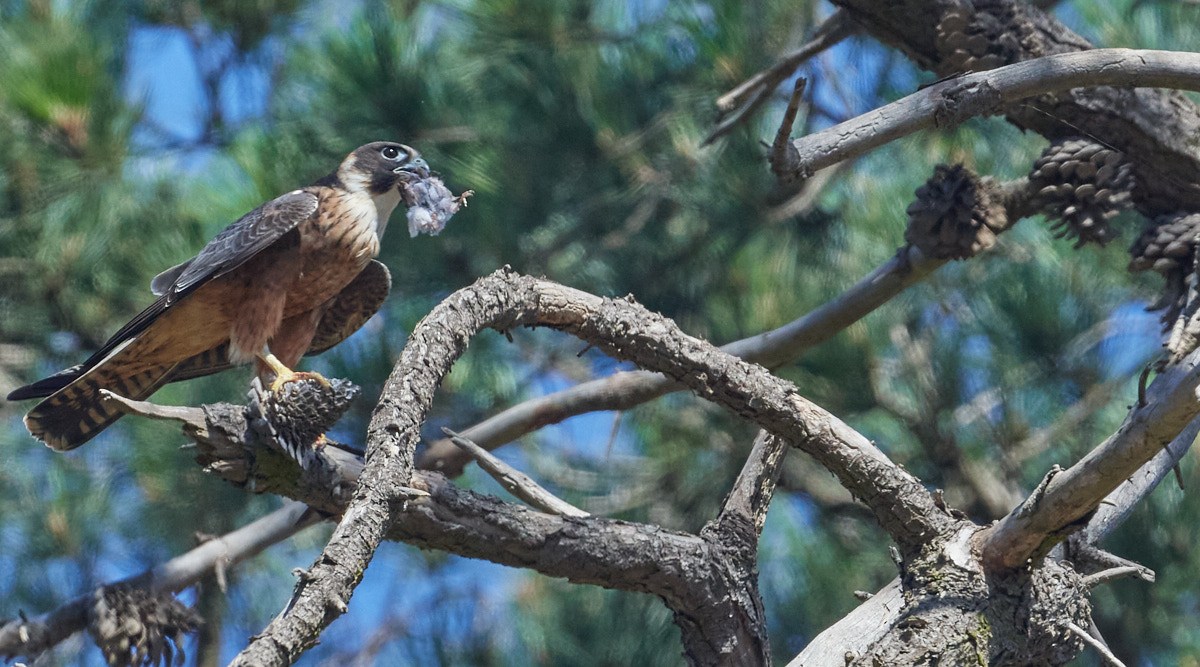
After helping herself, she then flies directly to the nest and seems to be feeding small pieces from her beak, so another clue the young are not that advanced.

Lastly the thing that has impressed me is the super efficiency of them both. There are no wasted wingflaps, they glide from one tree to another, hardly using any energy.  But, when needed, the wings dig in and they are gone.

Warning: Photos contain some graphic feeding moments.

The female approaching the waiting male
She has several perches that she uses while she waits. Here the flying gear is getting a work out
Arriving for her meal

The food transfer is super efficient and fast
Even though he is sitting a bit forward the size comparison is obvious.
Off to the nest to feed the young
Softly calling with the latest kill
This looks like Welcome Swallow on the menu. She is taking it straight to the nest.
The Werribee River runs behind the nest area and he explodes of the tree, disappears over the edge of the cliff and with about 3 more wing flaps is back on the tree.

Saturday Evening Post# 108: In the Glow

Translucence  noun
The quality of being translucent.-permitting light to pass through, but diffusing it so that persons or objects on the other opposite side are not clearly visible.  The latin roots of translucence are trans- through and lucere-to shine.

One more from the old “Lighting” notebook 

The wonderful thing about translucent light is the way it makes colours glow as the light passes through the material

Some examples include, flowers, feathers, water, steam, fog, even flags and fabric.

The results can begin to create an almost surreal quality to the material. 

When only using backlighting, the subject itself will be in shadow and careful careful with the exposure is the first step to ensure the right mood is created.

I once, as a junior member of photographic studio, was involved in setting up a shoot for an advertising brochure for a new winery.  New winery had commenced operations in what I believe was an old dried fruit packing storehouse.  A huge barn-like building covered in corrugated iron. (Very typical of a country store house)  Inside it was pristine in the wine-making areas with all the stainless steel vats, pipes and tubs.
However the foyer area and office was still in pretty much the old walk-in style, and a magic dust hung in the air to catch any rays of sunlight.

One shot, in particular, was going to be the  obligatory shot of the good drop in a glass.
Once we (think me) had carried in all the tripods, lighting and camera gear, the photographer scouted around for the best location

Now the old shed and more importantly the galvanised corrugated iron sheets had been repurposed from another location and small nail holes were scattered through the sheets.
The late afternoon sunlight was streaming in like tiny pencil points through the holes and illuminating the dust in the air.

“Bring me a glass of your finest red,” said the photographer.  Fine time for a drink I thought, we have work to do. 

He placed the glass, with the corporate logo, on a barrel in the foyer and moved it about until the sunlight through one of the nail holes stuck the contents of the glass.
”Here is where we want the camera,” he pointed. And I moved the tripod, camera set up to that spot.  He took a few seconds to get focus, work out exposure, you know all the boring photo stuff no one does these days, and then had me move the wineglass back and forward until…
The light struck the centre of the red wine and like some magic laser-beam, the glass glowed red and the colours swirled across the top of the barrel. 

“Click”. 

If you’ve ever seen buildings bathed in colours and changing patterns at night, you’ll be able to visualise the result.

Late one sunny afternoon this week we were coming back from  looking for a Brown Falcon at nest.

As I was unpacking IamGrey, I noted the evening light running through the roses in my next-door neighbours garden.
Magic.
The beauty of the petal colours and the amazing form and shape of the petals glowed in the light and
“Click”.

And although I have a one image per Saturday Evening Post policy,  here is the falcon as she turned toward the sunlight and the colours cascaded from the feathers.

Little Journeys: On the Road Again

Life I love is taking pictures with my friend.

Here we are a week or so out of a nearly 4 month lockdown. Depends of course where you start counting, but we were in one of the ‘naughty’ suburbs, so our privileges were removed a bit earlier than the rest of the city.

For EE and I, a run down to “The Office” was always going to be high on the must do first list.

So given a halfway decent burst of sunshine and we were off.

The one thing that we noted first was the amount of grass that covered normally bare areas.  A distinct lack of large kites, Black and Whistling, and how well some of the smaller scrub birds had done getting an early nesting in.

So in no particular order.

Purple-crowned Lorikeet
Purple-crowned Lorikeet pair.
Sad to report that the old branch has since parted from the tree trunk, exposing the nest, and they have moved on somewhere else. They have been loyal to this spot for at least the past four seasons.
Purple-crowned Lorikeet. Protecting its nest from marauders
Little Lorikeet. This one led me a merry chase through the leaves. I could hear it, but it just wasn’t easy to see.
Happiness is… A White-browed Scrubwren with tucker for its young.
Looks like the Dusky Woodswallows has swept in while we were in lockdown and already had a clutch of young on the wing
Most interesting find of the day. Juvenile Fantail Cuckoo waiting to be fed.
Fantail; Cuckoo and its hosts, White-browed Scrubwrens.
The adult Cuckoo must have been very clever as I always find these little birds among the most wary.
Higher up the track on the cliff line, a pair of Australian Hobby are re-nesting in a familiar spot. More to come on their progress I think.
The age old battle of David and Goliath. The immovable object v the irresistible force.
Both have much at stake with young to be fed.


Saturday Evening Post #107: Matching the Mood

Hotdiggity.  We’re gunna commit photography.

After last week’s Saturday Evening Post #106, I felt like continuing with the voice behind the light photo skills exploration.

There are many studio lighting ‘sets’. One of the more challenging is sometimes referred to as the light of “Comic Book Villains”.

Split Lighting.

A variation of side lighting. A main light source is used at 90 degrees to the subject-camera plane. It provides light to one side of the subject, and shadow to the other side.

It is not the most flattering light for portraits.
But.
It does add its own feel of dark mood to the subject—hence the ‘villain’ nickname.

Split lighting has quite a number of moods to offer.  One of the most useful is a feeling of conviction-assurance-confindence and sureness. It was used to great effect during the 1930s and 40s for movie starlets. A hint of mystery and  intrigue.

More recently I’ve noticed its been used in movie posters for ‘action’ style stories.
Lord of the Rings, Casino Royale, Lethal Weapon 4, Parker just to mention a few.  No, don’t watch them, I’m not doing movie reviews, just poster examples.
I once worked with a company that licensed the use of the Lethal Weapon 4 poster as an overlay for an entertainment centre experience. But. That is definitely another story.

It is also a very useful product in studio light, and has worked a treat for quite a number of car brochures.  Both Apple and Samsung have used a variation recently for their offerings.

The one thing about it is that the subject is always facing square on to the camera. The other day we were out with some Black-shouldered Kites.  The lighting was, well, overcast.
Porridge.

The grey sky was typical Rochester New York, 18% Grey. Now for those who don’t recall.  Rochester NY was (is) the home of the Eastman Kodak Company, some may have heard of them, they used to manufacture stuff called filum.
They also produced a device to help determine correct exposure. The R-27 Kodak Neutral Test Card. One side was 90% reflectance, White.  The other 18% Gray (note American spelling). It has been said that the 18% was chosen as it matched the grey skies of Rochester NY. It is not true that the sun never shines in Rochester, nor is it true that 18% reflectance is the average scene reflectance, but, tonight I won’t pursue that. Nor will I tell tales of the 8ft snow dump on the streets one winter.

The male has been named Bronson by my flickr mate, David Nice.
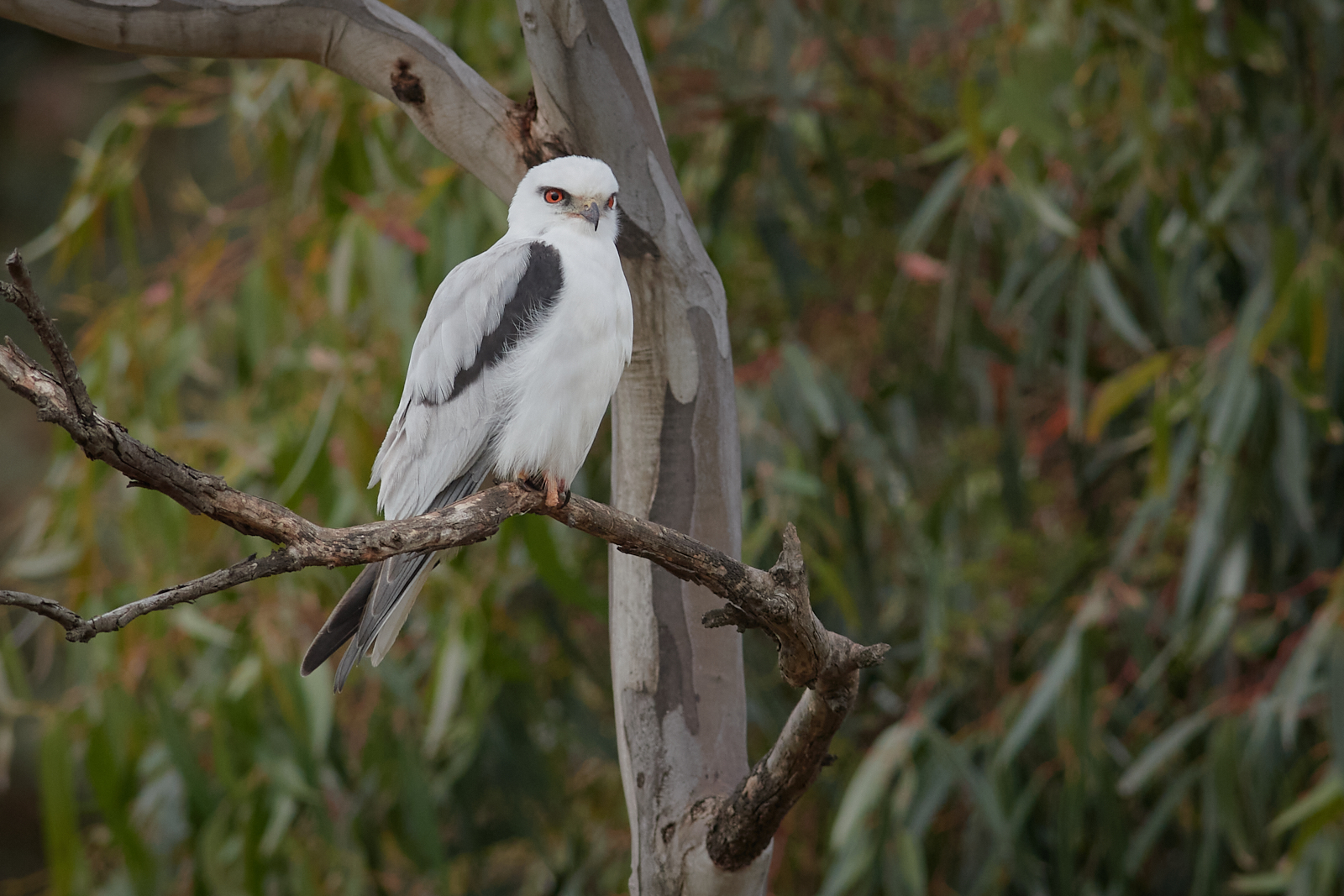
Bronson is a white and grey bird on a grey porridge sky. Think merge.

Then by one of those quirks of nature the clouds cleared momentarily and the early morning light brushed over Bronson’s side and he looked directly at me, and I had a Split Light subject and shot.

Gives him that awesome presence he deserves.

One frame was all I needed, and then porridge oozed back over and the moment was gone.

Little Jouneys: Home Catastrophe

Ok, I know they are simply ‘House Sparrows’. Somewhere there is a text that says, “…  And not one of them is forgotten?”

We had, EE, David Nice, and I been sitting waiting for some young Black-shouldered Kites to do something Black-shouldered Kitey.  Now raptor time is quite different to human grasp of the sun moving across the sky, the earth turning on its axis, its rotation around the sun, and the turn of the solar system in the spiral galaxy… etc.

While we were waiting we noticed that a family of House Sparrows had become interested in a dead trunk of a eucalyptus  in the area. The old sun-bleached and rotting wood had a number of openings and spaces that would apparently suit the sparrows in their nesting quest.

So over the next couple of hours a procession of birds carrying varying pieces of nesting material flew back and forth.

The male seemed more interested in offering advice than in carrying much, although to be fair he did lay in some pieces of grass.

A few days later we came back to monitor the kites and found that the old rotten trunk had suffered a major event, and a good metre of so of the wood had parted company from the main trunk and lay on the ground.  But what it did reveal was all the work of the past few days. The nest was exposed. Needless to say the male was none too happy about the turn of events, and if despair and disappointment are part of their makeup, then he certainly was upset.

We wondered if someone might have pulled the wood loose, but given the location it was most unlikely.  I am guessing that as they kept pressing the grasses into the small space that the pressure became so great that the old rotten areas simply couldn’t support it and down it came.

There was much discussion among them about using the lower part of the stump to restart a new nest, and they even bought in some twigs and grasses to get started.
Will have to wait till the next visit to see if they go on with it.

Bringing in the supplies. It’s possible to see how rotten the area was.
The supervisor at work
Oh, no. What has happened.
The front face of the trunk has fallen away leaving the nest completely exposed.
Time for the engineer to inspect the damage.
Hard to be sure, but it might be that the pressure of so much building material was just too much for the old wood.
I’m not sure, but I don’t think adding another piece of carefully chosen grass is going to solve the problem
A new start? Perhaps there is still room underneath for another attempt.

Saturday Evening Post #106: For the Love of Light

Someone once said, “Everything that comes from the camera, comes from the heart (Source: Your humble editor)

Now you might instantly think of some of the great emotive pictures that have been taken. The sharing of precious intimate moments between a grandmother and granddaughter perhaps.  The smile of proud family members at a graduation. The joy and delight of opening a special present.
All heart sharing experiences.

Alternatively you might recall photographs that have told of less happy moments or have shown  in great graphic details the destruction of the earth’s resources or man’s inhumanity toward fellow earth inhabitants.
All heart sharing experiences.

But.   There are other times when photographs are taken, merely in a mechanical or perhaps perfunctory way.
A tourist steps out of the bus into some historically important area, snaps of 2 or 3 shots, and goes into the local bistro for a meal.
Recently I saw some photos taken at the Grand Canyon.  Most of the people in the photo were more engrossed in what was on their mobile phone than the vista around them.
Heart sharing experiences still. But a heart that is not invovled in the mood, feeling or light of the moment.

As photographers we used to talk a lot about the “Language of Light”. Nowadays the discussion is almost always about what creative style, filter or add-on that can be applied in post production. My guess is because the heart is not in the photo experience, but is enamoured by some ‘Wow factor’ the designer has chosen.

Joe McNally, has a video training programme called “The Language of Light”. Joe has developed a visual style that is somewhat easily recognised. Great use of light, clever settings, the right model, and brilliant use of the medium.

In my formative years the concepts of the Language of Light was a major skill that was ‘drilled’ into neophytes. One of my early mentors spoke of it as, “We start with a dark canvas-the shadows- and we paint on that canvas with our brushes- the light.  Each stroke reveals a little about our subject.  When we have revealed enough, we stop. The remaining shadows help to set the mood.”

We were required to be able to discuss some of the major elements of the language.
Including:
The Direction. Where was the light coming from. Front, side, back, overhead, diffuse etc.

The Colour. These days we fiddle with White Balance, but it used to be called Colour Temperature.  Blues tend toward cool, Reds tend to stir the senses. Greens can be calming. These days there’s a slider for that. 🙂

The Quality. Hard midday sun, soft diffused, rim light, chiaroscuro. And how we handle it with scrims, flash fill, diffusers and filters.

The Quantity. And how we handle exposure. Too much, the mood might be lost, too little we struggle for delineation of the subject. Good light-bad light. Or perhaps just light that doesn’t match the subject or mood.

As learning photographers, we had to be able to discuss those terms at length, and sure enough on the end-of-the-year exam paper would be such a question.

Q 123. (5 points)
You are given a white china plate and a polished silver fork. Discuss your choice of light and what steps you would take to keep the detail of the plate while maintaining the filagree of the fork. (Use a diagramme if necessary)

Huh!, If necessary.  If you didn’t sketch at least one or more lighting designs you’d only get one mark, no matter if you filled three pages of detailed explanation. 🙂

These days no doubt it would be a multiple choice on some moodle platform. Simply fill in the check box of choice. No diagrams needed.

Q. 2
You are making an Instagram emoji. What lighting consideration would you choose.

A. Google to find latest trending style
B. None, my iphone 2345 doesn’t need light
C. Check to be sure that the lighting is not being exploited by underpaying third world profiteers
4. Not a relevant question.

The one thing that always seems to be missing from the discussions is the mood.  What is the maker really trying to express.  What indeed is coming from the heart.


We had an early morning start the other day, and by sheer chance the weather presented us with some fine rolling mists.

It was good to be able to enjoy the light playing on the shapes and shadows.


Little Visits: Hard Work Pays Off

Now that we have the chance to get out and about, well at least for 25km, it might seem strange that I’d start off by posting some activity on the river where we’ve been doing our daily walk.

Two things have become apparent on our little journeys.
Firstly: How many Magpie Larks are at work on nests or have already flown young.
Secondly: The numbers of Willie Wagtails, all with nests quite close to one another, 50m or so is not unusual, and they have all begun about the same time, and most of them are now fledging, or soon will be, their first clutch. And surprisingly for Willies, none so far seem to have suffered predation by larger birds.  We have about 6 nests for sure, and several others that have yet to be discovered.

It was time to take a look at how things were going, and to our delight one pair had managed to get their three young on the wing, either that morning, or the day before, as the young were still ‘getting their wings’.

Another pair, with perhaps the best nest location, under an overhanging branch now overgrown with a creeper, also just got their two on the wing. They seemed content to hop from branch to branch among the creeper and the branches.

Enjoy

2010-27_Z50_3013
One of two that have been on the wing for about 5 days.
Time for a food top up.
An adult with their three young aeronauts.
Still with short tails and rich brown markings. The short tail doesn’t stop them from “Wagging”.
Time for a food topup
And down it goes.
tough shot. Two just fledged and still really only branch hopping.
Overlooking its important charges. This is one of the adults with the branching young.

Saturday Evening Post #105: The Fruits of an Early Spring

While we’ve been in lockdown the past few months, I’ve watched with interest the antics and the movements of a pair of Blackbirds that regularly hunt in our tiny backyard.

Their energies hit high level just a couple of weeks or so ago, and I eventually figured out by watching that they were engrossed in a bush in the next-door backyard. A nest no doubt.

Then last week the frequency of visits, the amount of a calling and the digging in the garden went into really high gear.
Now, I’m not a bird feeder, so for a couple of days I simply refrained, but a sliced apple core, or a small handful of sultanas, or mixed fruits, raisins seemed to be the favourite, saw them ducking over the fence line with full beaks.

I had to smile.

And.

Today.

Looking out at the rain soaked ground, lo and behold, not one, but two big fat chicks sitting in the dry under the pergola.  With mum and dad making constant trips to top them up.

Why sultanas?  Well one of my Flickr friends in England David Brooker posted what must be the ulitmate friendship between human and blackbird.
Enjoy

Copyright David Brooker (2020), https://www.flickr.com/photos/davidbrookerimages/with/50412253708/


Here’s Mum feeding one of the young ones a small piece of pear.

Photographic Essay: On the Road Again

Our first real day out after 4 months of Lockdown.

The title of the blog says more to my hairstyle than it does to the fact we were out and about.

At the moment, Willie Nelson and I have similar hairstyles. 🙂
So hum a few bars of “I’m on the Road Again, life I love is making photos with my friend, and I’ can’t wait to be on the Road Again.”

Where else would we have started than a trip to “The Office”.

As it turned out not a bad choice for a day out.  We loaded up IamGrey and with a sandwich and a cuppa it looked to be a good day.

Here is a quick selection from the day.

First up for the day. Purple-crowned Lorikeets. Each time I find these little birds I always come away feeling better about life and the world in general. They have such calming attitudes
This pair have a nesting site that is regularly used. I was really happy to find them out enjoying the sunshine
Another pair of Purple-crowned have a solid branch for their site. This one is blocking the hole so that marauding Rainbow Lorikeets will not bother its young.
There has always been a steady number of Little Lorikeets at the Office.
I was hoping they might be nesting, but this one did not seem to be interested.
It took me quite awhile to find it amongst the canopy. For all their bright colours they are muted in the shadows of the leaves and blend in so well.
White-browed Scrubwren busy with lunch
A recently fledged Fantail Cuckoo. Another score for EE.
It sat for quite a time, as we ate our sandwich and enjoyed the Earl’s good blend.
It no doubt has been hosted by some unfortunate thronbill or wren.
It took off to a bush, and I followed to see where it had gone.
Not the best photo I ever made, but does show the activity.
The young bird quite happily called in “Scrubwrenese” and within a few moments a White-browed Scrubwren arrived with food, followed immediately by a second one.
So perhaps the Scrubbies have been host to this rather large youngster.
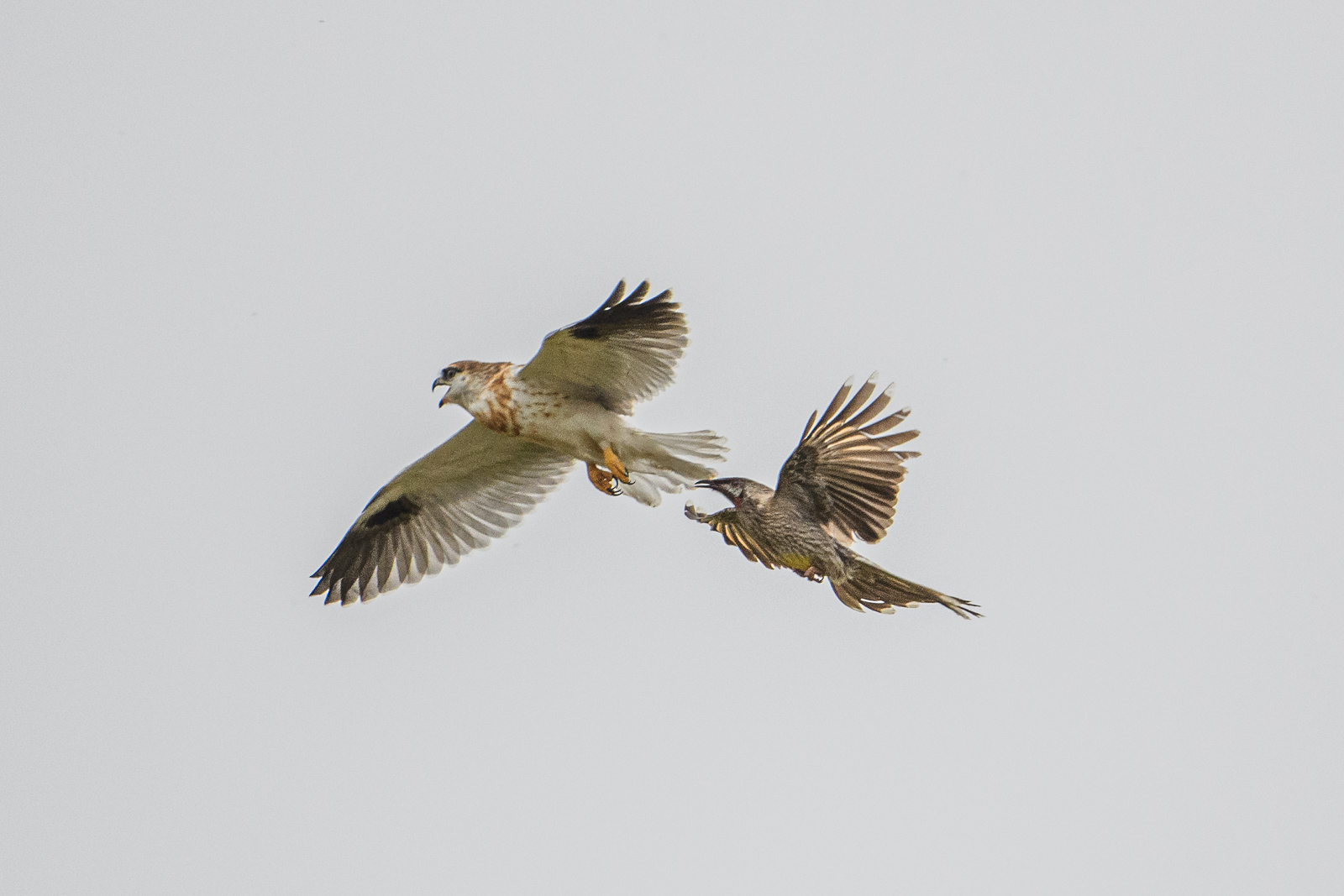
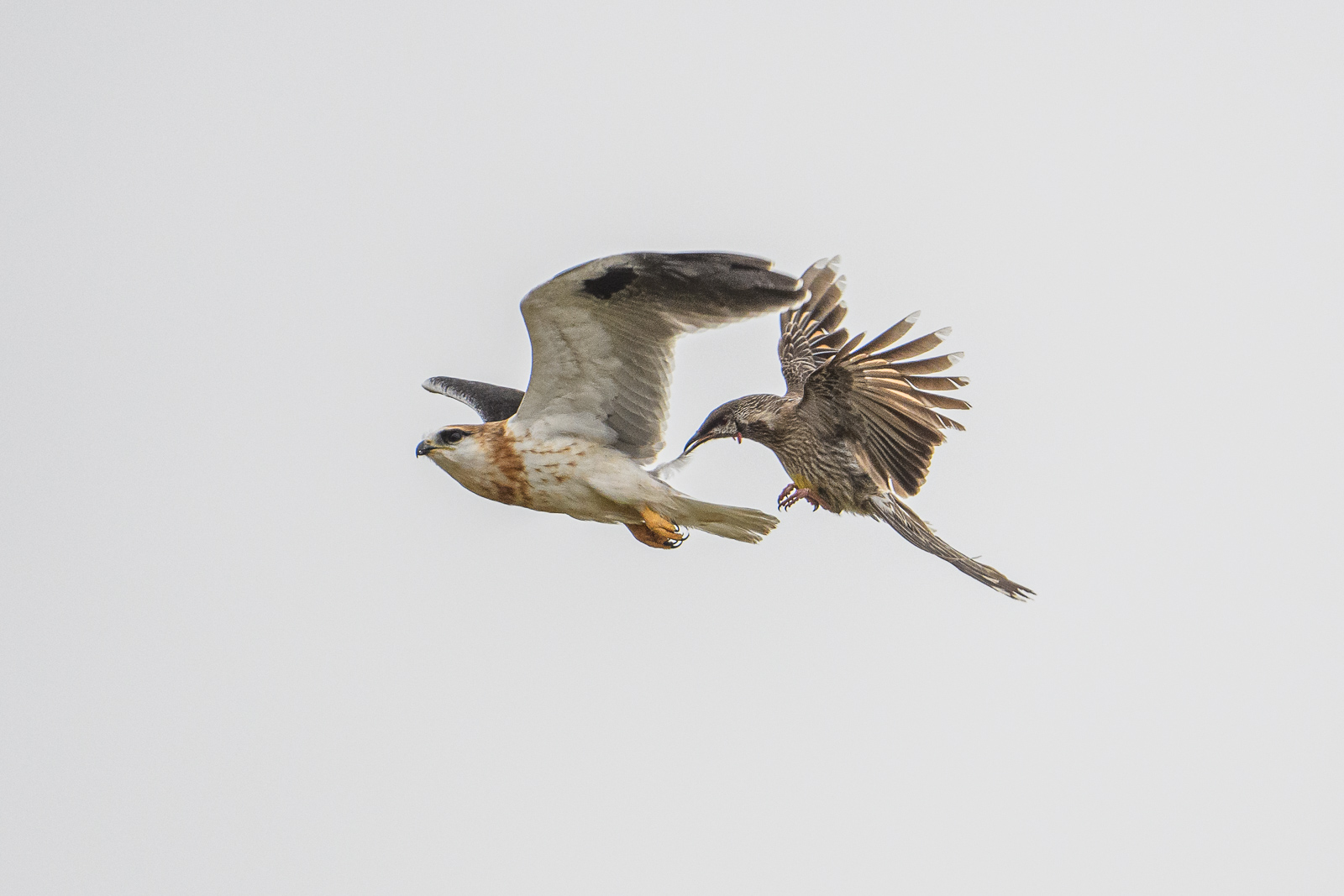
After following a lot of calling noises we located a pair of Australian Hobby that have settled into nesting. The local Red Wattlebirds have taken exception to the visitors and kept up a running battle with both birds.
No doubt their numbers will diminish when the young Hobbys are hatched.
The never ending battle.
Wagtail on Raven


And so humming a few more bars of Willie Nelson’s tune, we headed back to IamGrey and home.


Saturday Evening Post #104: Everyone Right to Go?

Every day for the past 100+ days Victoria’s Premier, Daniel Andrews, has started the daily covid press conference asking, “Everyone right to go?”
So much so that a clip of a number of his beginnings have been put together and you can find  it here. I don’t do Twitter so hopefully this will link through ok

Yes, Mr Premier, we are indeed Right to Go. Please.


In Saturday Evening Post, #87: The fine art of procrastination, I rambled on a bit about the huge amount of uncurated photos I had languishing my photo library and my lack of motivation to do anything about it. Why wade through photos from 2011, when I’m certain to have shots that are better, technically improved, more meaningful than those older efforts.
So the photos continued to glug up the hard-drive(s).

Not being able to get out has  plagued (if you’ll pardon the poor pun), my photo enjoyment and the ability to share new work here, and on Flickr among other places.
So to amuse myself I started a little game of opening a year, and then clicking randomly on a month and then day and viewing the shots that showed up. Some were, to say the least worse than I had anticipated. Did I really photograph that!!!!! ?

But just occasionally a little gem would pop up, and my Flickr friends will have seen a few of them over the past couple of weeks.

Time as they say, marches on, and one morning I was messing about in 2011 folder, and I thought, “Why don’t I just delete these ordinary photos.”
So, I did.

It felt good.

I moved the next day, and soon had whittled it down from 75 also rans to 4 keepers.

I was on a roll.
By the end of the day, I had a mere 1,400 images from my efforts of 2011.  And some of them I would be happy to use.  Given that I had been out and shot for 235 of those 365 days, that works out at about 6 shots per trip. Many had less, 2 or 3 being much more average. Events like a nesting or special encounter might have up to 12 or more.

Hardly exciting stuff, but when I tackled 2010 the following day, I was both inspired and a man on fire. 2009, then 2008, then 2007 quickly followed during the week. And as the image count dropped, the gigabytes of images soon fell as well, and that gave me more enthusiasm for the project.

The challenge of course will be to keep the momentum going as I move toward the later years, and I might well—thanks to Dan—be back out in the field soon anyway.

Our Red-capped Robin is from the 2007 series. This was one of the first years that I was out in Woodlands. The camera was my trusty Nikon D90 and the lens was a Sigma 150-500m f/5.0-6.3 zoom.(it was filling in while my main lens was off at the camera hospital being repaired after a dreadful accident in 90kph+ winds).  The rig was mounted on a Manfrotto tripod, and a Markins Q10 ball-head held it all secure.

Which again shows how I’ve changed, as I rarely shoot from the tripod rig anymore. The nifty little Nikon 500mm f/5.6 PF is handheld all the time.

Another change for the better is the use of modern NEF, (raw) converters.

I’m off now to charge up the batteries, and tomorrow hopefully we’ll be able to take some baby steps out into the wider world and begin to feel once again at home in the field.

Yes, Dan. We are indeed Right to Go.