It has been said by those who know, that, ” The call of the sea is heard only by those who have the nature of the sea in them”. And as I have an irrational fear of boats, I guess I missed hearing the sea bellowing at me.
But then there are so many other things that call us, and some we reject and others we accept and it becomes a passion, (Which I guess is what the original quote was poetically referring to.)
I have been a photographer nearly all my life, (excluding the first 8 years of said life). Did I hear some faint shutter sound, imperceptible to those around me. Or was it the slosh of developer in a processing tank? Or the biting smell of acetic acid in the stop bath? When asked the inevitable question at a function or such, “What do you do? Or these days, “What Did you do?” I always respond the same way. “I am a photographer, by backgound, training and profession”
Because I discoverd early on, answering “Photographer”, always opens up for scorn and derision. Like, how could that be a real occupation! But the supposed call of photography has rather been more an ear-trumpet to other pursuits. Currently it’s birds. And as I’m getting older, birds in flight, and raptors in particular it seems.
I’ve chased down many alleys in pursuit of images. Two areas I’ve stayed away from are Food photography and Medical photography—can’t stand the sight of blood. 🙂 Each field has usually led me to unusual characters, amazing people, and lots of learning. Sure, I know, I could have done it someother way, but filling it with photos has been the icing on the cake.
Gail Mooney, (you can find her here on WordPress) said, (and she has at least 30 years experience as an illustrative photographer), ” If I was just starting out, or in my 40’s, or 50’s, … I would not be complacent!”
And I look at all the excuses I’ve used in the past. Oh its too cold, I’ll stay home I need a new Lens The light is not right I’m not getting enough ‘likes on facebook” —Trust me. That one is made up 🙂 I just can’t find anything to photograph today Perhaps the client won’t like that shot The Bride’s Mother kept getting in the way
It’s a long list.
If the call of sea drives sailors to make amazing journeys then I’m so glad that the same sort of call by that ever-so-silent shutter, so long ago has kept me from becoming complacent about making the best pictures I can, as often as I can and enjoying the companship of other like minds.
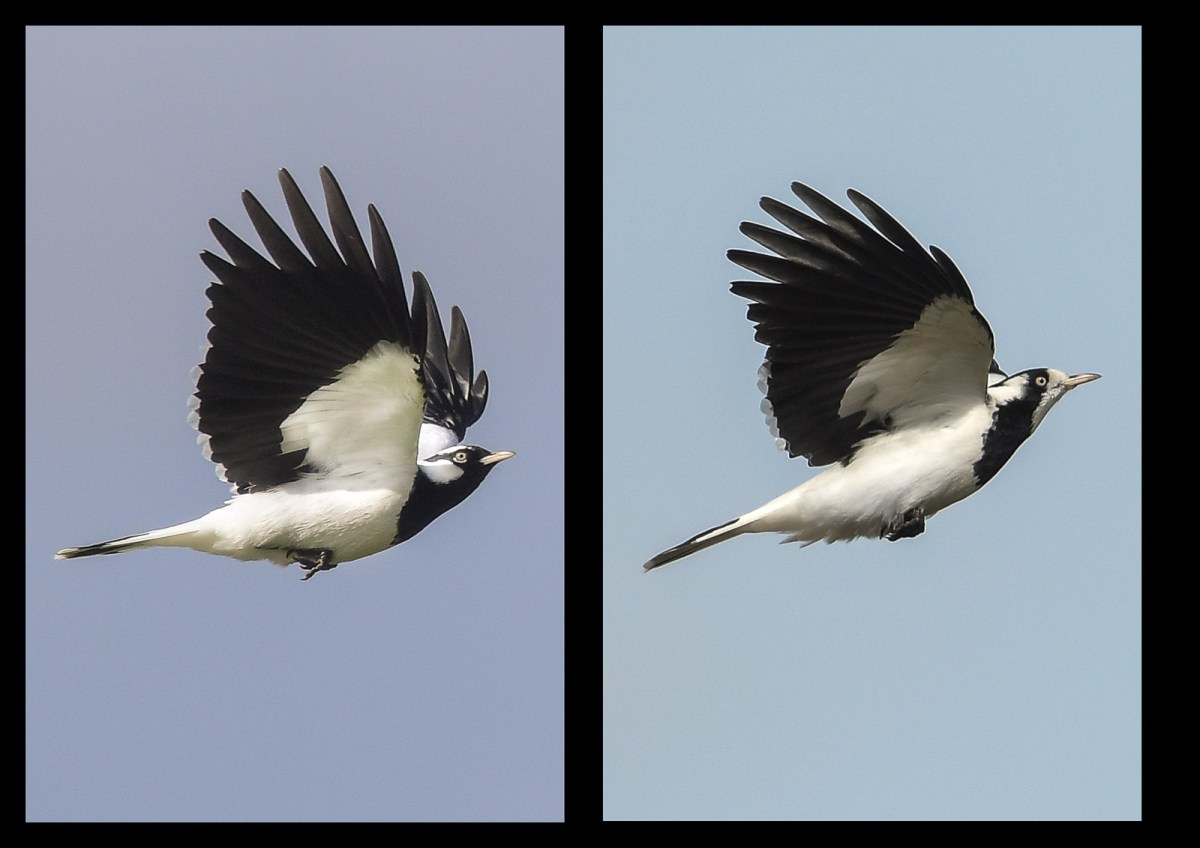
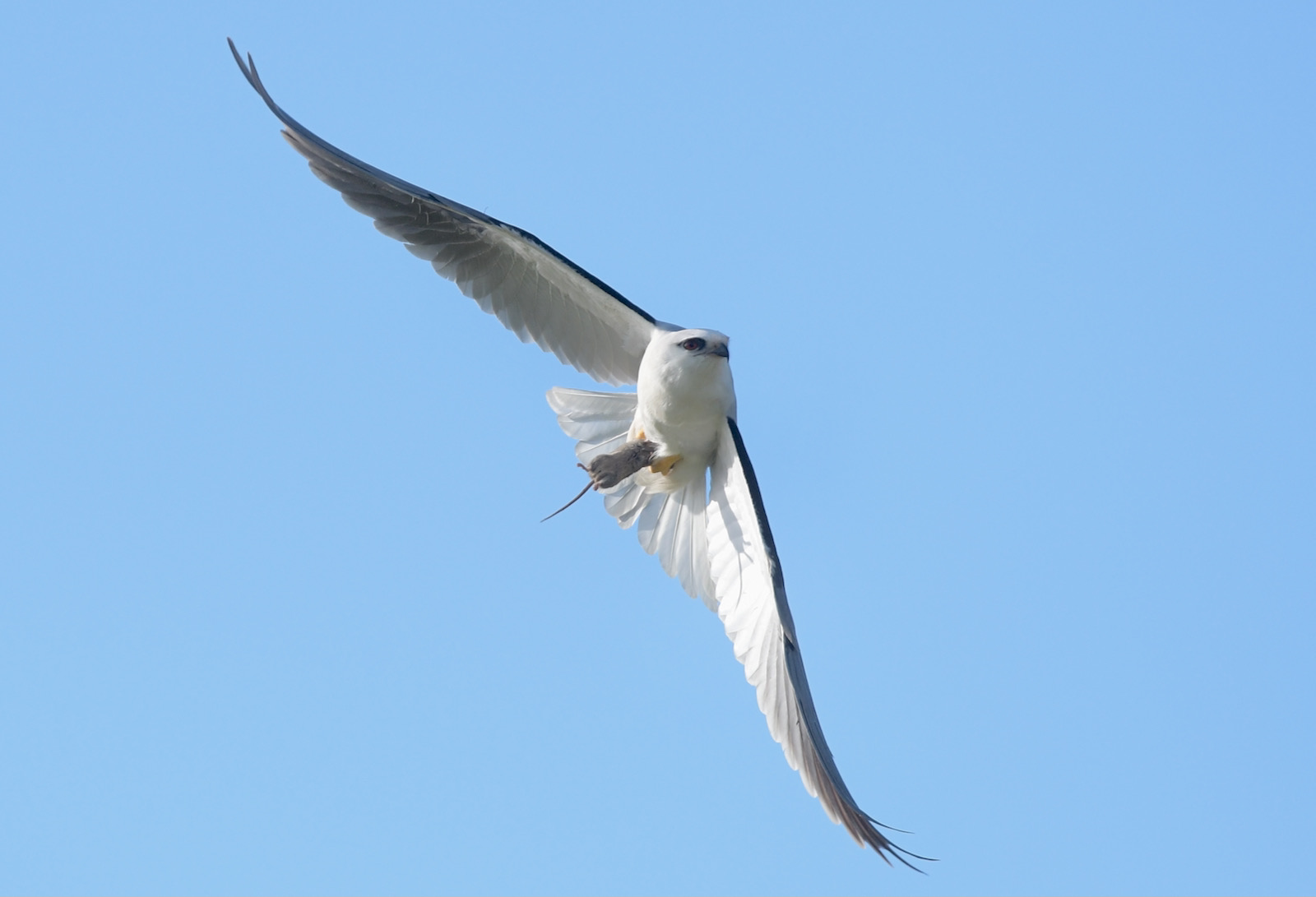
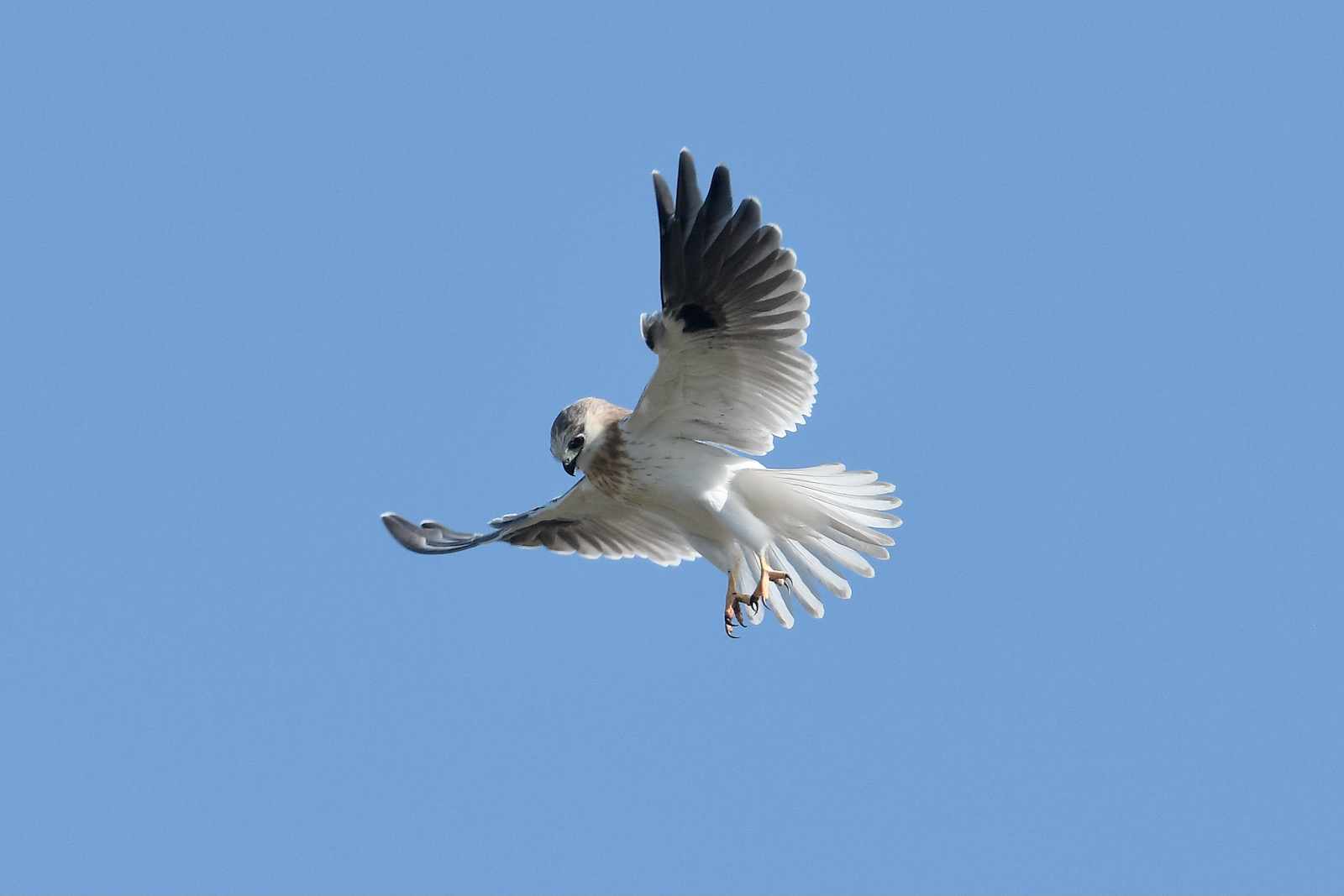
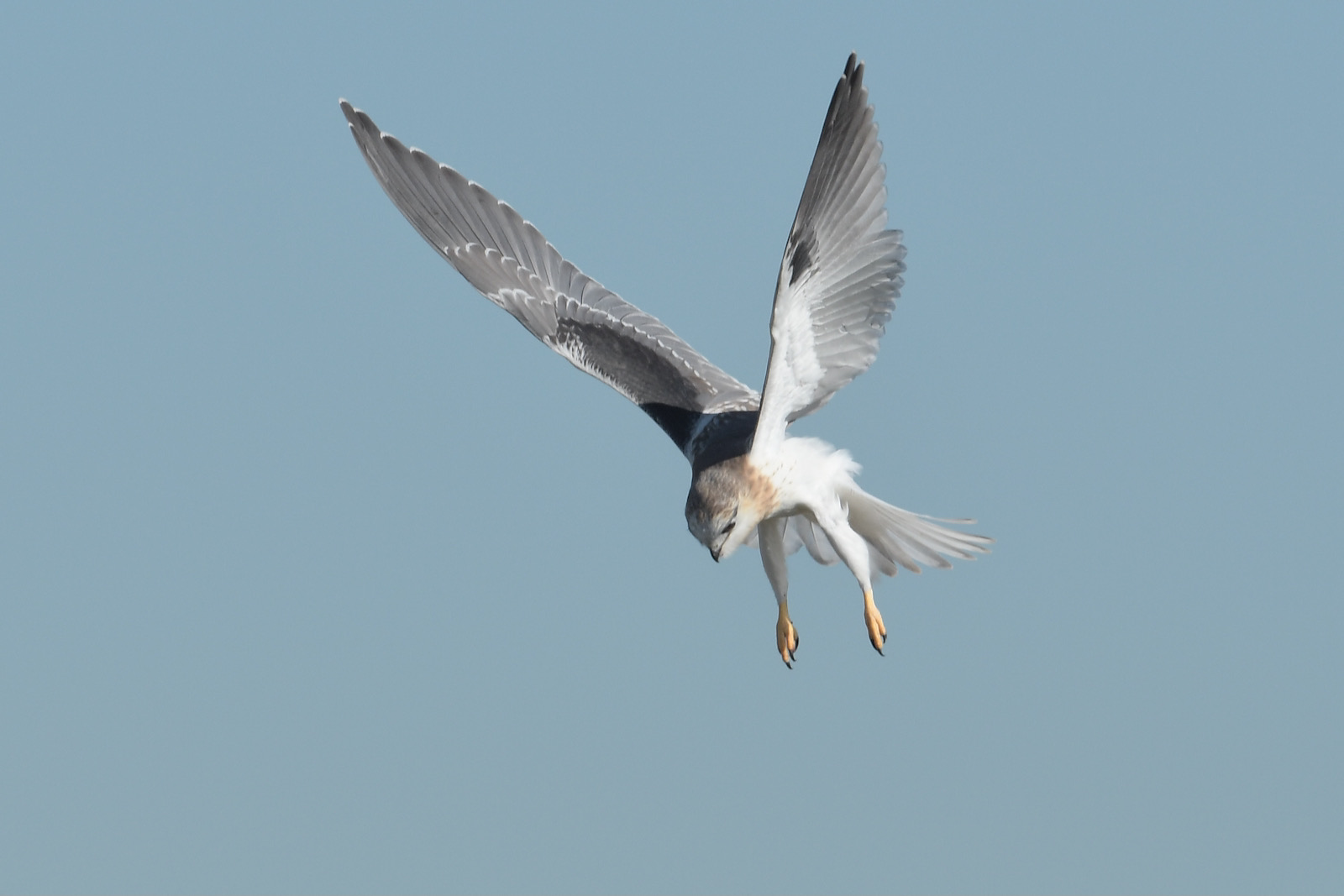
Nailed Mr and Mrs Muddie in flight—albiet on different days. Just happened to notice them while I was shuffling some pictures around. Thought a diptych was the answer.
I’ve been a bit remiss of late keeping the current nesting updated on the blog. I had decided that I’d just wait to make a single story rather than publish in installments.
Belle and Bronson had finished a clutch in early April, and the young were honing the last of their hunting skills, when it became obvious that the pair were planning a second clutch in the same nest. Normally after a clutch, the female takes a well earned break and may not be around for several weeks, and feeds herself, or sometimes moves on to another territory. So it was interesting to see them carrying sticks, Bronson feeding her and mating on a regular basis.
Then. The weather turned. I’m sure she didn’t plan for it, but the weather simply went from bad to dreadful. Rain. Wind. Hail. Gales. Some days all together.
EE and I were talking over the image selection for this set, and noted how few days of bright sunshine there had been and how much of the journey we had missed simply because it was too cold and dreadful to be out in the field.
Yet, to their credit, they persisted. The nest is exposed to the North. So any strong northerly winds, and there were whole days of that, really blasted onto the nesting site. It is a clever nest, among the young leaves and twigs at the end of a branch. It is built over a ‘Y’ at the end of the branch and a short dead stick in the centre of the “Y” takes the load bearing. But on a strong wind, the nest was lifted near vertically and must have been a wild ride for the brooding mother and eventually the hatched young.
Yet. To their credit, they persisted.
There are a few more photos than I’d normally publish and I’ve interspersed them through the text notes.
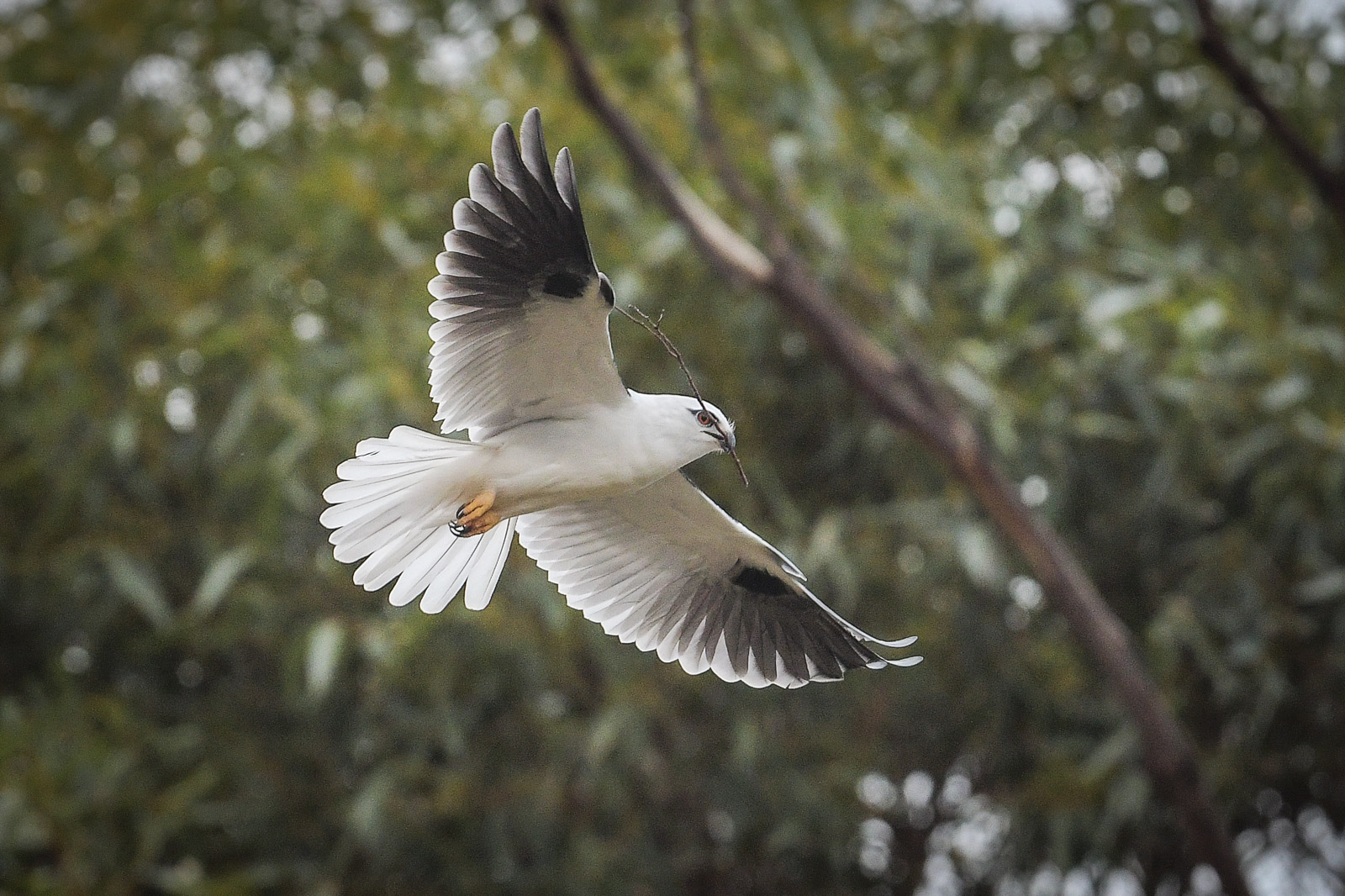
The first step in the process it seems is for the nest to be refurbished. Some internal material was removed, old feathers, dried leaves and some sticks. Perhaps it was soiled by the young before they could move about. Then a range of new sticks were added to build up the edges of the nest as the young had stood on the edges.
The next step was to top up Belle’s reserves. She will be on the nest and unable to catch for perhaps as long as 45 days. She will let him know when she is hungry.
It’s not often easy to get a glimpse of her on the nest, as she sits well down. This was a little later in the brooding and most likely the young were hatched and she was sitting over them rather than down on the eggs.
Hard to know at first how many are in the nest. For quite awhile we though we only saw two, so one might have been a few days behind the others. But once they get their bearings they are quick to want to see the world around them. It is often interesting to see those rich ginger colours, which at first seem to bright to hide them, but suprisingly (I jest) the grey, white and ginger are a perfect match for the nesting location.
Several days before they fly they move about the branches and twigs, a combination of clambering and jumping. This enterprising one had managed to get right out in the open to plead with Bronson for an extra helping.
Then the big day comes and they step out of the tree and into the air. Getting out is not so much a problem for them as working out how to slow down and stop well enough to land. The first few attempts usually are just dumping into the surrounding leaves—just as well they are soft. But in a day or so they can judge the speed and angle and make it on to the branches, albiet in a haphazard fashion
But the skills develop quickly, as you would expect, and within a few days they are highly manouverable little aeronauts. Wing strengh develops and long forays down the paddocks and out of sight become the norm.
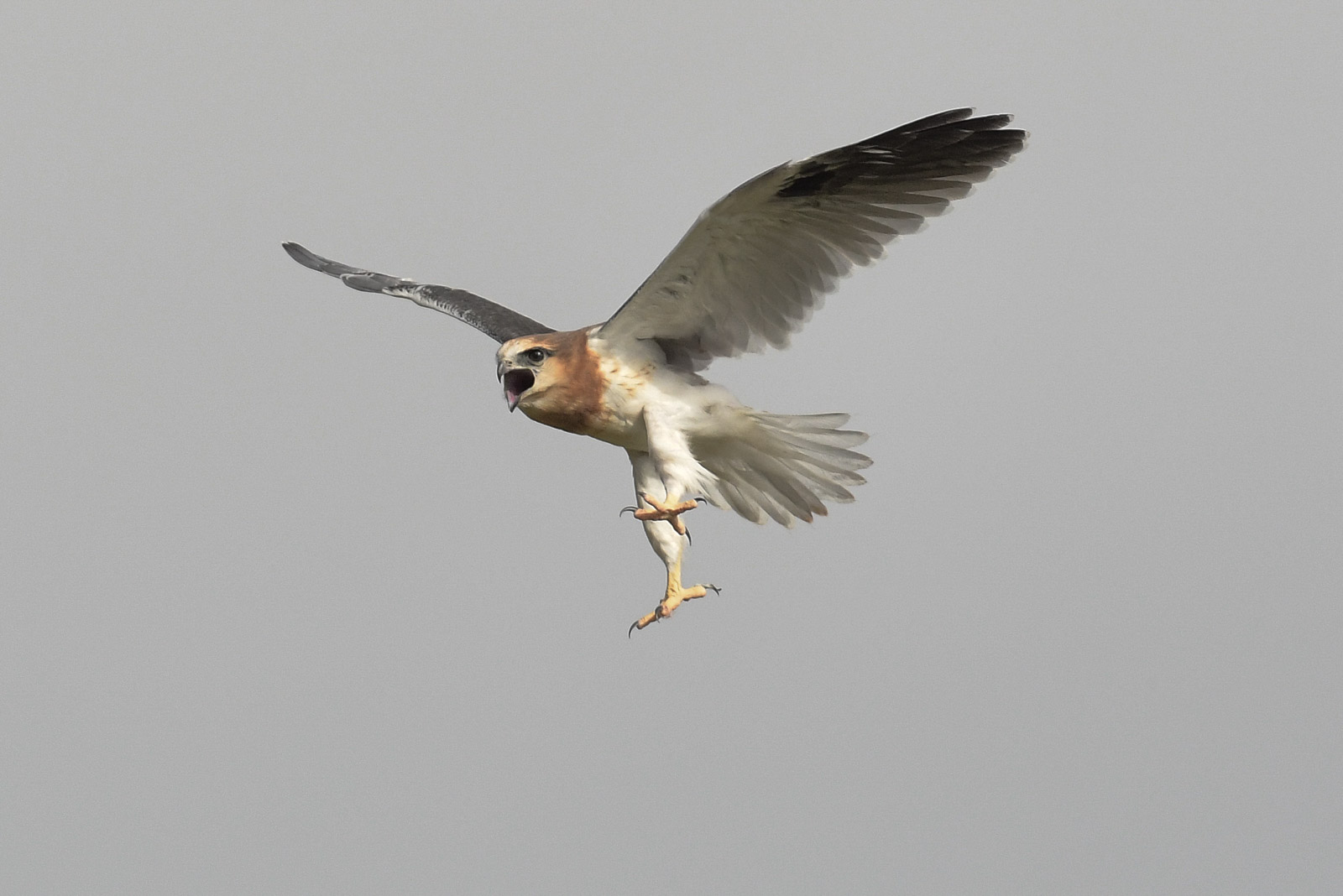
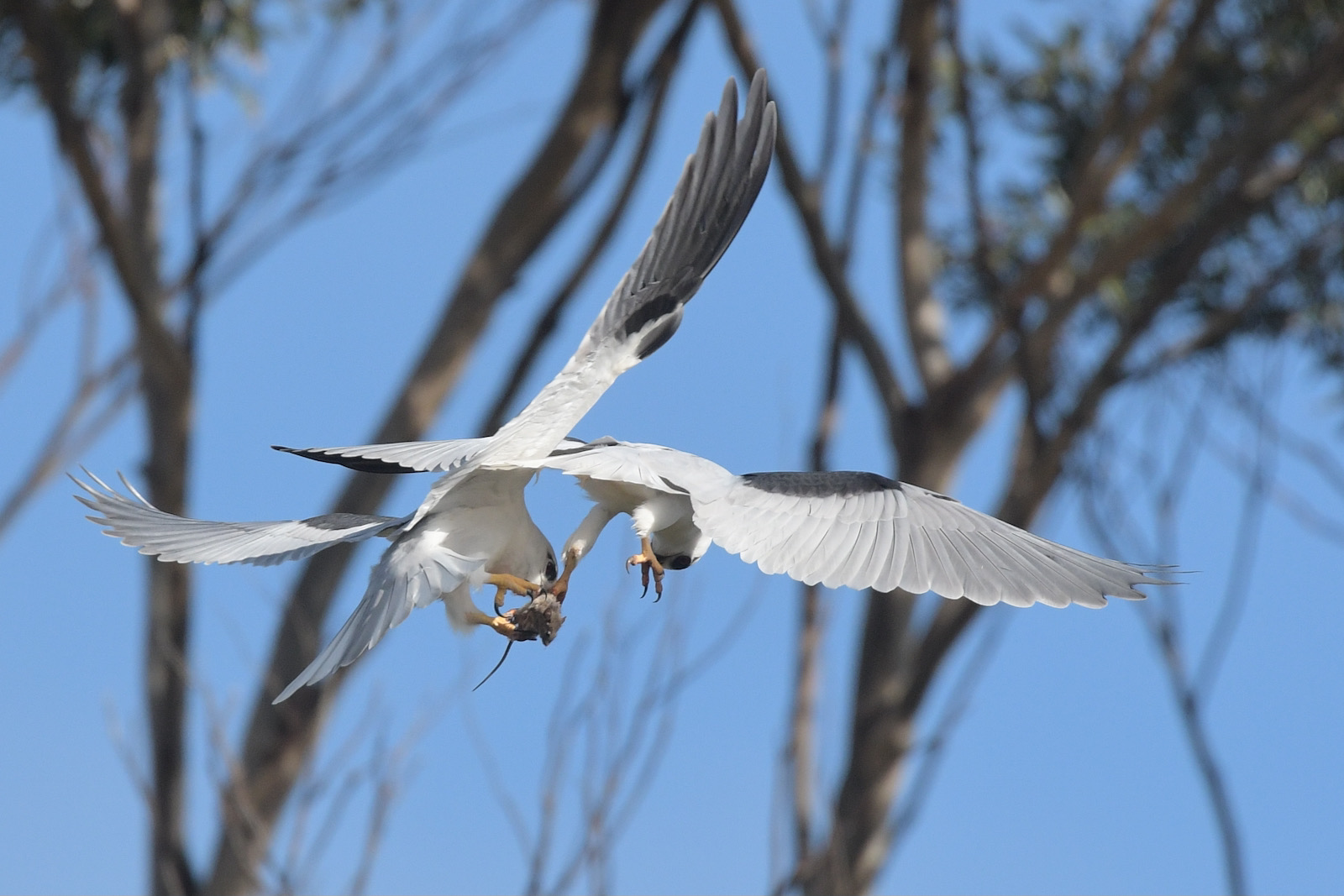
Then begins the process of teaching them to take prey from the male. They take to this execise with great enthusiasm, very little skill, clumsiness and what can best be described as un-coordination. A hard time for the male as he gets buffetted about by the young who judge the speed, height and angle badly and barrell into him with no hope of making split second corrections. He seems to take all this in a stoic manner and I’ve seen him sometimes raise a little higher to match the upward speed, or drop lower with a long outstretched leg to place the mouse in the waiting claws. Other times he seems to be able to hold out the mouse and then slip away sideways to avoid a headon collision.
Eventually all the training comes to fruition and they become highly skilled at judging the parameters and can do it with a minimum of effort and few missed opportunities.
And now they are just bragging. The once unskilled can now make a bold one legged move.
This happened a long way out, and I’ve only got small shots of the entire sequence, but the young one secured the mouse, and somewhere between grasping it, and wanting to eat it in the air, of course it dropped the mouse. Bronson was on to it but as my Flickr site shows, a mouse free-falling is faster than a Kite. They are built for hovereing and do not have the speed of say, a Peregrine or Hobby, and the mouse tumbled to the ground. He was however right behind it, and I think this one was dead, as he quickly retrieved it, took it to a branch and the young one safely collected it.
Soon the colours will fade and they will be ready to face the world on their own. As Eleanor pointed out the orange colouring come from a chemical in the feathers, Porphyrin.
It seems the baby colours out of the nest don’t moult out, the rich copper tones fade out gradually over a few week. The brownish colour on young BSKs comes from Porphyrin, which fades in sunlight.
Eleanor says, “Porphyrin, which has been studied less than other pigments, as it doesn’t occur in large numbers of birds. It is found for example in the reddish-brown feathers of a juvenile Black-shouldered Kite. This fades after a few weeks, without the birds replacing the feathers, as it degrades in sunlight. It is also found in the brown and reddish spots on birds’ eggs.”
Porphyrin also emitts or fluoresces under UV light so the colouring would show up quite brightly for the birds, which may be an indication of individuals, or breeding potential. All just too fascinating.
And so through the sleet, the hail, the rain, the high winds and freezing cold they have matured enough to move on from the nest site. Here Bronson is sitting with them, a symbolic sort of image as they are now banned from the nesting area, as Belle is already preparing a new nest and by the time I publish this, no doubt she will have another clutch on the go.
How quickly Belle and Bronson’s young kites have grown.
Yesterday, in the sunshine I might add, we arrived and expected to see them in the adjacent area. But hunt as we might, there was no sign. Then EE spied them way down the paddock, a long way from the nest. And for reasons that shall be come obvious, the parents seem to have given them their marching orders.
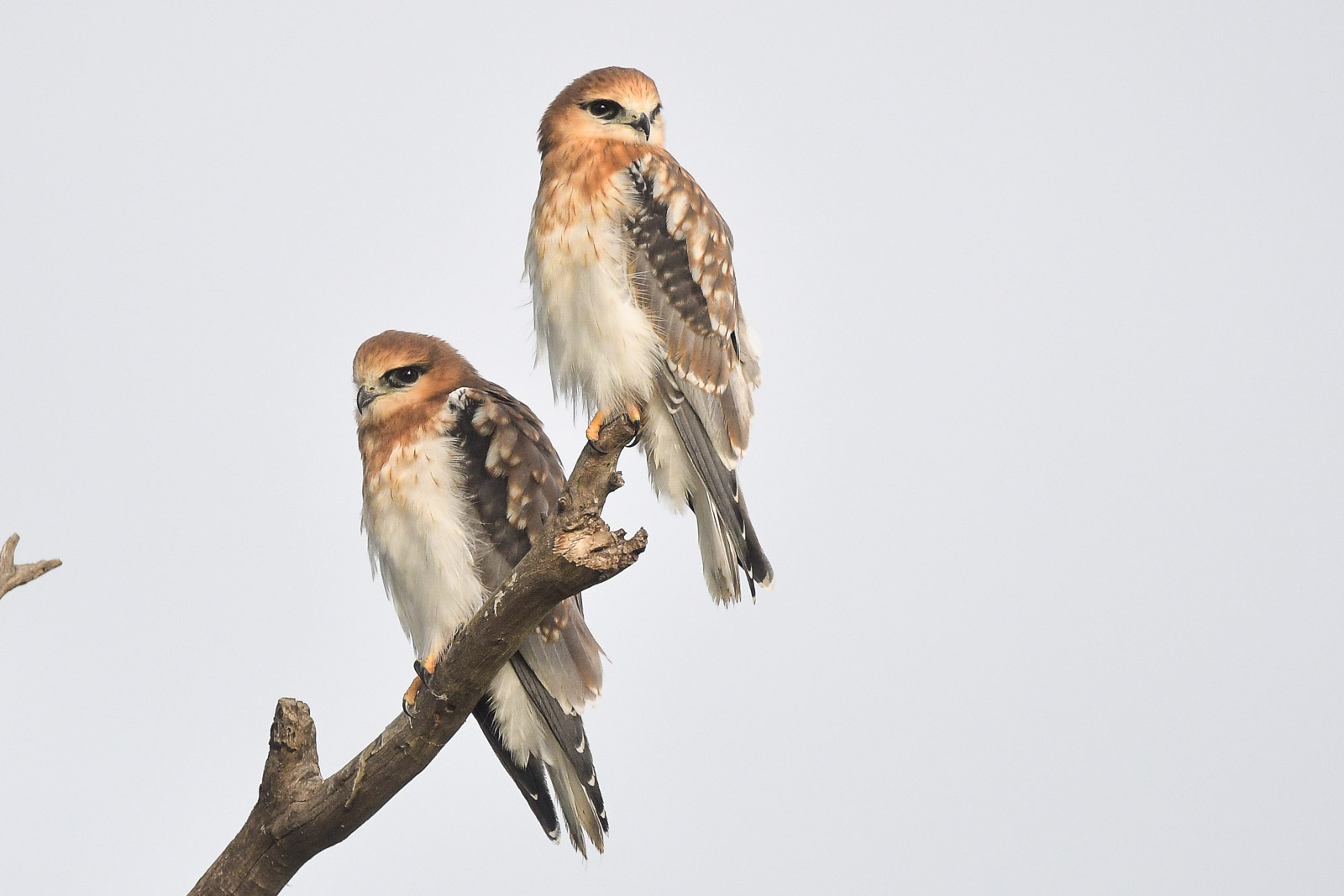
They have been on the wing just about four weeks. Normally they would be ready to leave, if not gone by about week six, so these young are hopefully well enough advanced to look after themselves.
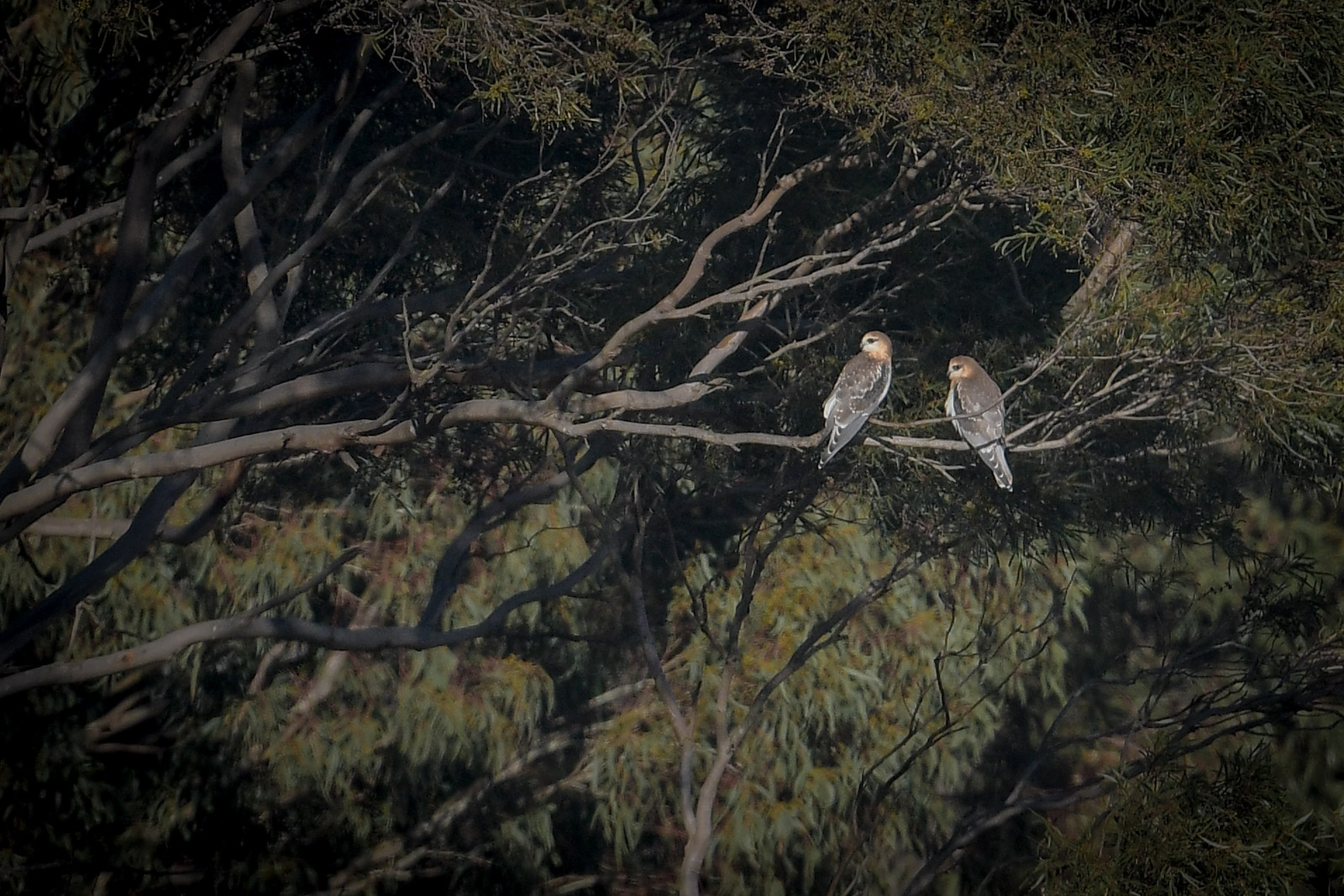
More searching for the third one, and eventually it turned up a little later in the morning to sit with this pair. One had flown up to the home nesting area, but a very speedy adult flew in a direct, straight line to intercept it, and with some outstretched claws and calling, the young quickly got the message and returned to their end of the paddock.
I read somewhere that the attrition rate for young kites is very high, can’t relocate the details, but it was over 50% that would succumb to an accident, or predator, or starvation within the first year. (Please don’t quote me on this, and if I find the reference, I will update here) Once Bronson stops feeding them, there is no further interaction with the parents and they just move on to find food and establish their own territory.
And the reason for their banishment?
It soon became obvious that Belle had a new nest on the go. Normally she would disappear for a few weeks, or month before making a new attempt, but the pair are well on the way to finalising the project and the young kites are unwanted as competition for food.
During the coming week I’ll put up a blog page with some of the actitity from this hatching.
Now some of their findings suggest that Belle and Bronson have either not bothered to read the paper, or the Black-shouldered Kite Instruction book as some of their behaviour differs from the paper’s birds. Still its a fascinating piece of reseach and more power to Stephen Debus and his team for the hours spent in the field and then in collating the findings.
There is an ad currently running on the telly for some sort of icecream confectionary and has someone with a friend how wants a bite of the icecream. Said friend keeps popping up in the most embarrassing moments asking, “Can I have a bite”
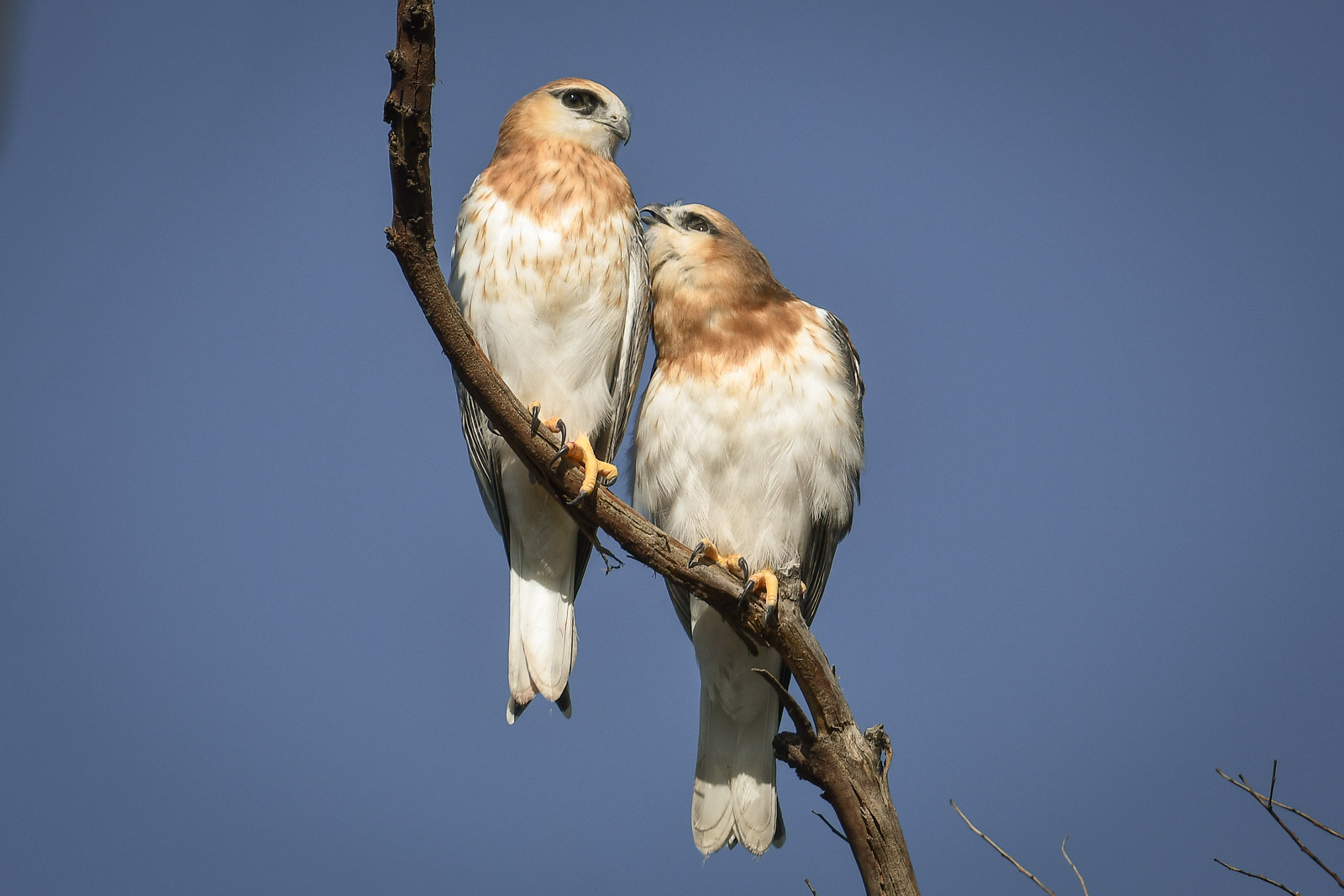
Thought the actions and expression of this little kite to its sibling was a bit like the ad. You settle down for a quite rest on a branch and someone comes to disturb.
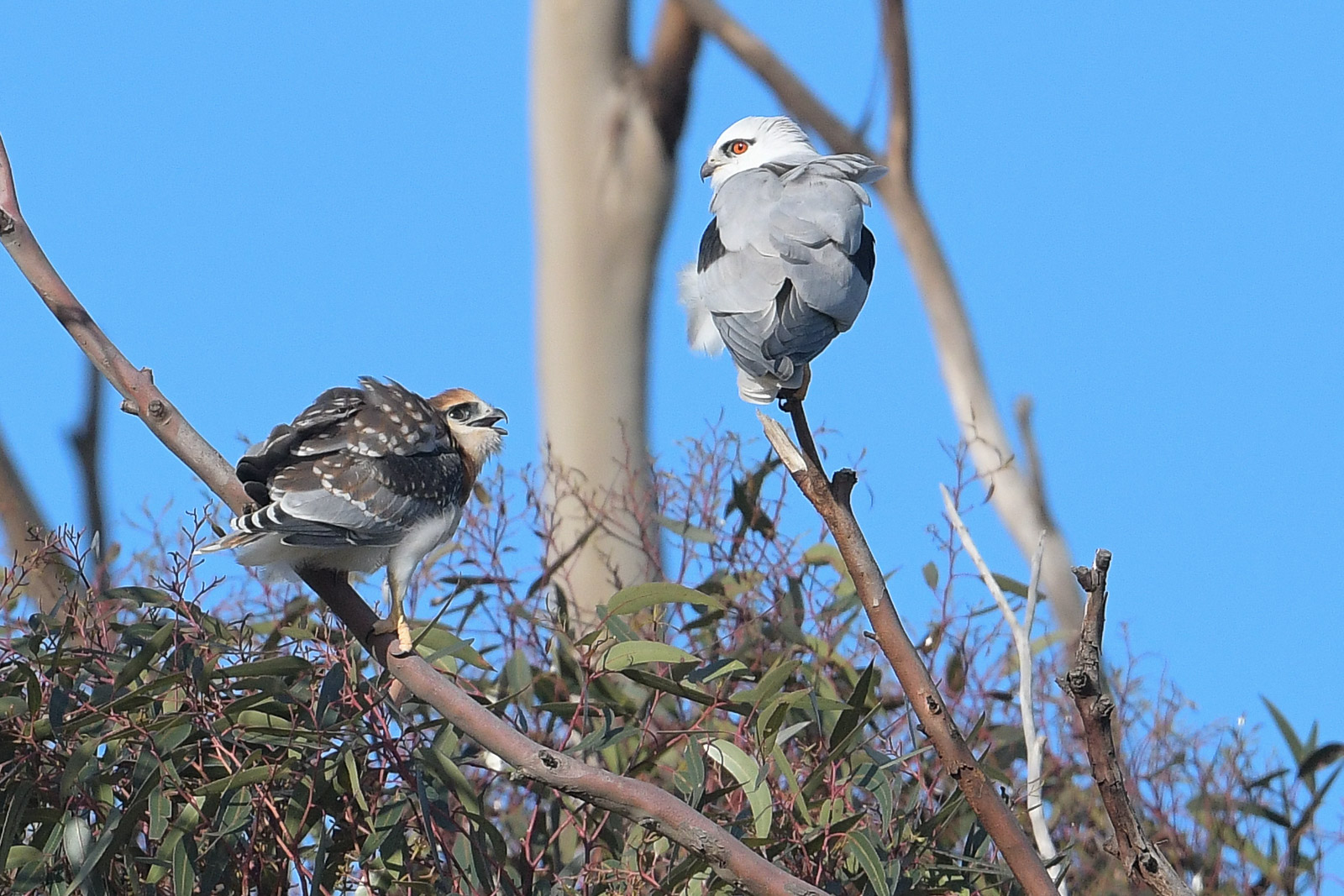
The pair were actually preening and this one thought it might help by picking through the neck feathers.
We have been struggling a bit this week with very average weather and haven’t been able to put in much time either with the local kites or some other birds we’ve been monitoring. So the weather doesn’t help the attitude either.
Had an interesting online discussion with a photographer who has returned from a trip with something like 4,000 images and the need to ‘process’ them. Along the way we talked about the interesting fact that these days taking a picture is ‘free’ no cost invovled and so we tend to take lots of them. Not just multi-burst, but lots of them and then hopefully edit back later.
Part of his lament was that out of the 4,000 or so images he would only spend some time on just a few. The rest would go unprocessed. Even in the past couple of years the entire multi-burst concept has changed. Once you might get a camera to make 3 frames in a second. The problem for us DSLR users is that mirror has to go up and come down for the next exposure. Now, mirrorless has numbers that match motionpicture speeds. My Dad’s old movie camera ran at 16 frames per second, many of the newer cameras exceed that by a long way.
Sure, editing is easy. Keep going till you get the good one. The one with the right expression, or the moment the bird behaves unusually, or get the perfect wing extention as it lifts of the branch, or lifts the fish out of the water.
The image is the work of Neil Mansfield via Flickr All rights are his.
So while the technology is always going to help us achieve some seemingly impossibe shots, sometimes it’s luck. Sometimes it’s patience. Sometimes, perhaps its going through the 4000 shots to find the gem and the rest will just be snapshots.
What if you slept And what if In your sleep You dreamed And what if In your dream You went to heaven And there plucked a strange and beautiful flower And what if When you awoke You had that flower in you hand Ah, what then?
Samuel Taylor Coleridge
“If you spend a long period of time in study and self-cultivation, you will enter Tao. By doing so, you also enter a world of extraordinary perceptions. You experience unimaginable things, receive thoughts and learning as if from nowhere, perceive things that could be classified as prescient. Yet if you try to communicate what you experience, there is no one to understand you, no one who will believe you. The more you walk this road, the farther you are from the ordinary ways of society. You may see the truth, but you will find that people would rather listen to politicians, performers, and charlatans.”
― Wayne W. Dyer
Sometimes people say the most insightful things, but sometimes it takes awhile to sink in, or perhaps other overwhelming thoughts press the useful to background.
Had a cuppa the other day with a few folk who were bemoaning the advent of our societies entrapment or mesmerisation by social media and technology in general. And how things were not like that in ‘the good old days’.
And it seems to me that the policticans, performers and charlatans have been able to make the most of the media, and why are the creatives left behind. But I think perhaps it’s what people dwell on, rather than searching out for the inspirational. There are plenty of pages, blogs and sites that allow creatives to express and reveal so much of their vision. As Mike Johnson of The Online Photographer once said, “Every generation has something new to offer, and you’ve got to take them on their chosen terms.”
Robin Walley, “The Lightweight Photographer”, also was offering some advice on composition. The takeaway for me, was not that the subject or scene conformed to some given set of rules, or even a set of ‘percieved rules’ of the viewer, but rather where was the photographer’s heart. Can I find that in the shot. Thinking back on some of the early photos I (or you) might have made and we were pretty excited about. What would it be like to revisit that same location or subject.
Robin says.
I shot this on my recent trip to Cornwall when walking through some woodland. It could be anywhere, yet I found it rewarding to spot and capture. The shape of the trees, the shadows and the light on the bridge all combined to make me think there is a picture here. I took a moment to capture it and then the light changed, and the moment was gone.
I remember wondering at the time if I had imagined the scene briefly looking good.
It’s also interesting to think back to when I first became interested in photography. I would often see images like this in books and wonder “What was the photographer thinking. It’s just a path, bridge and trees. There’s nothing worth photographing.”
How things change.
The young kites are starting to stretch their wings. For them it’s not an adventure, it’s life. For us it’s an exciting adventure in photography. It’s like finding the flower in your hand.
Just prior to covid restrictions, you know, BC (before covid) I had just started an “Amazing Magpies” project. I had opened up a webpage on SmugMug and was beginning to develop some acceptance by several Magpie pairs in our area. I was hoping to be able to follow them through the nesting and fledging of their crop for the season. Alas Living in Melbourne with the longest lockdown of any city in the world, I think some of the Maggies past on by the time we were out and about again. So I saved myself some money and closed the SmugMug page.
Mentioned last blog that we’d been out and had spent some time with a number of Magpie pairs on the day. Interesting to see that now that the nesting season in approaching how the pairs are beginning to take notice of oneanother.
Unlike many other birds, Magpies don’t seem to have courtship rituals. No long dance routines, or fly displays. They just seem to know who the right mate is, and stay together. And that’s what we’ve been seeing.
They seem to have begun to take much more notice of each other. Walking and hunting close to one-another, attentive little games. One pair we found today were playing some sort of hide-and-seek game around a bush. Running behind the bush so as not to be seen, but then, sticking a head out to be sure to be found. Frolicking at the ‘discovery’. Now I’m sure I’m anthropomorphising the activities but how else do you explain it.
One pair already has a nest site chosen, and the discussions are down to the furniture going in, and who does what in the construction. But mostly they sit on a fence together and scan the territory to be sure no one has dared to put a wing-flap over the boundary. If it should happen both are off at great speed and much wing noise as they rush to encourage the competition to move along.
So I thought about re-establishing the project. But in the end wondered if there was a Flickr group for Australian Magpies. After all there is a Flickr group for just about everything else. Including groups for Facebook and Instagram. 🙂 No Joke. Go figure.
But no. No group for Aussie Maggies. So. I’ve started one. I guess I’ll be posting a few more Maggie pics to Flickr over the next few months, to keep the group up todate.
For those not on Flickr here is the link to the Group.
You can click through the images in the group in this slide show
Ohh, a musical ramble! Sorry. It is as they say, about being in-tune with the manifestations of nature. Ohh lots of big words in there, and we are naught but humble pirates (Cap’n Barbossa, Pirates of the Caribbean)
—Chauching-tsu wrote it this way. Mysteriously wonderfully, I bid farewell to what goes, I greet what comes; for what comes cannot be denied, and that which goes cannot be detained.
Or put another way: Seeing the miraculous in the ordinary. If I insist on capturing only images that suit my style, perhaps I fail to appreciate life’s fulness.
Henri Cartier-Bresson said, “Photography is like that. It’s ‘yes, yes, yes, … It’s a tremendous enjoyment to say “Yes!” Or to paraphrase Alfred Stieglitz, “It is something as I’d never seen it before.”.
Our Grandie turned up the other morning, and said, ‘How about you take me out to photograph birds?” Not that we needed much of an invitation. So we loaded up iAmGrey and set off. First to check the Black-shouldered Kites, and found David N there as well, so we had a bit of a chat about things of the world, and waited for the kites.
We then moved on to Werribee River Park. It was a bit eerie to walk down through the forest as the last time we’d all been there was at the height of summer and much nesting was on the way. Off in the distance, said Grandie announced, “Sounds like a Fantail Cuckoo”, so we set off further down the track. I also heard, the distinct calls of a pair of Brown Falcons, but despite looking all over the sky through the trees, all I managed to see was treetops and clouds. 🙂
More calls, so we continued on further, coming to an open area between the treelines. I moved wide out hoping to be able to get a good look around the trees as the cuckoo might be out in the open.
EE called it first, no, not the cuckoo. “Up there,” she pointed. “It’s a Brown Falcon”. And as all good readers will know, the bird might well have been just this side of Argentina, so it was going to be hard for us mere mortals to locate. “No, there.” And,
Not to put to fine a point on it, a Brown Falcon, sitting very comfortably in the open. The markings almost certainly would id it as a bird that was a regular in the nearby River Park carpark, that I’d named “Bernie” as on a number of occasions we’d encountered him sitting in a tree at the carpark in the very late evening sunshine, ‘burnishing’ his rich, marble chest.
He was in no hurry. We watched as he scoped back and forth across the clearing. No doubt if there was prey here he knew about it. But in typical Brown Falcon attitude, he would not make his move until everything was worked out to the last detail.
Happy to sit, and Dwight was able to make some fine falcon shots. All good for a day out.
Just to say that Apples don’t Fall to Far from the Tree, as we walked back to iAmGrey, he turned to me and said, “What feather is this?” The rich ginger tones and the size could only be from a Nankeen Night Heron. We went to look among the trees. “There, out the back of this tree.” Hmmm EE is going to have sharpen her skills a bit more. The quasi-blackart seems to have come down through the gene pool. Just then the bird—tired of being pointed at, took to wing. And we got some great views of it flying through the trees.
David duChemin of Craft and Vision sent out an interesting update recently.
One of the things that intrigued me was the question of “What you would tell your younger self about the craft of photography he is embarking on” Now I know from an Uncle Google search that those sorts of questions and answers are spread all over the web, like those little bits of microplastic in the ocean.
And. I know that the 14 year old kid with the Super Balda camera and a roll of Ilford FP3 film would take little notice anyway. For a start off, photography as a career would not have had any notion or meaning. Nor, am I sad to relate, among the people and teachers of the time, would there have been any encouragement to pursue such thoughts. The closest I ever got was the local librarian who had assembled a fine collection of photo books by the masters. Perhaps I should have been more bold to talk with her about the choices. And also I must add, the patience of the local chemist that put up with my kid-in-a-lollyshop approach to buying photo-supplies from him—more, I fear of that story must follow 🙂
And anyway photography was a kind of like riding a bike, or bouncing a ball, it just happened as part of life. Bit like stamp collecting. You did it for awhile and then something else, flying kites perhaps, came along.
So I’d not have lectured said lad on the wonders of depth of field, or the charm of Chiaroscuro lighting. Nor would I have wasted the moment explaining how to ‘get ahead’ in a dog-eat-dog world of photo imaging. Nor would I have added, “Take up war photography, not weddings. It’s safer.” And I’d not be inclined to mention who to avoid like the Robot in “Lost In Space”—Warning, Warning, Danger Approaching. And of course I’d not bother to add why it would be necessary to learn the same hard lessons over and over again in terms of relationships with people.
My one piece,I think, would be, “Enjoy the Journey, don’t worry about the Destination”.
It’s been quite a three weeks of dreadful weather. Talk about Doona Hermit. So we decided the other morning, that a run to see how the Point Cook Black-shouldered Kites were travelling. We have three pairs of birds that began nests in the past few weeks, but the Point Cook birds would have likely flown. And. They did.
It’s a funny thing about the ‘Enjoy the Journey” advice. It works. We were pleased to see the young kites well on the way to adulthood, but, the wretched weather beat us. Grey kite on grey sky is not a good look. Add rain, and cold wind, and well, coffee shop is the option. Yet. As we began to drive out, I heard the familar call of the Brown Falcons, and so we stopped to have a look, and sure enough, Cassia of Cinnamon’s rather dapper white-chested male, had come in with a snack for her approval. By the time iAmGrey was parked and the doors were open, it was all over, so we followed them through the trees to where she had finished whatever delicacy had been offered. Then she took off through the treeline. I rather like this image as she is running on short wings as there is little room to manoeuvre through the trees. And we proudly drove away, happy that the pair were still in residence, and he was beginning the process of feeding her up for a nesting later in the year. A new journey is just beginning.
There would be few people who lived through the Vietnam War years that would have not seen the photo of “The Napalm Girl”. And perhaps only a few would know of the name of the girl, or of the photographer who took the picture.
June 8, 1971, Nick Ut was on assignment for Associated Press near the village of Trang Bang. What happened next is well covered by pages all over the web and doesn’t need me to reblog it here. I have thought long about bringing up the topic, but what I wanted to stress was the compassion of Nick toward the badly burned Kim Phuc. Again his words are so much more profound than mine, but he managed to get the young girl to hospital and then transferred to a burns unit, and stayed to make sure she was well looked after.
Many have said it was one of the defining images of the war that helped turn the tide of support to bring the war to an end. Nick won a Pulitzer Prize for the photo, Horst Faas, the editor at AP ran the story, breaking a number of rules about nudity and content, but believed the story must be told.
So 50 years on here are several links to the story of the horror of Kim Phuc and the compassion of one man, determined to make a difference.
And another from Joe McNally of a 40th anniversary shoot with Kim and her new baby. (I know I’ve linked to this in a previous blog, so apologise if you’ve seen it before.)
Kim started a Foundation dedicated to Healing Children of War and here is the site
I’ve chosen not to include a photograph for this blog page. Some things pale into insignificance.
Speaking with kindness creates confidence, thinking with kindness creates profoundness, giving with kindness creates love. Lao Tzu
Our local pair of Black-shouldered Kites go about the job of enlarging the species as though they are the only ones committed to the programme.
This past week has been constant rain, high winds and freezing cold conditions. But Belle has a job to do, and somehow through all that inclement weather she has stuck to the nest.
We too have been hunkered down. Looking out the door or window at the incessant rain, and feeling the cold creeping into the bones has not only been debilitating, but has dimmed any idea of being able to see how the Kites have been battling.
This morning, a look through the window, showed a few patches of blue-sky with no immediate rain. ” Let’s go see, and if it changes, we can always come home or go get a coffee,” EE said.
And as the good Banjo said, “We went.”
Mind, two people dressed for an Antarctic Expotition, or as a friend said the other day, Two Michelin Men, might not have been elegant, but at least kept the biting wind somewhat at bay.
At first it was all quiet, but then we noted that Belle was now sitting higher in the nest and there was white-wash on the branches below. So no doubt the young are beginning to grow.
In pretty quick succession Bronson arrived with first one, then two, a third and then fourth mouse. So he is doing his best to keep the high quality rocket-fuel going into little tummies and also keeping Belle satisfied.
In the end the Michelin men retreated to iAmGrey-heater turned on, and headed for coffee.
No doubt by the next time we can venture out, we might get the chance to see a tiny head or two.
Enjoy. And keep warm.
Bronson taking a well earned rest. The weather was but two points from raining and a cold wind swept across the paddock.Here is Belle, sitting up in the nest for the first time in since she began nesting some six weeks ago. Bronson arriving with the first topup.Belle dropping out of the nest to score the meal.A flyover and hover to be sure we aren’t getting to close. Bronson heading for the nestAnother food delivery.And another exchange.Bronson came in, with intentions of feeding himself, but Belle soon came out to make her menu request. In the end he lifted up and they did a mid-air exchange.
Welcome to a little bit of stream of consciousness
We were having a discussion about when a freelance photo-assignment is completed. Perhaps it’s an event, or a get-together, or maybe even a sporting event.
How do you know when to stop, and leave?
So we followed the options, well at least as many as we could think of. Perhaps the time to stop shooting is when the main action is over. The keynote speaker has left the building, the team has gone to the sheds, the family matriarch has gone home. The bride and groom have left for the honeymoon. Or are there still more photos to be made of the people cleaning up, the packing and load-out, the security going about locking-up the doors, and maybe the last lights being turned off.
I ventured that another option would be to, “Knock-off, and get home in time for dinner”. What do you mean, Knock-off?
Colloquialisms don’t travel well down the years or across cultures. I grew up in a farming and building community. Knock-off time was the description of ceasing work. Like “Striking a Blow” was getting started.
But, then we started to see other possibilities.
F’instance. The painting was a good Knock-off of the original. Meaning someone had made a pretty good copy.
Or how about, the soldier who was explaining his lack of some kit items, by responding, “Well someone must have Knocked it Off.” Meaning it had been stolen.
He was Knocked-Off his perch. Meaning that his status had changed as in Scomo was Knocked Off his Perch.
Then for the pedants: The new camera was accidentally knocked off the table onto the floor and destroyed the lens. Well, we all hope that never happens. 🙂
Some meanings come, of course, directly from movie sources as in, “Let’s Knock-off the so and so”, meaning to kill them.
Must be time to Knock-off a cuppa tea. Meaning a tea break. Or it’s so hot I could Knock-off a beer.
and off course a good one to finish. Knock it off, we’ve had enough.
Bet we missed a few.
And on that note, I think I’ll just Knock-off for the weekend. Seeya next week.
I have as many will be aware working a lot with Black and White, or Monochromatic images recently. In somewhat a return to beginnings. My very first attempts at photography were with a 127 size film camera and making contact prints from each negative individually, at first, in the family laundry under the glow of weak orange light. It’s hard to know if my somewhat blurry images of Blackie, the Cat could be seen as anything more than a waste of pocket money. 🙂
But I persisted, and as I did I learned something of the craft of photography by osmosis from books at my local library.
Here I learned of the work of a Sydney based photographer, Max Dupain. Most will have seen a version of his “Sunbaker” image. But Max was a much more influential artist. There are plenty of sites that delve into his life, history and art, so I won’t belabour that. He stood, against, in the 1930s the ‘pictorialists’. The blurry, hazy interpretations of people, landscape, architecture and more. He set a course of drama, clarity and importance of tone, shape and design..
You can flick through a range of his images on the web and conclude, “Oh, I’ve seen that before, or made shots just like that of the same subject.” But Max did it first.
I remember acquiring for my Father a copy of a Max Dupain series calendar around 1989. My Father’s own work was in someways contemporaneous with Max. We did spend a few hours occasionally discussing the photos on that calendar.
Max once wrote that if his work was to have any significance,:
” It has to be devoted to that place where I have been born, reared and worked, thought, philosophised and made pictures to the best of my ability. And. That is all I need. “
So it has been from that background that I’ve been been working in Mono of late. Not taking a preexisting image and using the amazing effects of Nik Silver EFx Pro, but rather looking for shape, tone, texture and design but rather seeking out images that have the qualities of a great Mono shot. I have been using the Monochrome setting in-camera, (and yes, they are JPEG), and once again experimenting with the use of inbuilt colour filtration to increase, or decrease a range of tones.
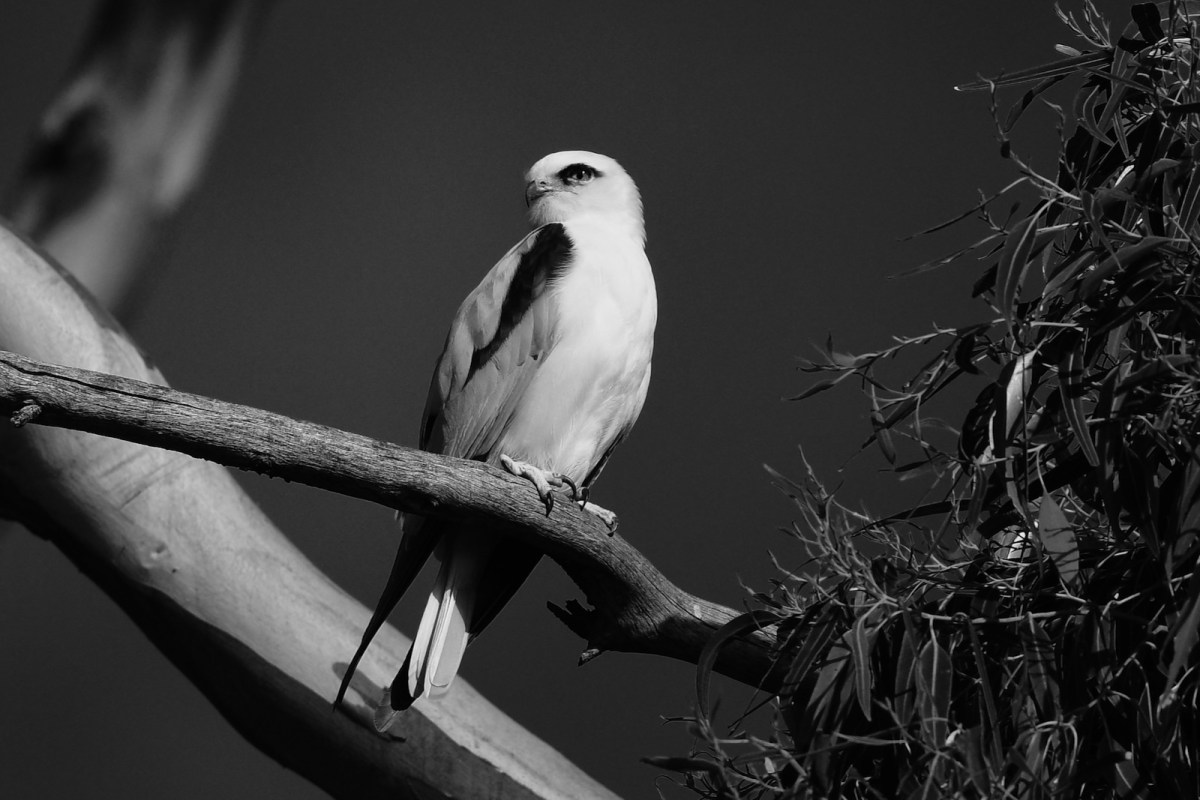
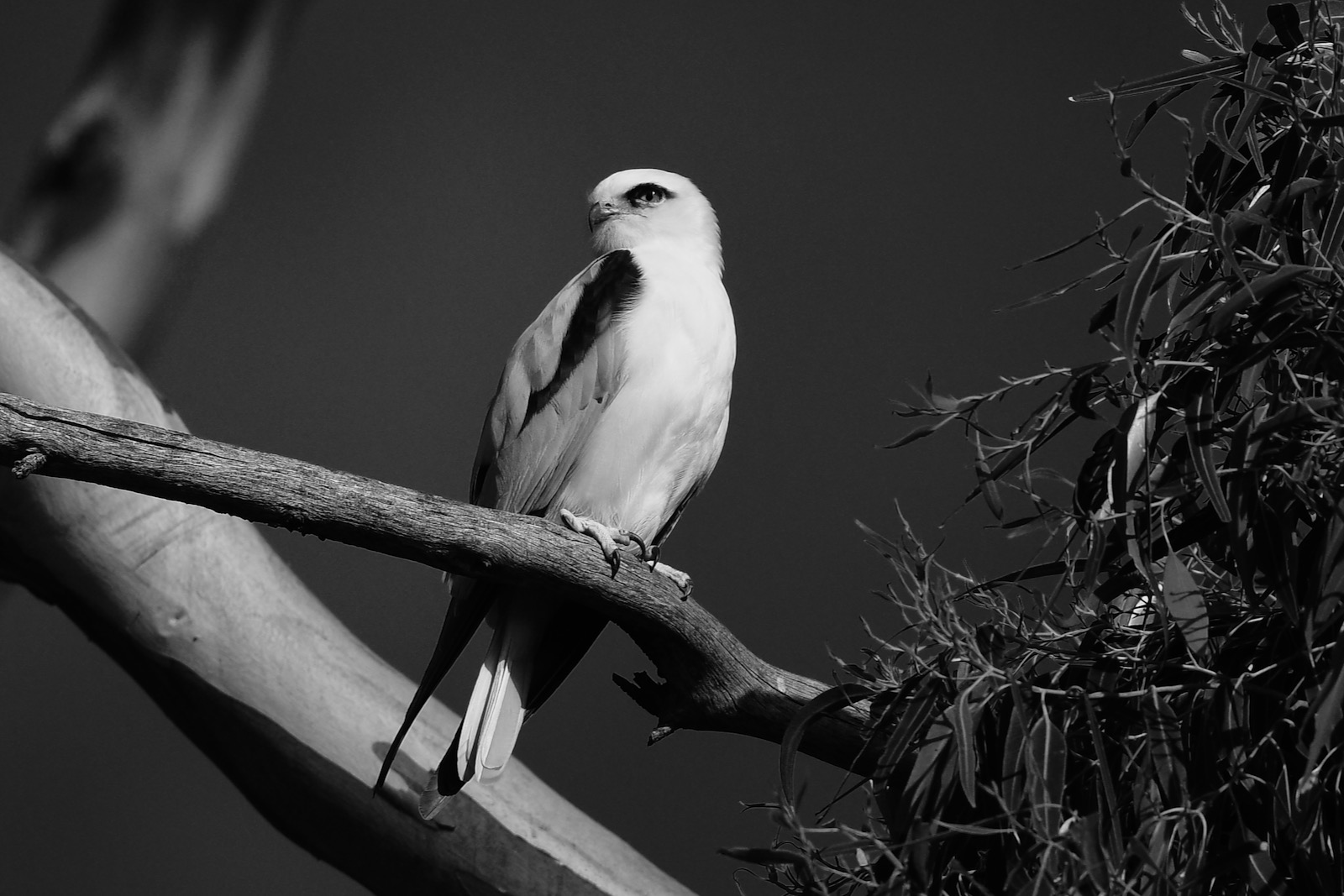
When I saw Bronson sitting in an open area against a clear blue sky, I was already seeing the final result. I have published a version of this shot on Flickr. I had opened up the shadows and brightened up the sky, but my first choice was as it came from camera.
We were travelling in the early. bright sunshine, on a very still, cold day. Our destination was a couple of paddocks to check for Flame Robins, and also a little further on to monitor the nesting progress of a pair of Black-shouldered Kites.
The narrow road is typical of farming communities with deep drains on either side and very little road shoulder, and while there was room to pass, there was no real room to park. We have been making this journey about once a week, and every so often perhaps twice a week to check on the progress of the Kites.
As we drove along the road, into the sunshine, a tree close to the fenceline, in the distance, looked to have three large bird sized shapes, and as it was a long way ahead we ran through the usual suspects, Ravens, Doves, Magpies, etc.
Then just as we approached, EE exclaimed, “They are juvenile Black-shouldered Kite.” With no where to stop other than the middle of the road, it was a bit precarious, so I moved up to a gateline and we walked back. Sure enough, three very handsome looking young kites. Where had they come from? Where they waiting to be fed? Wonder where the nest had been located? Now there are not too many trees suitable in the area, so it would be hard to pick one, and as we’d travelled that way a few times, and not seen any action in the area, it was even more a mystery.
After a lot of preening and wing stretching the answer to the question, “Are they waiting to be fed?” was answered as first one, then another lifted off with easy, flew out over the paddock and began to hover and drive down. These young kites had been on the wing for three or more weeks its seems.
We didn’t see a successful strike, but that was more to inexperience than anything and no doubt they were quietly confident of getting their own breakfast. After about an hour or so we moved on. The parents hadn’t been sighted and the young weren’t crying to be fed, so the best conclusion perhaps was they were now on their way out into the world on their own and were still travelling together for company.
Enjoy
It will be interesting to see if they are still in the area next time we visit.
There is so much about photography that is elusive. Sometimes like Eastern Spinebills, it is the subject. Our friend Rodger has been photographing them at Royal Park with varying degrees of success and as we were in the area we decided to go have a looksee.
After several hours it was sad to conclude that they would remain elusive. 🙂 We did manage a brief glimpse of one that came by, settled on a branch, and frustratingly was surrounded by small twigs and branchlets.
But.
We did see one.
I’ve only just received back from repair my 300mm f/4 PF lens. It is a great little lens to be walking about with and, as here, I use it almost exclusively with the teleconverter TC 1.4 which gives me a fine 420mm focal length.
This one I’ve owned since the get go. I received one of the first of the lenses in Australia. The dealer could only get an allocation of one lens. It’s been one of my go-to lenses for birds ever since. It does have a software issue with the D810 and vibration reduction settings, but as I’ve retired that camera it is no longer a concern. EE uses one and it never comes off her D500. That lens I’ve always thought has a little more highkey contrast than mine. Not much, but just noticeable if we shoot side by side.
Earlier this year mine started to look a little soft and rendering fine detail and feather markings became a problem. It came to head when I was working with a Little Egret that had some fine breeding plumage feathers and they all looked doubled-edged and soft. Strange. So began the usual: check focus accuracy, suspect the camera, increase contrast in the camera and turn off first one setting then another.
But to now avail. Then one morning when I was going to try again, I picked the lens up and it had a distinct rattle. ??? Seems that one or more of the glass elements had worked loose. The local authorised repair centre was about to close its doors and it seemed that I’d have to send the lens to Nikon Techs in Sydney. I managed to find a repair centre in Adelaide. DigiCam seemed to have some very good reviews, and I filled out a form on line, and the following day received details of how to ship the lens. It went the following day with their arranged courier.
DigiCam came back quickly with an initial report and it seems that several retaining rings had worked loose and needed replacement. Yes Please!
They kept me updated regularly on the progress, the need to order parts, and the likely turn around time. Great to have a good story to tell.
And about three weeks later the lens was returned looking very fine. They had even replaced a damaged element (which I have to say I put my hand up as culprit), so what I had was pretty much new out-of-the-box. Given all this happened over the Easter break, it was a super quick turnaround.
Tentative first test on the tv antenna across the road showed it looked as good as ever. Now that it has had several trips to the bush, and made some special images I must say that DigiCam have won me as a customer and I’m delighted to tell the story of exceptional service.
Now all I need is to find some more Spinebills to work with.
















 Birds as Poetry —— Just because I WANDER doesn't mean I'm LOST