Bet you thought you’d never see that head line again ah?
We needed to go to the Melbourne Airport. For the geographically embarrassed that is about ohhh? 15 mins from Woodlands. So.
Why don’t we leave early, have a look at the Red-caps and then go to said airport?
We did
Which was pretty amazing as we met Nina out there and she had had a good morning seeing among other things a Fantail Cuckoo. The carpark near the cemetery was abuzz with Thornbills and so many Grey Fantails. So after farewelling Nina, we set off for Red-cap country.
And we found a couple of female birds quite quickly, but no male. Then a couple of Rufous Whistler females seemed to be having a tiff over a male, and he happily responded with his usual “Echong” call. All very nice.
Enter stage right a Shining Bronze Cuckoo, and things were looking up.
Till.
The rain came. As come it must. By then we’d ventured into the (in)famous Backpaddock, only to discover its still a quiet place for birds.
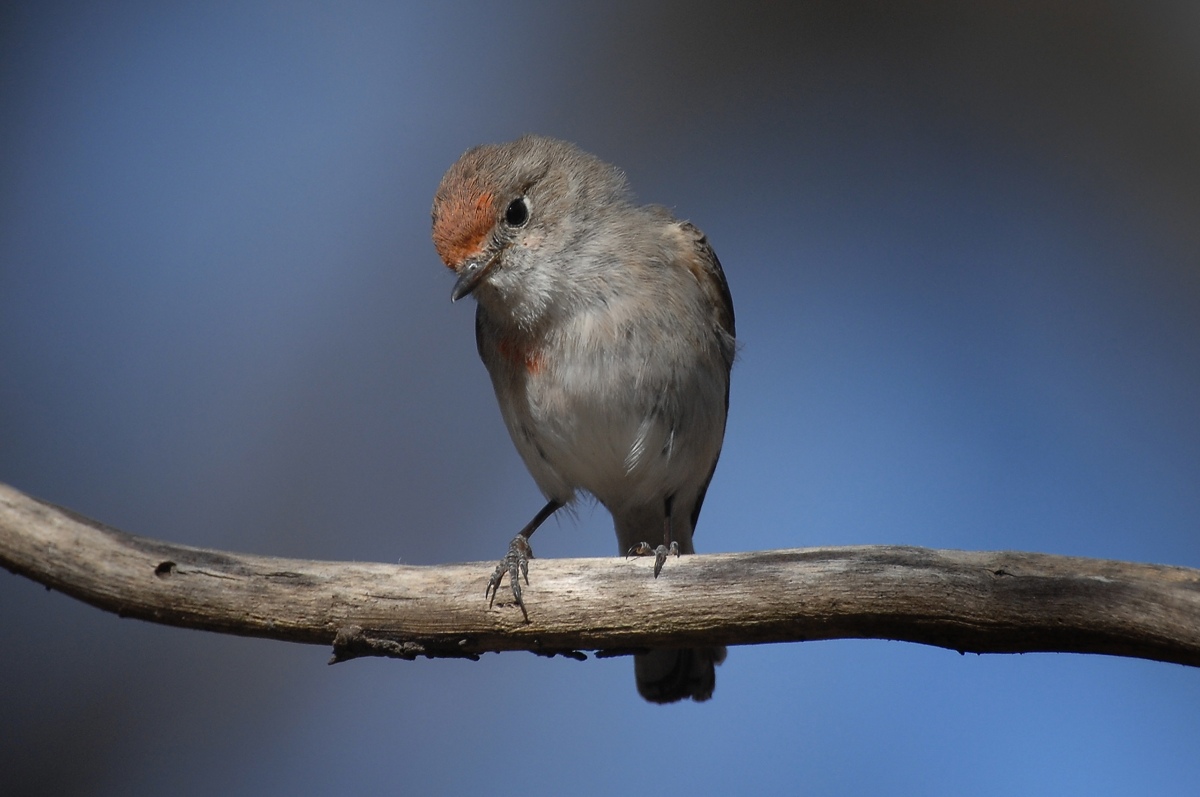
More time with the Red-caps, and I began to wonder if one of them at least might be the previous season juvenile having just moulted in as she has a very tiny red cap.
By now, the rain was winning and the coffee shoppee at Greenvale was inviting, then off to the birdless airport we adjourned.
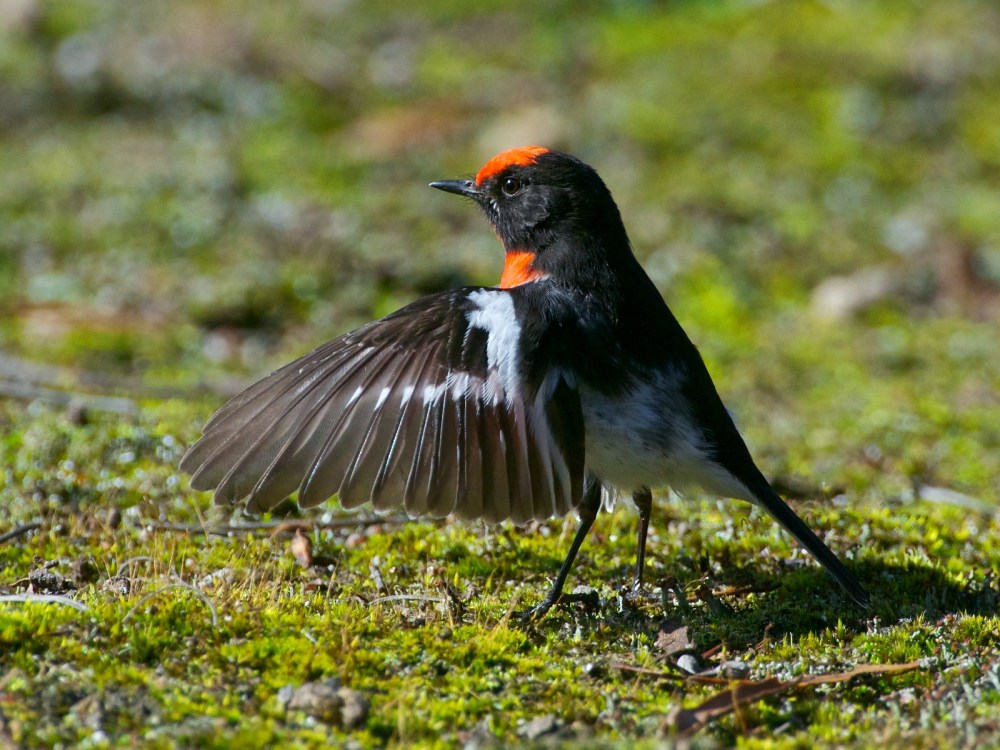
Red-capped Robin FemaleThey always seem to be able to take that little bit of extra time to pose the best possible wayWing over action. Seems to me that its main purpose is hunting to perhaps scare insects into movingIt certainly gives a great look at the wing patterningEeee ChongRufous Whistler FemaleOur very smallest bird. A Weebill.Always a pleasure to find a PardaloteHow about I pose here by the spider web. Yes, but turn around a bit more. Oh.
I think I’ve got Grey Box forest sap running in my veins. Spent a bleak rainy morning at Woodlands Backpaddock. Enjoyed every bit of it. Here is Peter the Prince.
That slow moving high stayed with us again today, and it seemed that an golden light evening would again be gifted to us.
We decided to go to the red-cap nurseries and see how things were progressing.
Lovely golden light was spilling through the trees, and we soon located a couple of males and their young.
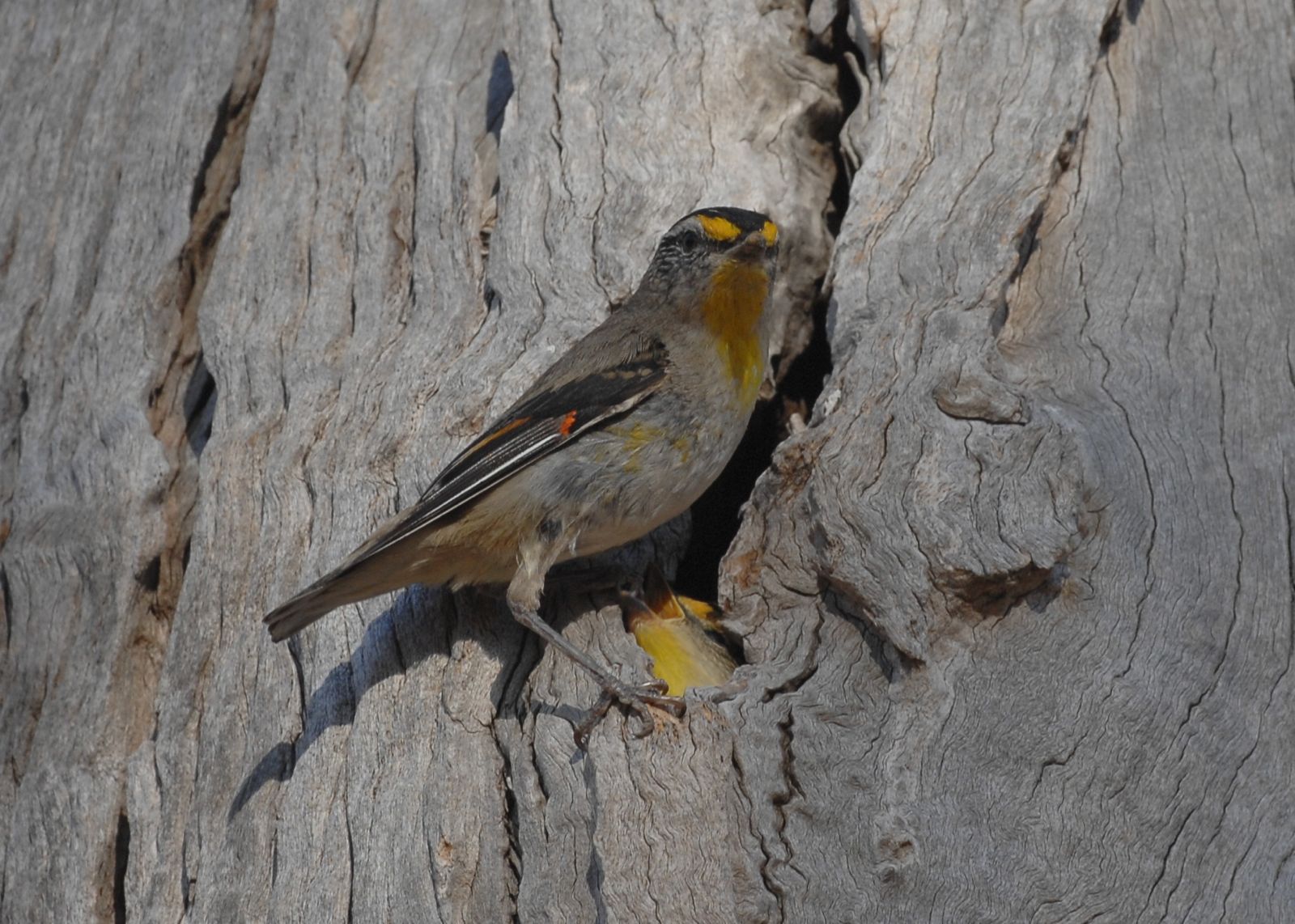
I set up the camera pointed at a Striated Pardalote hole as I expected them still to be feeding. I use a wireless remote and after setting up the camera move back about 50m to give the parents plenty of room.
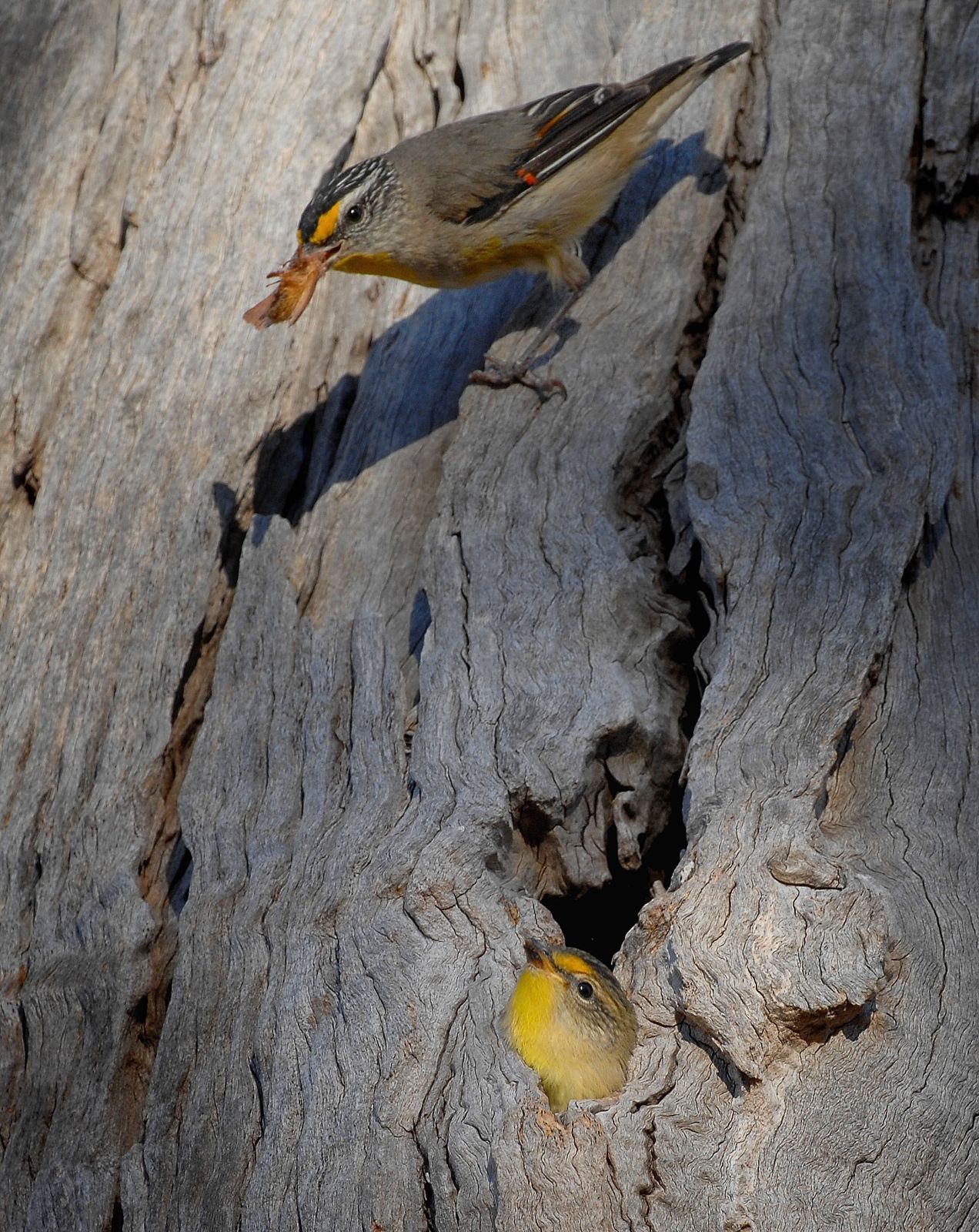
This time things went a little differently, after providing a few quick meals the parents were not visible for 15-20 mins. And then one returned with a big bug, and a baby Pardalote stuck its head out of the small hole (read very tiny hole), and seemed to be begging, but the parent was having none of that, and the process repeated itself for quite awhile.
It dawned on me, that what they were trying to do was to encourage it to come out and fly. Except. The tiny hole it was pushing out was too tiny even for a tiny pardalote. And it could gets most its body out with a lot of squirming and pushing, but then. It got stuck. The little wings and legs couldn’t get out of the hole and it had to retreat, and try again.
Now I suspect that when you’re a baby pardalote, not a lot of brain power goes into this. So push harder. Nope, still can’t fit. Ok, push more. The concept of big/small/ up/down, in/out and relative size are not big issues in a tiny pardalotes tiny brain and it probably doesn’t get much help from the gene pool.
They are the tiniest of birds. Laying across my open palm they only cover about half way. So there is not a lot of room in there for problem solving. So its likely we’ll not see Pardalote On the Moon, anytime soon. But I suppose the upside of that is they don’t spend a lot of time making things to blow one-another up with either.
Ok, to solve the problem Mum brought in a nice big juicy worm and dangled it at the top of the ‘big”, (a bit bigger than very tiny). Still having decided that pushing harder would get the job done it continued to push out of the tiny tiny hole and get the worm. Mum retreated.
A big fat bug soon appeared in the place of the worm and a lot of Pardalote “plink plink plinking” and a second adult arrived and then an uncle or aunt. Then to everybody’s surprise the little bird pulled its head in, popped out of the ‘big’ hole and was free to fly after Mum with the big bug. The second bird followed in a few seconds and it too was on the wing.
Now I’d love to show you the pics of the flight to freedom, but unfortunately as often happens on very special events, the autofocus on the Nikon went out for a holiday to the Caribbean and all the shots were out of focus. All of them. Every one. The lot.
But when the small birds were gone the “Peril Sensitive” (Hitchhikers Guide to the Galaxy- Douglas Adams), kicked out, and the last shot of the parent on the tree on its own is ‘sharp’. Serves me right for forgetting to manual focus. My usual step when multi bursting from remote controls.
Then when the night, light, birds just couldn’t get any better, the White-fronted Treecreeper put in an appearance and we got great views, if not great photos of this lovely bird. She was again on her own. But my mate Ray will be happy to know she is just inside the shelter area.
Henny and Penny landed on the same stump, so I montaged them for a bit of fun. Enjoy
A nice feed and we’ll soon have you out of there. Thanks Mum.
Now if you fly out, I’ll give you such a nice reward.
I’ll just keep pushing, I’m bound to pop out eventually. I hope.This needs a bit of a discussion. Do try to pull your head in and pop it out of the “larger” hole above.Henny and Penny hunting of the same perch. A bit of montage in PhotoshopWhite-fronted Treecreeper in action in the last moments of sunlight.
Neither of us was too excited about getting out of bed early this morning. We’ve had a week of days out with the birds, and just the thought of one more early morning was getting to be a bit much, so when the alarm clock ‘quacked’ into life (what else do you think I’d choose for alarms?), I hit the ‘off’ button rather than the snooze.
We figured some nice afternoon light would be good and ventured out to the back paddock. (formerly Bandicoot Big Brother House), and went down to sit in the area where two robins Henny and Penny had been working last year. Luckily enough they turned up after what can only be described as a long wait. (About two Cuppa’s worth of wait).
Spotted the Little Eagles taking the young ones, (at least two) out for a test flight, with much calling and zooming up and down in the lovely aftertnoon breeze. As I had the camera all set up for close up robin pics, but the time I got it pointed in the right direction, then I realised, the 1.7 TC was on, and I couldn’t get a bird in the frame, then I figured the focus activation was incorrect and had to fix that, then sort out the autofocus points, and by all this time, the Eagles, had gotten tired of waiting and had gone off for a coffee or something.
When Henny did turn up in his lovely red attire, it was obvious he was feeding young and a little bit of waiting, eg, another cuppa, I discovered he’d buried the young one among the leaves in the top canopy of a nearby gum tree. It was swaying back and forth in the breeze, but really well hidden, and so no photos there.
Penny, she of the lovely orange chest feathers, also put in an appearance. She was feeding a second and third fledgling and I managed to track down one of them. Her technique was quite different. She had one ensconced in a tree about my head height among a lot of thin spindly branches. It didn’t have the same wind problem, and seemed quite content to nod off between feeding session. She seemed to feed it for about 10 minutes and then leave it for 15-20 minutes, presumably to feed its sibling, and to have a bit of a rest. The other eluded me, although I could hear its calls for dinner.
At first they were a bit concerned about us, but Penny dropped into a tree about a metre from me, and after a few seconds decided I was either no harm or no interest and flew off to resume her duties.
So it looks as though she has managed a clutch of at least three. And the threeways birds have a couple, and no doubt now that Lockie and Primrose, where ever they are, have had a clutch, so the numbers are starting to mount up. There is still enough season for them to get another clutch in before February.
Just to make life interesting, on the way back to the car, Will.I.am. O’Scarlet came by and gave a good demonstration of his hunting skills, and I suspect therefore his family may be increasing.
Not a bad day’s work and a sleep in too!
Pennywith a nice big bug to keep her little one happy.
Thanks Mum! Penny delivers the goods
Henny the male Red-cap looking for food.
This will do nicely to keep the youngun’s happy
Penny inbetween feeding time, taking a break in the sunshine.
With the ongoing closure of the Backpaddock at Woodlands, the opportunities for following Flame Robin families has been greatly diminished. I have to admit defeat at this stage, as here we are getting close to the end of the winter over season, and I really only have a few images that I am satisfied with. Problem is of course not being able to follow the birds as they move across the light Grey Box scrub along the ridge lines in the Backpaddock.
Not that it is doom and gloom as a few parties come out on raiding sessions into the area outside the park, but it’s impossible to predict where and when, so it is pretty much hit and miss.
Also not being able to track the Red-capped Robins movements, it will slow me down a bit when they go to nest, as I don’t have any idea where they are in the territory, and they certainly aren’t going to put up flags. (Not that I am tracking nests, but rather where it is all happening so I can prepare for shots of the fledged young. I try not to disturb the nesting birds as she will get anxious and abandon a nest at any stage. I think her main concern is Cuckoos, but Ravens made havoc of several nests sites last year.)
So here is a compilation of the work from about the past two weeks. Weather has not been kind either.
The female is Primrose, and she has a territory that is outside the backpaddock. She is currently being courted by two males, but I think she seems to favour Lockie, so things will be as previous. I do hope the younger male finds a mate as he seems most capable of defending himself. With all the young that were produced in the area past season, it is a ponder as to where they all go.
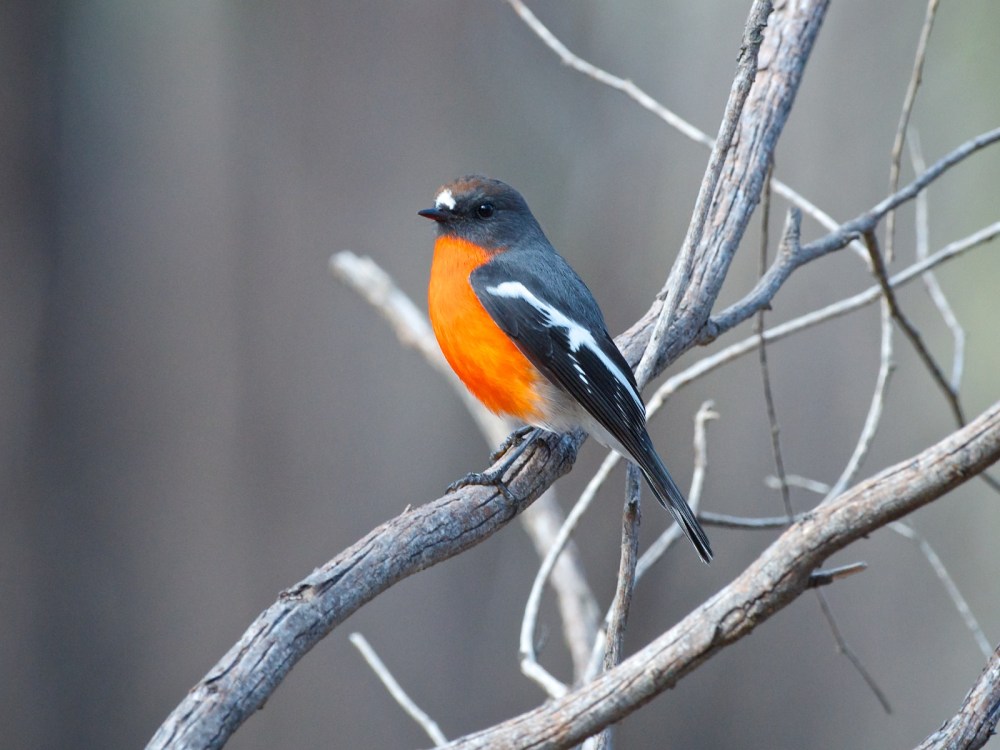
The Flame males were beginning to call with their territory call the last few days. They usually are gone in a fortnight or so after that. They go early, and then the females follow about a week or so later. But, I haven’t seen very many females, and am assuming they are up on the grey box ridges.
*** The images in the blog are now part of a gallery. As such if you click on an image it will open them all up in a slide show. That way you can advance through the photos rather then see them one by one and have to come back to this page for a new pic. I think it’s more elegant, and I wish I had figured it out earlier in the blog.
Hope you like it.
Primrose on the fence line near the cemetery
A male Flame Robin who came on a hunting expedition from the closed off Backpaddock area. Usually there would be a number of birds, but he was pretty much on his own.
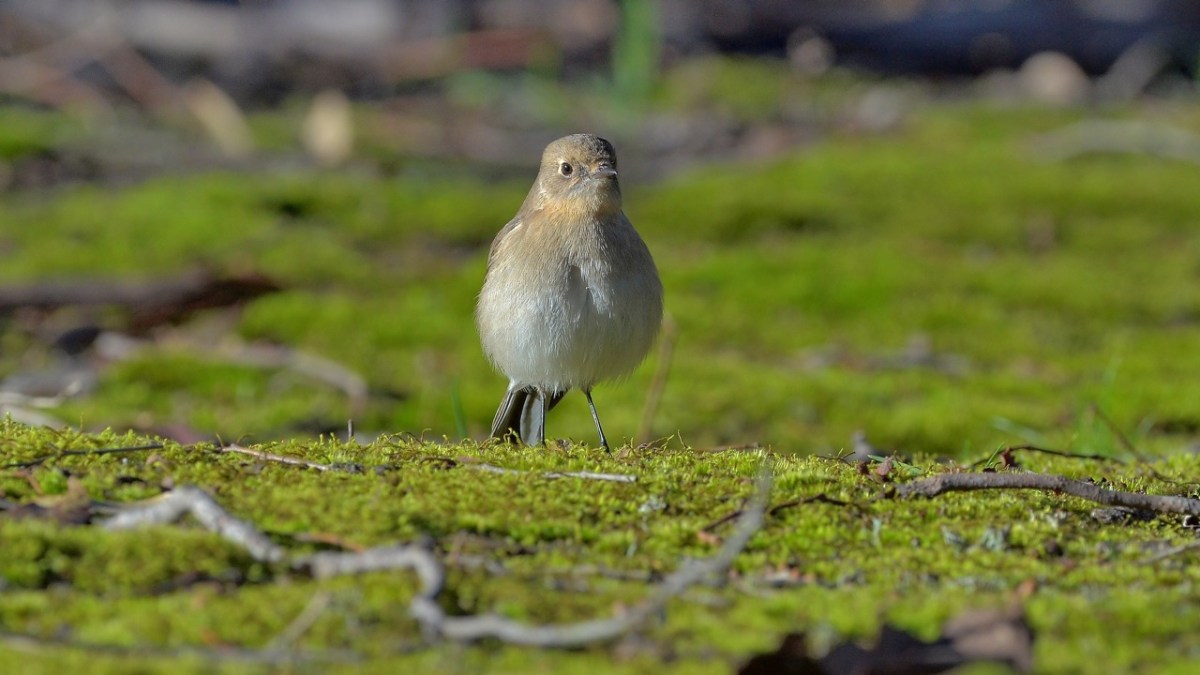
Interestingly marked young Flame Robin. It must be a juvenile moulting through into its adult colours.
Red-capped Robin Female. This is Primrose, (see the lovely apricot wash on her chest) overseeing a territorial dispute between Lockie, and a would be suitor.
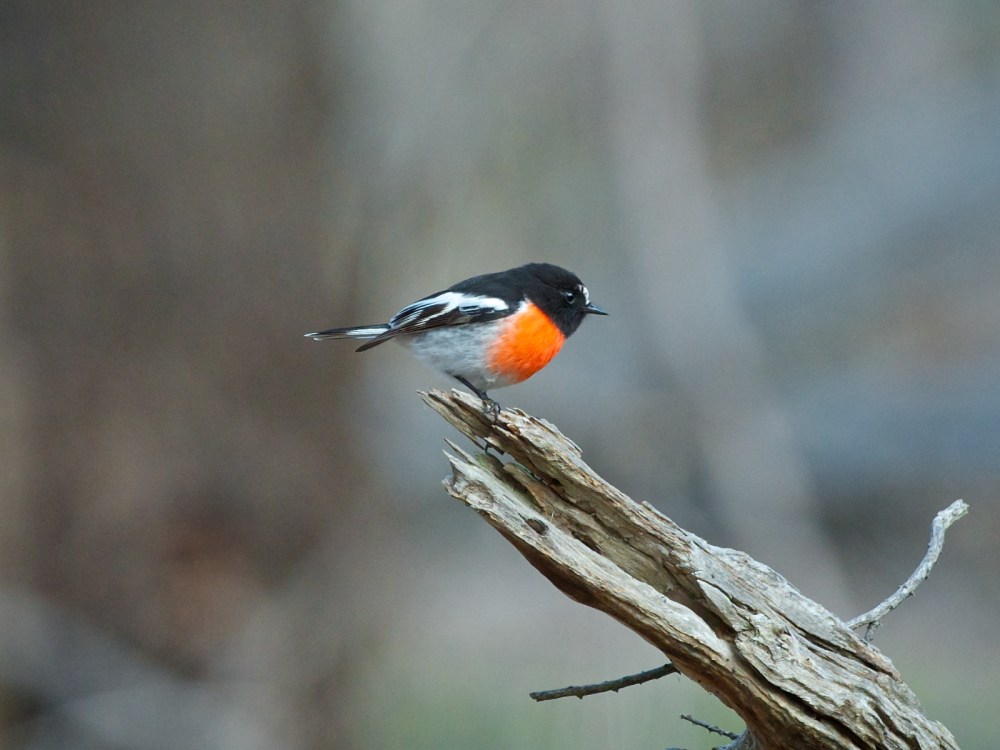
Female Scarlet Robin enjoying a long squishy worm. It gets a good belting on the branch to soften it up. Nice to see both of the Scarlets are still in the area. I’m hoping they stay for the nesting season.
Seems like forever since I opened up the WordPress files, but as life does, other things have been getting in the way from getting out to the park.
The past weekend was a washout. Literally. We went with the Birdlife Melbourne Photography group on just the wettest day. It poured, showered, drizzled and did just about everything except give up a bit of light and relief for the photographers. Andrew came along to lend a hand as a guide and that gave us a bit of flexibility about where to look, but in the end, the cameras mostly stayed in the cars and the rain jackets did their job.
Not to say we didn’t find anything with the highlight being a Yellow-tufted Honeyeater and several White-naped Honeyeaters.
Not one to be put off by a few minutes disappointment, I went back out this morning in the super sunshine. A few of the Flame families were feeding together and several other smaller parties were around the usual spots.
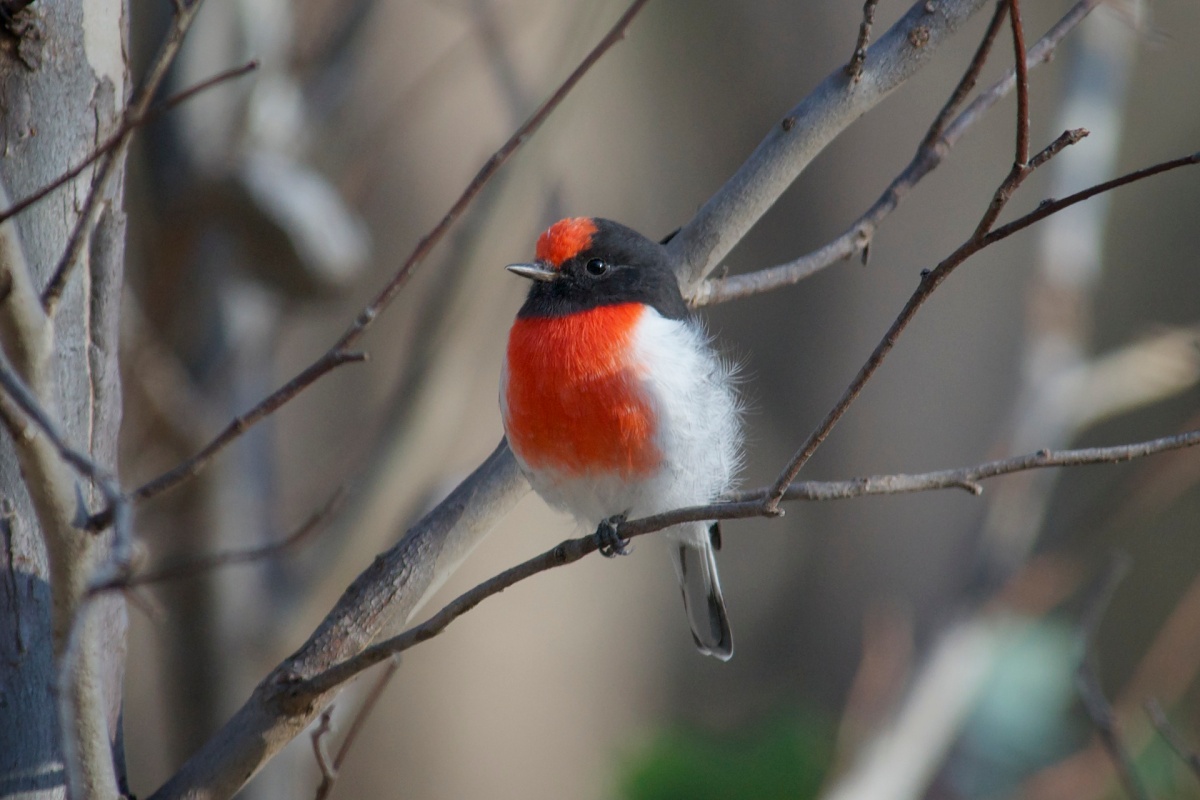
This Red-capped Robin was one of several from the morning, but I liked the backlighting and the good show on his chest feathers.
Second bird is from a small number of independent females that don’t seem to socialise with the other flocks.
This male is on a low branch. I am working on a very low tripod and laying on the ground to get a lower perspective. Get wetter, and muddier, but you see much more from the bird’s point of view.Hunting in the early morning sunshine on a moss bed. I was laying on the ground, camera on a low tripod, just to get a separation from the background.
Dorothy and I looked out of the window early in the morning, and decided it was just too nice a morning to sit at home and worry about getting ‘stuff’ done.
So we packed a picnic and took off to see what the Robins were up to. And they certainly were. We found the cemetery pair within a few minutes. The female must be the hardest working bird in the forest. She had at least 4 clutches this summer, and I counted 9 young that she had gotten off. Given that she lost at least one nest to Ravens, she really didn’t have a moment to spare. But she looks quite relaxed and in good nick at the moment. Her male, is sporting a cute little white feather or two around his beak, giving him a little moustache appearance.
We settled into a favourite spot in the fenced off area and while we waited Andrew and Adrienne turned up, so we had a lovely morning with the birds and some great company. The weather couldn’t make up its mind but sunshine probably dominated. The birds are not in a flock yet, each little family group seems to be moving independently. The three males, “The Brothers” are still together, and it was good to be able to find one, and then quickly find the other two in quick succession. Mr Cooper-top is sporting his lovely brown feathers.
The Brown-headed Honeyeater trapeze troupe dropped by, and we also were entertained by the four Grey-shrike Thrush as they worked the trees, bushes and ground litter.
By the time we had arrived home it was too cold to work in the garden so we compared pictures from the day’s effort. Dorothy is about to get a new Nikon 1 V1, the super little mirrorless camera, which just happens to have an adaptor that can attach the DSLR lenses, and that will give her some new opportunities.
The hardest working little bird. She has had a very productive summer, and now is piling on the food, ready for next season.This boy and his rather shy female put in an appearance, he is now one of three males in the area. They are a bit of a bully to the Red-caps I think.Mr Copper-top. One of three males that travel together, “The Brothers”.Another of “The Brothers”. He is nicely positioned against the spider’s web.
Friday dawned all lovely and still, with plenty of blue sky and none of the rain of the previous few days. I was getting a bit tired of pacing the floor and finding other things to do, so it was good to get back into the bush and see if the storms had diminished the robins activities. I needed not have worried, as they were soaking up the sunshine and on the hunt everywhere.
The Brown-headed Honeyeater aerial trapeze team came by for a visit and I’ve put up a page here with their antics on display.
This young lady spent a lot of the morning with serveral other females hunting on their own. They seem to have a different call, a Cheep, Chip, Chip, which must be a location thing. This one seemed to be the noisiest or most persistent caller. Perhaps it was “C’mon girls, let’s go over here.”Another one from the hunting party
After a couple of days of what can only be described as ‘typical’ Melbourne weather, the clouds eased off a bit, and the biting chill was gone from the wind. So we both ventured out to see what the rain had done in the park.
We quickly found a number of Thornbills and Pardalottes who were enjoying hunting in the sunshine.
Also found a few robins Scarlet is still there and his Red-capped consort has taken on a particularly brilliant orange/rust coloured cap.
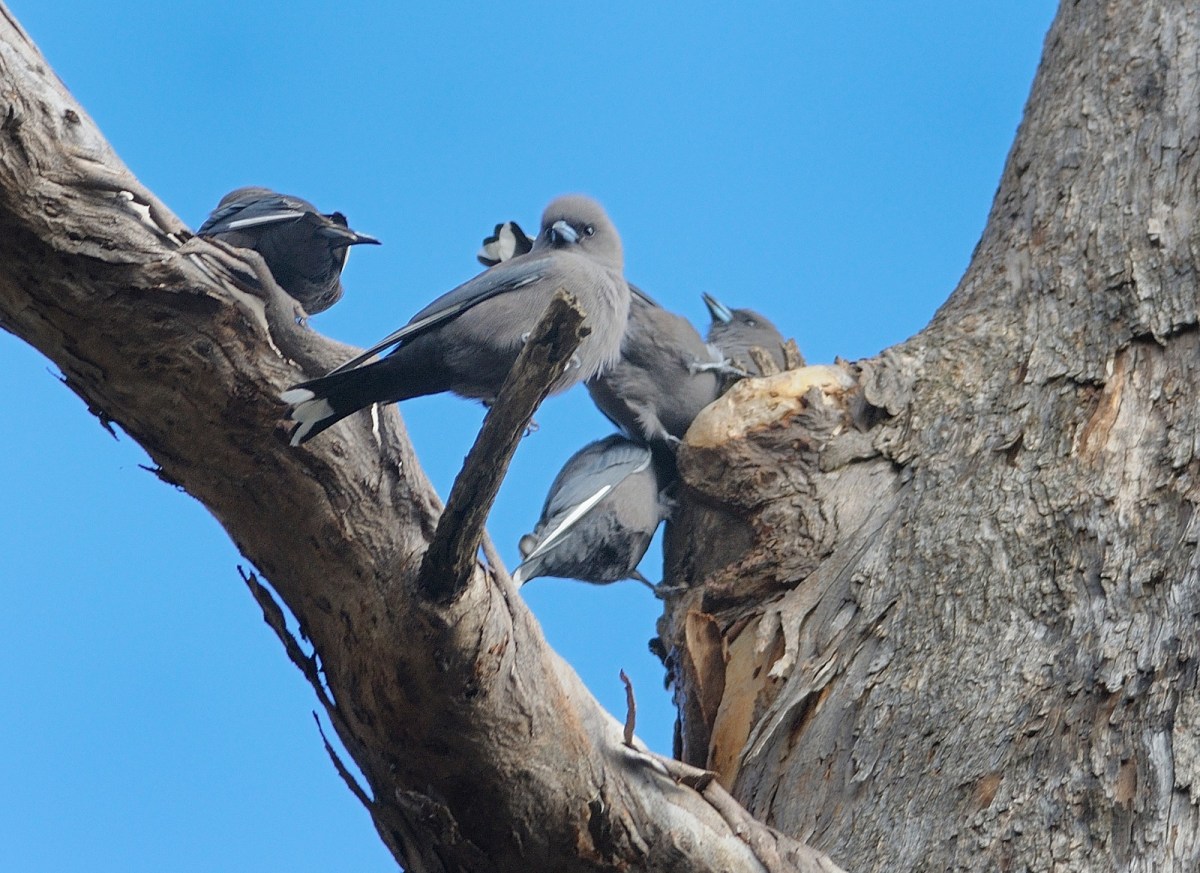
A small group of Dusky Woodswallows were enthralled with a small lump on a tree high up and spent a lot of time squabbling and mobbing one another, for what we suspect was a pool of water built up in the node on the tree.
And a lovely Redcapped Robin male danced by and posed against a freshly built spider-web. Pity the light was just overcast at the time as the web would have glistened in the sunlight.
Red-capped Robin male and a spider web contrast.Dusky Woodswallow flock taking a drink from a small pool of water high up in a tree.
Andrew and I had planned a morning out to scout about a bit. See Andrew’s Blog here.
The weather stayed kind, but for the first half hour or so, not a wingfeather was seen. We walked down along the ridge in the Backpaddock and again it was all very quiet, until we found a Red-capped Robin and then his lady, and probably a couple of juveniles. He has moulted out, and seemed quite pleased with himself and took the time to hum his little “deritt” song.
The girls had stopped down by the three road crossway, and were having their own great morning with a pair of redcaps, a Flame Robin female, and a couple of Flame Robin juveniles. Isn’t that always the way.
Andrew and I got back to find all the activity happening right where we had turned off the track.
The female Flame Robin looked in great shape. Very plump and sleek. So she hadn’t travelled far to get there. No pictures as I was driving the binoculars at the time and the camera wasn’t in reach. Don’t you just get that.
We walked, quite pleased with our collective selves, to the dam, and on the way a familiar red flash dashed across the track. Scarlet Robin. But then another wing flash, and it was not the Scarlet Robin’s Red-capped consort, but a real live female Scarlet Robin. Then a second one. Most interesting and rewarding. All were quiet, as they usually are. So I am not sure if they are all new arrivals, or two females only. The male and one female played lots of high speed pursuits about the trees.
On to the dam and a number of Grey-shrike Thrushes were bathing and then they too joined in tree chase games. And to make a great morning even better, Dorothy spotted a yellow flash in the tree, all excited we were, but it wasn’t a Robin, but one of two Eastern Shrike-tits, doing what they do best; eating grubs.
While we were congratulating ourselves on our good fortune, Rodger, he of the red-spot camera site fame turned up, and added to our morning’s wander.
The next few days should prove to be very interesting.
We all got back to the car in time for lunch, so a good end to what started out quietly.
Female Scarlet Robin. The first female Scarlet I’ve clocked for 2012.Eastern Shrike-tit hard at work on a lovely lunch time snack.
First day of April and the weather just keeps getting better. Dorothy and I had taken the morning to visit Westgate Park, right near the huge bridge over the Yarra. It used to be a city dump, and has been reclaimed, and with lots of volunteer work it is being turned into a little wilderness Oasis just a short trip from the CBD. More power to those who thought it a good idea and all those who worked to bring it back to such great shape.
In the afternoon I needed some retail therapy and on the way back stopped at the Providence Road carpark and met Peter Tompson who is a great contributor to the Victoria Birdline. We have a good chat about the Black Falcons at WTP, and another birdo friend, Richard turned up, and even more discussion ensued. Richard has a very extensive and annotated bird list going back about 20 years for the area, it even includes sightings from one of the park rangers at the time.
We walked down to the Backpaddock, and found our taxes had been at work, and the old gate had been repaired and now actually closes. Good work team.
Richard went off further down the range, and I did a quick scout about and found a pair of Red-capped Robins in the sunshine. This pair are starting to reclaim their territory. At the moment I haven’t been able to find most of the other pairs. Hopefully they are still about, just hiding. No sign of Flame Robins yet, but with the amount of food available everywhere, perhaps they will only pass through this year.
Red-capped Robin Male in his new winter attire. Pretty much full moulted and beginning to become vocal again.
Went back to check on the Scarlet Robin, and was pleasantly surprised to hear her early morning call in the forest. Despite a lot of looking, I was not able to locate her, as she was moving about in among the denser grey box undergrowth.
I continued on to an area I have reported on ealier, where a Redcapped Robin male went to a lot of trouble to convince me there were not nests up in that area. See here
After locating a small flock of Yellow-rumped Thornbills, I was settling to to photograph them when off to my left a Redcapped Robin male, turned up. And in a few moments a very young juvenile. All lovely striated waiting to be fed.
It didn’t take the male to long to fulfil that request, and then the young bird was left in a dead, fallen wattle, and the male disappeared. The young one amused itself taking food off the ground and generally exploring the branches. After about 10 minutes the male returned and offered up a nice looking orange coloured bug. Then they both flew over my head, and away. I scouted round for a few minutes and then found a second juvenile, this one seemed to be a bit more advanced. The male turned up, shared some food, and then gave a call and the two juveniles followed him across a clearing. And so did I. There was another old wattle there and again he left them and disappeared, coming back occasionally with food.
He seemed to have a scheme on feeding as the first young on the scene did not get the goodies, but he seemed quite particular about which one should be fed.
Then with another call they followed him to the next tree, and a third young one joined them! So they have had a very successful time. Now he was as busy as a one-armed paper-hanger as he tried to keep them together, find food and move them about the clearing. No sign of the female. Perhaps she was off shopping? Or perhaps she has taken the challenge of another clutch. Time will tell.













 Birds as Poetry —— Just because I WANDER doesn't mean I'm LOST