The Duty Sergeant would remind his team as they left the daily briefing, ‘Let’s be Careful Out There.”
In these days of rampant pandemic it still seems like good advice.
However being careful out there applies to some birds as much as it did to the police in “Hill Street Blues”
Longer term readers may recall that two years ago we spent quite a bit of time with a Brown Falcon pair as they nested. Cassia, of Cinnamon, provided us with some excellent insight into the nesting and feeding habits of their lives.
Unfortunately we were unable to follow up with them last season due to travel restrictions.
However with a change in limitations we have now been able to revisit the park, and after a couple of futile attempts, EE pulled the proverbial Brown Falcon Nest out of a Hat.
He had been hunting close into the nest in the open paddocks and seemed to be having some success, however we missed the food exchanges and were unable to determine a possible nest site.
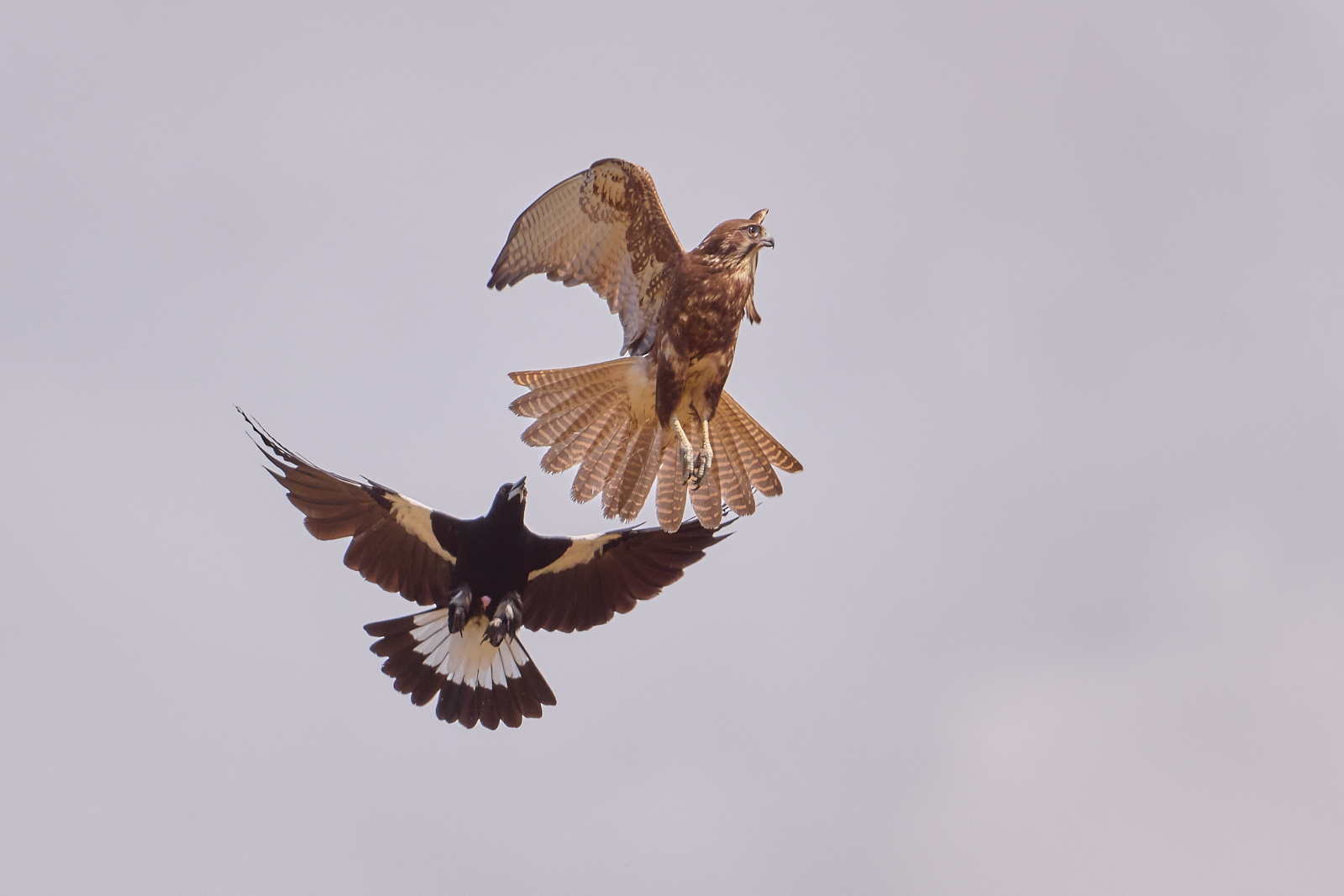
It was not only us that were taking an interest in the falcon’s presence. Australian Magpies took them as ‘easy’ targets and each time one of the birds flew, a flotilla of maggies were in hot pursuit.
Mostly the magpies are fast enough, and the falcons don’t put in that much effort to get away, but today it was quite obvious that the falcons were not going to broach harassment, and each time the magpies drew in close, the falcons put effort into the wing strokes and powered away. Not something I usually see.
Cassia does indeed, Need to be Careful Out There.
Here is a small selection of the morning’s activity.
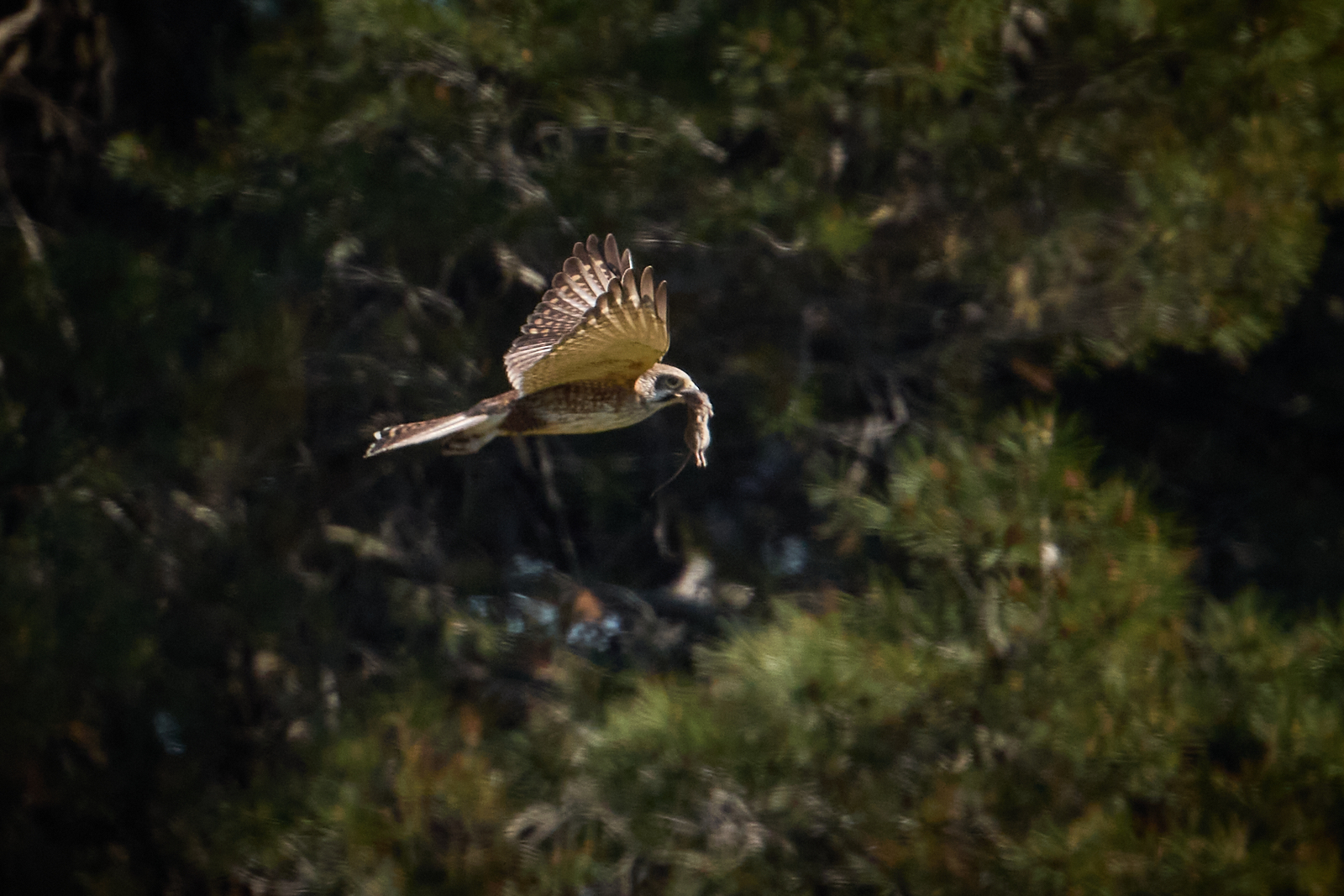
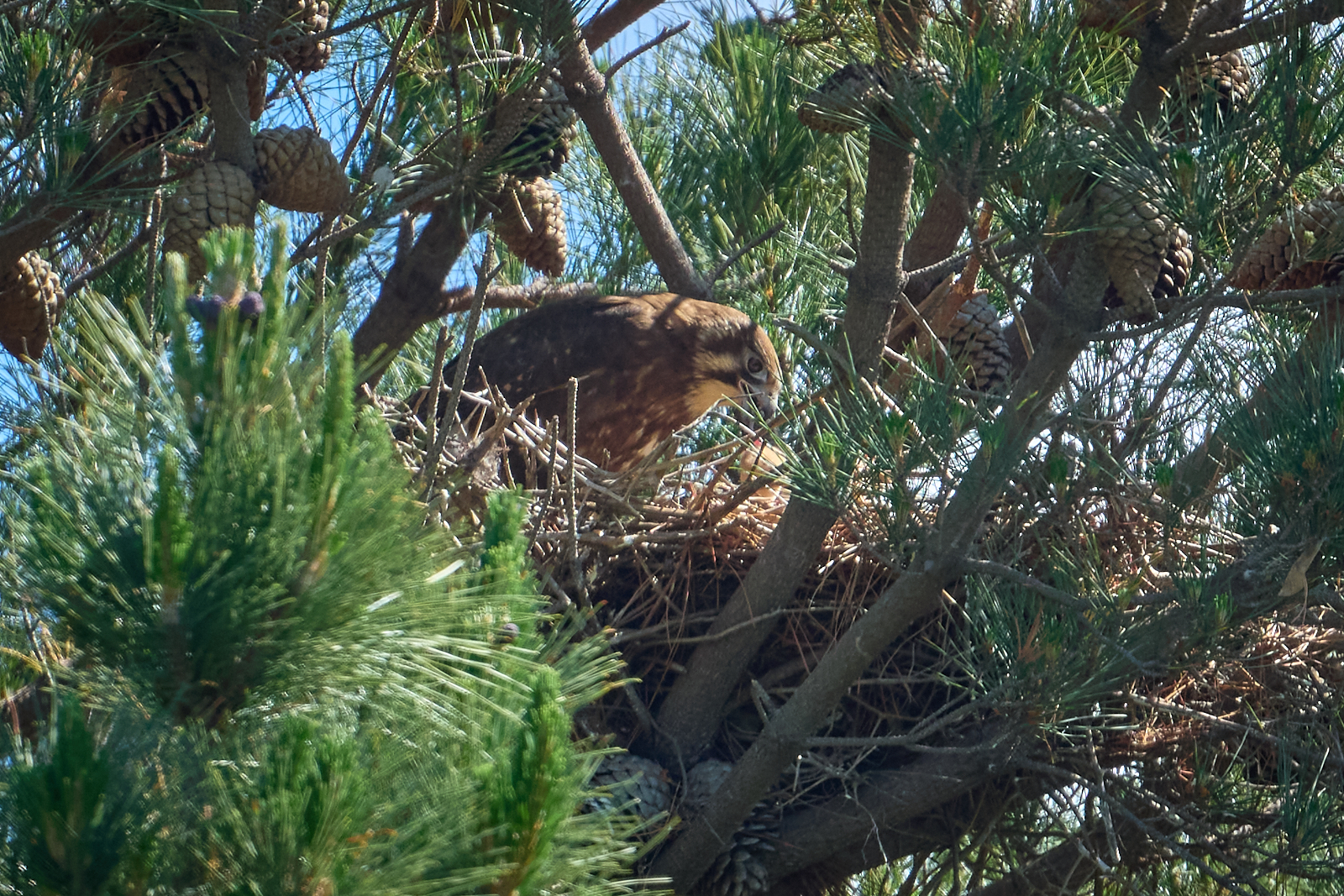
This is the male, he is lighter in colour. He is doing his best to hover over the grassesAction TIme. A quick drop on to some prey belowMouse delivery. Unlike Black-shouldered Kites, he carries the prey in his beak.The male: Time for a scratch on the wing.Sitting waiting for an opportunity to pounce. His yellow cere and eye ring are noticeable id markings. HANZAB notes that yellow cere may be a sign of age and is more prevalent in males. This bird might be at least 15 years old as we’ve seen him over a number of seasons.Heading out for another catchThis is Cassia, of Cinnamon and her nest with at least two young. They are only recently hatched, perhaps in the past few days.The magpies decided that Cassia was not going to sit quietly anywhere in their territory.Maggie closing in.She is well aware of the challenge, and is about to power away.This is the first time I’ve seen a falcon put in the effort to evade the charging magpies. I think she has the better of them in a vertical climbStretching out. The magpies might have the advantage on a downhill run or across a level field, but in this case she just lifted up faster than the magpie could manage.The male avoiding two enraged Little Ravens
In a recent article in “Nikon Users” magazine, an article on landscape photography had the following quote.
... the one thing we, as photographers, professional or enthusiast, must not lose sight of that we do this for a reason.

We enjoy it.

It's creative, and it's fun.

It's not easy, no one ever said it would be, but the buzz you get when you produce 'the' image is amazing.
Jeremy Walker. See here
Normally I like to keep a Saturday Evening Post to just one image that has impacted me during the week.
However, just for once I’m going to break with tradition, mostly because I think the images are related, tell a story, and also give an insight as to why I’ll be away this coming week.
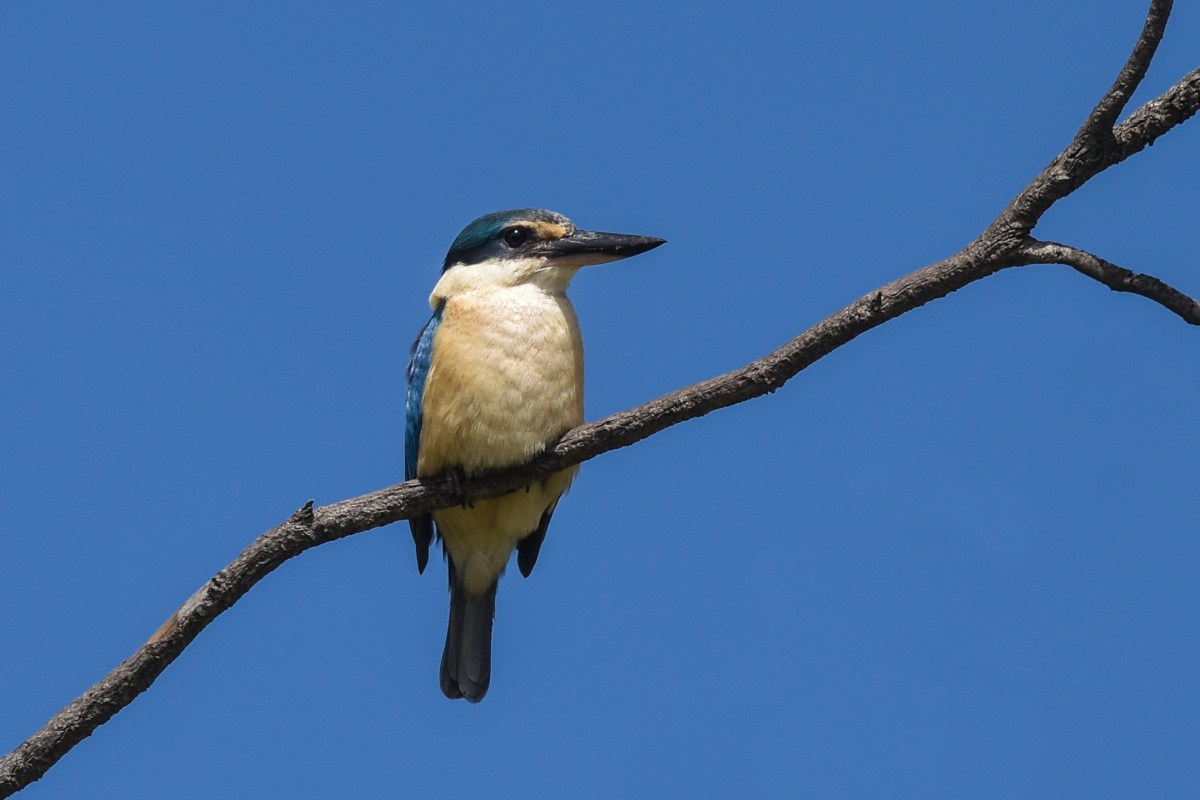
We had, EE and I, made a trip to Point Cook Coastal Park to look for the return of Sacred Kingfisher.
It was one of those days where the weather was not playing to our advantage. A strong northerly wind was ripping through the trees, and out over the beach, sand whipping up with each step.
We had as they say had a bit of luck with the Kingfisher—All Bad! Not a feather to be found, not wing flicks and not a single distinctive call.
Why don’t we go to the beach, saith she. Ok, saith I.
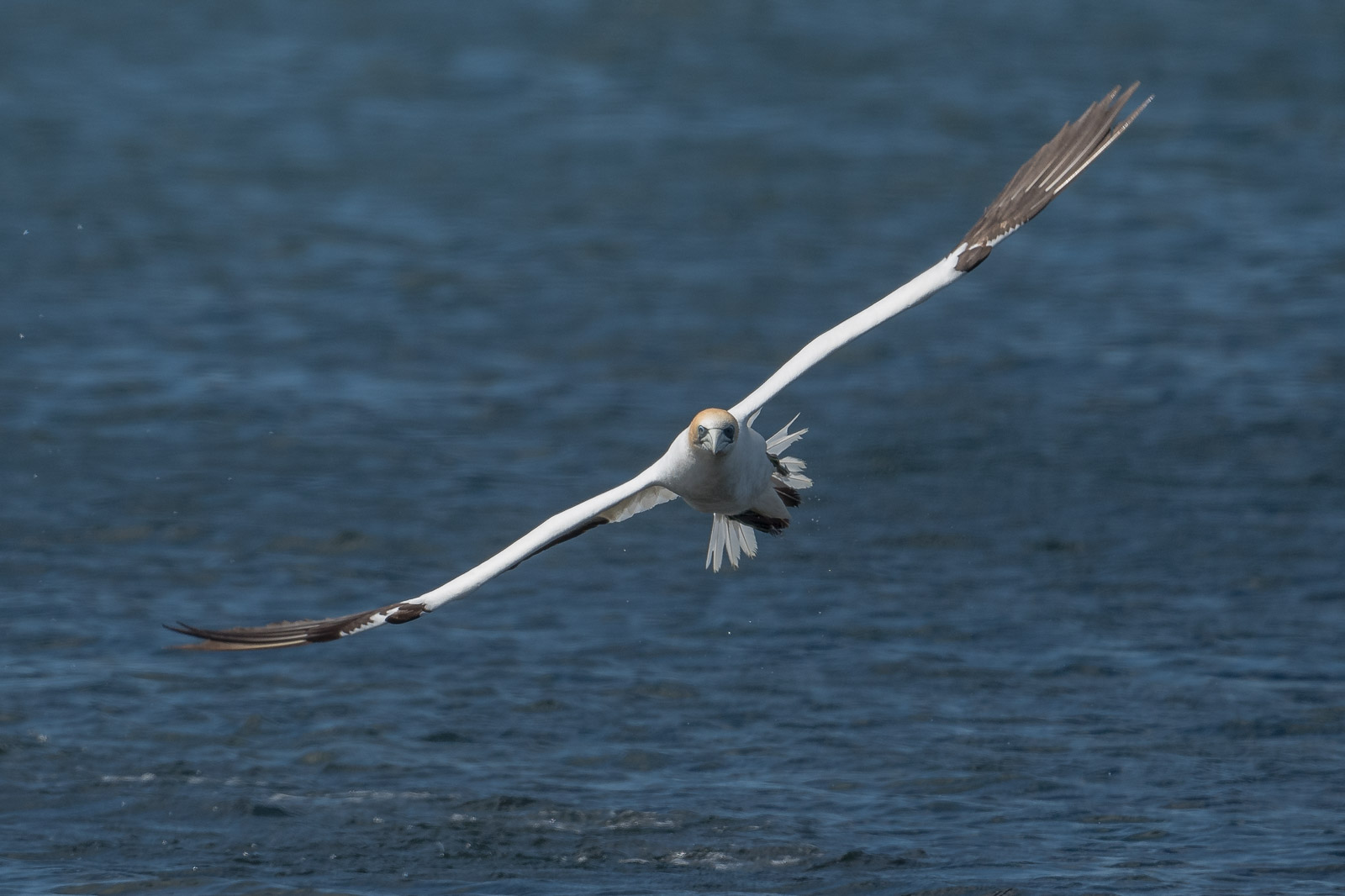
And just as we arrived at the beach a small squadron of Australasian Gannets appeared, fishing in the water in front of us. I’ve noted before that a lowish tide, and an offshore breeze seems to bring the gannets in closer, and not doubt because the fish shoals are working in closer.
This was exceptionally interesting as the tide was quite low, and the edge of the sandbank was visible in places, and the rocky ledge was also exposed. So the birds were diving into the water not more than 30-50m from where we were standing.
Its the closest I’ve ever been to such awesome birds in action.
There is something intriguing, boarding on infatuation about watching big fishing birds explode into the water. One only needs to look over the majority of bird books/site etc. to see the numbers of eagle, herons, cormorant and osprey photos to know that photographers find them irresistible subjects
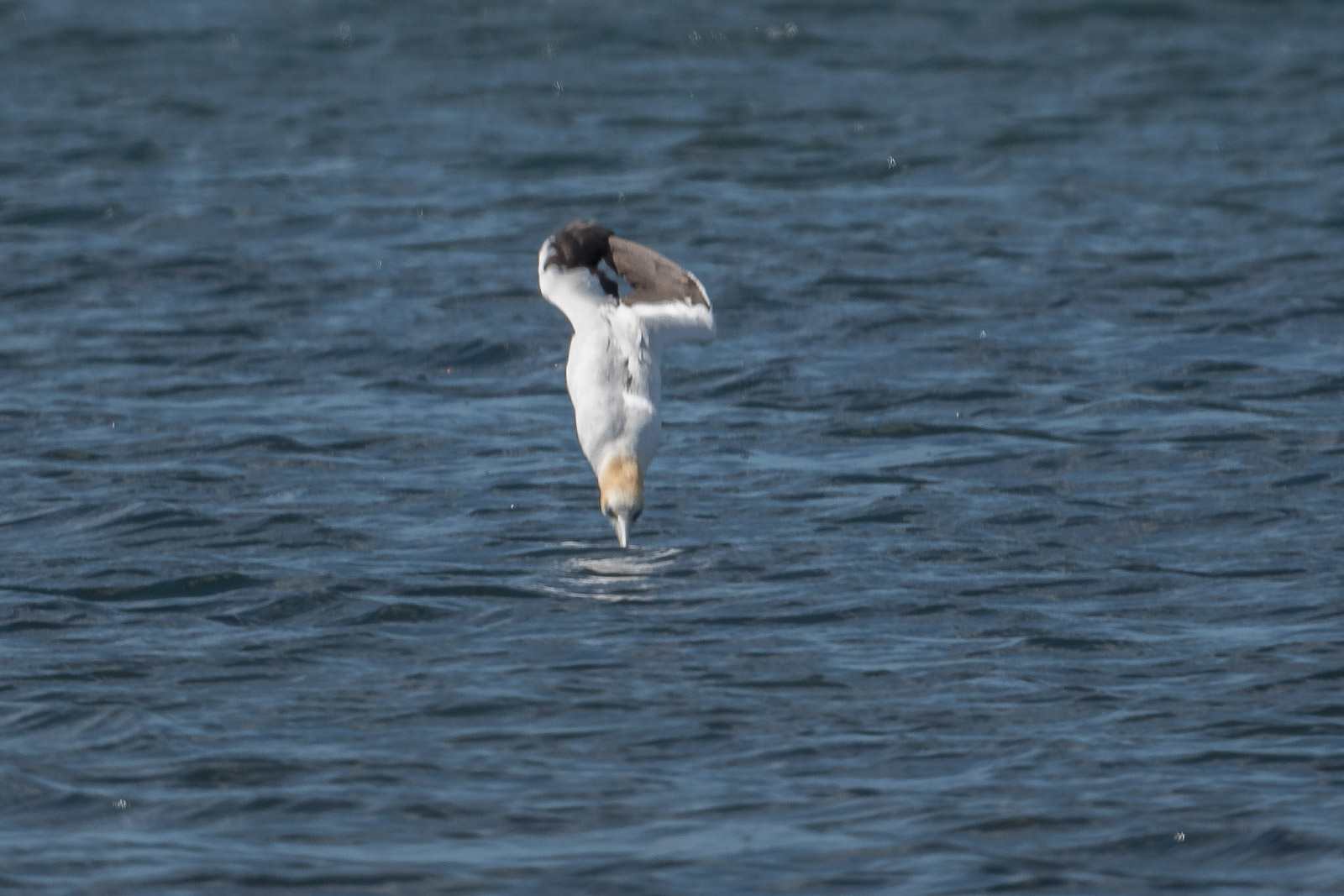
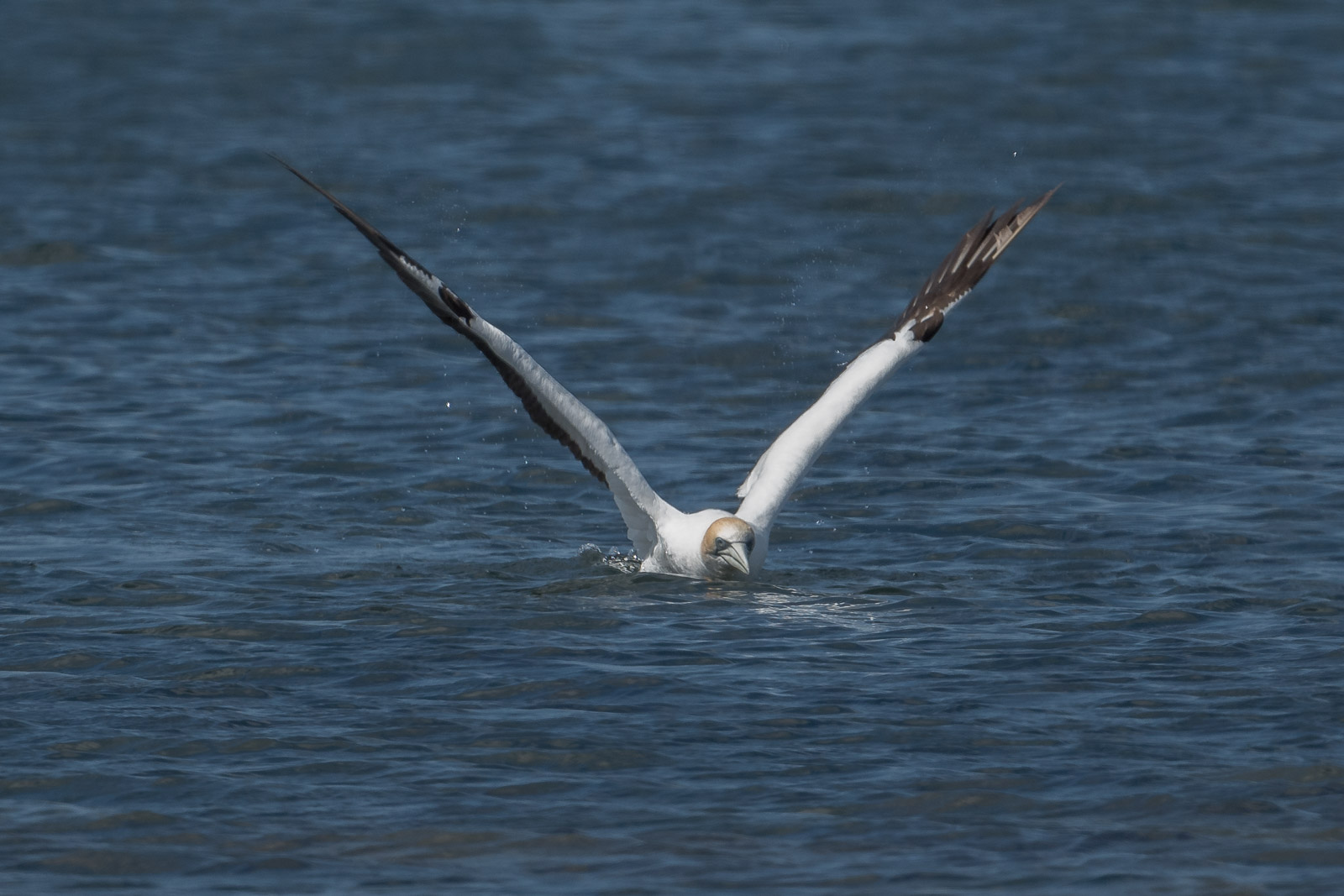
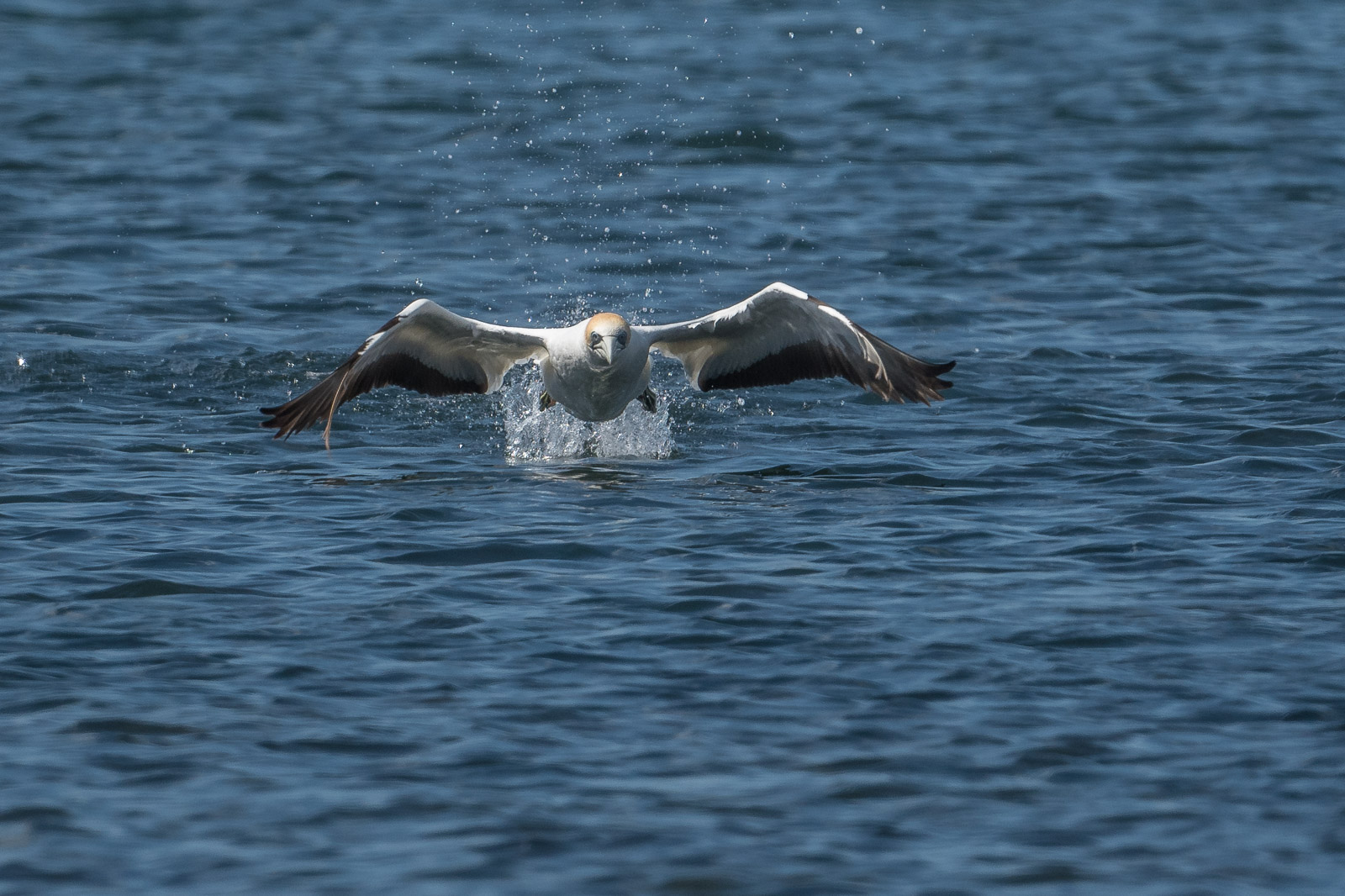
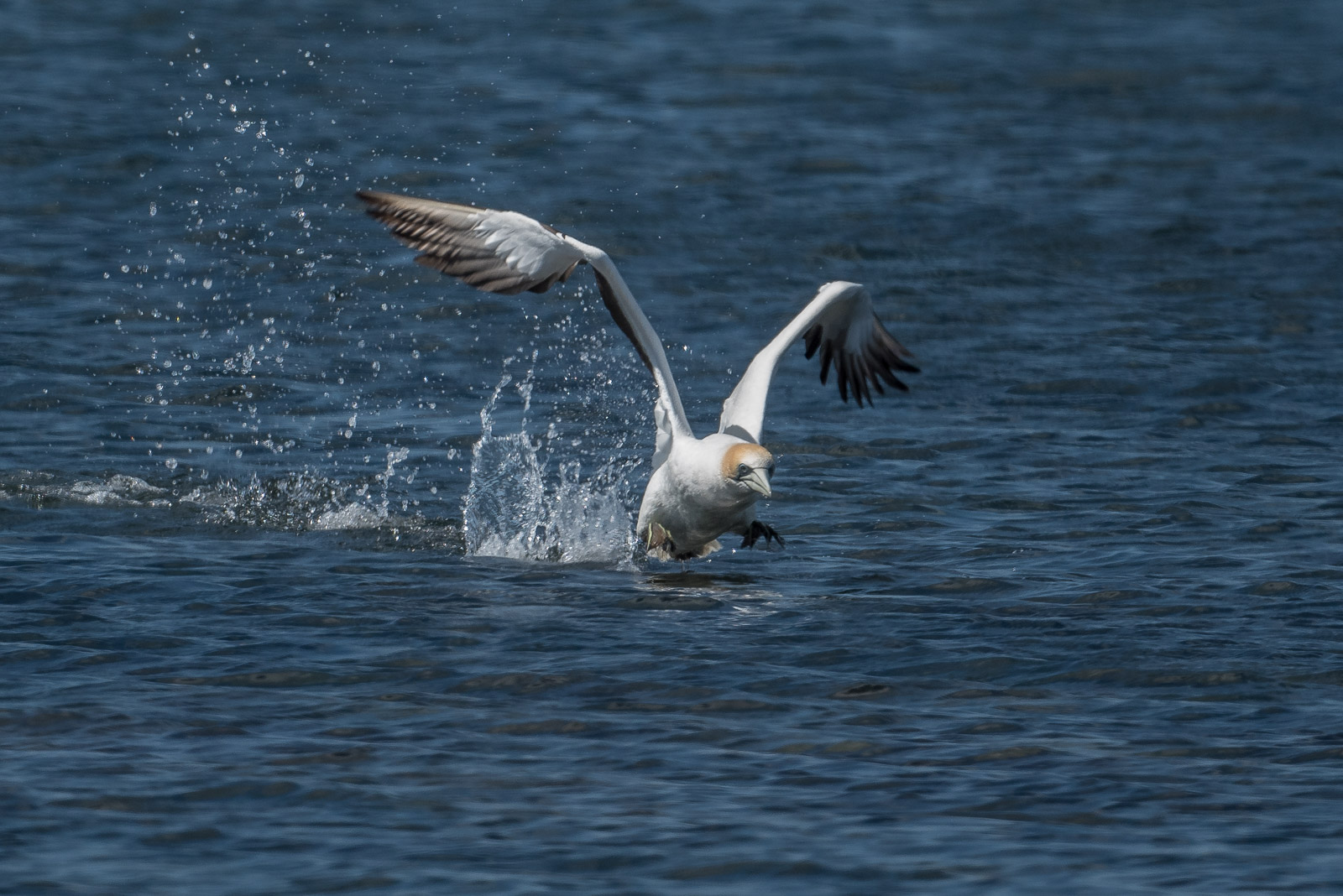
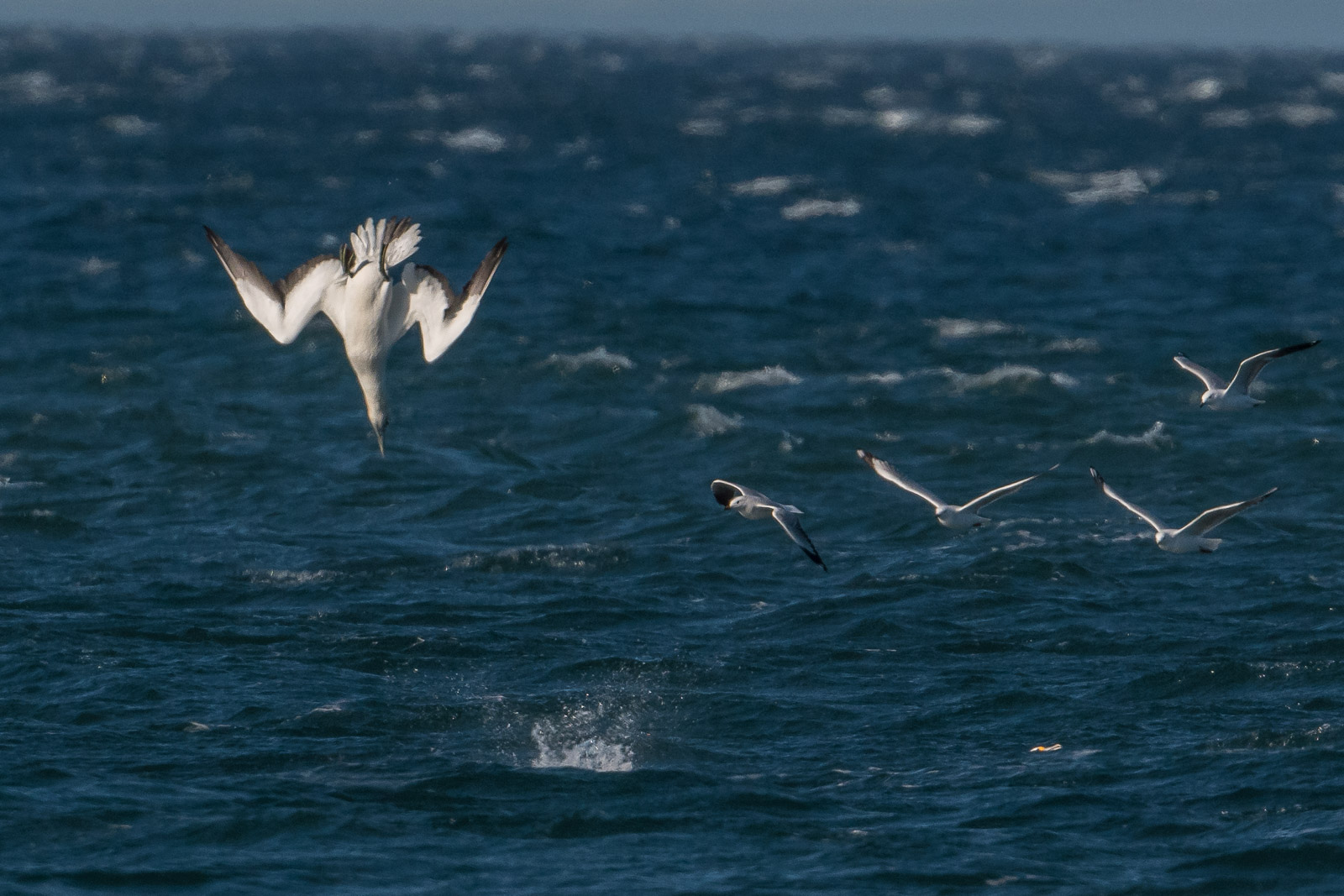
I’ve had several sessions with gannets out beyond the reef along the Point Cook coast and also down at Point Danger, near Portland. But these were frame filling birds, and because of the wind, they adopted quite a different approach to the attack. Normally we see them rollover and drop directly. But they seemed to drop the wings, hang out the legs, reduce speed and the torpedo-like slide into the water. Then after 10-15 seconds they must swim back up, as they fair bobbed out of the water, then settled back down to eat and prepare to takeoff. Fascinating.
“So”, she reminded me, “Why did we spend $40 to book a trip to see Gannets in the water next week?” Ya gotta laugh.
See how we go ah? Just don’t lose sight of the reason to be out and about.
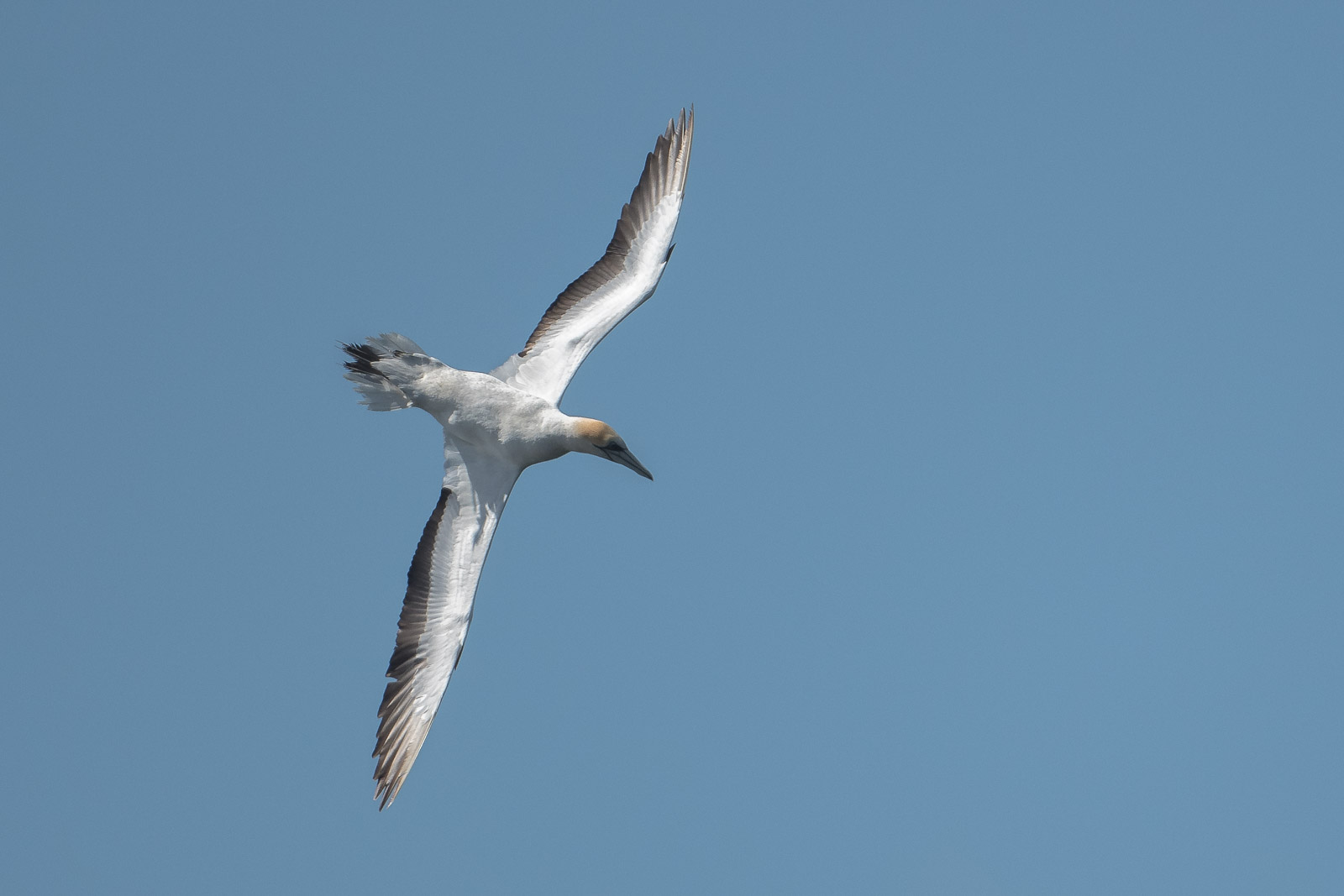
This is one of the few that I saw rollover preparing to diveWings tucked, legs out, tail flared. Speed reduction technique
ImpactThe rocks show how close to the edge of the reef the birds were workingFolded back wings preparing for entryComing upHow much power to get the big bird out of the wateOne jump two jumps, airborne.Head shake to get rid of excess water.Simplicity
It’s been a bit quiet for us of late. Too cold, too blowy, lack of birds. And hot chocolate at home…Yum!
We had been at Point Cook Coastal Park a couple of weeks back. Looking for Flame Robins—not too many, unfortunately—and EE’s Sea Eagle, (hers by virtue of she saw it first, not that any would be surprised).
By the time we had arrived there was a pretty stiff Southerly breeze at work, making walking challenging for EE and Dolly. However we found a sheltered spot at the beach, and opted for a cuppa and snack, and while we sat contemplating no Sea Eagle, Robins, nor Cormorants, (somewhat in that order of importance), a large mixed flock of sea birds arrived just about in front of us.
No doubt a school of fish was running along the edge of the sandbank a few hundred metres out. Outstanding among them was 25-30 Australasian Gannets. It’s really only on a Southerly that we see these birds in so close, so it was a bit of a treat to watch their controlled dives. A large number of seagulls and cormorants were also along for the feast and quite a few Greater Crested Terns.
Unfortunately for photography, they were just that little too far out, and mostly swung round into the breeze for lift off, which meant very few close passes. As it happened, however, I had packed in the Teleconverter, TC 1.4, so it gave me a little more reach with the 500mm.
Still for all that, all these images are huge crops from the D500. But it does reinforce what I’ve said previously about the lens. It does focus well, beyond the somewhat limited 30m or so of the cheaper tele/zooms.
Eventually the fish moved further out and up the bay, so we settled back to our now cold cuppas and enjoyed the action from a distance.
Made up for the lack of other special guests that day.
They seem to roll over, then correct and plunge straight downNo doubting where the target is.Starting to fold up all the hardwareAnd down it goes. Interesting to see the Pied Cormant appearing in the sequence
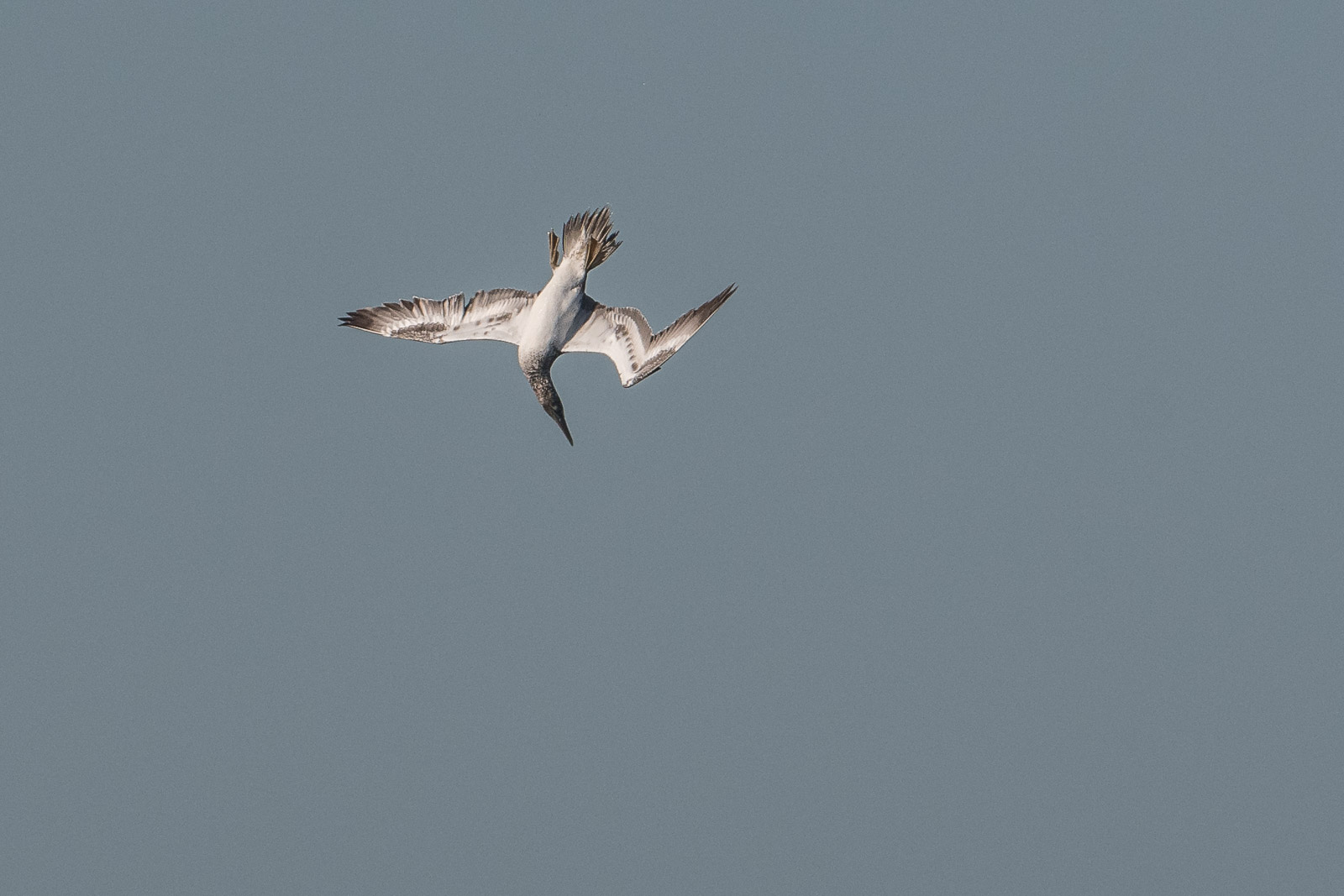
Another of the roll over actionsAll tucked up for a smooth entryA juvenile. When you consider it’s actually upside down as it comes out of the roll over, their body flexibility is awesome.
You can tell, dear reader, when its a quiet birding day. And that I’m down at the Point Cook Coastal Park. When the tide is in, the cormorants, Little Pied and Pied mostly, congregate on an old abandoned pier that orginally served the first Chirnside Homestead in the area.
Now it’s a shadow of its former self, but regularly used by water birds as a safe haven for resting, preening and establishing relationships.
And when there are no other birds on show, well, I settle down on the sand, and watch the comings and goings. Always some new thing to see.
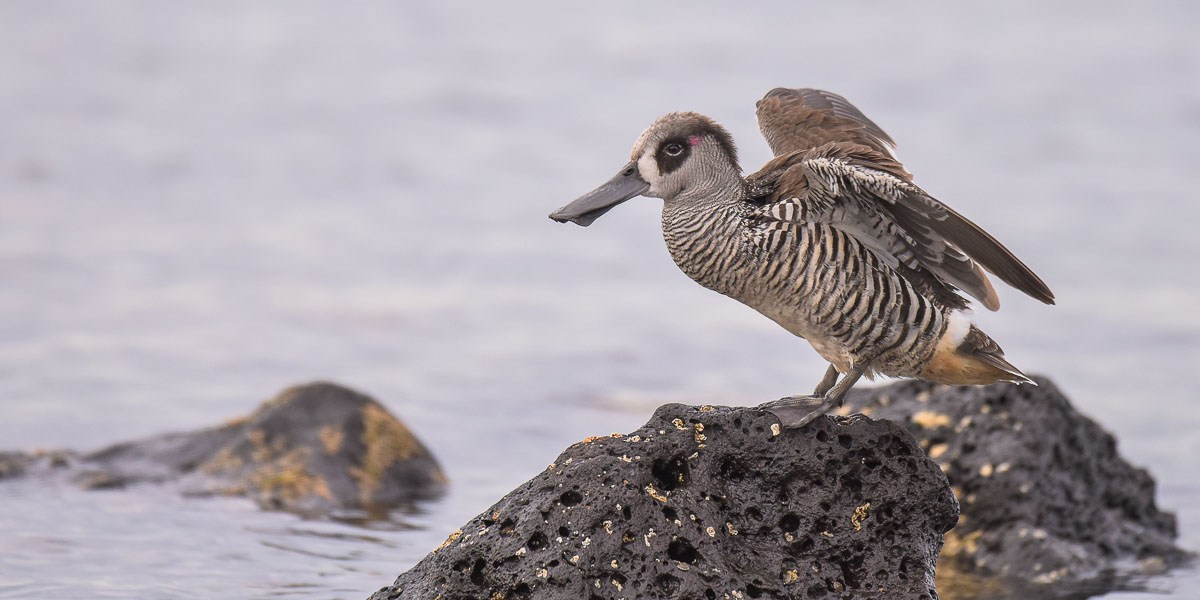
It says something about the whole day in general when, we set out to find some Flame Robins at Point Cook Coastal Park, and end up spending half an hour with a single Pink-eared Duck.
The plan was to have a look around the old homestead area and see if we could locate any Flame Robins that usually turn up for their winter holiday at the beach. And if we were really lucky, perhaps a Pink Robin, or two—that would be nice.
We met Bernie the ranger on the way in, and he (of the sharp eye), said he’d not seen the usual suspects so far this season.
Friend of mine once said in conversation as we chatted about my time in the bush, “Bird photography is pretty easy, you just sit in a deckchair and photograph any birds that happen to come by.” And today, for once, he was right. Thanks for the advice John.
Mr An Onymous had looked at the weather maps, the weather forecasts, the icon ladies and I guess in the end, just plain looked out the window, and declared we should take a trip to Point Cook Coastal Park on Friday. Sounded good as we’d not been out that way since the end of the Flame Robin season, most of the birds were well on their way back by mid of September.
What a difference to mood a bit of sunshine makes.
We were looking for a day out at the Point Cook Coastal Park with Graham Harkom and the Meetup Bird Photography Group, and as usual Graham managed to put on a picture perfect day.
We arrived in good time to find the park gates still locked, and so we stood around discussing the day’s activities and soon enough the gate was open. Just as well we were a little late starting as a few late-comers thought they’d arrived on time.
Within a few moments of getting out of the car, EE had discovered “Brown” the resident Brown Falcon, and he seemed quite happy to sit in the sunshine. Then, for reasons falcon, he took to the air and patrolled along the treeline by the carpark. Much of course to the chagrin of every magpie in the area. So we started with some good views of Brown in being harassed by first one, then another magpie.
Through the gate and along the track out to the Monument, we also managed some Flame Robins, White-fronted Chats and a particularly good view of several Striated Fieldwrens.
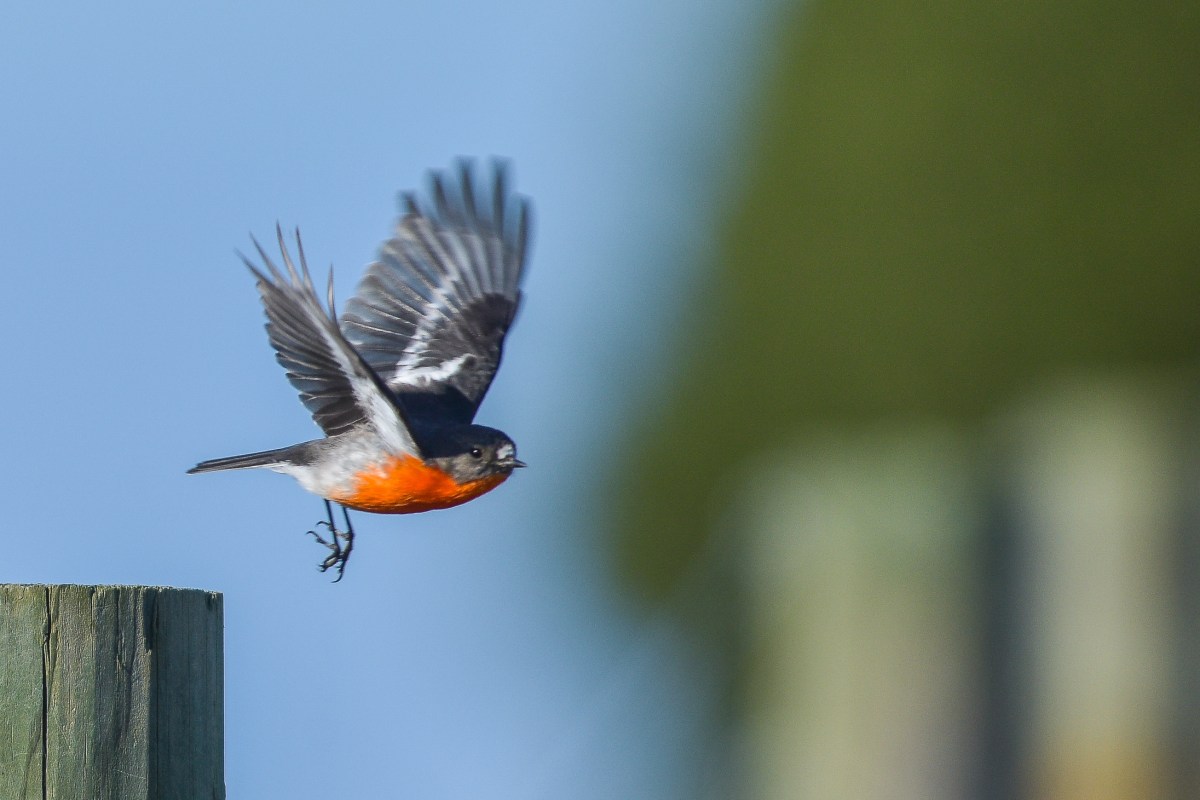
From there we wended out way back along the beach-line and found a small flock of Blue-winged Parrots sunning themselves on the fence-line. And we managed to get some pretty good shots for the photographers. Then one of our more alert spotted a flash of red, and a Flame Robin males spent the next ten minutes entertaining us flying from fence to track to feed. He seemed the least concerned by our presence and again it was a photo opportunity.
Add a couple of Whistling Kites, and several Black Kites that seemed quite taken by our presence and made low passes to get a good look at us. Perhaps they were doing a “People Count” or a “Camera Type Count”. Whichever it was nice to see the sunshine glinting on those rich deep brown wings.
By the time we’d made it to the Homestead area, the tide was well in, several Australasian Gannets were working in the waters further out, EE managed some White-faced Herons, and Pacific Gulls while she had waited for us to turn up.
A large flock, (300+) Little Black and Pied Cormorants were working on a fish shoal out beyond the reef, and every-time the shoal moved a large black mass ascended to the air to catch up with. Very impressive.
A walk back to the car through the farmland revealed some more Flame Robins, several White-browed Scrubwrens and a loud-voiced Singing Honeyeater.
After lunch a few of the group continued round to the RAAF Lake Lookout and spent some time at a pond with circling Welcome Swallows. Where are you Rodger Scott!!
Graham then spotted first one, then a second Little Eagle at work over the Lake, and we were discussing the presence (or lack of) Goshawks, when over the treeline a bullet shape with longish tail appeared and at first I’d picked it for a Goshawk, and we were both amused we’d been discussing the same. Then as the bird drew closer, it pulled up its wings in a most ungoshawk manner and revealed itself as a Peregrine Falcon, and it was most intent on making the Little Eagle’s life just a bit miserable. Several close stoops had the Eagle moving on thank you.
Thanks to Graham for organising the day, and to all the grand folk who turned up to add such a delightful companionship to a glorious sunny day. Really, after the past week or so, the weather just seemed to make the air sing.
Enjoy.
Brown Falcon, being seen off by an Australian Magpie
Was chatting with a birder friend, and I mentioned the Point Cook Coastal Park, and he said, that he didn’t plan to go there much as most of the birds were pretty common, and only occasionally was a Plover or a Pratincole enough to take the trip down there.
When we relocated home a couple of years back, Point Cook was on the top of my list as a suitable place, and to be honest, it was second, third and a close run fourth on the list. And of course the logic was it was but a few minutes from the Coastal Park of the same name, and it would be neat to roll out of bed, and stroll on down to the park.
In the end, much wiser heads than mine (EE as it turns out) found us the place that ‘we’ wanted and Tarneit took on our new home address.
But every so often when the light is right, and sometimes when its wrong we venture down to the Coastal Park. And surprisingly, many of the common birds down there have become a bit like friends.
So today we went, not to count, nor to get our lists up, nor necessarily to capture the best bird photos ever, but to visit some friends.
Our friend the Brown Falcon was in the carpark area, and we enjoyed some time with it, as it hunted quite casually from the fence line. Also found a number of Flame Robins that have made the park their winter beach residence.
And of course the usual Pied, Little Pied and Great Cormorants down on the old jetty. They gave us some pretty impressive flight displays while we sipped on a fine cuppa.
Then the local White-faced Heron, and the pair of Pacific Gulls cruised by hunting on the out-going tide. And to our amusement, a pair of Black Swans how have obviously just coupled up were making interesting subjects as they hunted together on the gentle rolling outgoing tide.
As we walked back to carpark, the air literally filled with raptors.
At one point we had all up at the same time, Little Eagle, Black Kite, Whistling Kite, Brown Falcon, Australian Hobby and Brown Goshawk. I was hoping that the resident Spotted Harrier would make an appearance, but we had to be satisfied with those six.
We stopped along the road to look at some Flame Robins bathing in a tiny pool in a paddock, and some ‘new friends’, came over to say ‘hello’. So we spent a few minutes becoming acquainted with several chesnut horses.
We might not have added any ‘new’ birds to our list, but we had as the Sans Bushman said, “Recognised some birds,and built a tiny connection with them, that is growing into a thread”
Enjoy.
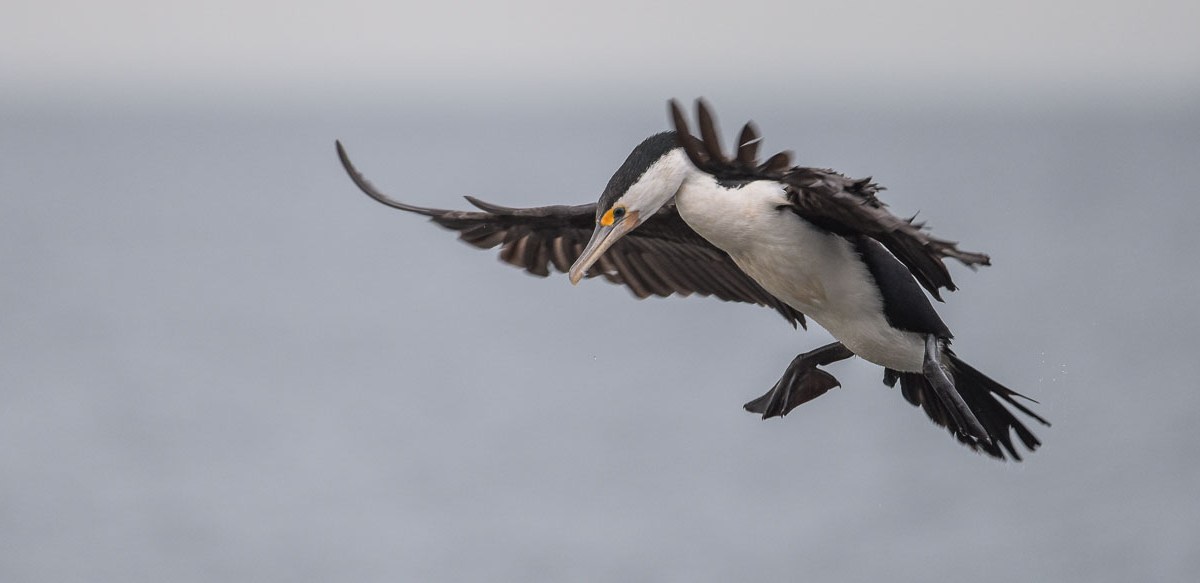
Pied Cormorant on landing approach
Open water, easy landing.
Flame Robin, I suspect the colours suggest a first year male moulting in.
Is that another photographer pointing a lens at me?
Time to go
Brown Falcon. I thought it was going to sweep along the fence. But it simple jumped down to take a lizard
The couple that eats together stays together.
After you. Oh no I insist, after you.
The always dependable Pacific Gull
White-faced Heron, racing to shore so as not to lose its catch in the water.
Flame Robin.
Flame Robin about to pounce
Brown Falcon on a turn
Yellow-rumped Thornbill.
Just came by to say hello. One of several horses that welcomed a thoughtful touch. EE was ready to oblige.
Early morning drizzle, (and icon ladies had got it right!). Not much chance of a ramble today, and the sky is deep leaden grey. Lowering, the poets call it.
Brrring Brinnng. EE’s phone message do dah goes off. Scares the life out of the unprepared. Roll over pull-up doonah.
“It’s a message from Rockman’s the clothing shop, they have a 40 % sale on today,” In most excited voice. Pull-up doonah a little closer.
And there’s a Rockmans over at Point Cook, we could, well, take a look along the beach at Point Cook, then have lunch at the shopping centre, and I could go and save some money.
Doonah is now a ball around my head.
So, as you guessed. Clever reader that you are. We went.
Well, the raindrops on the windscreen didn’ t seem to be diminishing, and had turned to a light drizzle by the time we parked.
Found some lovely, active Flame Robins in the first few minutes. Yep, just as I figured. Not much light.
We ventured to the beach area. Low tide here, and most of the birds are well out beyond the end of the rock platform.
By morning tea time, we’d not seen much more than the usual suspects, and even the cormorants had abandoned the old jetty. Open the thermos, and enjoy, at least it wasn’t bucketing with rain.
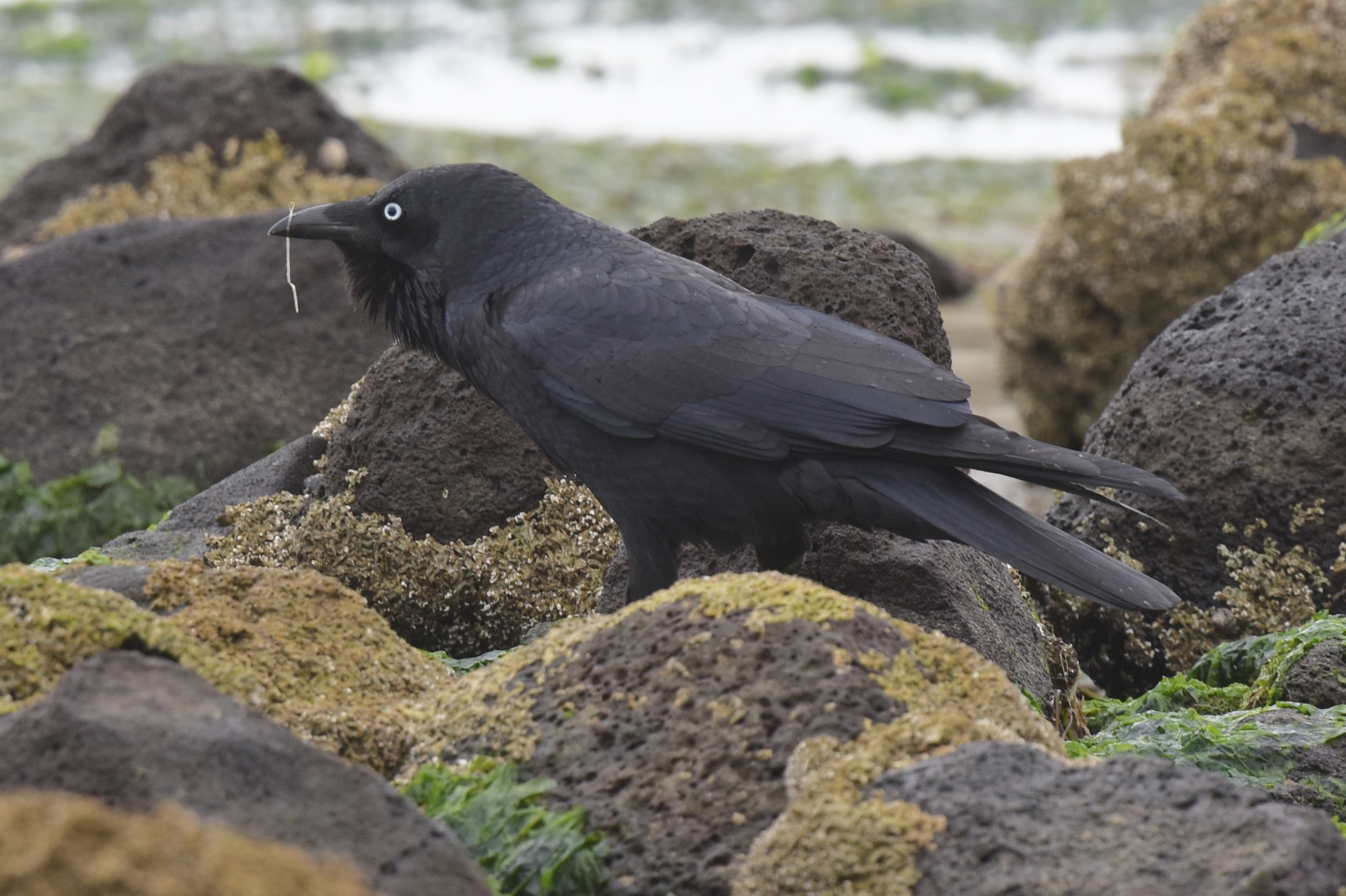
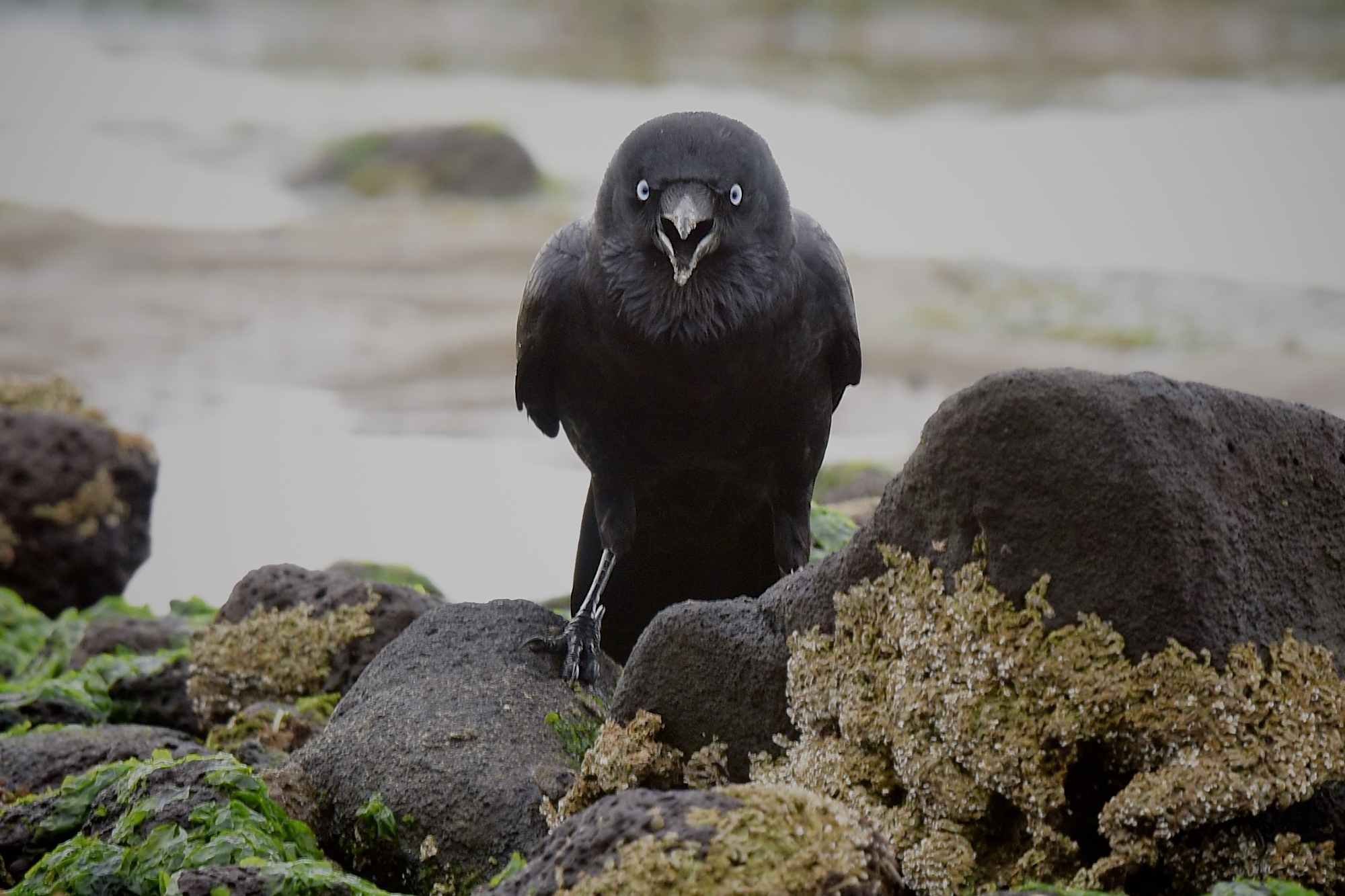
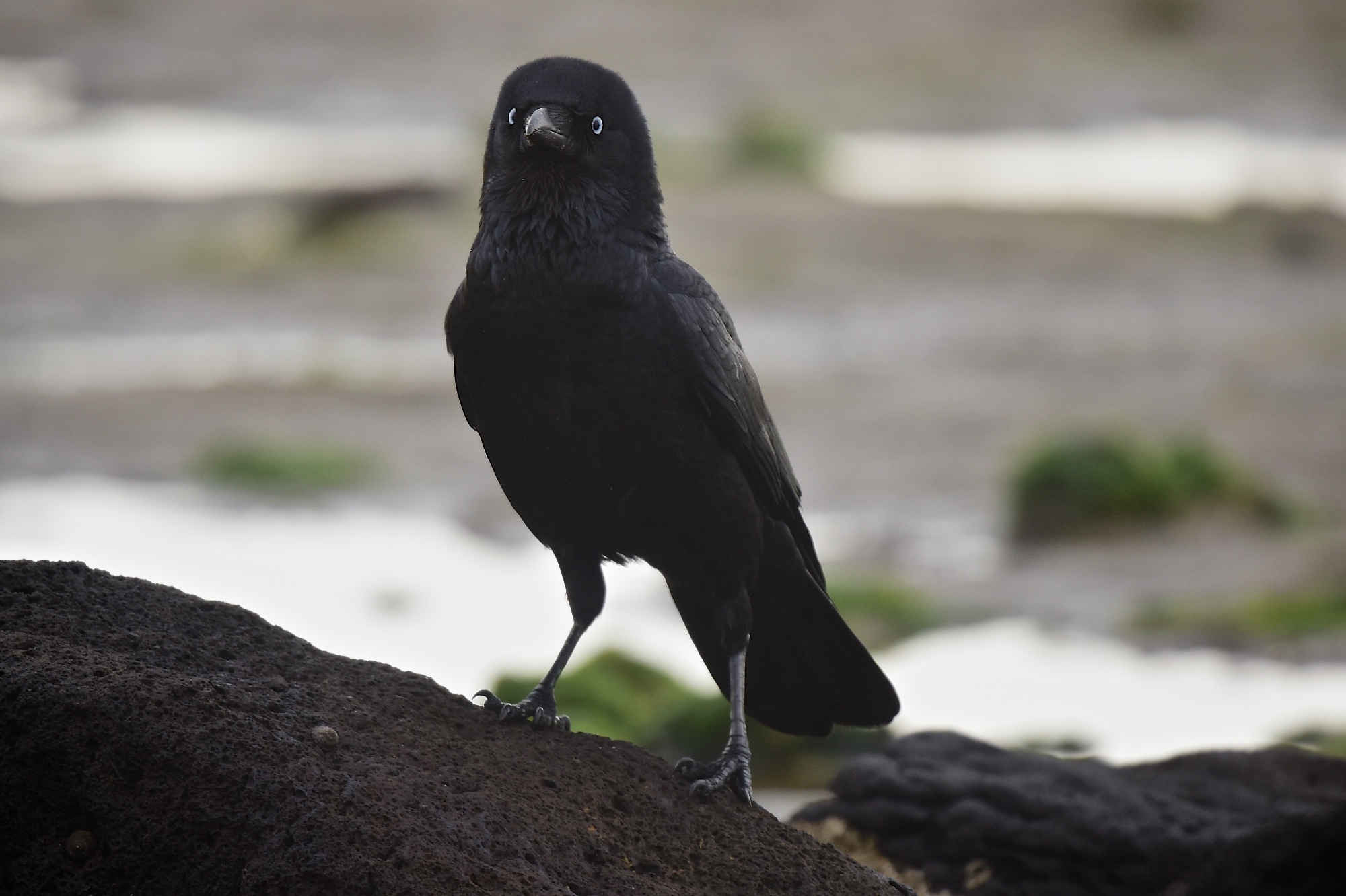
Cahhh Cahhhw Cawww, from along the beach. A Little Raven was working among the exposed rocks and intent on telling somebody what was going on. Into the second cuppa and the bird had worked right up to where we were sitting. Then began the usual, is it a Little or an Australian Raven?
One of the most interesting calls these birds have is a really guttural purr. (I can’t think of a better word), and the hackles stick out when its made. And soon a partner arrived on the rocks, and they began a fine old discussion.
But a black bird on a black backdrop, or a white background on a really porridge grey day is not going to get me pushing the shutter with any enthusiasm.
Till.
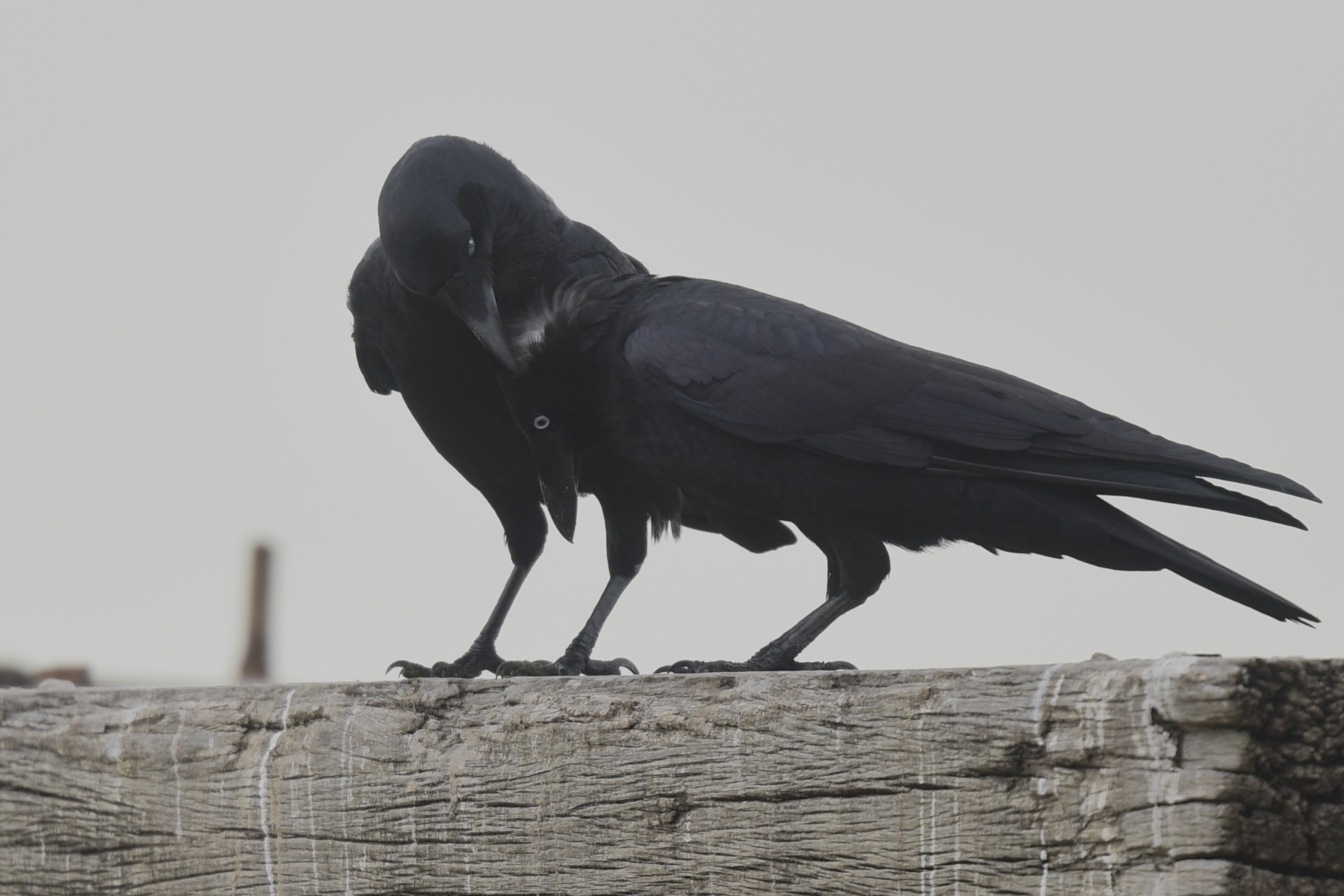
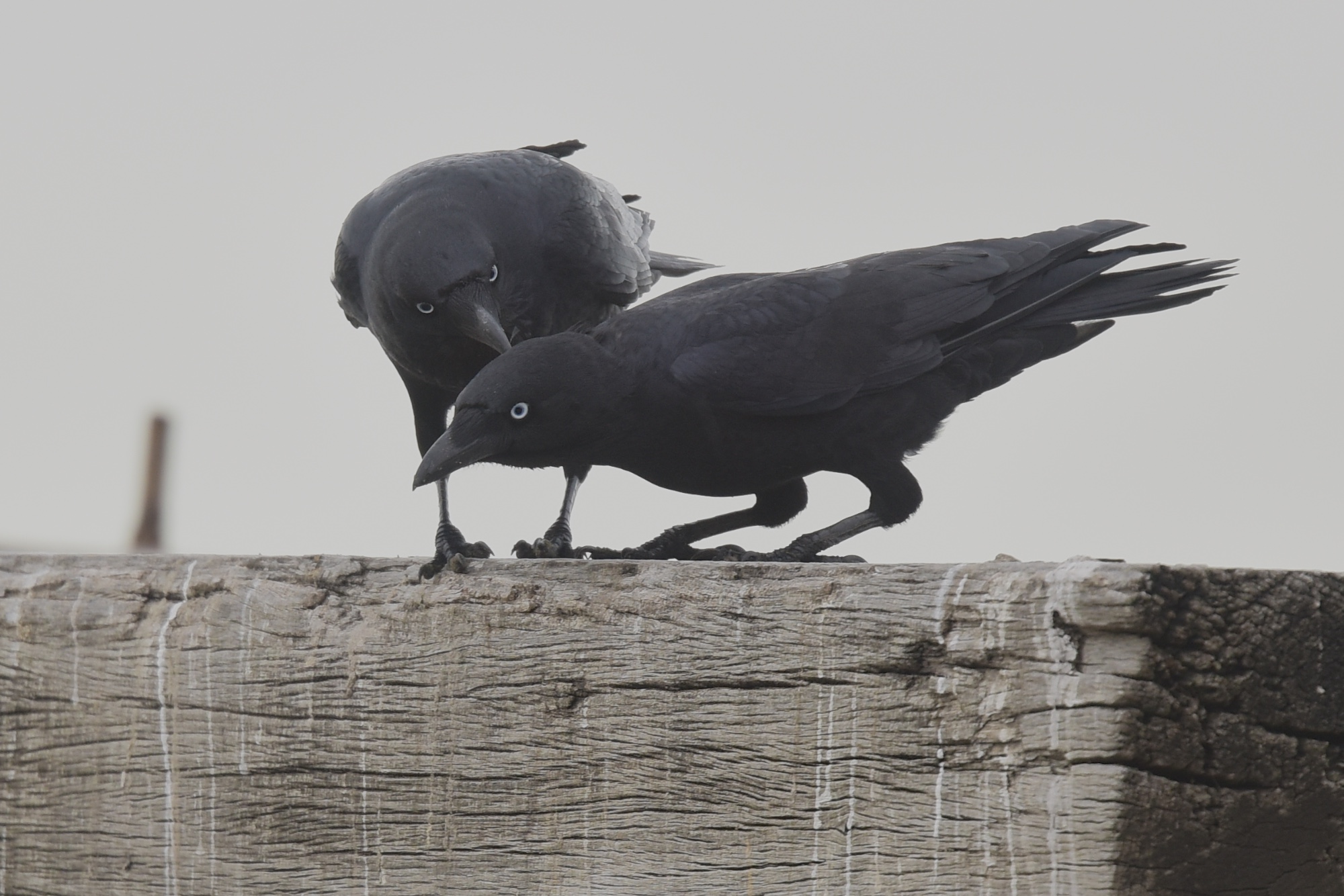
Both flew to the top of the old jetty. And after a bit more discussion, the smaller of the two moved closer to the other, put its head down and. The larger bird began to alopreen it.
We tend I suspect unfairly, to have a low regard for Ravens. Well, they are black, likened — or associated — through our western culture with evil, hang around supermarket and food outlet rubbish bins, are a pest to all sorts of farmers and in large flocks are dangerous to small birds at nesting time. And if I’m not mistaken, the bloke in the Ark, let out a Raven to check the conditions, and the Black bird did not come back. Another strike against it. Yet of course, the Dove, always pictured as white, was the good guy. I’ve checked the old texts, and there is no indication it was white. But don’t let the facts get in the way of a good story
So to see these two birds engaged in some sort of pair bonding, (and they do, it seems, stay together for life) in such a tender way was really a highlight of the day.
And ‘we’ got to Rockmans, saved a bag of money, and had lunch.
Enjoy
Nothing of any food value was discardedIt has a distinct almost purring call.The photo complexity, dark on dark and lightAfter moving in close the smaller one put its head down.Ah!! that feels goodMust be both a mark of bonding, and cleans the areas that otherwise would be hard to reach.Ahh, the bond is stronger.Calling to her mate as he hunts along the beach
You deserve a break, and I’ve got two days off from Blogging 101. Phew!
EE, Mr An Onymous and I had the chance the other day to take a bus tour to a wetlands that is managed by Parks Vic, but not accessible to the public. It is an old saltworks on the edge of the bay at Point Cook, Victoria.
One of the highlights of the day was discovering (well it was pointed out to us by the ever helpful Libby the bus driver), a recently hatched White-headed Stilt chick (Yes, I know, I know, we call them Black-winged Stilts, but that is in the world of bird names, so, well, (as Paris Hilton was wont to say,) So, Yesterday!
Mum White-headed Stilt was not to impressed to have half a dozen eager photographers too close to her young, and kept issuing warnings to us and instructions to the little one about how to look its best for camera.
The little dude still has lots of down feathers and spent a lot of time preening at them to get rid of them. They must itch or annoy I think.
Enjoy. We did.
Great to see such a young bird doing so wellMum Offering instructions on how to pose for the photographers
Took an unexpected turn and ended up at the Point Cook Coastal Park. We had planned to have lunch at the Homestead Cafe. But. Its closed. Until further notice.
So we grabbed the cameras and headed for the beach.
Down by the pylons of the old jetty a Pacific Gull pair were stationed bobbing up and down in the waves. Then with a leap, they would duck under the water and emerge with a crab dinner.
These shots are not one sequence but the best from about 15 mins of watching them at work.
One look at the weather map was enough, didn’t need no icon waving, weather talkin, danger predicting tv dude to tell me. It was going to be cold, miserable, overcast and photographically crippling.
But.
We went anyway.
Mostly to see if the Flame Robins were at Point Cook, -yes. Was the Pink Robin(s) there. No. (well not that we could find) Were the pair of Black Kites any further advanced with the reproduction activity. Jury out on that.
After being blown down toward the beach, the tide was well out. Half blown out, I’d suggest. And there were a pair of Pacific Gulls resting in the lee of the rocks. And the shutter speed was on the never-never plan.
After awhile one of the gulls got up, flew to a rocky edge of the water and retrieved what I take to be a Sea Urchin. This hard shell creature is more than it can break open by hitting on a rock. But, the species has developed over the years a working technique. Take the prize up about 20m and drop it on the rocks. Smash. Or at least on the second attempt.
Waft down and enjoy the feast.
After performing this feat several times in front of us, it also attracted the usual scavengers and free loaders. So on the incredibly strong wind several Whistling Kites came to pay a visit to their new ‘best’ mate. However Pacific was having none of that and inspite of some clever wing work on the part of several attacking at once, the gull simply stood its ground. In the end, they moved on to look elsewhere and gull went back to its snack. And then moved down the beach with the next catch.
Nothing like a snack after lunch
Clever technique for tough food.
Bombs away.
Now to enjoy a nice snack after all that hard work
If at first it doesn’t break. Try again
Oh, let me take a closer look
Low over the rocks, riding on the strong north wind, the Kite made its first pass at snatching the food.
Lining up in the breeze for a run for the goodies
“Its so easy to catch a gull sleeping on the job”.
Hah! you don’t sneak up on me!
One last look and the Kite headed for more likely food takings
Sometimes you can always tell when a raptor is in the air. The birds go quiet, or there is a series of warning calls ring across the forest. Or, the local magpies and ravens go into high gear agitation and speed across the sky in pursuit of nemesis.
The latter was the case the other morning. A local Little Eagle had been out and had collected itself a pretty fair meal, and was carrying it home tucked in its crop. See the flickr shot here.
A little while later, the ravens and magpies were on high call and in hot pursuit. The day was very windy, and it favoured the highly manoeuvrable and speedy ravens, so the poor Little Eagle copped a right pounding. The wind gave the ravens a great climbing speed and they were able to outclass the raptor. It on the other hand couldn’t get advantage as it had to keep losing height and changing direction. It’s plaintive ‘peep’ call is pretty pathetic.
For some reason, Little Eagles seem to cop it from everyone. Its diet rarely would include taking birds but it seems to get the rap from all the birds. Such is the way of life on the wing.
Also hard to get them all in frame when you’ve only got the big lens handy and the wind is blowing a gale and wrenching it out of cold old hands.
She is on a fence post and has come down the fence line to see what I’m doing. Had to step back a bit to get focus. Too close for the lens focus setting.
For the technically ept, its shot with the 300mm f/2.8 and a TC 2.0e iii. Equiv focal length 600mm. I had the presence of mind to stop down to f/10, to at least get some little depth of field. My calc is about 3cm. As I’m running the D810 on Auto-ISO, it bumped the ISO up to 2500. Something I’d probably not do normally. And its hand-held. My Flickr mate Martyn would be happy. See his work here.
Only Noise Reduction is the tiny amount that my software adds at ingestion.
For an extra look try the “Full Size” button on the bottom left in the gallery shot.
























 Birds as Poetry —— Just because I WANDER doesn't mean I'm LOST