Come, Dance with Me

EE, Mr An Onymous and I had made an early morning trip to the Western Treatment Plant.
One of those days that only Melbourne in winter can produce. Out of the box. No wind, crystal clear blue skies and warming sunshine. Brisk, glad to be alive temperatures. Air quality: Still.

We spent an hour or so with a group who were staked out waiting for the “legendary” Orange-bellied Parrot to make an appearance. And of course we’d heard it all before. “Oh, they were on those shrubs about 45 minutes ago…. 😦

Still we did manage to see a couple of them streak over the bushes and hide among some trees.

We ventured on.

Later in the day, (my, how time flies on a blog), we spotted a Brown Falcon zip across a bund and over a pond, to land on what looked like a small mound of stones and earth. This bird was particularly interesting as it had an almost pure white chest. And, as it turned out, was one of a pair, both in light morph. But that is for another story.

We parked near said Falcon, and EE noted, as she does, up the track was a pair of Brolga.
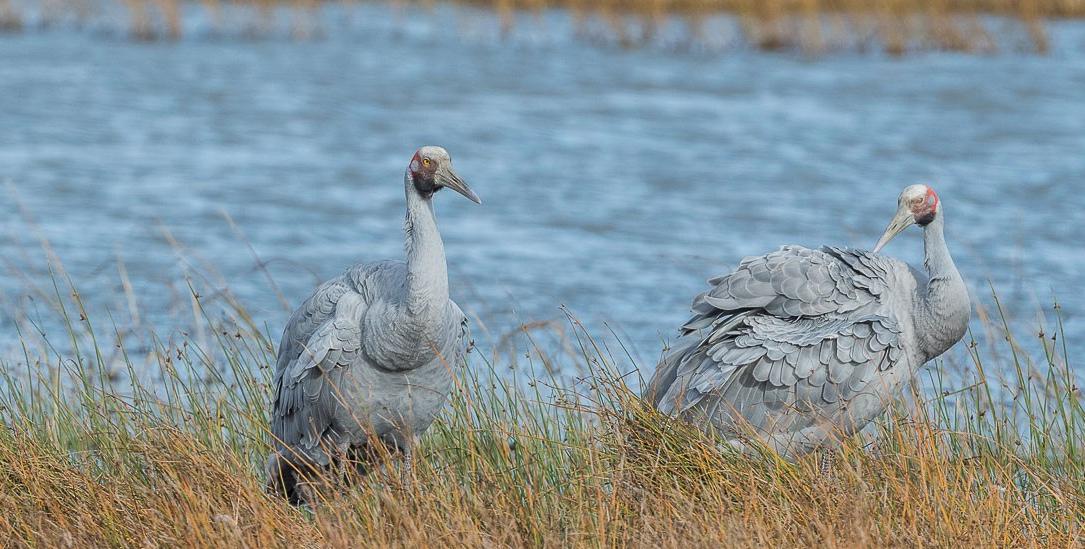
We slowly walked up toward them. They had settled on a small ‘peninsula’ of grasses on the pond so felt safe enough, and after a couple of checks went about their business. We stopped at a repecting distance. They were in no hurry, and neither were we, so it was a great opportunity just to watch.

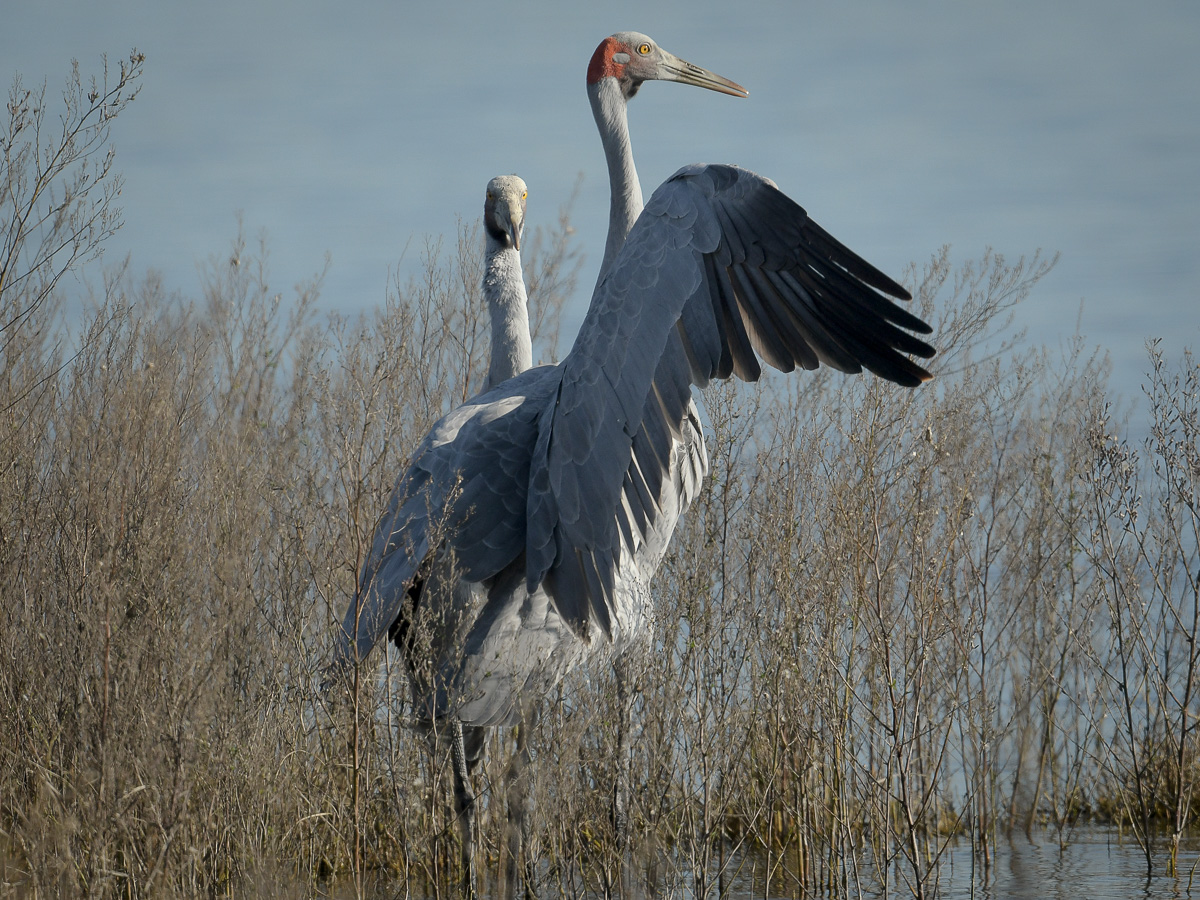
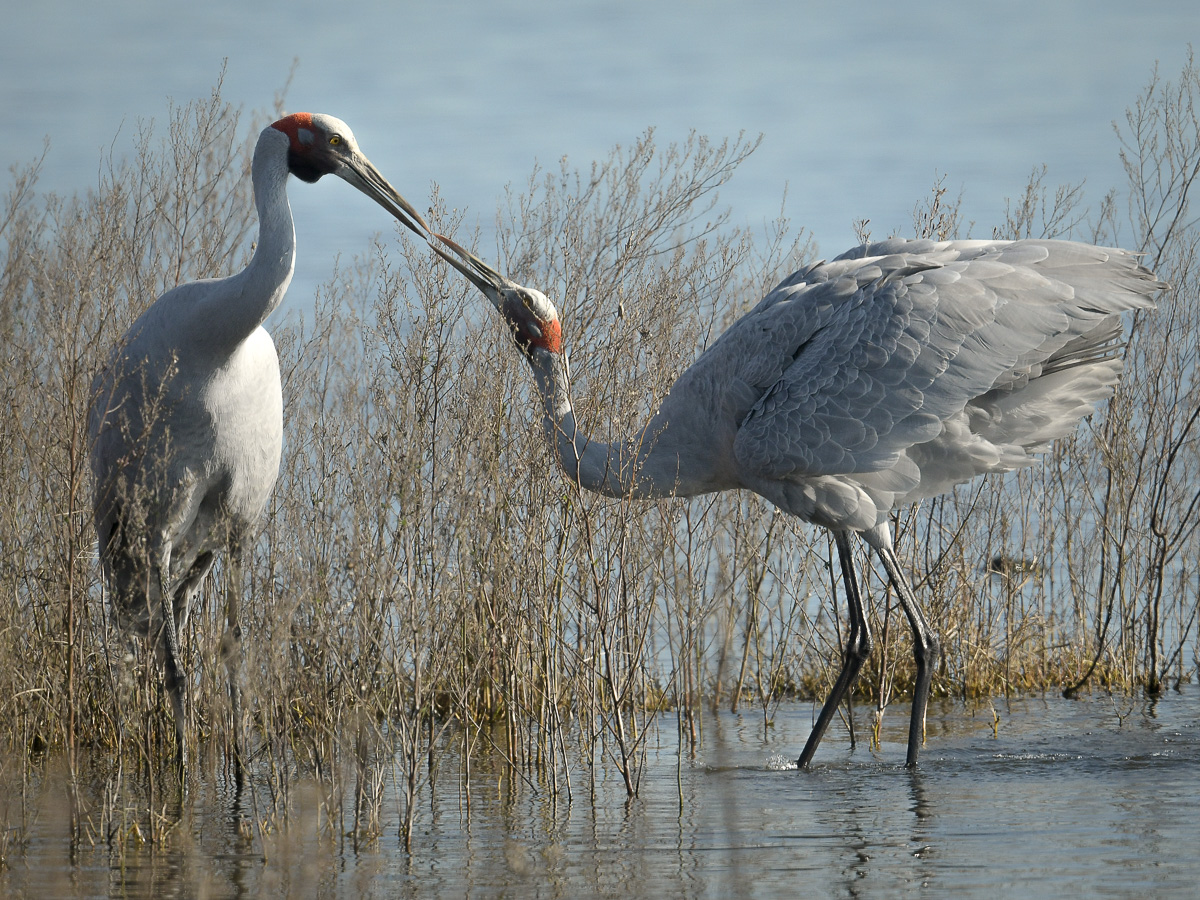
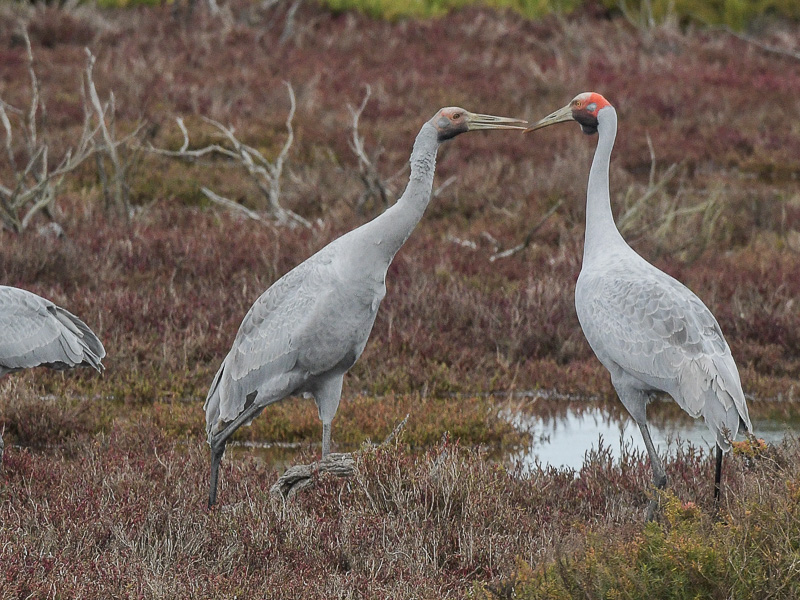
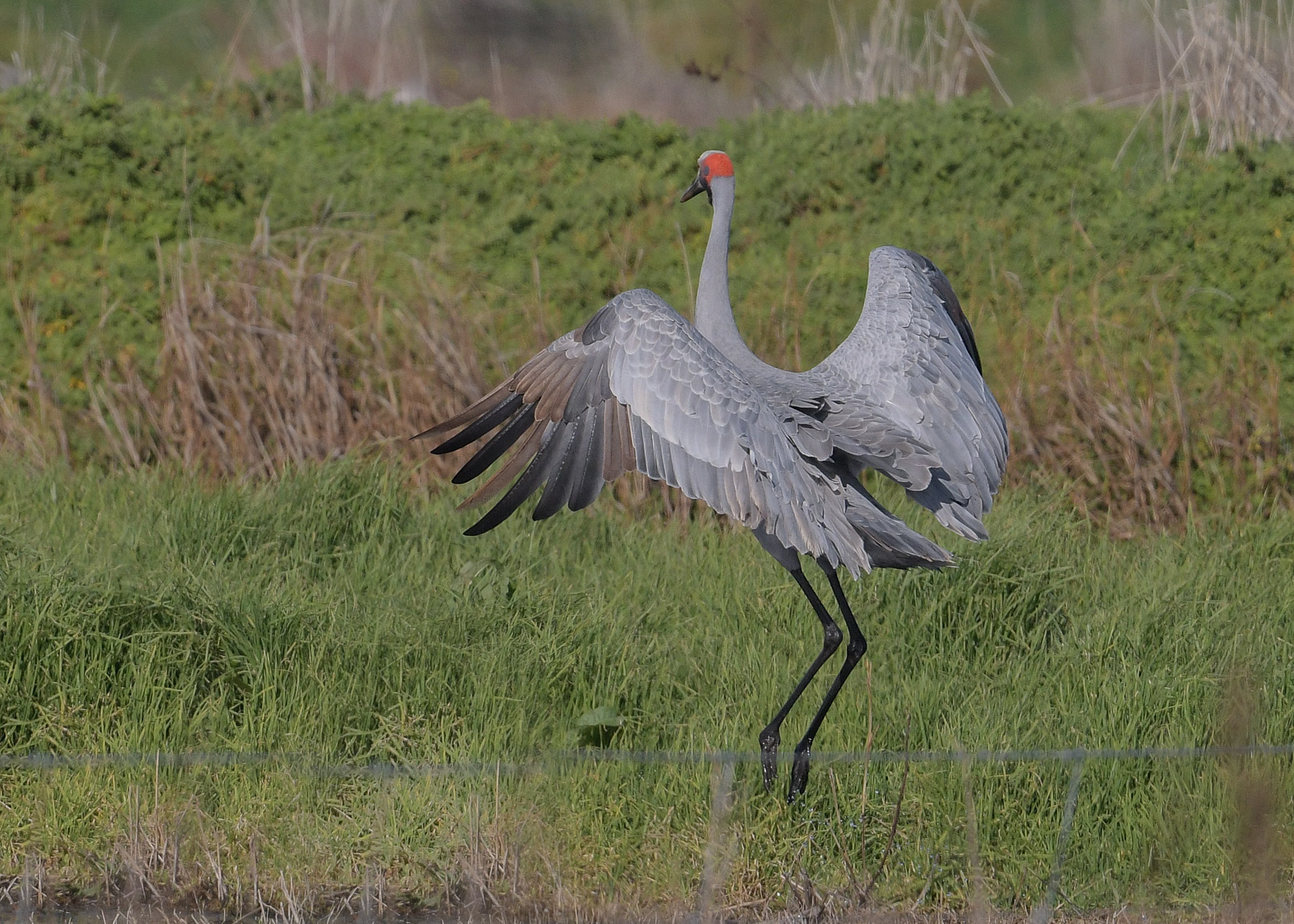
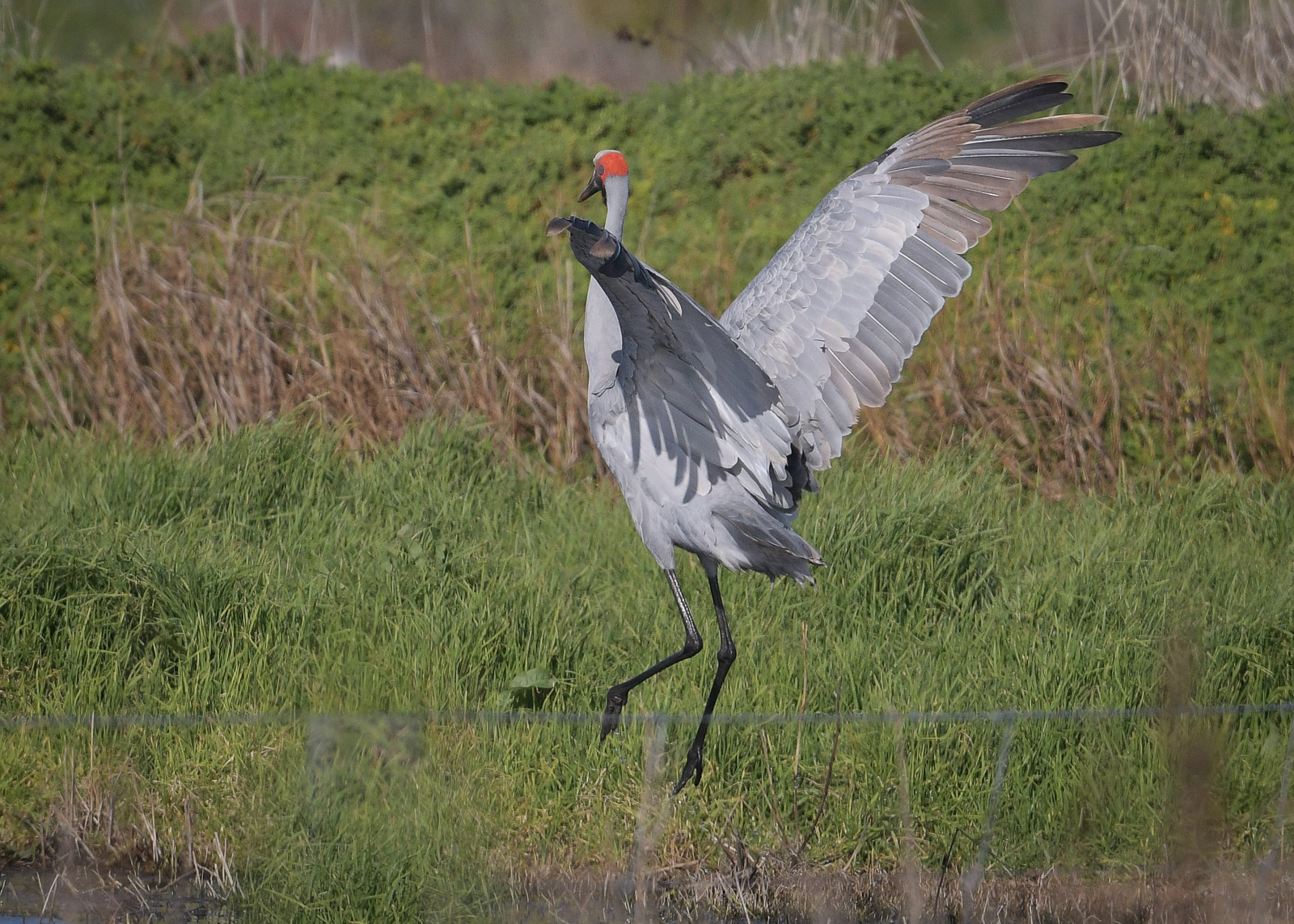
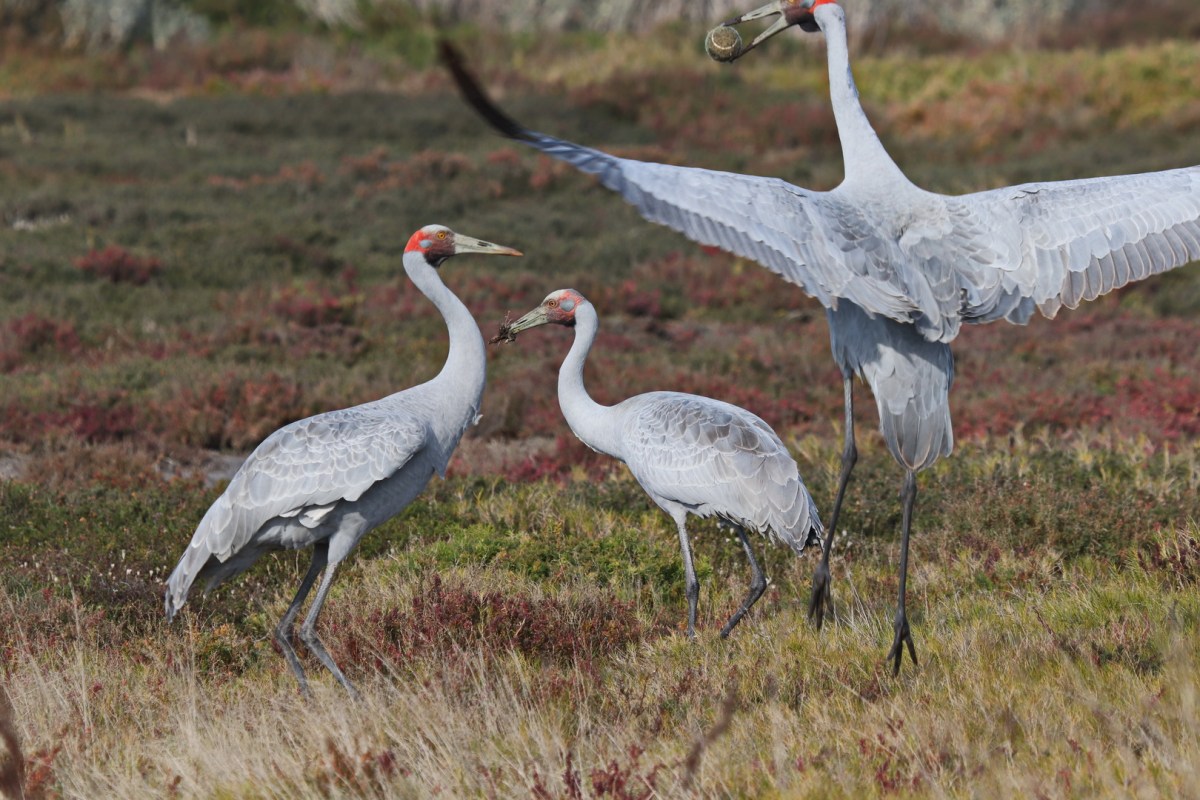
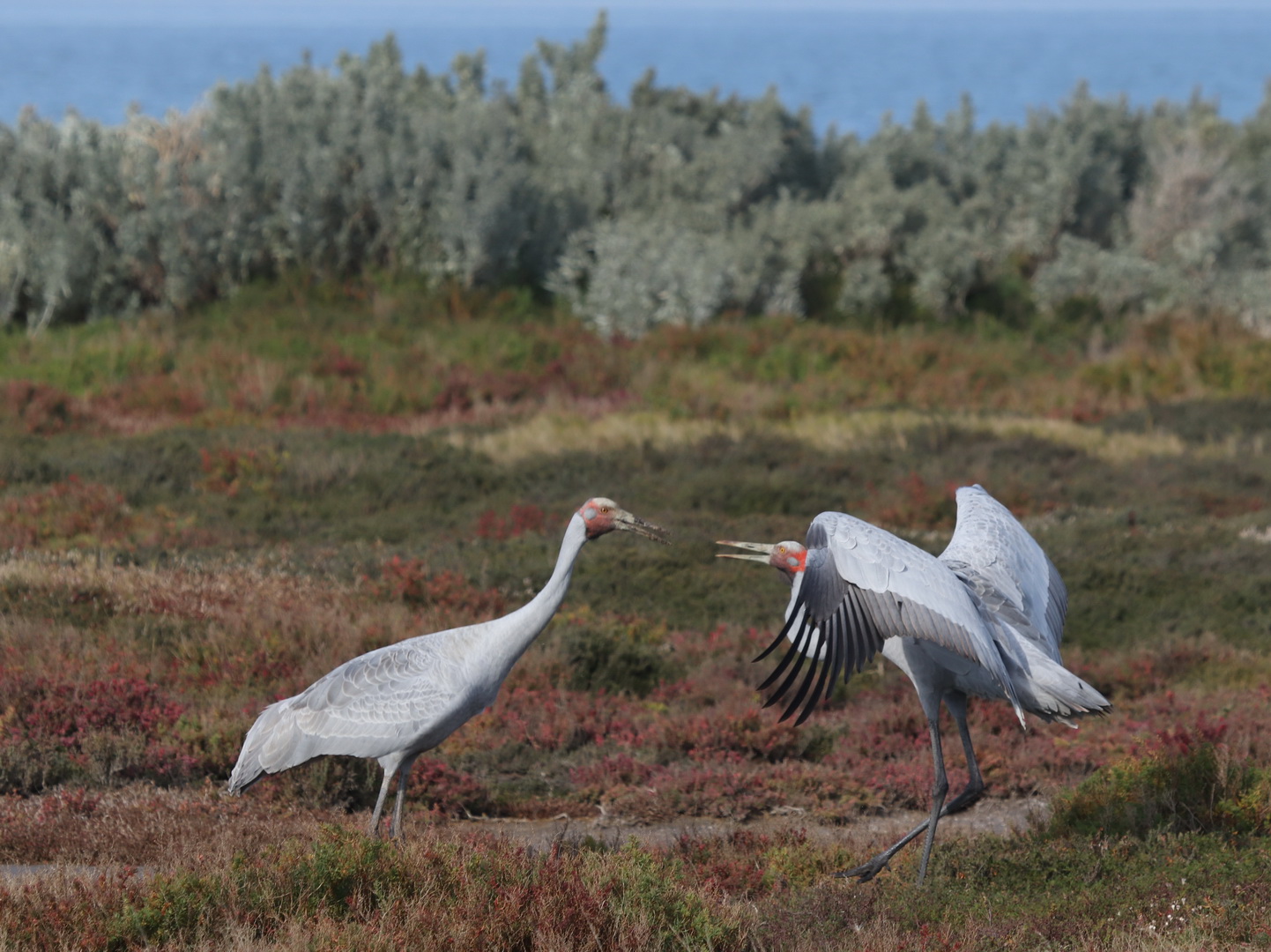
When on a sudden, one stood up, waved its wings, touched beaks with the other and proceeded to waltz around the grasses and out in to the water.

And for the next five minutes we were spellbound by the performance. Sadly I was much too close with the long lens and missed all of the aerial leaps and bounds.
Fascinating to see such a big bird delicately lift into the air and featherlike return to the water.
Finally there was another round of beak-touching and a small splash in the water to cool down.

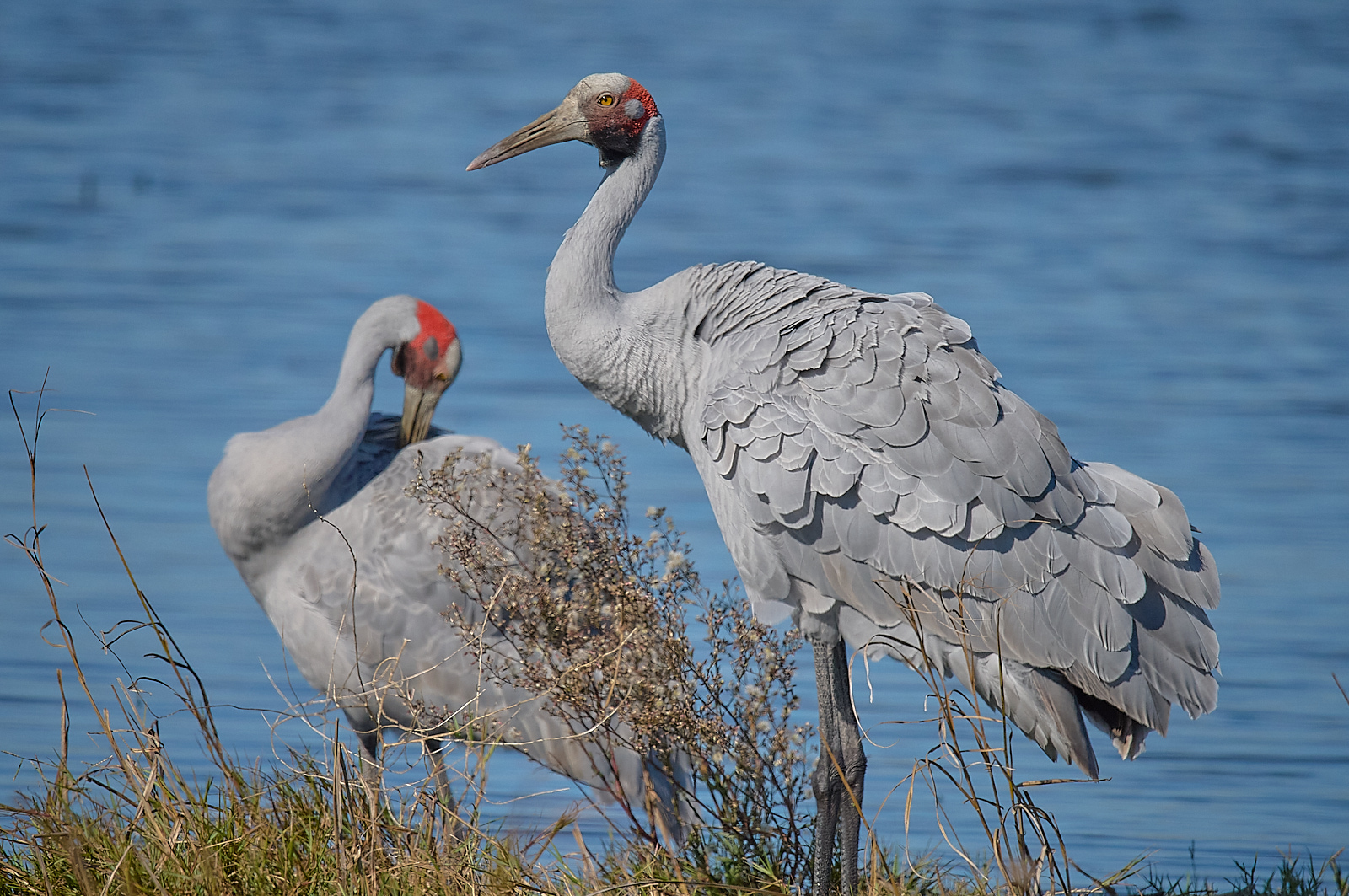
They walked up the bank, and crossed the road in front of us without any hesitation. Once across the road, into the next pond, a preening session completed the performance for the day.

With three large grins we walked back to iAmgrey and headed off to Gerry’s for a coffee and chat about the experience. It was one of those days when a short piece of video would have been just the ticket.

Enjoy.

Wednesday Wandering: Tennis Anyone?

Talk about coincidences.

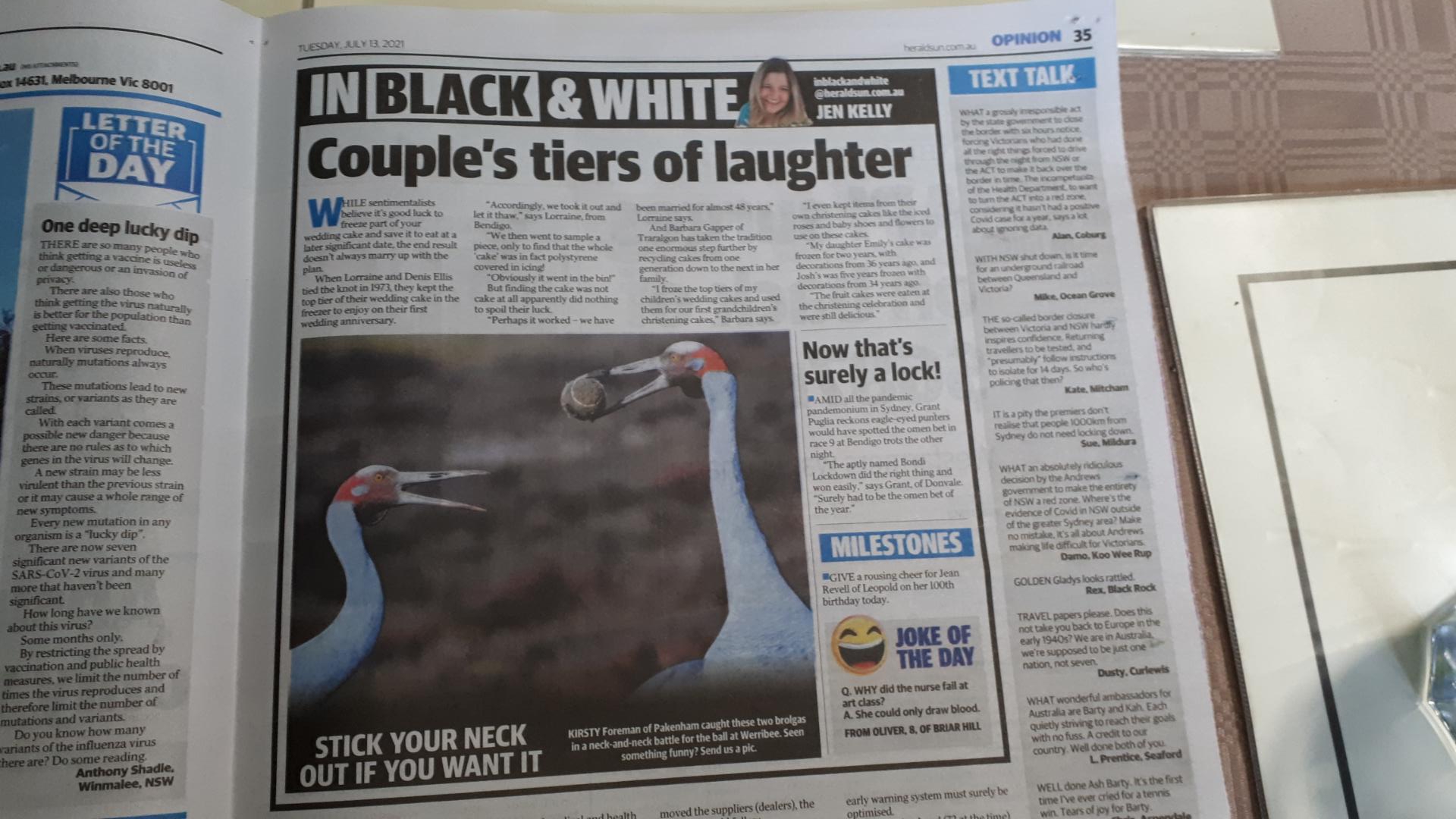
In early July 2021, my friend Nina had been at the WTP and found a family of Brolga playing with a tennis ball. Nina kindly let me put the story and the pictures on this blog and here is a link
Tennis Stars Be Prepared to be Amazed
It was just at the start of the Wimbledon Tennis.

+D4 turned up yesterday, and EE and I decided a trip to the WTP would be as good a location as we’d not been down for awile.

As we moved through the Western Lagoon area, we spotted a small number of Brogla opposite a pond on some lower ground.

And.

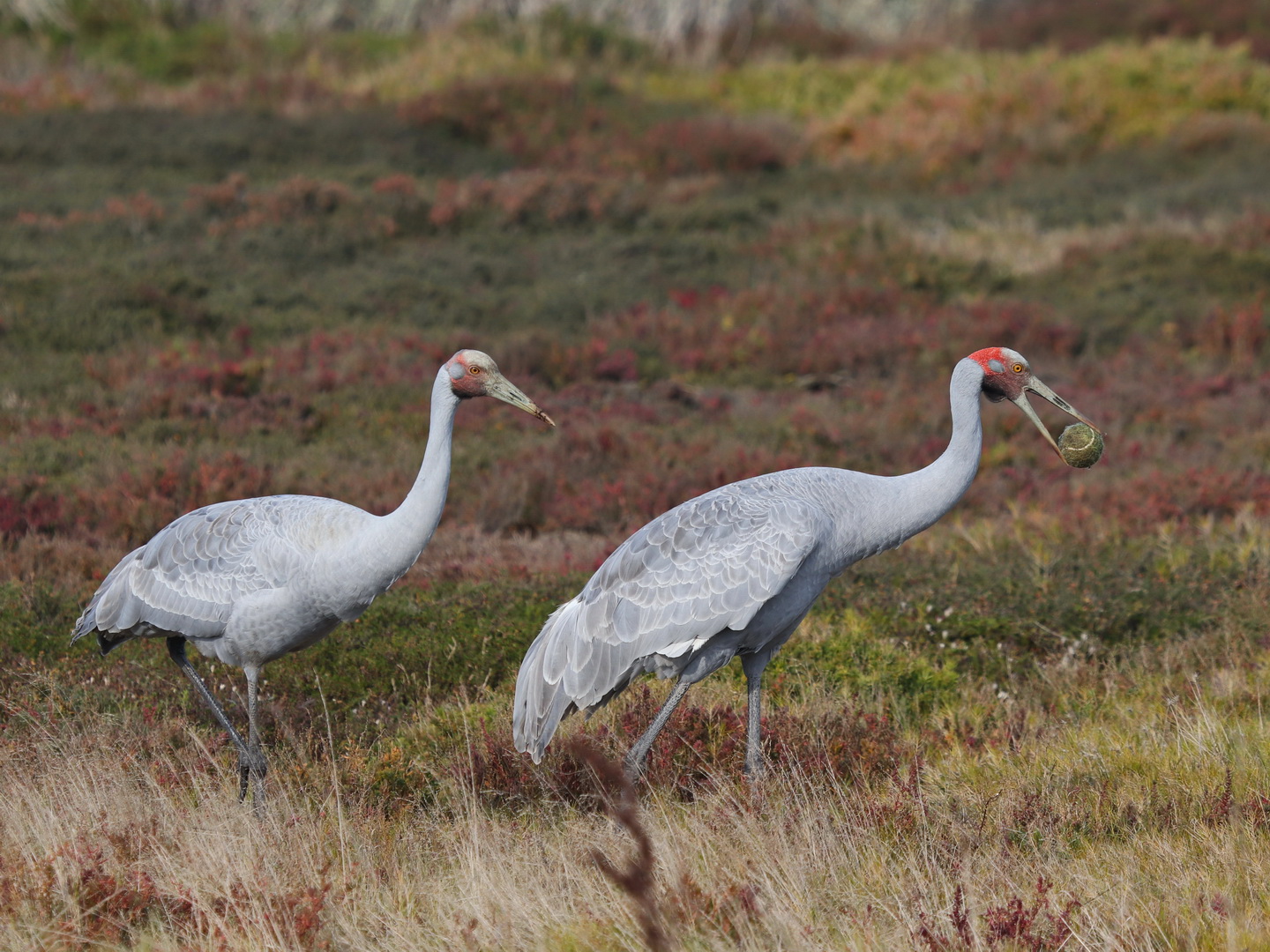
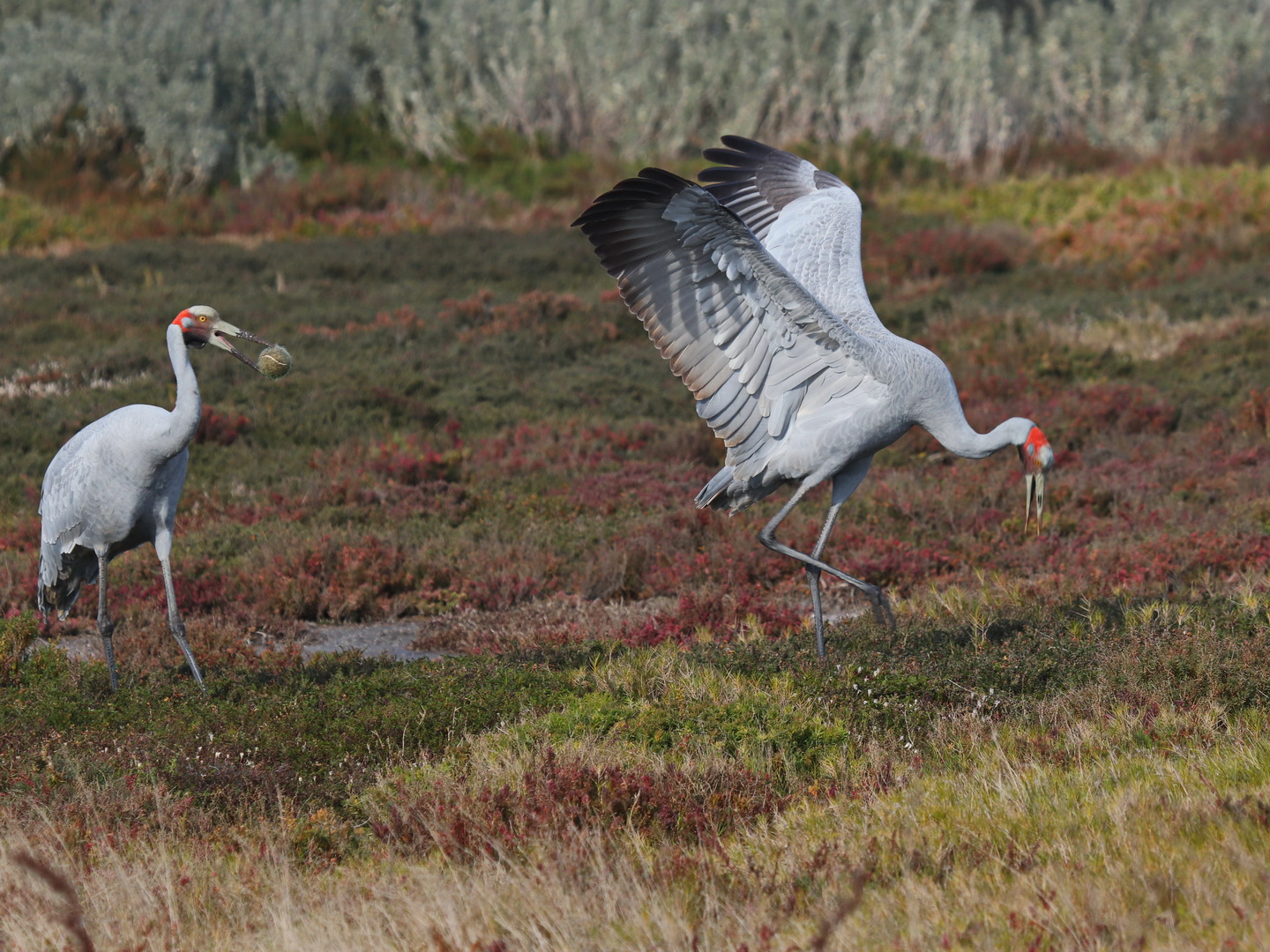
They were playing with a Tennis Ball Coincidence. And Wimbledon started this week. Coincidence?

The universe is far too complicated for me to understand.
The question is, “Is it the same tennis ball from 2021?” Or do the Brolga have Amazon ship in fresh ones each year?

And here’s how the game progressed.
In the end, as two of them seemed to argue, a third one came in and picked up the ball. “It’s my ball, and I’m taking it home.”

Enjoy

Along the Track: Duck Inn

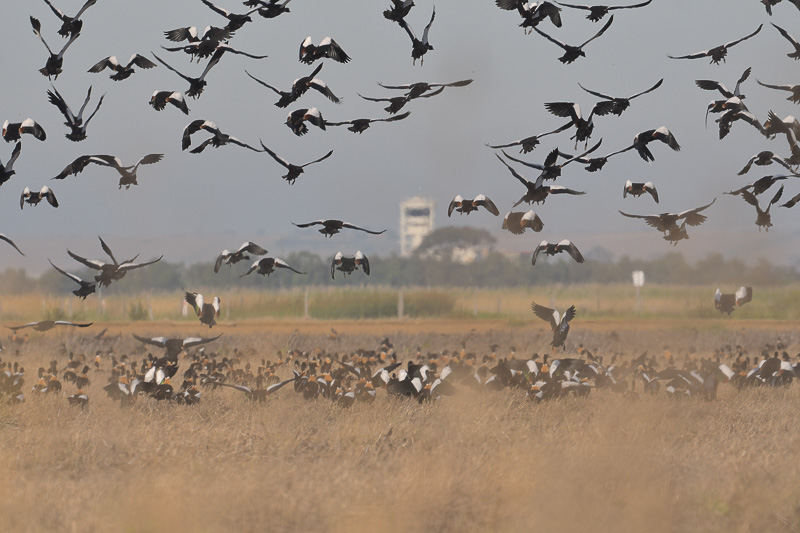
Every year thousands of Austalian Shelduck fly into the Western Treatment Plant during November. 
When I grew up, on the river country, they were called “Mountain Ducks”, so as a littleun, I just assumed they must be, as the horse in the The Man from Snowy River, “mountain bred” But it’s highly like that among the thousands, not one has ever been seen in mountain territory.

They congregate to moult out all their flight feathers and for a few weeks are flightless. And pretty helpless. The foxes can ravage the flocks and its not unusal to see a dozen or more carcasses by the roadside on a trip through the plant.

Once they have gained a new set of flight feathers they then begin to fuel up for the next part of their journey.

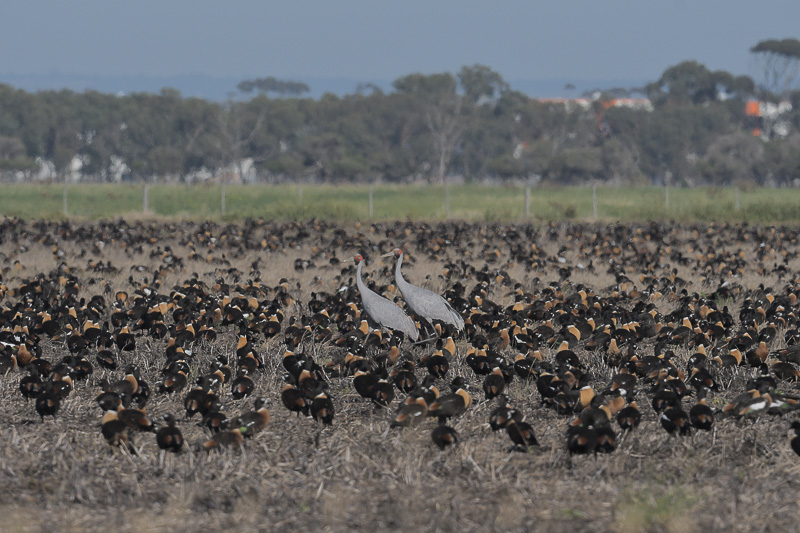
We stopped on Twentynine Mile Road to have a look at a great number of them feeding.
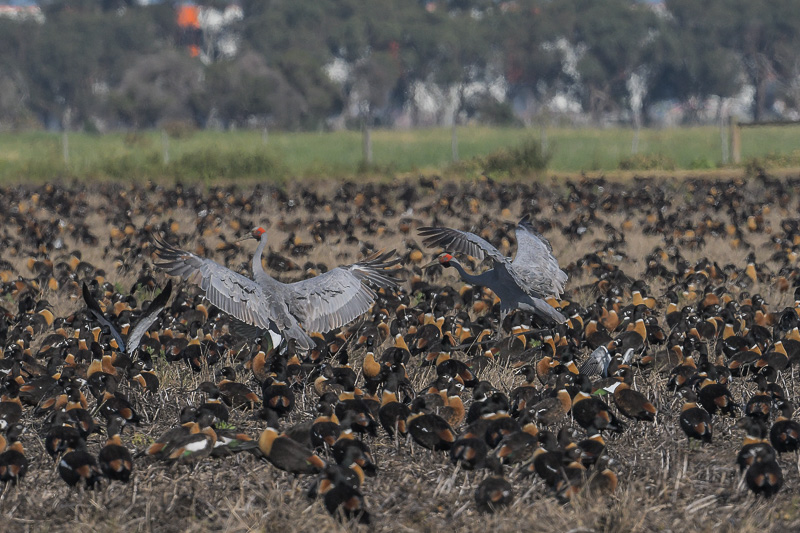
 And for bonus points a pair of Brolga landed and walked through the flocks. 
With a few wing flaps and some head shaking they seemed to clear a path between the ducks, until in the end, perhaps tired of that game, they took to wing and headed further down the Plant.
The ducks just continued sitting, enjoying the sunshine.

As it Happened: In the Early Morning Light

+D4 had turned up for a couple of days, and we decided a trip to the Western Treatment Plant would be possible given the weather looked like it was going to be pleasant for most of the day.

Despite the need to get up early in the cold, we took an early morning run down the freeway and arrived not too long after sunup.

Breaking from usual tradition we started at the “Western Lagoons”. The clever plan was to look for, see, and photograph Black Falcon. Great idea, but not very well implemented as the Falcon didn’t seem to get out of bed early.

There is a spot about halfway along the Lagoons where the ponds are much higher than the abutting farm fields, and a water channel seperates the road on the bund of the ponds with the lower paddocks.

As we travelled along the pond road, EE took great delight in pointing out there were Brolga ahead, and sure enough, of course, you dear reader would not have doubted, she was right.

They were gathering together in the lower paddock, and eventually we saw eight of them. We sat on the upper road for around an hour or so, as it was easy to look down toward them, they were comfortable with the distance we were away, and the channel also gave them protection from close approaches.
So unpreterbed, they walked back and forth, preened, feed and did a few dances and introductions.

The one thing I noted, as I sat there was because of the richness of the early morning light, was how their feathers have a most attractive sheen.

So in no particular order here are a few from the morning’s visit. ro

Assembly.
Every so often one would stop and give a call. In the still early morning air, the calls were quite powerful
The grasses and shallow water seemed to suit their feeding habits
From where I sat on the high grasses, everyso often my long lens was just too long.
Several were fascinated by clumps of grasses and merryment enused as they tossed it about and jumped around
It seemed to be a game that only one played at a time
Perhaps they were practicing for a grass throwing event at the Olympics.
It wasn’t always immediately obvious which of them were a couple, but some times two would seperate away for a quiet stroll together
The calling seemed to make the rest of the group away that they wanted a few private moments
Getting to know you
There is the overall scene. I had to borrow +D4’s zoom for the shot

Along the Track: Morning Rounds

It’s possible on a day at the Western Treatment Plant to clock up over 100 kilometres of driving. The entire plant is over 10,000 hectares — a little smaller than Philip Island.

Some recent changes to the access areas means that those who formely had limited access may now, from the 31st of July 2023, enter what was previously the “Special Access” area and required a different key. Now, One Key, (as they say in Tolkien) rules them all.

I think it’s fair to say that these days there are three sorts of people who visit the plant.

1. The true birdo. Dedicated to seeing as many species as possible in the shortest time, and of course to find that elusive ‘visitor’ to add to the total. These folk have been the mainstay if not the major visitors for many years. Travelling every road and side road is part and parcel of the visit.

2. Now it seems that photographers are becoming the dominant “species”. Again, desiring to see and photograph as many birds in the day and be able to have them all posted to Instadump or Spacebook before anyone else. Speed of travel is their essential hallmark, and sometimes it seems to me, to resemble a Rally-cross event (I used to photograph such events a long time ago so understand the techniques)

3. The art photographer. Not yet a huge group, but growing I feel. They have a need to find a bird and provide the ‘best possible’ image of said bird that shows not only the best of the bird, but their ’empathy’ for the species. Also prepared to stand around and pontificate about the latest mirrrorless kit and lens that is a ‘game changer’.
Clambering over grass, through salt-bush, crawling along the beach and the mudflats, is de rigueur for that expressive moment. Often I’ve noted of late, dressed in camo and ghillie-suits, looking more like an SAS Sniper. Willing to stop in the middle of a bund road to walk, crawl, or sneak to a spot to get that shot. Meanwhile the roadway is blocked to all other passersby.
( I know, I think I used to do this!- sans the ghillie)

A fourth visitor group, just to show I can count beyond three: is more the traveller about the plant, seeing birds and generally enjoying an outing.
These days, I have to admit to fitting somewhere between 3 and 4.

We no longer do the ‘full tour’ We have a few ponds and areas that we’ll go to, sit for awhile, and then move on. Most days, it’s an early morning start, and by lunch time, it’s time to go on up the road to The Highway Lounge, and one of Gerry’s well made hot brews.

With the sun streaming in through the window at breakfast time, the other morning, it didn’t take long to abandon other projects for the day, and head on down to the WTP.

Here are a few from the day. Click on an image to move to a Gallery experience

Enjoy

Along the Track: A Morning at the Plant

After the last couple of ranty posts, I thought I fine day at the plant might be a good idea. 🙂

The Western Treatment Plant is about the size of Phillip Island and to travel all the tracks and explore all the possible bird sites can easily consume an entire day, and a goodly chunk out of the fuel budget for the week. 🙂

We tend to be a bit selective about the areas we travel through. Preferring to stop at one location for a time and see what is moving about. It also depends a lot upon the weather. Being a flat farmland, there is little shelter from high winds or the heat of midday.

So we tend to go either late in the afternoon when conditions are good, or early in the morning. Morning can be hard at first as the long drive in from the main road is directly into the rising sun. But once in the bird area it becomes easier.

We had decided to go on the morning as the weather looked promising, and if the wind picked up as predicted then back to the Highway Lounge and a Gerry Coffee.

Here then is a look at how the morning, and the birds progressed.

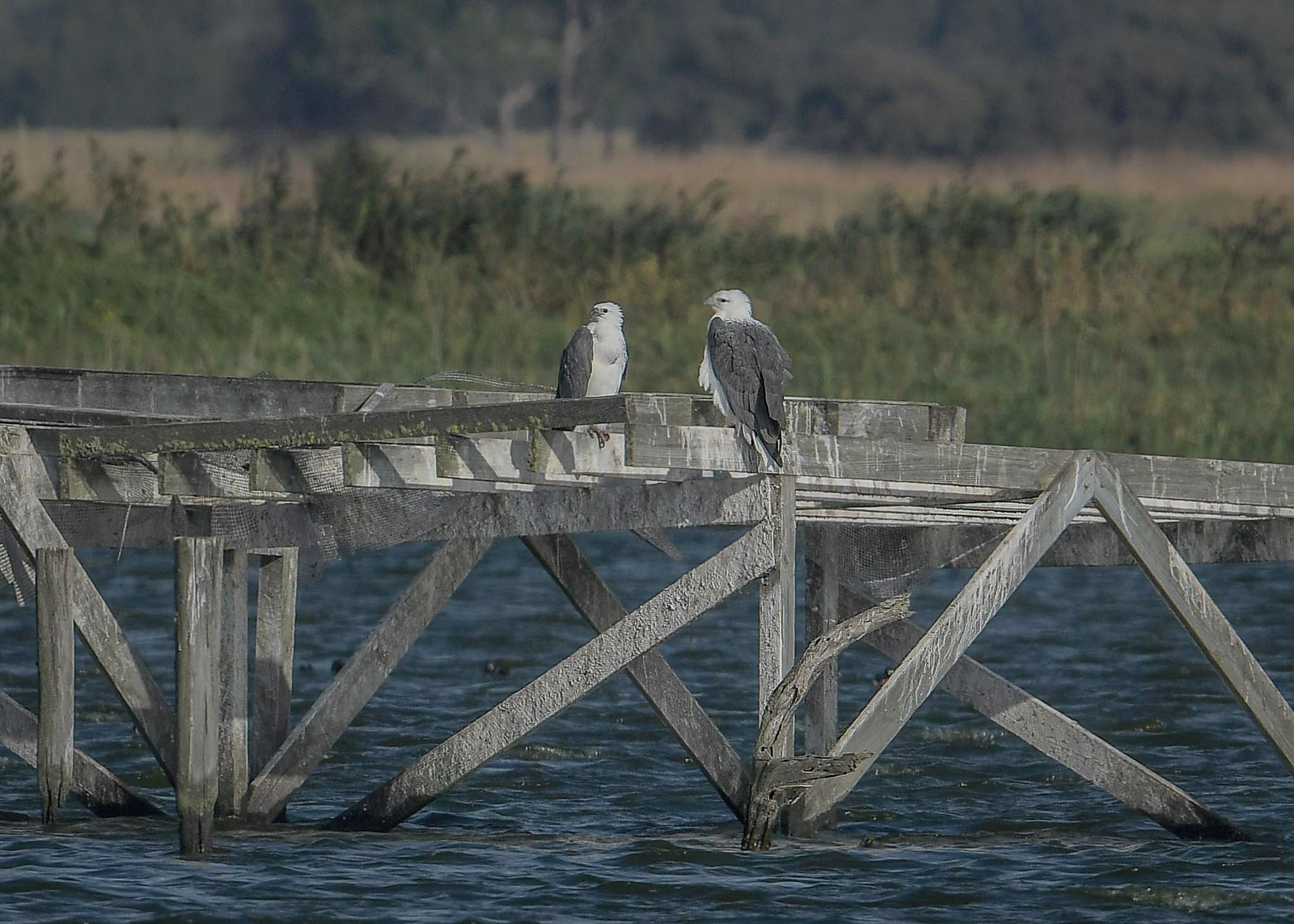
White-bellied Sea-eagle being harassed by a passing Swamp Harrier. I don’t think the apex predator was fazed.
Said Swamp Harrier, then made a close pass over the reeds on our side of the lake.
The ponds held many Hoary-headed Grebes.
A committee meeting. These two Sea-eagles were resting a long way out in the middle of the large lake.
Meanwhile up close the Reedbirds were moving about in the sunshine
A small selection of the many hundreds of Hoary-headed Grebes.
Whatever the current title, I still refer to them as Mountain Duck. The nomenclature police seem to think they are Australasian Shelduck. I don’t think the birds care really. They now all have nice new feathers and will be journeying northward soon
Not sure if this Sea-eagle was from the earlier lake ones, or whether it came in from south along the beachline. But there could be as many as four working in the area at present.
This Collared Sparrowhawk was making the most of the increasing high winds. And showing off that extended middle toe.
Fueling up for a long trip ahead. Curlew Sandpiper
These two Sharp-tailed Sandpipers are starting to colour up. Here they are ‘hiding’ out of the strong wind behind some reeds
It has been an increasing good year for Brolga at the Plant. We saw one pair with two well grown young. A second pair with a young one, and this third pair on their own
One of my fav inflight birds. The Little Egret
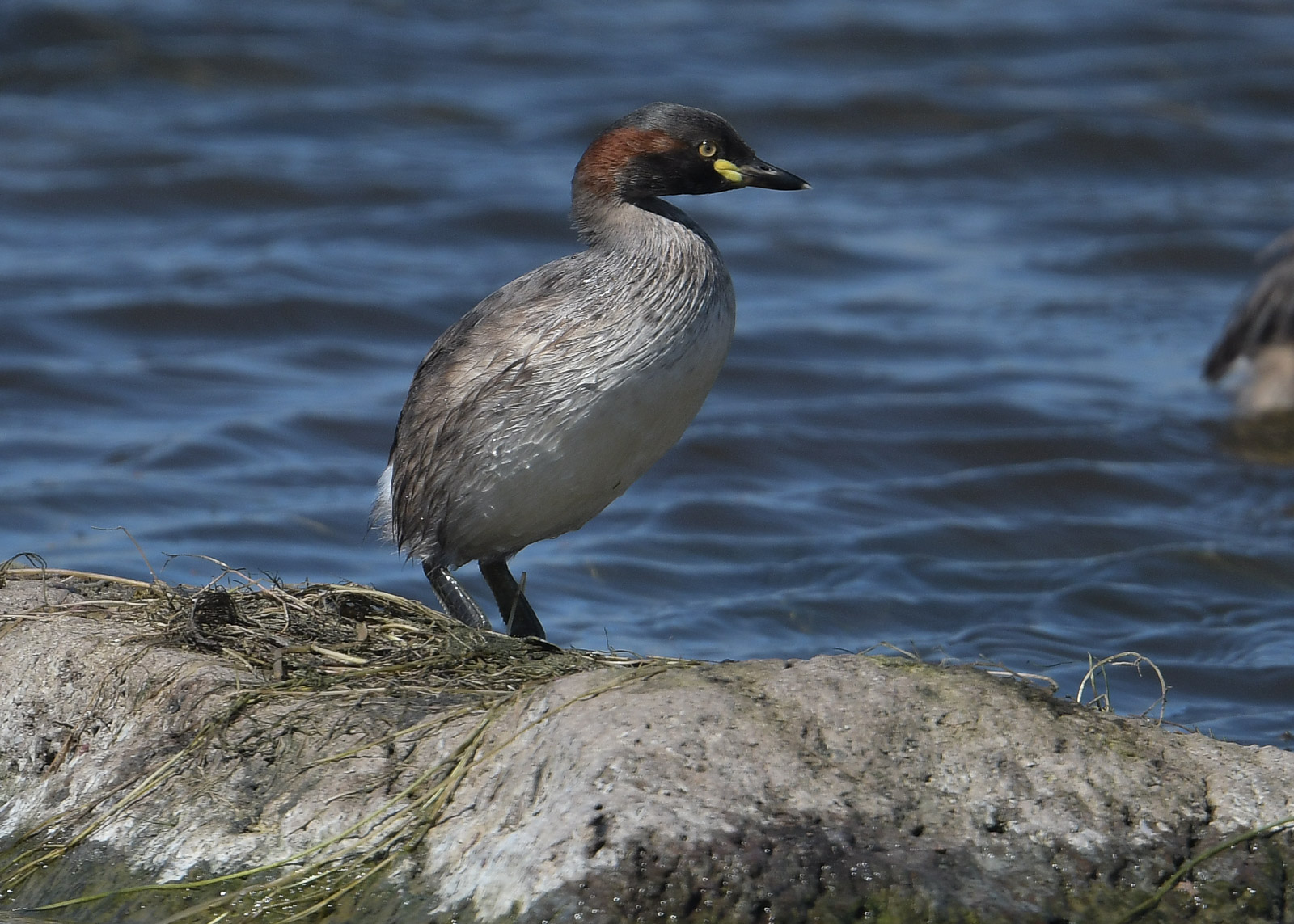
I can’t ever recall seeing an Austalasian Grebe standing up, nor on a rock. Perhaps a nest is on the way.
Also managed a great wing display just for bonus points.

Little Visits: A Morning in the Western Treatment Plant

Due to an odd arrangement of circumstances, that would take several blog pages to cover and even more to wend the pieces together, we had decided on a trip to the Western Treatment Plant. (WTP)
What, of couse, was not in the “How to do it” manual was control of the weather.

Grandson “+D4” was staying over and t’was the only day avaible. For those interested “+D4” comes as an ‘Addition’ to the “3D’s” fabled for their “Dawdling” while on car-convoy on such trips to the WTP.

We picked up the usual Coffee-to-Go from our local and hit the highway. (Mr An Onymous, has a theory that in future times, sociologists and archeologists will conclude that ‘hit the road’ had some quasi-spiritualistic meaning and that the poor deluded ancients would go out and hit the road with their hand expecting some mystical experience—but— I digress)

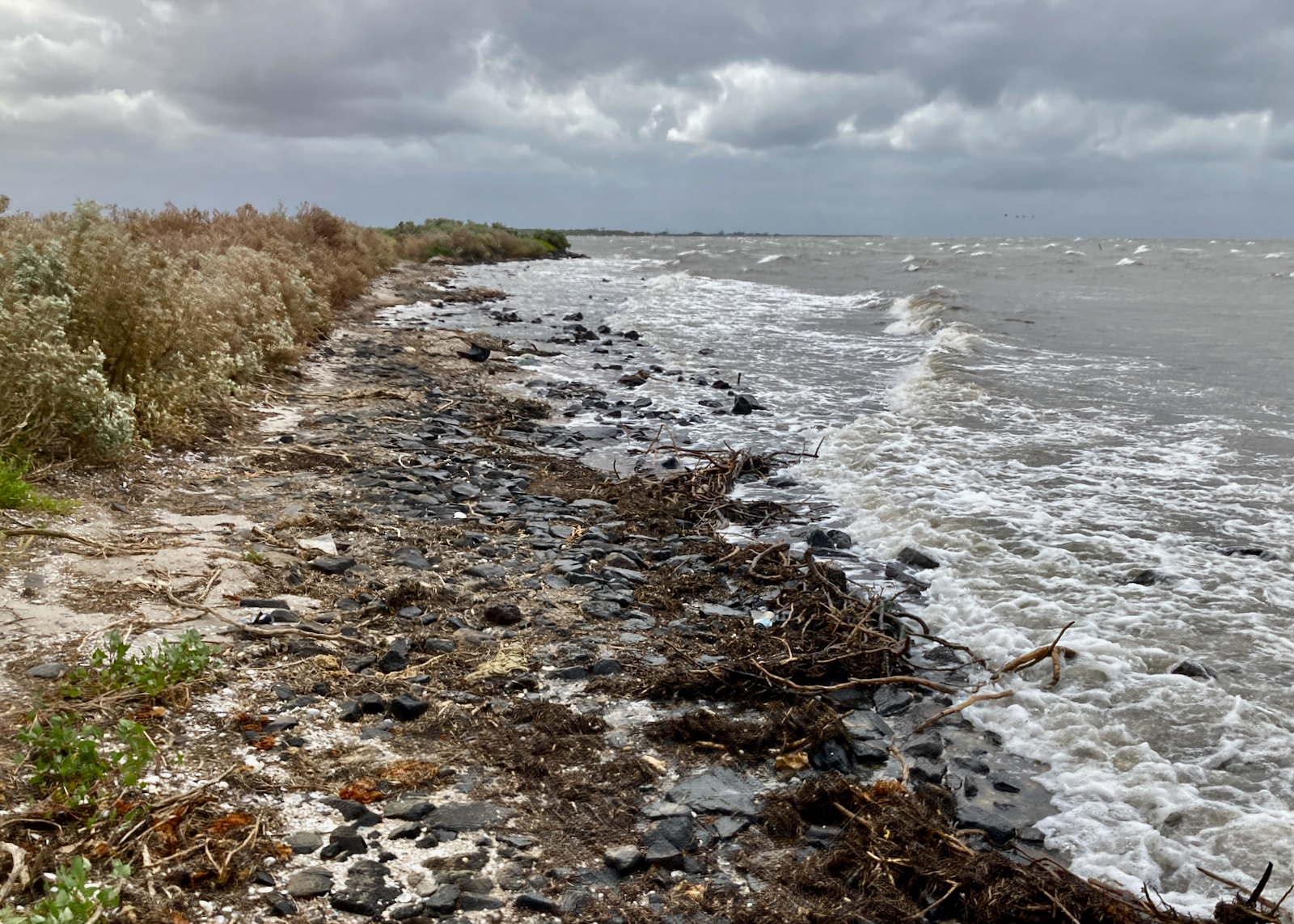
The overcast, rain and high winds did not digress. Nor did they ease off. I may have mentioned before, that I can deal with the poor light and the rain at the WTP, but not the wind. It just makes getting out of IamGrey and standing in the open a truly harrowing experience and one that even the best of birds seems avoid at all costs. For those that might venture there, the track in the “Special Section” that was out along the beach area and barely passable with 2WD is now eroded to the point of being 4WD only.

So we had a fairly quiet trip about the plant. Good news is the roads are in very good condition and the closure has allowed several areas to be graded and topped and the drive experience improved no end.

We had hoped that White-winged Black Terns might have returned by now, but if so we didn’t get a sighting. The weather changes seem to have altered the plans of many returning migrants so far this season.

So as the blog is more now about the photos of the day, and less about the babble, here tis.
Enjoy

This is part of the coastal road at the Plant. Normally it is accessible by 2WD, but now 4WD and low tide are the recommendation. Erosion is quite evident. We retreated.
A small selection of Pied Oystercatchers hunkering down on a sandspit out of the wind.
This beautiful Goose has been on its own for at least 12 months, but has remained faithful to the area. I’m sure it doesn’t recognise me, but each time we go past its territory, I stop and we exchange a few head-bobs and it goes back to feeding.

I’m pretty certain it has lost its mate, the pair used to be quite the regulars in the area and nested over several seasons. For its own reasons it hasn’t ventured away to find a new mate.
Female White-fronted Chat. They seem to take extraordinary care about returning to the nest with food, and will spend many minutes checking everything out before deposting the food.
One of a pair of Brolga that were working in the T-Section
He is returning to see how things are going with his nesting mate. I’m sure that is a Swan smile
I saw the nest from the other side of the pond and we drove round for a clearer view. This clever lass was taking no chances and had built her nest in the very middle of quite a deep pond and it seems to have paid off with a lovely set of matching cygnets.
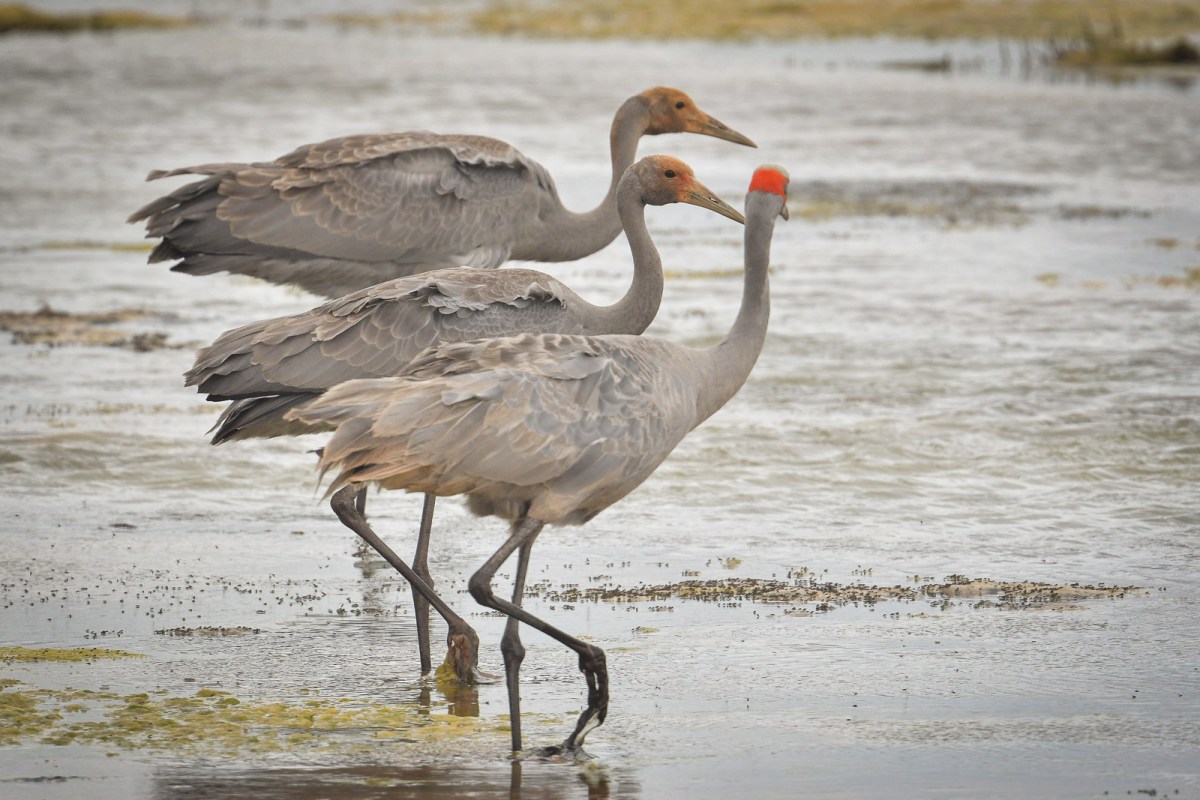
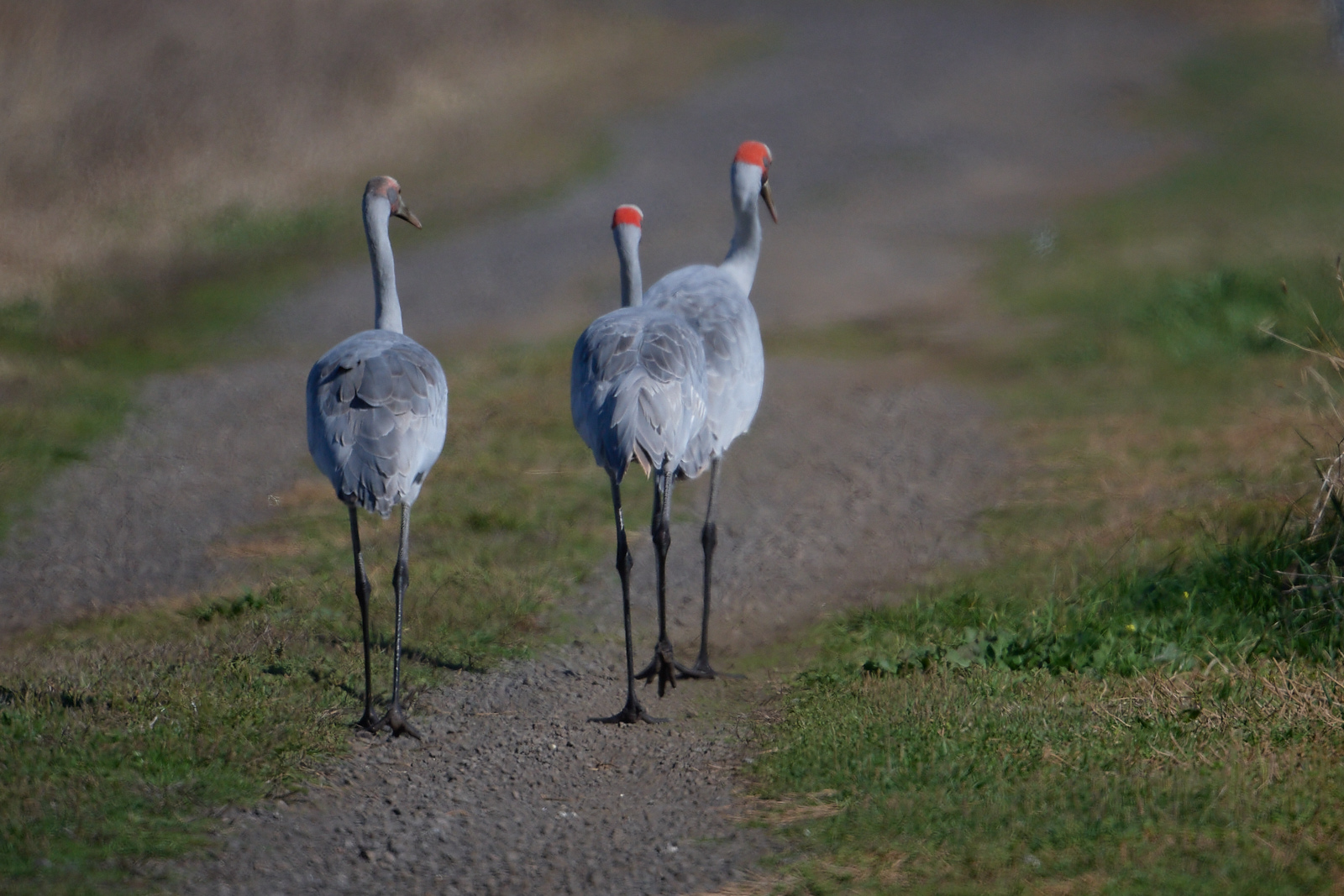
By early afternoon, the wind, the cold and the rain has gotten the best of the best of us, and we made one forlorn loop around the Western Lagoon area. Surprisingly we spotted a pair of Brolga with two quite large well developed juveniles in tow. Well worth the extra few minutes and the tired and exhausted among us were quick to respond to the opportunity. The birds seemed quite relaxed and in no hurry to go anywhere, but big long legs quickly carried them across the ponds.
Quite well developed. I’m not sure if they are fledged, but that normally takes around 3-4 months. Which just shows how silly Uncle Google can be, as I’ve seen figures of 2-3 weeks, which are impossible. They stay with the parents for nearly 12 months until the next breeding cycle.
Here is an intersting factsheet on Brolga on Farms.
For bonus points we called in to see the Hobbys on the way home. This one is now just about a ‘brancher’ and no doubt days from flight. The nest is festooned in discared down.
All tucked up secure. Three little Wagtails about a week old.

Tennis Stars Be Prepared to Be Amazed!

My friend Nina was down at the WTP last week.
She sent me a note of her adventures, and has kindly allowed me to share them here.

In a galaxy far, far, far, far, away, in another time, Nina and I both worked for a large multi-national. Her love of the environment and my natural history photography have kind of kept us in touch.

All the photos, words and story are Nina’s.  Obviously copyright, and intellectual property rights belong to her and should be honoured.

Here is what she sent me.
I had an extraordinary experience at the WTP with friends last Friday.

Where ever we went, we kept running into Brolgas.

On Kirks Point track we watched some Brolgas playing with a tennis ball for more than an hour. At first I thought they were trying to eat it, but after a while I realised they were just playing. One would drop it and the next one >would pick it up. They would also pass it to each other. I have many blurry photos because I was shaking with excitement. The memories of thisclose encounter will be with me for ever.

The images are linked to a larger version so just double click to see.  Be Amazed!

Thanks Nina.

If you would like to contact Nina drop me a note and I’ll pass on the details.

Be Amazed

Little Visits: The Flight of the Brolga

I was going solo at the Western Treatment Plant.  #kneetoo was tucked up in her wide view bird-hide at the hospital, and as the sun was shining in a clear blue sky, I thought a quick trip to check to see if any Flame Robins could be making the most of the weather and the paddocks at the Plant.

However after a bit of fruitless searching it was obviously not going to be my day for robins.

A final quick trip around the “T Section” area just in case a Brown Falcon or two might be present and then home was my plan.

As I unlocked the entry gate to the area, I heard the long rasping call away off in the distance of Brolga. A scan around the horizon and it was not likely I’d spot any as the calls had been a long way off, and had now stopped.

I prepared to shut the gate and another birdo was approaching to go out, so I held the gate open and said I’d lock it as they left.  Then, just as I swung the gate across the road, that rasping cry filled the air, and this time I’d id’d the location. Sure enough in the air were three Brolga. Then as the shapes grew more distinct, it was likely that they were not only coming in my direction, but would perhaps make a pretty close pass by.

Locking the gate, I grabbed the camera and hoped that the pass would be on the sunny side of iAmGrey.

The more I watched, the more I became aware they would be using the roadway behind me as sort of navigation aid, and would pass right over the top of me.

And they did.

They disappeared behind one of the bunds, and I wondered where they had ended up.

Satisfied with  the fly by, I went on to look along the roadways. Time for a cuppa, so I pulled up at one of the cross tracks and pulled out the doings.

Then the croaking call rattled over the ponds and I looked a bit further along the track and the pair were in head stretch calling mode, and engaging in a little pair bonding.  Cuppa forgotten, I moved along the track for a better looksee.

They settled down to some preening and feeding and the juvenile with them was feeding in one of the shallow ponds.

I went back for my Cuppa and sat and watched until they moved off the pondage and up on to the track, and moved further along to continue their morning routine.

Satisfied, I packed up and headed off for a visit with the patient.

Enjoy


A Day at the Farm

Tis true to say that EE and I haven’t been down to the Western Treatment Plant for quite a number of weeks.  The weather, health things, family events and perhaps a touch of sloth just seems to have gotten in the way.

My photo mate Neil, sent me a note about his last weekend trip, and we decided if the weather opened up a bit, we’d at least drive down 29 Mile Road for a looksee.

So this morning after a couple of Tai Chi class sessions,  we loaded up with lunch, a cuppa or two of Earl of Grey and of course the essential cameras and headed out in the warm sunshine, (and to tell all the story, the rather crisp wind as well).

Before we reached Beach Road junction, we spied some Flame Robins, but they wanted to work far out in a paddock, and we could only get glimpses.

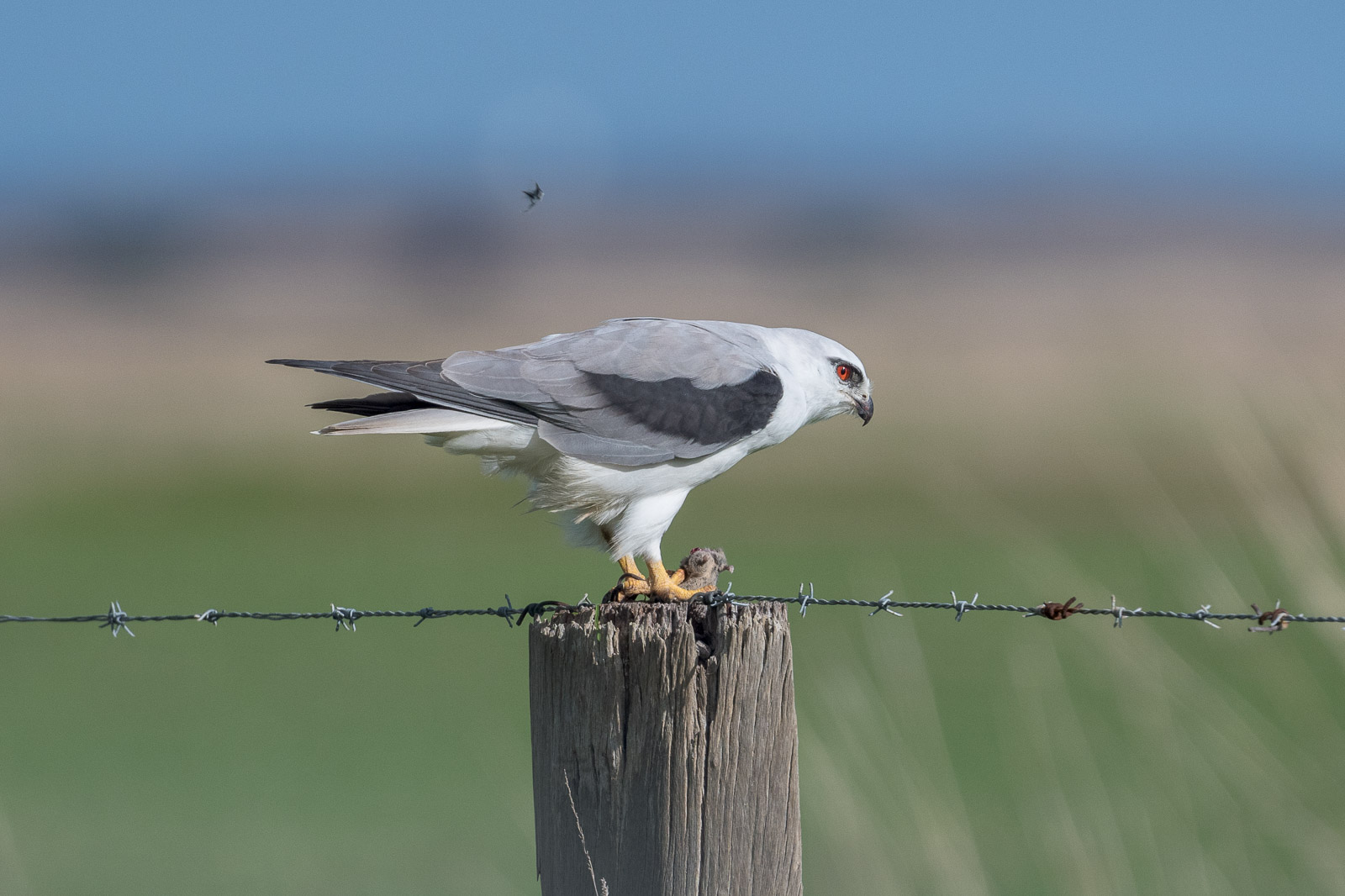
Further on down, and a trio of Black-shouldered Kites were keeping the mice on their toes.

And as we sat with lunch at the first corner on the 29 Mile Road, a Spotted Harrier wafted by making some very nervous Swamphens.  As we entered the T Section area, we were looking for Brolga as Neil had sighted them here at the weekend, but we lucked out.

Next we found a single Flame Robin female that was working around a puddle of water on the roadway.

Looking up, I heard the familiar call of a Black-shouldered Kite with a mouse, and as we looked a Black Falcon swept in from no where and after a little evasion from the Kite, the Falcon secured the prize and took off with the erstwhile and very angry kite in hot pursuit, but to no avail.  The Black is just that good in the air.

As we drove back out, lo, the very Brolga had turned up in the first pond and were busy preening, we shared the last of the Earl of Grey and enjoyed their unconcerned wardrobe adjustments.

So for a first day back at the farm, it was a most enjoyable and profitable time.

The fur flies as the Kite prepares lunch

Fast food

Spotted Harrier at work over Swamphen pool

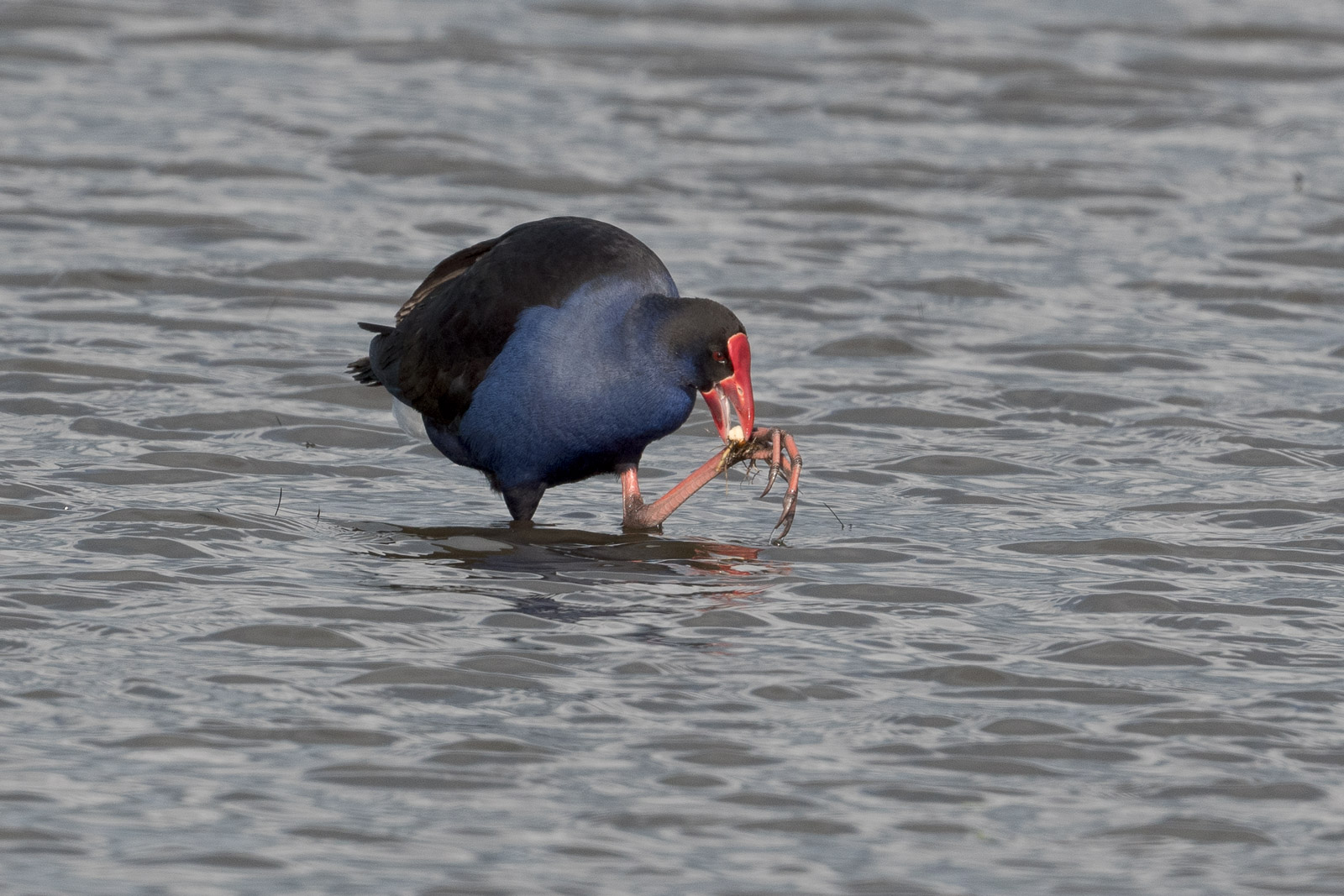
Australasian Swamphen with impeccable table manners

Golden-headed Cisticola

Female Flame Robin

Black Falcon speeds in on a free lunch

Easy to see why the Kite has no hope of winning this battle

Having lost its mouse, it did at least give the Falcon a parting swoop.

Preening Brolga

Snapshots: A Raptor Day at the Treatment Plant

A search on the Bureau of Meteorology website, has quite a bit of info on the lack of rain in mid of Australia.  See here http://www.bom.gov.au/climate/drought/
At the bottom of the page is a couple of graphs that begin to put it all in perspective.

And as it dries out, it seems, that quite a number of birds are moving south.  Or toward the eastern coast.
And we’ve seen quite a change in the numbers of smaller falcons and kites in our area.  In the space of a 10 minute drive the other day we saw 14 Nankeen Kestrel.

So we took a trip to the Western Treatment Plant on a sunny morning.

Continue reading “Snapshots: A Raptor Day at the Treatment Plant”

Funny old thing is Serendipity

“the occurrence and development of events by chance in a happy or beneficial way”

The weather map showed a large high stalled over us for most of the day.  “Let’s do an evening at the Western Treatment Plant”, saith, I. “We could take down the picnic, and have a fine old evening watching the sunset over the bay, and maybe photograph a few birds, and well, just enjoy the evening sea breeze.  What thinkest thou?”.

A call to Mr An Onymous, and the famed, and legendary “Blackmobile” was on the highway loaded with his fine repast. EE and I decided on a Peri-Peri Chicken Salad, and a round of Earl of Grey.

Pied Oystercatcher
Pied Oystercatcher


Continue reading “Funny old thing is Serendipity”

Meeting Up with Friends Take #2

Graham Harkom, as self-confessed birder and mad photographer, also among his other accomplishments runs an online bird photography group,   Melbourne Bird Photographers, under the Meetup banner.

See Here

So most months there is an event to turn up to.  It’s such an intriguing way to organise an event, and great kudos for Graham and his organising group for keeping up the great places to visit. Always good for birds, photography and chatting, and of course food!

So, when I discovered the next one was to be at the Western Treatment Plant, it wasn’t too hard to tick the Yes we will attend box.

So, as the Banjo was wont to say, we went.

Also my long term mate and fellow conspirator and Flickr mate Mark S came over to make an excellent day of it.   Graham, herein named, “He who always has brilliant sunshine for his events”, met us at the Caltex Servo at Werribee and had turned on the sunshine as requested.

28 keen folk sipped Gerry’s best coffee, ate raisin toast, and talked about the day’s opportunities.  We took off toward Avalon, stopping long enough to get some good views, if only average photos of some Banded Plovers, then it was on to the T Section, and the inevitable wait by the Crake Pool, and out came the Australian Crake, right on time.  No Brolga here, so off to the Paradise Road ponds for our little convoy.

Met a carful of helpful folk who said, “Down there somewhere we saw Brolga”, which unscrambled meant. On to the 145W outflow. A very co-operative Brown Falcon stopping us in our quest, and gave some great poses, and a fine fly off shot for those of us not too busy checking the camera settings. —Will I never never learn!!!!  😦

Then, we spotted the Brolga, (Singular in this case), and the usual dilemma,  stay where we are for distant, safe views , or drive on a small distance and see if we can get closer.  We drove.  And the kind bird tolerated us, for a while, then gave a super fly by quite close.  Too much fun.

We had a quiet photography time at 145W, and lunch, then it was on to Lake Borrie. My mates Neil and David turned up in the Prado,they were both out playing with new toys, A Canon 1D X and a Nikon D4. Ah, the joys of learning new equipment.

As we drove back the Brown Falcon had perched on the ‘Specimen Tree’ in Little River and we managed several great shots in the sunshine.

On toward the Bird-hide for some good views of Musk Duck, Great Crested Grebe and an obliging Swamp Harrier made the journey well worthwhile.

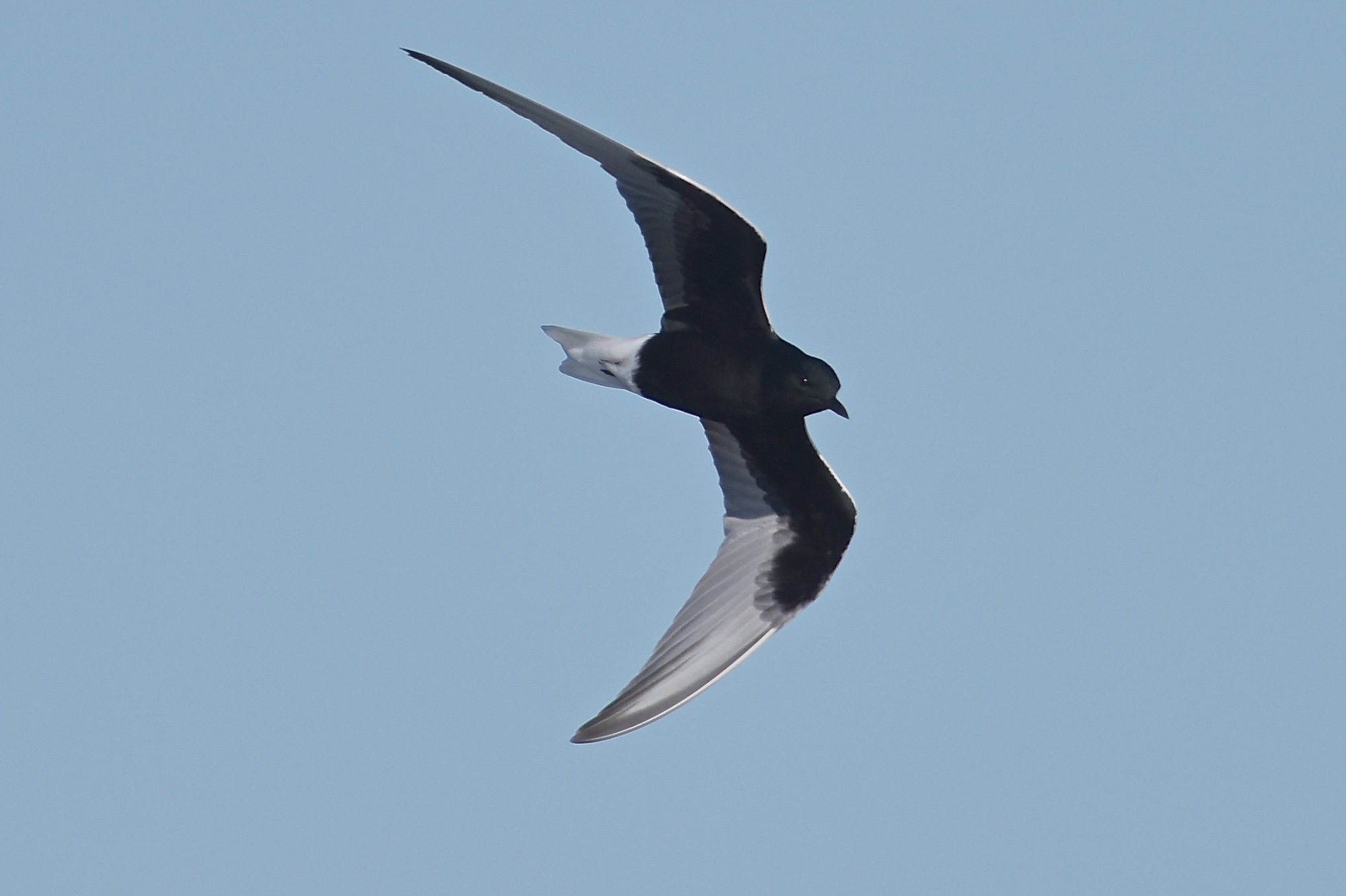
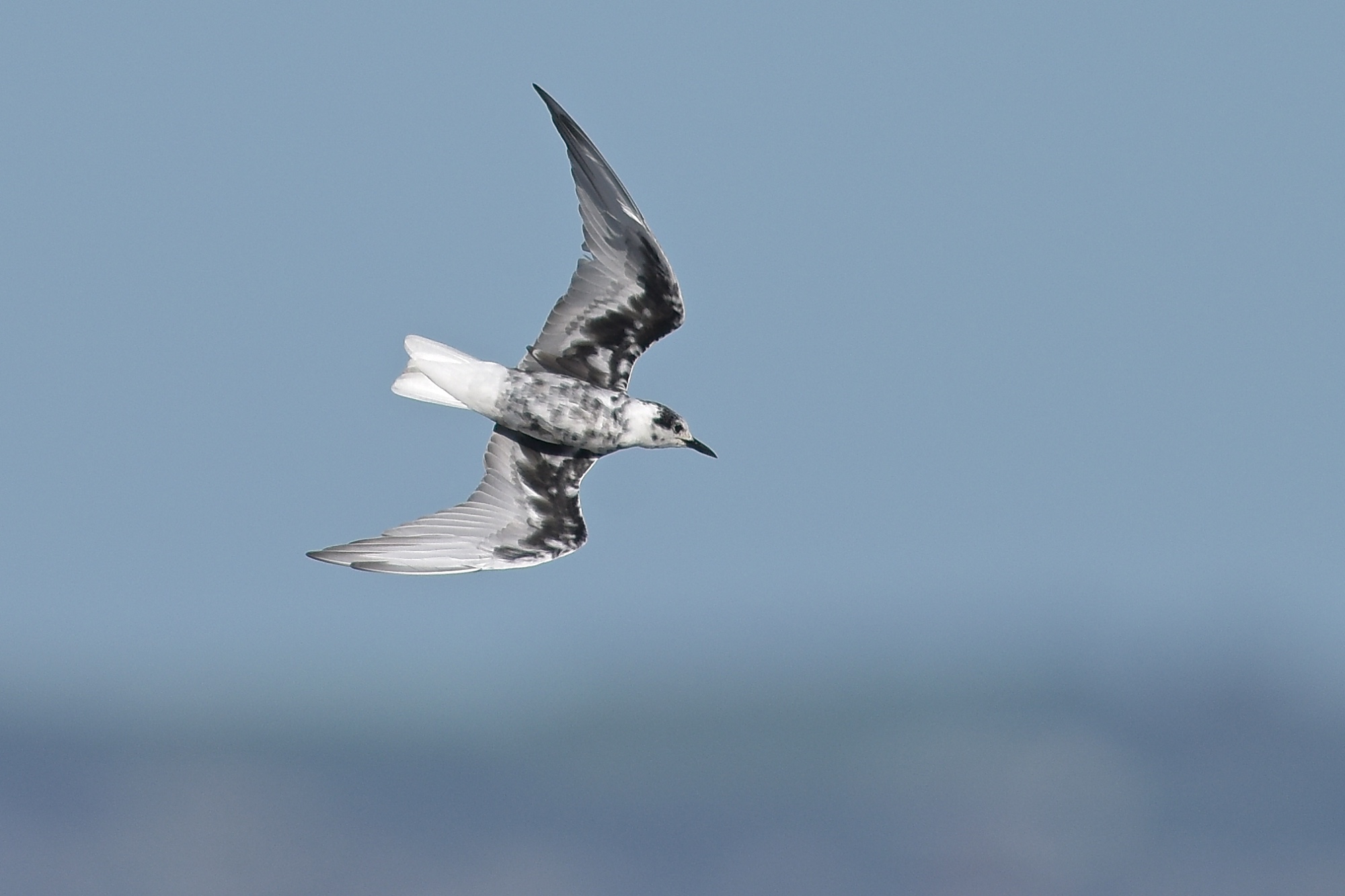
Then we took a quick detour toward the top end of Lake Borrie, and to my surprise and great delight—Picture if you will, a small child in a sweet-shop—I spotted some White-winged Terns hunting in the next pond.  (They used to be called White-winged Black Terns, but like many things name changes are important.)
Not that I cared as a most remarkable all Black flanked bird tacked into view.  It was in full breeding plumage, and has to be seen flashing over the water to be genuinely appreciated.   By now the memory cards were filling up. And they were just Mine!!!!!

These birds are only at WTP a few weeks during the year, and mostly never in breeding black plumage. Also every other time I’ve seen them it’s been raining.  See some other blogs on here.

A really top find, and a great way to end the day. A quick run up the highway. A refreshing cup of coffee and some good discussion on the finds of the day,- including a top shot of a Spiny-cheeked Honeyeater (Missed that one! ), and everybody back in their transportation and  time for home.

Thanks again to Graham “He who always has brilliant sunshine for his events”, and the pleasure of his visitor from Thailand, for such a good relaxing day, and so much to see, and to all those intrepid Meetup-erers who ventured down, and enjoyed the day with us.  Hope to see you all again down the track.

Enjoy.

A fine start to the day with a Black-shouldered Kite warming in the morning sunshine

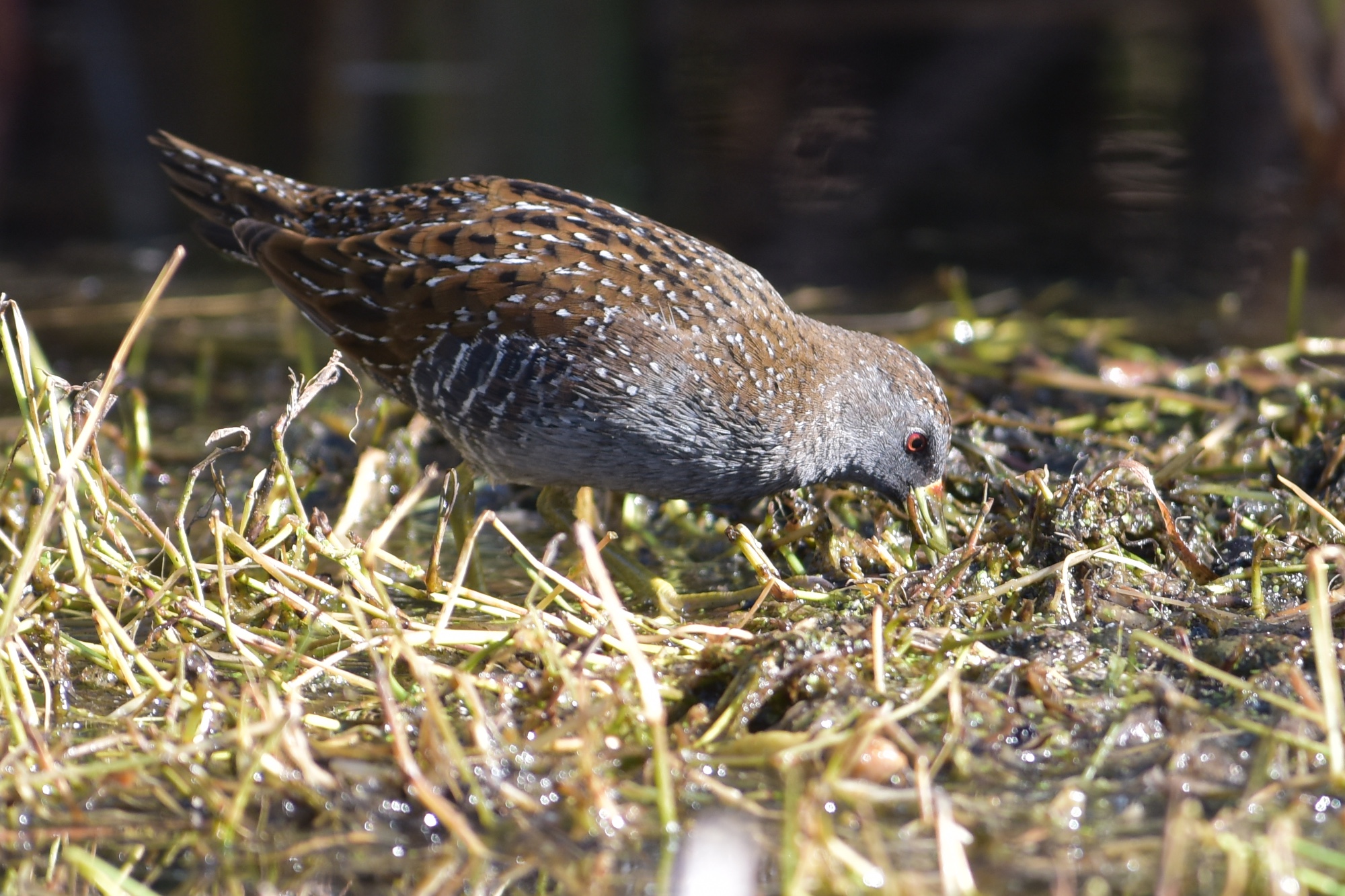
At Crake HQ, an Australian Crake on good display.

A hunting we wiil go Whistling Kite over paddock
A hunting we will go. Whistling Kite over paddock

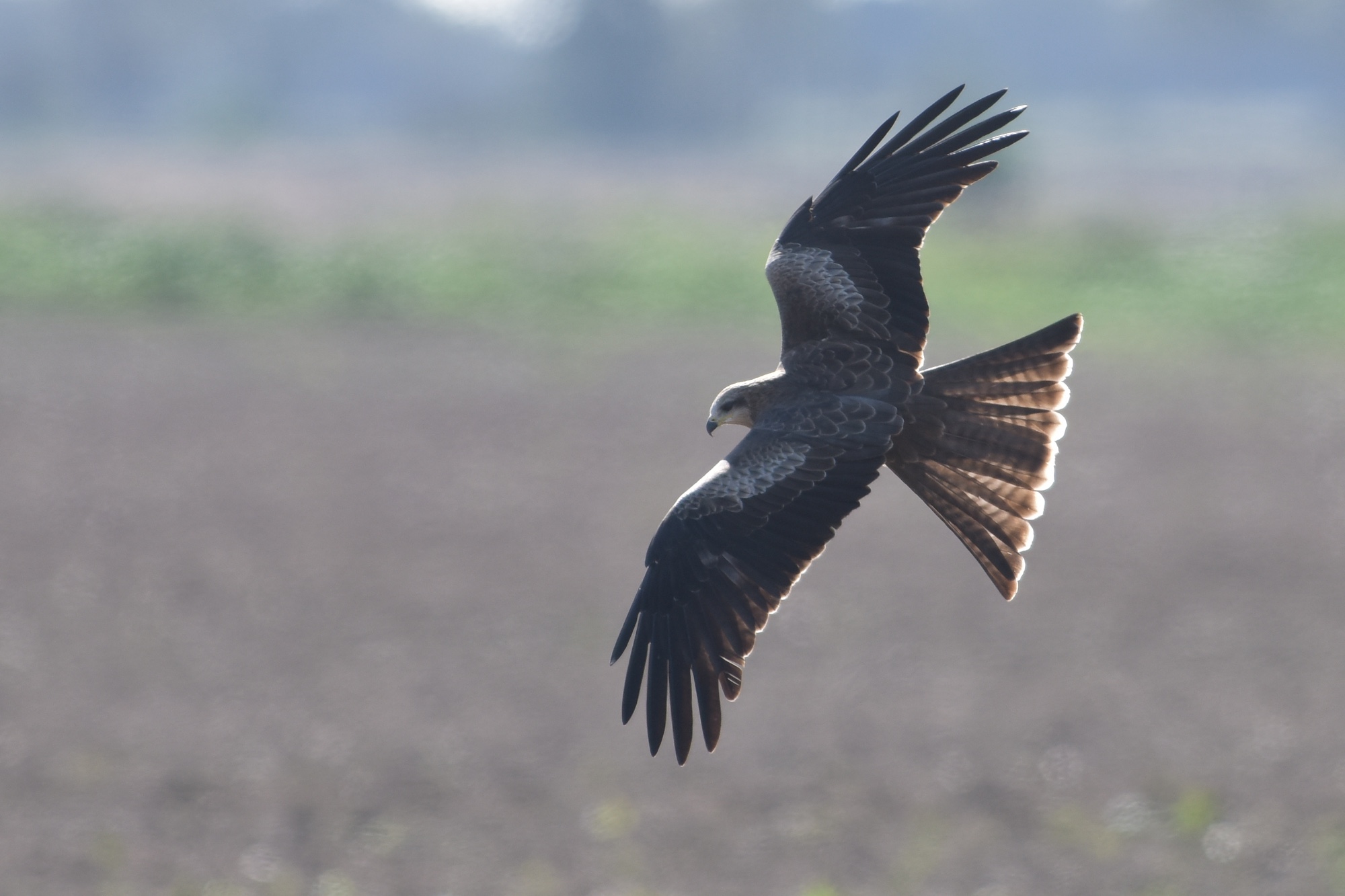
A Black Kite on a tight turn hunting small insects.

No one gets past here!

One of the finds of the day. Brolga in flight

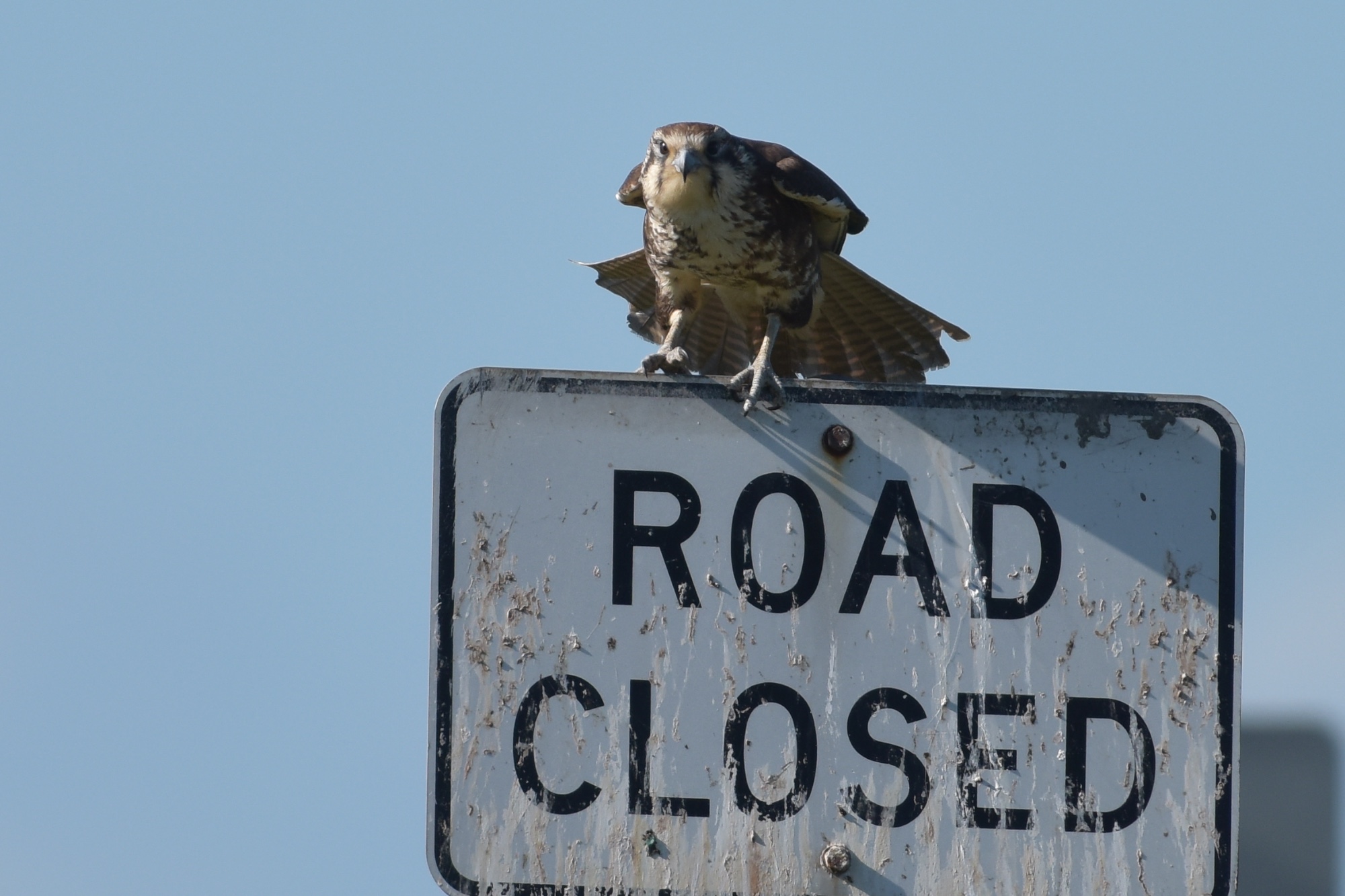
Brown Falcon on Specimen Tree

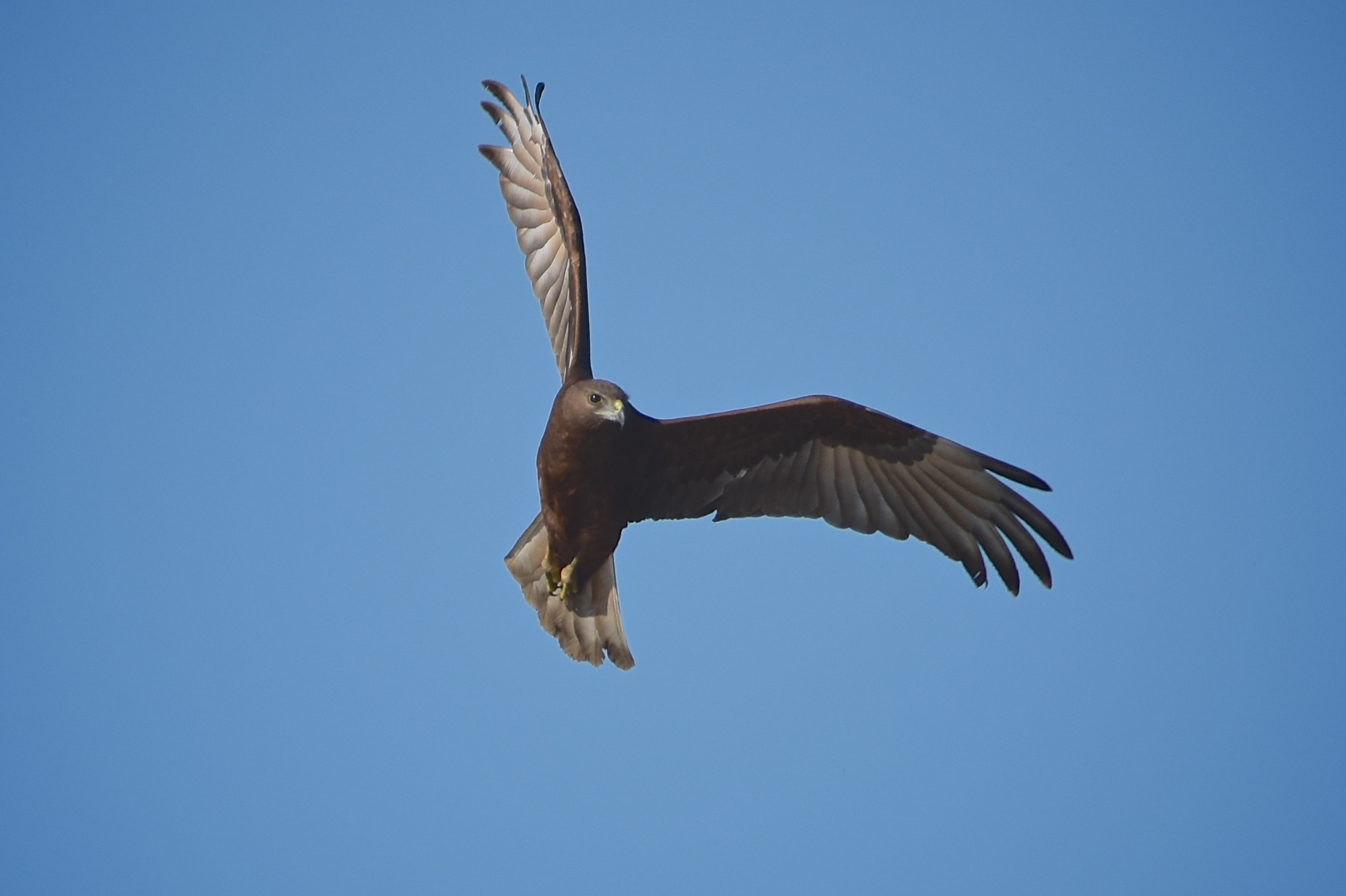
A Swamp Harrier on a tight turn. Another one for my "How to Sneak up on a Swamp Harier", book. :-)
A Swamp Harrier on a tight turn. Another one for my “How to Sneak up on a Swamp Harrier”, book. 🙂

White-winged Tern. What a great find, and this one in full breeding plumage.

So Good. Here is another.

White-winged Tern (formerly White-winged Black Tern for obvious reasons), this one is moulting in.