Among the residents at Serendip Sanctuary are seveal pairs of Emus.
We were walking toward the nesting Cape Barren Geese when we spotted a pair moving in the scrub behind the track. A quick peek around the tree-line and we managed to get a view of them bathing.
The recent rains had filled up a substantial puddle of water, not enough to dampen more than the ankles of an emu, but none-the-less, this enterprising pair decided that by squatting down, wrapping the long legs around, it was possible to get most of the body into the water. No doubt in the wild, they’d just wade into a creek, river, dam and not have to go through the ungainly procedure.
It took each of them several goes to find the deepest spot and then flop down for a good soak. The amount of water they were able to shake off was pretty impressive.
And for all those who’ve been conned by the “Oh, you need to keep your birdbath pristine clean for the health of the birds…. blah blah…” Take a look at the colour of the syrup running of these dudes.
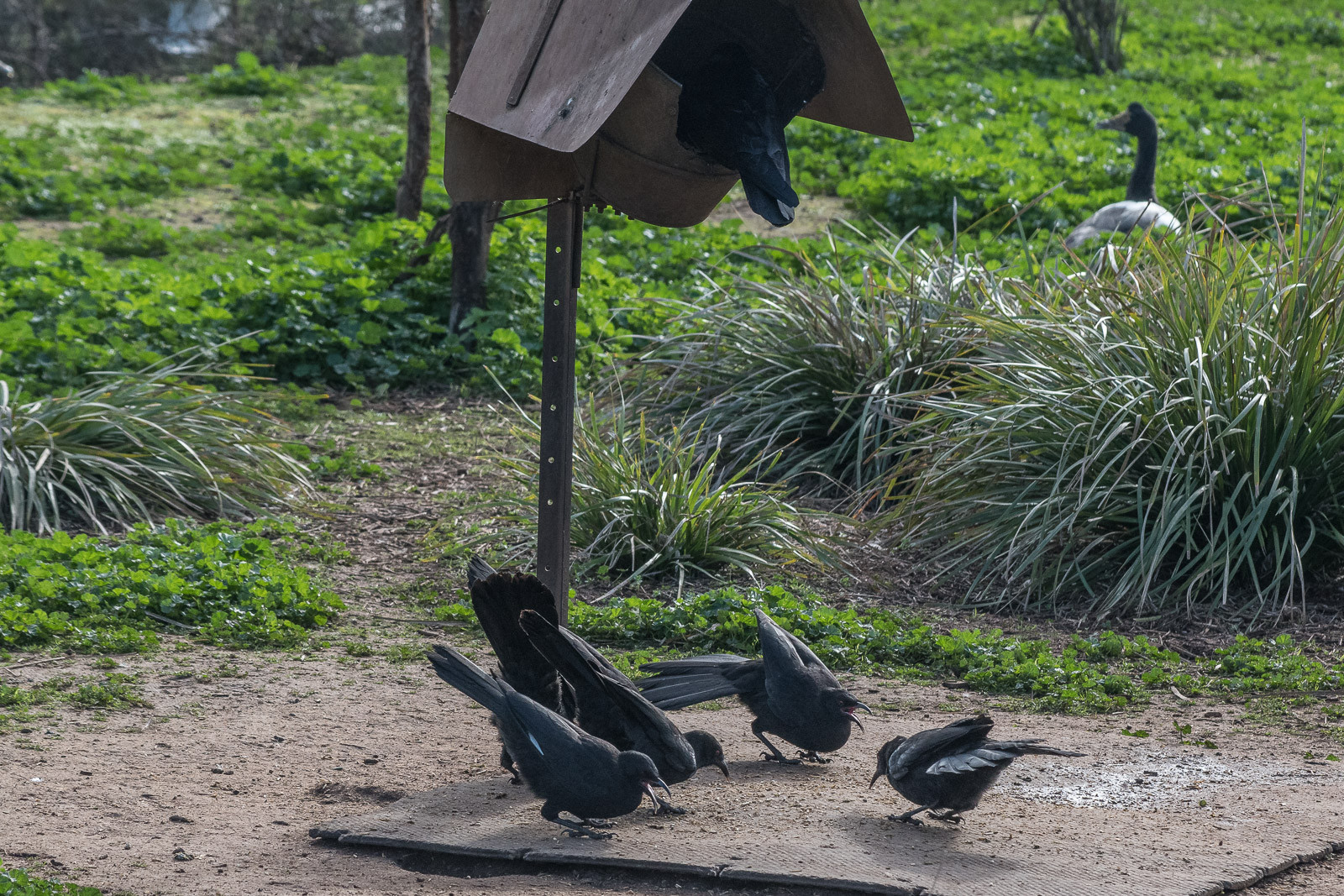
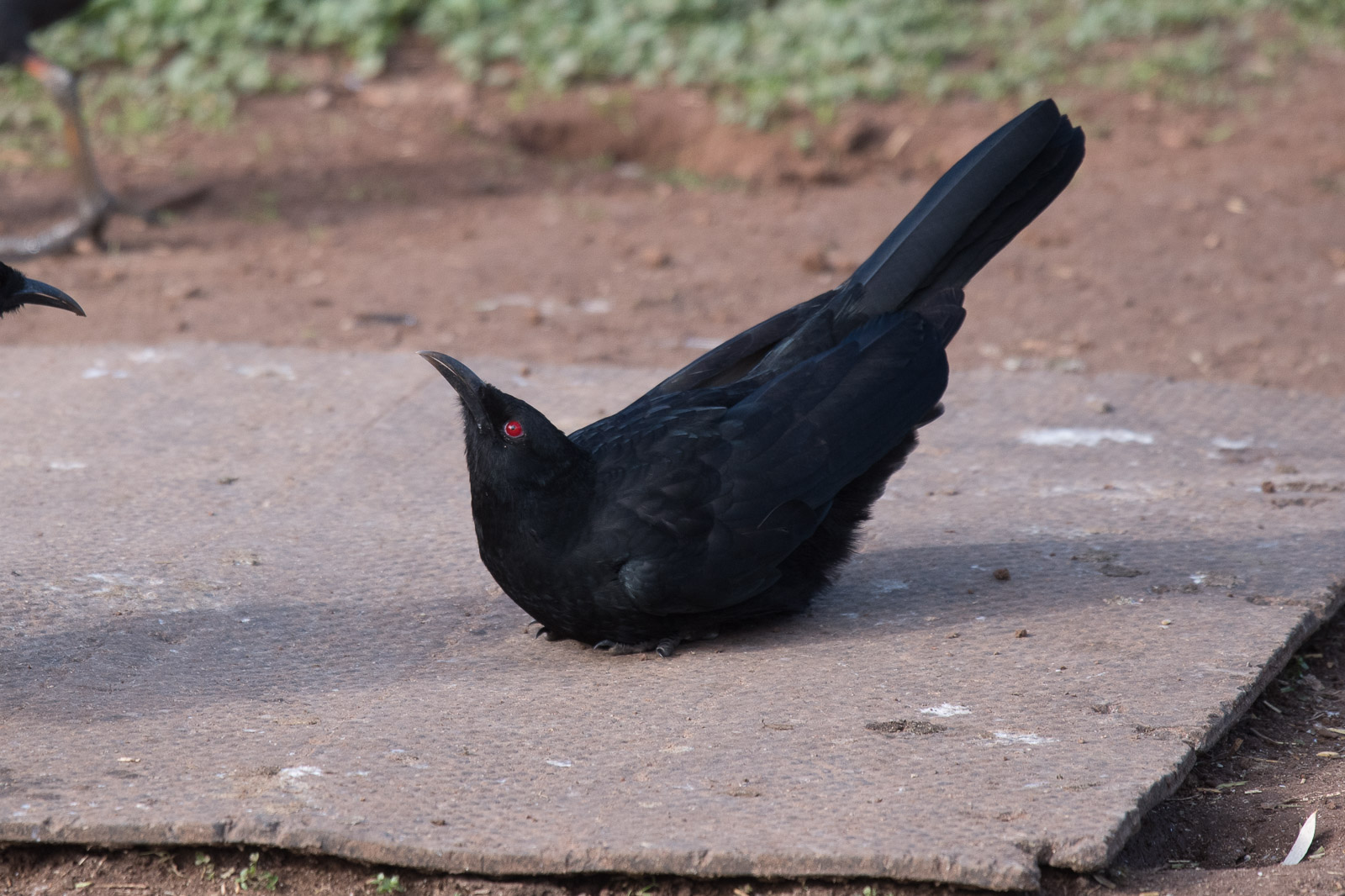
Long term readers will remember, or might recall, that I have a warm and fuzzy feeling for “Choughness”, the life skills of your average White-winged Chough clan.
I put up a shot a week or so ago from a trip to Serendip Park, where the Choughs were trying to raid the feed bin for Brolgas and Magpie Geese.
Now it probably doesn’t take much to figure out that your average feeding spot for a brolga or goose is somewhat higher up than even the tallest chough.
The family I worked with two week ago had adopted the ‘jump higher its got to work’ approach as each family member tried-usually in vain-to get a grip inside the feeder and only had time to grab a small beakful before plummeting back to earth.
However time goes on. Problem solving skill seminars and practice sessions followed up with various counselling events, has given the Choughs a new approach to the problem
Or
This is a different family and well on the way up the evolutionary ladder. Next step Chough on the moon?
This family had developed a very workable solution indeed. One clever bird, (Called Lucky by its friends) would jump up, flap/drop onto the edge of the feeder, and somehow balance its centre of gravity over the feeder and thus successful land inside. Then with great scooping bills-full, drop seed out of the feeder to the waiting family members below.
The only draw back to this incredible bit of problem solving is the Brolga, Magpie Geese and Little Ravens, don’t take to kindly to their food supply being raided, and every few minutes Lucky was forced to abandon its position to avoid a sharp wrap from the Brolga.
It’s been a bit quiet for us of late. Too cold, too blowy, lack of birds. And hot chocolate at home…Yum!
We had been at Point Cook Coastal Park a couple of weeks back. Looking for Flame Robins—not too many, unfortunately—and EE’s Sea Eagle, (hers by virtue of she saw it first, not that any would be surprised).
By the time we had arrived there was a pretty stiff Southerly breeze at work, making walking challenging for EE and Dolly. However we found a sheltered spot at the beach, and opted for a cuppa and snack, and while we sat contemplating no Sea Eagle, Robins, nor Cormorants, (somewhat in that order of importance), a large mixed flock of sea birds arrived just about in front of us.
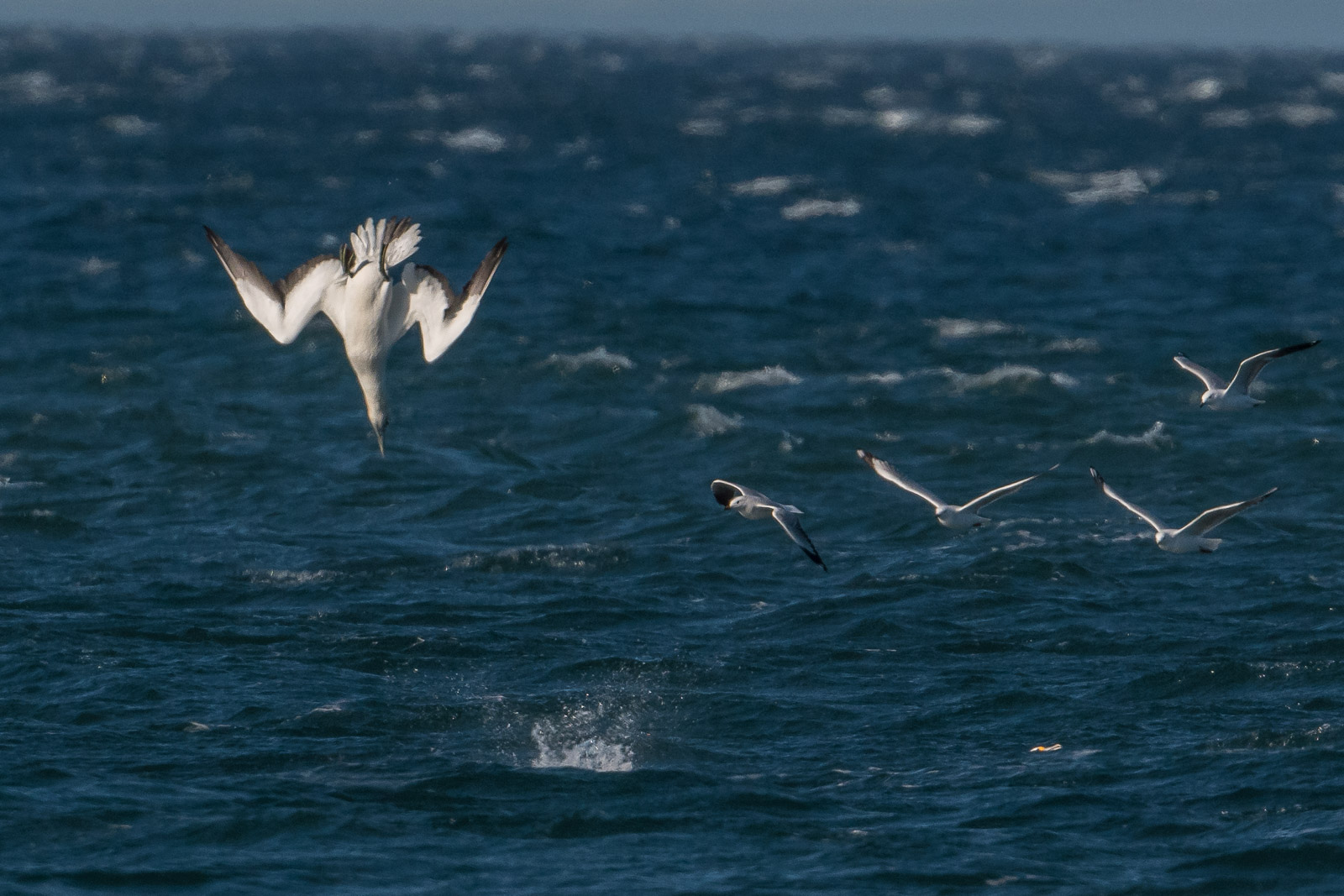
No doubt a school of fish was running along the edge of the sandbank a few hundred metres out. Outstanding among them was 25-30 Australasian Gannets. It’s really only on a Southerly that we see these birds in so close, so it was a bit of a treat to watch their controlled dives. A large number of seagulls and cormorants were also along for the feast and quite a few Greater Crested Terns.
Unfortunately for photography, they were just that little too far out, and mostly swung round into the breeze for lift off, which meant very few close passes. As it happened, however, I had packed in the Teleconverter, TC 1.4, so it gave me a little more reach with the 500mm.
Still for all that, all these images are huge crops from the D500. But it does reinforce what I’ve said previously about the lens. It does focus well, beyond the somewhat limited 30m or so of the cheaper tele/zooms.
Eventually the fish moved further out and up the bay, so we settled back to our now cold cuppas and enjoyed the action from a distance.
Made up for the lack of other special guests that day.
They seem to roll over, then correct and plunge straight downNo doubting where the target is.Starting to fold up all the hardwareAnd down it goes. Interesting to see the Pied Cormant appearing in the sequence
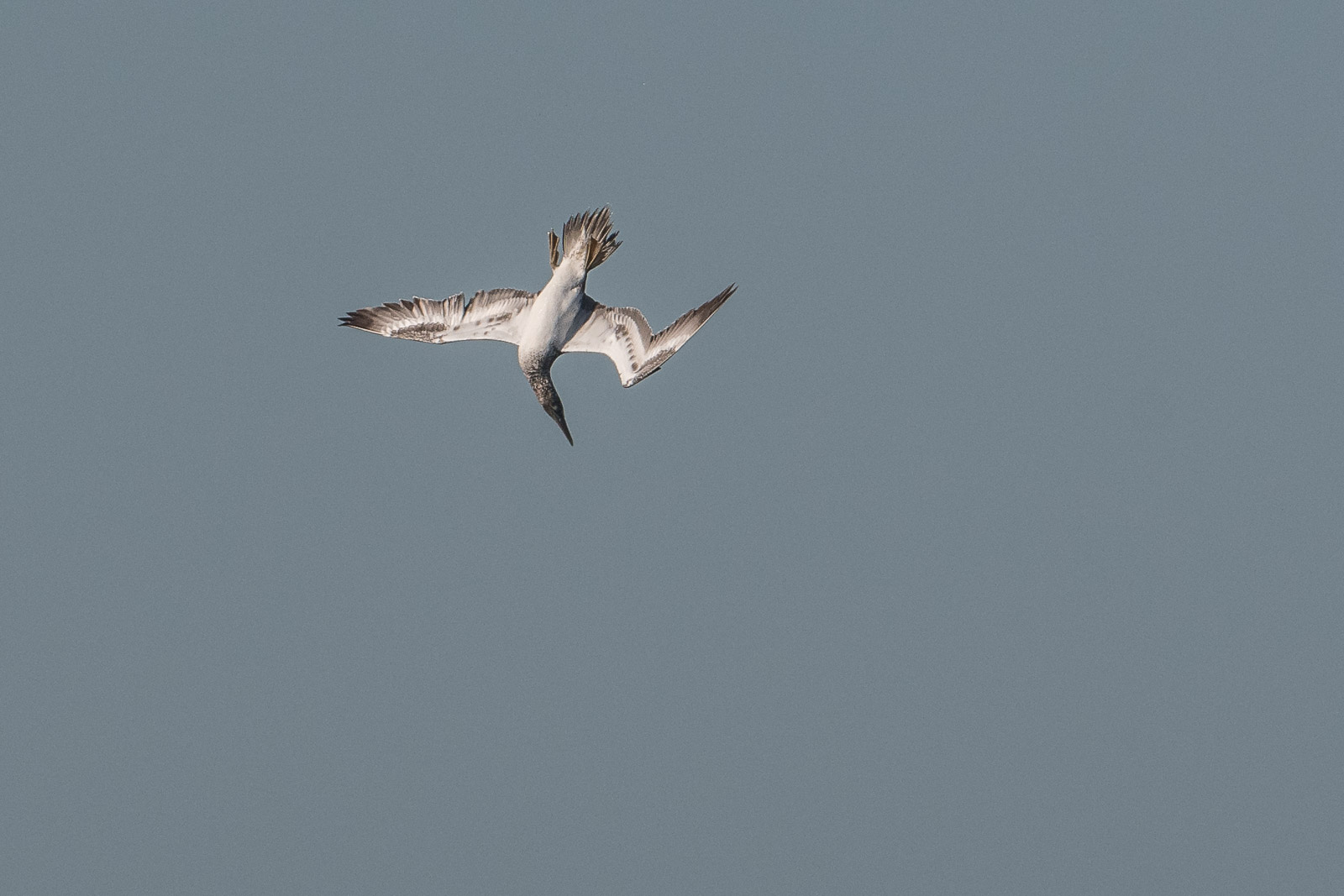
Another of the roll over actionsAll tucked up for a smooth entryA juvenile. When you consider it’s actually upside down as it comes out of the roll over, their body flexibility is awesome.
As our younger girl grew up, the group U2 were a constant source of music enjoyment in the house.
And as I hit number 40 for the Saturday Evening Post, I thought I’d quote from one of U2’s music would be a bit special.
Lots of interesting anecdotes about the piece, but I’ve always liked Bono’s statement, “We wrote it in 10 minutes, played in in 10 minutes, recorded it in 10 minutes, mixed it in 10 minutes, but that has nothing do with with why its called 40. (How Long!)
Rainbow Lorikeets are among some of the brightest, and most active little clowns that frequent the trees where we live. They can always be counted on to come up with a new wing flap, expression, act, or even song to entertain.
I have no idea what this one was upto, but its mate was on the branch next door, and for some reason, lots of big wing flaps were needed to emphasise the importance of some point of communication. I managed to get it right on the end of the outward stroke.
“Many will See, Many will See and Hear” (40, How Long)
Photography is one of those great expressive mediums that, unlike, say, painting, words, sculpture or dance, to name a few, relies on the moment. At the press of the shutter, the motif is set. An author can rework a sentence, paragraph, chapter or even a complete manuscript. Painters leave in, or add in necessary parts of the subject to provide just the right story.
Famed street photographer, Henri Cartier-Bresson, —HCB—(he was much more than that), coined a term “The Decisive Moment”. Often quoted in photo blogs, books, magazines and the like, (including this one it seems), yet rarely understood in the context with which he gave it life.
Here’s a good working definition:
“The decisive moment refers to capturing an event that is ephemeral and spontaneous, where the image represents the essence of the event itself.”
As Captain Barbosa in “Pirates of the Caribbean” says, ” There be lots of long words in there, and we’re naught but humble pirates.”
Reams have been written, and great theses developed to explain what HCB might or might not have meant.
He also said, “To me, photography is the simultaneous recognition, in a fraction of a second, of the significance of an event.”
and then this, “Photographers deal in things which are continually vanishing and when they have vanished there is no contrivance on earth which can make them come back again.”
That sounds more like my bird photography in the field.
It’s been quite awhile, since we’ve been able to find, let alone work with Eastern Yellow Robins, but EE’s perseverance hung out again this past week, and we managed a few minutes in the You Yangs with an active feeding bird.
After several relocations and changes in light, I was getting a feel to the actions of the bird.
And because of the morning light getting a reasonable balance of fore and background from the hard light was a challenge. Find bird in viewfinder, move about for best background.
Then it landed on a single upright branch. After several shots against dark and light backdrops I settled on the light on dark approach, and the bird turned into the lighter side. I waited. And then almost imperceptibly, the ‘significance of an event’ occurred as the bird bobbed as it lined up the next meal, and then slid of the perch.
Nailed it.
We went to a BirdLife Werribee, (formerly Werribee Wagtails) monthly outing that included an afternoon at Serendip Sanctuary.
It’s a fairly close park for us, and we visit several times a year, and if the granndies turn up, it’s a day out in the field, but on formed tracks, and things to do, so makes a pleasing family day. And it’s quite close to Lara Village and a certain Routley’s Bakery Pie shop. Which proved too much of a draw for Mr An Onymous and me, so we stopped off for lunch on the way through.
Furphy’s Ale and beef for him. Tandoori lamb for self.
I’m always a bit uneasy about photographing in an enclosed sanctuary area. It’s not a matter of ethics—per se—but, rather always seems to me a less challenging experience than working with the birds in the field. After all, the kangaroos have already seen a 1,000 tourists this week, so you are not exactly interesting. They also know, people stay on the tracks, yell a lot, and move on. Some even wave, point fones at themselves and ‘whatever animal is that in the background?’ selfies abound.
So truth be told I normally wander through the area ohh and ahh appropriately, try not to get upset when someone points at a Tawny Frogmouth and says, “Oh, look, what a cute little owl!” and enjoy others enjoying their wildlife experience. (I’m not a spoil sport entirely!!!)
However it seems I’m mellowing with age. 😉
After so many trips, I’ve come to respect the locals. In their locality. Not only the ones in enclosures, but also the ‘visitors’, that have stayed on as Star Boarders. Quite a lot of the bird life is free on the wing and come and go as the season dictates. Others, for various reasons, including breeding programmes, are permanent.
And, what I’ve discovered from all that is I’m not so fussed about the lack of challenge, and much more interested in the closeup portrait. The challenge for me is working with the bird for the right setting/location/lighting and then allowing them the freedom to move about unstressed. A humbling experience, but really has given me a feel of involvement with them as individuals. So much so that I look forward to being in their area, and hoping I’ll be able to make the best of the moments they share.
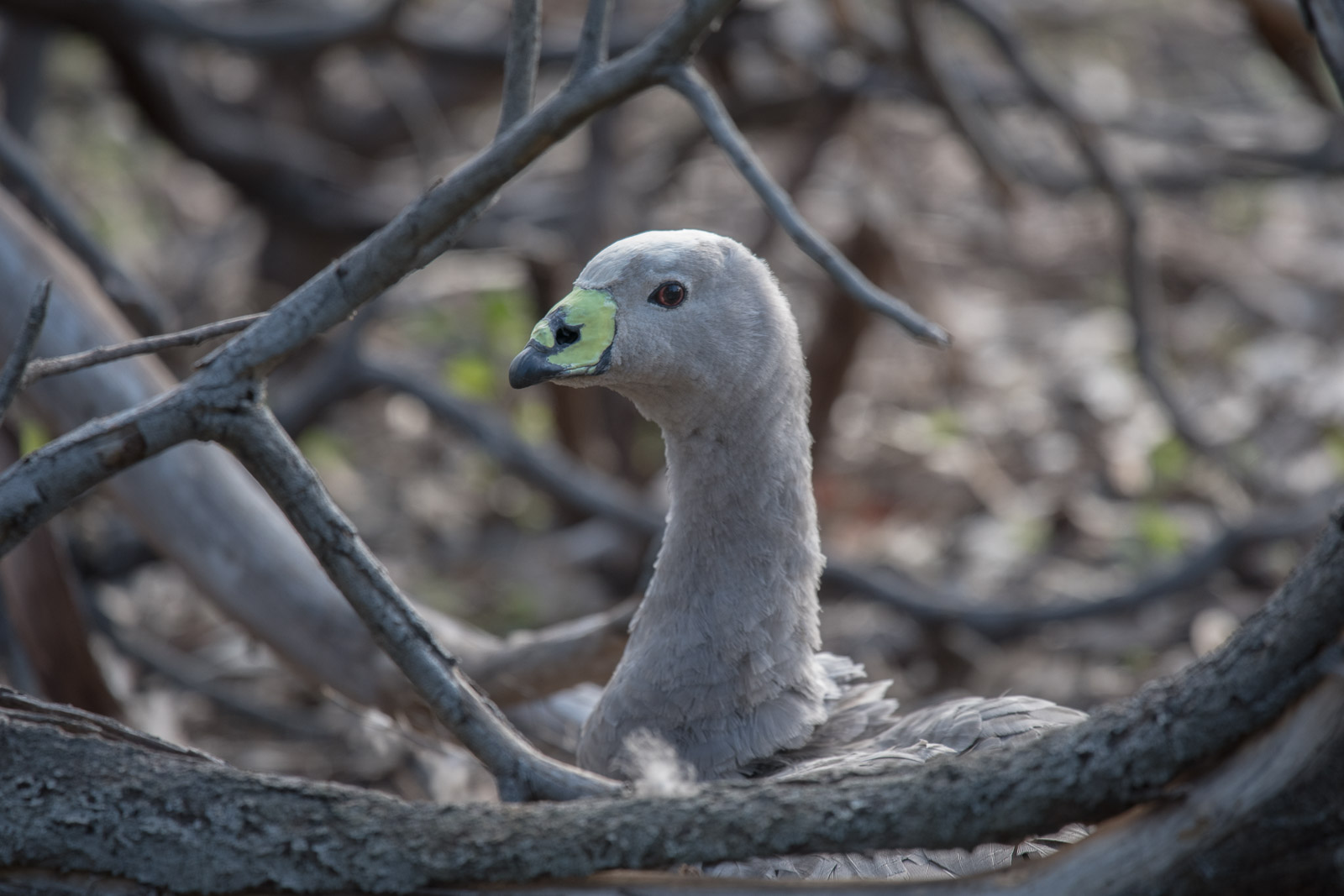
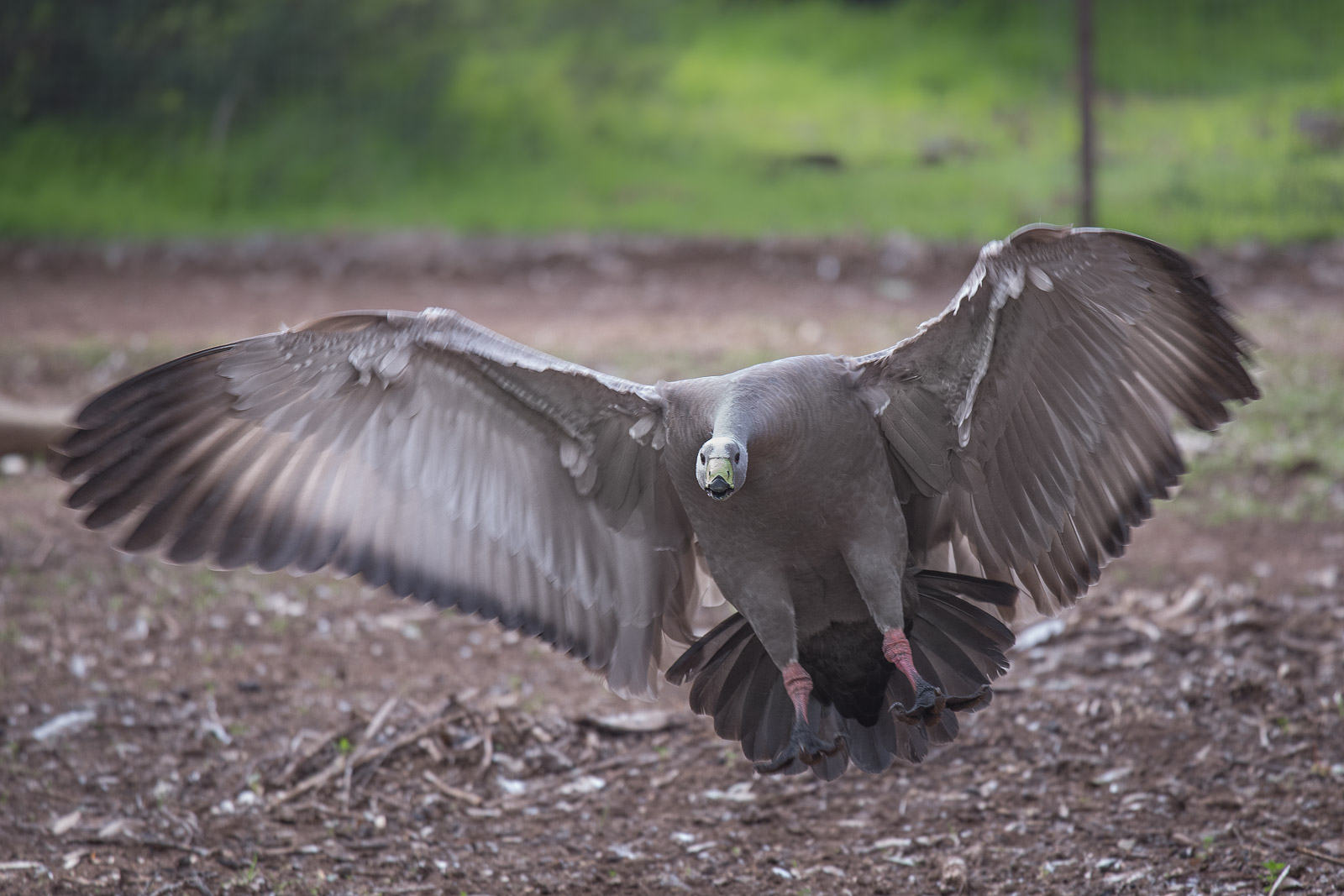
Of special interest to me is a pair of Cape Barren Geese. These big birds have settled in to make Serendip their home territory, and with ready provided food, can you blame them. It’s nesting time right now. One enterprising pair have made a nest site among some downed branches and scrub, not more than 5 metres from the main walking track. I spotted him first, and as he paced back and forth as people went by, I wondered, “Where is you mate”, and then I saw her. All tucked up in her ‘secure’ haven.
The rest of the Wagtails tour/ensemble, moved on. I sat down with the pair for about 10 minutes. Now a sitting goose doesn’t do a lot. Yet, the warm image of ‘mum’ raising her young, is such a classical performance.
Choughness, as this blog has often commented is a joy and delight to behold, especially as we don’t know the rules.
Inside the enclosure with the Brolga, there is a feeding station about brolga height. But rather attractive to your passing White-winged Chough. Except, they don’t have a good ‘hovering-flying’ technique, and so couldn’t access the food by sitting on the edge of the feeder. No where for them to attach.
Coughness is never defeated by such mere challenges. So bend down, spring up on uncoiled legs, flap once to get direction, sail into the open feeder, grab a beak full and use those same wings to flutter back to the ground. Innovation at its best.
There is a bird enclose that houses quite a number of birds in a fly aviary.
Interestingly Buff-banded Rails are there in good numbers, and often Freckled ducks. One of the rails that I saw was quite white, so it must be a leucistic (the cells don’t have the ability to make colour).
And while I was there admiring that ‘Cute little owl’ (ggrrrr- it’s a Tawny Frogmouth!!!!), a pair of King Parrot turned up for a looksee at why wasn’t I walking through, yelling, pointing, and waving a fone about. Thanks Mrs King, a lovely portrait session.
A day at Serendip is always a good experience with the birds, and now I’ve discovered my new friendships with them, I’ll look forward to the next trip to enjoy the photography of them as individuals, and find ways to express their character in a much more sympathetic manner.
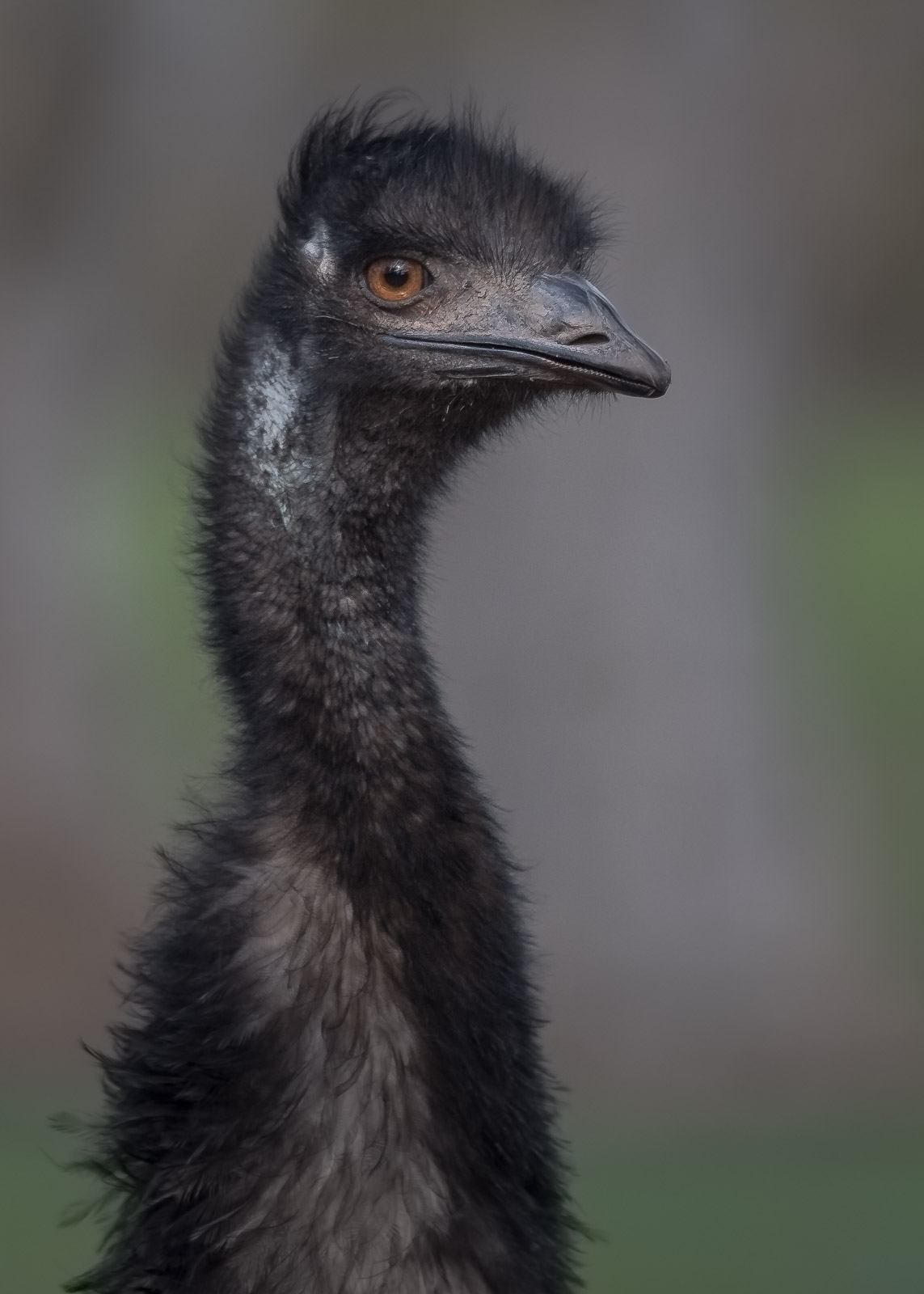
Emu Portrait, in soft light. Finding the right background is the challengeOh, there you are, all tucked up in a safe nestSitting pretty, watching the parade of humans walking byWith a one, and two, and go. Coiled up like a spring it has to leap/flap about a metre and a half to get to the covered over feeding area.As the old cartoony used to say, “Thunderbirds are GO!”Incoming. Fiercely protective male makes a stunning entrance.Buff-banded Rail, not exactly blending in like its neighbors. Best guess is leucisim.Mrs King, always looking resplendant.
So, I settled into the window seat, with a nice hot cuppa, a few good books, and watched the clouds chase one another across the sky.
First stop was T S Eliot “Ash-Wednesday”,
I rejoice that things are as they are
And another from Lao Tze,
“I am a guest in this world, delighted by my host’s generosity, I accept what is offered”.
A week back EE and I had set out on a very bright sunny morning to go to Point Cook Coastal Park to look for Flame Robins.
Did I mention sunny, oh, yes, it looked like a treat. But by the time we had arrived on the ground, a huge grey cloud could be seen over the horizon and coming in our direction. Within a few minutes a thick sea-mist had set in. And with no breeze, it just hung in the air.
We found some robins, but the lack of light and the difficulty of getting close enough to get a clean shot meant that our time was severely limited to a few records of the birds at work.
One of my mentors used to talk of the two major influencers on a photograph. The Elements, and the Intent.
Elements are easy. They are the ‘things’ and the camera settings we choose. The Intent is what am I trying to say. What will the view perceive and what is the best way to approach and arrange the elements.
And what better way to challenge those opportunities that the use of the mist to eliminate all the unnecessary and concentrate on the intent.
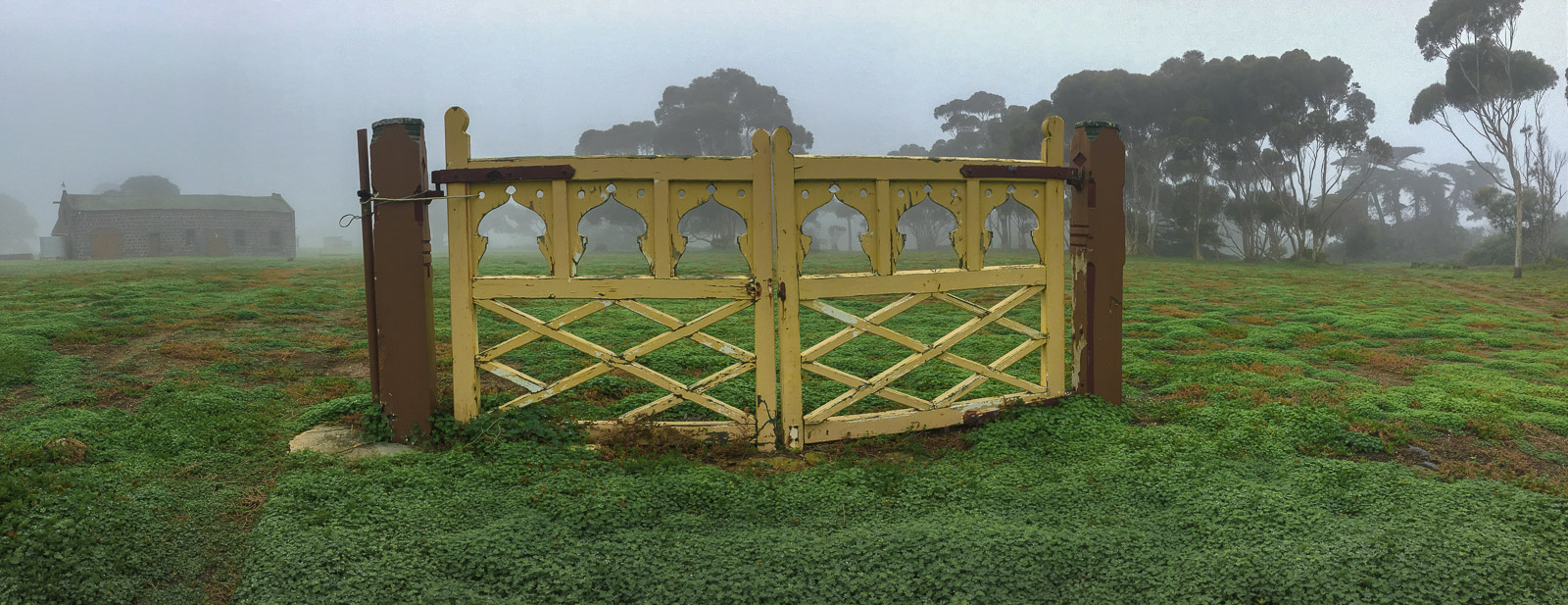
As I’d not bothered to bring a smaller lens, out came the iPhone and a bit of a look about soon revealed some panoramic opportunities. (I’ve talked here before about my fascination with the wide-wide view and really appreciate the simplicity of the phone’s pano feature).
The old gate was an obvious choice and I enjoyed the wrestle to find the right framing, and the best backdrop.
And I came across a small pine seedling struggling to exist on an old log of its previous generations. (Lao Tze would be impressed).
Here is how it looked, and here is a link to the final on Flickr.
Enjoy
One of my first optionsWhat I really wanted was the old gateway to dominate the frame
And the first look at the seedling at work
And here is a link to the final that I shared on Flickr.
“On the Post,” she cried.
We were driving along a flat farmland, busy, country road. Which Post? Seemed an obvious question from the driver’s side view. Thought I was supposed to be keeping it on the blackstuff, and avoiding making close personal contact with the oncoming traffic.
“Back there, on your side.” Makes it even harder.
Slow down a bit, look for a spot to pull off the road. No easy matter either as we’ve had a good share of rain of late and the pools on the grass on the side of the road, are not a promising parking location. 500 metres and I’m off the road. Now to wait for a break in the traffic to get around avoid cars in both directions. I’ve seen it less busy on a club day at Winton or Philip Island circuits.
“Think its a Brown Falcon,” so around we go. “There.”, but I’ve spotted it in the sunshine by then. Another of the avoid other car contact at all costs manoeuvres, and I’ve got the car about 50 metres from the most likely photo spot.
Slog back through the mud, avoiding if possible the road spray from our passing friendly roadsharing traffic.
By the time we’d got to a break in the roadside bushes, I’d already called “Peregrine Falcon”. Much too broad across the shoulders for your average Brown.
“It’s caught something,” Something, being, as it soon becomes apparent, is a rabbit.
First problem. The first signs of a morning seamist are just about on top of us, and the sunlight has a limited tenure. Second, the bird is much too far away in the middle of the fence line. Thirdly in my haste to slosh down here, I’ve left the Teleconverter in the car. Bad move.
Two passes by a magpie and the Falcon is a bit nervous, and takes to the air, at first I thought because of its run, it was going to come close, but it soon swung out, around, and headed down the line. Now too far for much else than enjoying the moment.
Then the seamist closed in, and we needed a guide dog to get back to the car, and the strains of bagpipes and Paul McCartney’s “Mull of Kintyre” ringing in my ears.
Enjoy
Just about to have its morning meal interrupted by a passing magpieWith a tail flick its away. Easy to see the prey was a rabbit.Getting up to speedAnd now too far away, and with a mist rolling in, the best we can do is watch. Is that bagpipes I hear in the background?
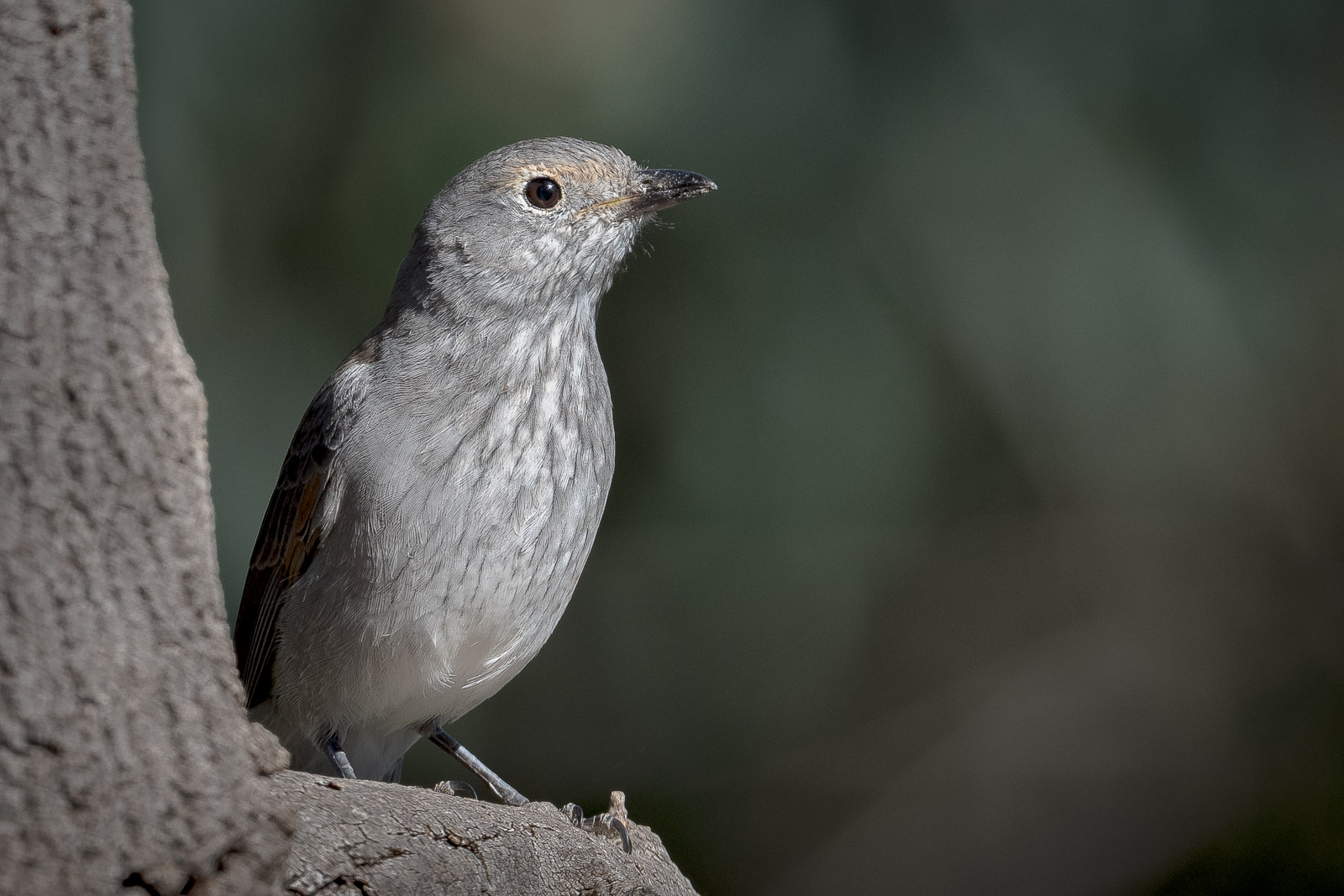
“I want to sing like the birds sing, not worrying about who hears or what they think.”
He, no doubt, had never heard of the great songster of the Australian bush, but again, no doubt, he would have been impressed by the range, the volume, and the variety of the songs of the Grey Shrikethrush.
In winter when there is no one to impress, the one or two note call is quite penetrating, but hardly melodic, but come the season for mating, the call changes to the most beautiful and sustained tunes.
I once found one nesting in a old concrete tank, the shape of the broken top of the tank made the whole thing a superb sounding box, and as I peeked in side the bird was in full cry, not worried about who hears, not what they think.
It is estimated that a pair will maintain a 10 hectare sized territory, and perhaps that is why the loud song must ring from one end to the other.
Their diet is quite catholic, and they have no qualms about helping themselves to robins, thornbills and other small birds egg and young. I once saw an adult with a match-sized stick, poking it into a hole in a branch to lever out a small grub.
John Latham, one of Australia’s early and great naturalists gave it the binomial Colluricincla harmonica. Colluricincla refers to Thrush, while harmonica, from the Greek harmonikos, – skilled in music, and Latin, harmonicus- harmonious.
This was one of a pair that were working their way along a river’s edge. The simple calls were enough to keep them in contact with one another, but also gave me the opportunity to locate them amongst the scrub.
Someone asked me the other day, about my habit of regularly getting up early in the morning and spending the first hour or so out walking. At the present, most of that time its in the dark, as the sun doesn’t raise its sleepy head until around 7:30am.
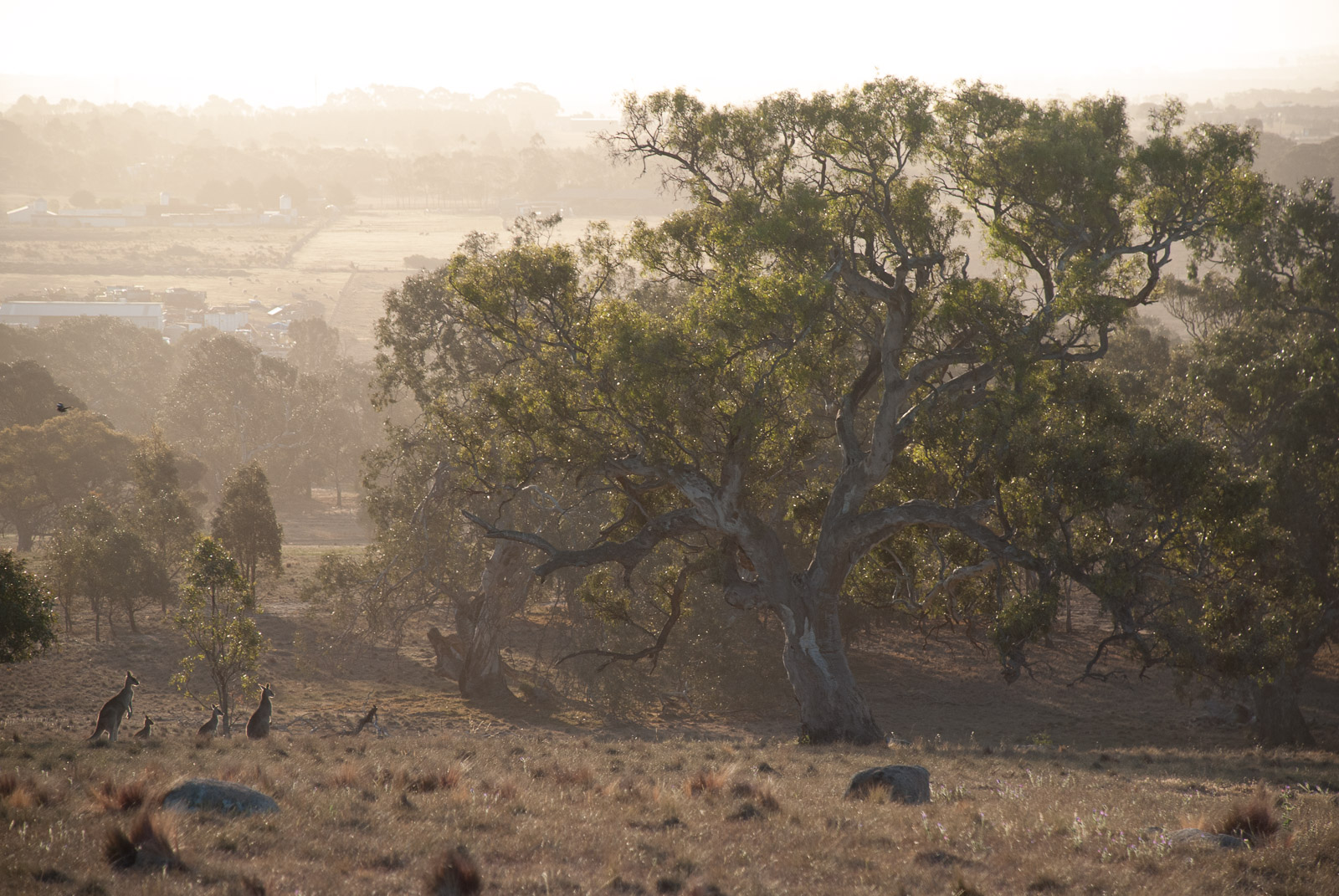
My walk takes me along a bicycle path besides the Werribee River among some wonderful old Red River Gums. My answer to the question probably was a bit profound for the uninitiated, but I responded. “I like walking at that hour of the morning as I can hear the trees breath”.
Lao Tzu suggests in one of his famous verses that a harmonious life is built around a sense of awe and acceptance. Walking at the hour helps me build that sense of awe.
In the 16th century the mystical poet, St John of the Cross would write a somewhat similar thought of awe and acceptance.
My beloved is the mountains, And lonely wooded valleys, Strange islands, and resounding rivers, The whistling of love-stirring breezes,
The tranquil night, At the time of the rising dawn, Silent music, Sounding solitude, The supper that refreshes and deepens love.
The light skipping through the trees weaves its dance of shape and form and is miraculous. Unhindered, it scatters its rays of brilliance, plying shape and shadow without thought or favour. Working it magic in the natural course of the universe.
Lao Tzu would say, enjoying the moment “You will never weary of the world”.
Tis true to say that EE and I haven’t been down to the Western Treatment Plant for quite a number of weeks. The weather, health things, family events and perhaps a touch of sloth just seems to have gotten in the way.
My photo mate Neil, sent me a note about his last weekend trip, and we decided if the weather opened up a bit, we’d at least drive down 29 Mile Road for a looksee.
So this morning after a couple of Tai Chi class sessions, we loaded up with lunch, a cuppa or two of Earl of Grey and of course the essential cameras and headed out in the warm sunshine, (and to tell all the story, the rather crisp wind as well).
Before we reached Beach Road junction, we spied some Flame Robins, but they wanted to work far out in a paddock, and we could only get glimpses.
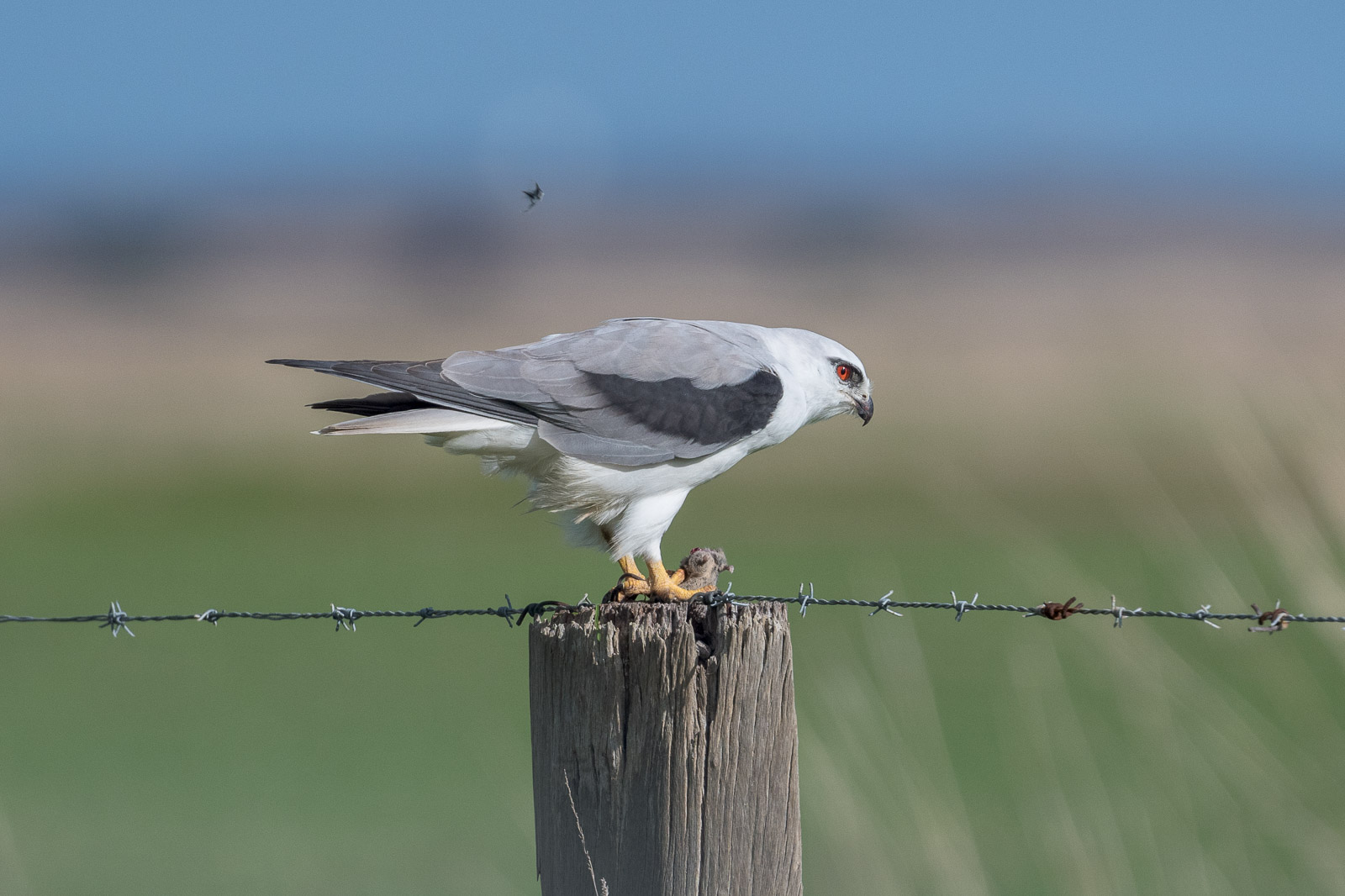
Further on down, and a trio of Black-shouldered Kites were keeping the mice on their toes.
And as we sat with lunch at the first corner on the 29 Mile Road, a Spotted Harrier wafted by making some very nervous Swamphens. As we entered the T Section area, we were looking for Brolga as Neil had sighted them here at the weekend, but we lucked out.
Next we found a single Flame Robin female that was working around a puddle of water on the roadway.
Looking up, I heard the familiar call of a Black-shouldered Kite with a mouse, and as we looked a Black Falcon swept in from no where and after a little evasion from the Kite, the Falcon secured the prize and took off with the erstwhile and very angry kite in hot pursuit, but to no avail. The Black is just that good in the air.
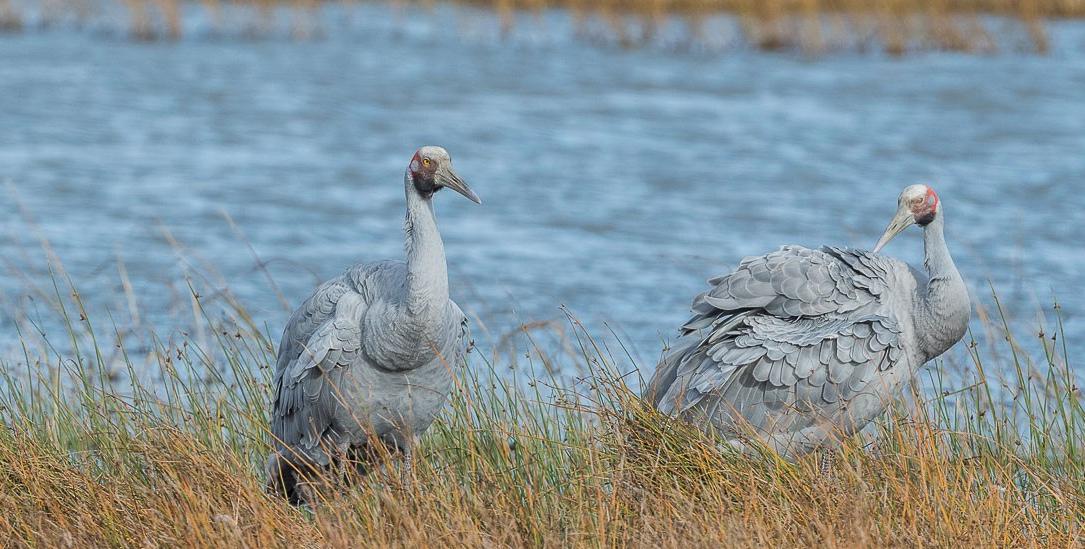
As we drove back out, lo, the very Brolga had turned up in the first pond and were busy preening, we shared the last of the Earl of Grey and enjoyed their unconcerned wardrobe adjustments.
So for a first day back at the farm, it was a most enjoyable and profitable time.
The fur flies as the Kite prepares lunchFast foodSpotted Harrier at work over Swamphen poolAustralasian Swamphen with impeccable table mannersGolden-headed CisticolaFemale Flame RobinBlack Falcon speeds in on a free lunchEasy to see why the Kite has no hope of winning this battleHaving lost its mouse, it did at least give the Falcon a parting swoop.Preening Brolga
I have of late been looking at the prospect of replacing my ageing Lightroom. Adverse, as I am to paying the Adobe conglomerate a monthly hostage or blackmail fee, I was hoping to find a reasonable standalone option. Not that I want flashy sliders and zillions of use/ful/less presets. No, my requirement are simple. Good image management, and the excellent keyword search facilities. Truth be told, I think Abobe still are the only ones in the ball park.
But I was amused to look at some of the offerings. Catchy marketing phrases, “Make the most of your photos.”
“Reveal the hidden photo within”. “Photos that will look their ABSOLUTE best”. “Match your artistic inspiration”.
I worry about ‘finding the hidden photo’, as in I’ll put up an image I’d have deleted anyway, and a few tweaks with the ‘inspired’ AI software, and dah dah! Oh, what a great image, I didn’t know I was THAT good a photographer. Where has the image been all my life.
Yet not one of them has the simple ability to find the Keyworded “Black-shoudered Kite, WTP 600mm f.8, D810”, or what ever. With just on 100+k images, I’m not likely to rekeyword to match a program that can’t read standard IPTC data sets.
But what got me thinking was the ability to now discover previously overlooked photos that somehow match my artistic inspiration.
As a young photo-assistant, my mentor talked of three images. The one we saw, the one we photographed, and the one we printed and distributed to the customer. Now it seems we can add a fourth, the one we never saw coming.
Which I suppose means I can mindlessly point the camera out the window, run the file through some AI (artificial intelligence, in case you’ve not been keeping up), and lo, there it is in all its glory. No longer is digital development or enhancement a craft in the service of my vision. It has become my vision.
It’s like a singer with no vocal training, no voice development and no concept of fine breathing picking up an AI microphone and revealing the hidden talent within to sound like Pavarotti.
There is, so say the ancient sages, a little bit of Yang in Yin, and a little bit of Yin in Yang. I’m often grateful that I came to photography at the height of black and white. The power that comes from working to get the best angle, the right shape, the richest lighting, all necessary to take our 3D world and bring it on to a 2 D medium, print/book/screen.
Push the Yang, and we get dark moody results. Push the Yin, and light and bright shines forth.
I found this Little Raven on a local tv antenna. It was preening, and talking to its family stationed on other close perching spots. At some point, just as I pressed the shutter, it decided to turn and talk to its close neighbour.
What astounds me is the bird’s ability to turn its head in the direction it’s going to move, then lift off and with total confidence turn its body to match the direction and plant its feet back on the perch. Poetry in motion.
The yin of the eye makes its statement within the yang of the bird. The yin of the cloudy sky is balanced by its little bit of dark antenna.
The freedom of the bird is contrasted by the fixedness of the aerial.
The confidence of the bird is balanced against the rigidness of the tubes.
The cleverness of the bird making use of the available is contrasted against the metal structure built for just one purpose.
It is said of famous battle photographer Robert Capa, when asked by a collegue why his photos weren’t good enough, responded, “If your photographs aren’t good enough, you aren’t close enough.”
It’s easy at first blush to believe that Capa meant, well, get out of the trench and get close to the action. However it is more than likely that his comment had a much deeper meaning of getting close to the subject in an intimate knowledgeable way.
It’s about a matter of experiencing. And as bird photographers we chase distant subjects with the longest lenses, and its hard to establish a feeling of the intimate from a distance.
For us its a matter of spending time, respecting the subject, and allowing the time to wonder. I really believe one of the great gifts of photography is that it teaches us to see. And not just what we see,
but,
How we see it.
So much so that I can say, with some degree of wonder, that the camera has opened my eyes to the world around me. Not just the natural, but the human. Some of it from the dark side, but also from the beauty. It’s not a perfect world, but I don’t want to discuss that here.
The gift helps us to learn to see. Moments of interaction of shape, light, line colour, slow down.
And we make space for wonder at the world around us and the brillance of the amazing medium we have to share those moments with others.
I know, the think global, act local is all the rage in some politically correct circles.
We have been thinking locally the past week or so. Partly because of the weather— finally getting the rain we desperately need. And also strong winds, which we could do without. 85kph gusts the other day. Seriously, if you can’t stand up in it why go out.
EE and I have had need to visit the local medical area at Werribee Hospital precinct. As it turns out, my Flickr mate David Nice, has several good areas mapped out in the area. With Kestrels, Brown Falcon, and Little Eagles, and ‘alleged’ Black-shouldered Kites.;-)
So after the serious stuff, and the coffee in the cafe area, to recover, we’ve been sitting in the car along a couple of the roads by the local paddocks to see what is happening. Now tis true we don’t have the bird Karma of David N. but I do have EE, and that is about the best advantage I can offer.
Oh, she cries, Black-shouldered Kites, I scan. Nothing. I scan more. Still nothing, I point the Bushnells across the sky. Nothing.
Ok, saith I, Where?
Over there, beyond those trees. What she actually means is in the next suburb! Bushnells finally lock on. Yep, those two insignificant dots, could be Black-shouldered Kites. I retire defeated.
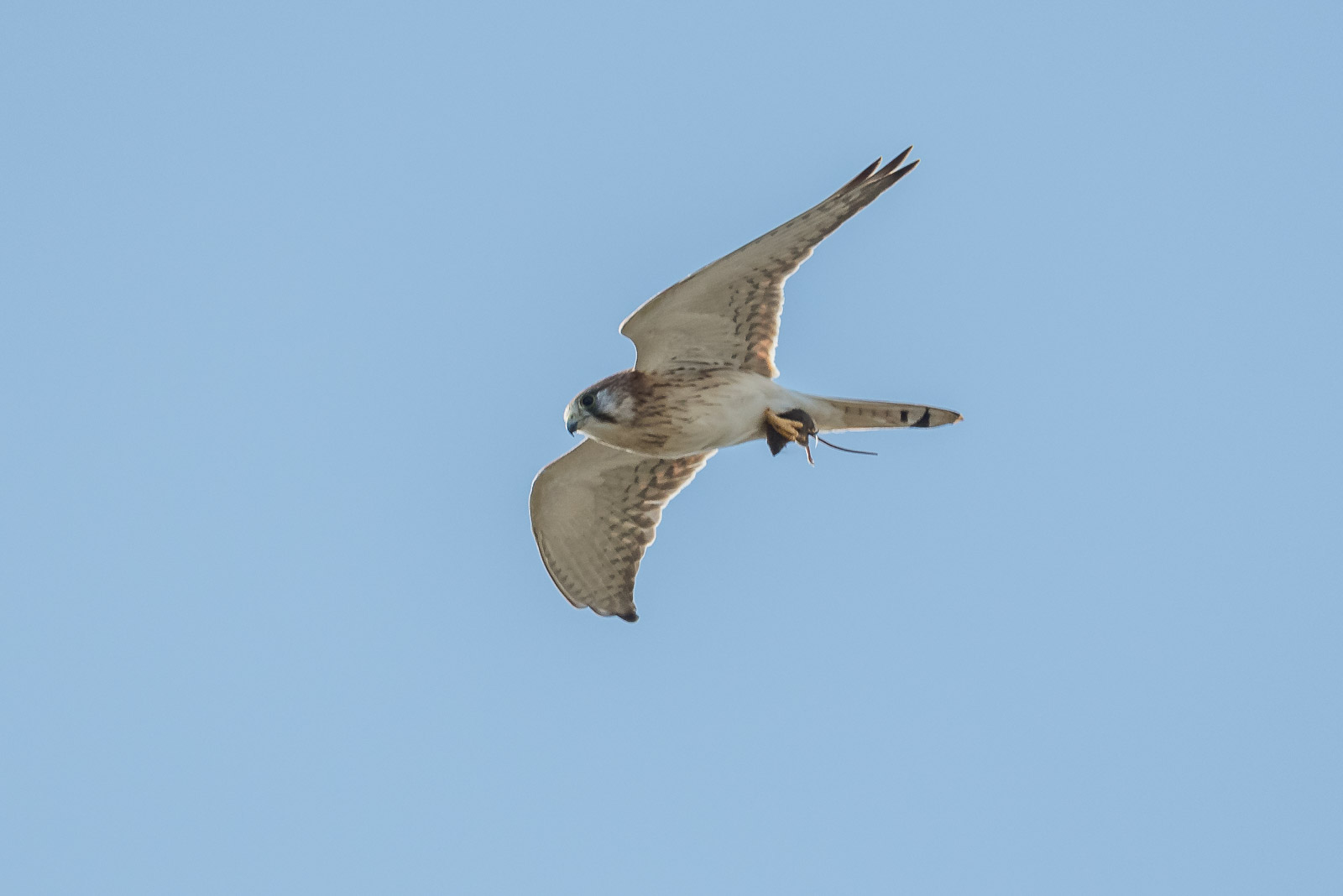
“On the left”, the cry goes up. Turning in my best Tai Chi move, I make a brush knee move to the left, and sure enough, as I swing up the camera, there is David’s friend, ” Georgia” the Kestrel, lining up for a hunt. So we spent the next few minutes in the area, and saw her making a number of catches, crickets or the like, I suspect.
She then lucked out with a mouse, then another, which she stashed near a rock, and as we were geting ready to move, she flashed by with a third one, to land on the buildings in the medical precinct. Not sure where she went with it after that.
We then moved further south, and found a male Kestrel hunting in the paddocks near the Uni. At one point he was about three metres above the median strip on the roadway, with cars ripping past on both sides. My heart was in my mouth. No luck, so he too moved on.
Found Arthur the Brown Falcon at work in the fields again. Every time he got airborne, the local Magpie squadron took him out, so he was contented to hunt mostly among the tall grasses and roadside.
And just as the light was going to be captured by thick dark clouds, a Little Eagle drifted overhead, and it too moved further over the freeway.
So.
Think local does have benefits.
Locked onLift off.What are you doing in MY paddock. Inquisitive Willie Wagtail just has to know.Male, levelling into positionLittle EagleLittle Eagle on a close passNankeen Kestrel, (M), hunting on a roadside verge. He is only a few metres from traffic both ways.Arthur the Brown Flacon. He had been sitting on the fenceline for about 10minutes. Then just dropped the couple of metres.Hard to know what he caught, but after a few minutes contemplation, he moved on.Georgia with a mouse. She will prepare it, then take it across the paddock and tuck it away under some stubble for later on.Her lunch is tucked away for later.
Georgia with a second mouse. She will fly to the buildings on the far side of the road.Georgia with the second mouse. I’m unsure what she was going to do with this one, but she disappeared behind the buldings. And we headed for home.
























 Birds as Poetry —— Just because I WANDER doesn't mean I'm LOST