His strident one note call resounded across the paddock, to be answered by her equally raucuous cackle. Alistair was bringing in an offering snack for Cassia, of Cinnamon. They met in a treeline about 800m from where I was and I missed the noisy food exchange, but did see Alistair fly out and land in the open on an old tree.
After a suitable meal time, Cassia, swung out to land in the same tree. Interesting.
As she prepares for her nesting period, he needs to make sure she is quite well topped up to last the nearly 8 weeks of confinement when she won’t hunt for herself and relies on his constant attention.
It’s a little early for any eggs to be laid, based on previous seasons, I’d expect that to happen toward the end of September, (but who knows with Falcons).
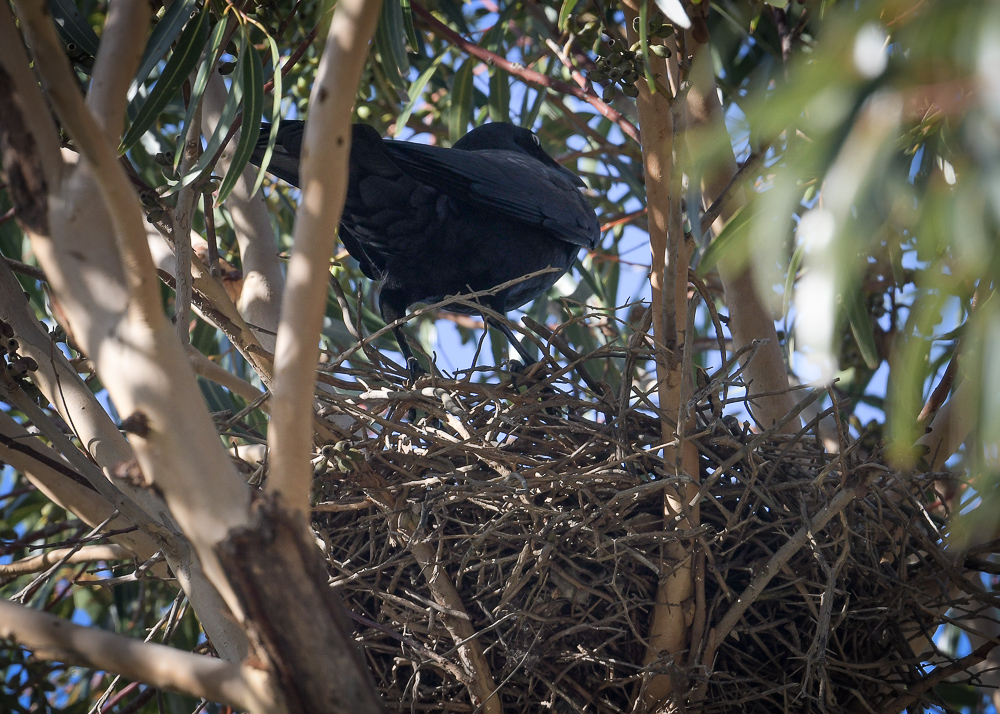
Browns don’t build nests, they are quite the environmenally aware creatures and chose to repurpose a Magpies nest from a previous season. Maggies, don’t tend to use the same nest, preferring to purpose build. So it’s not as though the Falcons have to eject any unwanted sqautters.
With other things to do in the morning, mostly because of a strong offshore breeze bringing some Gannets in close enough for a reasonable photo, we didn’t pursue the happy couple.
On the way back from the beach, we detoured through the pine-tree-line, in case they were sitting. Foolishly I rounded a tree and without looking stumbled on to Cassia perched down low. She bolted. I castigated myself for being so clumsy.
She quickly regained composure and sat in a tree about 50m away. And watched. And I watched.
Alistair came in quickly on the wind, turned and landed on the branch just above her, and watched. She watched. I watched.
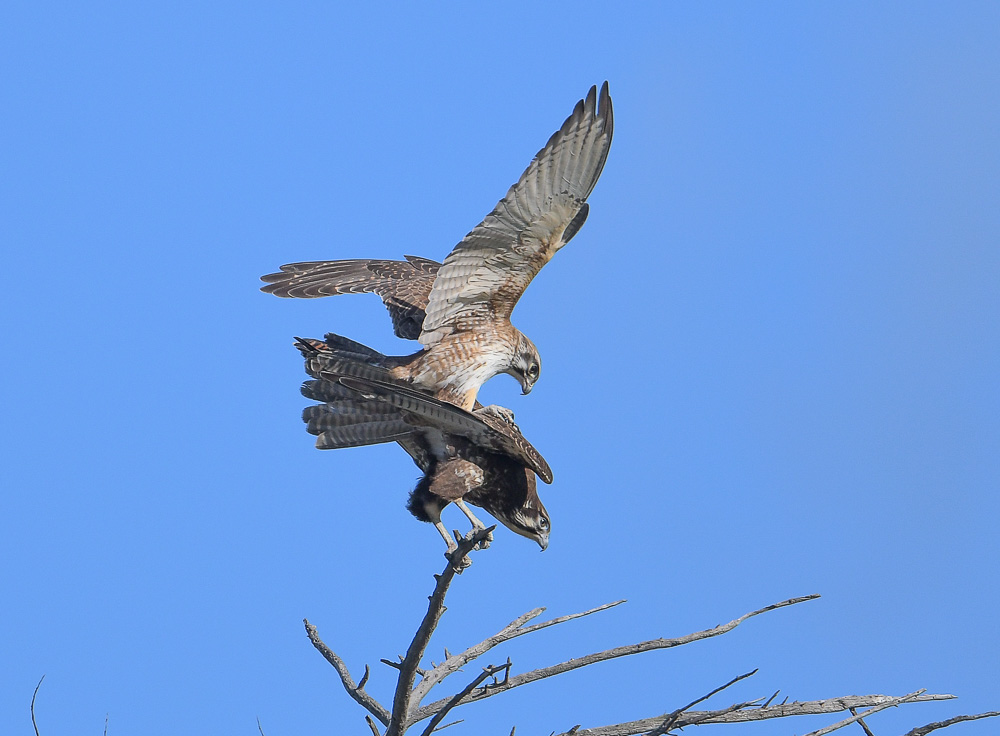
A quick wing flap and Cassia landed near him, but on the highest open branch. And watched. Then after a typical Falcon TIme Wait, she crouched over, and called him, encouraging him to mate. Alistair, it has to be said, did not need much time to consider the offer. Turning into the wind, he lightly took off, ever so gently landed on top of her bent over back, and the process of pro-creation began.
He then lifted wings and again ever so gently lifted off and away.
She relocated to another tree deeper in the pine tree line and we left them to carry on.
Enjoy
A long way down range. Great to see them together.
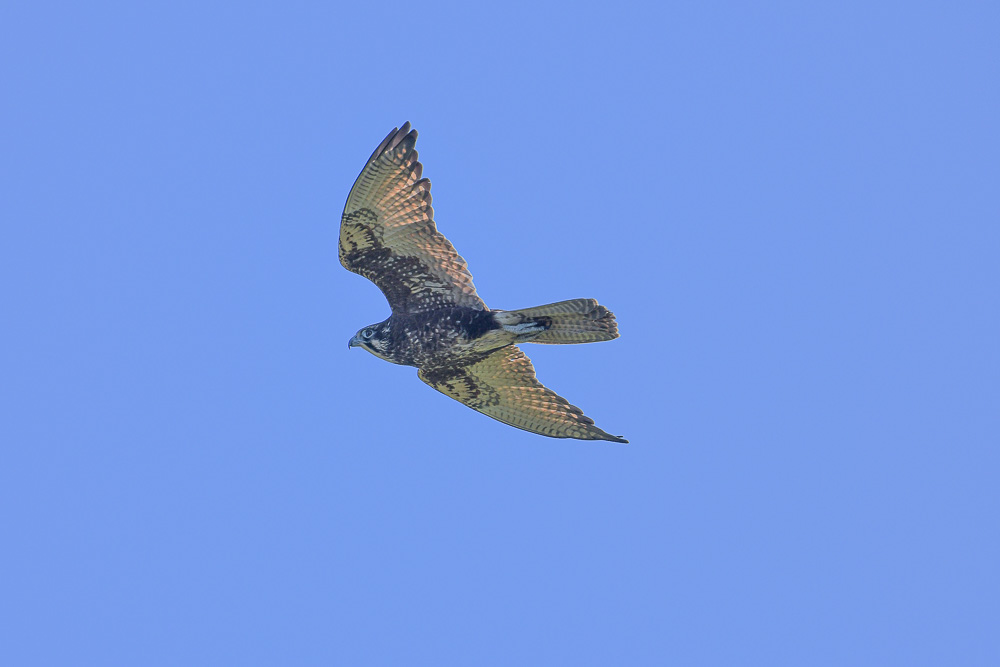
The strong northerly wind gave him a chance to show of his flying skills.
My fault. Apologies. Please forgive. I stumbled on her perched and startled her. She quickly recovered and landed about 50m away to wait for him.
Alistair landed on her back, ever so delicately I don’t think I saw her move under the weight
Sometimes mating is a raucous event, but this time both birds were silent.
She needs to be able to push her tail up out of the way for them to be able to make contact.
In less than 4 seconds and its job done.
Wings out in the strong breeze, he lifts of as delicately as he arrived
And a few seconds later Cassia also launches
The jury is out as to where the nest might be, but the smart money is on it being in this general location.
The four D’s had set out at Truganina Park on a lovely sunny day—which would rapidly turn into a cold, windy and squally morning—but who would know!
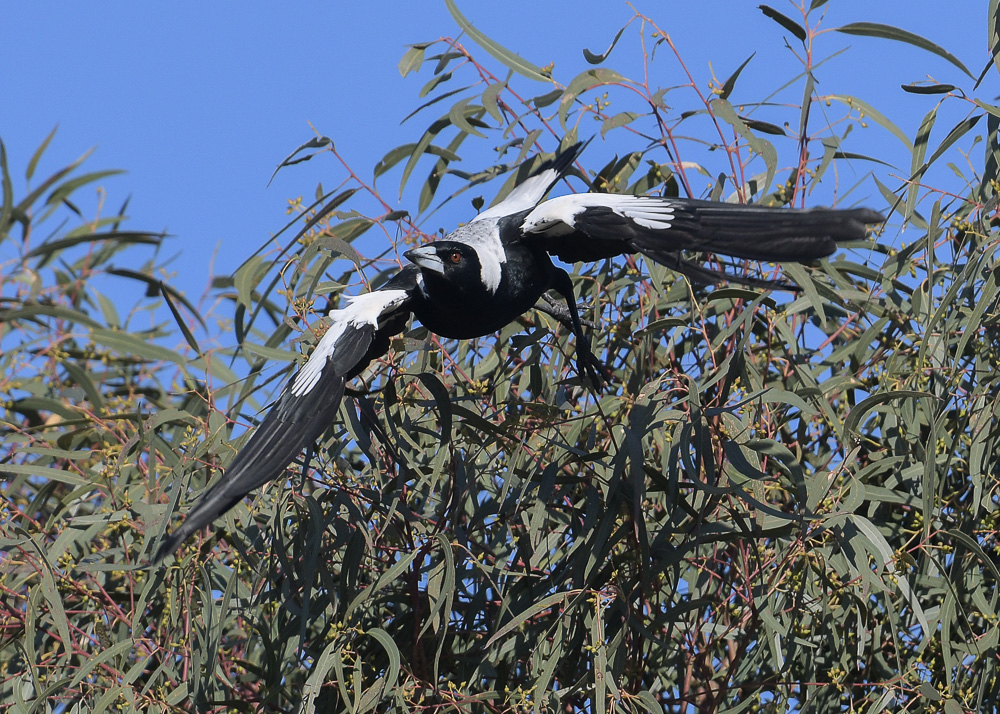
No sooner had we entered the park than a black and white streak sped past and landed in a tree just above the picnic shelter.
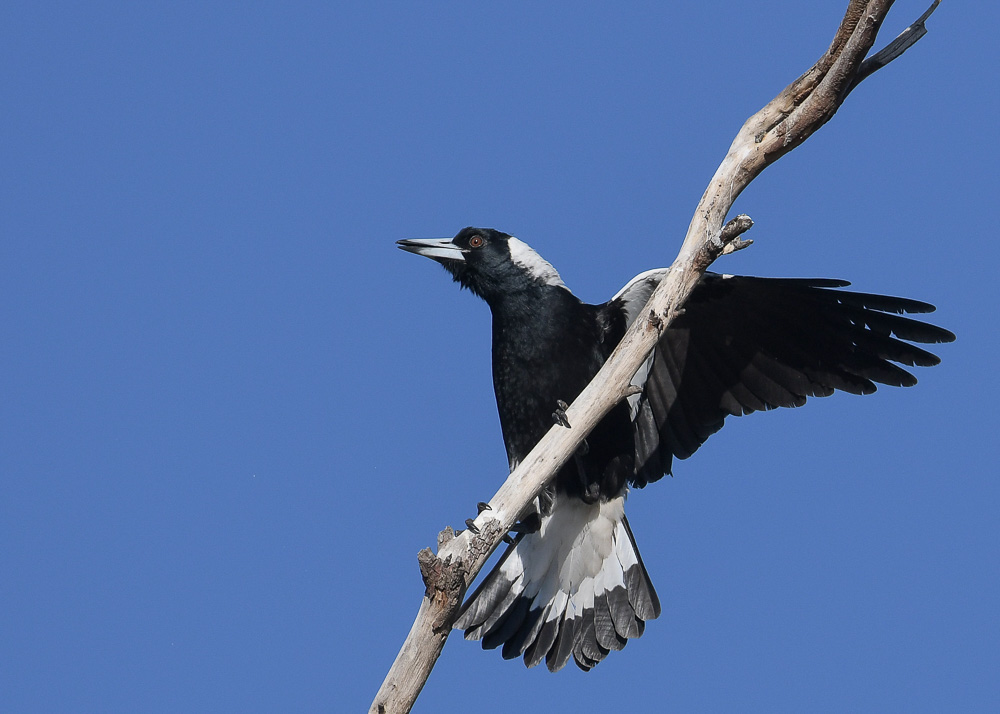
At least two loud exclamations from the D’s “There’s a New Nest Going in Up There”. And we all looked. Sure enough a lot of twitching and shaking in the leaves, and the resident Austalian Magpie was hard at work.
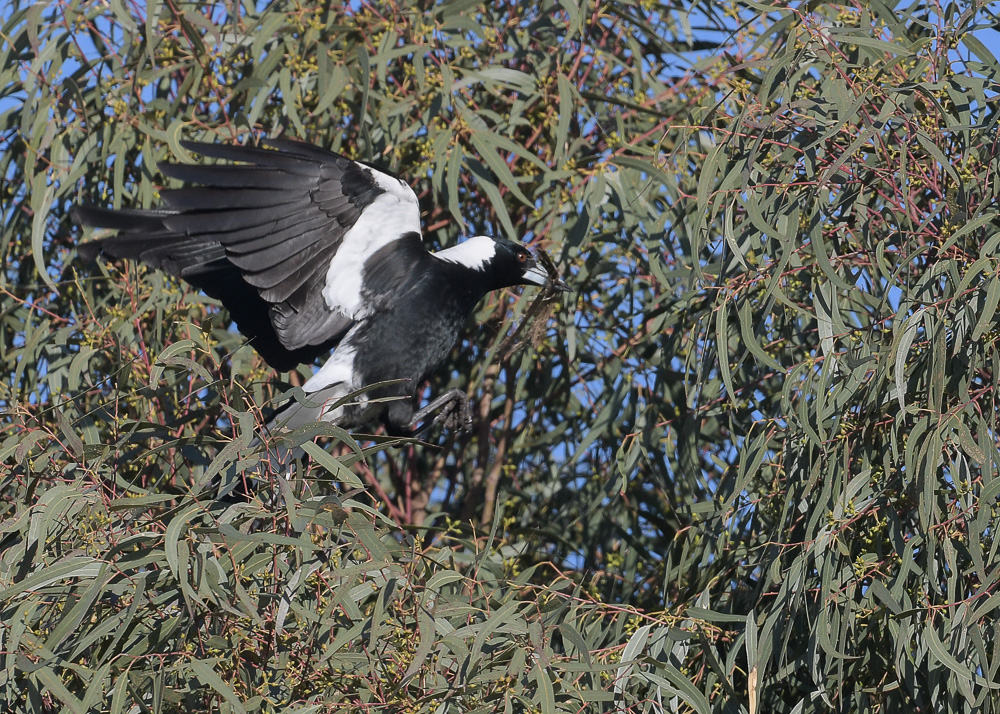
In the space of about 15 minutes she made 5 more trips into the tree. She was loaded with sticks and grasses and by midmorning must have been well pleased with her work.
There is a cleverness to the location, as we found out later as we sat in the shelter enjoying a cuppa of the Earl’s finest—wise move given the weather. For her high position she has great views and it gives ready access to any handouts that might be forthcoming from humans and their messy eating habits when outdoors.
Very quickly both the female, and then gliding in from a long way out, the male, arrived to see what we had to offer. These are no first time birds and have been in the area for at least 10 years or so, perhaps even more. They know all the best spots to get that handout, and she won’t have to fly far for something for her growing young.
As it happened
A flurry of feathers and she is out for another load of material.Airborne, simply gliding away from the nest siteMore twigs to build a strong nestNo time to rest and enjoy the view. Work to be doneLaying in the fine soft furnishingsPrecision Flying to deliver in exactly the right spotEndless rounds for a most important activity ahead. We wondered if she was installing wifi, nbn and wall tv.
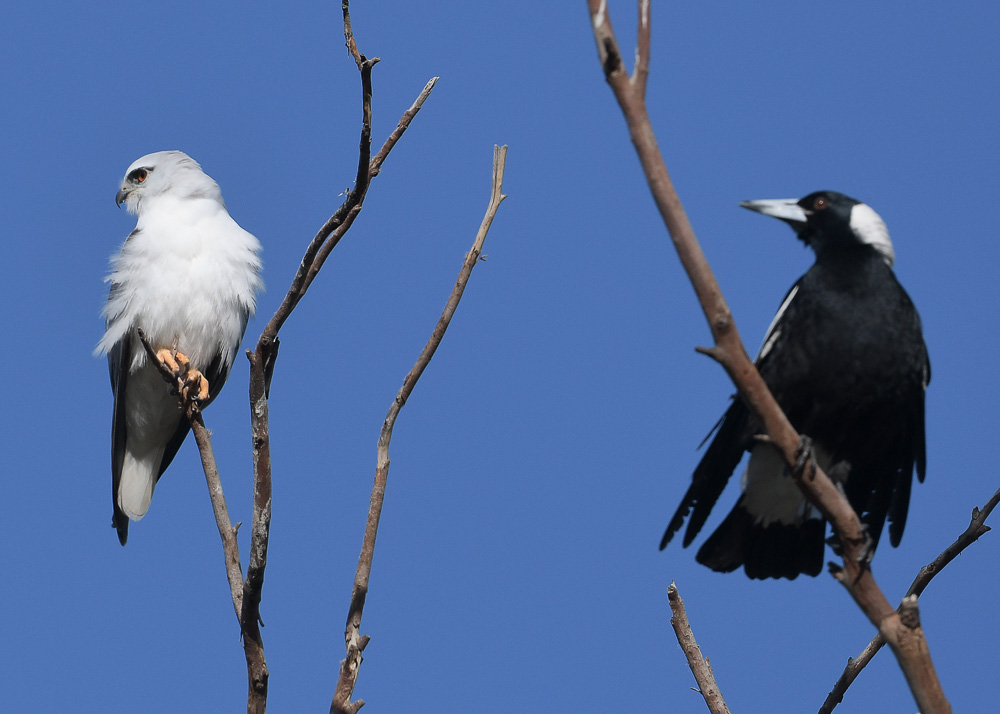
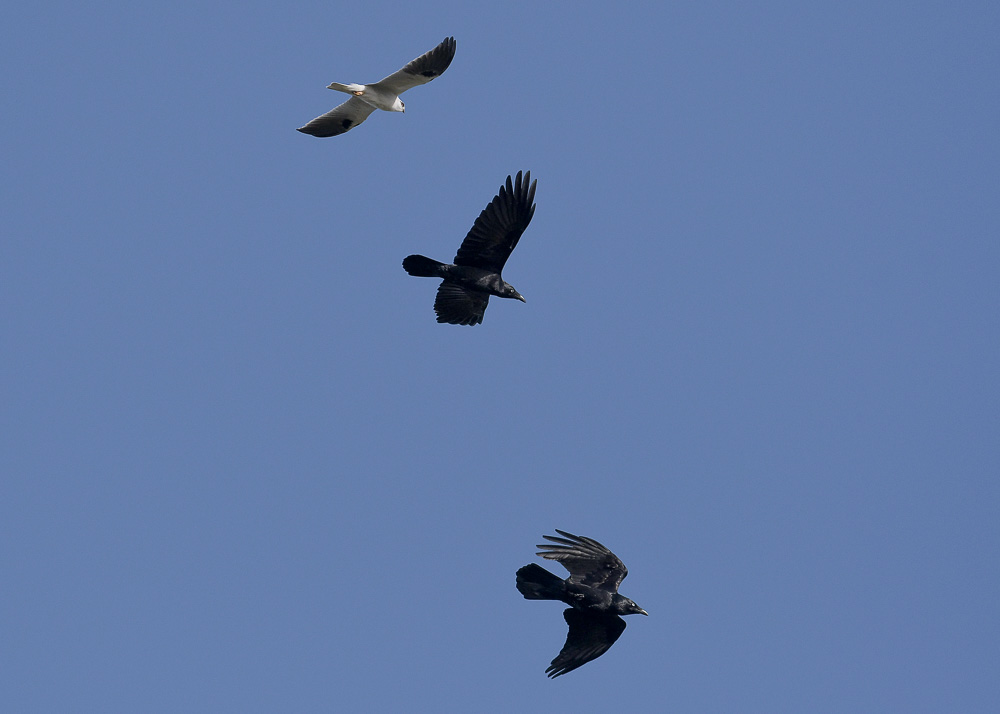
We had on a chance stopped by to see if infact Madeline the Black-shouldered Kite had any prospects of a full nest. Whatever is going on is worth defending as she cleared out a murder of Ravens, a lone Black-faced Cuckooshrike, the two Falcons, Cassia, of Cinnamon and Alistair, and confronted the home team neighborhood watch Magpies.
The Ravens have a nest about 3 trees down from her nest, and it’s going to be an ongoing battle. In the end, she pursed the Falcons to about a radius of 600-700 metres. It was a very busy morning for a very aggressive and angry bird.
As it Happened.
The Raven was hoping it was going to be safe under the tree to work on the nest.
Maddie had other ideas, and it was time for it to move on.
The alpha female Magpie came, perhaps to negotiate, but that wasn’t going to happen
Look out. Here I come
Wisely the Maggie left the branch.
But returned and tried to look as intimidating as possible.
A more frontal attack was launched
In the end, they both landed and decided on their next tactic.
The victor, after 6 rounds. (at least). Maggie moved on. Madeline was already eyeing off the passing Falcons.
Been pondering of late about the future of Birdsaspoetry Blog. Maintaining a full library of images and keeping up with adding new posts, amid all the other things that happens in a life is certainly a challenge.
Had a quick ponder and think I’ll be publishing less of the ‘complete’ photo-journalist stories and concentrate on just one, perhaps two moments that we’ve been seeing. Fewer pictures per post, so that might be an advantage in this ‘immediacty’ age. 🙂
Have been working at making project albums on another site and am trying to figure a way to link directly to here, but. More on that another time.
Madeline and Mike at Point Cook have been working on a second clutch for the year. Progress seems to be slow and it’s hard to determine at what, if any, stage the clutch, if indeed she has layed, is progressing. The tree area is also favoured by the local Magpie clan, and a number of Little Raven pairs. (They are now busy carrying sticks and settling in). So, tree and air space are becoming a little crowed for Madeline and perhaps her progeny.
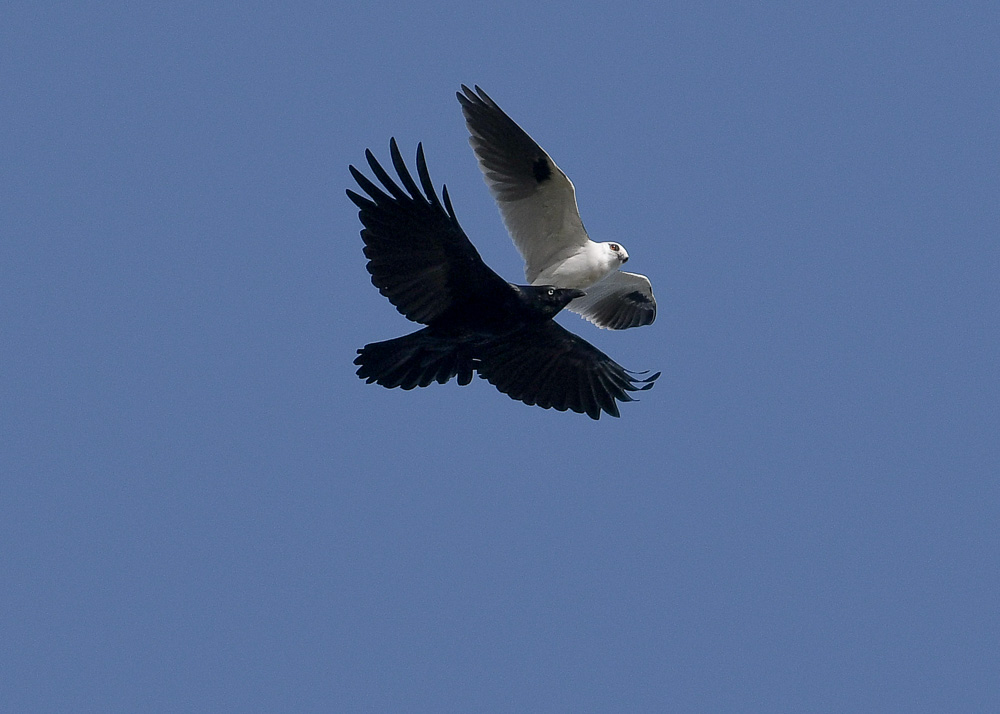
She is not having anyone put their nest in any proximity to her chosen site so a battle royal was in progress. The nifty little kite had two advantages, she can soar without using any energy—the ravens have to keep a constant wing -beat to stay up. And she has some speed advantage stooping from on high. The ravens have two advantages. Sheer numbers. There were about 12-15, and sheer cunning. While they allowed the kite to attack one or two, the others would group up for a sneak attack while she was distracted. After about 10 minutes, it all calmed down as the ravens needed to land and refresh.
Mike came sailing over the paddock with a fresh mouse, as if nothing unusual was going on.
Let Battle BeginThe little Kite did, early on, get harassedHer abilty to stoop from on high meant she could keep them moving along, herding them away from her nesting areaSpeed comes to the rescueBut she could also be ambushed by one of the many support groupWhen it was all over, Mike came in unconcerned and delivering a meal.
It’s possible on a day at the Western Treatment Plant to clock up over 100 kilometres of driving. The entire plant is over 10,000 hectares — a little smaller than Philip Island.
Some recent changes to the access areas means that those who formely had limited access may now, from the 31st of July 2023, enter what was previously the “Special Access” area and required a different key. Now, One Key, (as they say in Tolkien) rules them all.
I think it’s fair to say that these days there are three sorts of people who visit the plant.
1. The true birdo. Dedicated to seeing as many species as possible in the shortest time, and of course to find that elusive ‘visitor’ to add to the total. These folk have been the mainstay if not the major visitors for many years. Travelling every road and side road is part and parcel of the visit.
2. Now it seems that photographers are becoming the dominant “species”. Again, desiring to see and photograph as many birds in the day and be able to have them all posted to Instadump or Spacebook before anyone else. Speed of travel is their essential hallmark, and sometimes it seems to me, to resemble a Rally-cross event (I used to photograph such events a long time ago so understand the techniques)
3. The art photographer. Not yet a huge group, but growing I feel. They have a need to find a bird and provide the ‘best possible’ image of said bird that shows not only the best of the bird, but their ’empathy’ for the species. Also prepared to stand around and pontificate about the latest mirrrorless kit and lens that is a ‘game changer’. Clambering over grass, through salt-bush, crawling along the beach and the mudflats, is de rigueur for that expressive moment. Often I’ve noted of late, dressed in camo and ghillie-suits, looking more like an SAS Sniper. Willing to stop in the middle of a bund road to walk, crawl, or sneak to a spot to get that shot. Meanwhile the roadway is blocked to all other passersby. ( I know, I think I used to do this!- sans the ghillie)
A fourth visitor group, just to show I can count beyond three: is more the traveller about the plant, seeing birds and generally enjoying an outing. These days, I have to admit to fitting somewhere between 3 and 4.
We no longer do the ‘full tour’ We have a few ponds and areas that we’ll go to, sit for awhile, and then move on. Most days, it’s an early morning start, and by lunch time, it’s time to go on up the road to The Highway Lounge, and one of Gerry’s well made hot brews.
With the sun streaming in through the window at breakfast time, the other morning, it didn’t take long to abandon other projects for the day, and head on down to the WTP.
Here are a few from the day. Click on an image to move to a Gallery experience
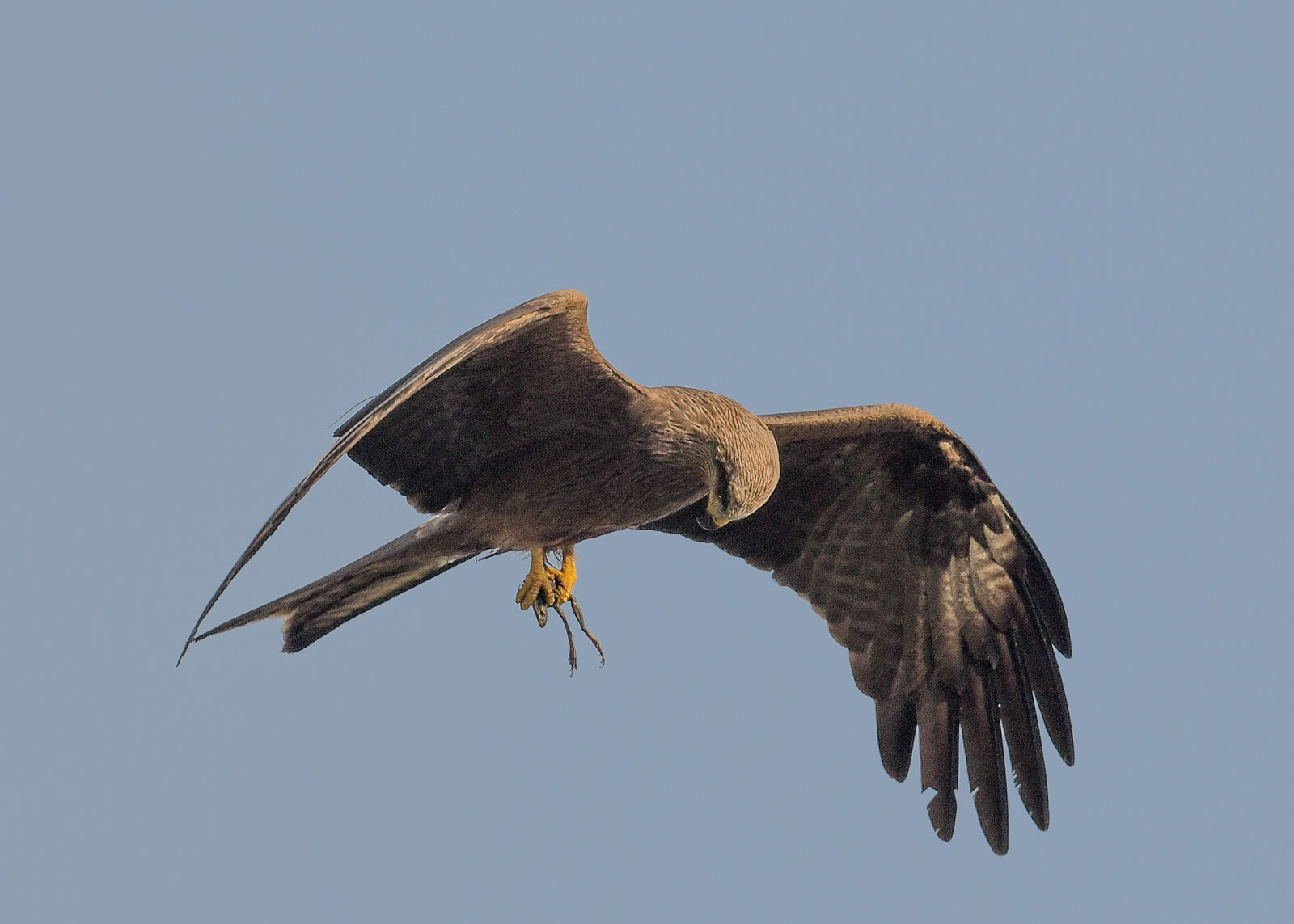
Black Kite,Black KiteFan-tailed Cuckoo. We seem to have quite a number of these birds wintering over. This one seemed happy to sit in he sunshine and callBrown Falcon: Another bird fluffed up soaking up the sunshineThis little Hoary-headed Grebe seemed as happy out of the water as in.
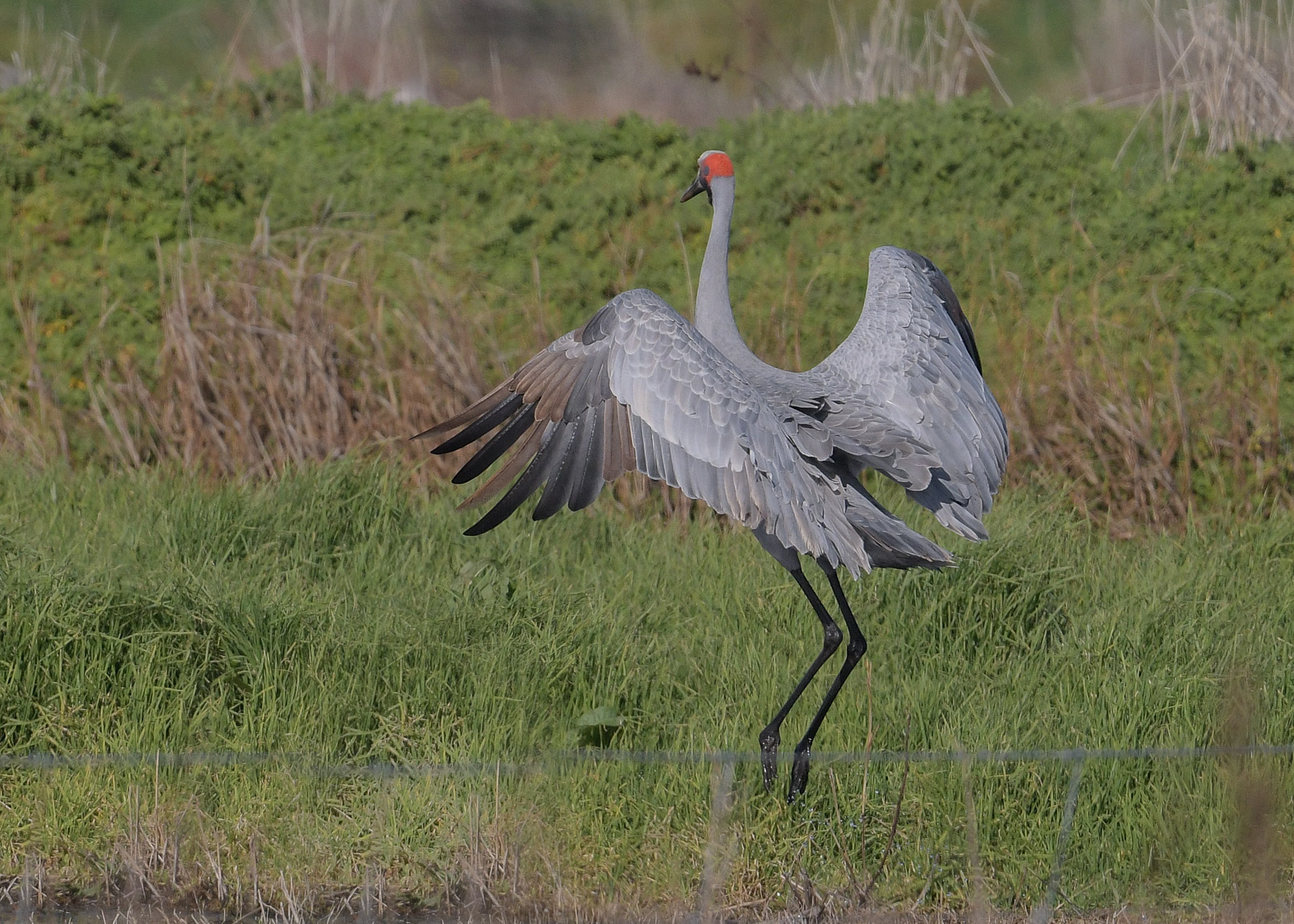
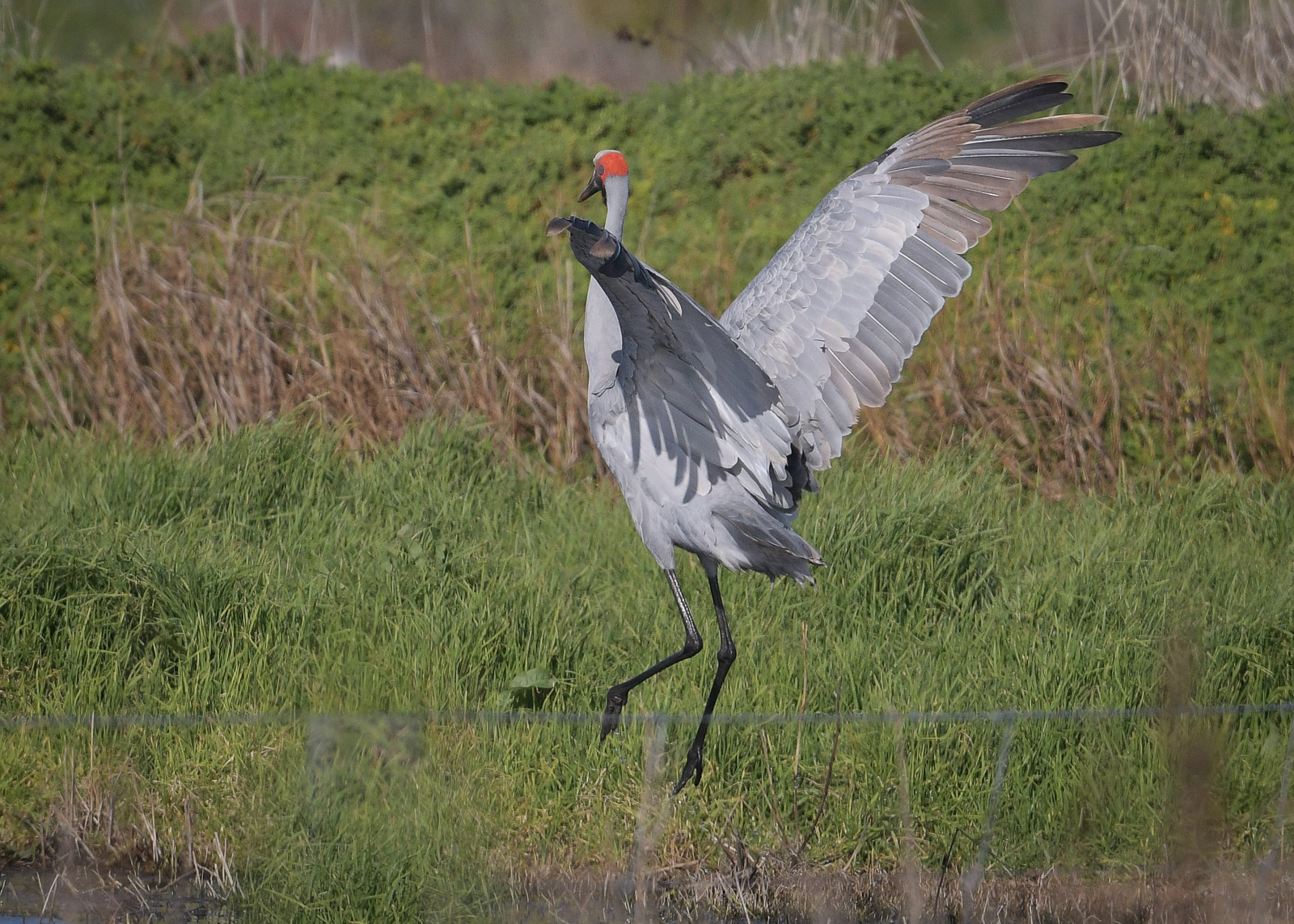
Most unusual to see one walking aboutClean, clean clean. A Musk Duck busy with ablutionsCome Dance with me. A Brolga that also seemed delighted with the warmth of the sunshineCome dance with meBlack Kite Games birds play. This was one of several that were swooping down, picking up grass and twigs and just doing it for funPart of a four Brolga squadron, adjusting for landing.
Sedge is the collective noun it seemsCome dance with me. This one was picking up twigs from a bush and performing its balletWe stopped on the roadway as we left to watch a Kestrel at work. It landed on the road in front of me, and I had to move back to get the focus
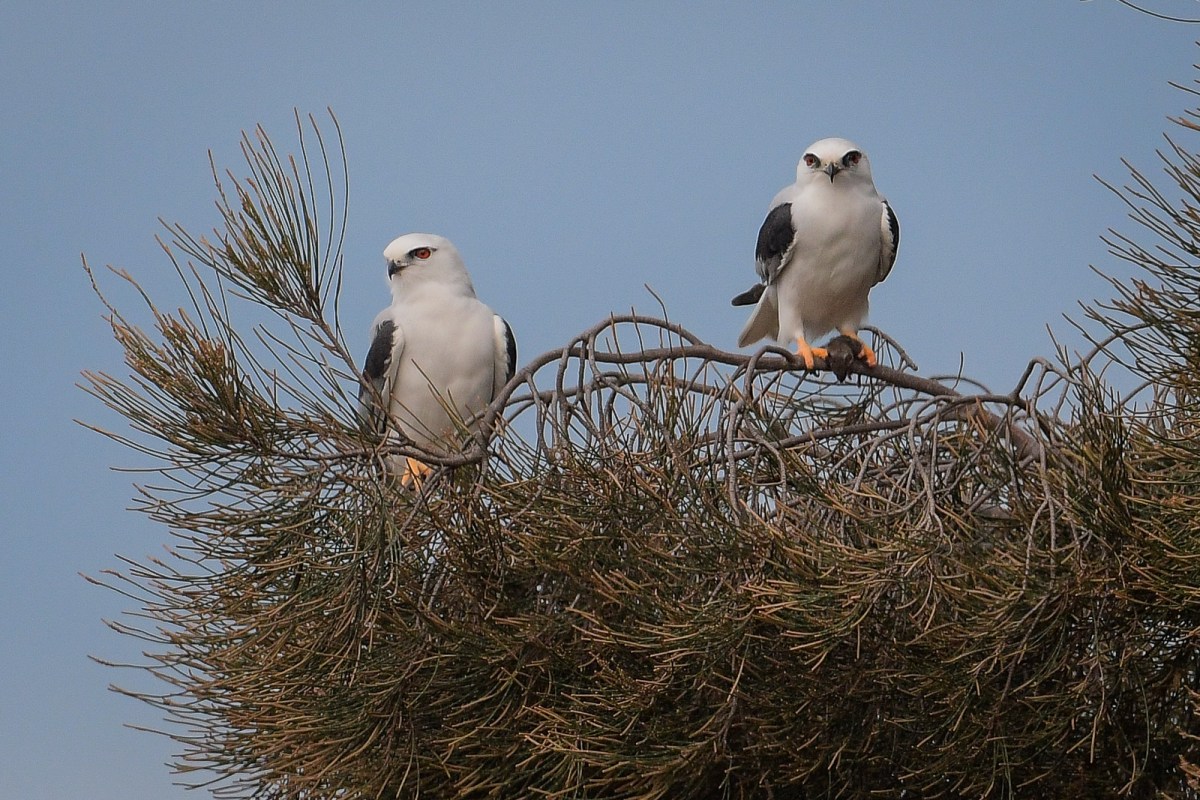
Regular followers will know that not too far from home, in a quiet roadside reserve, we have over the years been following the nesting activities of a pair of Black-shouldered Kites, named, Belle and Bronson.
If the boy scout arithmetic is close to correct, (and a lot of covid-lockdown not withstanding), it’s likely the that pair over about 4 years had as many as 10 successful clutches and two that were abandoned for various reasons.
Each clutch on average was 3 young birds, with two being just 2 young. All seemed to survive to leaving home, so its possible between them they flew at least 28 young birds to add to the population.
There is some anecdotal evidence that Belle had a least two Bronsons. Which would make her quite an old bird in Black-shoulded Kite years.
In September 2022, they again flew in sticks and mated and she settled in to the job of her 11th clutch. But. The weather turned dreadful not long after she had layed the eggs, and we had over a week of incessant rain and extreme high winds. We had watched the branch carrying its precious cargo being tossed about like a leaf.
After about a week, Belle disappeared. The nesting was over. We’ve seen her do this before and usually after bulking up for 2-3 weeks, she’d return. Time, as they say went by, and no sign of return.
Bronson was still home-schooling his previous two young. They were pretty much full grown and self-sufficient, but they stayed around the home tree, and he sat with them for a couple more weeks, eventually they too left and the paddock and small treeline was bare of Kites.
All through October and November, we kept checking, but in the end it was obvious. This party was over.
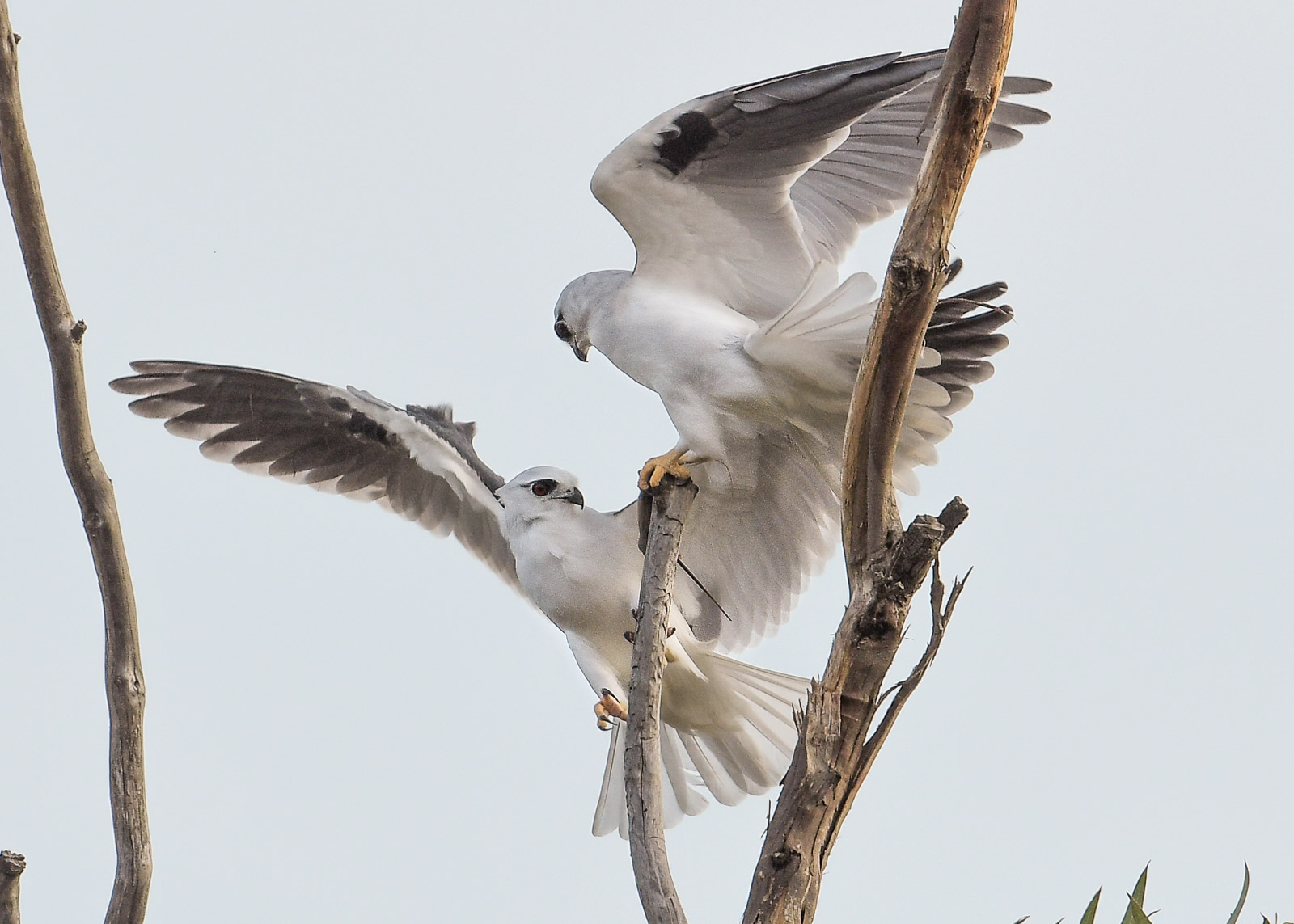
We did make occassional visits, but all through till March there was no further activity. I had been following a second pair of Kites about a kilometre down the road, so a drop in wasn’t too hard. In early April, we heard familiar sounds of a Kite short squeaking call. All excited, perhaps the pair were back. However we only found one and it certainly wasn’t from the missing pair. A few days later a second one was visible. This one certainly was a much younger bird and we wondered if they were a pair. Hard to tell, initially. They certainly didn’t behave like the originals and they had some unusual habits. Including not using any of the more familiar perches and spending time at the far end of the little plantation. Also it soon became clear that they did not engage in aerial transfer of food. And to be honest, watching them try to transfer on a branch showed how clumsy either, one, or both of them were. Eventually they settled on using the large street lights over the freeway as a level table to pass the mouse across. Strange.
The upside was the work, began, a site was settled on, and settled into. Stick carrying, and mating were the order of the day. Inspite of their clumsy food transfering, the mating seemed to go quite well, thank you.
I’ve delayed writing about it, and showing some pictures as it’s been very much an on-again off-again process. We think of them as ‘new age’ birds that have a new set of rules. 🙂
Meet the new CoupleDiscussions about nesting materialsPlenty of building material going inShe seemed unsure how to take the mouseEventually persistance paid offAnother complex food transferSettling into the nesting areaYet another complicated food transfer. But it is getting smoother.The alternate food transfer location.From a roadway that is near the nest site, its just possible to make out the nest. Here Belle is beginning to beak feed her hatched young.
We had chosen to go to Point Cook to see if we might get some close in Gannet hunting pics.
Well they were there, but so, so far out. Perhaps 40-50 of them, and a great splash was in progress. Lovely to watch, but no photos of distinction.
However, the day was not lost, as we managed to have visits from no less than 7 different raptor species. Didn’t manage a worthwhile shot of the Collared Sparrowhawk or a departing Swamp Harraier, but we were entertained over a cup of the Grey of Earl, by 5 Whistling Kites that seemed to want to play through the tall pines at the water’s edge.
Mike the Black-shouldered Kite is still busy as Madeline is sitting on a new clutch.Interesting to find a pair of Little Eagles. They kept high in the air to prevent the local Magpie neighbourhood watch from harassing them Cassia, of Cinnamon, and Alistair made a brief appearance, and were happy to sit together and exchange calls. While not a resident, this Hobby is making occassional shows through the parkFive Whistling Kites were out for a morning’s fun. They kept us entertained as they chased each other through the treesWe haven’t seen good number of the kites for a couple of seasons. The wonderful rich wing markings that kind of resemble a studded jacket were a treat. Such big birds, yet so highly manoeuvreable through the trees.And as we headed for home we found two Kestrels at hunt
Just shows that sometimes a day is unpredictable. Enjoy
We started out heading to monitor several Black-shouldered Kites nestings, but as the early morning sunhine beckoned when we made it to the freeway we decided a coffee at Gerry’s at the Highway Lounge and then on the WTP for a looksee for robins.
Coffee despatched, we didn’t have any success with the Robins however.
For those that have visited the WTP we headed on up toward Ryan’s Swamp.
A good move it turned out to be as there were a number of raptors working along the roadway.
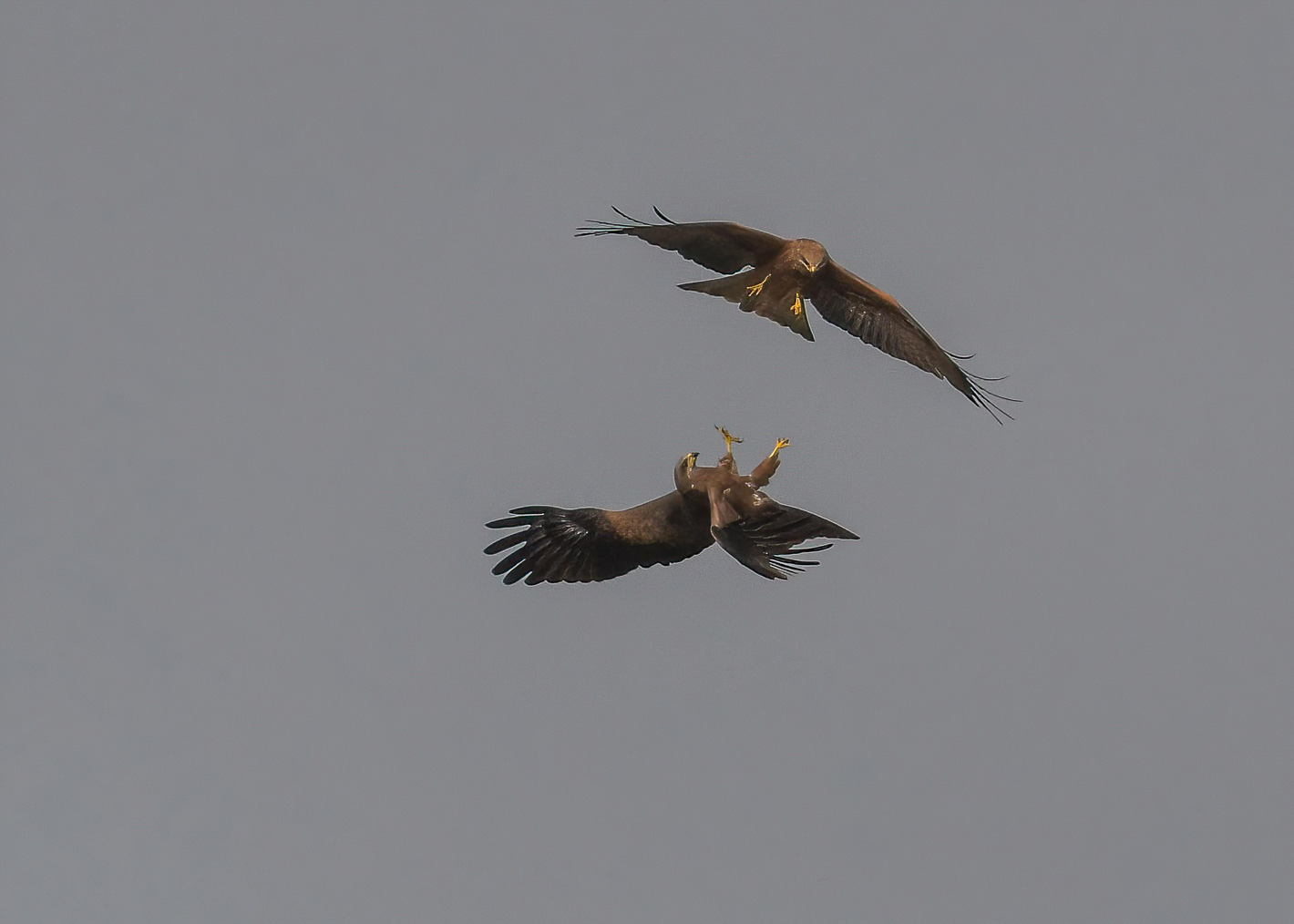
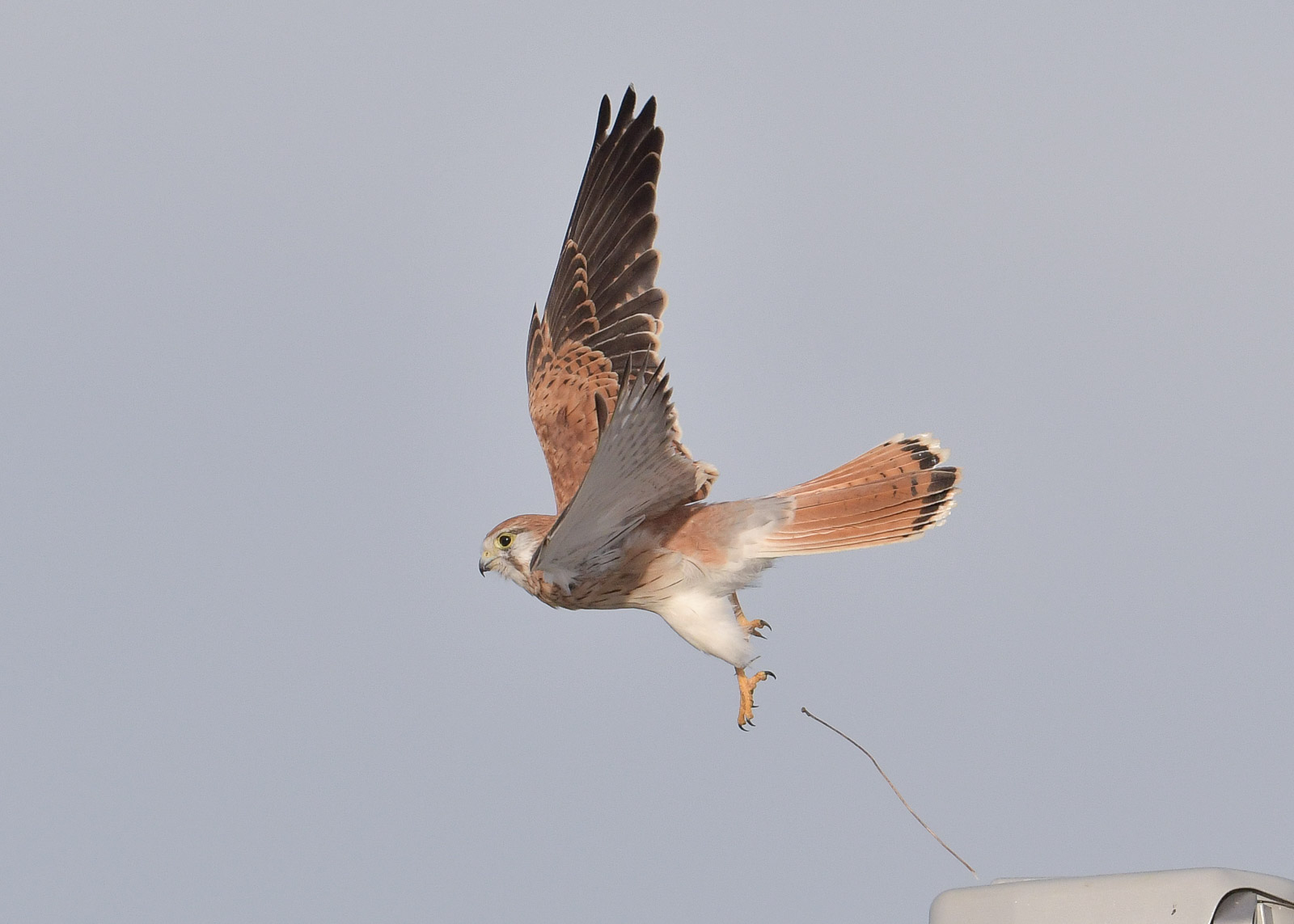
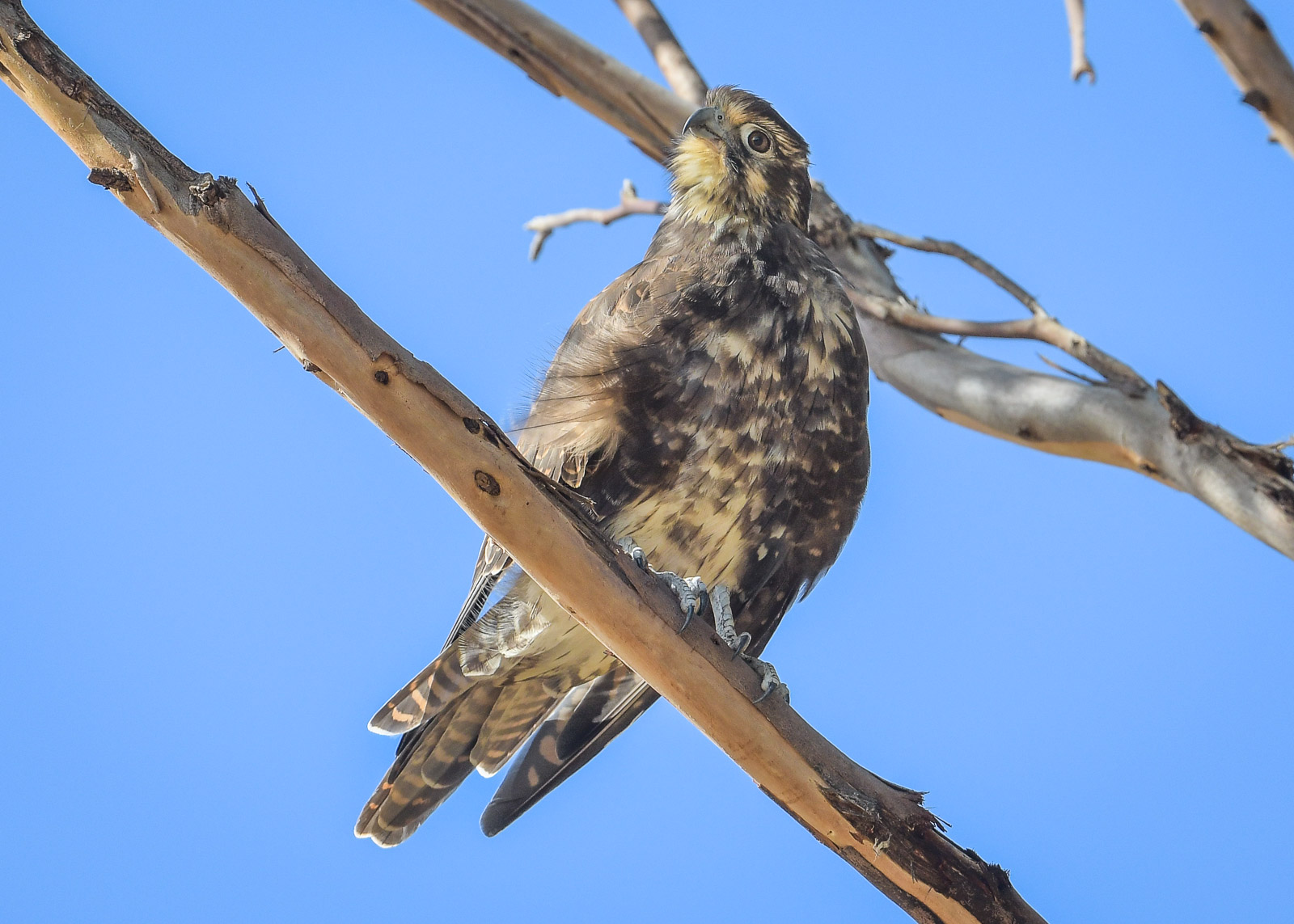
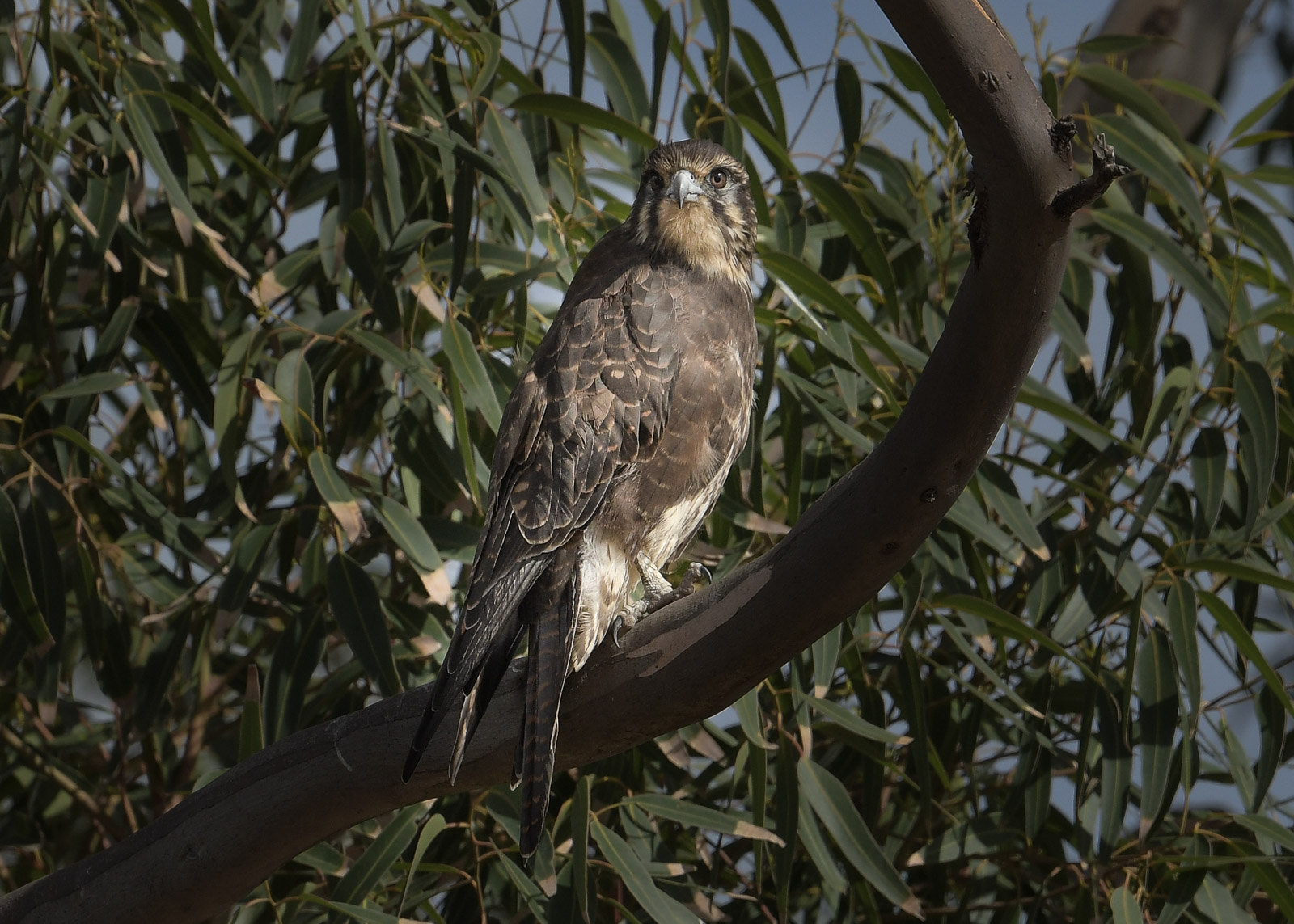
Our first sighting for the day, a Black Kite among the old treesA female Nankeen Kestrel was ‘hawking’ up the remains of breakfast. A little furball lump of undigestible rubbish. We spotted this Brown Falcon ‘walking’ along the road, no doubt it had scored a meal, as it flew to the tree and the next 45 minutes or so we stood with it, as it slowly digested the meal. There is something special about being able to observe this bird, unstressed, and watch its various character traits.Handsome in the early morning light with dark storm clouds building behindA number of Black Kites were also in the same area. It looks like full on dogfight, but these big birds seem to love to play about togetherAnother Black from the same area, and it appears to have nesting in mind.Meanwhile the others continued the gamesYet another Falcon swept in to see what was going on.It didn’t take us too long to find a pair of Black-shouldered Kites at work on nesting. Unlike most Black-shouldered these were nesting in the top of a dead tree in the open.
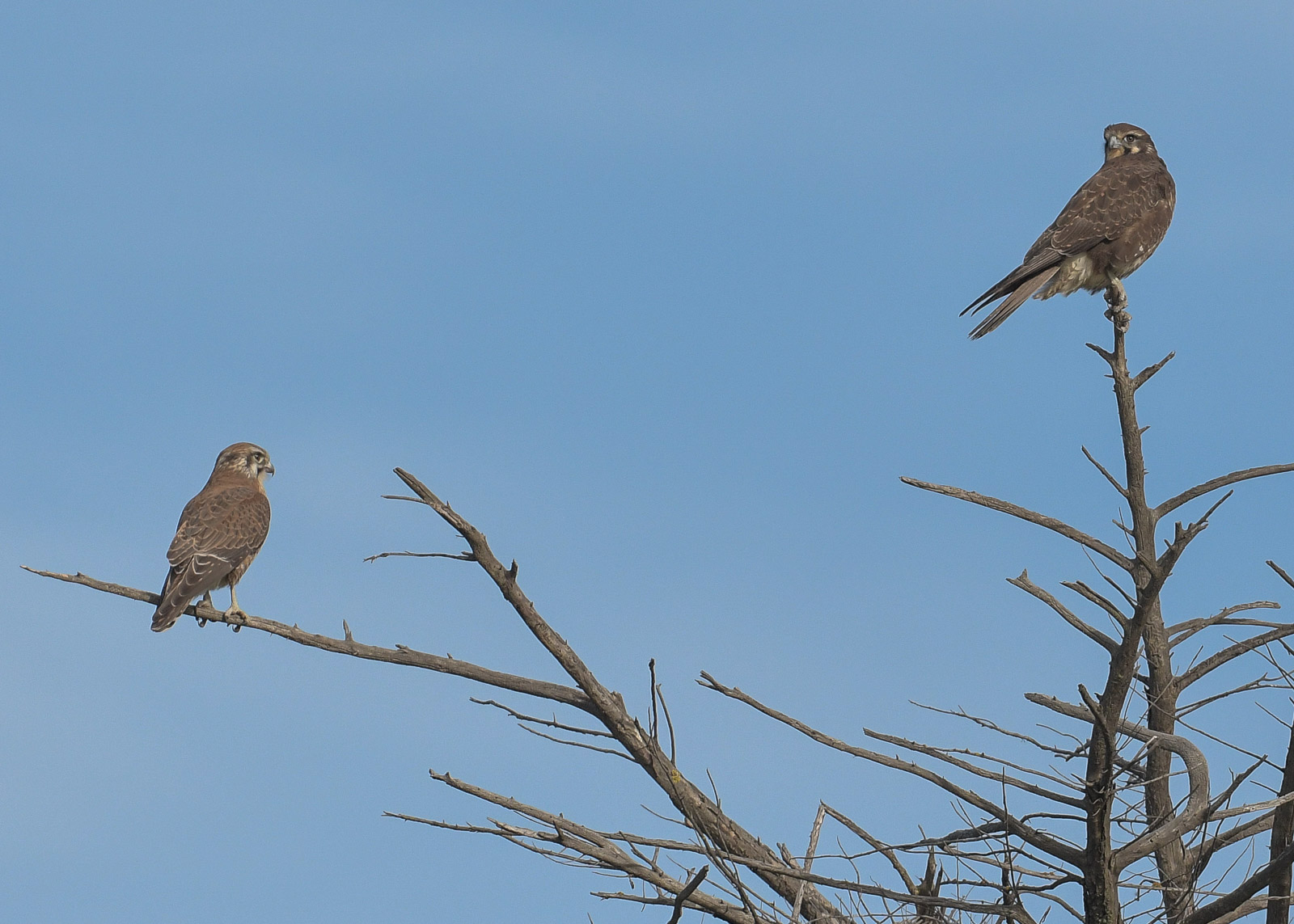
Here the male has just arrived to relieve the female for awhile.Nesting hasn’t blunted her hunting skillsDon’t mess with Mamma. She is unhappy about the Black Kite attention on the treelineMore Kestrel hunting. I missed the catch of this one. A pair of Brown Falcons, they are not ready to mate, but are doing their best to keep the pair-bond alive and bright.
He has just swept in from a few aerial stunts to impress her.
She is crouched ready to accept his advances.
We again spent 15 minutes or more watching their various antics, and after a lot of calls and cackles, they both flew to different perch area to repeat the performanceHey, I think you look pretty special.
Well I can’t speak Brown Falconese, so who knows what he said.
We have been following a pair of Black-shouldered Kites since early January.
It’s been an on and off again project, both for the Kites and for us. Because of the distance, its just that little too far to be regularly checking on them, and in the beginning, they were somewhat half-hearted about making a start.
But by late Feb, it was pretty clear she had taken a nest in a pinetree next to a public carpark. The Point Cook Coastal Park is now surrounded on the landside by housing estates and is a popular walking, bicyling, picnicing location, so the carpark is always extremely busy.
Early morning light, or late afternoon is best suited for the location, and it was not unusual to see a photographer or two standing on the grass against the fence line waiting for the young to show themselves.
I thought it wise to wait until the cycle was nearly over and I had a reasonable show of the activities, rather than just publishing a few isolated moments of the action.
So in the growing tradition of the blog, here are the pics to tell the story.
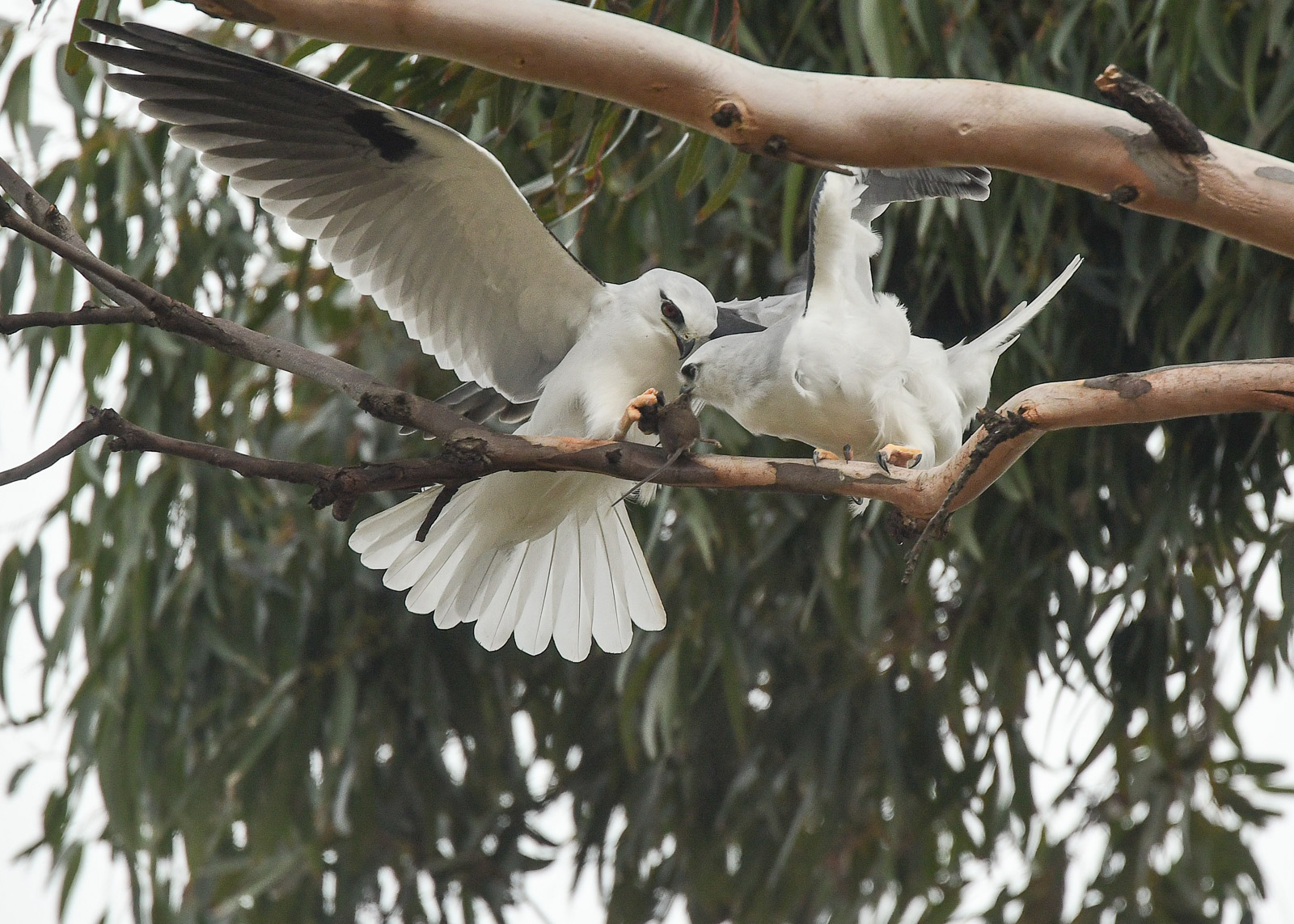
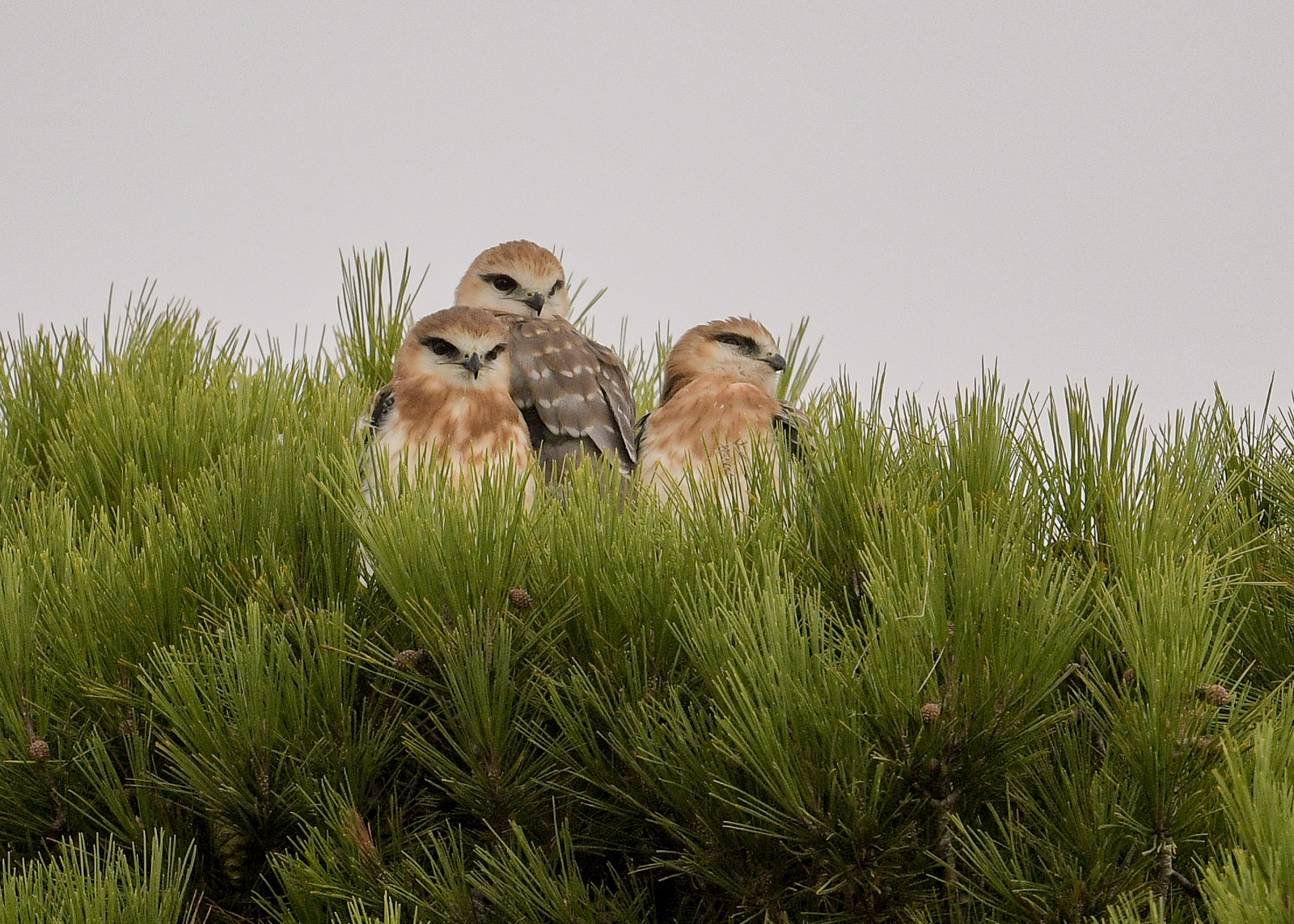
After a month of sitting on her eggs and another 3-4 weeks of feeding the young, Mum was finally ready to put them on display. At first we thought there might only be two, but eventually a third little head made itself visible. Perhaps one of the eggs was late hatching as it seemed one was always behind the other two in gaining the skillsOnce they were out and about, Mum went off for a rest and Dad took to raising and feeding them. They were very vocal in expressing their needs Not sure which day they flew, but one morning we arrived to find them out and about. Those first few days are a bit awkward in the air.Landing is always a traumatic event for the first few daysRule #5 In the Black-shouldered Kite Manual. Don’t harass Dad to go and catch a mouseTime to meet the friendly neighbourhood watchOne of the last skills to learn is aerial transfer of food. They always seem to be willing to participate in this activity. The one thing I’ve noted is that he already knows whose turn it is to take the mouse and will avoid the attacks of the others to be sure the right one gets the offering.
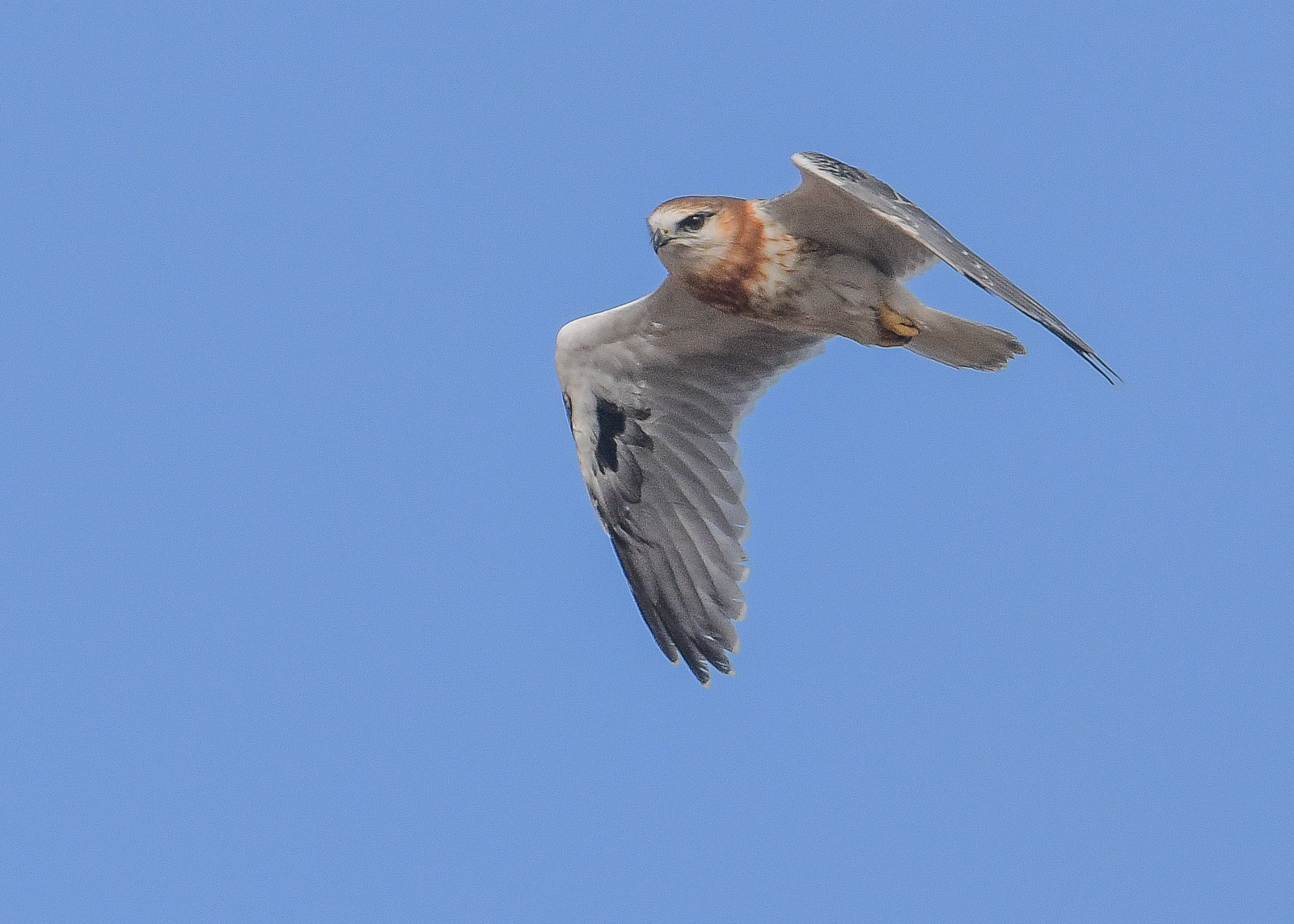
And like all good Black-shouldered Kite stories, the last we see of the young is them sweeping out over the field, hovering and then diving down to secure their own feed.
We are left to wonder is the pair going to have another clutch soon
It’s been awhile since I posted, and I’ve been hesitant to upload this long set of picture. It’s not that I can’t edit them down to say just a few, but each carries a different aspect of the story.
So it’s publish, or perish.
+D4, our Ballarat-based granddie invited us up for a weekend, promising all sorts of picture opportunities. And it has to be said—delivering.
Toward the end of the day, he took us to a new housing estate area to look at a pair of nesting Black-shouldered Kites, and as we needed to be back in time for a meal were making our way through the partially built houses, when EE exclaimed, “Kestrel”. And there she was sitting on a street lamp, hunting for small insects, spiders and crickets among the grasses between the houses.
The late evening light broke through the clouds and the bird, which had been working the area while the tradies had been busy all day, was not fussed by a couple of photographers getting in the way.
Time just rolled away, as did the images on to the memory cards. I lost count of the strikes, but each one was short glide from security fence, street light, or dumper bin, into the grass.
There are a lot of shots here, and I partly apologise, but if I cut it down to just the stars of the show, then the magic of the moment would be lost.
A series of take-off
1 of 4A series of take-off
2 of 4A series of take-off
3 of 4A series of take-off
4 of 4My fav take-off sequence. Amazing to see that her head remained fixed on the landing spot.
1 of 5My fav take-off sequence. Amazing to see that her head remained fixed on the landing spot.
2 of 5My fav take-off sequence. Amazing to see that her head remained fixed on the landing spot.
3 of 5My fav take-off sequence. Amazing to see that her head remained fixed on the landing spot.
4 of 5My fav take-off sequence. Amazing to see that her head remained fixed on the landing spot.
5 of 5She was happy to pounce quite close to where I was standing I had to move back to get minimum focus distance.
After the last couple of ranty posts, I thought I fine day at the plant might be a good idea. 🙂
The Western Treatment Plant is about the size of Phillip Island and to travel all the tracks and explore all the possible bird sites can easily consume an entire day, and a goodly chunk out of the fuel budget for the week. 🙂
We tend to be a bit selective about the areas we travel through. Preferring to stop at one location for a time and see what is moving about. It also depends a lot upon the weather. Being a flat farmland, there is little shelter from high winds or the heat of midday.
So we tend to go either late in the afternoon when conditions are good, or early in the morning. Morning can be hard at first as the long drive in from the main road is directly into the rising sun. But once in the bird area it becomes easier.
We had decided to go on the morning as the weather looked promising, and if the wind picked up as predicted then back to the Highway Lounge and a Gerry Coffee.
Here then is a look at how the morning, and the birds progressed.
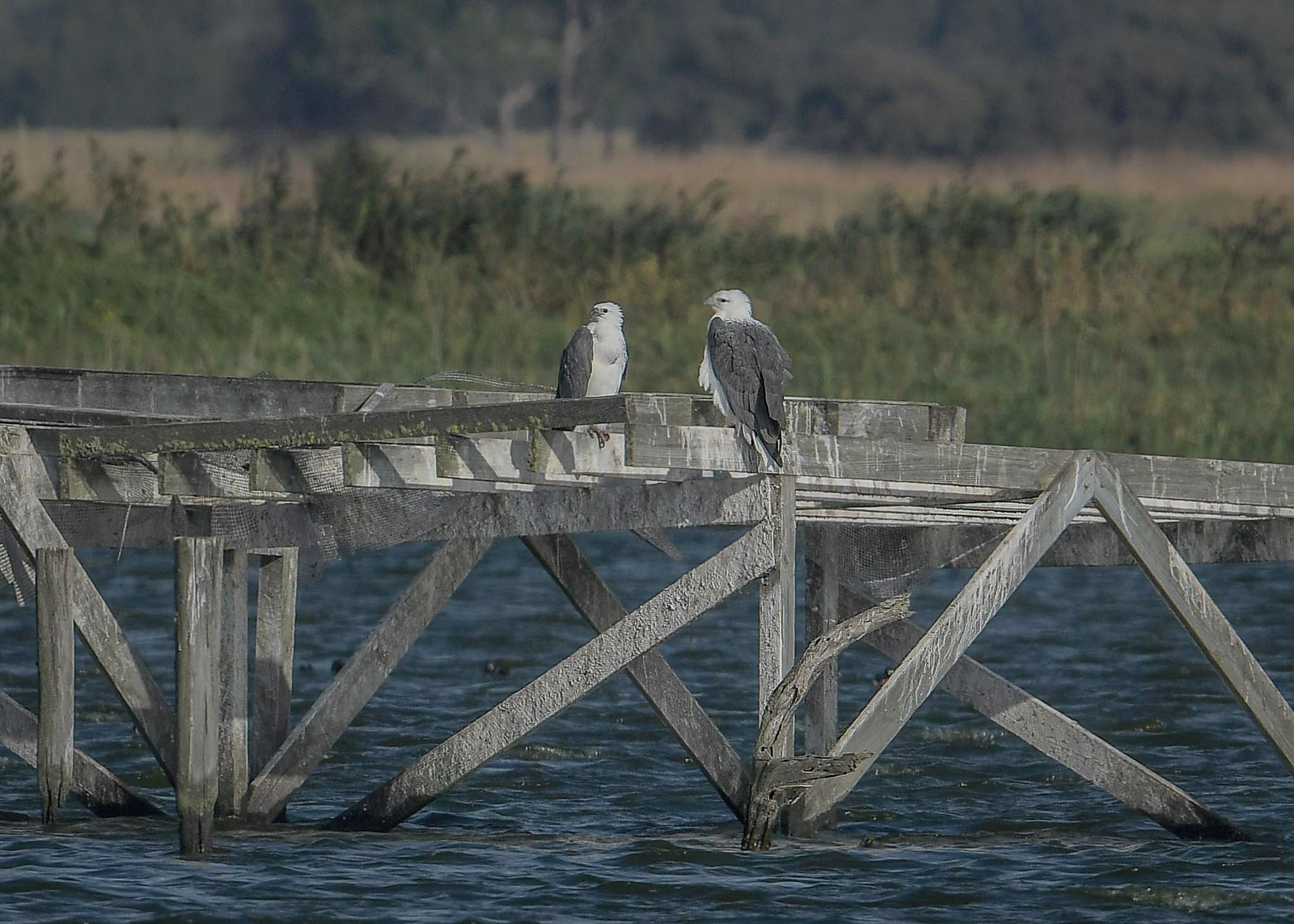
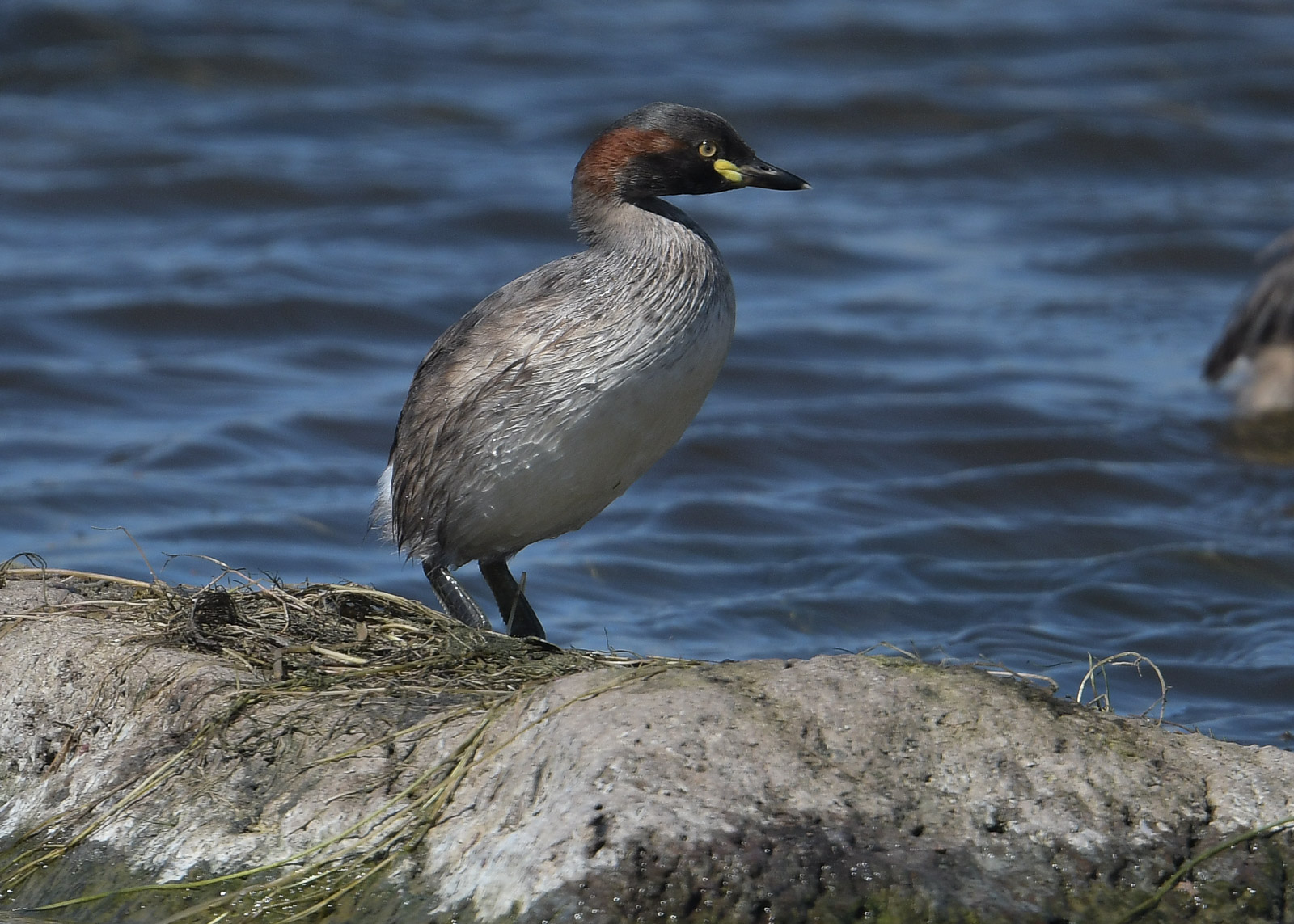
White-bellied Sea-eagle being harassed by a passing Swamp Harrier. I don’t think the apex predator was fazed.Said Swamp Harrier, then made a close pass over the reeds on our side of the lake. The ponds held many Hoary-headed Grebes.A committee meeting. These two Sea-eagles were resting a long way out in the middle of the large lake. Meanwhile up close the Reedbirds were moving about in the sunshineA small selection of the many hundreds of Hoary-headed Grebes.Whatever the current title, I still refer to them as Mountain Duck. The nomenclature police seem to think they are Australasian Shelduck. I don’t think the birds care really. They now all have nice new feathers and will be journeying northward soonNot sure if this Sea-eagle was from the earlier lake ones, or whether it came in from south along the beachline. But there could be as many as four working in the area at present.This Collared Sparrowhawk was making the most of the increasing high winds. And showing off that extended middle toe.Fueling up for a long trip ahead. Curlew SandpiperThese two Sharp-tailed Sandpipers are starting to colour up. Here they are ‘hiding’ out of the strong wind behind some reedsIt has been an increasing good year for Brolga at the Plant. We saw one pair with two well grown young. A second pair with a young one, and this third pair on their ownOne of my fav inflight birds. The Little EgretI can’t ever recall seeing an Austalasian Grebe standing up, nor on a rock. Perhaps a nest is on the way. Also managed a great wing display just for bonus points.
Before anyone starts writing to me about the following encounter, please read the disclaimer at the bottom of the blog. Thanks.
We were deep in Cassia, of Cinnamon Country. Part of the pair’s territory includes an area known by locals as, “The Duck Pond”. A small ephemeral pond(?) created with good intentions, but unsuccessful in the sandy beach area. However there is a good stand of trees and some favourite perches for the Good Lady of the Manor and her handsome companion.
The long winter rains had filled the Duck Pond and it made a perfect nursery for a number of water birds to raise their young. We were monitoring a pair of Little Aussie Battlers, who were risking it all for a second clutch before the pond dries out.
Given the Grebes mistrust of humans, while EE made a close approach I stayed on the outside of the tree line and watched proceedings, and also kept an eye across the paddock.
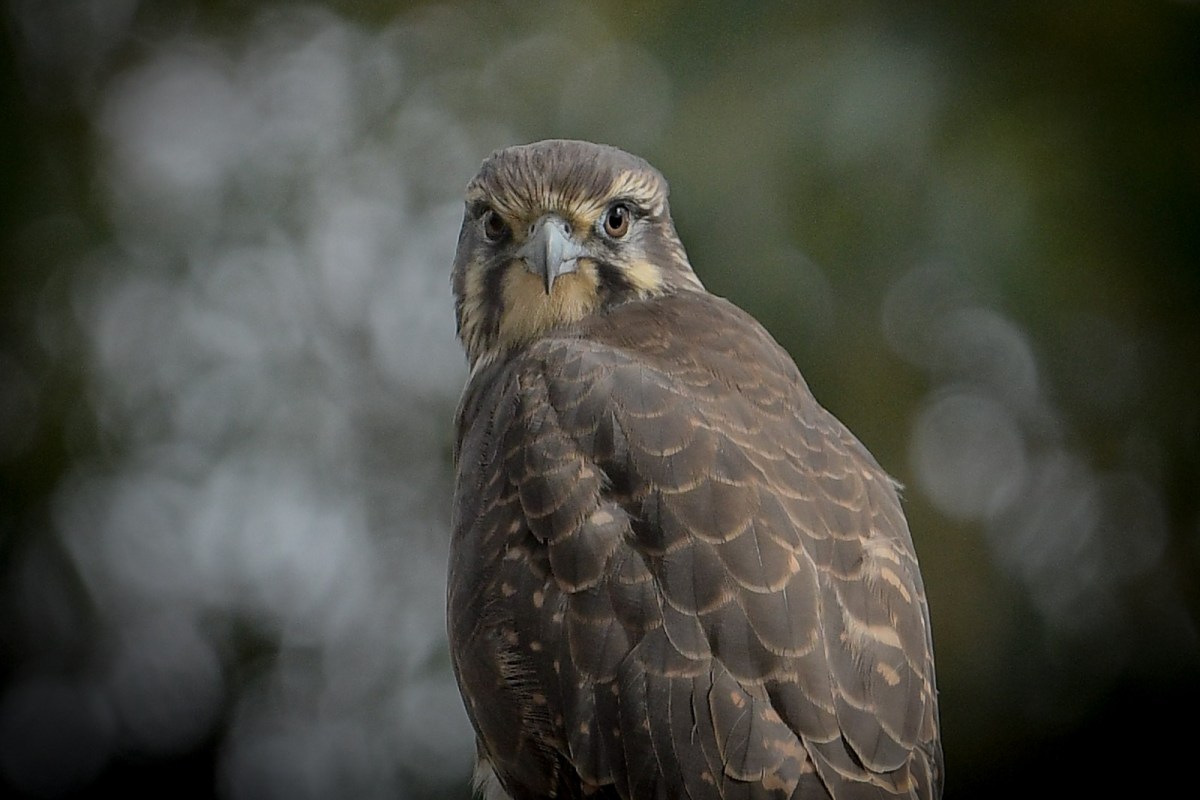
I spotted a dark shape moving over the dried grasses of the paddock, and after a few seconds decided to put the camera on it for a better look. It was Cassia, of Cinnamon. She was heading across the paddock in the general diretion of the tree line. I am convinced that Brown Falcons do not fly whilly-nilly about but each move is determined and with purpose. She kept coming. It didn’t take me too long to figure out that she was on a direct line to where I was standing. And, I began to make a frame or two. The approach was typical Falcon. Low and fast. And, to make it more complex for the photographer, she was coming out of the sun, so it was mostly a glare in the viewfinder. She crossed a fence line just in front of me, and swept up, and into the sun. Blinded momentarily, I didn’t see where she went and I turned around but couldn’t see her flying through. EE helped by pointing up.
And there, just above my head sat a very calm Brown Falcon. I tippy-toed out from under the tree for a better view. Would she move? No.
She settled in to preening. As I stepped back I noticed that her companion, he is a most handsome light coloured bird, was in a tree on the other side of the pond. Some detective work afterward, suggested he had brought in a snack, but, had dropped it when challenged by a passing Hobby or Peregrine. Being glued to the narrow view through the lens, I’d missed all the extra activity.
And that no doubt was why Cassia had made the journey. I found a fresh caught prey in the grass near the fence a little later on, and suspect that it was the piece contested. Also there is no doubt that Cassia knew exactely where it was and would reclaim it later.
She made no effort to move from her perch while I moved about for a better angle, and when I finally walked further down the tree line, she also moved to see what I was doing (perhaps?- am I that interesting?) Which allowed me to make several different portaits.
40 minutes later (I checked the camera time data) and she still was in no hurry to move on. So we left her to do what Browns seem to do so well. Contemplate.
It is worth checking her tail set in these frames as she is well on the way to moulting in a new set of feathers to replace the summer worn out ones. And there are a few wing feathers that need replacing too. Some recent blog posts show her worn feathers. No doubt in a couple of weeks, her new wardrobe will be complete.
Enjoy.
Flying low across the paddock. And just in case you should wonder. She is looking directly at me, and is well aware of my presence. Just about to get lost in the Sun. She is sweeping up to land in the tree directly over my headI think she might still be watching the Hobby high in the sky overheadAlso spotted her handsome companion. He is a wonderful light coloured bird. But has a zero tolerance policy for the human condition. A view of the double tail as the new tail feathers grow into place. Sometimes preening is a neverous reaction, other times it’s down to the serious business of looking your best for WordPressDid I mention he is human intolerant. TIme to depart. I like the look here, “Now where is he going?”We moved back down the pond area, and she also relocated. Gave me some casual portaitsChanges of light and angle give different aspects. One legged pose suggests she is quite comfortableI’d be confident she was working out the best appoach to pickup the dropped carcass.
Getting Close: Hiding in Plain Sight. This is my preferred method of getting close to and working with wildlife. The goal of this approach is to have the wildlife, over time, come to accept my presence and have THEM approach me (rather than chasing them across the landscape). The biggest downside of hiding in plain sight is that can be very time consuming. While I can think of worse things than sitting out in the wilderness for hours or days on end (though it can be decidedly uncomfortable at times), it does take extreme patience and focused attention (so it’s unlikely any today’s teenagers will ever practice this technique). Interestingly, I can’t count the times where I’ve captured memorable – and totally unexpected – images (like this Lorquin’s Admiral) while hiding in plain sight. This ability to watch ALL around me while hiding in plain sight is extremely valuable (and the inability to do so one of the main reasons I don’t like sitting in an enclosed blind). Don’t think I’m holding back information on this “hide in plain sight” technique – it doesn’t involve any form of animal “whispering” or zen-like connection with the wildlife. There’s nothing magical, special, or even difficult about it, other than finding the discipline and time to practise it.
Disclaimer birdsaspoetry.com policy. This bird is completely wild. There is no baiting, or use of calls, or other methods to encourage the bird to approach. It’s her choice to fly aross the paddock and land where-ever she wants to. We’ve worked with the pair for a number of seasons and are careful to treat them both with respect and care. I take her confidence very seriously and feel we are fortunate to be graced by her presence.
We don’t get a close encounter on every trip, and should she be put to wing in my presence, I am the lesser for the carelessness.
So the old story goes: Give a man a fish and you feed him for a day. Teach him to fish And he’ll sit in a boat all day drinking beer. (at least I think that’s how it goes)
EE was out for the day, and as the weather was fine in the afternoon, I decided to go to a special place at Point Cook park. We don’t usually go out that far, as its a long haul through some very loose slippery sand so we avoid it.
A point in the park was formed millenia ago when the great western plains lava flows occurred. The lava jutted a tongue out into what was to become Port Phillip Bay. Over the years, sand has been deposited on both sides of the rocks, and two tiny little bays have been formed with the sand keeping the water shallow. On low tide the point can go out for about 150m or more, and on very low tide the sands are exposed and its possible to walk out most of the way.
The rocks form a lovely resting spot for the seabirds and it’s not unusual, even on high tide, to find cormorants, gulls and terns, and occassionally swans and pelicans making the most of the view.
I like it as a quiet, lonesome place. One of my preferred solo birding spots.
So I pushed on through the pine plantation, slogging over the hot slippery sand until I reached the coolness of the shoreline. Then a few minutes along the beach to the point. Luck would have it, it was late on a falling tide so there was some exposed sand I could walk out on. Because of the little bays, the water is pretty shallow and it’s easy to take off boots and socks and roll up the Levis and wade out a bit.
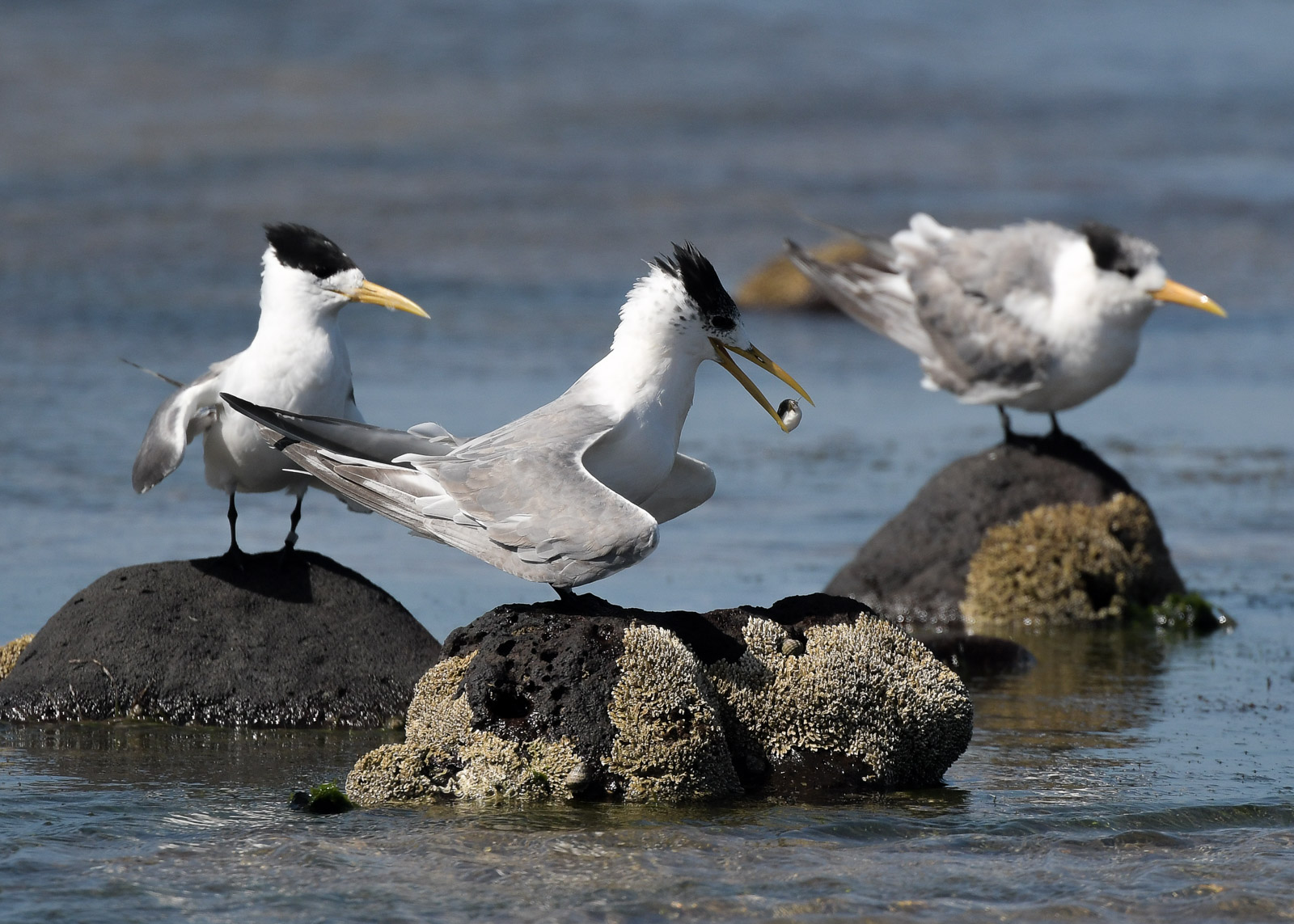
Greater Crested Terns were in abundance and fishing further out, but returning to enjoy a meal on the rocks. A scattering of Red-necked Stints were also in attendance, getting ready for their epic journey. When I walk out in the water paralled to the rocks, the birds generally are relaxed and don’t seem to pay any attention. Except for a pair of Pied Oystercatchers, that immediately moved as far away as they could to the sand on the far side. Then they do what Oystercatchers do best. They glared at me.
A tern came in with its latest catch and seemed to want to brag to everyone about its good fortune, and flew about from rock to rock cackling and playing with the meal.
I moved back to the sanddune and sat on the grass with a brew of the Earl’s finest and soaked up the feeling of isolation.
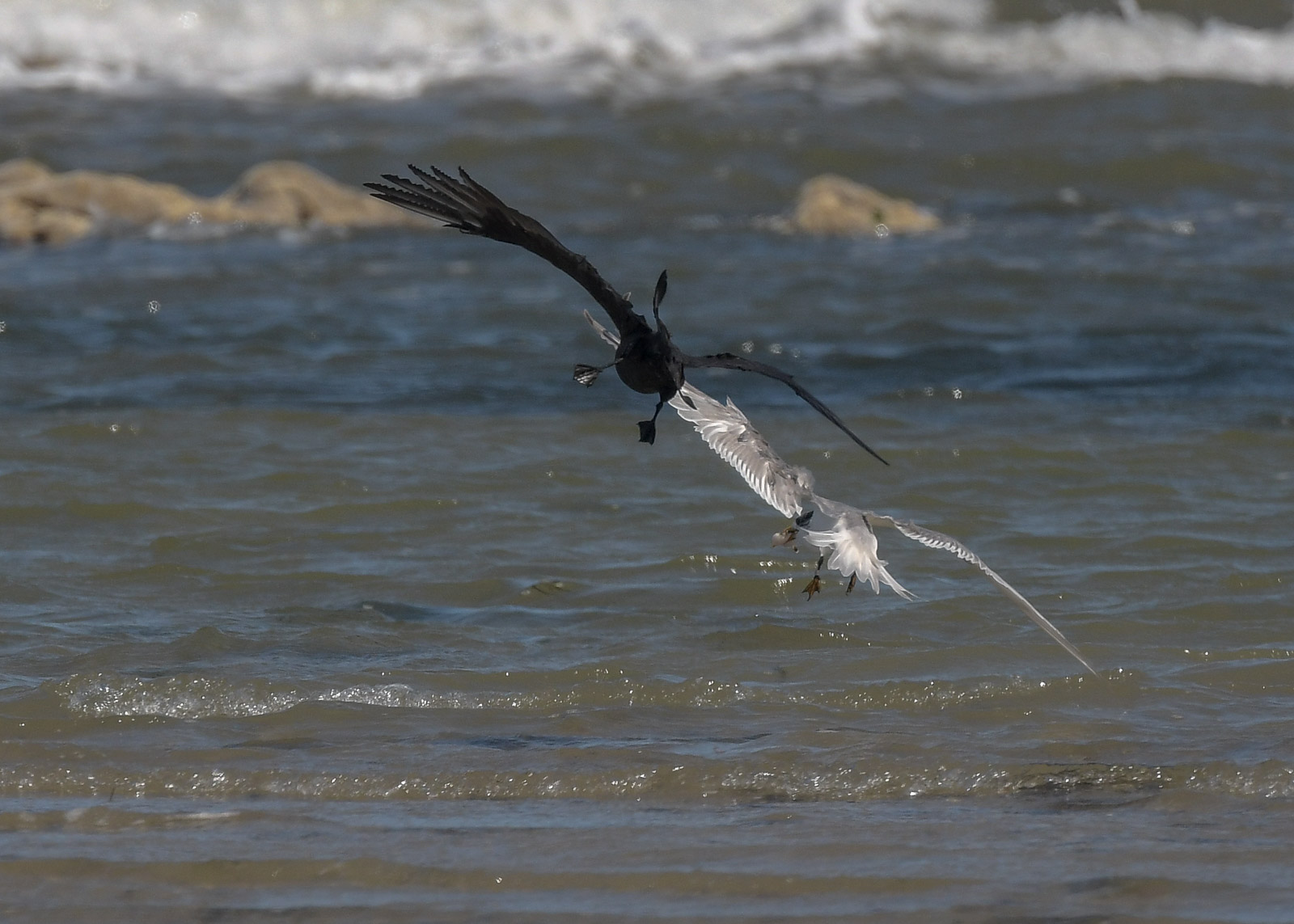
With a loud call and wing flurry the gulls all took to the air and at first I missed the action, then a dark shape flew over the rocks. Regaining composure, and the camera, I called out to no one in particular, “Arctic Jaeger”, and as there was no one else, its just as well I didn’t call to anyone in particular.
Sure enough. A Jaeger was looking for an afternoon snack, and what better way than to relieve some hapless gull of its meal. But they were gone. It turned to head along the beachline, just as an unsuspecting Tern flew in with its latest meal. The Jaeger summed the matter up in a split second and the chase was on. Jaegers have a surprising turn of speed and incredible air contol, at one point, its head was going in one direction, its wings in another, the body in yet another direction and its feet controlling the action.
Somehow the Tern managed to lose enough height to get onto the sand, and mantle its meal with its wings. Thwarted the Jaeger moved along the beach to retrieve some other offering and in the flick of a wing was gone.
Time had run out, so it was time for me to slog back through the pines and home.
Enjoy
Greater Crested TernsA Greater Crested Tern doing a spin dry to remove excess waterA young Greater Crested Tern picking up from the shallowsOne of a handful of Red-necked Stints working the areaShowing off its prizeDon’t play with your food.Arctic Jaegar. A summer visitor, not one I’d usually see, and certainly not in close to shoreA very surprised TernJaeger applying the brakesA serious chase and one the Tern does not want to loseClosing inThe Tern was heading for the safety of the beach and managed to land with its food intact.Thwarted the Jaeger collected something from the beach before flying offAnd for bonus points! As I was leaving a Black-faced Cormorant flew in. They normally reside futher south in the Bay, so its been good to have a few around.
In realestate they say that position is everything.
We’ve been away the past week or so with the rellies on the family acres. So, not much birding to be done, let alone photography—if you bypass the usual family happy snaps.
We passed by a dam yesterday, and the eagle-eyed among us cried, “White-necked Heron”. But with the traffic and the icecream melting in the back, there was no stopping for such a rare event. Interestingly the day before that, we’d spied two White-necked Herons in a local water-retaining basin that was drying out. (But that’s another story)
Had it go back out past the dam this morning to get to the shopping centre, so loaded up the camera this time, well, you know. Just in case.
No case.
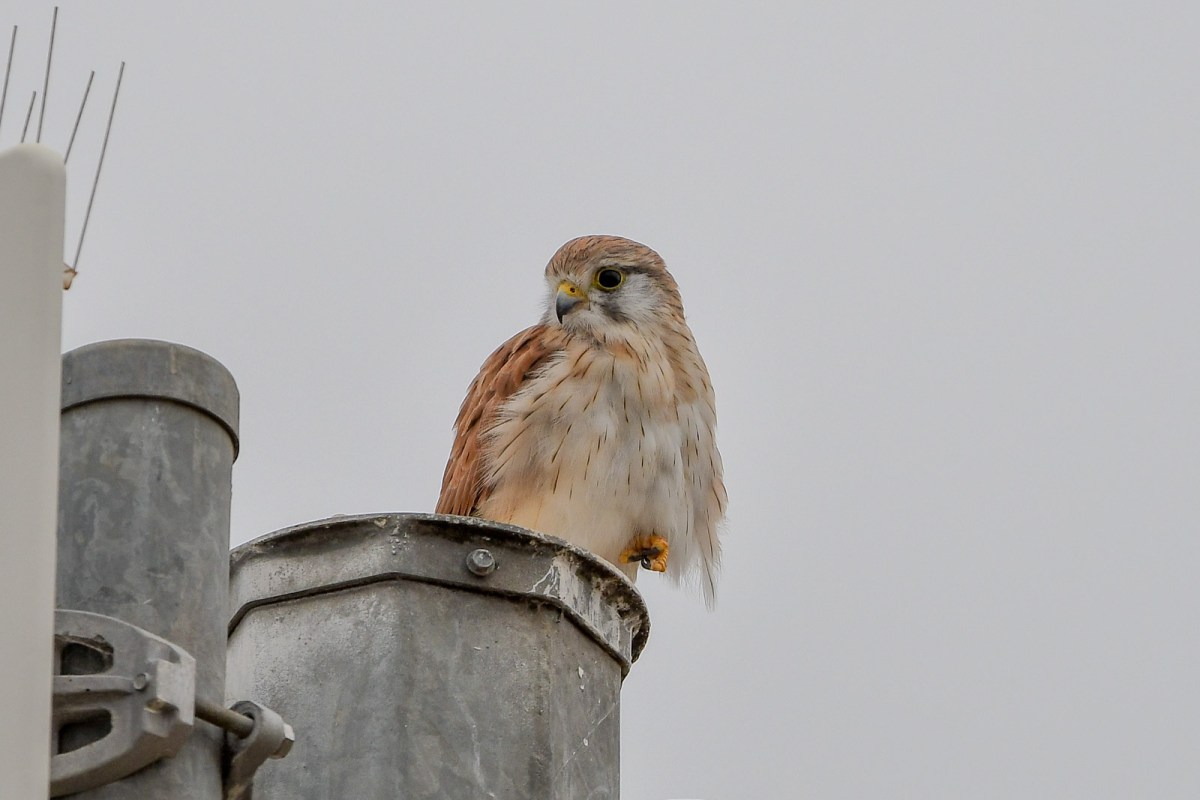
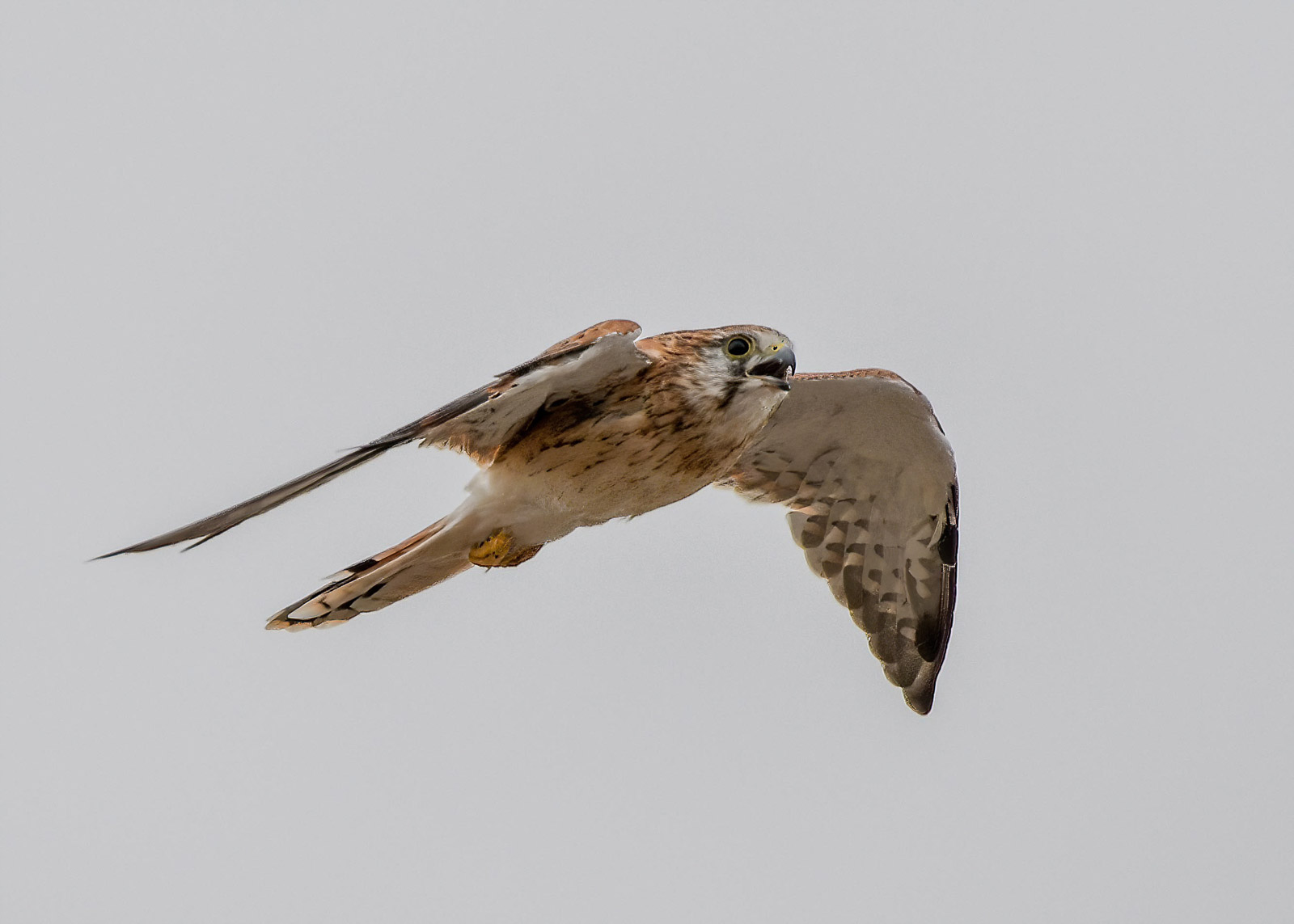
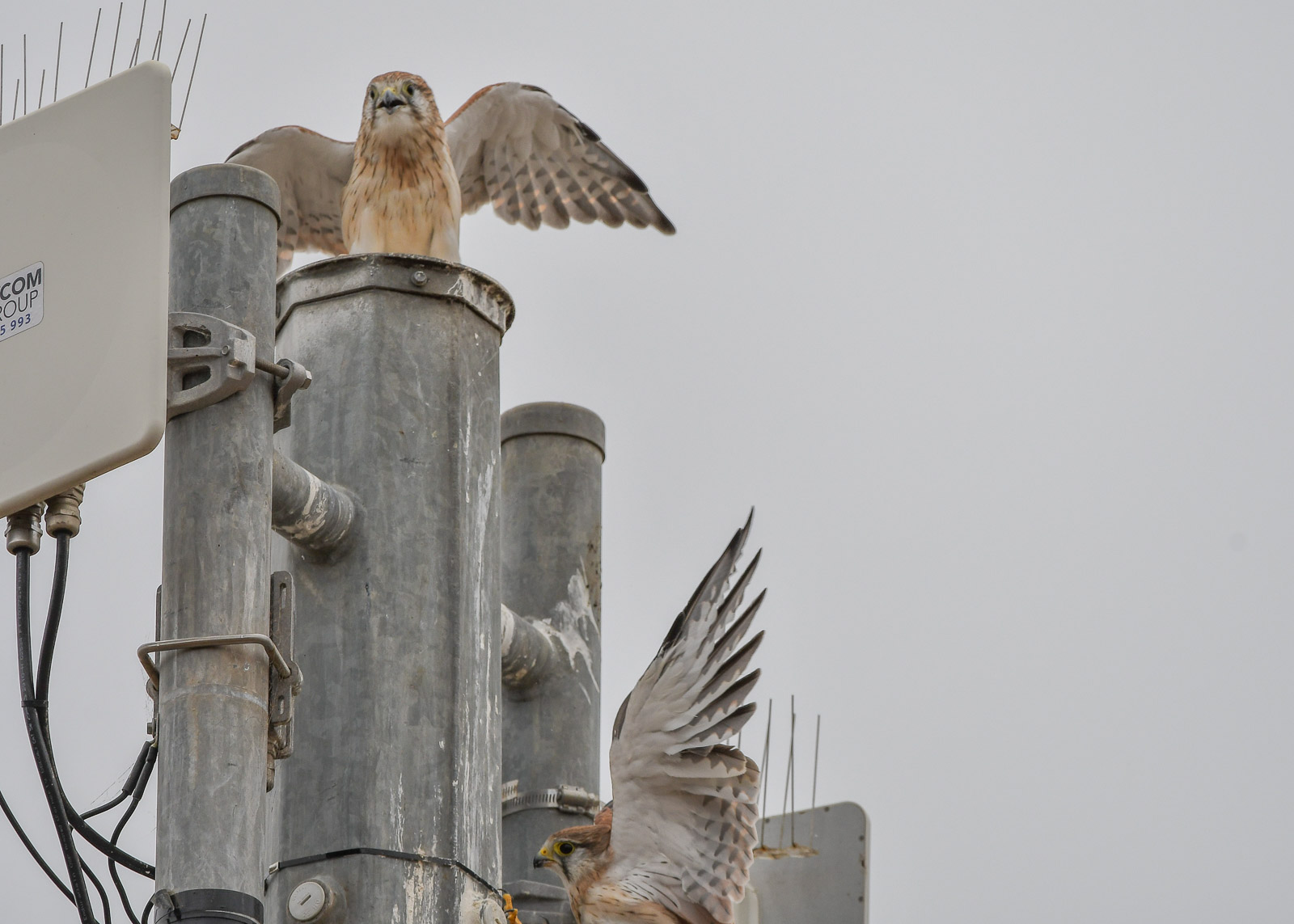
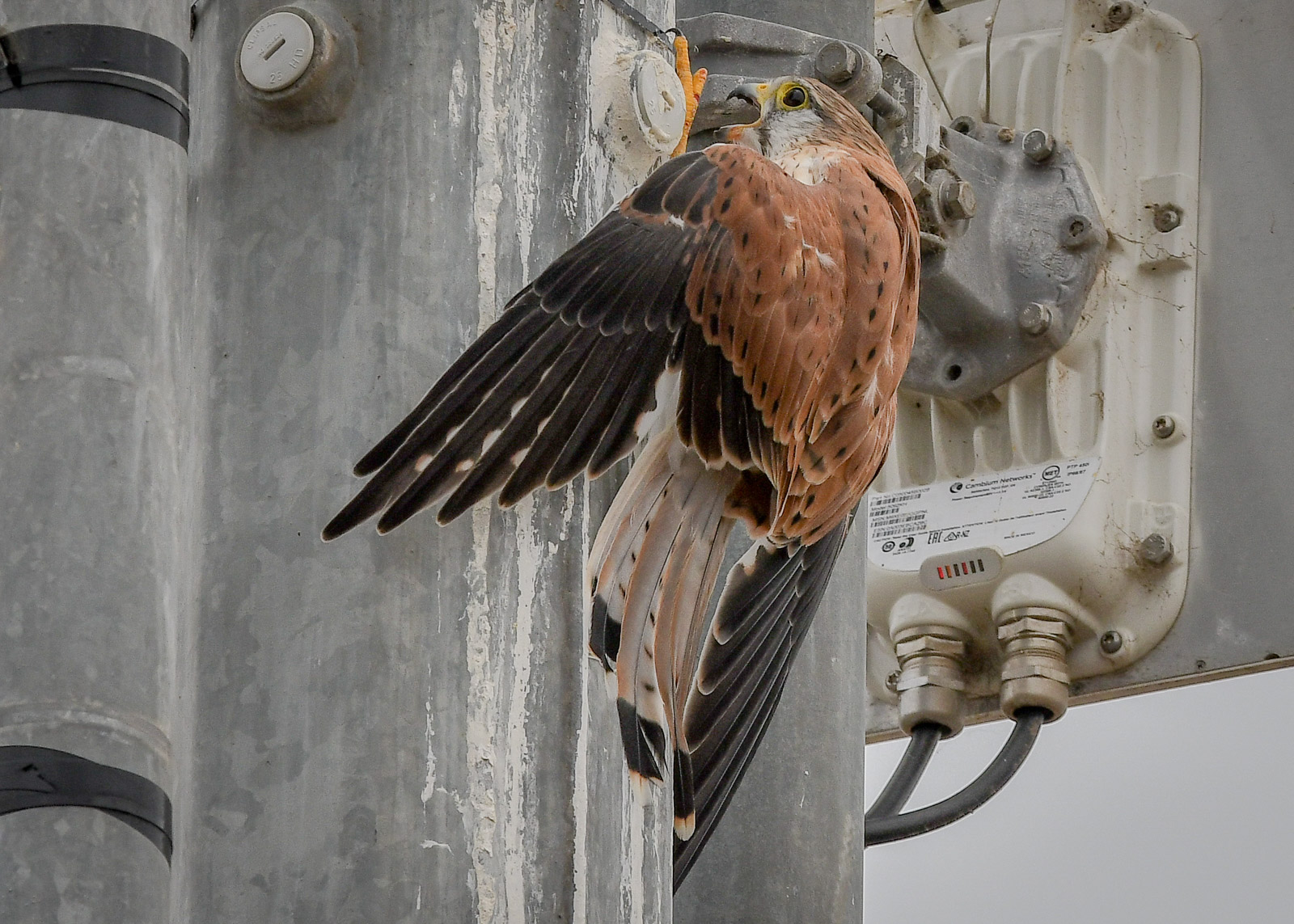
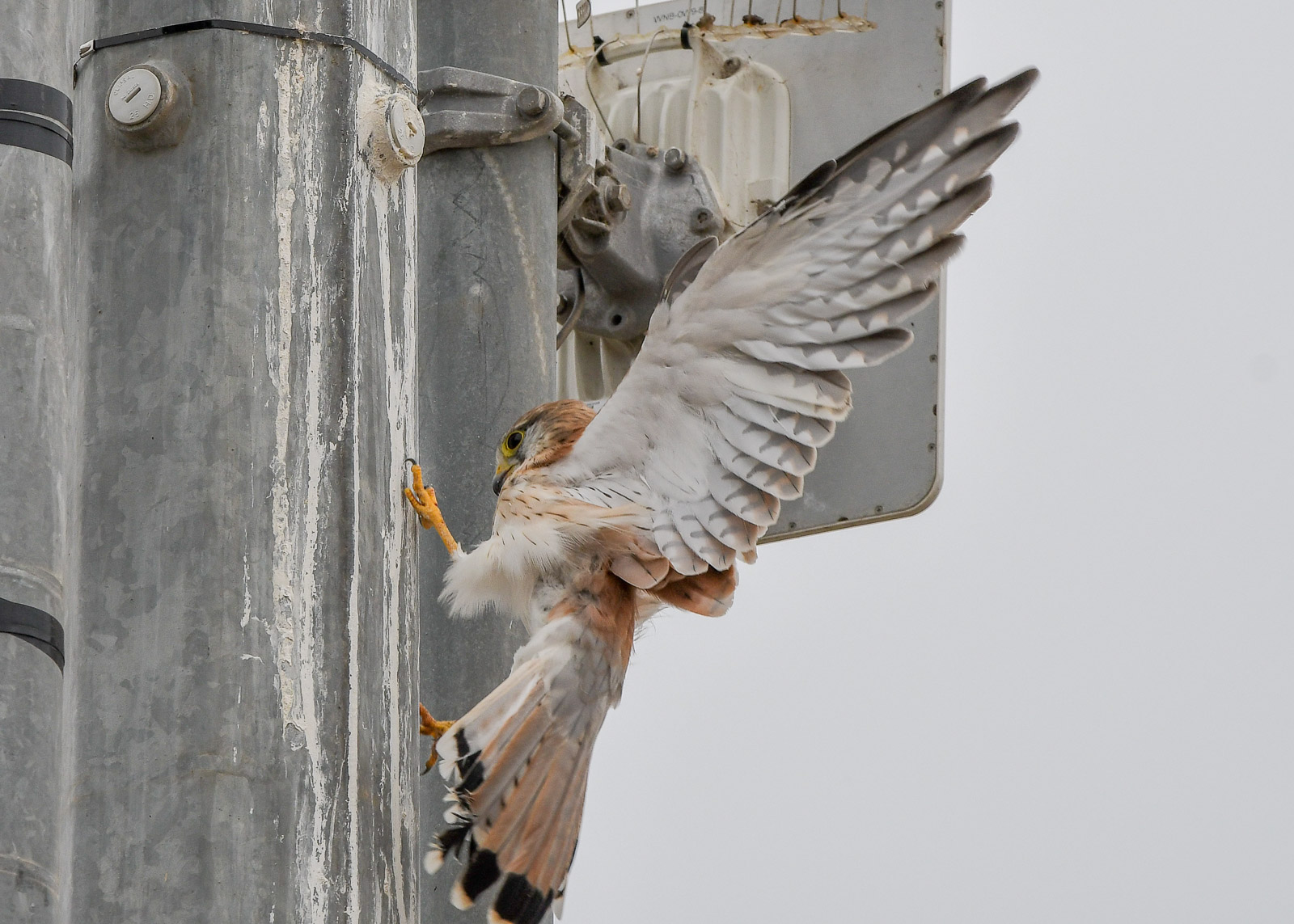
As I headed for home I noted on a comms tower at the end of the old road where we’d been photographing Black-shouldered Kites, (and we always look, just in case one might return), sitting on said tower was a Nankeen Kestrel, and with no icecream to worry about, I went for the looksee.
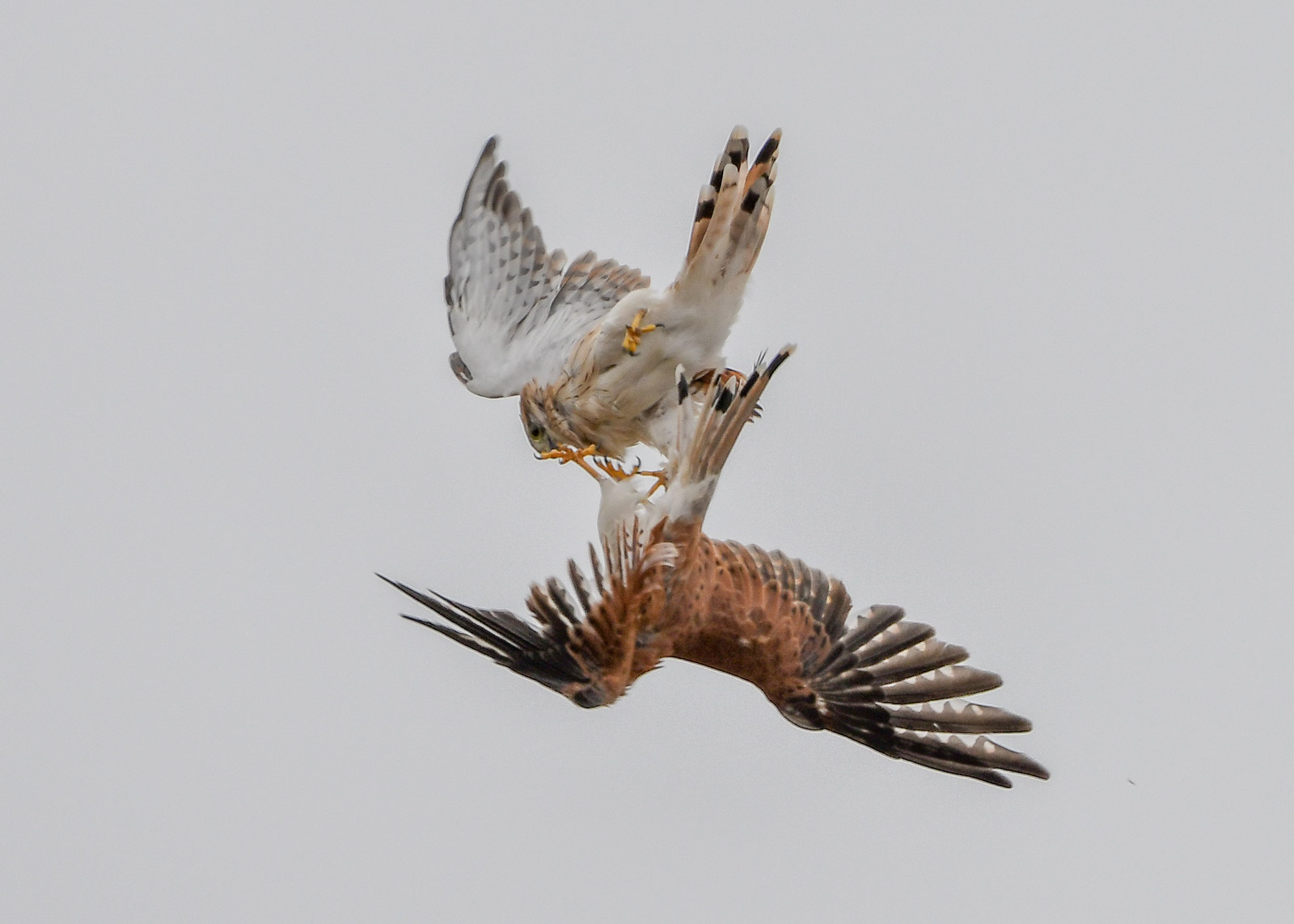
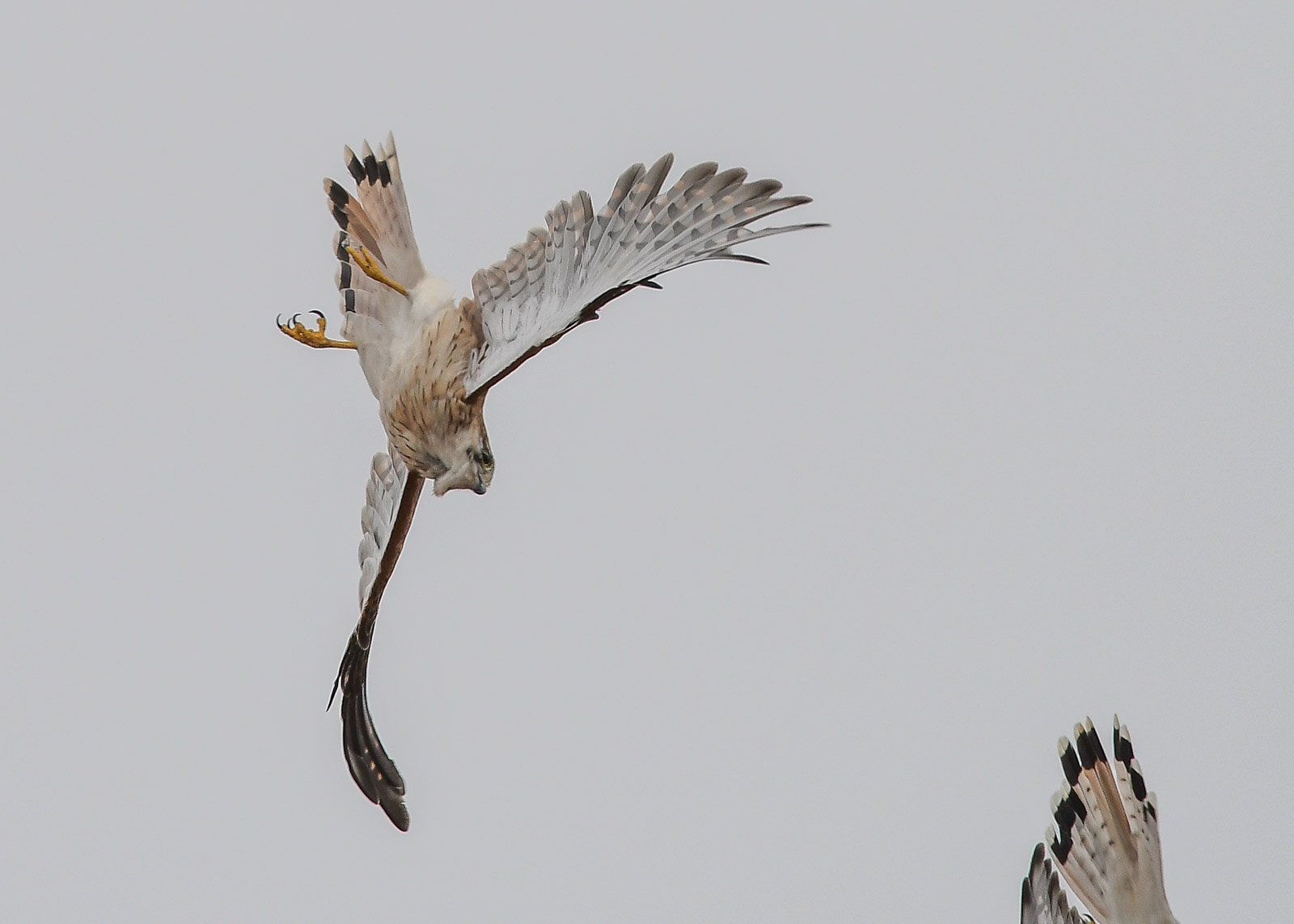
Looking very relaxed it was, and I moved up the little hillside for a better angle and view. Suddenly the air was filled, (as they say in the classics), with the lovely quivering sound of Kestrel talk. And a second one swung in, intent it seemed to unseat the present incumbent and take control of the tower.
Backstory behind us, here are the photo-moments.
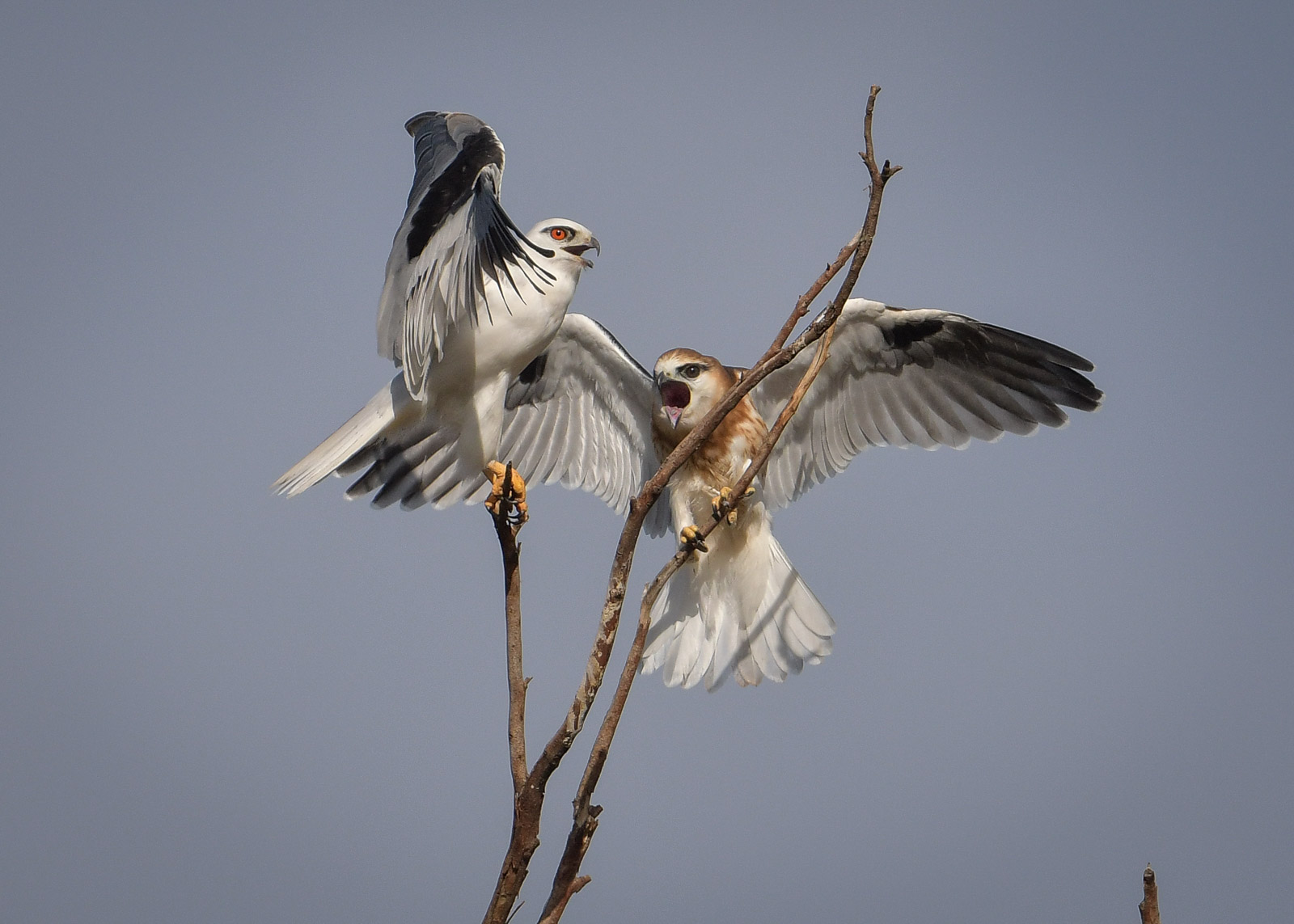
A female, looking very relaxed and comfortable.A crisp quiverous cry that is so typical of a Kestrel, she warned the approaching bird off. Out of mischief or malice, the second one swung in, in full cry. Had to wonder if there were two adults in the area, or whether these were siblings from a recent clutch. No quarter given, or taken.A second pass dislodged the original bird and it slipped down the tower trying to hold on, both to its position and dignityWith a lot of name calling it was time to think of a new planFrom its uncomfortable perch it dropped away to make its own attack.Defend. But to no avail as it was swept from the tower.If I thought it was all in fun, then then next few moments showed how serious they both were.Both birds capable of giving as good as they gotIt was interesting to see how quickly they could recover from being attacked to being the aggressorBut like all realestate disputes, it’s hard to reach agreement.Several more cackling calls and it was all over and one flew out across the paddock to safer groundWhile the victor took up a perch on a nearby power pole and resumed normal business.
It seemed to me, that this would not be the last of the encounters.




















































 Birds as Poetry —— Just because I WANDER doesn't mean I'm LOST