Over the next few days we checked back to see how things were progressing.
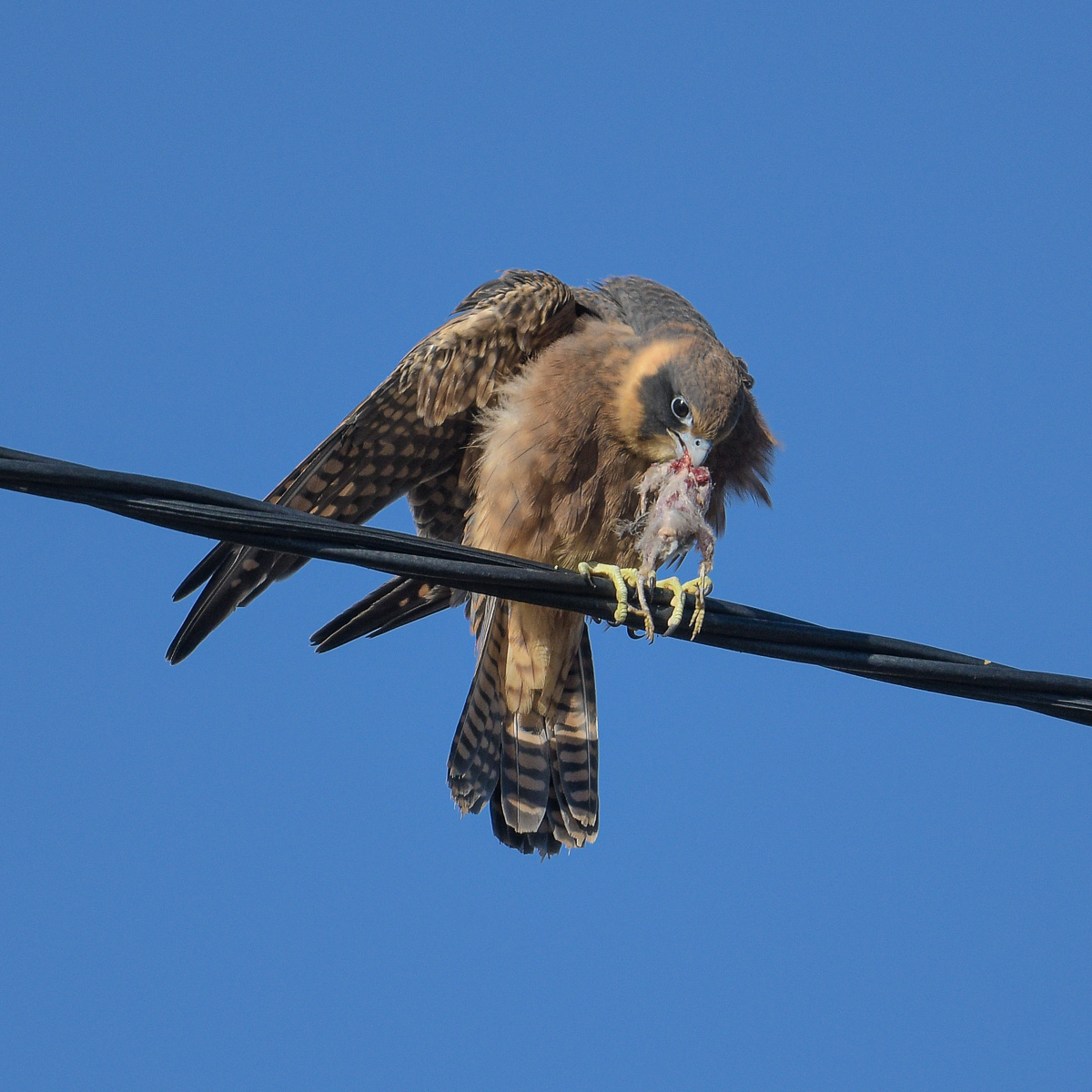
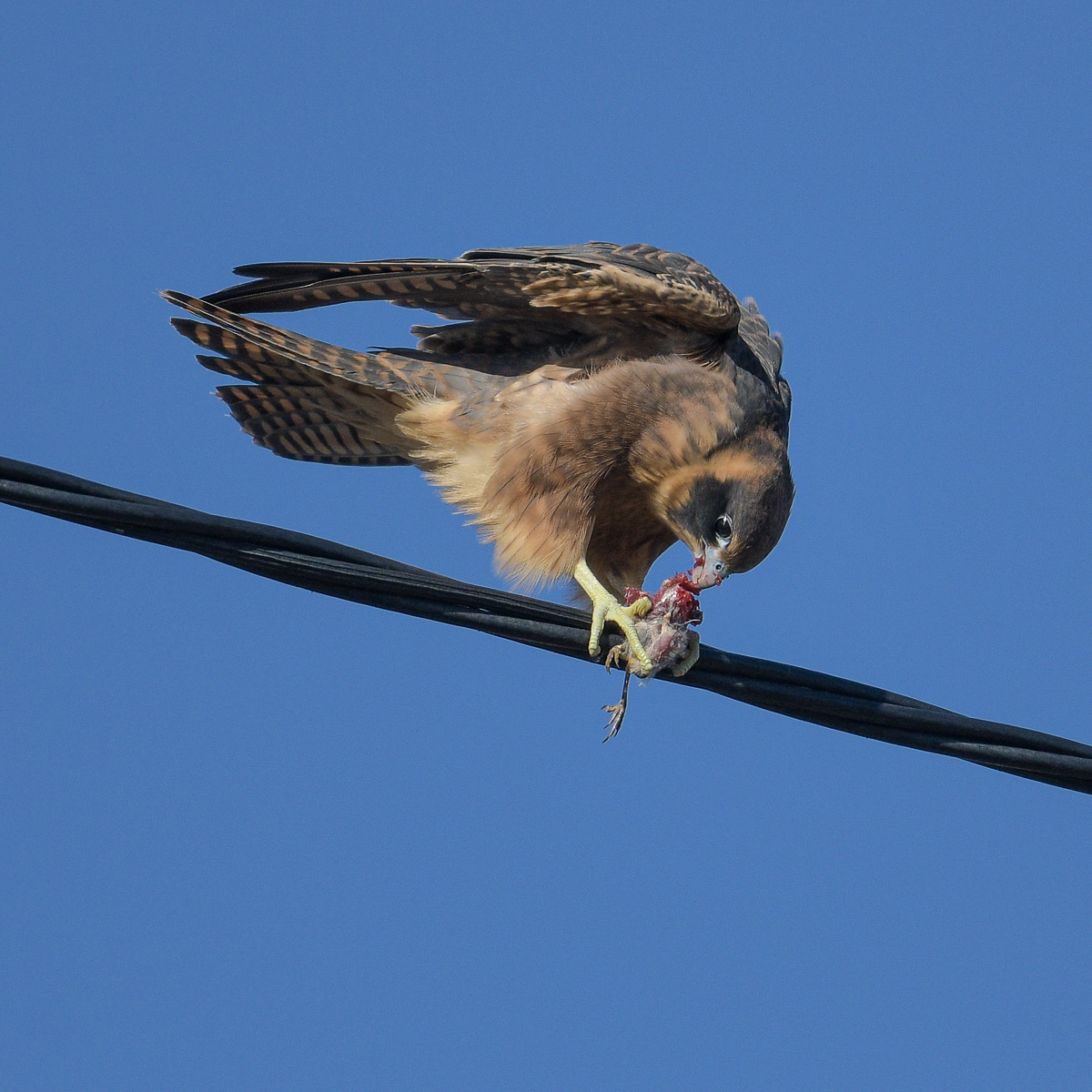
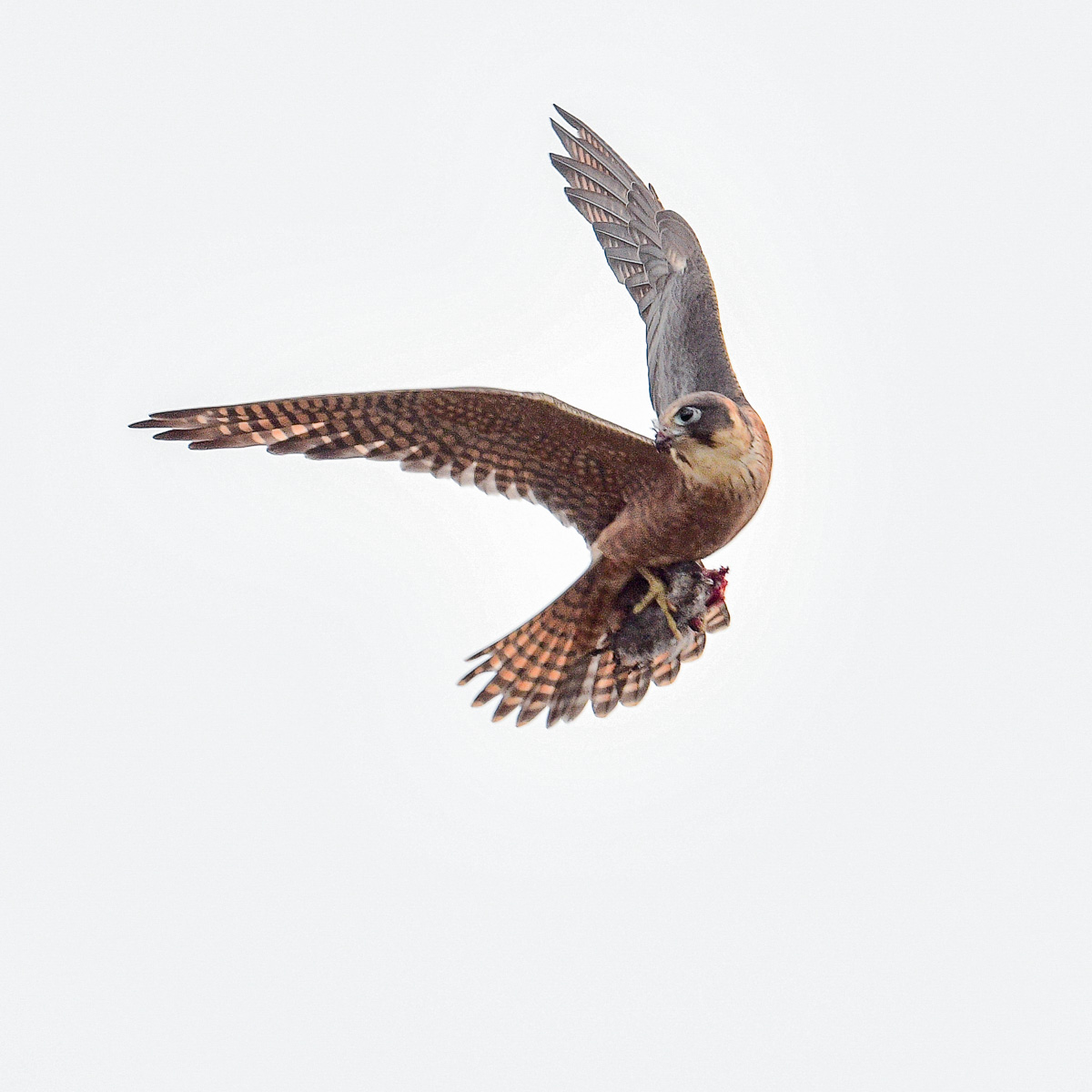
The female had flown in with a recent catch and prepared it for the young. She then flew to another tree and made sure the young one recieved some nourishment by feeding it small pieces of the prey. She then passed it to the youngster and it took off to fly about with its prize.
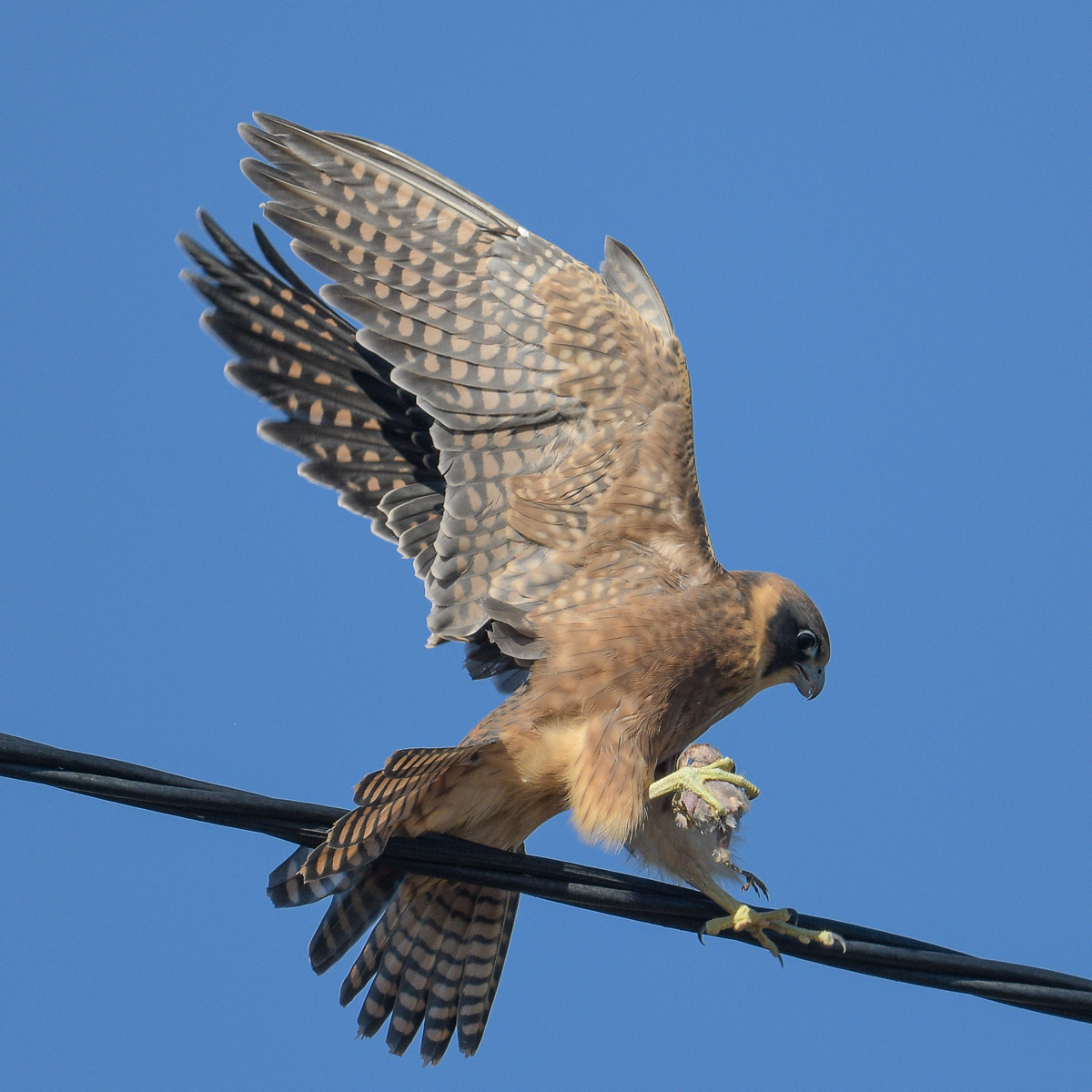
For some reason it decided, in the end, to land on one of the main powerlines that crisscross the carpark.
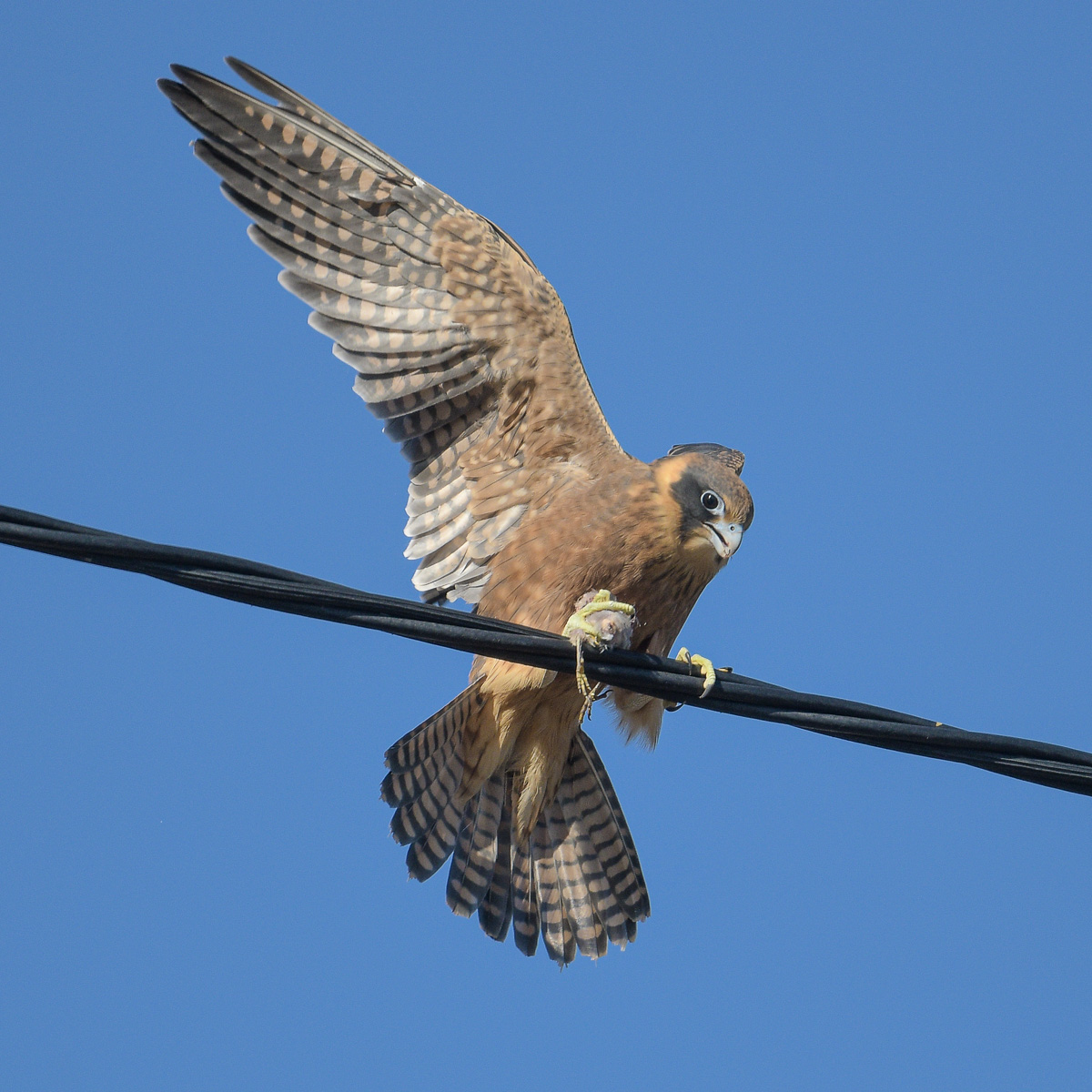
Landing with extra weight, on a swinging powerline proved to be a much more difficult task than the youngster anticipated and things quickly got out of hand.
But persistence paid off and after serveal slips, misses and fumbles it finally attached itself and its meal to the powerline.
We conitinued to monitor them for a few more days, but by now they were well on the wing, and the carpark didn’t quite hold much attraction unless food was on the offing. Like all young Hobbys they were keen to learn how to gain height and fly greater distances. It was interestsing to watch them disappear out of ight on one side of the carpark, and then so quickly fly through to disappear on the other side.
We had a few other close encounters, but always too short, and far too fast.
Enjoy
The feathers fly as she preparesOff to deliver the goodsSuprising how agile the young were with the extra loadPowerline landing proved trickyOh my tail is caughtNow my wing is tangled.Leg down, balanceNot too far forwardSettling. Just like you caught it yourself
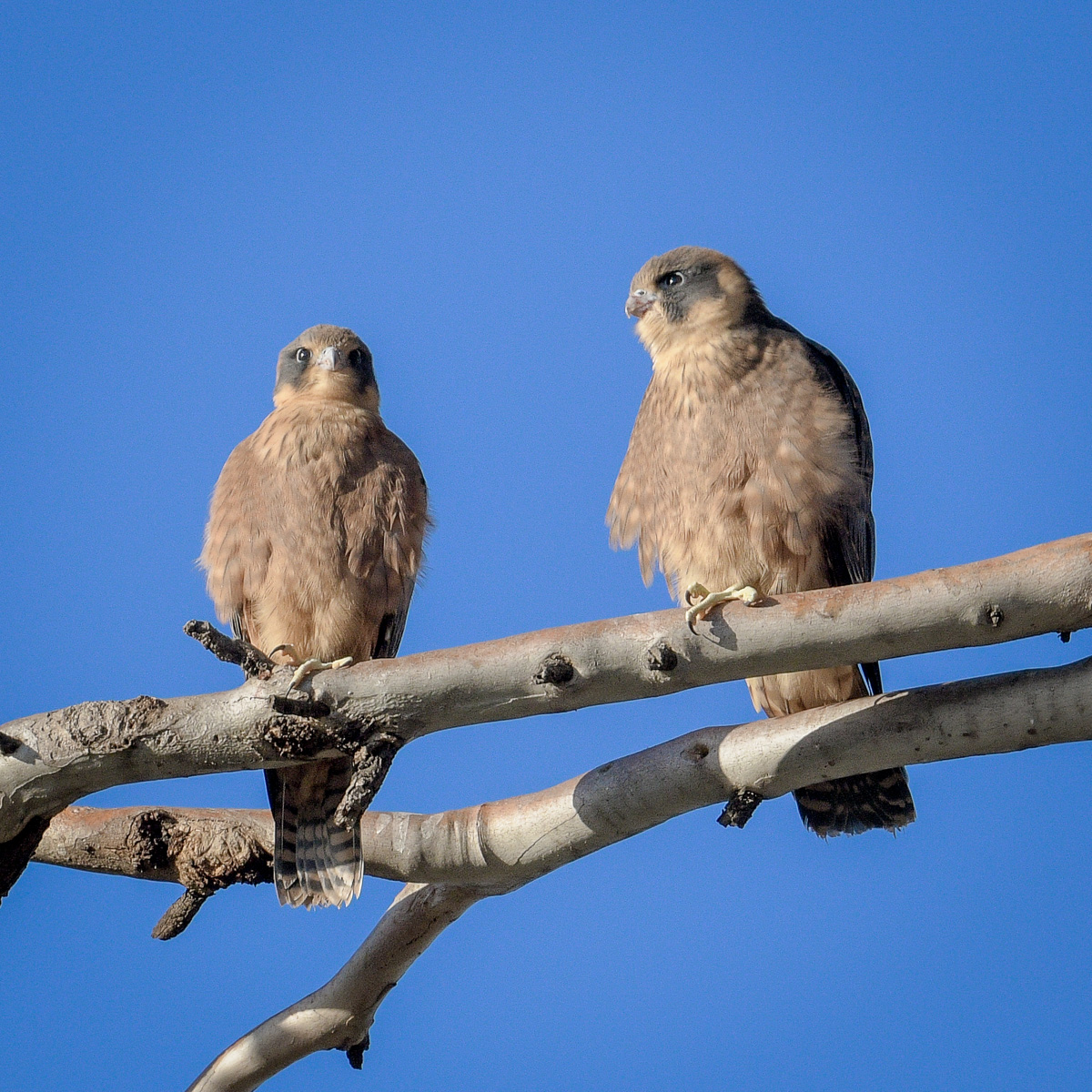
Thanks to my Flickr buddy DaveSPN we’d been following a pair of Australian Hobbys that had decided to nest in a tree in the carpark at a local shopping centre. The tree chosen—and they had used it in previous years—is located at one of the entrances to the shopping centre as well as the bus-train interchange. Insert words, “constantly busy” here.
It would be fair to say, that not one in a thousand who used the area were even aware of the tree, let alone its inhabitants. Nesting Hobbys can be particularly noisy at feeding times and also the other birds cry out warnings when one or the other approaches. But I never saw anyone look up to take notice. The challenge of course is to stand in the middle of a carpark with shoppers, buses, shopping carts and pedestrians constantly passsing by and to remain inconspicuous—Euphemism for “Impossible”.
The young fledged a couple of days before the Christmas break, and we devised a cunning scheme to make the most of the closed shops on the 25th of December. A check of the weather maps indicated it would be a clear morning, and the site of the tree meant early morning sunshine would be classic.
Game in play. We breakfasted really early, still dark, loaded up the cameras, and headed out, still dark, with just a hint of light starting to fill the eastern sky as we drove along. Looked good. Next to no traffic on the road, and we quickly arrived at the carpark with the first rays of light coming over the horizon. Looked good.
It’s hard to image a carpark that less than 12 hours previously was full with frantic shoppers but now it was as they say, empty. Except, for a couple of vehicles, which I did not go to inspect. Not my circus. Not my monkeys.
The young birds were out, and after some preening, playing, and investigating everything that moved, Mum arrived with some food and some good action shots were easy. A lass in a car was leaving the carpark, and shouted “Merry Xmas- or something,” as she left, I waved.
And a guy who wanted to know, of course, what we were doing. He should ask me, wandering about on Christmas morning!!! But I declined to answer the usual, “Photographing Striated Fieldwrens”, realising that wouldn’t help, nor would “Australian Hobbys, in that tree”, so I settled for some general ramble, which in the end he declared, “so, you don’t to talk to me.’ and stormed off. I thought the young lass’s response was good so offered that to him as he left.
The Hobbys of course were completely unaware of all this and just kept begging for food, or trying out their flying, and landing skills. No coffee shops opened, so we headed for home. So pleased with the morning, that we decided to join in the Boxing Days sales caper, and went back the following morning for a few more hours. This time we were dodging traffic, but, the birds seemed oblivous.
Here’s a selection. Clicking on a thumbnail should give you a full size image in a slide show.
Enjoy
Out early to enjoy the sunshineThe smaller one is probably a maleThey do spend a lot of time preening each otherPowerline landing skills need some workNeither of them has the right balanceEasy to land on a light standSomething to chew onAll this flying about is tiring business. Where better to snooze than the top of a light standMum is still feeding each oneBut they get to fly around with the left overs
We all love Rainbow Lorikeets. Big, Bold, Colourful. A circus in a small feathered package. Except, when there is too, too many of them, and they become a pest.
We have a small area adjacent to a golf course and sandwiched between the course and the river. I suspect some of the undulating ground is from trailings dumped when they scraped the course. The river is not always contained in its banks, and in flood will fill up many of the lower laying areas of the forest. There are quite a few resident River Red Gums, some many hundreds of years old, and a lot more younger trees that could have been planted after the golfcourse construction was complete. The younger trees have created quite a canopy as they reach to get their share of sunlight.
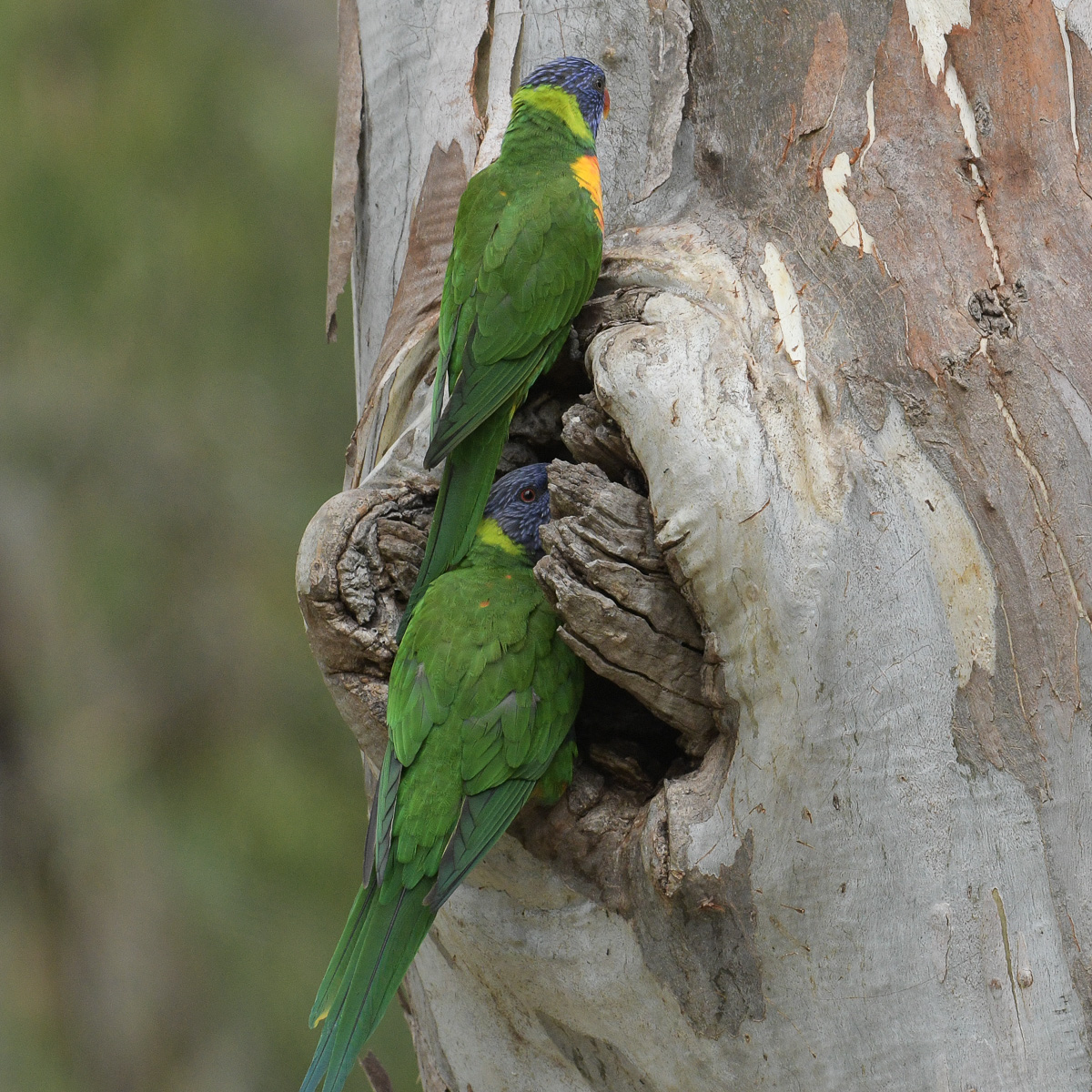
So there are quite a number of suitable nesting trees and the Rainbow Lorikeets have commandered the best and the second and third best sites. Smaller parrots, the Purple-crowned and Red-rumps have had to find other nest opportunites. And also the visiting Sacred Kingfishers, but more of that on the next post.
EE and I were out looking, and listening for Sacred Kingfishers. It was getting late in the season, normally they would have a spot picked by late November and be nesting in early December. But time was running out as all the suitable holes and places where they could open up a new hole were taken. Trying to find a nesting pair of Kingfishers in a dense forest is really the job for Sir Pecivale of grail fame, but then… we have EE.
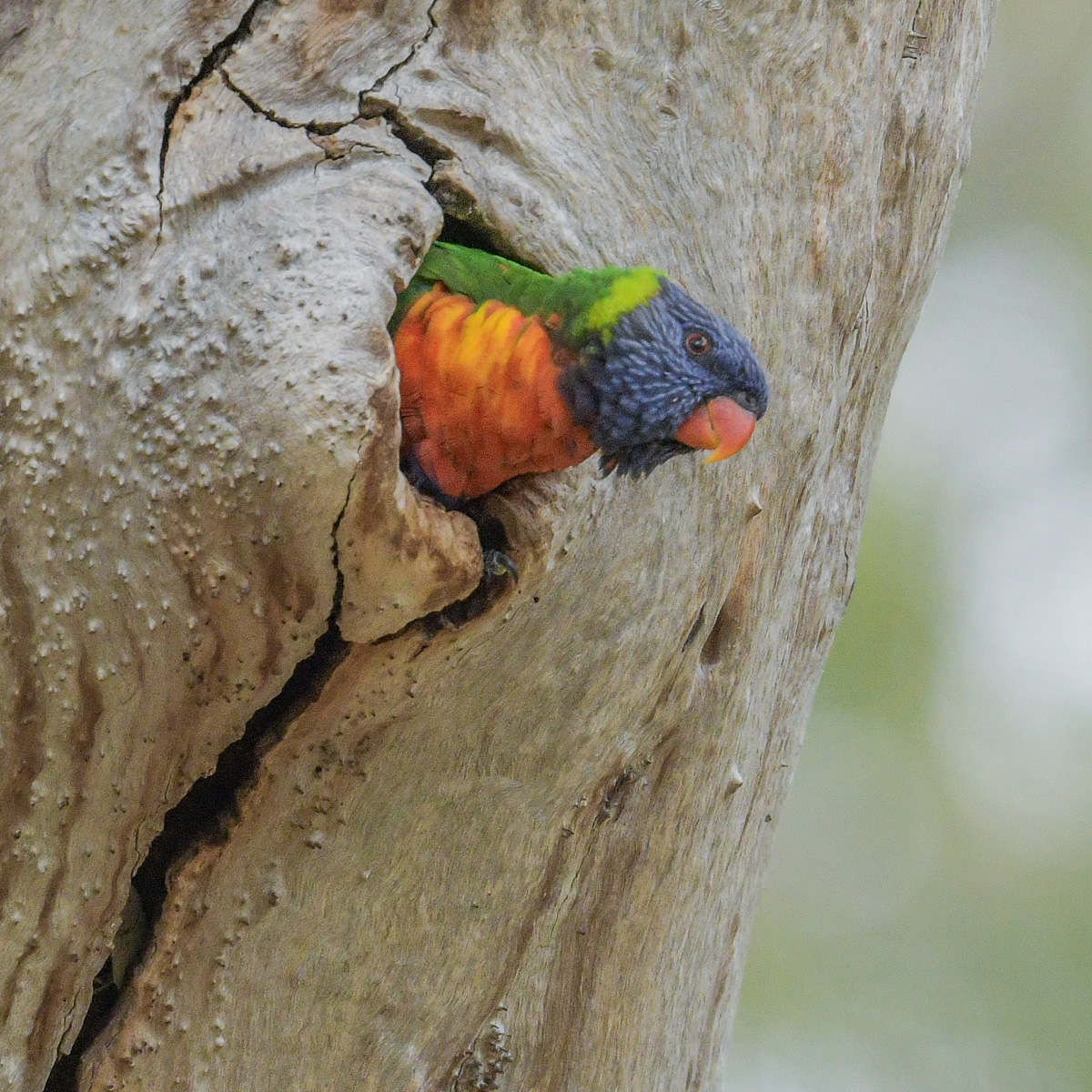
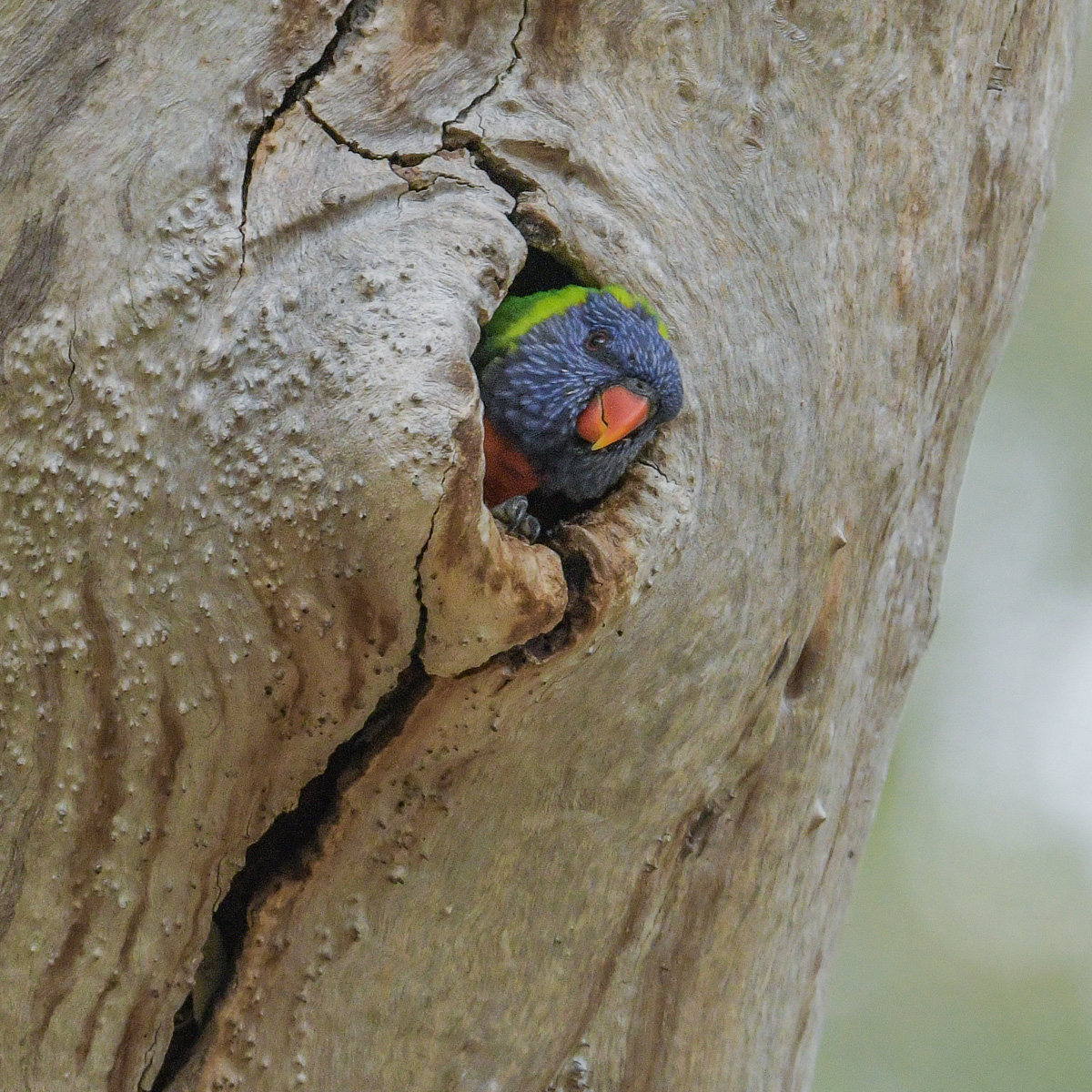
We were passing by a hole that was used in a previous year by the Kingfishers and not surprisingly, a Rainbow head popped out. I now, rarely bother to even aim the camera at them, so went on a few steps. And again it swung its head out, and pulled it back, and repeated the action. Given they are so cheeky, I didn’t take much more notice. Like voting, I don’t do it, because it only encourages them. Two or three more steps, and the bird repeated the process again. And I realised.
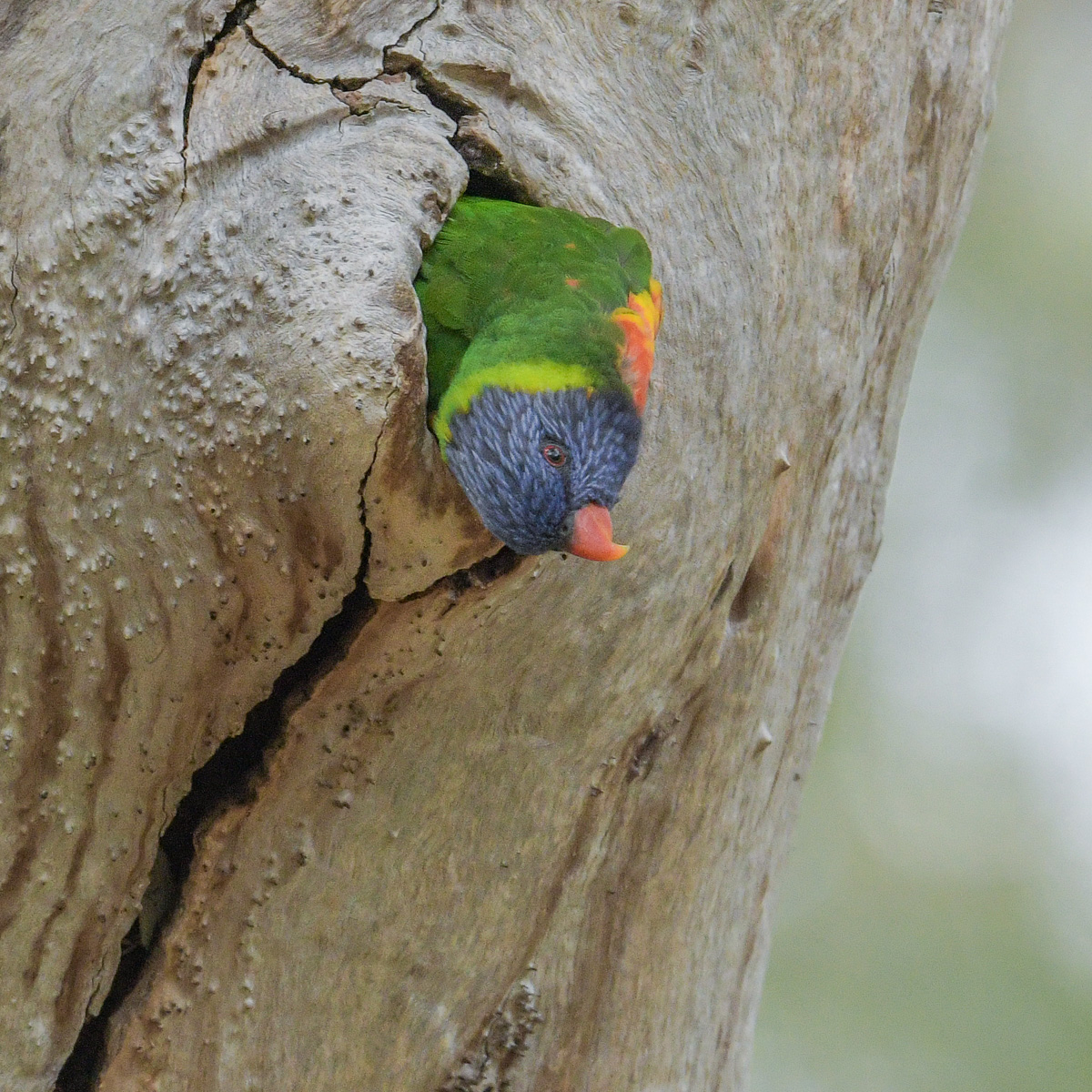
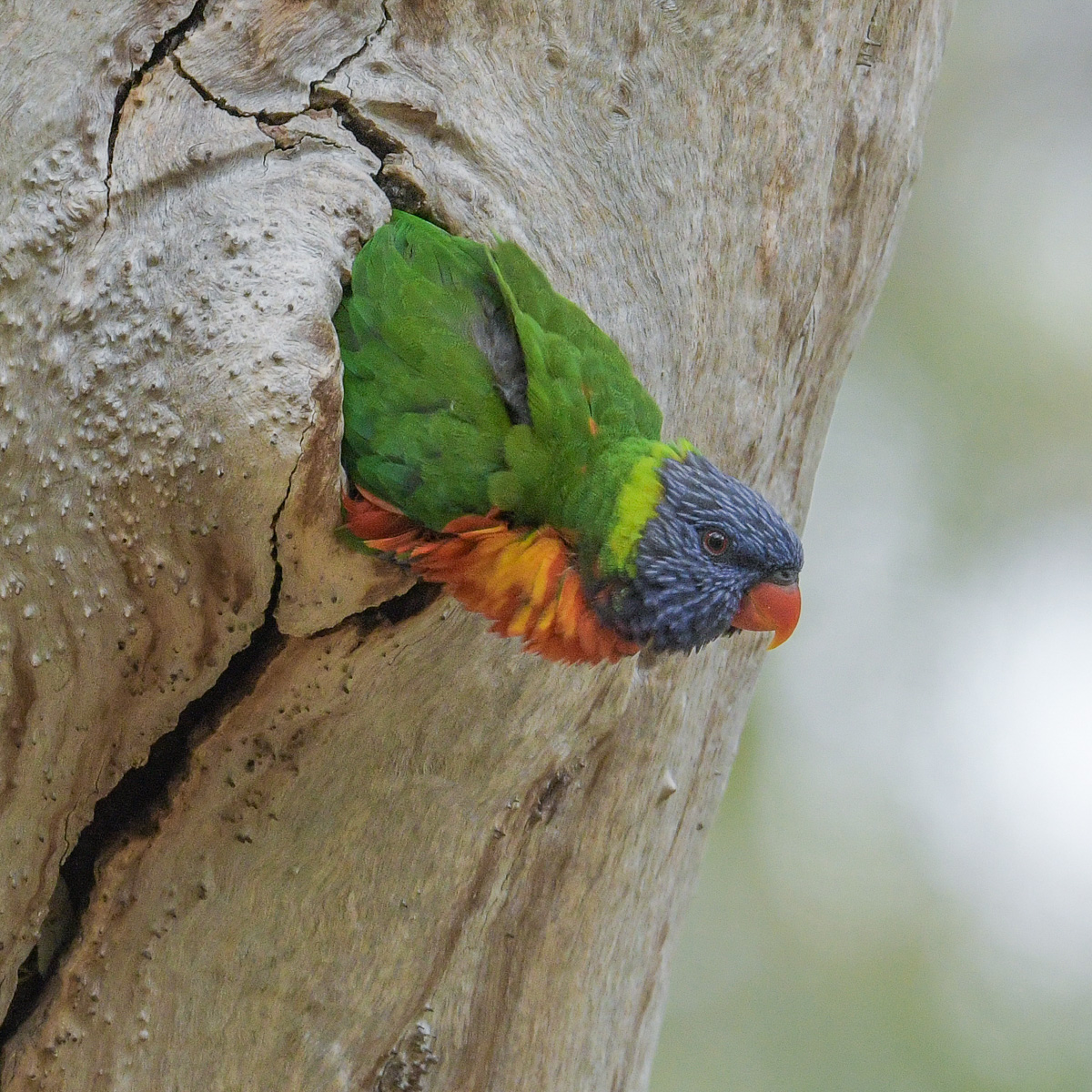
It was having difficulty getting out of the tiny hole. It could get its wings out, but not its tummy and feet, or its feet, but the wing width wouldn’t fit.
The Kingfishers tend to excavate a hole with a small entrance compartment, and then turn the hole, in this case, to the right. Then, I’m guessing, build the nesting chamber behind the little plug near the front. So to get in they must enter, and then turn sharp right. Easy if you are as small as a Kingfisher… not so easy if… you’re a big fat Lorikeet.
I’m not sure if this one was entirely stuck, or just couldn’t get a purchase with its beak to leverage the wider bits out of the tiny hole. So it stuck its head out, and as much of its body as possible, and swung about trying to get a beak grip.
After a couple of minutes, I do have to add, I said, “Well it’s your own silly fault” and decided to move on. Then with a big effort and some extra leverage it managed to slip out. When I returned later past the tree the pair where inspecting another, larger, and hopefully more suitable accomadation. Enjoy
Click on an image to got to larger size slideshow.
Over the years it’s possible to discern the differences in the calls of Australian Magpies. What the language means of course remains a mystery, but some sounds go with some actions.
The rolling call of a pair declaring their territory against all comers. The short sharp bark of a a contact call between birds feeding on the ground, just to stay in touch and know where everyone is. Alarm calls for the close immediate family, and a different one for local clans, and a different one again to warn other local clans of danger. No doubt there are plenty more.
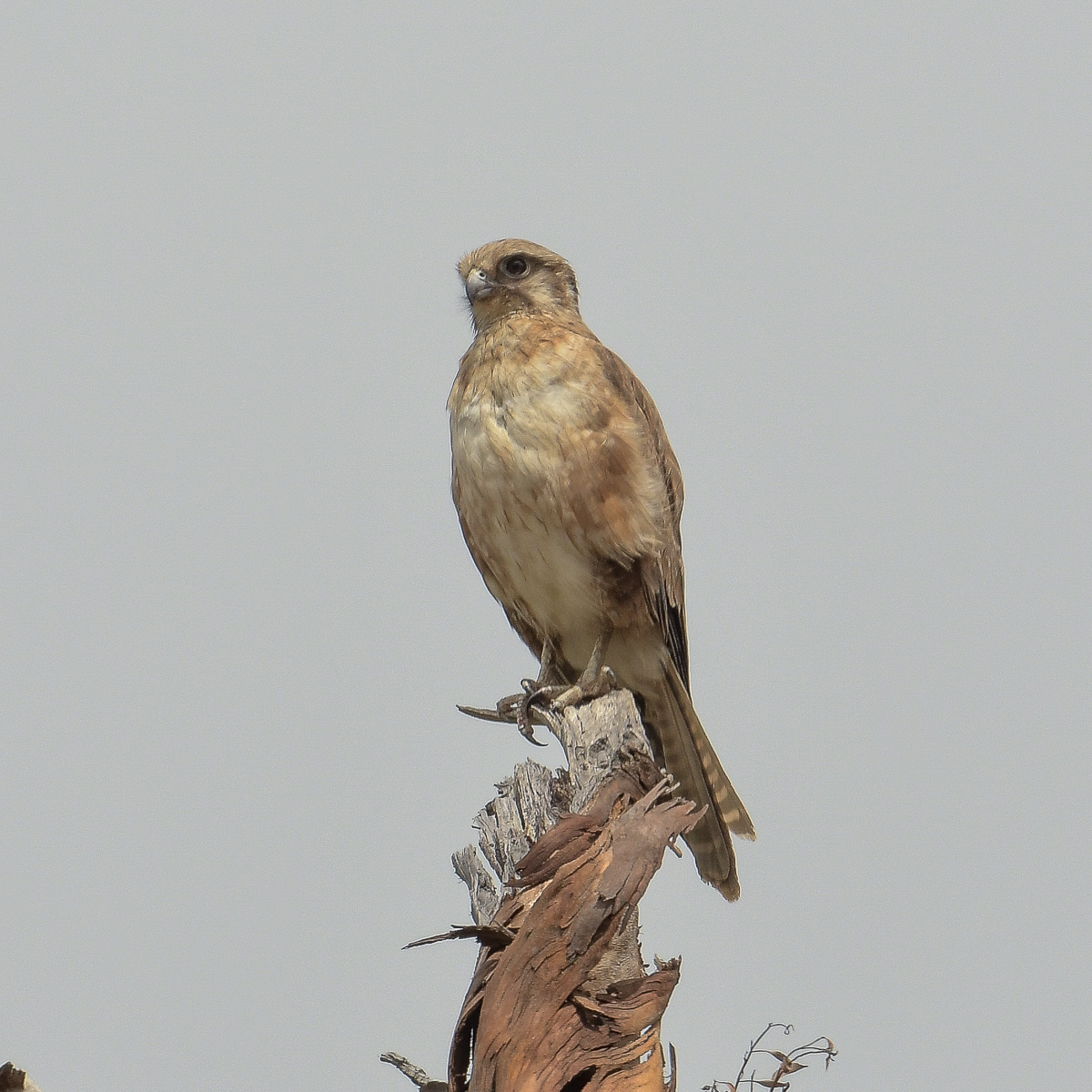
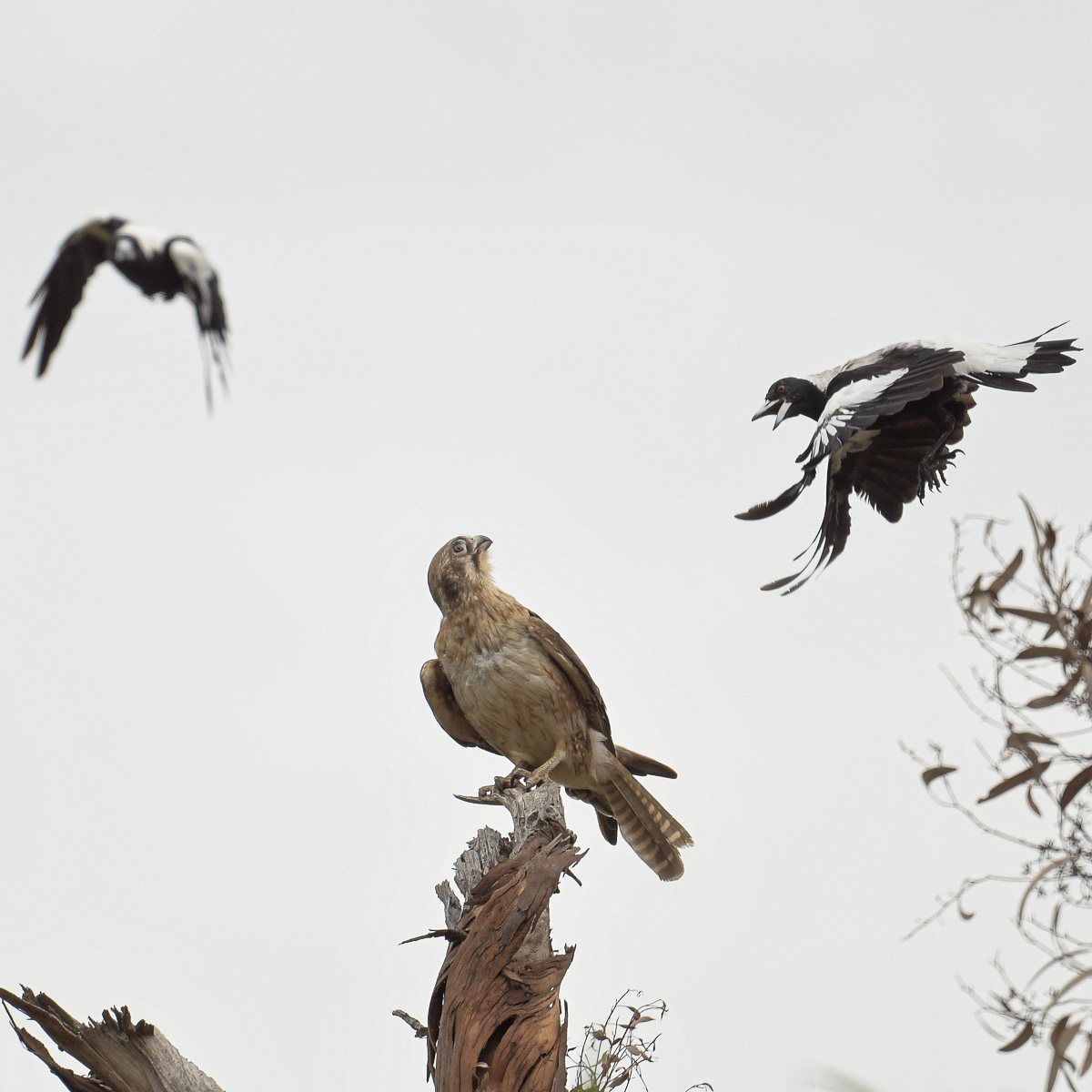
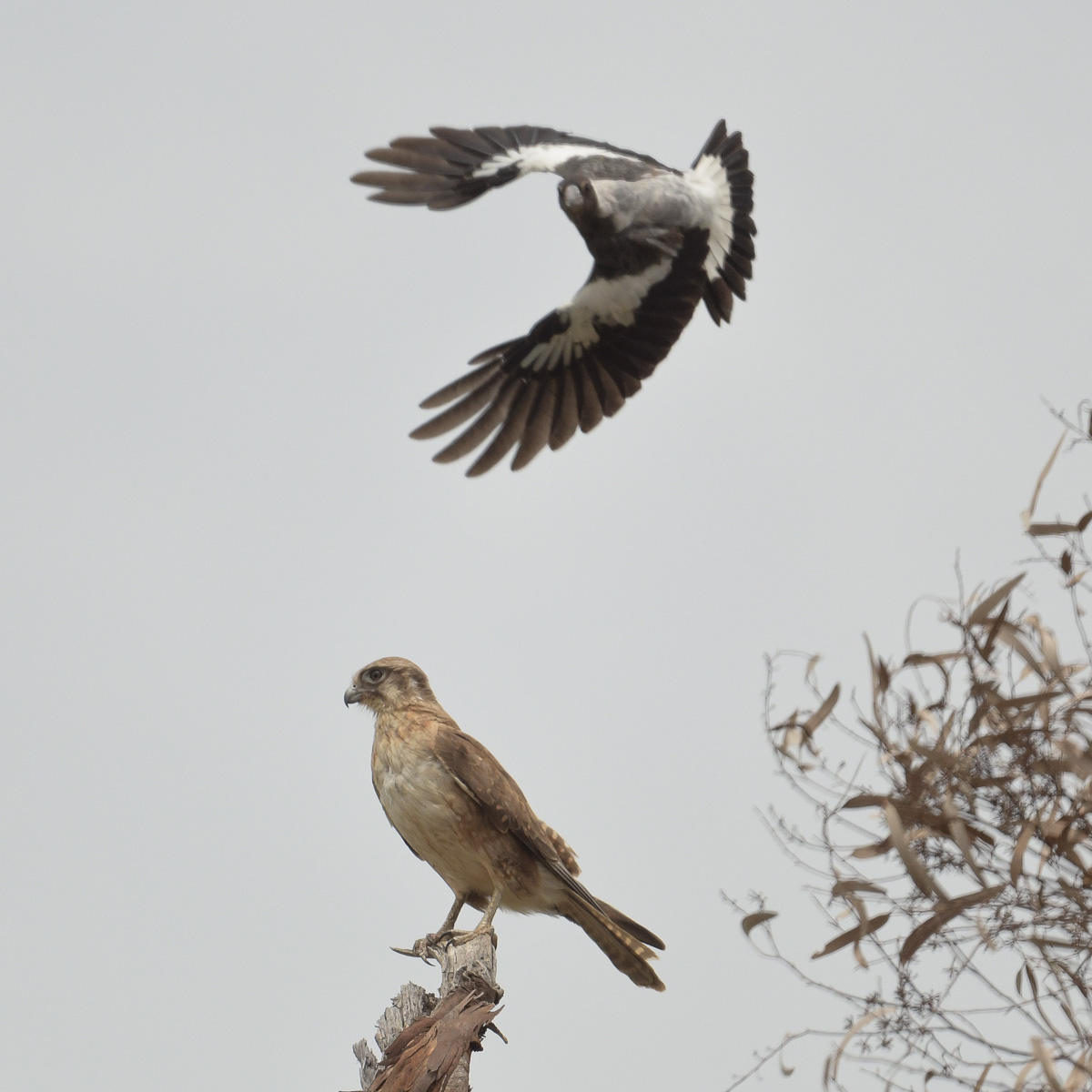
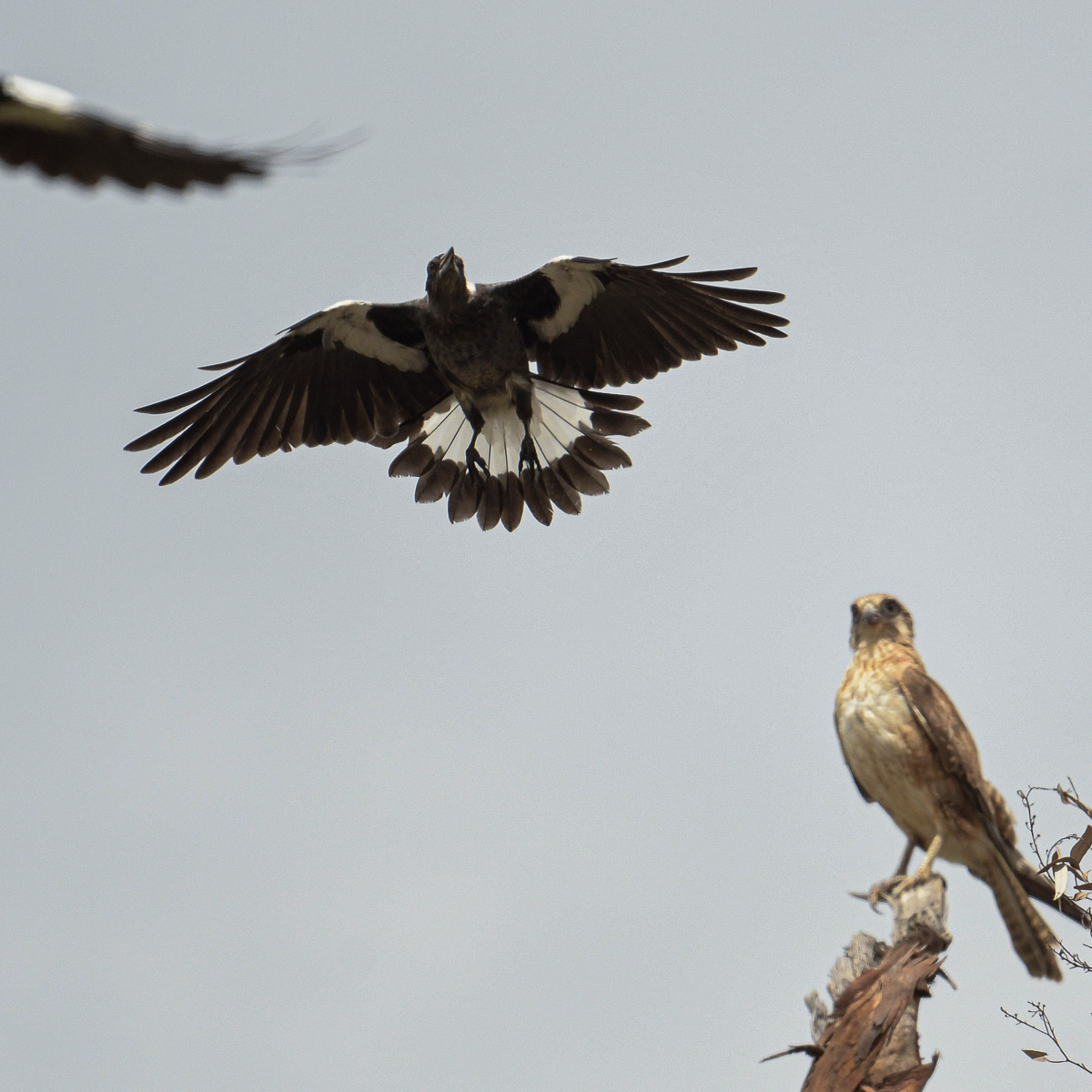
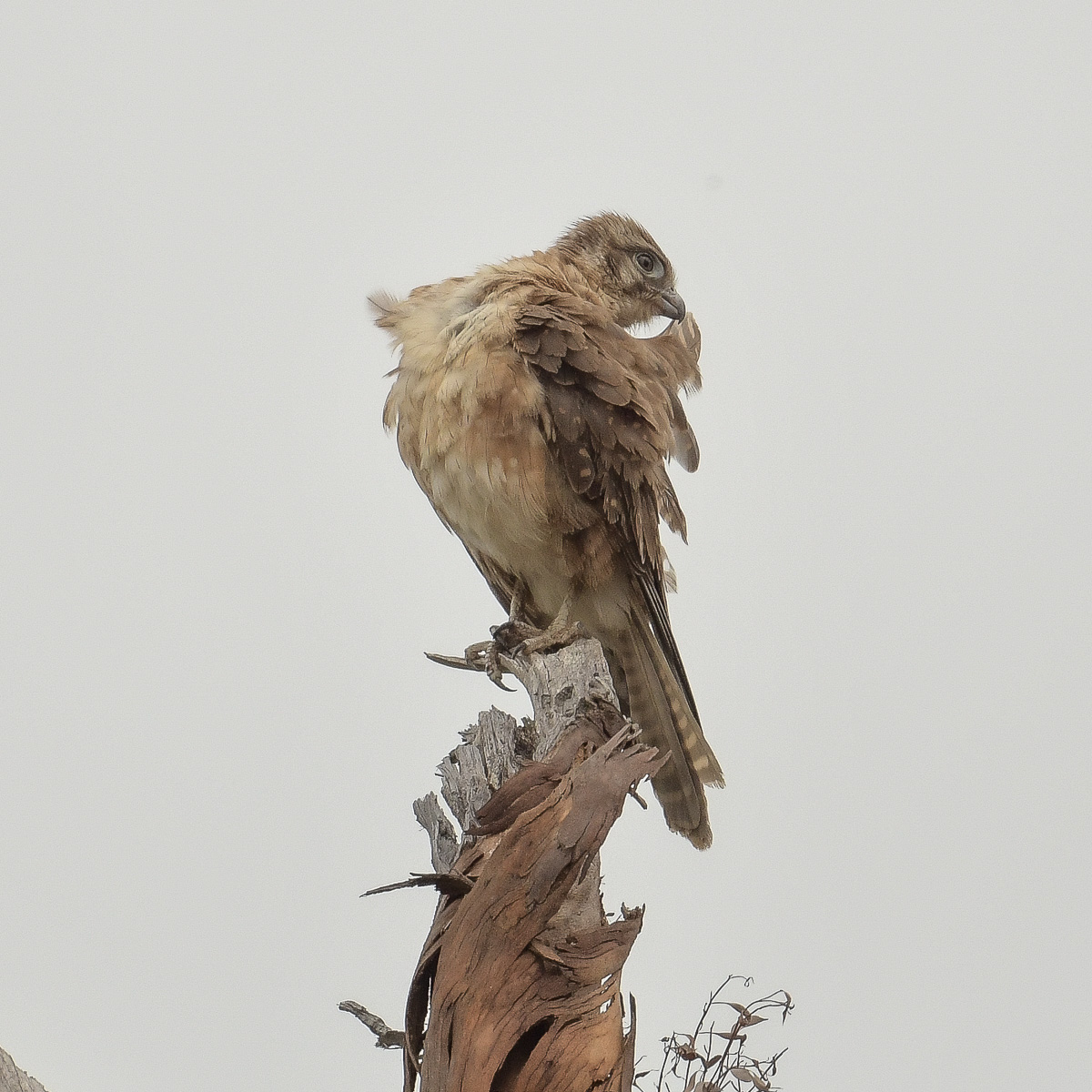
One call, I’m certain is distinct and the other day as we walked up the hill to iAmGrey to packup and head for home, the stark-highpitched agitated call went up from at first the Maggies in the local area, and then rolling down the field to others. I’ve heard it before, and exclaimed to noone in particular, “”Brown Falcon”. And as I turned around, not to check for Falcons, but to see where the Maggies were going, there on a lone tree propped a Brown Falcon. The family took off to harass it, and get it on the move. Brown Sat. Mum, Dad and a young juvenile made lots of loud calls and swooping attemps. Brown Sat.
The call went out to the next clan, and sure enough suddenly the hapless Falcon had five more loud, angry Magpies sitting the tree, calling and swooping. I sometimes wonder if there is not a bragging rights thing that goes on. “Oh, I got it to move”. “I put its wings up” “I was ‘this’ close” etc etc. Brown Sat.
By now the air around the Falcon was full of loud calling angry black and white feathered shapes. The Falon didn’t have much option. If it flew, the combined squadron would have had the advantage of speed and agility and it would have been mobbed all the way across the open paddock. Clans that were not directly involved were now spaced out along the paddock, supposedly uninterested, as they pretended to be really interested in meal gathering, but should the Falcon head in their direction, they would have been ready to rise to the challenge and add to the clamour, and so on to the next clan, and the next. Brown Sat.
We figured at least three possibiliies. 1. Brown had just finished a meal and was in no hurry to fly anywhere until it was digested. 2. Brown had spied some tasty morsel worth waiting for, and was going to sit until the right moment to pounce 3. Brown had no other option than to sit. Flying into such a concentration of Magpie angst could have serious consquences. Brown Sat.
Brown Falcon time is really impressive. 30-40 minutes on one location is not unusual. In the end, the clans exhausted themselves, and left the scene. Brown, now only had a photographer in the paddock to worry about. So it did what is pretty usual. It pretened to be unconcerned about the whole affair and began to preen.
I waited another 10 minutes. Brown Sat.
Other activities required my attention, so we left. As we drove out, it was still on the branch.
The past few weeks, I’ve seen a number of the photo websites I follow turn their attention to the ‘background’ of birds photos. I’m not going to rehash it here, but it was intersting that we have been working close quarters with a pair of Sacred Kingfisher hoping that among the busy realestate in the river flat forest that they might find a suitable nesting site. Many of the holes are already taken by a range of Rainbow Lorikeets, Red-rumped Parrots and sadly Common Mynahs.
The forest has some old growth Red Gum, but mostly a mix of younger trees. Each is strugglling to get as much of its canopy into the sunlight and the sun only pentrates in tiny, thin fingers though the covering.
Result for your photographer is little real bright light, so its high ISO speeds, slower shutter speeds and wide open lenses.
So I’ve been able to experiement with those dreamy soft backgrounds that the photo-info/influencer-sites have been lauding as the ‘new’ look. Funny how things seem to go round in cycles.
And apart from lots of mis-information the simple physics of it all seems to escape most of them. As “Scotty” of “Startrek” fame was want to say, “Ye Cannae change the Law of Physics”.
Depth of Field has three basic principles and a k=Constant to work this stuff out. Here they are. Lens focal length, Lens Aperture, Subject distance. And depending on how well corrected said lens is in design and manufacture will also influence the softness of the result. Lenses like the 70-200 f/2.8 and 300 f/2.8 series are cracking examples of how soft and milky those out of focus bits can become. Similarly, the 105mm f/2 and the wonderful 200mm f/2 have to be used to be appreciated.
Oh. The K?? Well in the calculation K has a value that represents:-“The Circle of Confusion”. And as every student who has had to make those calcs will tell you, “What an appropriate name!!!!”
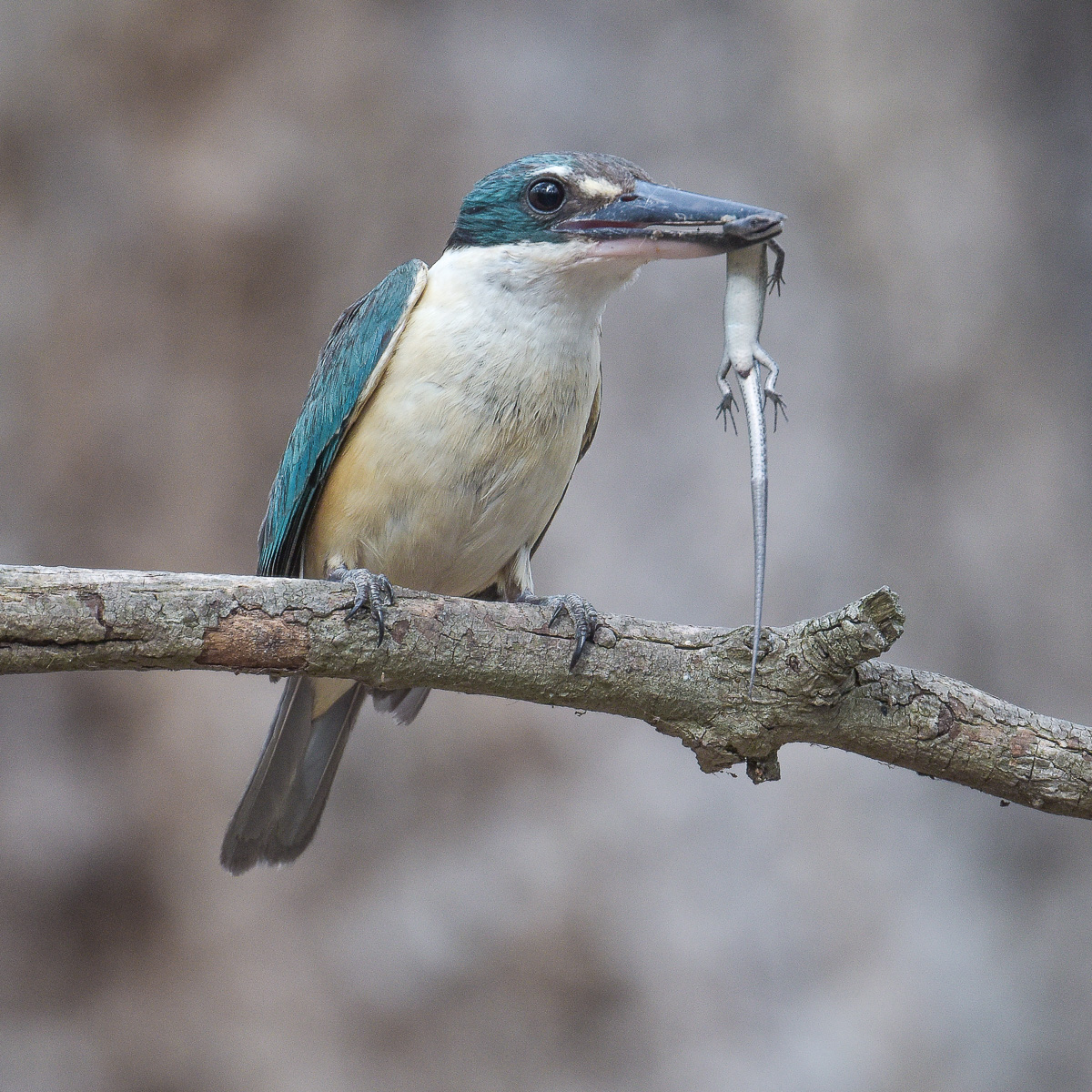
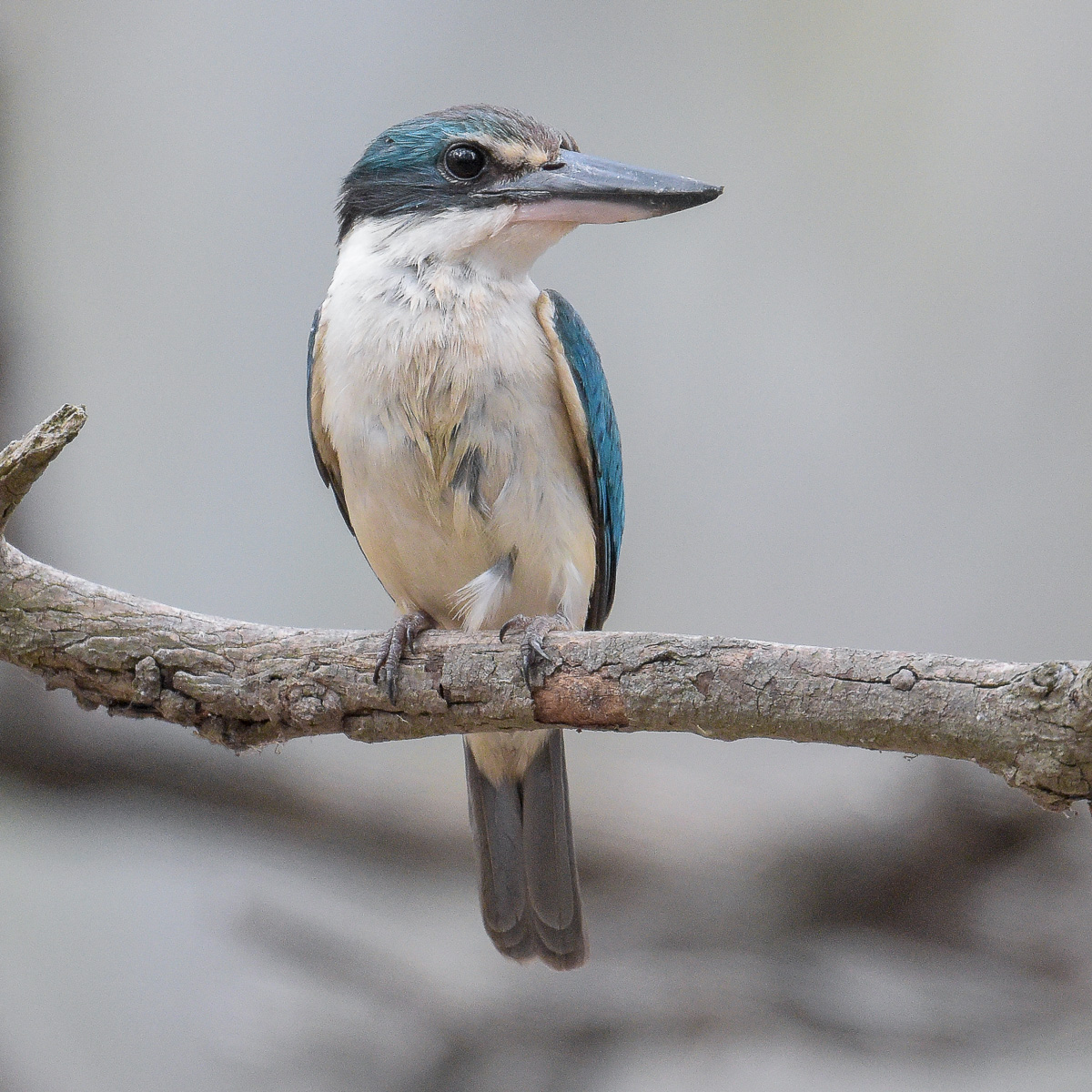
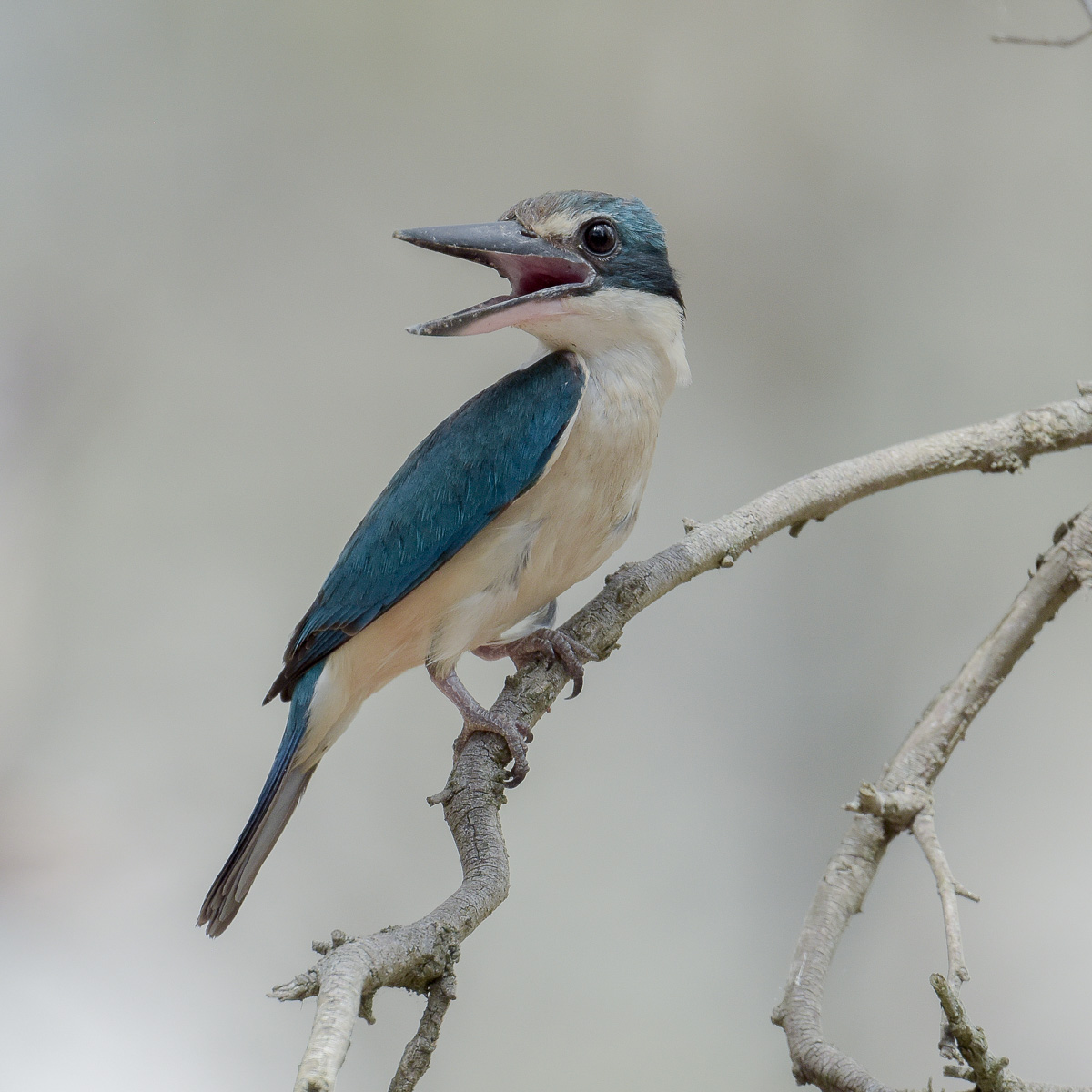
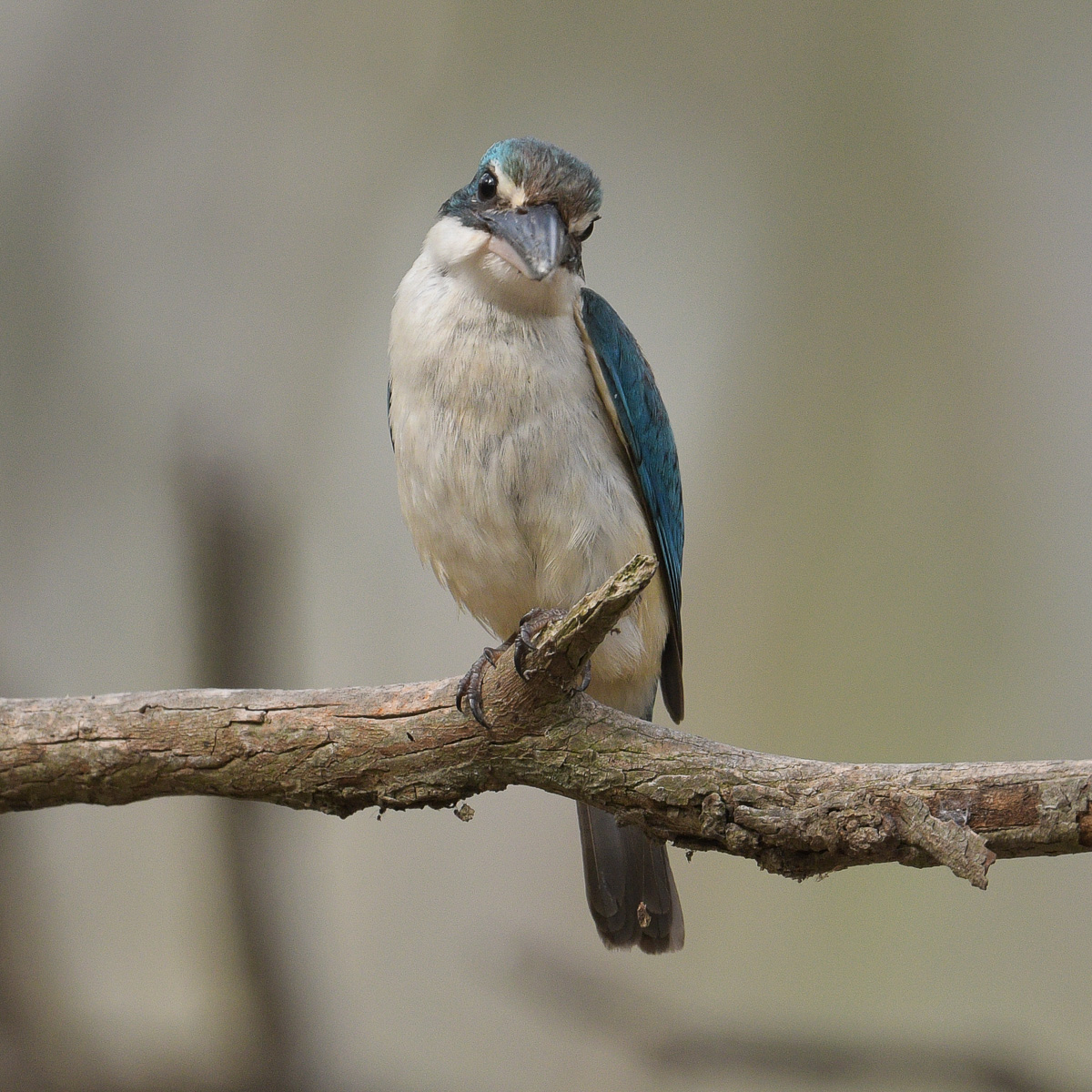
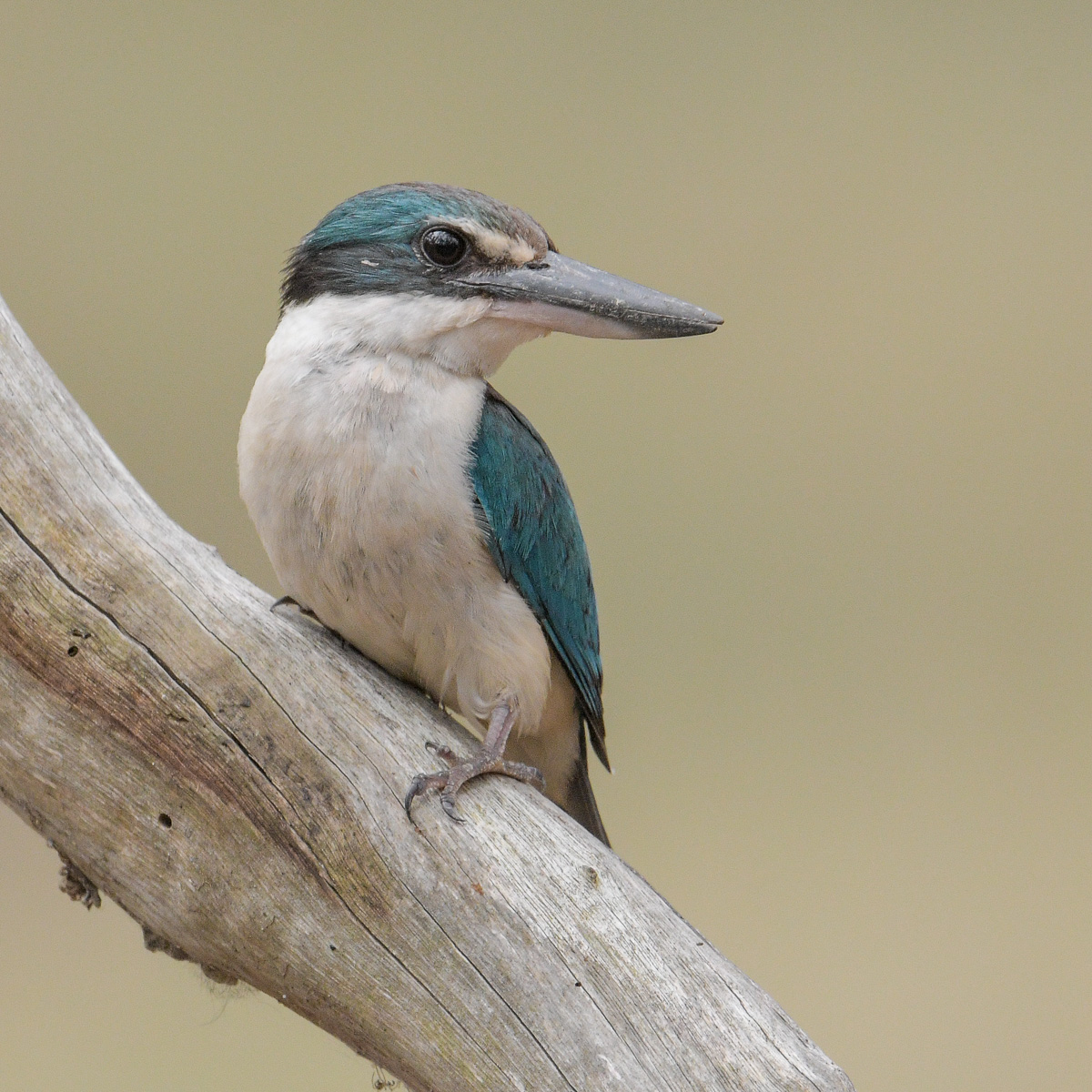
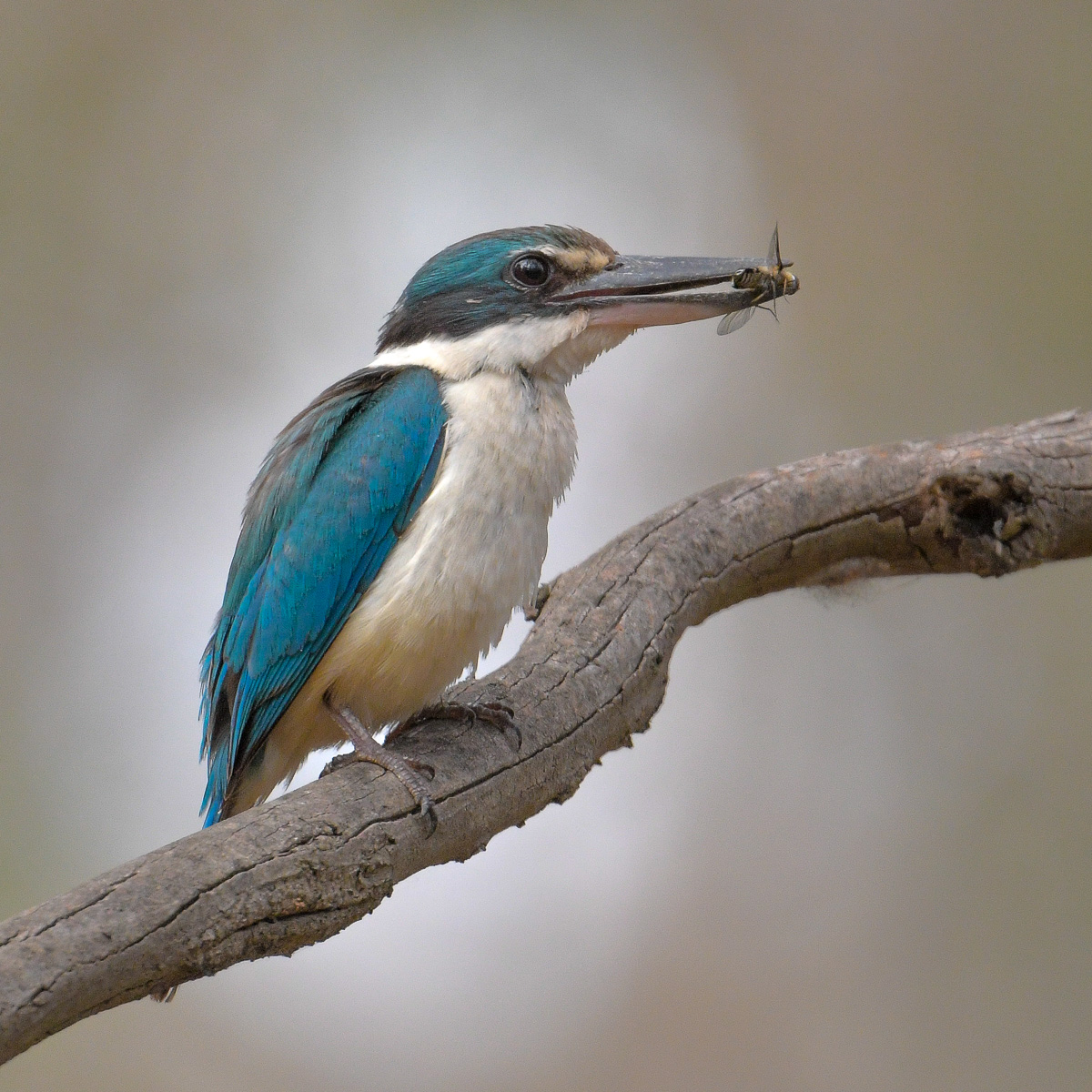
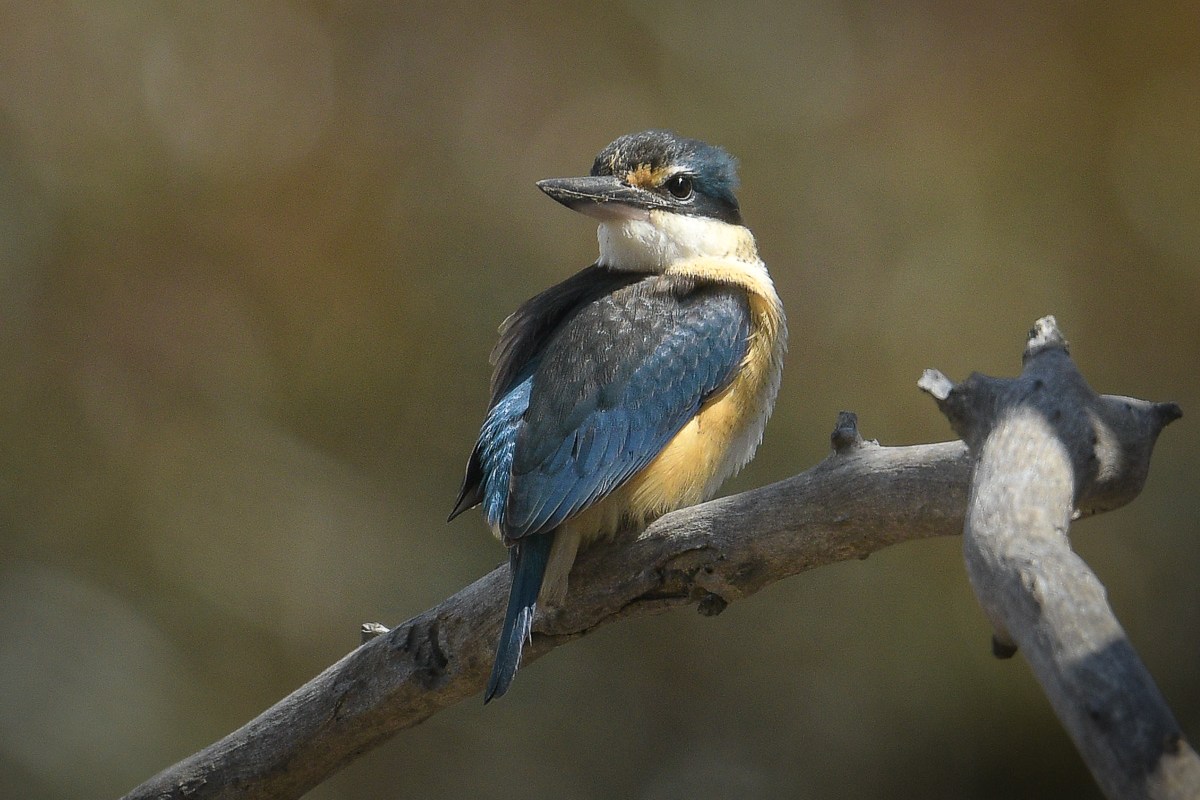
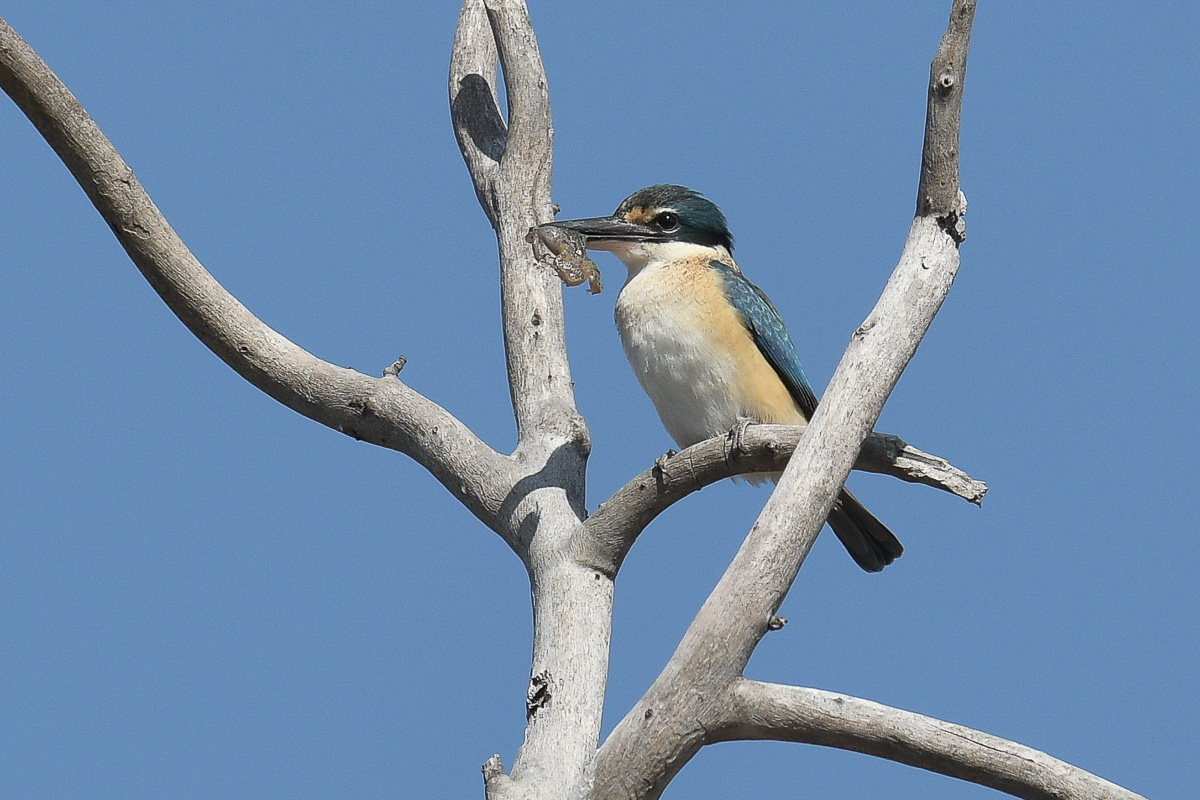
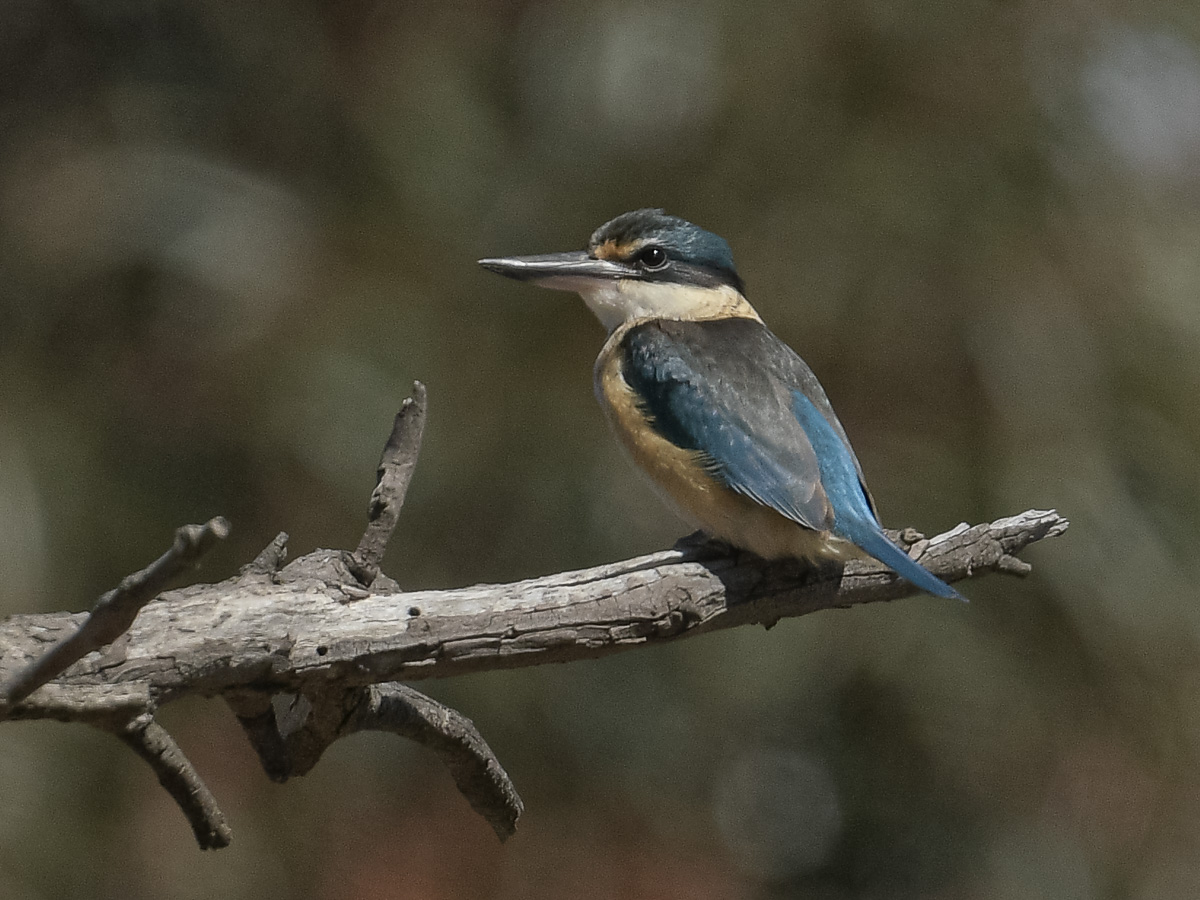
The softer lighting in the forest has helped reduce some of the harshness and two very cooperative Sacred Kingfishers who don’t seem to mind at all landing close by where I’m standing have given me some lovely soft out-of-focus-fuzzy bits. For the record, most of these shots were taken with the 500mm f/5.6 or 700mm f/8 (the 500mm with converter) or I even stuggled down with the 300mm f/2.8 and converter for 420mm f/4
Enjoy Its a Gallery so click on an image for a larger view.
And for bonus points. Both decided to show of their lunch on the same branch.
I don’t recall getting an invite, but here I am 2025. Faithful blog followers will have noted a lack of posts since about October last year—2024 in the old language. It’s not that I abandoned the blog, but have been at work on another compelling project that had no connection with either photography or birds.
I’ve also been wanting to update the style of the blog, and have my heart set on making the opening page look a little like Instra, with sqaure pictures across the page. But its proving more challenging that I expected. So here for the time, is the “No changes to be seen here” blog. Rather than force the issue, I also won’t be making a regular “Saturday Night Post” in the future. Just birds and words.
We had been working on and off with a pair of Sacred Kingfisher that seemed to be setting up for a season in a dry creek line. But in the end, it seems they either were “‘only foolin'” or have moved on to another location. Perhaps the lack of water, and the dry surrounds might have convinced them to look for a more suitable place.
So here, is a selection of images from those few weeks.
We had been travelling up to the family acres. A good part of the journey is on a two-lane freeway. The speed limit is a ‘suggested’ 110kph. I’m sure it’s suggested as most of the outside lane didn’t see it as a suggestion, rather as a lower limit.
The inside lane was mostly travelling at more modest, say, 90kph. That is normally the lane I sit in, as I’m as much interested in the journey than the desire to get there before anyone else. The 110+ lane was a constant snaking line of vehicles: Buses, Trucks,-small and large and B-doubles, cars, and Prado’s towing caravans.
Travelling in the “slow” lane does provide a chance to enjoy the around of the scenery, and of course to check the skies for any birds in-flight.
We managed to catch up with the end of the next slow lane parade, about 10-12 vehicles, and tucked in behind at a suitably safe distance. Meanwhile the steady stream of the fast lane streamed by.
Then one of those jaw-dropping moments. “You’d never believe it.” That can’t be right, No, Never.
Standing on the white-line between said, fast and slow moving traffic snakes was…
A Little Raven.
As the fast lane rushed by and the slow lane meandered along, the gap between the two lanes would not have been more than about 1.5 metres.
And there.
Walking along, like it was out for promenade, was a Little Raven. Seemingly oblivious to the rushing vehicles. There was no room for it to move between either line of vehicles, and we were about 8-10 cars back when I first noticed it. Still with wings tucked in, and a determined look on its face, it walked the narrow space between the vehicles.
Yajusthaddabethere!
We watched with heart in mouth as we approached it and quickly sped by. Thankfully we were the last in the line, and the Raven taking the opportunity lifted off after we had passed and dropped onto the side of the road. It’s cool, calm approach probably saved its life, and we were left to ponder if it had been caught out unexpectedly, or was it something it had done before.
Yet another lesson in the adaptability of some birds, and an opportunity to once again be amazed by the intelligence of these impressive creatures.
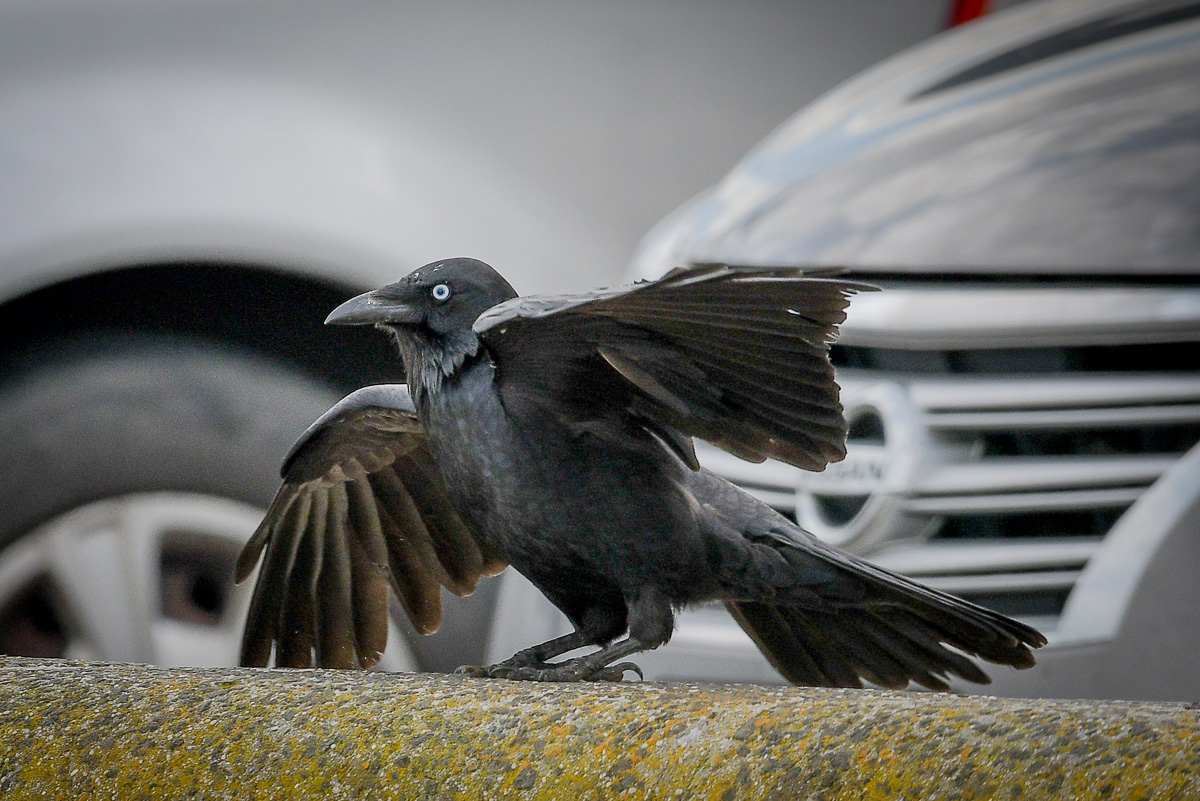
Of course I didn’t make a photo of that bird. Let’s face it, it certainly took me by suprise. So here is one I made in a carpark on another occassion.
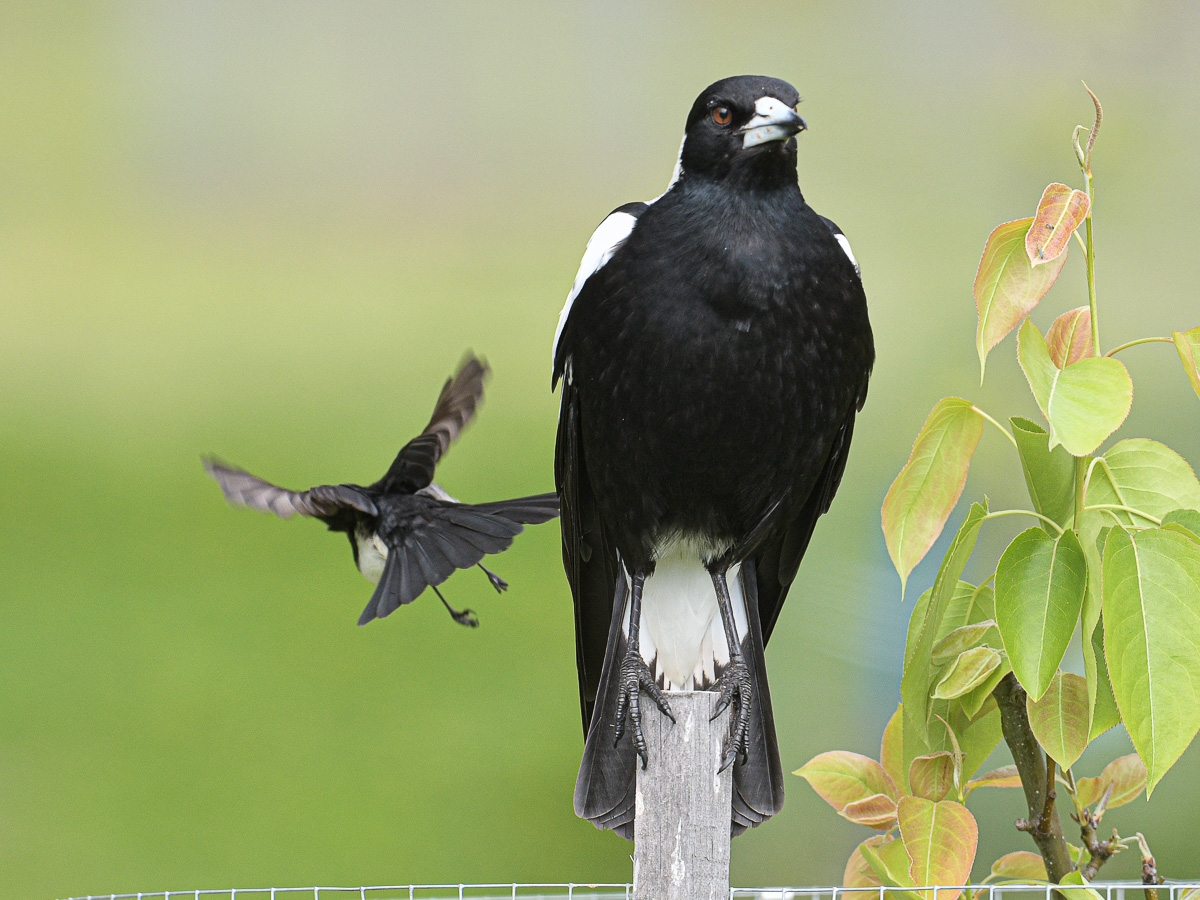
Just about anyone who has been out and about even casually observing birds will have come across the Australian Magpie. (We have two variations in Australia, a White-backed, and a Black-backed) In my southern location the White-backed in domicile.
Maggie won “Bird of the Year” in 2017, and with good reason. They have been able to adapt to the human condition, and thrive. Many streets and parks will have a family, and at present in our street one is sitting on eggs.
And casually observing will inevitably come across a Willie Wagtail that takes exception to the Magpie’s presence and a battle royale will begin. The brave little Wagtail seems intent with constant chittering and bumping into the Maggie to move it on. And no doubt with good reason. Most Wagtail nests are in the open, or at least in minimal leaf protection and the young make a fine meal for Maggie to feed to her young.
We were walking in a local orchard and Willie came out to see what we were doing. I know this pair from previous years and no doubt they have a nest or are planning to begin soon.
Willie posed well for me on a single garden stake, and I moved in a little closer for a better shot. At the same time four sets of large wings flashed between me and the garden stake. The local Magpie Family dropped down on the grass in front of me. The female and two younger ones, (one I take it to be from last year’s crop), began to feed in the grass, while the male forced WIllie from its pedestal and sat surveying the area.
Of course it doesn’t take your average Wagtail too long to regain its composure, and immediately it began to fly at the back of the the Magpie, eventually grabbing tiny claws full of feathers and sliding down it’s back.
I’m sure Magpies aren’t all that fussed by the harassment, they just take it as the cost of doing business. In the end the larger bird dropped to the ground to join the family, and Willie took its rightful place back on the garden stake. Such are the daily conflicts.
We’ve been up the family acres this past week. Had the chance to go and have a peek at a pair of Peregrine Falcon that have taken up residence in a creek-line escarpment
After the usual bumpy ride in along the old track, we were able to see the splashes on the rockface that showed their presence. The face they have chosen, catches the early morning sunshine, and because of the angle of the cliff, the light quickly goes off the face and leaves the nest in shadow. We had planned for an early start, but, as families, are, this had to be done, then that, and a discussion or two on other things, so it was a late start. By the time we arrived, early morning feeding of the sitting bird had been accomplished and it (presumably the female) settled down and occasionally poked its head over the stone battlement. The other bird didn’t return in the nearly two hours we had available.
I noted the rockface on our side of the creek was a little lower than the main bluff, so looked to find a way to get up a little higher. Rock climbing on a grade 27 (Ewbank) face is not something I was equipped for nor had a desire to free climb. I did find what could probably be a goat track, if there were goats in the area, (no pun intended) and it was no longer used, perhaps the ethereal goat met its doom there. After a little bit of struggle, I managed to get the old body carefully, and that is very carefully, upward on the loose rocks, and slippery wet grass. Not to mention assorted blackberry and prickly wattle and some sticky myrtle. That work gave me a view into the nest site. It’s a great site for such a nest, perhaps a large boulder dislodged a long time ago and left a sizeable hole which the bird could settle down into, and it would be protected from all but the worst eastern driven rain. (A rain we rarely get).
Once atop of the escarpment, I waited, hoping (she) might move in the nest, or the other bird might return for some flight shots, but time, as they say, ran out. I walked back along the edge as I’d seen a sloping area further around that was close to where the parked IamGrey waited patiently, and would be an easy descent. Great idea. Foiled by thick blackberry bushes and bracken. Not being able to see through the bracken as to what might be underneath lead me back to the aforementioned “goat” track, and looking down, it seemed even more precarious than going up. Once in a lifetime years ago, I would have tackled it and not even thought about it, now, each step was carefully considered and eventually without too much drama, except for those pesky blackberry and prickly wattle spots, I was back on ‘level’ ground.
One last look at the nest site, and it was time to return to family festivities.
Was doing a google search t’other day and as usual managed to get lots of info, most of it—irrelevant to my original enquiry. That I should have been surprised.
It was a simple question about how far can you see to the horizon. I live on the Western Victorian Lava Plains. The plains extend 350 km east-west. So I was wondering as I stand in the open paddock on flat ground, how far can I see in all directions. Seems the general consensus is around 5km. Mind my ophthalmologist will tell you at that distance most of what I see would be pretty blurry.
Why, no doubt you are wondering, and what bought this inquisitiveness on?
Sky Dancing
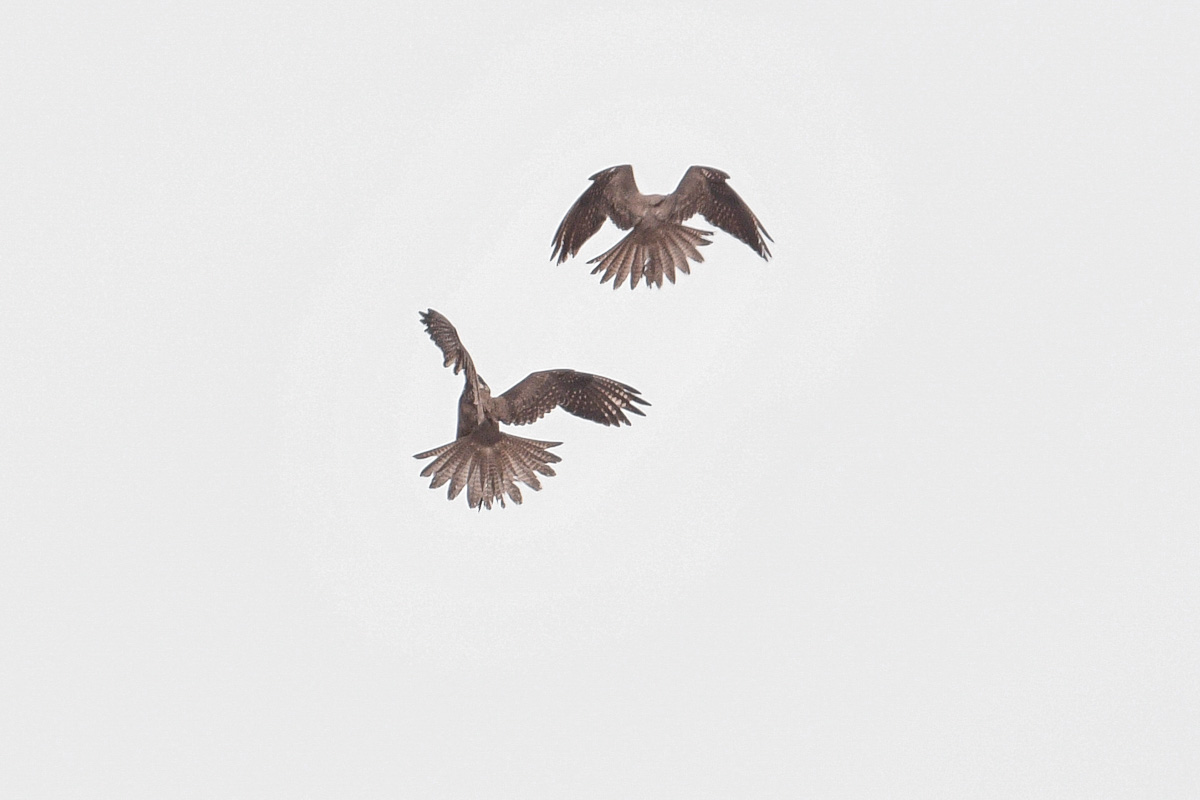
The area in which I was standing is part of the territory of a pair of Brown Falcon. As she prepares for a nesting season, they tend to spend a lot of time sky dancing. Pursing one another across the sky with much calling and aerial displays.
This pair are mostly human intolerant (Me too!) so getting close is no easy matter.
The winds have been high for the past couple of weeks, and on this day there were gusts of 50kph or more. The strong winds seems to give the birds an extra enthusiasm. Standing in the open paddock it was easy to see them scoot across the sky, from horizon to horizon. If you’ve never seen or heard a pair of Brown Falcons pair-bonding, I’d hope one day you can. It is accomplished with lots of aerial antics and much raucous calling.
From where we stood we are able to see them sweep across the entire sky. So quickly and so far that sometimes they disappeared from sight. It was humbling to see these birds flash back and forth covering several kilometres either side of where I stood in mere seconds. It would take me 15 minutes to walk back to IamGrey in the carpark.
They also were working quite high up, so any photos I made really are at a distance. These may not be the most useful pics I’ve made, but worth sharing.
Lots of flying close together, quite a few times one or the other was flipped upside down or even one on top of the other with only metres seperation. They were so fast on the wind, and so high that the normal harassment by Magpies and others just couldn’t get started. Even if a Maggie had made her best vertical ascent, the Falcons would have been a kilometre or more away by the time she got anywhere near to the height.
In the end they disappeared to a tree-line way down the range, and perhaps that is where this year’s clutch will take place. Time, will tell
The past couple of weeks have been anything but a birders paradise in terms of weather. Even the birds know it!
The beach at Point Cook where we currently are frequenting, has been beaten upon by wind and wave, and the sands have been moved from one location to another. It’s quite interesting to see part of the rock formations now standing boldy in the water, and further along the beach new sloped, almost perfectly sculpted, sands that would be prized in any tourist location.
From the early settlement days there is remnant of a pier that now stands, just a bit forlornly, a shadow of its former self. It has long been a resting place for the local cormorants and gulls, and now because many of the foreshore rocks are covered by sand, it is even busier that previously.
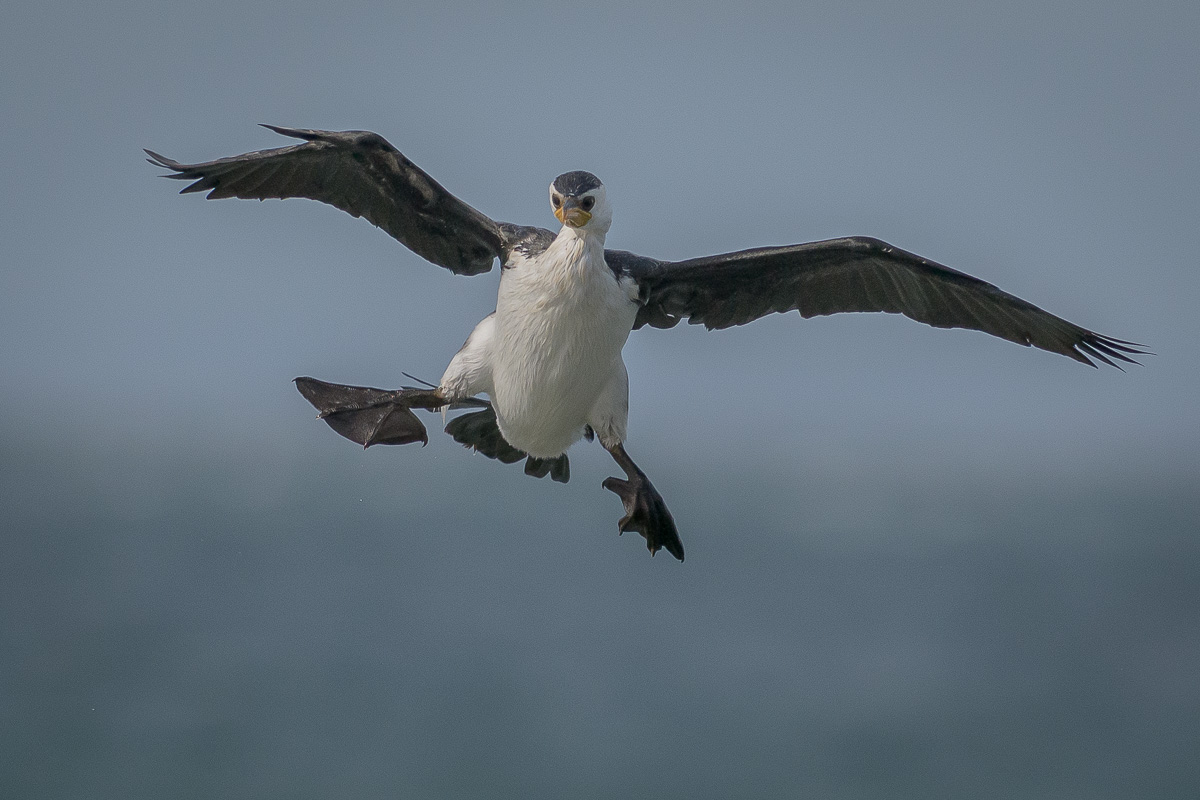
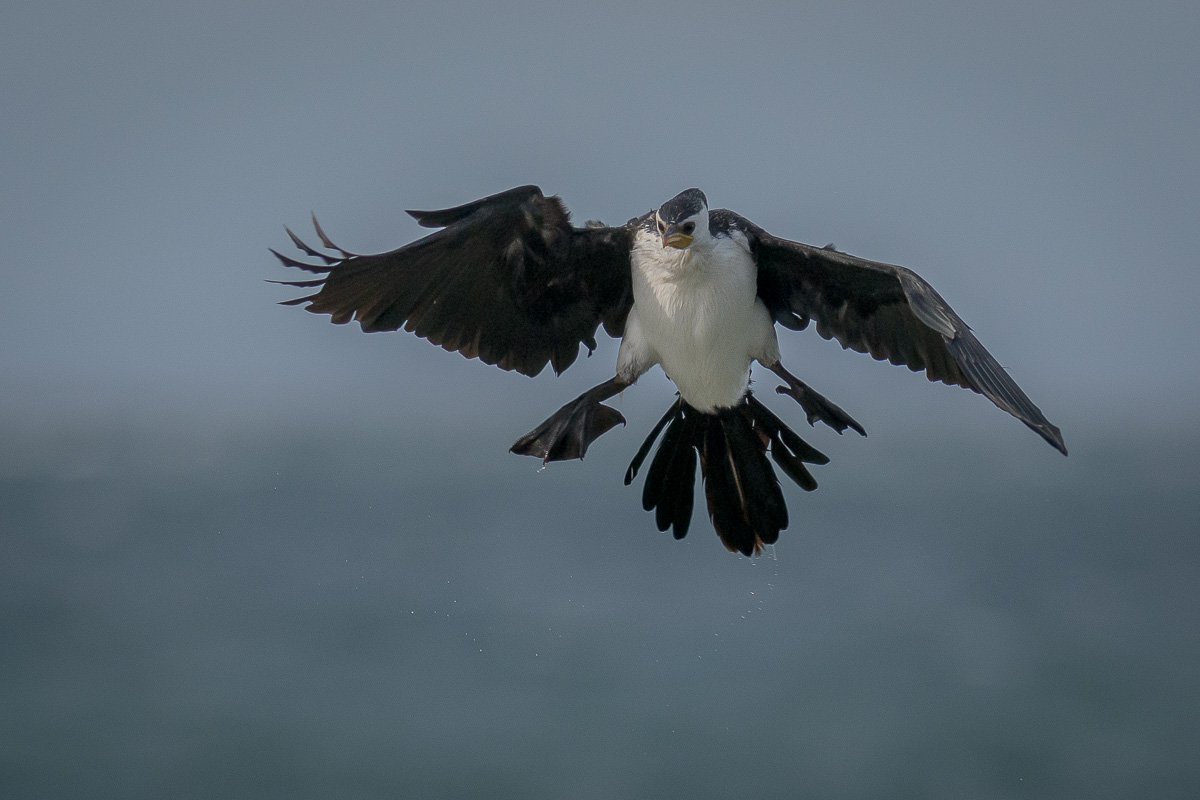
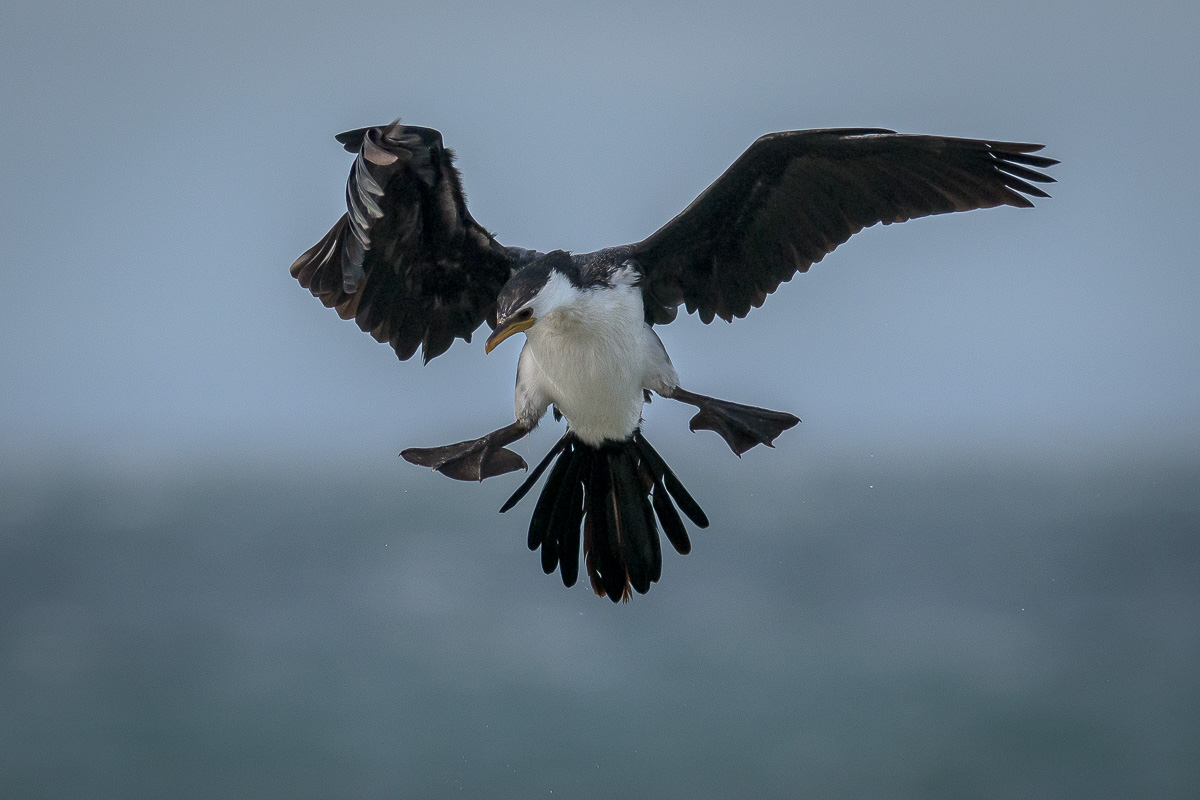
One of the birds that regularly come to rest and dry out are Little Pied Cormorants. For some reason, they seem to have a habit of a most ungainly landing technique and no two ever seem to be the same. So it’s rather fascinating to see them slip in across the water, all sleek and wings held out, to lift up and suddenly their confidence seems to change, and body, wings, and feet all seem to go in wildly different directions.
I’m sure there is method to it all, but it does provide for some interesting observations. Add to the normal challenges, this one was landing into about a 40kph+, with a few bursts that would have been much higher.
Still, persistence pays off.
Here’s another that just gave up and crashed into the water.
The arrival of Demeter and Persephone To the ancient Greeks, spring and summer signified the six months when Persephone returned from the Underworld, and her mother Demeter made the earth bloom and grow bountiful after her absence.
Now, of course this was written for the more northern climes, so for us mere southerners, perhaps Demi and Seph get two goes at coming around. Facts should never get in the way of a good yarn.
Now a good rollikin’ Greek legend has many a twist and turn The good Bard used a variation of the story in his play, “A Winter’s Tale”, with the basic structure recalling the myth of Persephone, a beautiful young girl abducted by Hades, the god of the underworld, from a flowering field where she was playing. Allowed to return six months of every year to the earth’s surface, Persephone’s comings and goings explain the cycle of winter and summer. Demeter, of course, is the one that negotiates the release of her daughter, and so every year as Spring rolls around mother and daughter are reunited and the earth,—because of Demeter’s happiness, blossoms and new life develops . The Bard, in his way, used a tad or more of poetic licence on the basics of the story.
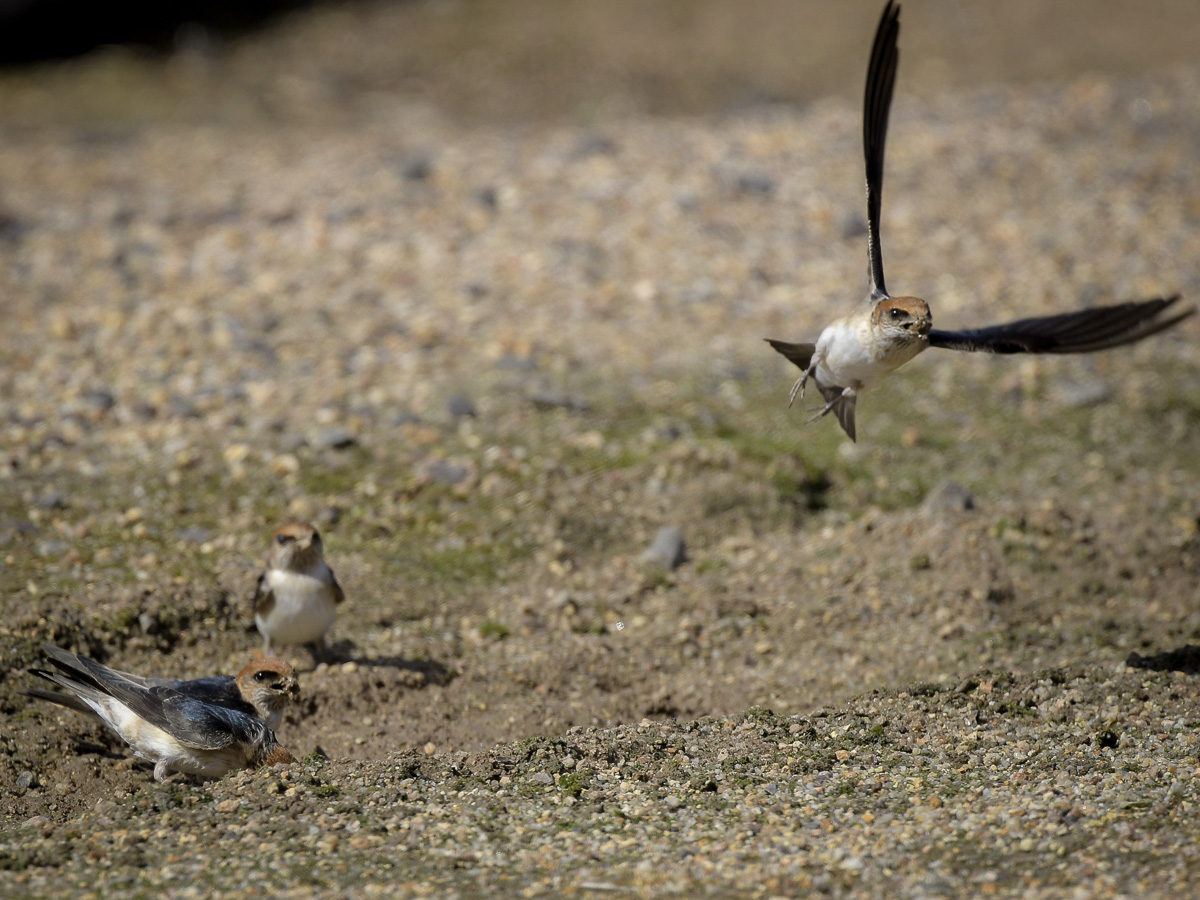
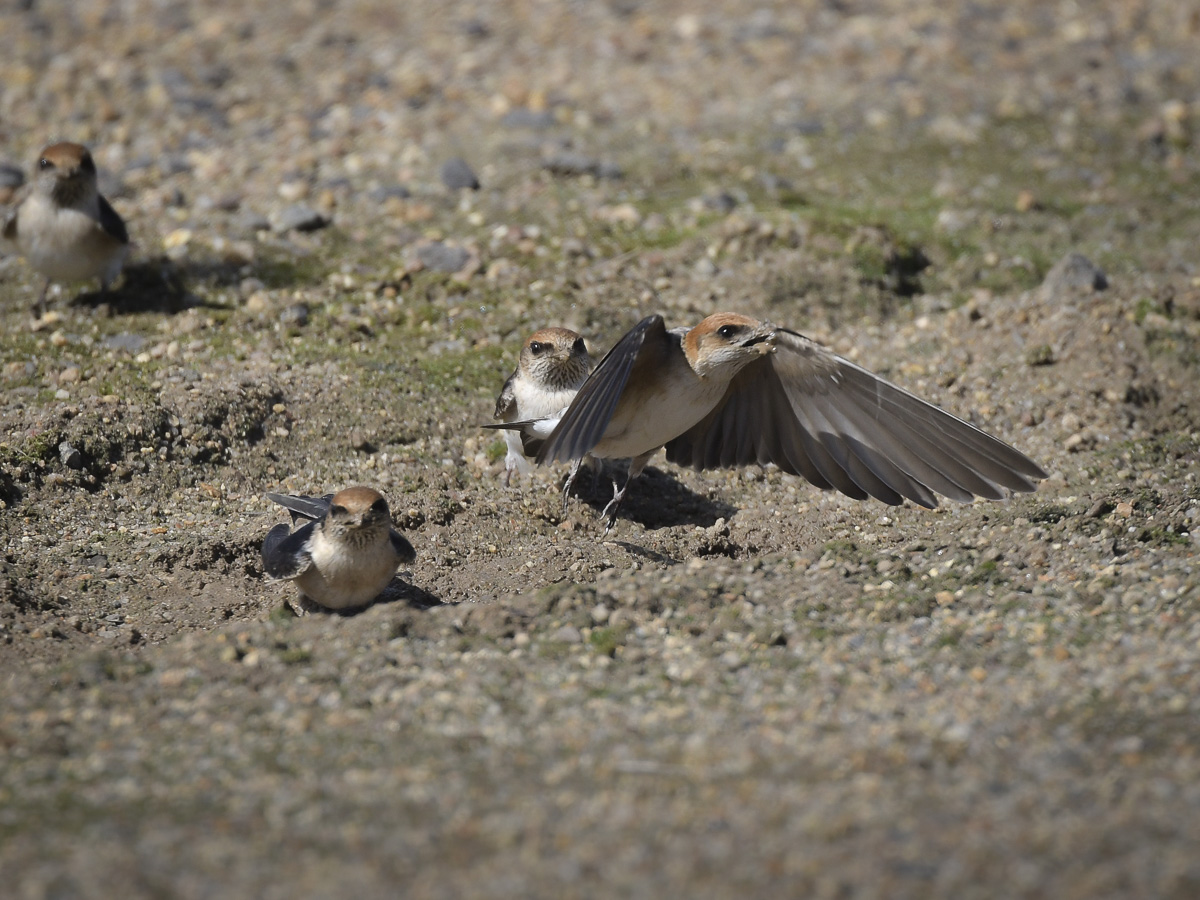
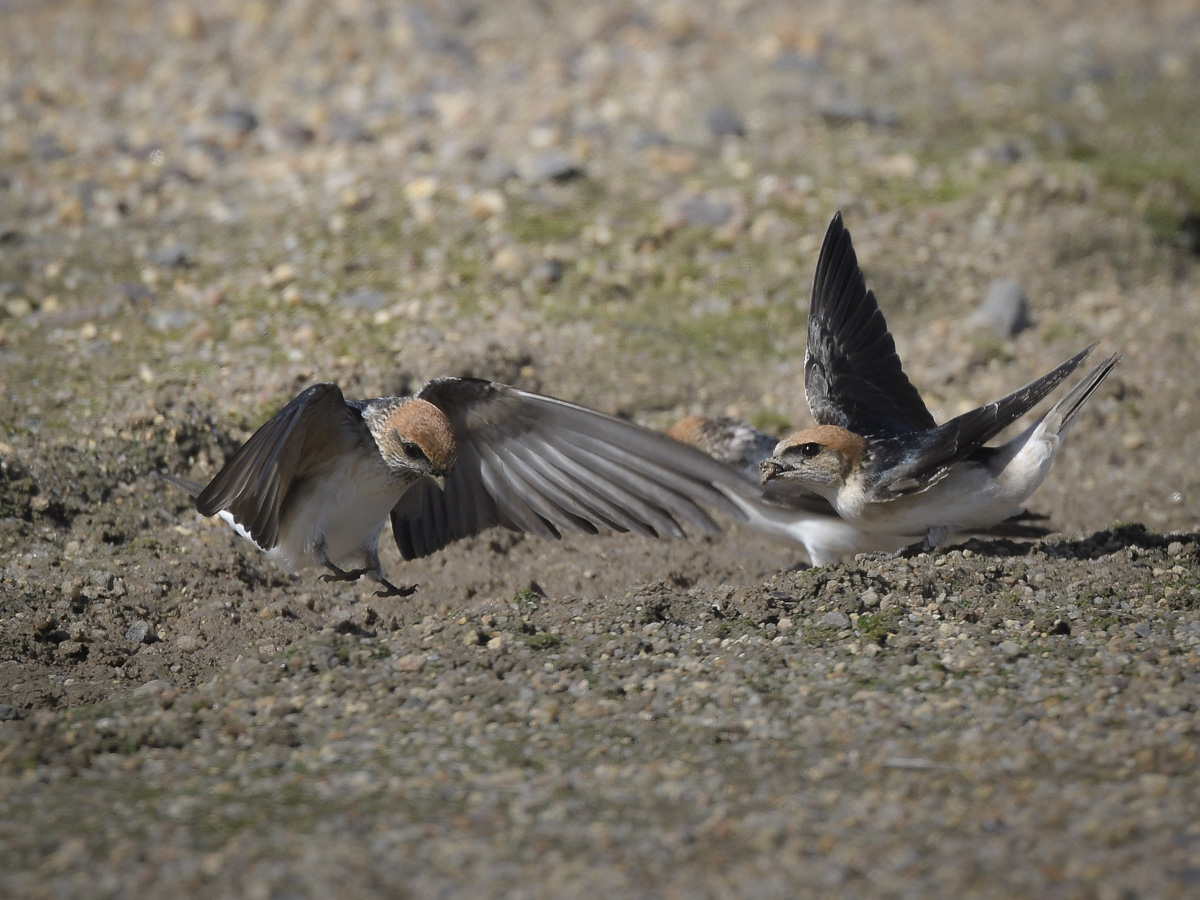
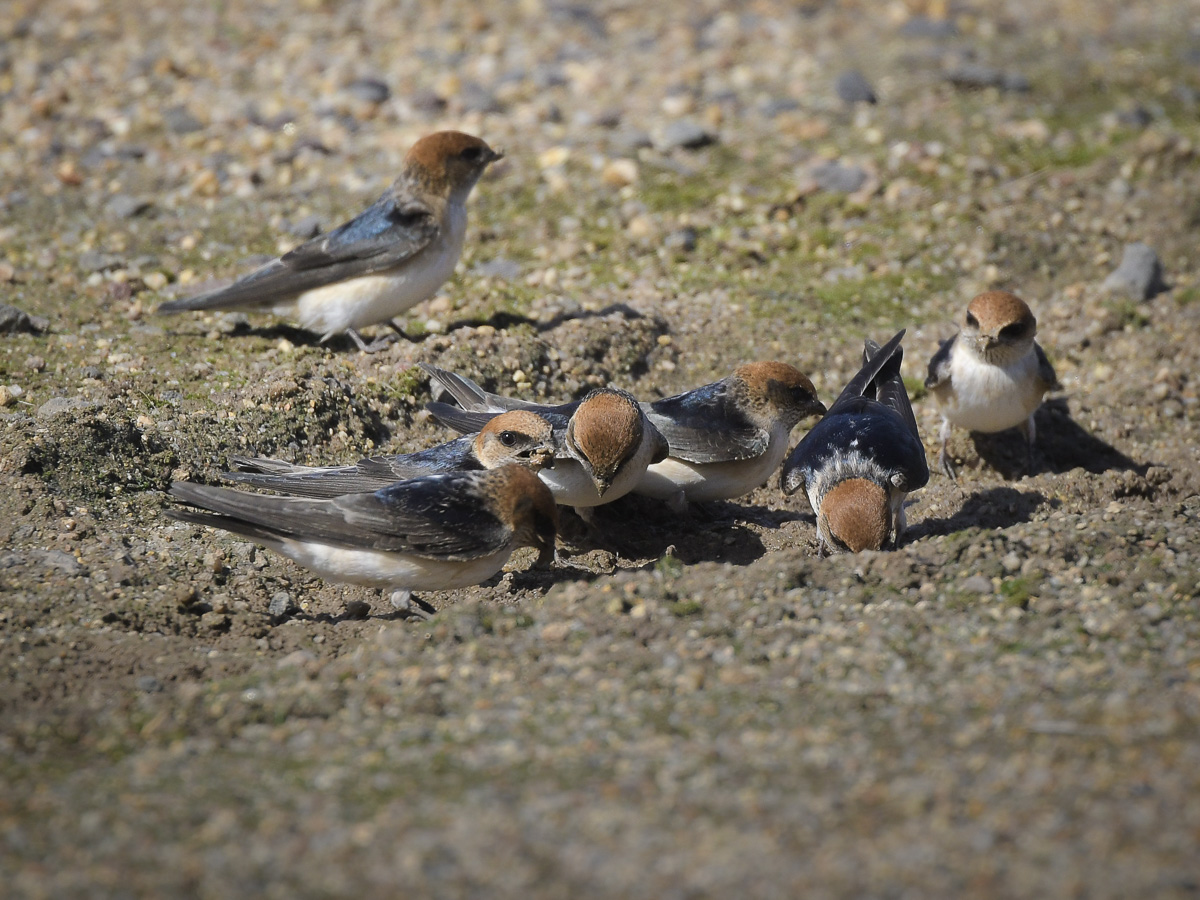
Fascinating, I’m sure, but I’m also sure that the flocks of Welcome Swallows, and Fairy Martins are driven by more than a whimsical legend or an English poet/playwright.
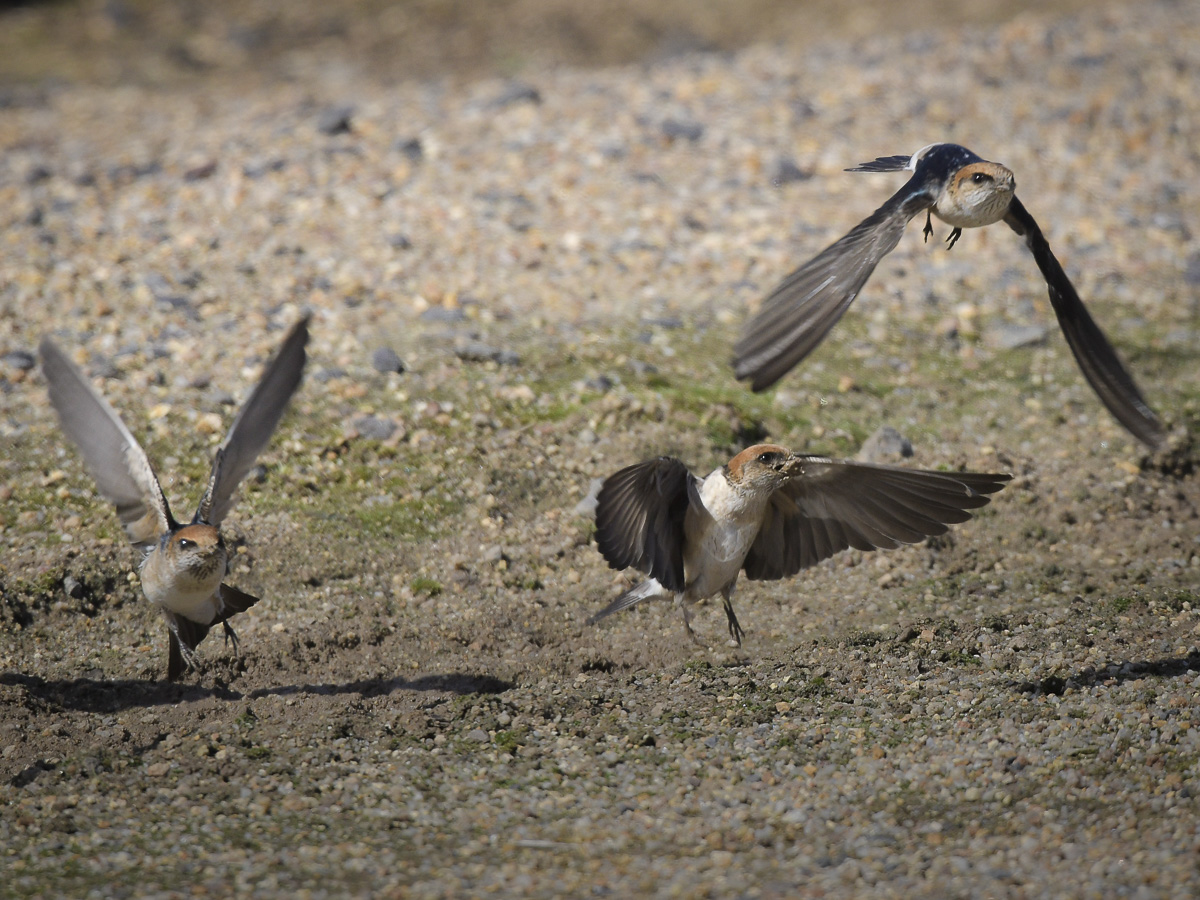
We had decided that as the sun was shining and the wind wasn’t howling, that a trip down to Werribee South Marina,(and coffee shop) would be a pleasant way to spend the morning in the sunshine. Close by to the waters edge, there were still few tiny puddles of water, and some mud. For the next 30 minutes or so the Fairy Martins and Welcome Swallows swept in to collect material for their little nesting projects. Wouldn’t it interesting to know how many trips they each made, but they must have had a site quite local, as no sooner did they seem to depart than they were back for another load. The small area of mud was alongside a busy footpath. (The sunshine bought out not only Demi and Seph but all the locals for their dog-walk and coffee fix) The little birds seem to pay it all no attention, lifting off if disturbed, to circle about and re-land. Such is dedication. Demeter would be proud And such was the action that a pair of Magpie-larks joined in as well. However I missed seeing their mud collecting.
On the way home we stopped for a few minutes as there is a family of Magpies on the corner of a close street. How close? Well between EE and I we walk past the tree several times a week, in the early first light of morn.
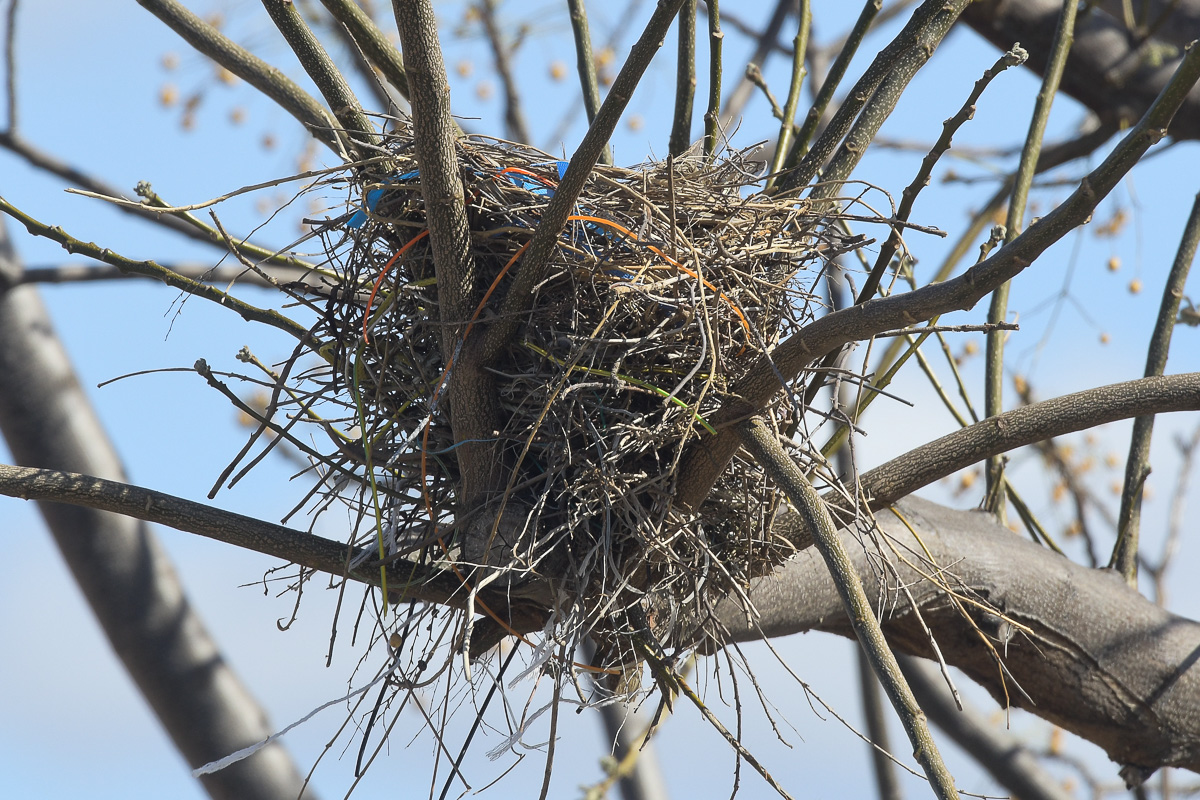
I went by earlier in the week and didn’t notice anything unusual, but Mrs Maggie has been very busy and has in just a few days constructed a very secure, if somewhat open planning nest. Suitably festooned with discarded building site materials. Colour Coordination is obviously important to throughly modern roadside Magpies. I’m thinking I might name her Persephone.
As I can easily see the nest from the footpath, I do hope to keep a track of the comings and goings as the season progresses.
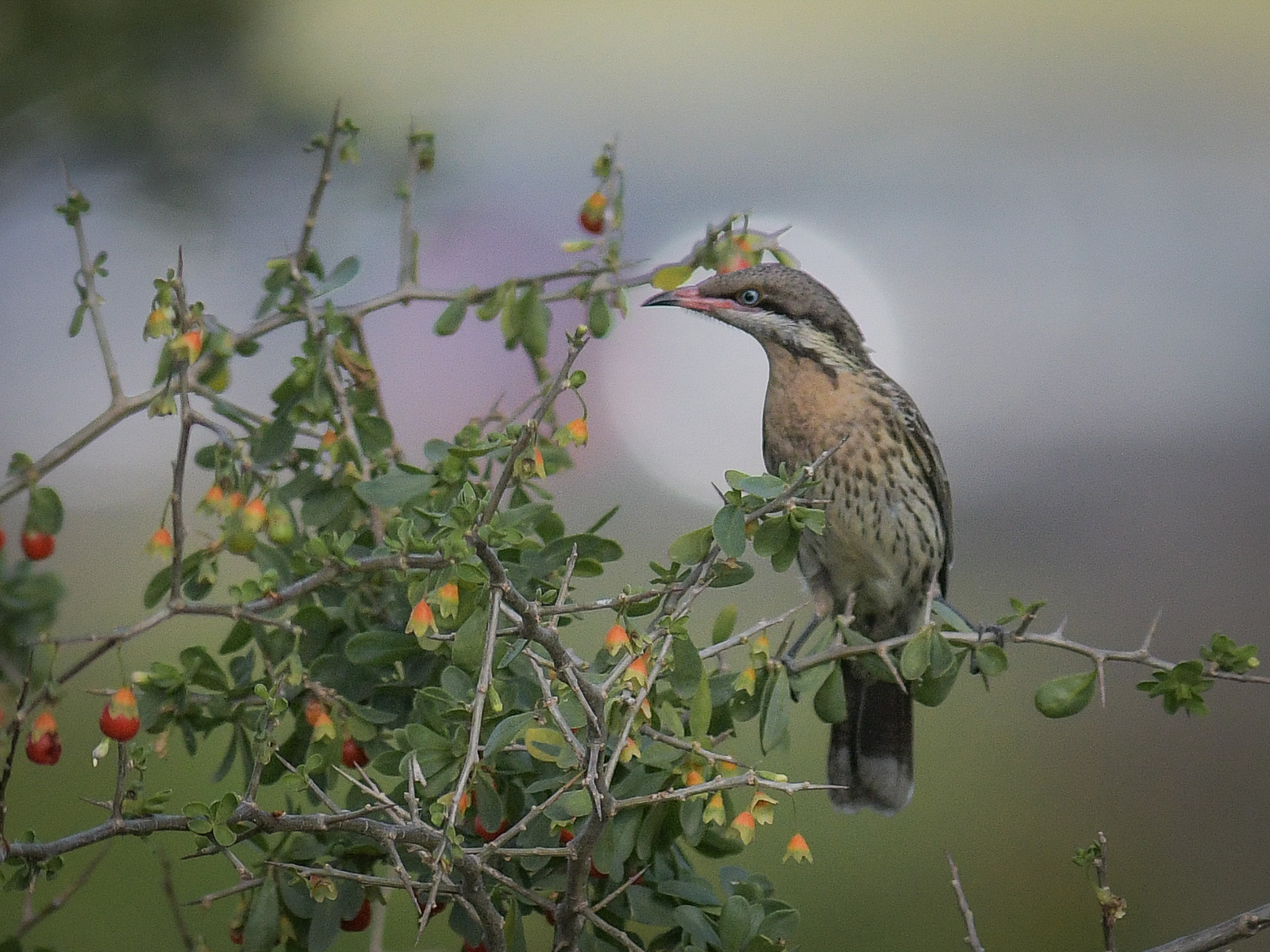
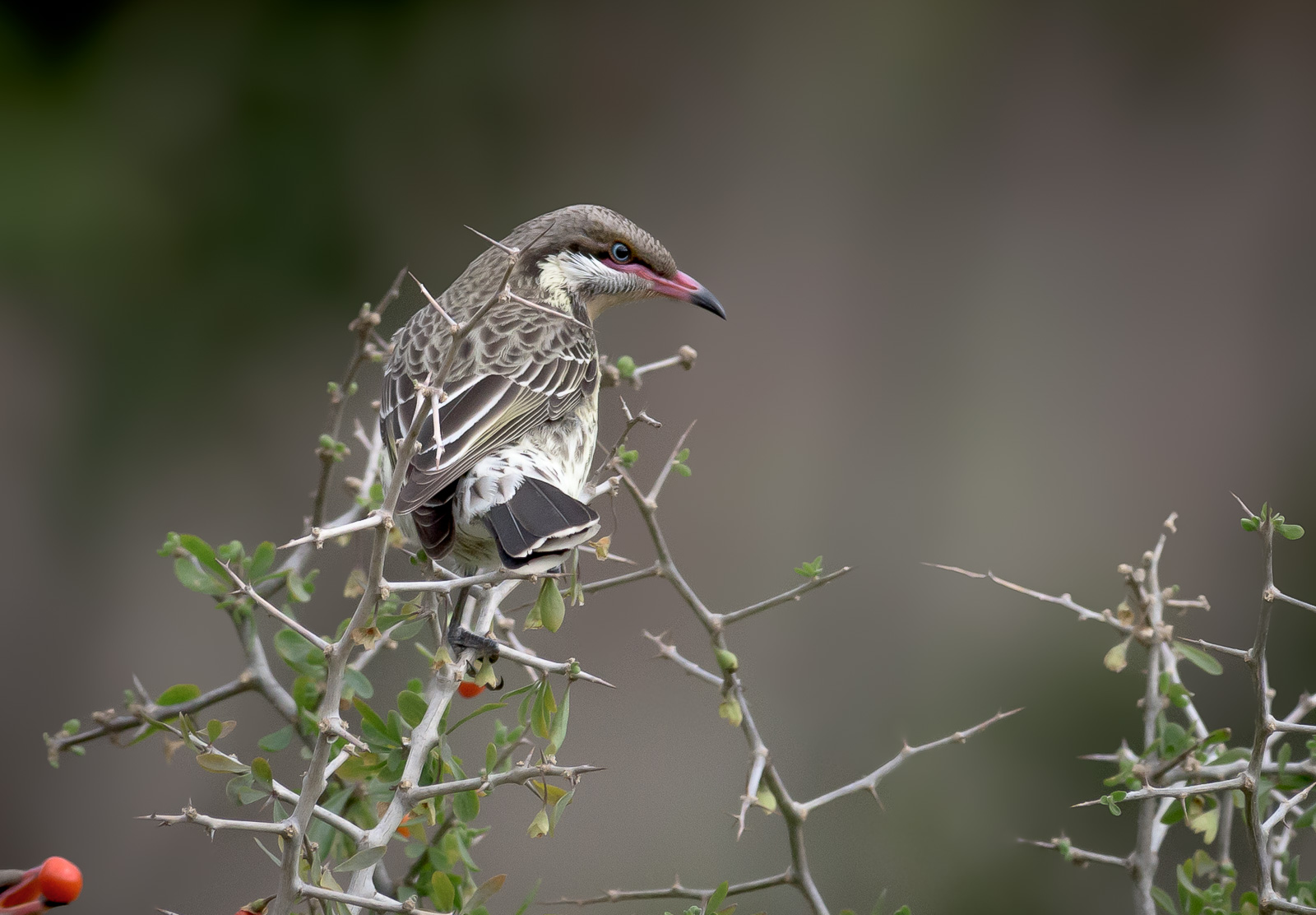
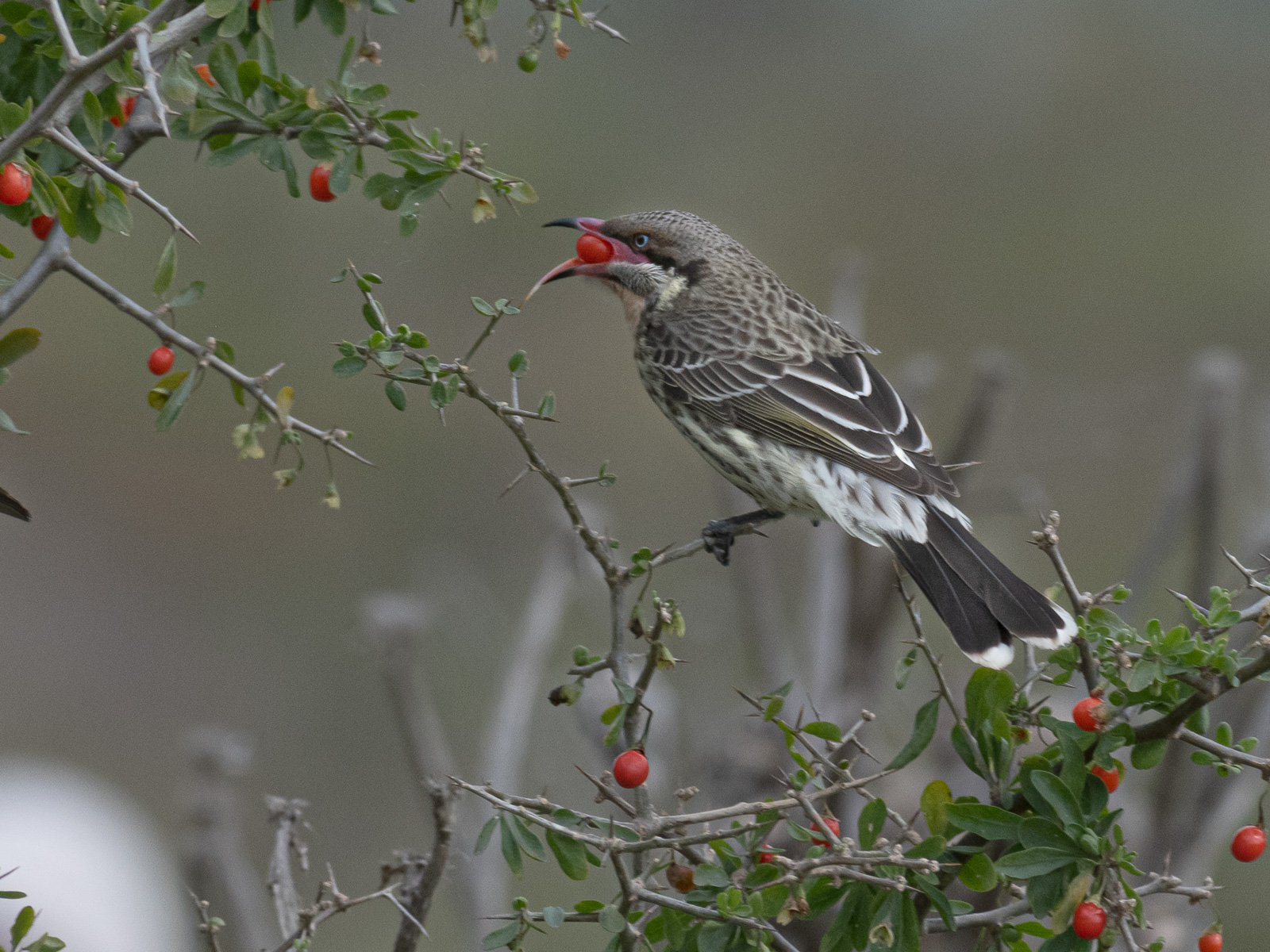
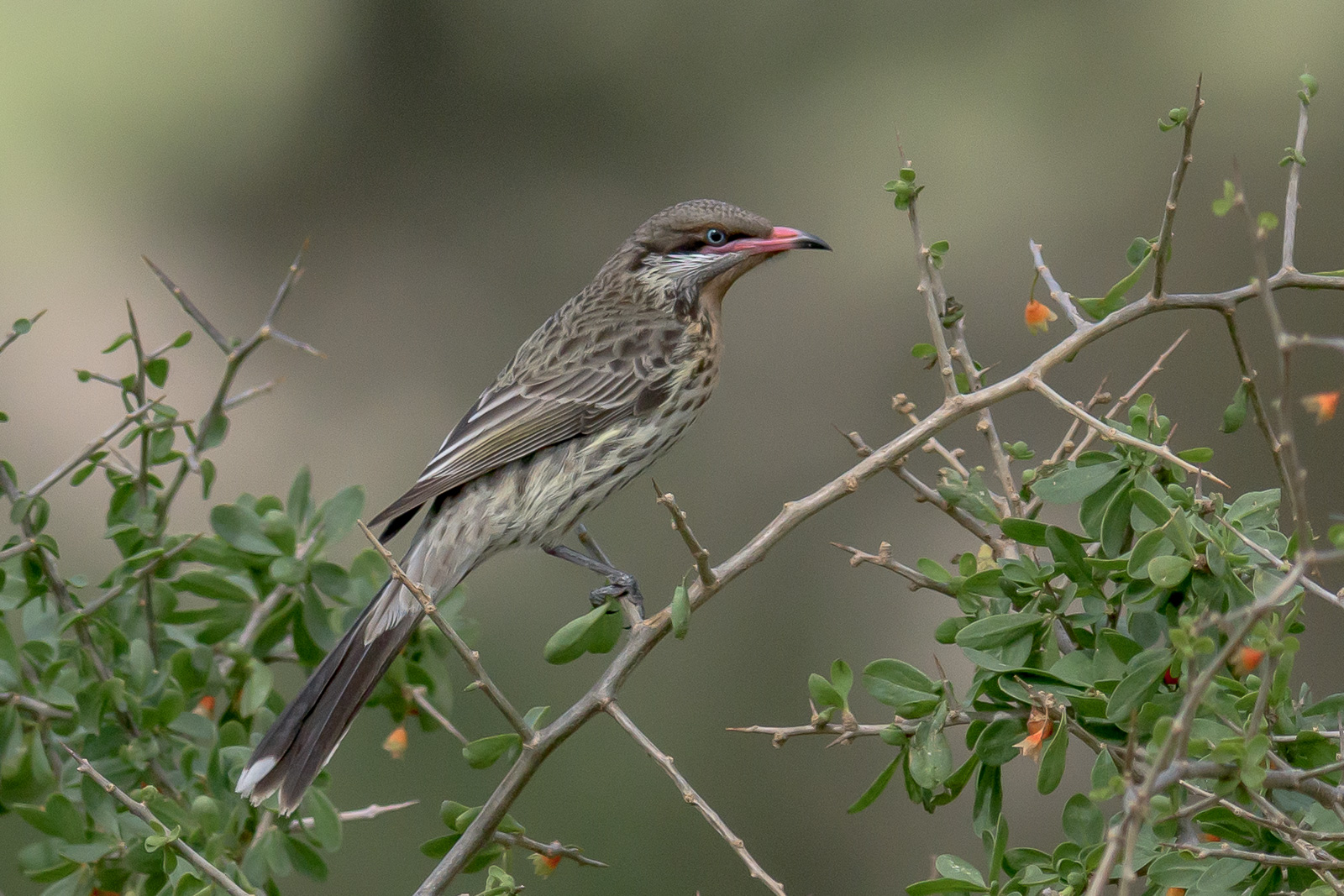
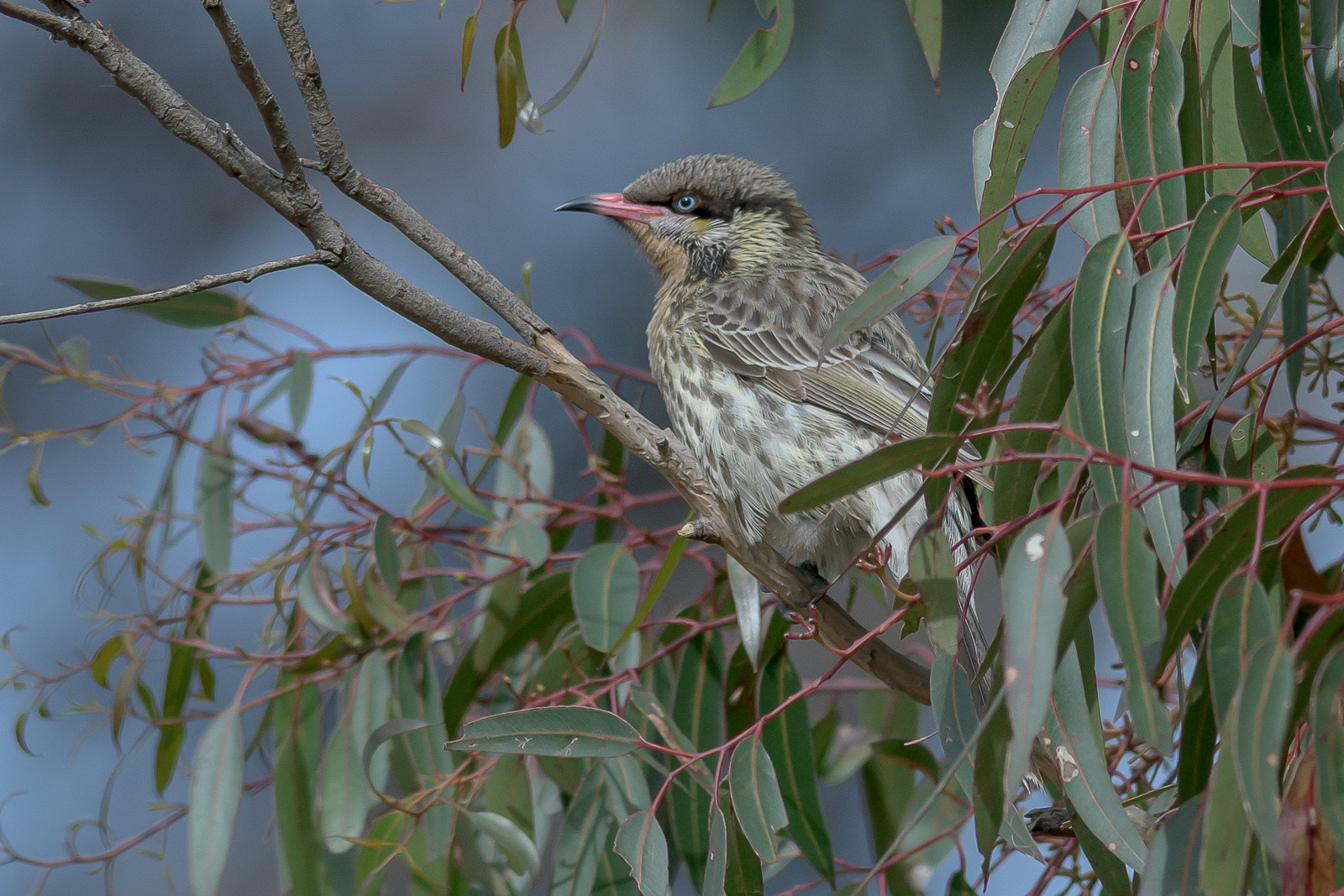
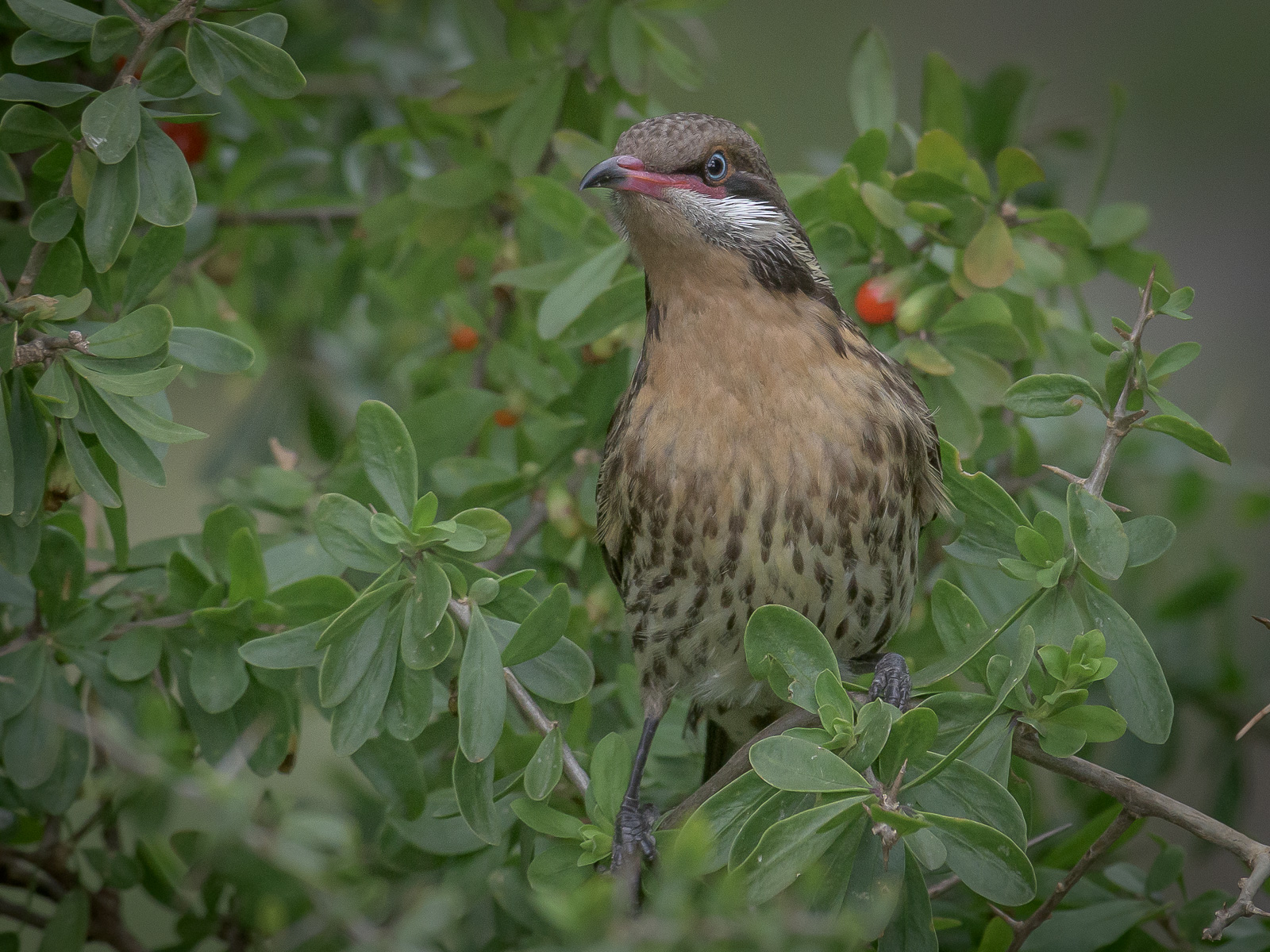
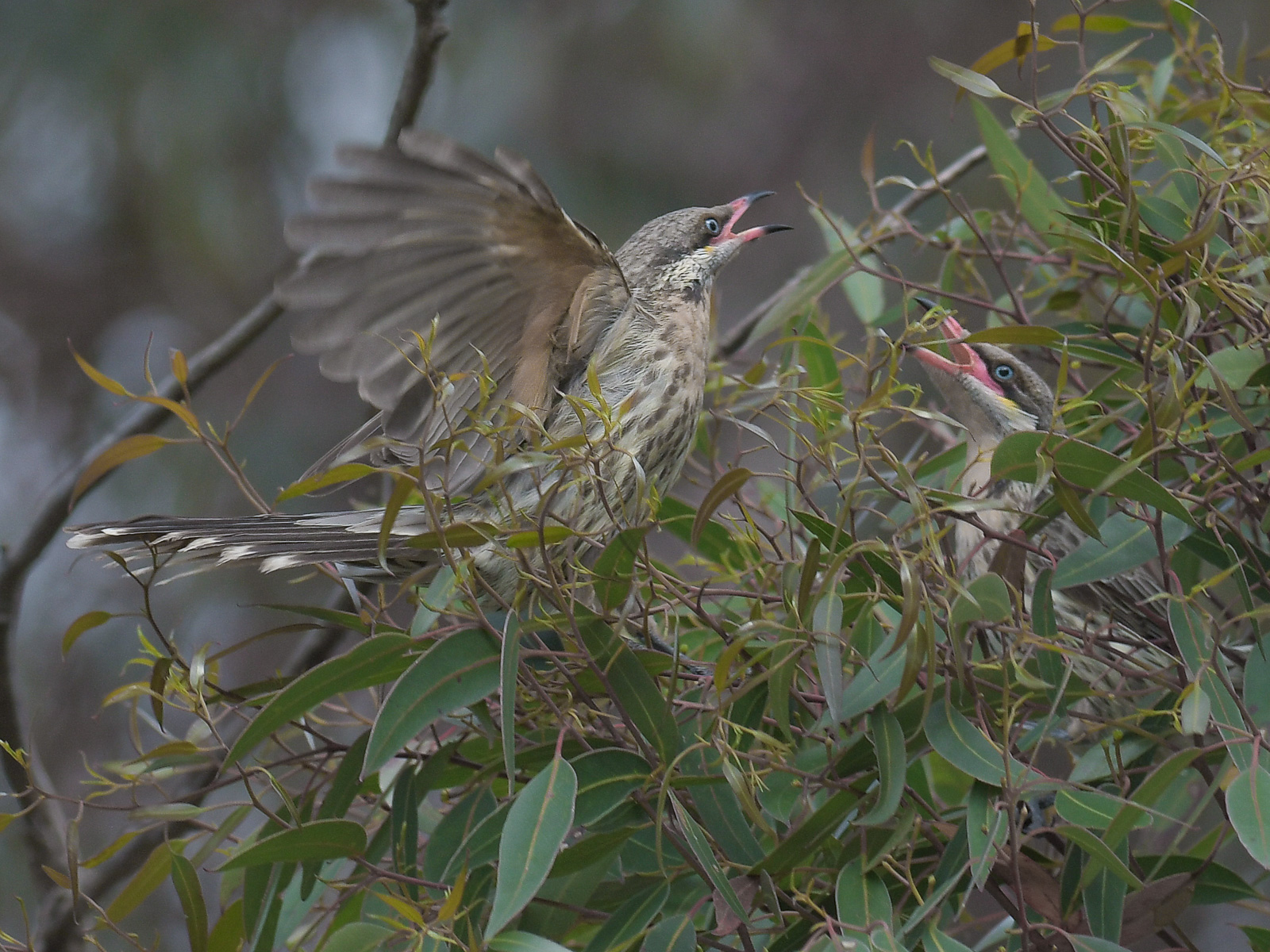
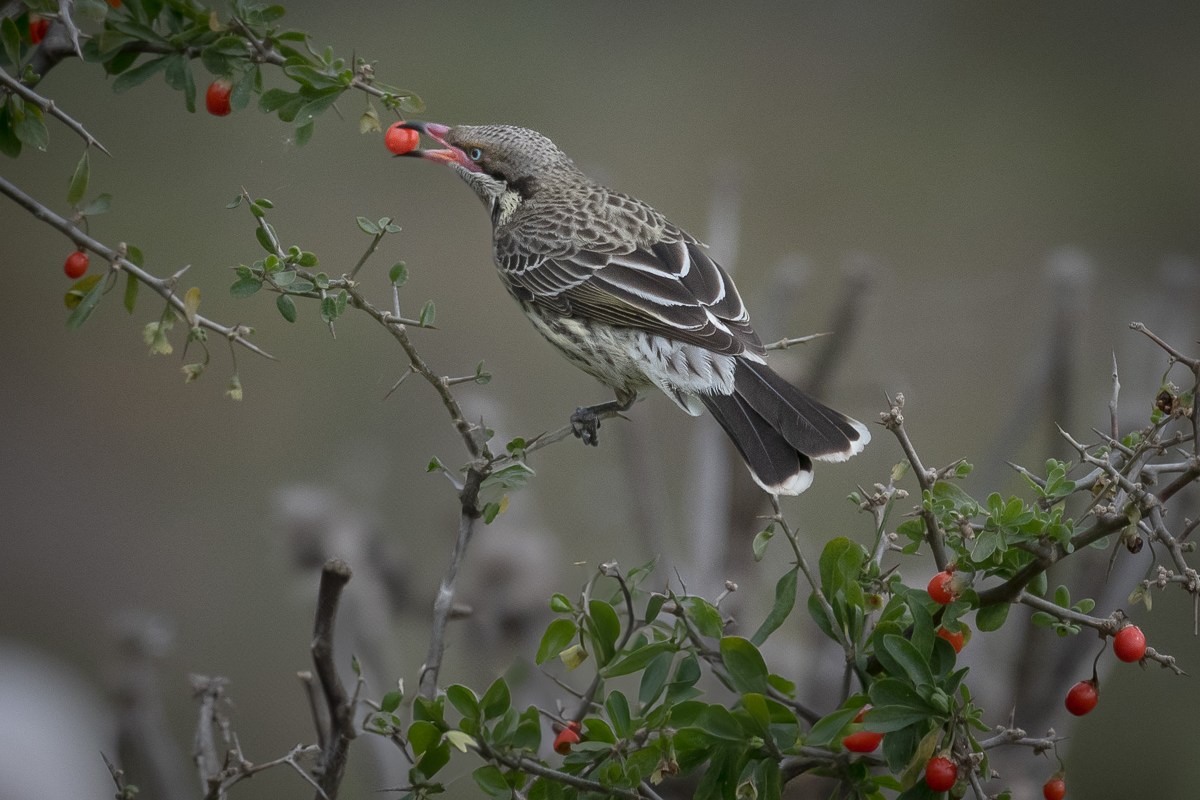
Here are some of the Spiny-cheeked Honeyeaters from the same time and location.
Checked back the other day, after about a week. All the bushes are pretty well stripped, except for one isolated bush in the middle of the paddock. For some reason it hasn’t been touched.
The Spiny-cheeked are still in residence, but the Cuckoo-shrikes have moved elsewhere
Enjoy
There is enough for everyoneLiked the spotlight effect on this oneThey seem fearless about moving through the thornsNot often I’d see a closeup portraitThorns? What Thorns?TastySuch a fine looking birdWhen not feeding they were working through the leaves on the treesAnother pause for a portraitShowing off the Spiny cheekI wish I knew what this was about, but didn’t realise the other bird was well inside the leaves until I followed this one as it landed.
It’s probably well known, that I have a love/hate relationship with Adobe. Well, not all Adobe, just Lightroom in particular. It’s a product that I love to hate. And to be fair, it has managed my library for the past 10 years or more, so perhaps it should be a more of a tolerant relationship. And no, I’m not going to highlight each of the niggles that I have. Just I’m always on the lookout for a better library manager. But recent changes to the suite has caused me to perhaps reconsider my position. I’ve never been enamoured by their raw converter, much preferring Capture One, Raw Power, or DXO and even Nikon Capture/Studio (in no particular order) to deal with my NEF file conversion.
However some recent changes seem to me to have finally given me the result I was looking for at import. All good.
I’ve often said about the enhancement of images, (these days euphemistically called ‘post-processing’) that I’d happy with a copy of Photoshop 5.5 with its clever—then released—Masking Layers, Brushes and Curves tool for just about all the changes I need to make. (ps. I try not to spend hours in front of screen, pulling first this or then that slider, hoping to produce a prize-winner out of something that I’d normally send to the Trashbin.)
When I was travelling extensively PS5.5 running on a little Libretto Toshiba notebook did all of the heavy lifting for me. And given the size of the Libretto (it was only just a little larger in size to an Iphone 15 Max) just fitted in one palm, it wasn’t a bad effort. (How times change) And I was much happier to move to the first Macbook Air with a decent size keyboard.
But… Back to Adobe Lightroom in particular.
To keep up with the latest and greatest, of course, Adobe have introduced several AI components into the Lr suite. One of which is the Generative AI Removal tool. Swipe over the ‘offending’ intrusion into the perfect composition, hit the “Apply Button” pause to take a breath, and there before your very eyes like some magician’s trick, ‘it’s’ Gone… And just to be sure, new buttons offer three. (Count them. 3 ) choices of result.
Wannaseehowitworks? Well I did too.
As it turned out while I was working with some Spiny-cheeked Honeyeaters on boxthorn (see last week’s post) a clever little Sparrow landed on the bush just in front of my moment. Yep, I could have cropped around it, and neither you or I would have had to wade all the way down here, But I thought. Why not? Why not indeed, so. I did.
With and Without Sparrow. Version #1 with some space under the bird and a clever addition to the branch
Version #2 filling in the space. Version #3 creating a nice branch that can support the bird. You can click on the pics to get a full size view of each pair.
I know. Scary. And of course no one is every going to believe anything else I post again. 🙂 Some, suspicious that we are, might even be wondering. Did he actually paste the Sparrow in from another shot? 🙂
Like many of the ‘new’ features using AI, personally I don’t find the need compelling. But for those days when the wind is howling outside, the rain is pitching down and I’ve crawled out from under the doona long enough to make a cup of the Earl of Grey, it does while away a bit of time.










































 Birds as Poetry —— Just because I WANDER doesn't mean I'm LOST