A day out with the Sisters

Took sometime this morning from the routine things and Dorothy and I headed to the park, inspite of the weather.  There was a cold north wind blowing the trees around home and it didn’t look all that good for the park.  However, as these things do, the sun managed to find openings in the clouds and a sundrenched Tawny Frogmouth was preening in the tree near the carpark. A good start.

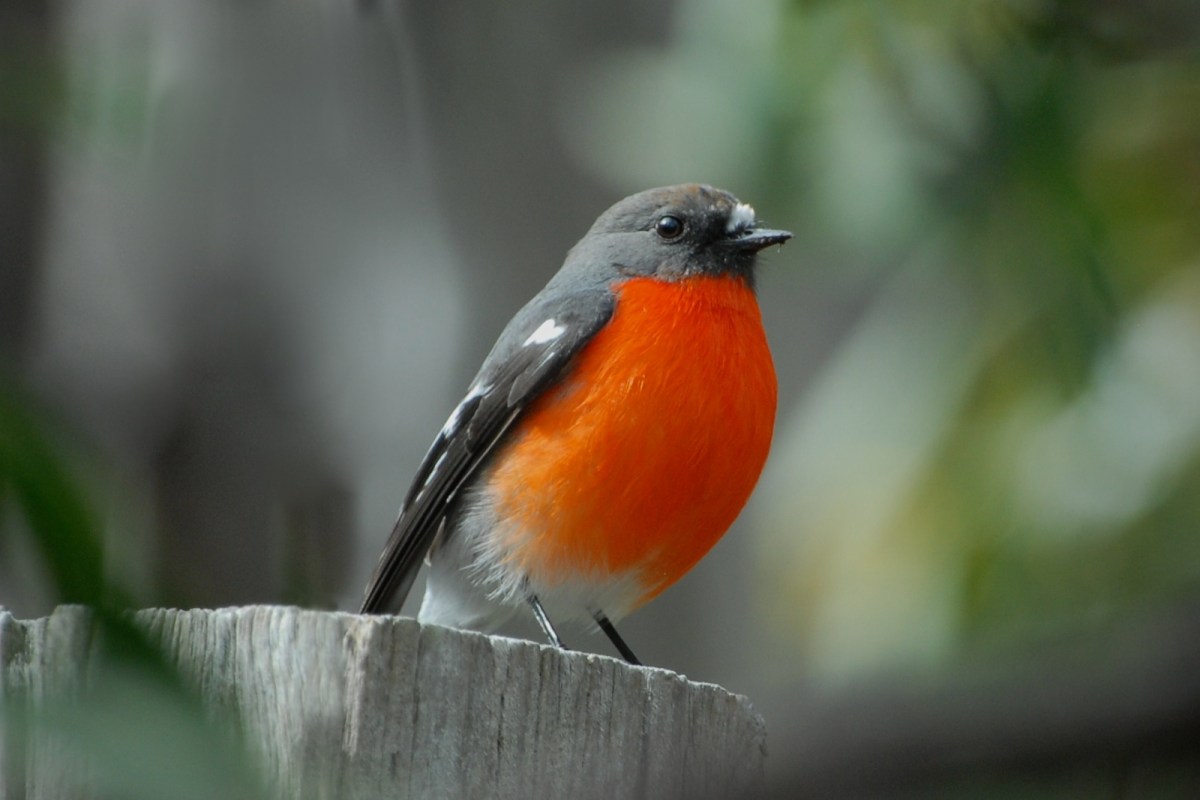
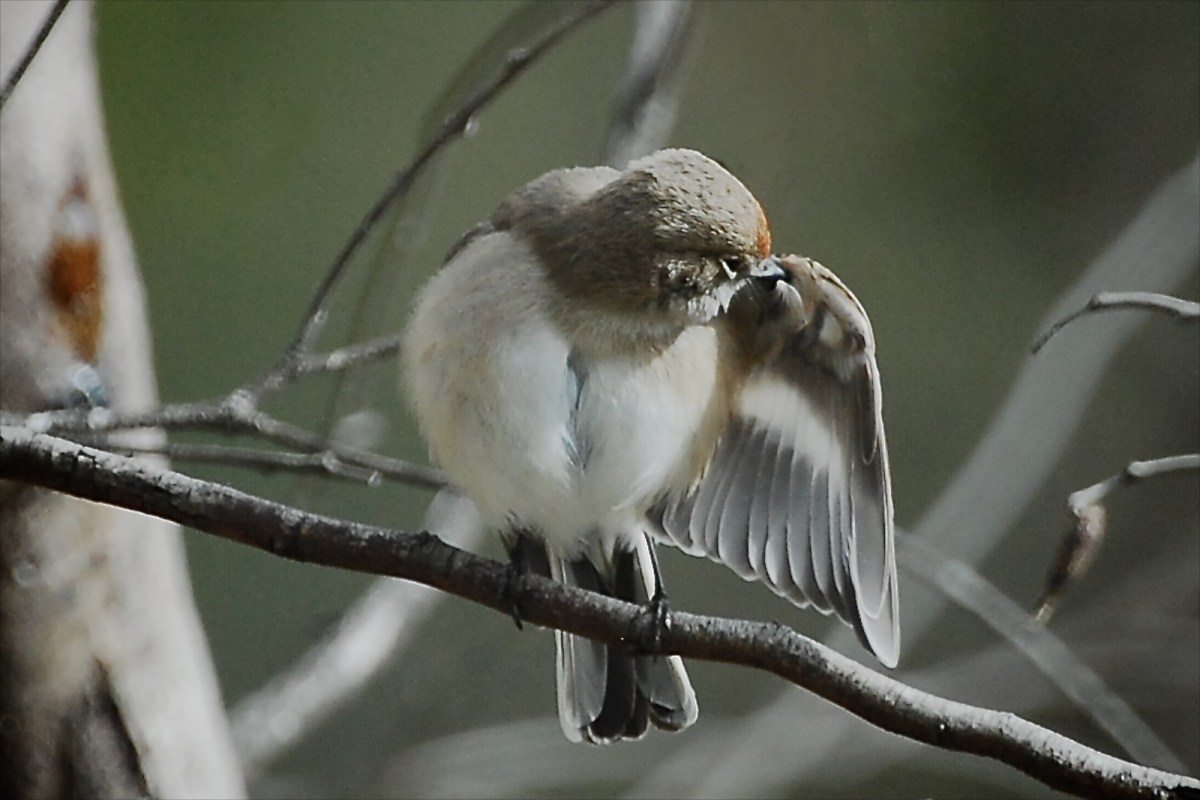
Down along the track toward the still locked conservation area, we managed to find a few Flame Robins. Mostly females. This is a bit of a change as they have been few and far between this season. Mostly I think because they have been hunting down the range inside the proposed Bandicoot area. ‘Nuff said about that.

Not that the ladies were in any way inclined to be helpful, hunting among the smaller trees and among the dead blackwood wattles.  Little light in there, and hard to see a bird, let alone apply the autofocus to them. Hunting may be what they were doing, but so was the autofocus.
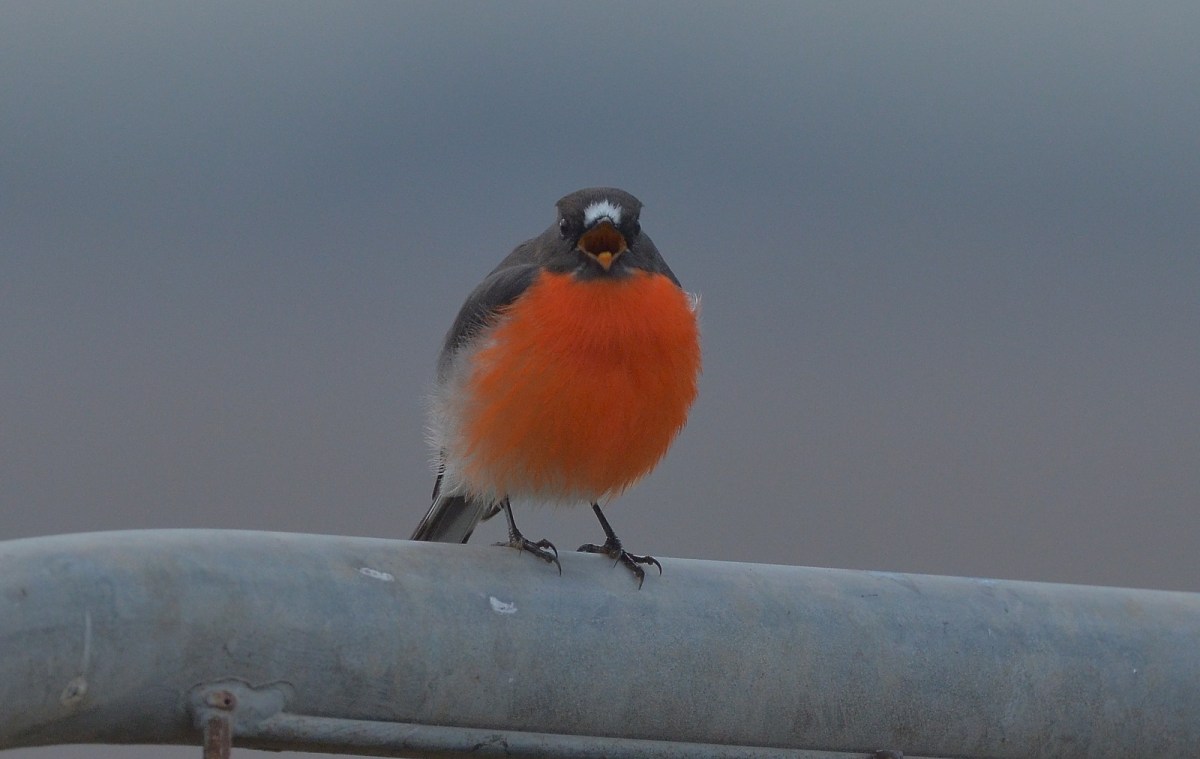
Then the male Scarlet Robin put in an appearance.  And managed to place himself in the sunshine and not among all the loose sticks and leaves and for the first time in quite awhile I managed couple of reasonable shots, and also the chance to get a really good look at him. And how he has changed since those early days in December when he first arrived, looking all brown and dishevelled.  My money was on it being a female, for a couple of weeks, and then slowly the feathers began to moult in. Now to see him, full grown, remarkable deep black head, stunning red chest, and a lovely white cap over his beak.  He really is the part.

Now he has his own lady, and I’m hoping that they may stay over, it would be such a treat for the forest.
The little female red-cap hasn’t been seen since the gates were closed for Bandicooting, so I really don’t know what has become of her.  I did come across a small, single female down along the old hospital fence-line last week. After about 40 minutes there was no sign of any male companion, so she does appear on her own. I want to get another day in to check on that.  Perhaps this might be the lone female?  I can only guess and speculate.  There are probably a number of displaced young from the last season.

The Flames sisters came past at rate of knots, keeping on the move all the time, so it was really a matter of catch them as I could.  But so quickly come, so quickly gone.

Here are a couple that gave me a few seconds to get organised.

Tawny Frogmouth in preening mode in the late morning sunshine. It was so intent that it didn’t adopt the traditional stance, but happily worked away at its feathers.
Male Scarlet Robin, now a most elegant looking bird.
Lone male Flame Robin hunting along the park access track
Lockie on fence wire, I like the out of focus sweep of the wire.
Lovely female Flame Robin. The sunlight poured through the leaves of the trees as the strong wind moved them about. I waited until a break of sunshine came.
Flame Robin in “HIgh Key”. I’ve rambled on before about high key, but it does provide, life, excitement, freshness to an image. The camera nailed the exposure. Pretty much as shot.

Red-caps and Flame Robins

Redcap 106 by birdsaspoetry
Redcap 106, a photo by birdsaspoetry on Flickr.

The weather is certainly not co-operating for bird photographers. We have been out about 6 times and only one of them has had any sunshine, and when it did, the birds were no where to be found.
After looking at the gloomy weather in the morning, it was already time to call it quits, but I had changed cameras due to a technical glitch with one of them. (Technical glitch is tech speak for the #@$$% shutter packed it in and it will have to take a trip to camera hospital, and most likely the outcome will be, “Cheaper to buy a new camera mate”, always said with a smile.
So to try out the old system, we loaded up, and headed on out.
It is so late in the season now, that the Flames are not likely to be seen as a flock, in fact, my guess is that another week and they will be gone.
Found Lockie and Primrose, both very busy with the business of breakfast. She captured a great big moth, and spent a few seconds tendering it up on a brach, before gulping it down and looking very pleased with herself.
We also found a small hunting family of Flame Robins and they were very furtive. One landed in a tree and gave me a few seconds to get a peekaboo shot through the leaves.
Also saw a pair a of Scarlet Robins. We are both hoping that they will setup a territory. He is most vocal and travels about the canopy displaying as he goes. Time I guess will tell.

Via Flickr:
This little male was hunting in the early morning rain, and took to working from a stump about 6 metres from me. He filled the frame on the 500m +TC2.0, and when he dropped on to the ground to feed he was beyond the closest focus of the lens, but I had a really good view of him that close. DOF is so small that its legs and eyes, cap and chest iin focus, everything else is out of focus.

These images I’ve posted directly. Cannot figure out how to get them out of Flickr as a set.

This bird landed in a small growth tree and proceeded to play peekaboo through the leaves at me. The TC20 on the 500mm lens made autofocus a real nightmare. But. The result was worth the persistence.
Sometimes images make me smile and this one does.
This female has already built at least one nest, and is starting to show the egg patch in her chest feathers. Perhaps with a few days of warmer weather she might be ready to lay.
This is one of two males in a small hunting party. They are moving so quickly through the scrub now as they bulk up for their soon coming journey to the high country. He landed just near my camera position but was gone without stopping to feed. Obviously looking for the best stuff now.

Woodlands and Red-capped Robins

I might have mentioned in the previous post that timing is everything.  And it is, so is getting close.
We never ever seem to have a short distance between our lens and the birds we love.  We sneak up, we sit and wait, we drive about hoping to find a bird that is inquisitive enough to come-look-see, and we buy expensive, long focal length lenses when it becomes apparent that aside from patience, not much else works. (Luck of course being the factor that most other people have.  I was once a member of a junior football club, the coach began by explaining, “We’ve been having a run of luck lately.  …… Long pause….. “All bad.”

So I’ve been haunting the camera stores, pouring over pages on ebay, all hoping that I could find that magic lens at an even more magic price.  Not that my AF-S 500m F/4 is a slacker.   Just want it to be longer.   So after a bit of soul-searching, (most would tell you that wouldn’t take long in my case), I decided to get Nikon’s new TC20eIII televerter.  Now the websites will tell you it won’t focus, won’t work, isn’t sharp, won’t put the cat out at night, and makes appalling coffee, but I’ve learned to ignore most of that.

Truth be told it does focus.  Somewhat erratically on my D700, well on my D200. The problem is the little elves inside get tired of trying and give up.  So the lens sometimes locks, or it loses focus and then goes all the way from one end of the range to the other, hopefully stopping at the right spot on the way back. Sometimes.  Sometimes the elves get distracted by the light coming through the trees, or the highlights on a leaf.  But, hey its 1000mm and if it was an old manual focus lens, I would have to rock back and forward over the focus point anyway. For those young’ns who don’t understand that sentence, back in the days before autofocus we used to manually- by hand and eye-  focus the lens.  Strange but there you have it.

So here I am in the forest.  2x on board.

And up pops Primrose.  For a bit of a chat.  The first image is full frame.  She was that close.  7 metres it says.  The second image is also close to full frame. just cropped a bit of the top. 5 metres it says.  Couldn’t get all of her in the frame. Just in case anyone is guessing, according to the book she stands 10-11 cm tall.  And she kept on coming closer.  In the end the focus just gave up, and I had a minute or so of a very tiny bird hunting on the roadway alongside my knee. Who said birding is hard?

But all this is about Check the sharpness.  Just a little pre-sharpening using Nik Presharpener 2.0  The image has heaps of feather detail, has kept colour and contrast and all in all if I’d have sprung the zillion dollars for the 800mm Nikon, it wouldn’t be that much better and twice as heavy to get into the bush anyway.

Also found the most beautiful Scarlet Robin female, who also posed nicely, but not quite as close. All in all a good day, and a good start to my relationship with the 2x converter.

How close can you get? Now turn to the right, work it, work it.
She is as close as the focus can work. TC20eIII on 500mm lens.
Found this beautiful Scarlet Robin in the sun on a side track. She waited long enough for me to get organised
The light was a little soft and kind. She wasn’t as close as Primrose.


Just for a bit of fun.
The photographer is the big ugly dude on the right with all the hardware. The bird, subject of said photographer, is the little tiny smudge on the lefthand side. Sort of puts it all in perspective really.


Western Treatment Plant: Timing is everything

There is no doubt about it, timing in the bird photo world is just about everything. You can come back from the Camera Exchange with some of the best goodies on the planet,(and a severe bend in the credit card), and walk about for days and not see much at all.

You can turn up with your old gear, not well prepared and not expecting much, and it suddenly all happens around you.

We, Dieter, Dorothy and I, took an early morning mark down to the Western Treatment Plant on Thursday.
Weather was supposed to be cloudy overcast, and we mostly went for the cups of tea, the chats, the play with the cameras (two of us are breaking in new kit from Camera Exchange), I had to make do with my ‘old’ technology stuff. Feel almost antiquated now.

We strarted out on the river on the road to Ryan’s Swamp.  A female Nankeen was in the dead trees in the creek, and was pretty happy to let us get close enough for some good shots in the early morning light. A good start, but it got better.

As it turned, the sun burnt of the soft mist clouds by mid-morning and we had some decent sunny-breaks.

Down near the outflow at the end of 15 East Road ( I Bet it has a name, I just don’t know it), we were greeted by a small flock, yes, a flock of Black-shouldered Kites at play, or mating, or territorial. Bit hard to work out when they don’t put up signs.

Anyways, these four birds were engaged in aerial combat right over our heads, some times coming alarmingly close.  What a great sight. What a great picture opportunity.  A couple of unfortunate Silver Gulls found themselves the target of this aerial mayhem, and were hopelessly out gunned.

The main feature of the event was birds that locked talons and then spiralled down.  I wonder if the bird who gets to turn head-first wins? while the other has to be unceremoniously twisted backwards?   No one I guess seems to know.
A female sat on a post on the beach, and offered lots of screaming encouragement , and then too joined in the foray.

At that point we would have been satisfied for the day.

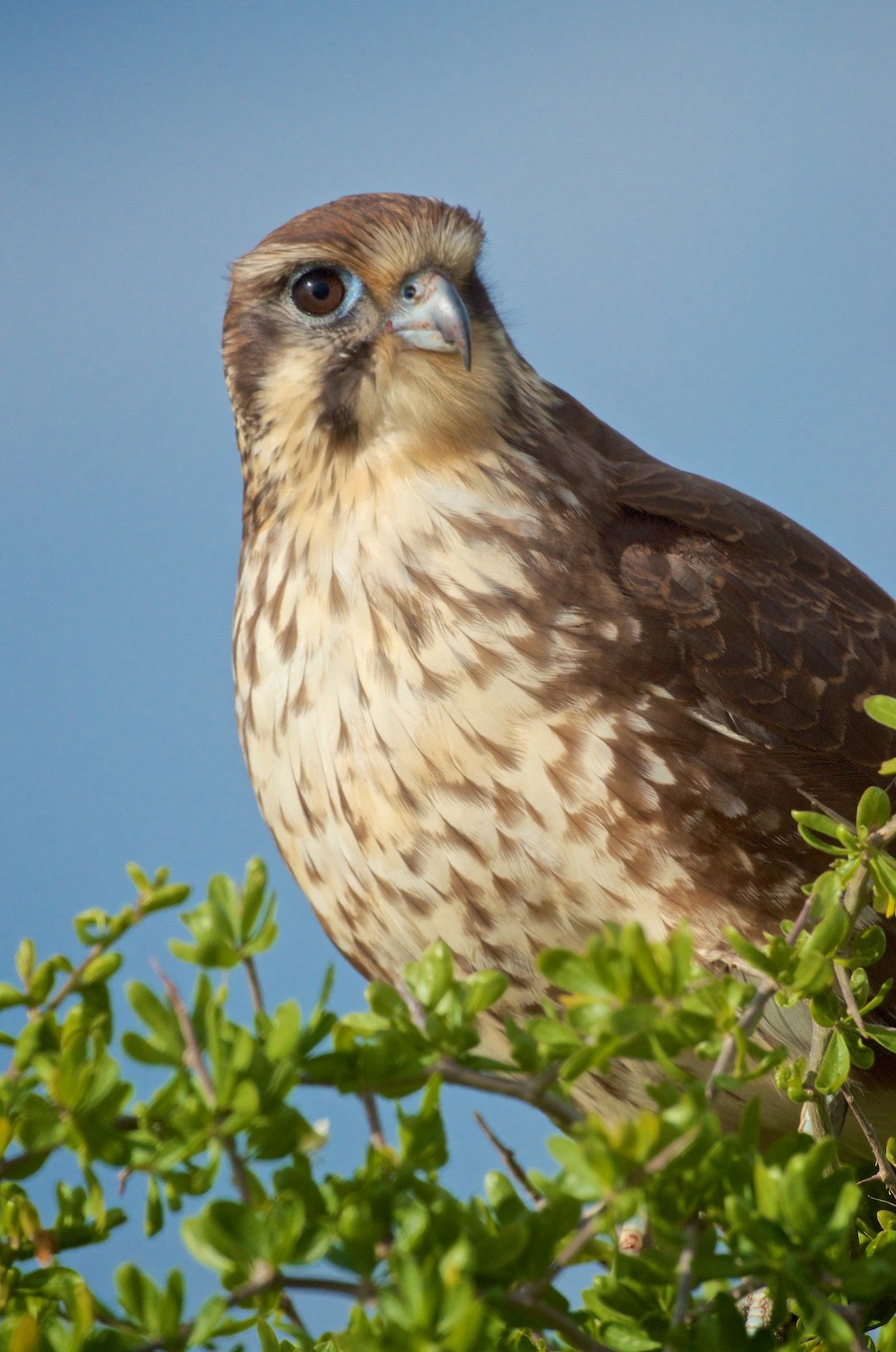
We drove back along the track past the Bird-hide by the beach, and found a Brown Falcon (think it be the same bird from a previous post.)  It sat while the team inched up toward it, and then the magic line was crossed and it was airborne.  All of about 5 metres. And again, and again. Good stuff.

I drove the car up to where it was perched on a box-thorn bush on the side on the road, and it didn’t flinch. Needless to say the team got some good pics, while I positioned the car.  We moved on.  About two minutes later it passed by the driver’s side window of the car about 3 metres off the ground and about 5 metres away. It paced us for a few seconds then sped up, and sat on another box-thorn bush.  This time I assembled the camera kit and edged the car up to where it was. Again it held its ground.

So there we were, me and the bird.  It was so close, even a vertical could not get it all in, so I opted for head and shoulders portraits. We are thinking of name it Elvis, as it just didn’t want to leave the building.

It flinched when I started the car, but held its nerve and we drove on leaving it in peace.  A nice day’s work.

A little further on, I spotted a female Nankeen Kestrel on a post near the road, and at first thought she must have damaged a leg as she was having difficulty on the post top, but she flew to the next post, and lo and behold, she was holding a mouse in the foot, and couldn’t get a grip on the post.  Then she settled herself and enjoyed the mouse from one end to the other. Lots of mouse fur flying in the strong breeze.

A couple of over enthusiastic kites who locked talons and twisted about in the air. The noise of the talons scraping was like fingers down a blackboard.
This female Nankeen Kestrel made short work of her mouse-takeaway
This Brown Falcon was hardly camera shy. We think he might be Elvis in disguise.

Robins’ Bath Time

There can be no doubt about it, water in small pools is a huge attraction to the small birds. It seems that once one finds a spot for an afternoon tub, the sounds of splashing water brings them all out for their turn.

After some very overcast weather and a bit of rain, I had given up hope of a day in the forest and consoled myself with looking at Bill Majoros’ site Third Bird from the Sun it is a treat and has some lovely photos and information. Worth a visit.

Anyway, by early afternoon the rain had abated, still was overcast, but I had some weekend shopping to do, so on the off chance put in the 3oomm lens and the 1,4 converter and headed out.

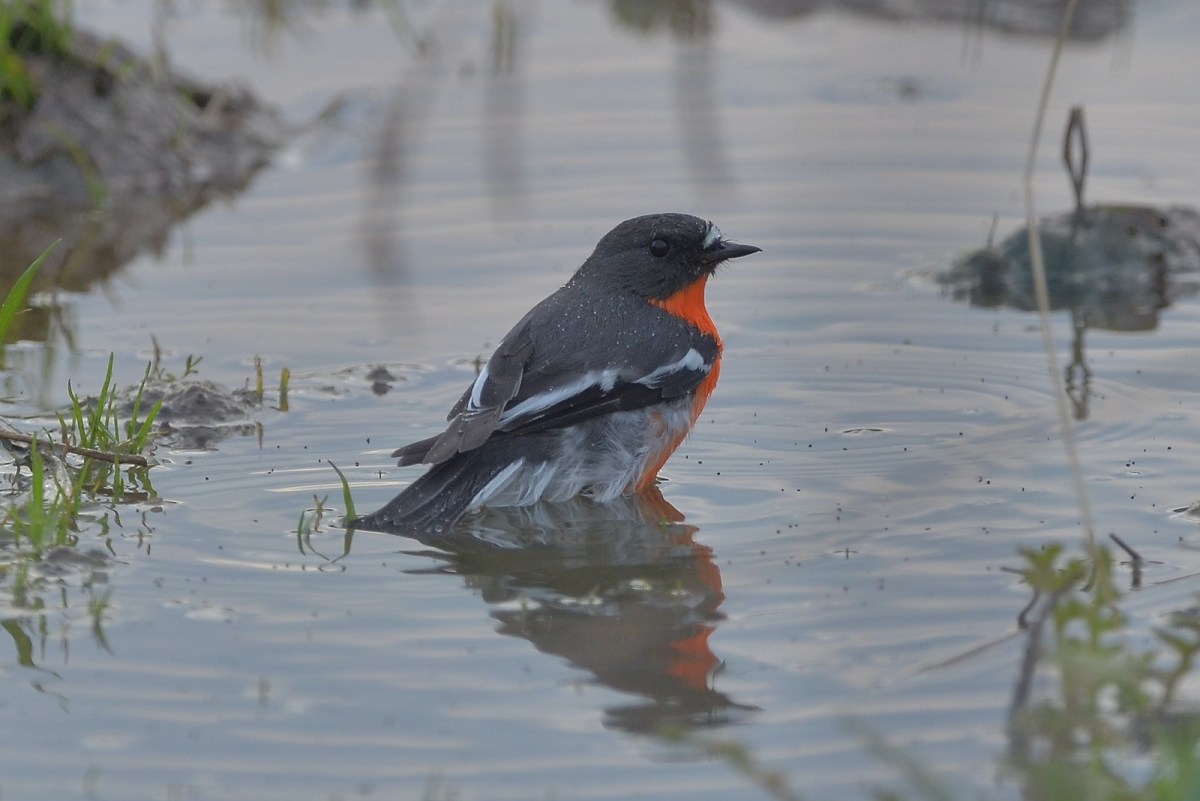
I hadn’t gone very far along the track when I came a small pool of water from the morning’s rain, and a flutter of wings and a male Flame Robin leapt out of the water, landed on a branch near me and began to preen.  Interesting, but what happened next was one by one the flock came down to take their afternoon bath too. They are very organised about it, and there is much cheeping and clicking involved in working out who’s turn it is next.  They don’t seem to bully one another for position and each waits patiently for the one to finish. Or steps in at the other end, just hurry things along.

That they enjoy the bath is evident by all the chattering that goes on.  So I watched and pressed the shutter, scolding myself for leaving the big lens and tripod at home- but them’s the breaks.

Toward the end of the session the local female Red-capped Robin turned up and took her place in the line.  Then some Yellow-rumped Thornbills moved in, and a Scarlet Robin,  However the Thornbills fled, and everybody followed. That is the way of a flock.

If I’d of had some sunshine, it probably would have been a red-letter day as it is, I went home with a card full of images and some pretty nice memories.

To fit them all in the page, I’ve added them as a gallery. Click on an image it will go to a larger size and you can navigate through them. Enjoy, I did. And, more importantly so did they.

Woodlands Historic Park robin season


With the ongoing closure of the Backpaddock at Woodlands, the opportunities for following Flame Robin families has been greatly diminished.  I have to admit defeat at this stage, as here we are getting close to the end of the winter over season, and I really only have a few images that I am  satisfied with. Problem is of course not being able to follow the birds as they move across the light Grey Box scrub along the ridge lines in the Backpaddock.
Not that it is doom and gloom as a few parties come out on raiding sessions into the area outside the park, but it’s impossible to predict where and when, so it is pretty much hit and miss.

Also not being able to track the Red-capped Robins movements, it will slow me down a bit when they go to nest, as I don’t have any idea where they are in the territory, and they certainly aren’t going to put up flags.  (Not that I am tracking nests, but rather where it is all happening so I can prepare for shots of the fledged young. I try not to disturb the nesting birds as she will get anxious and abandon a nest at any stage.  I think her main concern is Cuckoos, but Ravens made havoc of several nests sites last year.)

So here is a compilation of the work from about the past two weeks.  Weather has not been kind either.

The female is Primrose, and she has a territory that is outside the backpaddock. She is currently being courted by two males, but I think she seems to favour Lockie, so things will be as previous.  I do hope the younger male finds a mate as he seems most capable of defending himself.  With all the young that were produced in the area past season, it is a ponder as to where they all go.

The Flame males were beginning to call with their territory call the last few days.  They usually are gone in a fortnight or so after that.   They go early, and then the females follow about a week or so later.  But, I haven’t seen very many females, and am assuming they are up on the grey box ridges.

*** The images in the blog are now part of a gallery.  As such if you click on an image it will open them all up in a slide show.  That way you can advance through the photos rather then see them one by one and have to come back to this page for a new pic.  I think it’s more elegant, and I wish I had figured it out earlier in the blog.

Hope you like it.

Sunshiny day at WTP

At last the weather gave a bit of relief, and with an onshore breeze, a resonably low tide at around mid-day, it looked like a good time to re-visit the WTP.
So we loaded up the car, picked up Dieter early in the morning and progressed to see what was happening.

We found a Brown Falcon that has mastered the art of hovering.  Mostly Brown Falcons hover like a house-brick, but this one has been able to figure out the technique.  We’ve seen it down around the Kirk Point area before exhibiting its skills.  A Swamp Harrier had made a kill and had been pursued by a number of Ravens, and had dropped the victim. This Brown Falcon had been somewhat in the middle of it all and was pretty certain that a free feed was waiting somewhere in the grass.  It was completely oblivious to our presence and hunted quite close going over Dieter’s head at only a few metres.  It was a great few minutes to watch.

Further along we came across a Spotted Harrier, ‘Languidly- that’s how its described in all the books’ making its way along one of the small channels. It passed quite close to the car and seemed un-preturbed by us.  It has a primary feather that is loose, perhaps its moulting.

A second Spot turned up with what looks like a Eurasian Coot as its lunch.  The coot can weigh upwards of 1 kilo, so it must have been quite an effort to get airborne, and maintain a steady course.

All in all a good day out with the birds and with plenty of Black-shouldered Kites and Nankeen Kestrels on the wing there was always something to be photographing.

Dipped on the Oriental Pratincole, which is always too far away to get great shots anyway.

Hovering Brown Falcon. It skimmed over the waters edge looking for the prey dropped by a Swamp Harrier. It didn’t have any success in the few minutes we watched. Perhaps the mouse or rat escaped for another day.
Spotted Harrier casually making its way along a water channel at WTP
Another Spotted Harrier, this time with takeaway lunch.

Study in High Key

One of the great delights of photography is the various elements, lighting, and juxtapositions that provide visual excitement and interest in an image.
One of those that brings life, feeling, brightness and subtly of form is High Key images.

The Black-shouldered Kite lends itself to this form as its delicate grey and white matches the requirements.  Then the lighting has to match, and the pose has to be effective and the exposure just about right, and so it goes.

Here is one I prepared earlier.  The bird’s brilliant red eye makes a lovely counterpoint for the high key treatment.

Big Birds up at WTP

It started out as a windy day, and stayed that way.

Good day for big birds we thought as Dieter and I drove down to Werribee. We went too look for the elusive Oriental Pratincole. However the roads were still pretty much awash from the  rain of the last few days, and Austin Road, where the best sighting had been made was literally mud from end to end. When a guy in a four-wheel drive arrived and chatted about the bird and how many 4be’s had been down Austin Road on the weekend,  that was just about it for my little humble two wheel drive milk and bread pickup vehicle. He also announce, ‘there is no hope of me going down there in this. (referring to the 4Be), so that was enough for us to wander on to other roads that were much better suited to the milk and bread pickup.

To our delight we found a Black-shouldered Kite that was hunting just along the roadside and got some lovely views as it came up to the car, circled around and then continued on down past the car. Wonderful.

I noticed some commotion among the silver-gulls and ducks on Lake Borrie, and a sweep with the binos revealed a White-bellied Sea Eagle on a tree. So far away.  Now to get to there we had no option but to go the long way, as the road down along the bay was pretty much closed for the mile and bread van.  In the end it took us about a15 minutes to get round near the trees, and lo and behold the Eagle was still in attendance along with a flock of very angry gulls.  So we had plenty of time to get some reasonable pics before the poor eagle left the demented gulls to their own business.

Australasian Grebe

Seems like forever since I had a chance to put up a post.  Didn’t think, ” Went out got wet, saw nothing”, was going to be a big hit in the blogging world.

With the Woodlands Backpaddock area being out of bounds to mere humans, and especially photographers, while the great Fox hunt is on, the best I can do is put my nose up against the fence like a little kid in a lolly shop and dream.

The new Eastern Barred Bandicoot programme in the park is in full swing.  One of the first jobs is to remove all the ferals that are in there. Notably cats, and foxes. They have done a good job of rejuvenating the fences, so all the remains is to get rid of the last of the more persistent foxes.  My guess based on just sitting and watching, is that there is upwards of a dozen in there.  And my guess, totally untechnical of course is that some of them are breeding. Which would explain the occasional smaller animals I see.  My other non technical guess is my money is on the foxes.  The release of the fresh bandicoot families can not go ahead until they are absolutely certain the area is now free of ferals.  But how long that will take is anyone’s guess.

Meanwhile the Flame robins are still in the area, but our time begins to run out pretty soon as they will be getting ready to move back to the high country by August.

So.  What to do.  Down to the Dam area today with my mate Neil A.  We found a few Flame males and a couple of Australasian Grebes and I was lucky enough to get a reasonable handheld shot of said Grebe. Really like the reflection, and I added just a brush full of contrast to make it stand out more from the water.

Australasian Grebe and reflection
Male Flame Robin who came to my side of the fence for a little visit.

Looking for Flame Robins

Monday dawned all nice and bright.  No rain, little wind, a good day for a stroll along Moonee Ponds Creek at Woodlands to look for Flame Robins.

But, by the time I’d arrived and walked into the paddock, the weather turned a dismal shade of grey.  So back to the car, put on the Driazabone (they really are!), and put in the wet weather covers for the cameras. Thank you Mr Aqua-shield.

As it turned out, I had only arrived down at the creek, when the first of a number of Flame Robins began hunting in the area near me.  In between showers, I managed to find 5 birds, and all of them seemed to be young males in state of moulting through.  I didn’t spy any males nor single females.

But the rain set in.  Down by the Billabongs is a lovely place,  lots of wonderful Red Gums and plenty of shelter from the rain, so I headed there. So did a large and significant sized flock of Yellow-rumped Thornbills, together with their tame, pet Willie Wagtail and a flotilla of Silver-eyes. So we all sat in the shelter of the Red Gums.  I had chosen a particularly large tree with a dry side, and plenty of shelter from the wind.  I think the birds chose it at as  an alternative feeding area.

The rain eased and I took the time to walk around to near the Cumberland homestead site.  I could hear the “Mip, Mip” of a Black-shouldered Kite and through the mist eventually I spotted one on a tree, and then another further down the range.  They both flew when the rain eased and one came down to a tree near me, but the rain was simply toomuch to pursue the issue any further.

Heading back up the hill toward the old Church site, I spotted the Flame Robins at work in the paddock.

Here is a male who posed long enough for me to get organised.

Young Flame Robin in moult. He is hunting down along the Moonee Ponds Creek, near the Billabongs area at Woodlands.

Just little wanders

Had a wander over the weekend with the organised Beginners Group of Bird LIfe Asutralia (Melbourne Group).  Titles get so long these days, and the acronyms are dreadful, but by the time I get it all typed I’ve forgotten what it was I was going to ramble on about.
Oh, yeah, we went with the beginners group to Woodlands.  Now as the National Parks people are on strike, the gate at Somerton Road is closed.  Which in some way s me thinks is a good thing.  But with nearly twenty cars parked along the road it did look to say the least a bit dangerous.  And as Somerton Road is apparently the extension of some race track or other, speeds along the road are simply overwhelming at times, with some of the best passing manoeuvres that would do credit to  Mark Webber at Albert Park F1, are taken with out much concern for the narrowness of the roadway.  Anyway I digress.

The weather was pleasant if just a bit overcast and after a stroll around the Moonee Ponds Creek tracks, – Note: the river was in a flood, probably 1 1/2 meters or more deep.- we decided to move around to the Providence Road carpark and spot Robins.  And on this day, the resident Tawny Frogmouths had moved to a new tree and were not to be found.  I was pretty much accused of  climbing up in the morning and moving them. <ggg>

The gate to the Backpaddock is now closed, so we made do by following the kangaroo tracks down toward the Dam area.  Now the robins were pretty much on strike too, it seems. However I broke away from the main group and with a little bushcraft, and determined perseverance and highly developed robin finding skills.  And let’s face it. LUCK, I found the pair, Lockie and Primrose. They were taking a bit of a stroll down toward the dam as there were some nice wet patches of run-off water from the previous couple of days.  Next, call up the group, so some thirty birdwatchers descend on 10 square metres of robin feeding territory and the fun begins. “There on the tree just on the left of the other tree, near the branch sticking out behind the wattle, near the laid over stump, about a metre off the ground, oh, never mind it’s flown away.”  Much too much fun.

Some of the beginners did however manage to get a good views of Lochie and another male, and Primrose seemed completely unpreturbed by it all and just continued to feed.  So after about twenty hectic minutes with the binoculars and pointing just about everybody had seen some good robin views.

We then moved back to the cars and had another great view of several of the Flame and Scarlet robins in the paddock near the cemetery.  Enough for all, so lunch was at the Woodlands Homestead. Then a bit of a walk around Woodlands Hill, but no raptors were up.

Dorothy and I went back for another look in the pm, and found some Flame Robins and Lochie and Primrose again.  Here he is in the sunshine.

Redcapped Robin Male, hunting in the sunshine after several days of intense rain.


Here he is again with a nicer background. He is my second most favourite of the Red-caps because he is very relaxed with me most of the time.


Hello, and aren’t you looking super?

No one can say that the weather has been photographically kind over the past few days.  Its not just the risk of taking the cameras out in the rain, or the chance of getting wet, its just the light is so weak that the exposures are wide open, slow shutter speed.  Even on a tripod, the chances are the bird is breathing in and out faster than the shutter speed, so, its a blurry pic.

Stay home, do other things, play with last years images and hope for a break.

So with high hopes we set out early this morning, sun looked good, and the weather man gave us a 50/50 chance.  Should be good.

But!  The gate to the Woodlands Backpaddock is locked.  Work is going on to remove the feral invaders, and keep the feral photographers out.

Sadly we traipsed back towards the car.  But on the way, we found a lovely looking Female Scarlet Robin, so of course we stopped to play.  She and her mate were a bit skittish at first but after a little bit we managed to meet on sort of mutual terms and were able to get reasonably close. Good light and the rest was easy.

After all that excitement we travelled on a bit further and found an Eastern Yellow Robin.  Very impressive, and again a bird that once it settled down was not to fussed by being chased by a photographer.

Looks like we’ll be travelling a bit further to keep up with the Yellow Robin and fill in time till the gates are re-opened.

Female Scarlet Robin in the early morning light


Female Scarlet Robin hunting


Scarlet Robin Male


Find of the day. Eastern Yellow Robin in a small clump of Black Wattle

WTP evening

Getting a bit cold for an evening drive, so we thought we’d start early. Like after lunch!

It’s a long way to WTP, if the weather is only so so, and if its not being very helpful, the best idea we reckon is to stay home. But throwing out best advice out the window, we went anyway.  Hadn’t been for a couple of weeks, and wanted to see who things were going.

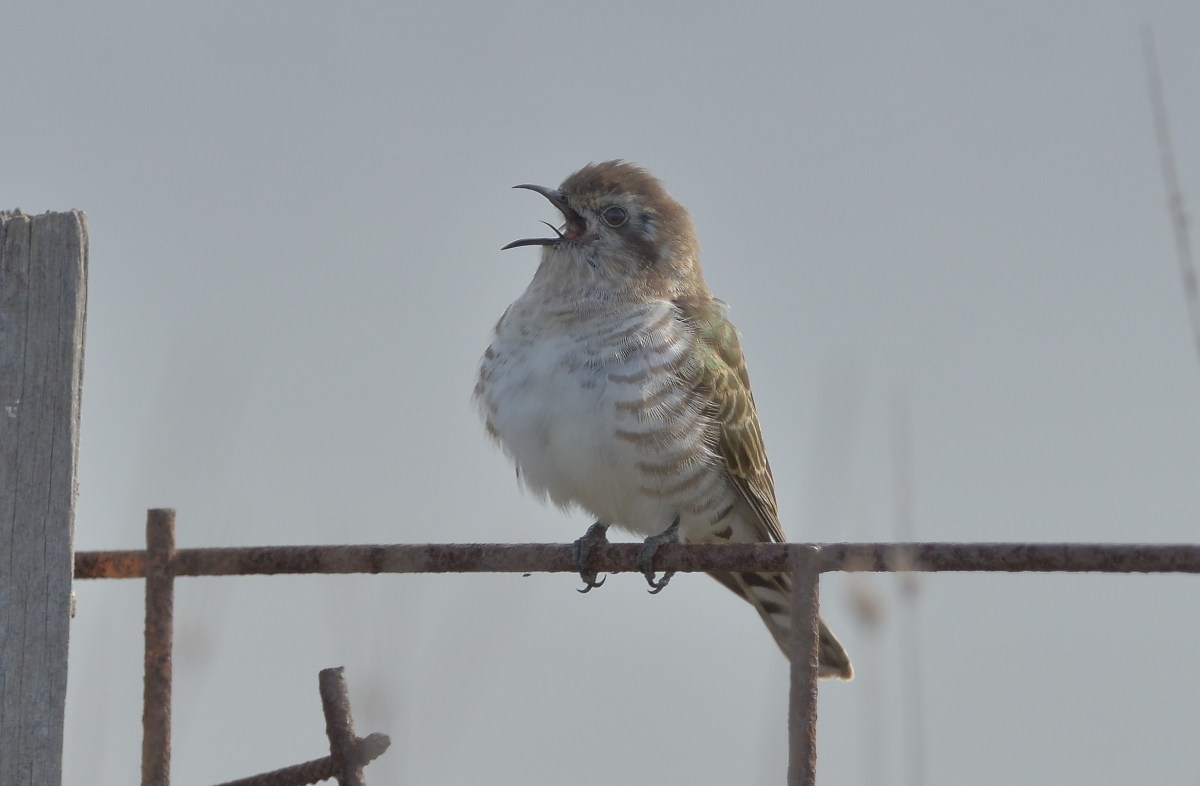
Along the Spit area, a Horsfield Cuckoo sat on a post and piped for us, it was answered by at least two other birds, and we have just recently spotted about six or seven sitting on the fence rails. This one co-operated and sat in the very weak sunshine, which was good as it meant no harsh shadow detail loss.

Further along were several Red-capped Plovers and a number of Red-necked Stints in the shallows at the Murtcain Outlflow.

Down along the Beach Drive near Lake Borrie we came across an ambitious White-bellied Seaeagle taking home a duck dinner.  It was pursued by a pack of very angry Silver Gulls, and perhaps it wasn’t duck on the menu afterall?

As we were leaving with the sun well and truly set behind the You Yangs, right on the Paradise Road exit gate, Dorothy spotted a Flame Robin taking its evening bath and then a few minutes to dry out all the feathers. Made a great end to a day.

Horsfeld’s Cuckoo in call mode
White-bellied Sea Eagle escaping with someone’s relative
Male Flame Robin taking an evening bath
Male Flame Robin after a bath