Saturday Evening Post #45: Risk Assessment

I saw a warning sign on the tool chest in the back of an RACV Roadside vehicle the other day.

Warning before beginning work have you made a Risk Assessment.

Good advice I thought for someone working on car repairs on the side of the road with cars, buses and trucks speeding by, each driver totally self-obsessed in their own world of radio, wifi, facebook and family troubles.

Good advice, I thought too for your average photographer at work on the beach. 🙂

We had spent the morning, in the sunshine—let it be said, around Point Cook. We had arrived at low tide, and around this area the tide recedes in some places out as much as 100 m or more exposing lots of interesting little rock pools and seagrass beds and rocks that mark the edge of the shallows.

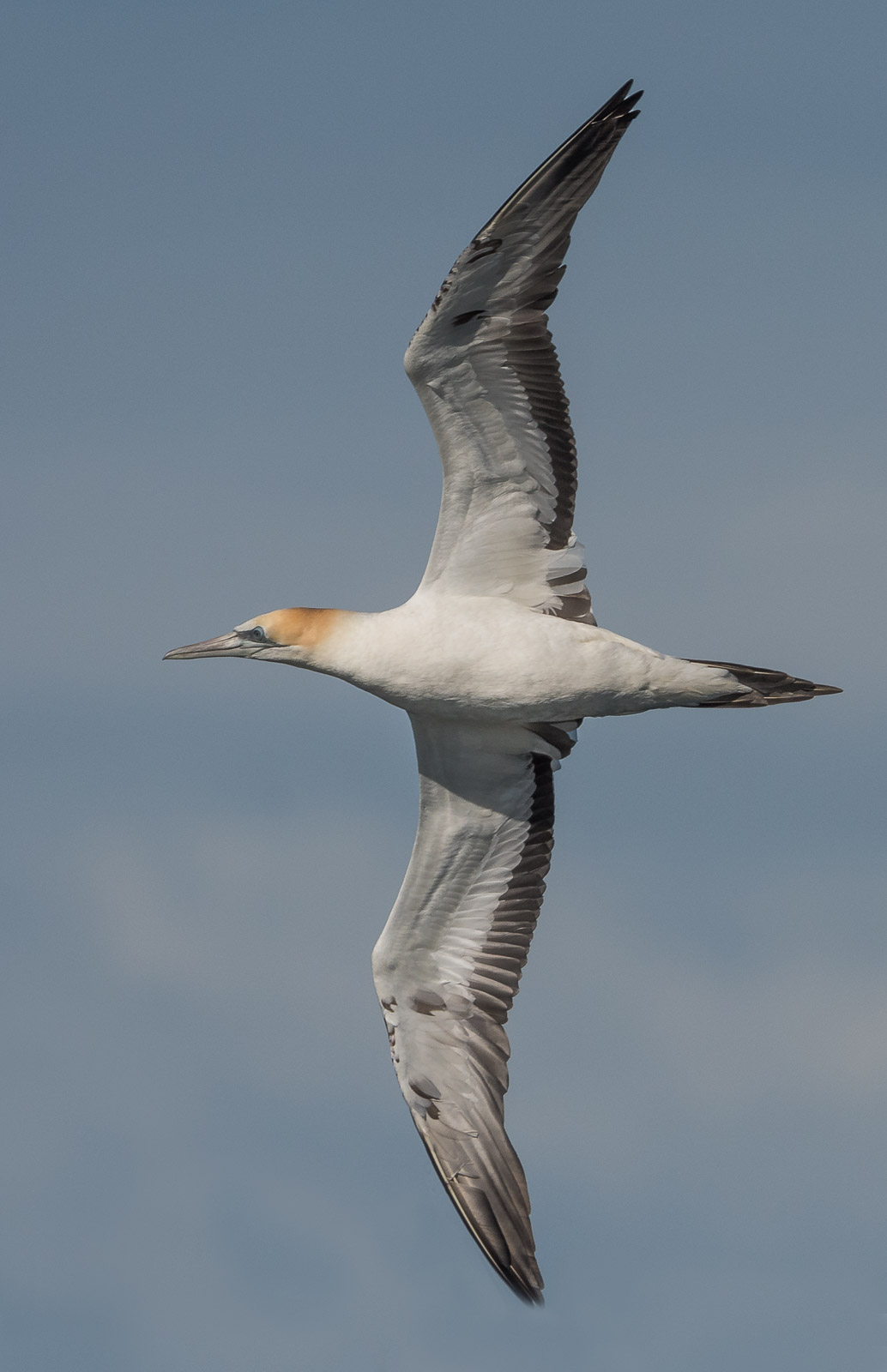
Normally terns, cormorants and gulls are the usual suspects.  And occassionally when the wind is right, strong winds coming inshore, Australasian Gannets that patrol up and down, just out of camera reach.
However on this day, with a strong off-shore wind, the gannets were working along the area just out beyond the farthest exposed rocks. I don’t know for sure, but hazard a guess they were going down to around the Werribee River mouth, turning north and the gliding past us, about midway to their turn around somewhere near Altona, at the Kororoit Creek outlet or Jawbone Park.  Just a guess.  About a 15 min and 10 min turn around time.

So after watching several passes and buckling on the TC1.4 Televerter for a bit of extra gain, I pondered, I could walk along the dry sand/mud, step on a few stones and be close to the action.

That would work.

So I set out. Ever alert as a big wave might squash my plans, or perhaps the tide would turn and maroon me out on the dwindling dry ground around the rocks.
As I stepped over one puddle to another, it was apparent that the tide was indeed turning, as the little riverlets of water were heading in to fill the pools near the beach.  Risk Assessment time.

I ventured on to the far rocks and waited 10 minutes and of course the gannets didn’t turn up on time. Look behind me, ok, dry land all the way. Wait.
10 more minutes and the first gannets begin patrolling down toward me. Still a bit too far out for great results.  They disappear up the bay. Wait.

15 minutes later, and a look behind indicates that I’m running out of time. And the birds appear.  Remember that TC? Well at 700mm focal length, the closest bird overwhelmed the frame.  Quickly take off TC, balance on rock, hope not to drop expensive optical devices on the rock or worse into the salt water. Risk Assessment zero!

Another 10 minutes and the birds are patrolling again. Not as close as the first pass, but I’m running out of options.
Look behind. Water is beginning to fill in some of the lower pools and its all a few minutes from joining together and wet feet slog home.  Risk Assessment.
Retire now to survive for another day.

Australasian Gannets are interesting in Port Philip Bay.  They roost on several of the navigational structures around the bay and on a man-made island called, “Pope’s Eye” near Queenscliffe.
Some reseach, indicates that the birds that fly up and down the coast line on the western side are primarily males.  In other areas it’s pretty much a 60% female, 40% male mix.

I also discovered the link to a web cam on Pope’s Eye.

If you’ve ever wondered what goes on in a gannet colony, and you wanted to avoid getting wet, travelling to Portland, and the smell, then this is well worth the few minutes to view. Solar powered it only functions in good weather.
It cycles a pre-recording if the live feed is off.  Bet you can’t wait for tomorrow.

Here it is.


And here is the quick Fly By.

1908-16_DWJ_0969_NX2

Moments: Rainy Days and Sundays

The Carpenters may have sung about Rainy days and Sundays, all those years ago, but the past couple of days have made a tremendous change on the countryside around us.

Many paddocks that were dry and barren, or had a blush of winter grass on them, are now shiny, polished lakes, with several cms of water covering the lower surrounding areas.

Not much fun for our favourite pastime, so EE and I have been a bit housebound of late.

It’s not so much the rain. I’ve been wet before and understand the process, in much the same way birds do.  You get wet, and then you dry out. No point in arguing with the obvious. As my long ago bushwalking leader used to  say, “If you want to stay dry, STAY home.”

It’s the wind.  Hurts the eyes, makes the cold colder, drives the rain through the best wet weather gear and is just plain uncomfortable to stand around in peering through a wobbling viewfinder.  Not to mention the(lack of) wisdom of taking expensive camera gear out in those conditions.
And don’t even think of hiding under trees in such weather.  The news has had to cover several unfortunate incidents regarding uprooted trees.
So better to stay at home, drink warm cacao in hot almond milk, and dream of better days.

But you can, as EE says, Only take so much indoors.  We looked at the weather, and as she has an arrangement with several pairs of birds at the moment, it was time to go see if the rain had washed out their hopes of an early clutch.
First casualty we found was a pair of Masked Lapwings that had taken up a nesting site on the lawn of a nearby shopping centre.  The sheen of water across the nest site, and lack of parents anywhere pretty much confirmed the worst for that pair.  Not that they’ll be setback.  She’ll be back as soon as the water recedes.

But all the birds with tree based nests were ok it seemed.  One small area of trees, that used to surround a small wetland is quite the maternity centre at the moment, and there are lots of anxious males sitting around wondering what to do.
Ravens, magpies, Pacific Black Ducks and Chestnut Teals, Black-shouldered Kites. A pair of White-faced Herons, although to give full disclosure, its hard to say they are actually sitting at this stage.

One of the more interesting sightings was a Fan-tailed Cuckoo pair.  They are giving a pair of Red Wattlebirds shivers. Lucked out trying to find the nest, (if its there yet), but the Cuckoos seemed to be relentless in the area, and the Wattlebirds were seriously aggressive, but really couldn’t see off the determined Cuckoos. Be interesting to see what happens.

Here is a visual diary of the morning out.

Australasian Pipit.
They nest in the grass. Apparently they will nest anytime season is conducive.
Proud Dad, waiting, waiting, waiting.
Another male, hoping to lead me away from his brood
With plenty of time on his hands—paddles, he is practicing his one legged stand
Another ‘busy’ Dad
One of a pair that were eager to appear as if they were feeding off the fence, but most likely they were watching a pair of very nervous Red Wattlebirds.
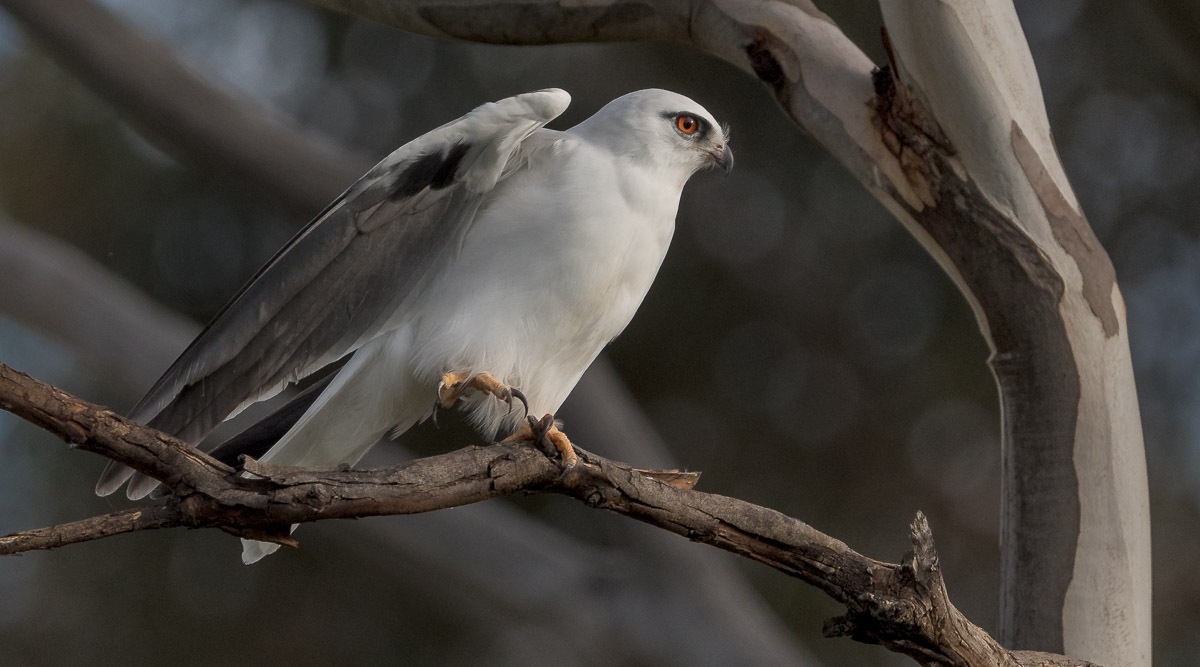
A Black-shouldered Kite, contemplating taking up diving lessons to find mice.

Saturday Evening Post: #44 Peace

The white dove occurs in the legends and stories of many cultures as a symbol of peace.

Over the past several weeks, a number of family, friends, acquaintances and their families have had to deal with a range of challenging circumstances.

Details aren’t necessary, but a moment to pause and reflect and to reach out is.

In times of emotional or physical hardship, it’s easy to feel hopeless so for all people who are struggling with life-altering challenge.


May healing and peace come on swift wings.

Saturday Evening Post #43: Don’t Look Away

We had located a bird, not a ‘lifer’, but one that we see so infrequently.

Problem number one, was, it was ensconced in a old dead bush. Probably a melaleuca or a prickly wattle.  And there the bird was, happy in its quite secure ‘fortress’.

Take a shot or two, just for the record. Walk about a bit, nope, no clear shot that side either.
Bird flys.

Hey, it’s out in the open with a rolling hill behind for a soft backdrop.  Hmmm bird photography is so easy.  Approach, secure a nice frame. Now to wait for a lift off for wing details.
The light goes. Deep clouds gather and the shutter speed drops. Deceivingly low.
Oh, of course the Vibration Reduction, (IS or VR), will take up the slack. But, that is never the case.

Maybe crank up the ISO. Well there goes the feather detail.
So I wait, slowing shutter speed, dwindling light, and hoping the bird will fly.  Watching.  Watching.
Watching.

Light goes to porridge. Shutter speed splutters to a slow crawl.

Time to make some adjustments.
And.

As I pulled the camera down to :
(A) Reset the ISO up a stop,
and
(B) bring the shutter speed up a half stop.

The bird, without warning dropped of the perch and to the frantic warning cries of honeyeaters and thornbills took off along the treeline.

I’d not even rotated the dial yet.

I’ve quoted Ming Thein before, but just in case you missed it.

From Ming Thein

“If you are waiting for something to happen to get a shot, you must be hyper vigilant at all times until you can no longer stand it or have your concentration broken for you: because the minute you turn away, decide to take a pee, sneeze, or pack up for the day…what you’ve been waiting for will happen”

Wise words Ming.

There is so much to be said for having confidence in the camera and the setting I’m using.  Not needing to think, “Oh, I’ll try this or that, or perhaps do this.” I rarely chimp, most I’ll do is check that the exposure is close to where I want it.  If its a touch on the light side when I glance at the LCD then I’m happy.  Any changes are what the sliders in the photo app are for.

For the same reason, I don’t use auto ISO. I just can’t predict where the shutter speed will go.  (Aperture is always the one variable I don’t vary)

Yet, I got in the mail the other day another mail about another ‘Artificial Intelligence” (AI) software that will turn my images into
“Stunning views of your subject”.  Yep, I was stunned.

Can’t imagine how AI is going to be there at just the right moment when the bird unfurls the sails and floats away.

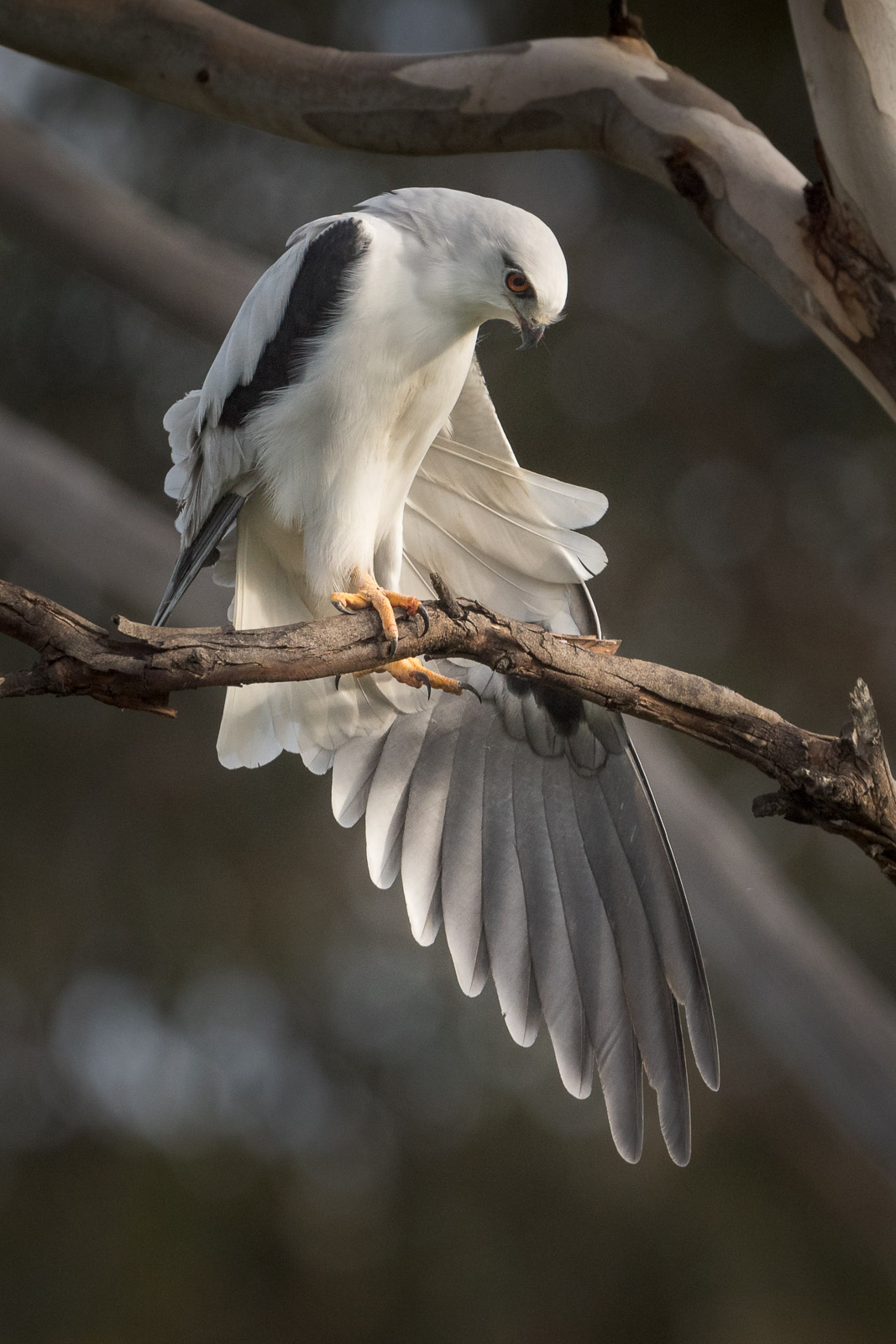
I waited for this Black-shouldered Kite.  No changes of settings.
Just waited.
And eventually, it looked, and lifted off.
Who said Bird Photography was hard.

1906-25_DWJ_6749
From the EXIF 1/3200 @f/5.6 ISO 400. Yep, that’s what I’d have expected

Moments: Territiory and its Defence

We were at Eynesbury.  Looking, as usual for Flame Robins, and finding none, we had moved our endeavours to Jacky Winter.  Now Jacky is not in nesting mode at the moment, and range a bit wider across the forest it seems.  So we waited around some of the usual haunts.
I noted off on the far side of the open area, an old Grey Box, now a skeleton of its former self, and no doubt with some good nesting hollows hidden among its wide branches.

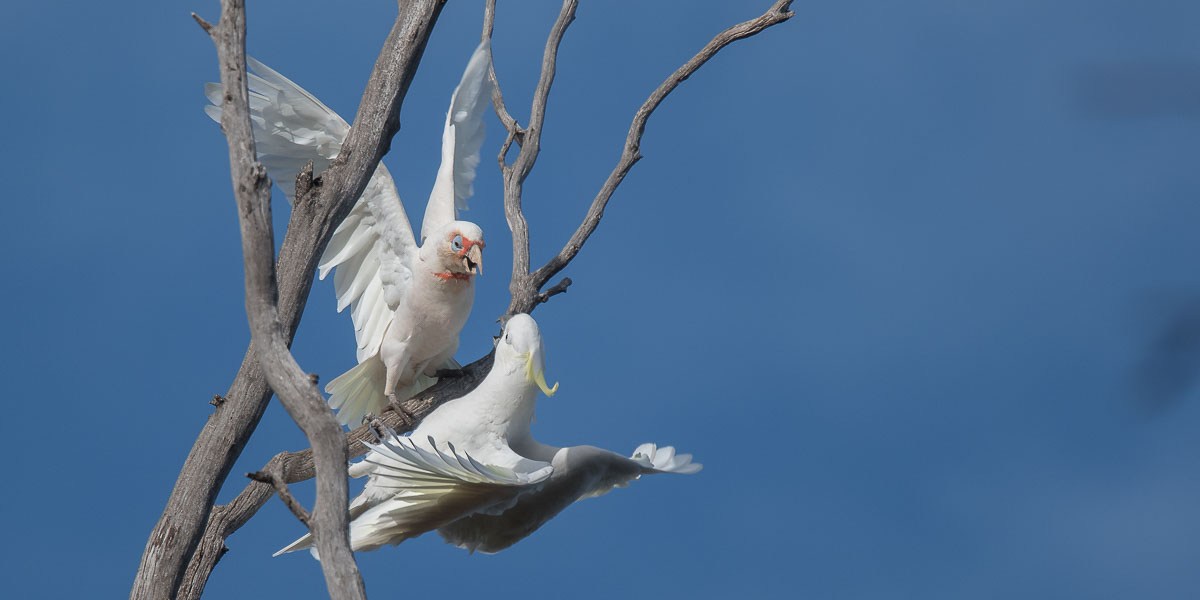
A lone Long-billed Corella has sat in the sunshine for quite a few minutes and just seemed to be enjoying the warmth.

When on a turn of fate a small group, mob, gang of Sulphur-crested Cockatoos in full cry happened past.

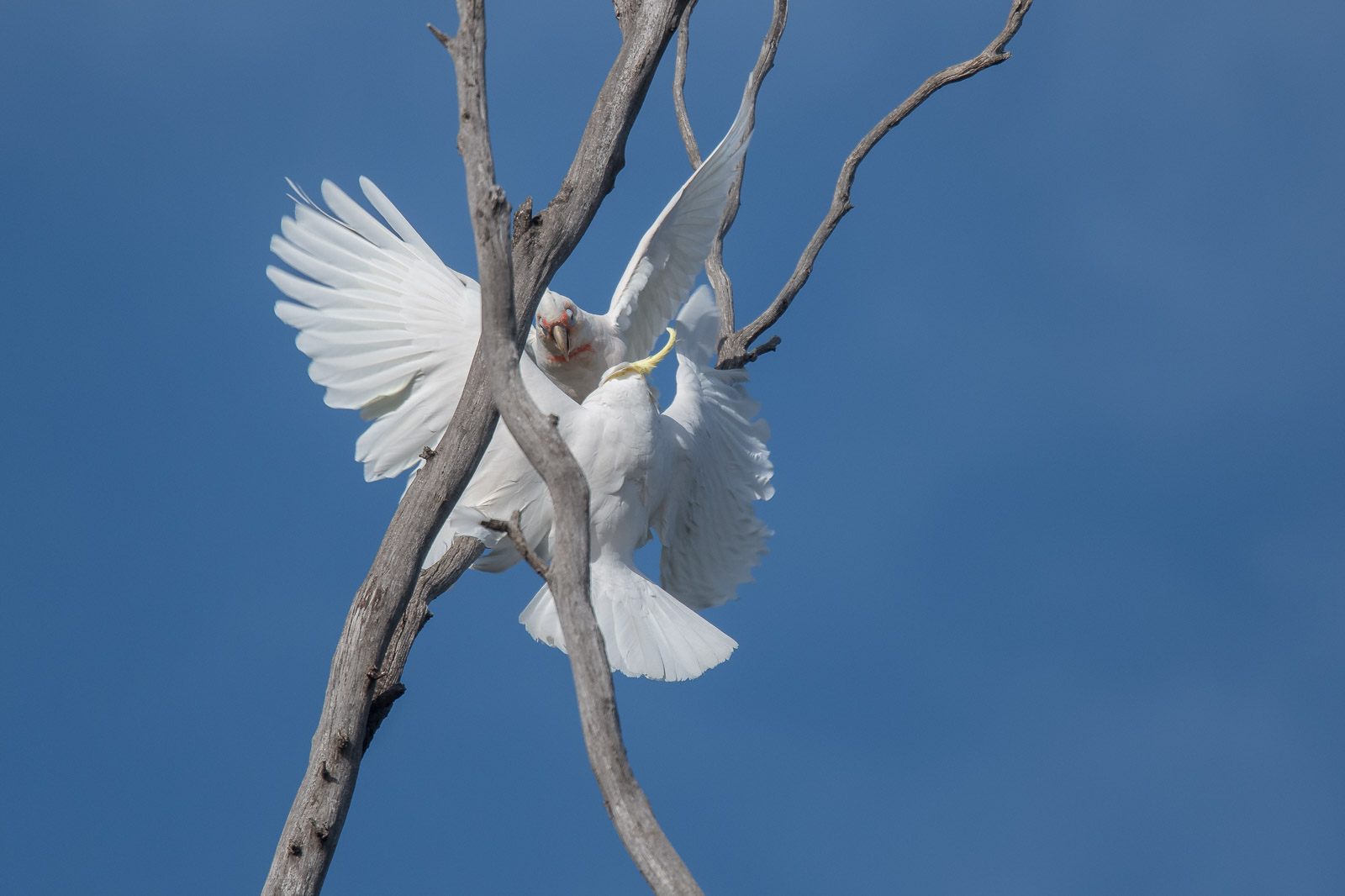
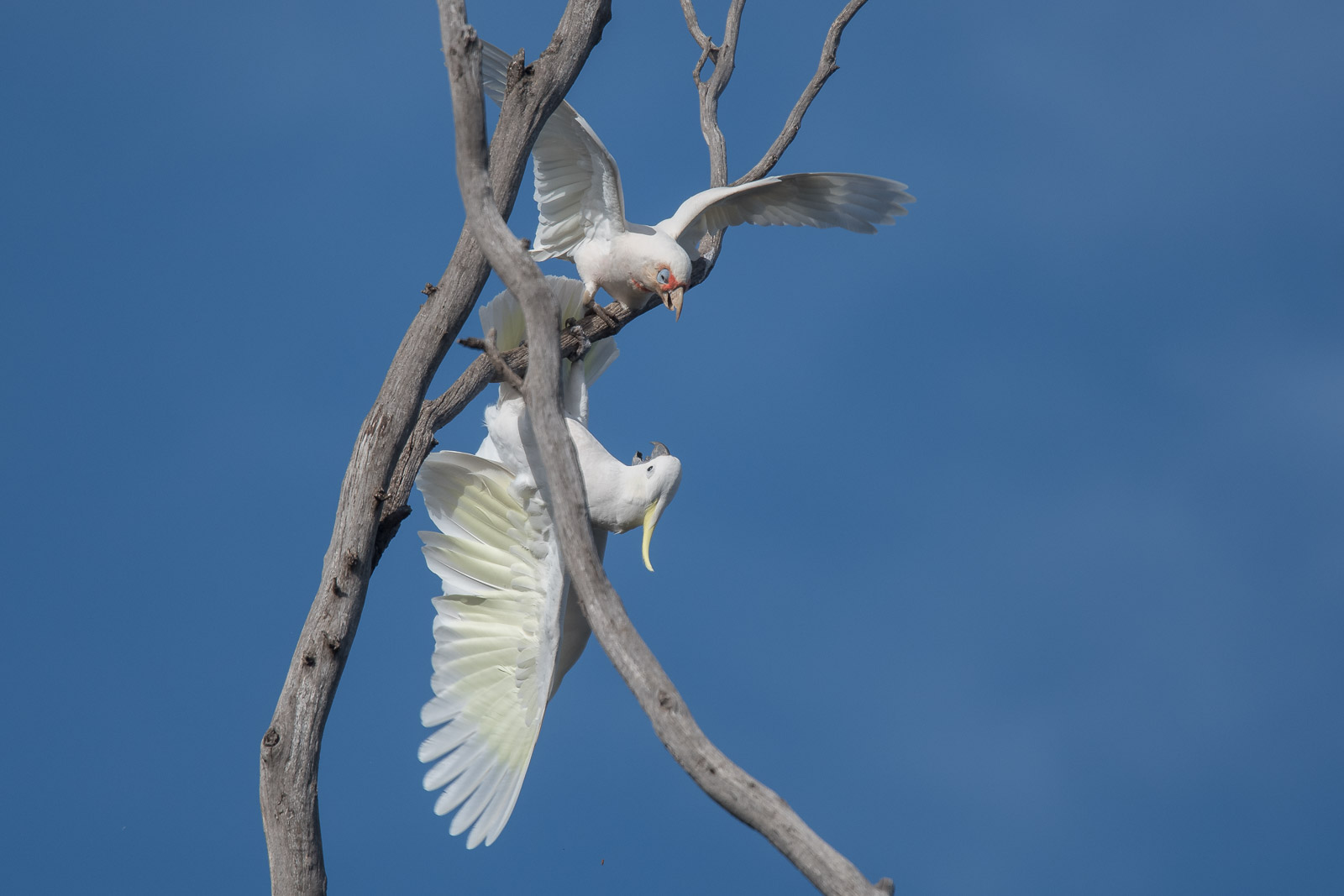
For reasons, I can’t figure, one of them dropped down out of the flock and headed straight at the erstwhile Corella.  Who to its credit decided that being pushed from its perch was not going to happen without a struggle.

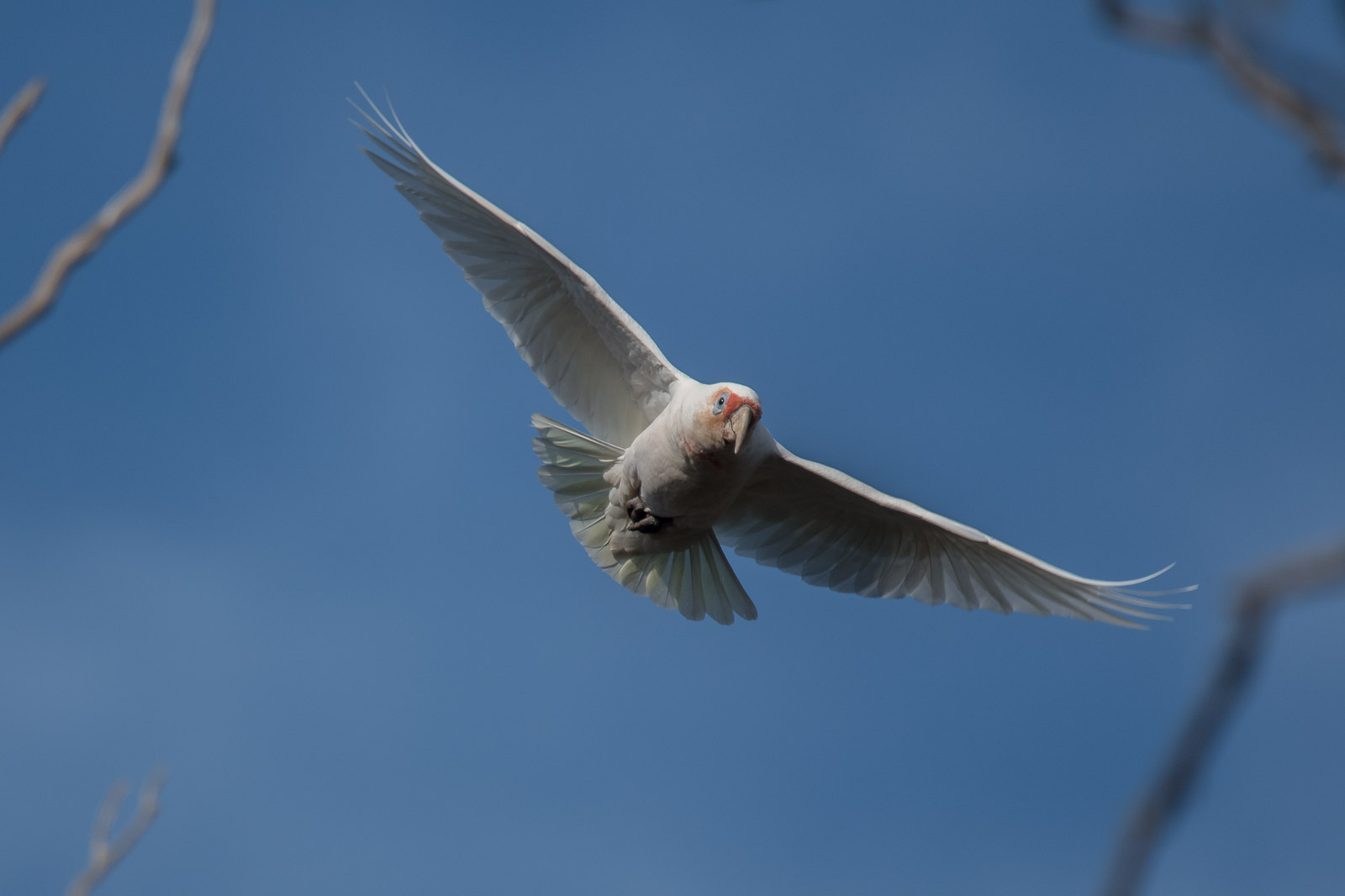
However in the end, the bigger bird won out and the Corella took to the air.

After a few proud crest flushes, and a loud calling session, the Sulphur-crested Cockatoo departed to catch up with its mates.

Here is how it panned out.


–––

Saturday Evening Post #42 “I’m Not a Lifesaver”

No doubt you will have seen as the credits in a magazine, newpaper or book for Photo by AFP.

AFP is a noted news service that goes all the way back to 1835. AFP are the initials for “Agence France-Presse”.

They currently have over 400 photographers-photojournalists at work on stories in war zones, policitcal events, and just about everything in between that is newsworthy.

One of their photographers has recently come to my attention.

His name is Aris Messinis, a Greek photographer.

The image that has created my interest in his work, and his life, and his compassion, was  a photo taken in March 2017 in Iraq, in Mosul, at the time of the ‘libertation’ of the township from the oppression of Islamic State, (ISIS).  I don’t have access to the image, and below is a quick copy from a magazine in an iPad display.  I don’t normally put other photographers work on this blog, but none the less, to explain it would be much to difficult. And I can’t locate a reference site to give it full credit.  The copyright is the work of Aris Messisnis.  His work is worth more than a second glance.

What caught me with the power of the image, built around the smoke, dust and haze behind the couple, that cover, yet hints at the destruction. While the glace behind is both protective and fearful.  The touch of the family belongings in the single yellow plastic bag holds both their possessions and the centre of their life away from the misery behind.

In October 2015 on the Island of Lesbos (Lesvos), he covered the story of refugees making the prerilous crossing of the Mediterranean looking for a new start to life.

During this assigment, Aris crossed a line that many of his peers feel must never be broken. He put down his camera and helped the people he was sent to photograph. Several photos of him helping children, and babies to safety through the surf surely testify to his involement as more than just a observer of the human condition.  He called out his fellow photographers for not helping a boat that had capsised and plunged its overloaded passengers into the water, “You could take all the pictures you needed, and then lent a hand to help. Why didn’t you?’

The response.  “I’m a photographer, not a lifeguard.”

This is a photo by Petros Tsakmakis. The photo is not one of those ‘set’ for the moment, Aris carried a number of children that day. Petros took quite a number of Aris carrying in young children

Here is a link to a full story by Aris. https://neoskosmos.com/en/33347/aris-messinis-afp-photographer-blog-refugee-crisis-lesvos/

Please be aware, that there are, as they say on the tele news, “Some quite confronting images on the site”.


Aris says, “I respect the need to be objective, but in our personal time, when we are not working, we are human.”


Thank God he was human.

Photos shared on the site are the work of Aris Messinis and Petros Tsakmakis. I acknowledge the copyright to be theirs or their associated companies.


Moments: Bathing with a Friend

Among the residents at Serendip Sanctuary are seveal pairs of Emus.
We were walking toward the nesting Cape Barren Geese when we spotted a pair moving in the scrub behind the track.  A quick peek around the tree-line and we managed to get a view of them bathing.

The recent rains had filled  up a substantial puddle of water, not enough to dampen more than the ankles of an emu, but none-the-less, this enterprising pair decided that by squatting down, wrapping the long legs around, it was possible to get most of the body into the water.   No doubt in the wild, they’d just wade into a creek, river, dam and not have to go through the ungainly procedure.

It took each of them several goes to find the deepest spot and then flop down for a good soak. The amount of water they were able to shake off was pretty impressive.

And for all those who’ve been conned by the “Oh, you need to keep your birdbath pristine clean for the health of the birds…. blah blah…”  Take a look at the colour of the syrup running of these dudes.

Enjoy

Saturday Evening Post: #41 Problem Solving

Long term readers will remember, or might recall, that I have a warm and fuzzy feeling for “Choughness”, the life skills of your average White-winged Chough clan.
I put up a shot a week or so ago from a trip to Serendip Park, where the Choughs were trying to raid the feed bin for Brolgas and Magpie Geese.

Now it probably doesn’t take much to figure out that your average feeding spot for a brolga or goose is somewhat higher up than even the tallest chough.

The family I worked with two week ago had adopted the ‘jump higher its got to work’ approach as each family member tried-usually in vain-to get a grip inside the feeder and only had time to grab a small beakful before plummeting back to earth.

However time goes on. Problem solving skill seminars and practice sessions followed up with various counselling events, has given the Choughs a new approach to the problem
Or

This is a different family and well on the way up the evolutionary ladder. Next step Chough on the moon?

This family had developed a very workable solution indeed.  One clever bird, (Called Lucky by its friends) would jump up, flap/drop onto the edge of the feeder, and somehow balance its centre of gravity over the feeder and thus successful land inside. Then with great scooping bills-full, drop seed out of the feeder to the waiting family members below.
The only draw back to this incredible bit of problem solving is the Brolga, Magpie Geese and Little Ravens, don’t take to kindly to their food supply being raided, and every few minutes Lucky was forced to abandon its position to avoid a sharp wrap from the Brolga.

Where there is a will there is Choughness.

Enjoy

Moments: Free-for-All

It’s been a bit quiet for us of late. Too cold, too blowy, lack of birds. And hot chocolate at home…Yum!

We had been at Point Cook Coastal Park a couple of weeks back. Looking for Flame Robins—not too many, unfortunately—and EE’s Sea Eagle, (hers by virtue of she saw it first, not that any would be surprised).

By the time we had arrived there was a pretty stiff Southerly breeze at work, making walking challenging for EE and Dolly. However we found a sheltered spot at the beach, and opted for a cuppa and snack, and while we sat contemplating no Sea Eagle, Robins, nor Cormorants, (somewhat in that order of importance), a large mixed flock of sea birds arrived just about in front of us.

No doubt a school of fish was running along the edge of the sandbank a few hundred metres out.  Outstanding among them was 25-30 Australasian Gannets.  It’s really only on a Southerly that we see these birds in so close, so it was a bit of a treat to watch their controlled dives. A large number of seagulls and cormorants were also along for the feast and quite a few Greater Crested Terns.

Unfortunately for photography, they were just that little too far out, and mostly swung round into the breeze for lift off, which meant very few close passes.  As it happened, however, I had packed in the Teleconverter, TC 1.4, so it gave me a little more reach with the 500mm.

Still for all that,  all these images are huge crops from the D500.  But it does reinforce what I’ve said previously about the lens.  It does focus well, beyond the somewhat limited 30m or so of the cheaper tele/zooms.

Eventually the fish moved further out and up the bay, so we settled back to our now cold cuppas and enjoyed the action from a distance.

Made up for the lack of other special guests that day.

They seem to roll over, then correct and plunge straight down
No doubting where the target is.
Starting to fold up all the hardware
And down it goes.  Interesting to see the Pied Cormant appearing in the sequence


Another of the roll over actions
1906-28_DWJ_7306
All tucked up for a smooth entry
A juvenile. When you consider it’s actually upside down as it comes out of the roll over, their body flexibility is awesome.

Saturday Evening Post: #40 “I will sing, sing a new song”

Ha!  Just messing with your minds really.

As our younger girl grew up, the group U2 were a constant source of music enjoyment in the house.

And as I hit number 40 for the Saturday Evening Post, I thought I’d quote from one of U2’s music would be a bit special.

Lots of interesting anecdotes about the piece, but I’ve always liked Bono’s statement, “We wrote it in 10 minutes, played in in 10 minutes, recorded it in 10 minutes, mixed it in 10 minutes, but that has nothing do with with why its called 40. (How Long!)

Rainbow Lorikeets are among some of the brightest, and most active little clowns that frequent the trees where we live.  They can always be counted on to come up with a new wing flap, expression, act, or even song to entertain.

I have no idea what this one was upto, but its mate was on the branch next door, and for some reason, lots of big wing flaps were needed to emphasise the importance of some point of communication.  I managed to get it right on the end of the outward stroke.

“Many will See, Many will See and Hear” (40, How Long)

Enjoy

Saturday Evening Post: #39 Decisive Moment

Photography is one of those great expressive mediums that, unlike, say, painting, words, sculpture or dance, to name a few, relies on the moment. At the press of the shutter, the motif is set.  An author can rework a sentence, paragraph, chapter or even a complete manuscript.  Painters leave in, or add in necessary parts of the subject to provide just the right story.

Famed street photographer, Henri Cartier-Bresson,  —HCB—(he was much more than that), coined a term “The Decisive Moment”.  Often quoted in photo blogs, books, magazines and the like, (including this one it seems),  yet rarely understood in the context with which he gave it life.

Here’s a good working definition:

“The decisive moment refers to capturing an event that is ephemeral and spontaneous, where the image represents the essence of the event itself.”

As Captain Barbosa in “Pirates of the Caribbean” says, ” There be lots of long words in there, and we’re naught but humble pirates.”

Reams have been written, and great theses developed to explain what HCB might or might not have meant.
He also said, “To me, photography is the simultaneous recognition, in a fraction of a second, of the significance of an event.”

and then this, “Photographers deal in things which are continually vanishing and when they have vanished there is no contrivance on earth which can make them come back again.”

That sounds more like my bird photography in the field.

It’s been quite awhile, since we’ve been able to find, let alone work with Eastern Yellow Robins, but EE’s perseverance hung out again this past week, and we managed a few minutes in the You Yangs with an active feeding bird.
After several relocations and changes in light, I was getting a feel to the actions of the bird.

And because of the morning light getting a reasonable balance of fore and background from the hard light was a challenge. Find bird in viewfinder, move about for best background.

Then it landed on a single upright branch. After several shots against dark and light backdrops I settled on the light on dark approach, and the bird turned into the lighter side.  I waited.  And then almost imperceptibly, the ‘significance of an event’ occurred as the bird bobbed as it lined up the next meal, and then slid of the perch.
Nailed it.

1906-30_DWJ_7466


Little Visits: Serendipitous

We went to a BirdLife Werribee, (formerly Werribee Wagtails) monthly outing that included an afternoon at Serendip Sanctuary.

It’s a fairly close park for us, and we visit several times a year, and if the granndies turn up, it’s a day out in the field, but on formed tracks, and things to do, so makes a pleasing family day.  And it’s quite close to Lara Village and a certain Routley’s Bakery Pie shop. Which proved too much of a draw for Mr An Onymous and me, so we stopped off for lunch on the way through.
Furphy’s Ale and beef for him. Tandoori lamb for self.

I’m always a bit uneasy about photographing in an enclosed sanctuary area. It’s not a matter of ethics—per se—but, rather always seems to me a less challenging experience than working with the birds in the field. After all, the kangaroos have already seen a 1,000 tourists this week, so you are not exactly interesting.  They also know, people stay on the tracks, yell a lot, and move on. Some even wave, point fones at themselves and ‘whatever animal is that in the background?’ selfies abound.
So truth be told I normally wander through the area ohh and ahh appropriately, try not to get upset when someone points at a Tawny Frogmouth and says, “Oh, look, what a cute little owl!” and enjoy others enjoying their wildlife experience. (I’m not a spoil sport entirely!!!)

However it seems I’m mellowing with age. 😉

After so many trips, I’ve come to respect the locals. In their locality. Not only the ones in enclosures, but also the ‘visitors’, that have stayed on as Star Boarders. Quite a lot of the bird life is free on the wing and come and go as the season dictates. Others, for various reasons, including breeding programmes, are permanent.

And, what I’ve discovered from all that is I’m not so fussed about the lack of challenge, and much more interested in the closeup portrait.  The challenge for me is working with the bird for the right setting/location/lighting and then allowing them the freedom to move about unstressed. A humbling experience, but really has given me a feel of involvement with them as individuals. So much so that I look forward to being in their area, and hoping I’ll be able to make the best of the moments they share.

Of special interest to me is a pair of Cape Barren Geese.  These big birds have settled in to make Serendip their home territory, and with ready provided food, can you blame them. It’s nesting time right now.  One enterprising pair have made a nest site among some downed branches and scrub, not more than 5 metres from the main walking track. I spotted him first, and as he paced back and forth as people went by, I wondered, “Where is you mate”, and then I saw her.  All tucked up in her ‘secure’ haven.

The rest of the Wagtails tour/ensemble, moved on. I sat down with the pair for about 10 minutes.  Now a sitting goose doesn’t do a lot. Yet, the warm image of ‘mum’ raising her young, is such a classical performance.

Choughness, as this blog has often commented is a joy and delight to behold, especially as we don’t know the rules.
Inside the enclosure with the Brolga, there is a feeding station about brolga height. But rather attractive to your passing White-winged Chough. Except, they don’t have a good ‘hovering-flying’ technique, and so couldn’t access the food by sitting on the edge of the feeder. No where for them to attach.
Coughness is never defeated by such mere challenges.  So bend down, spring up on uncoiled legs, flap once to get direction, sail into the open feeder, grab a beak full and use those same wings to flutter back to the ground. Innovation at its best.

There is a bird enclose that houses quite a number of birds in a fly aviary.
Interestingly Buff-banded Rails are there in good numbers, and often Freckled ducks. One of the rails that I saw was quite white, so it must be a leucistic (the cells don’t have the ability to make colour).
And while I was there admiring that ‘Cute little owl’ (ggrrrr- it’s a Tawny Frogmouth!!!!), a pair of King Parrot turned up for a looksee at why wasn’t I walking through, yelling, pointing, and waving a fone about.  Thanks Mrs King, a lovely portrait session.

A day at Serendip is always a good experience with the birds, and now I’ve discovered my new friendships with them, I’ll look forward to the next trip to enjoy the photography of them as individuals, and find ways to express their character in a much more sympathetic manner.

Emu Portrait, in soft light. Finding the right background is the challenge
Oh, there you are, all tucked up in a safe nest
Sitting pretty, watching the parade of humans walking by
With a one, and two, and go. Coiled up like a spring it has to leap/flap about a metre and a half to get to the covered over feeding area.
As the old cartoony used to say, “Thunderbirds are GO!”
Incoming. Fiercely protective male makes a stunning entrance.
1907-02_DWJ_4665
Buff-banded Rail, not exactly blending in like its neighbors. Best guess is leucisim.
Mrs King, always looking resplendant.


Enjoy

Saturday Evening Post: #38 “I accept what is offered”

Been a wet stormy day in our neighborhood.

So, I settled into the window seat, with a nice hot cuppa, a few good books, and watched the clouds chase one another across the sky.

First stop was T S Eliot “Ash-Wednesday”,
I rejoice that things are as they are

And another from Lao Tze,
“I am a guest in this world, delighted by my host’s generosity, I accept what is offered”.

A week back EE and I had set out on a very bright sunny morning to go to Point Cook Coastal Park to look for Flame Robins.

Did I mention sunny, oh, yes, it looked like a treat.  But by the time we had arrived on the ground, a huge grey cloud could be seen over the horizon and coming in our direction.  Within a few minutes a thick sea-mist had set in.  And with no breeze, it just hung in the air.

We found some robins, but the lack of light and the difficulty of getting close enough to get a clean shot meant that our time was severely limited to a few records of the birds at work.

One of my mentors used to talk of the two major influencers on a photograph.  The Elements, and the Intent.

Elements are easy. They are the ‘things’ and the camera settings we choose.  The Intent is what am I trying to say. What will the view perceive and what is the best way to approach and arrange the elements.

And what better way to challenge those opportunities that the use of the mist to eliminate all the unnecessary and concentrate on the intent.
As I’d not bothered to bring a smaller lens, out came the iPhone and a bit of a look about soon revealed some panoramic opportunities.  (I’ve talked here before about my fascination with the wide-wide view and really appreciate the simplicity of the phone’s pano feature).

The old gate was an obvious choice and I enjoyed the wrestle to find the right framing, and the best backdrop.

And I came across a small pine seedling struggling to exist on an old log of its previous generations. (Lao Tze would be impressed).

Here is how it looked, and here is a link to the final on Flickr.

Enjoy

One of my first options
What I really wanted was the old gateway to dominate the frame


And the first look at the seedling at work

And here is a link to the final that I shared on Flickr.


The eternal struggle for life

Moments:Mist-erious Morning Ramble

“On the Post,” she cried.
We were driving along a flat farmland, busy, country road.  Which Post? Seemed an obvious question from the driver’s side view. Thought I was supposed to be keeping it on the blackstuff, and avoiding making close personal contact with the oncoming traffic.
“Back there, on your side.” Makes it even harder.

Slow down a bit, look for a spot to pull off the road.  No easy matter either as we’ve had a good share of rain of late and the pools on the grass on the side of the road, are not a promising parking location. 500 metres and I’m off the road.  Now to wait for a break in the traffic to get around avoid cars in both directions. I’ve seen it less busy on a club day at Winton or Philip Island circuits.

“Think its a Brown Falcon,” so around we go. “There.”, but I’ve spotted it in the sunshine by then. Another of the avoid other car contact at all costs manoeuvres, and I’ve got the car about 50 metres from the most likely photo spot.
Slog back through the mud, avoiding if possible the road spray from our passing friendly roadsharing traffic.
By the time we’d got to a break in the roadside bushes, I’d already called “Peregrine Falcon”. Much too broad across the shoulders for your average Brown.
“It’s caught something,” Something, being, as it soon becomes apparent, is a rabbit.

First problem.  The first signs of a morning seamist are just about on top of us, and the sunlight has a limited tenure.  Second, the bird is much too far away in the middle of the fence line.  Thirdly in my haste to slosh down here, I’ve left the Teleconverter in the car. Bad move.

Two passes by a magpie and the Falcon is a bit nervous, and takes to the air, at first I thought because of its run, it was going to come close, but it soon swung out, around, and headed down the line.  Now too far for much else than enjoying the moment.
Then the seamist closed in, and we needed a guide dog to get back to the car, and the strains of bagpipes and Paul McCartney’s “Mull of Kintyre” ringing in my ears.

Enjoy

1906-23_DWJ_6534
Just about to have its morning meal interrupted by a passing magpie
1906-23_DWJ_6541
With a tail flick its away. Easy to see the prey was a rabbit.
1906-23_DWJ_6543
Getting up to speed
1906-23_DWJ_6562
And now too far away, and with a mist rolling in, the best we can do is watch. Is that bagpipes I hear in the background?