Saturday Evening Post #124: Sneak Attack

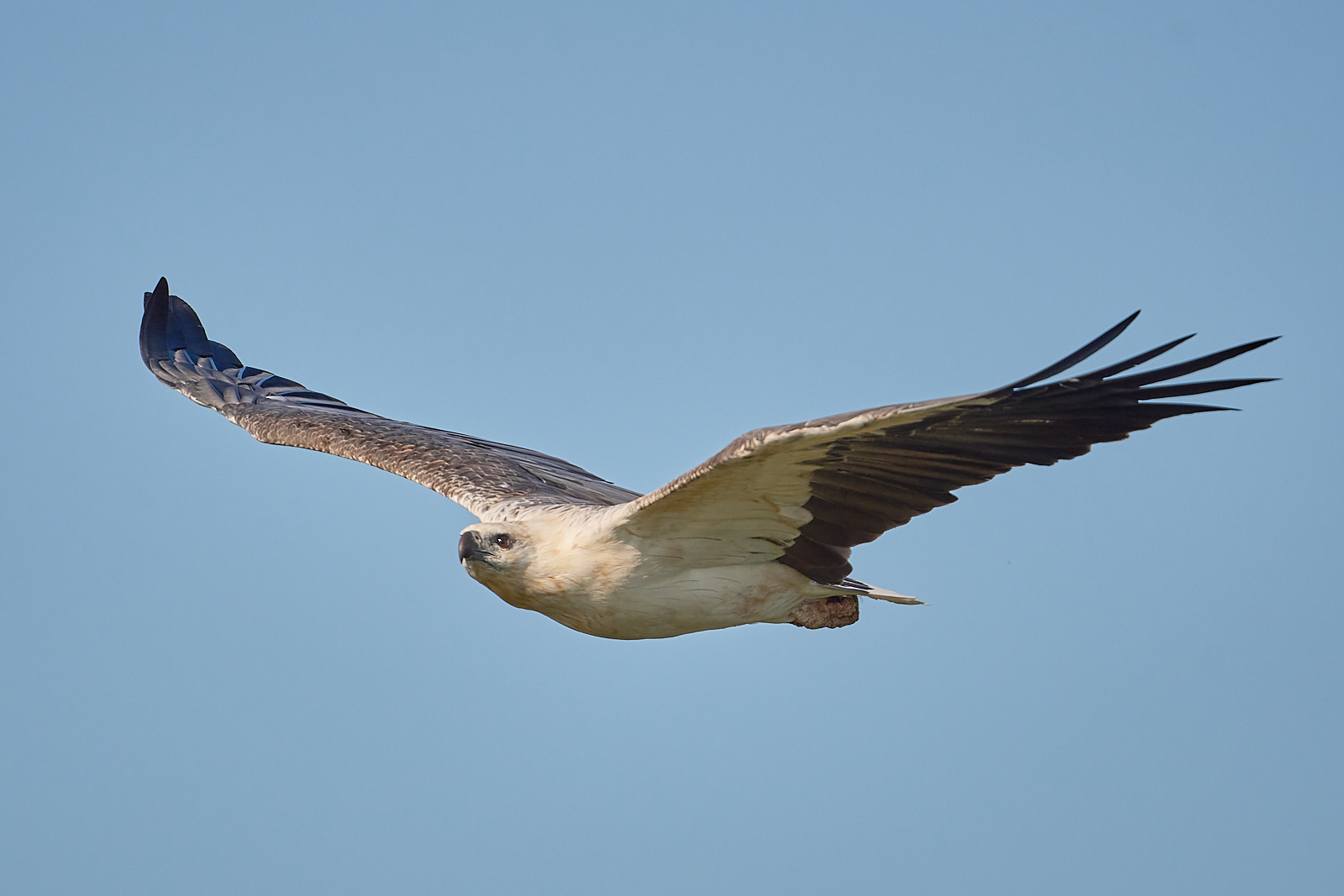
I don’t have too many closeup or head on shots of Swamp Harriers.

Our local area of rivers, a few large water storages and of course the wonderful bird haven at the Western Treatment Plant all carry their fair share of “Swampies”.

But.

It is said, that a Swamp Harrier can see the flea on a dog at 40 Kilometres.
I’ve always thought that might be a bit of an exaggeration, and it would more likely be around 38 km 😉

They also have a total, “Zero Tolerance Policy for Human Beings.” This means they will turn away at the slightest chance of human presence. There are stories of Swampies abandoning a nest when the young are just days from fledging, if the area is compromised by human activity.

So your average photographer around Swampies ends up with lots of flying away back shots.  Showing the colour of its tail as it stretches out to put as much distance as possible between them and us.

They will always have a glance behind to be sure of the source of their concern. So, we accumulate a fair number of bird looking back under or over wing as it powers away.

I’ve sat motionless in the reeds, camera at the ready, while a Swampie makes its way slowly, surely and with great care along the edge of a reed bed. I’m sure that they can spot the mirror going up when I press the shutter and by the time the mirror has come back down again, the bird is already turning away. Perhaps another reason to ponder using a mirrorless camera?

Not only do they hunt from a distance, but they also patrol just above the water line with sweeps over a likely reed bed.  This is a head down absolute dedicated to the task at hand operation.
I’ve probably said before, but I think they have some sort of mapping system that they check against.  If there is a change to what they see to the ‘map’ the airbrakes go on and a much closer investigation begins.
Same map alerts them to a photographer, cleverly sitting in the reeds with camera gear and self all cleverly cameoed up.  That lump wasn’t there before!  Is it food? No!  A danger!  Turn Now. And they do.

This bird was on investigation duty along the edge of bund. It swept high, and low, running across the water, pulling back to gain some height. A cleverly co-ordinated sweep of the area.

I held my breath, I was ‘hull down’ on the other side of the bund, so it hadn’t shifted its gaze that far ahead, and would only have spotted the camera and me from the shoulders up.

Finally I couldn’t hold on any longer and let off a burst, and a split second later the bird had turned and was gone.

I was using the amazing Nikon D500 PSUEDO eye-recognition autofocus and it maintained focus even though the bird was disappearing behind the canola growing on the side of the bund.

After last week’s Saturday Evening Post, about eye-recognition, I couldn’t help myself and this shot seemed to fit so well.
The PSUEDO af is really only single spot focus, kept on the bird’s head.  The D500 does the rest.-)

Bonus Night, here are three from the sequence

I was concentrating on the bird as much as it was on its hunting and didn’t see the grasses until I looked at the shot on screen.
Now I see you.
Peeling away from danger.

Little Visits: Like a Needle in a Haystack

…. or a Kingfisher in a Forest.

“Found It”, the text message said.  Neil A. and I both smiled.
We had been photographing the nesting Hobbys and EE had decided to leave us, and venture further on down into the forest to look for a pair of nesting Sacred Kingfishers.
Sacred Kingfishers are not noted for putting up a Neon Arrow pointing the way, and to say that sacred could also be interpreted as ‘furtive’ would not be pushing the language too far.

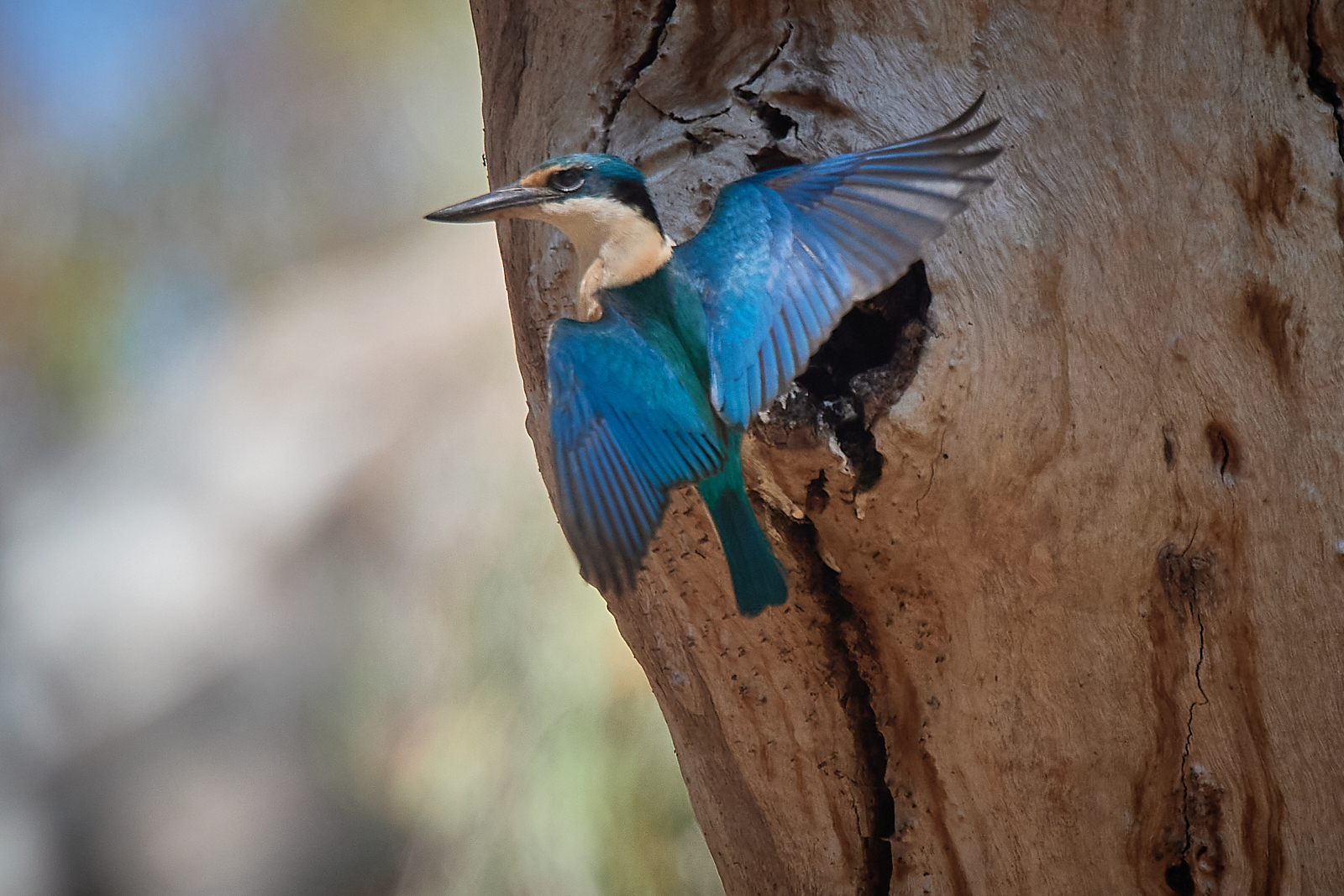
Sacred Kingfishers in our area come down from up north in late Spring and after a lot of calling through the forest, select a suitable small opening in an old tree and move in.
They don’t spend a lot of time sitting around contemplating their next move. The most we usually see is a flash of green and blue disappearing into the forest.

The one upside is that they have a particular ‘skcrrrarrk’ call when they are near the nest.  They also are able to sit perfectly still for many minutes and because of their colour set will simply blend into the surrounding forest colours.

However, with several seasons under her belt, and eyesight and intuition that must have been handed down through the gene pool for generations, Neil and I both had our money on EE’s ability.

The ring on my phone, announced in the absolute minimum of words, that the hideout was located.  Neil had other places to go, and so we parted company and I headed on into the scrub. Now, my challenge was not to locate the Kingfisher nest, but rather to hopefully find EE, another needle in a very large haystack.

To my surprise she wasn’t too far from where we’d spied a bird a few days before, just off a main track.

Another succinct conversation. “There.”

Well, I could see a number of trees with holes that might have been useful. A pair of Red-rumped Parrots popped their heads out of one, and a fierce looking pair of Rainbow Lorikeets seemed to have another hole staked out. So I eliminated them from the search.

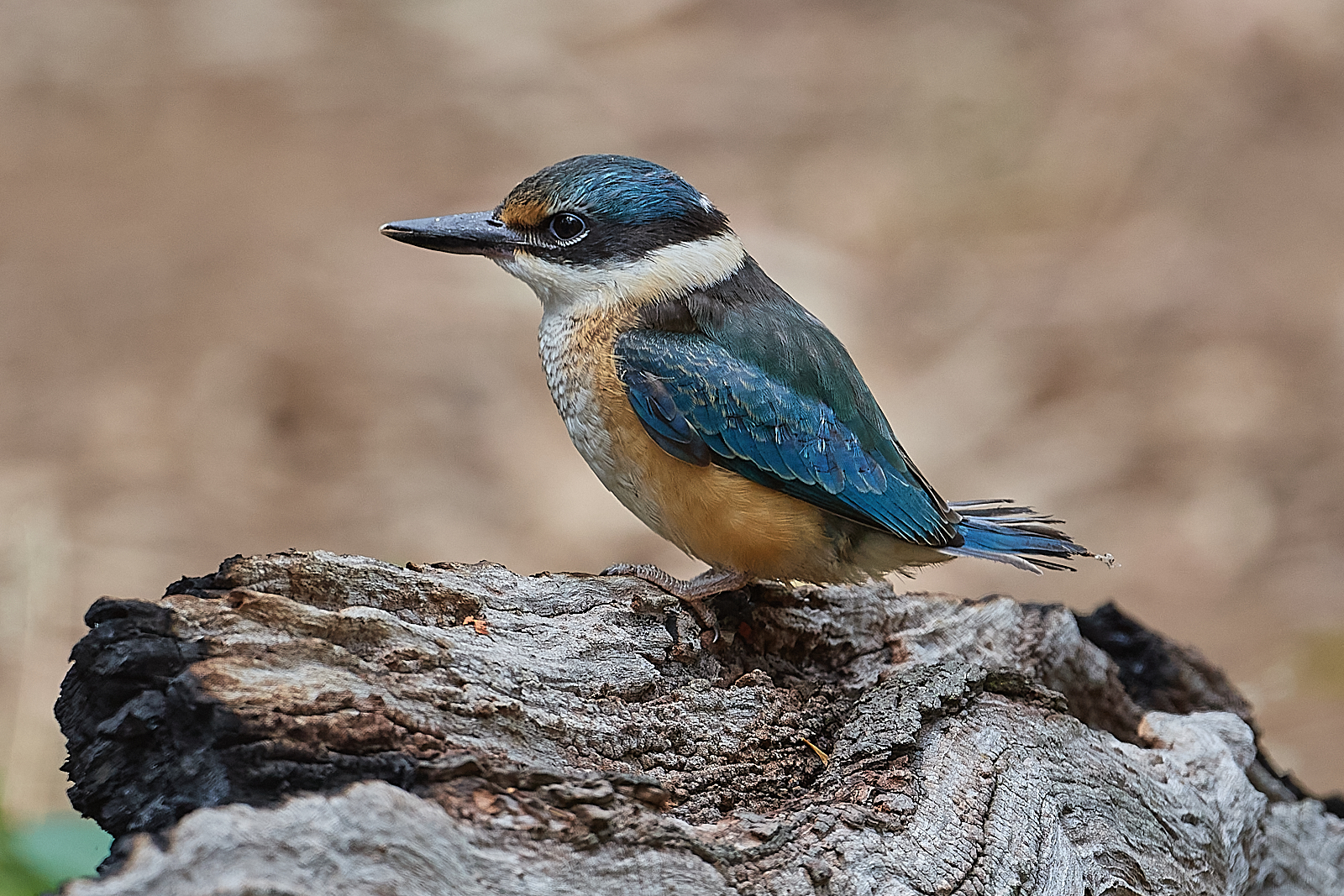
“He’s coming”, EE called, and in short time a male Sacred Kingfisher turned up on a branch not that far from where we were standing.

He sat.

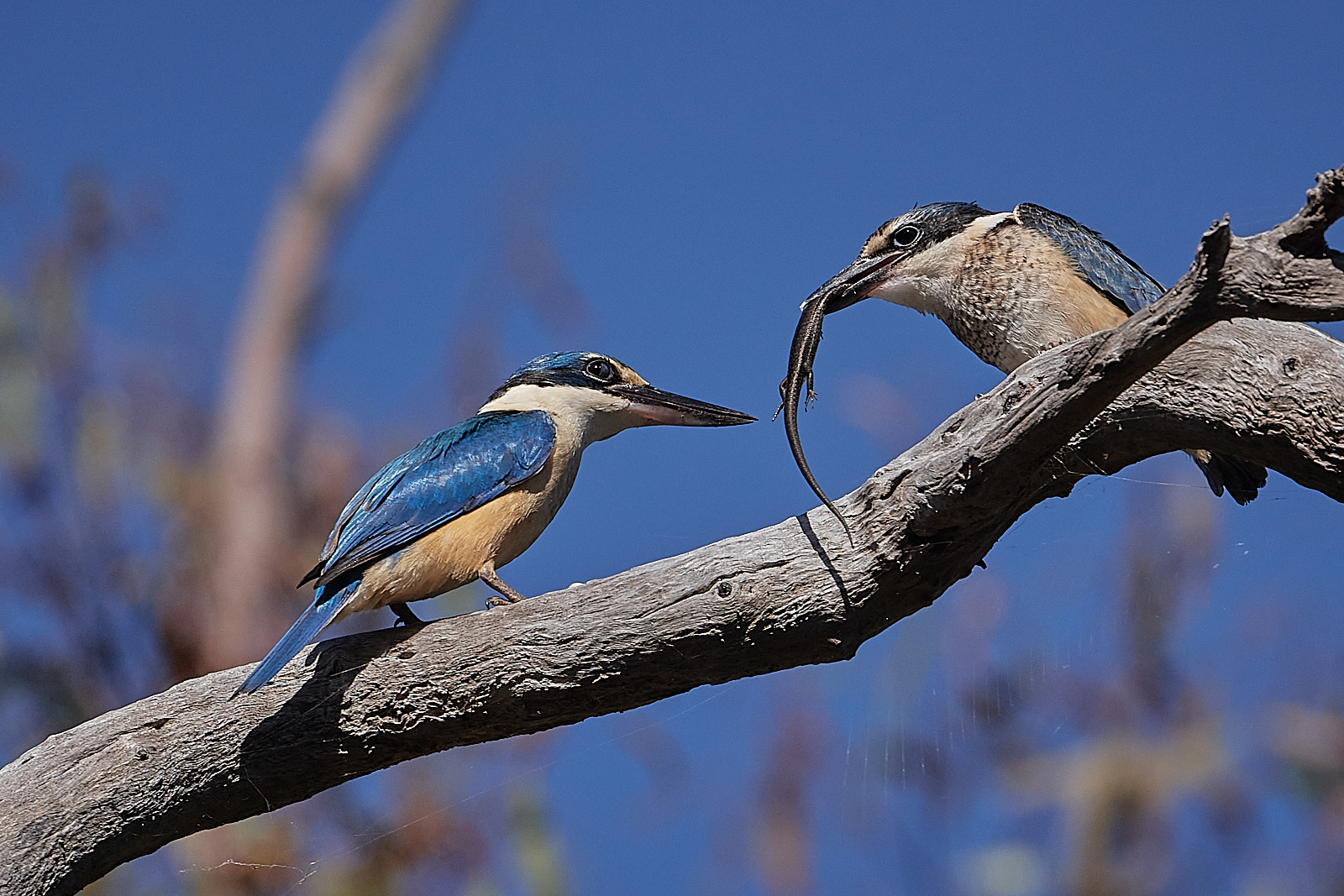
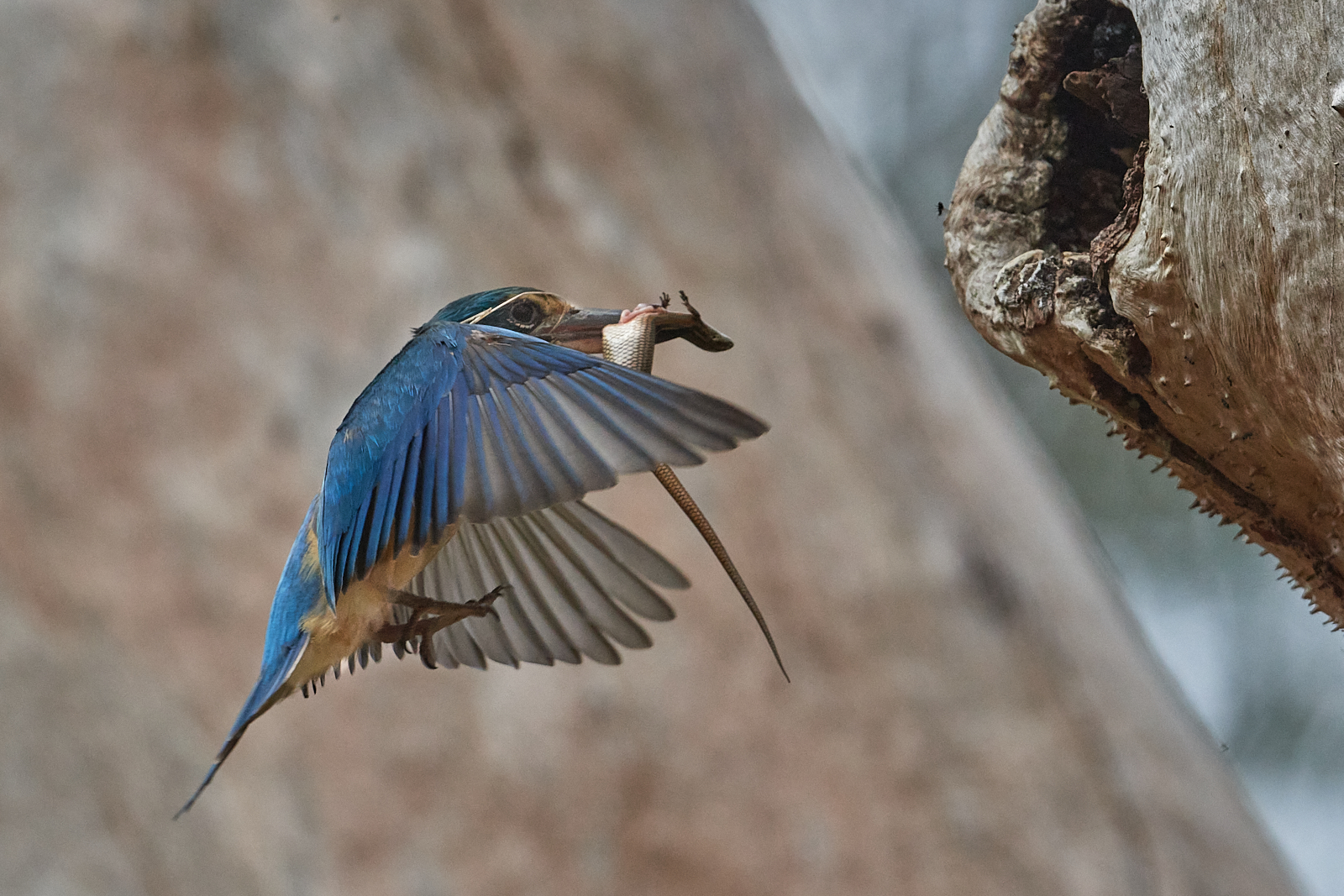
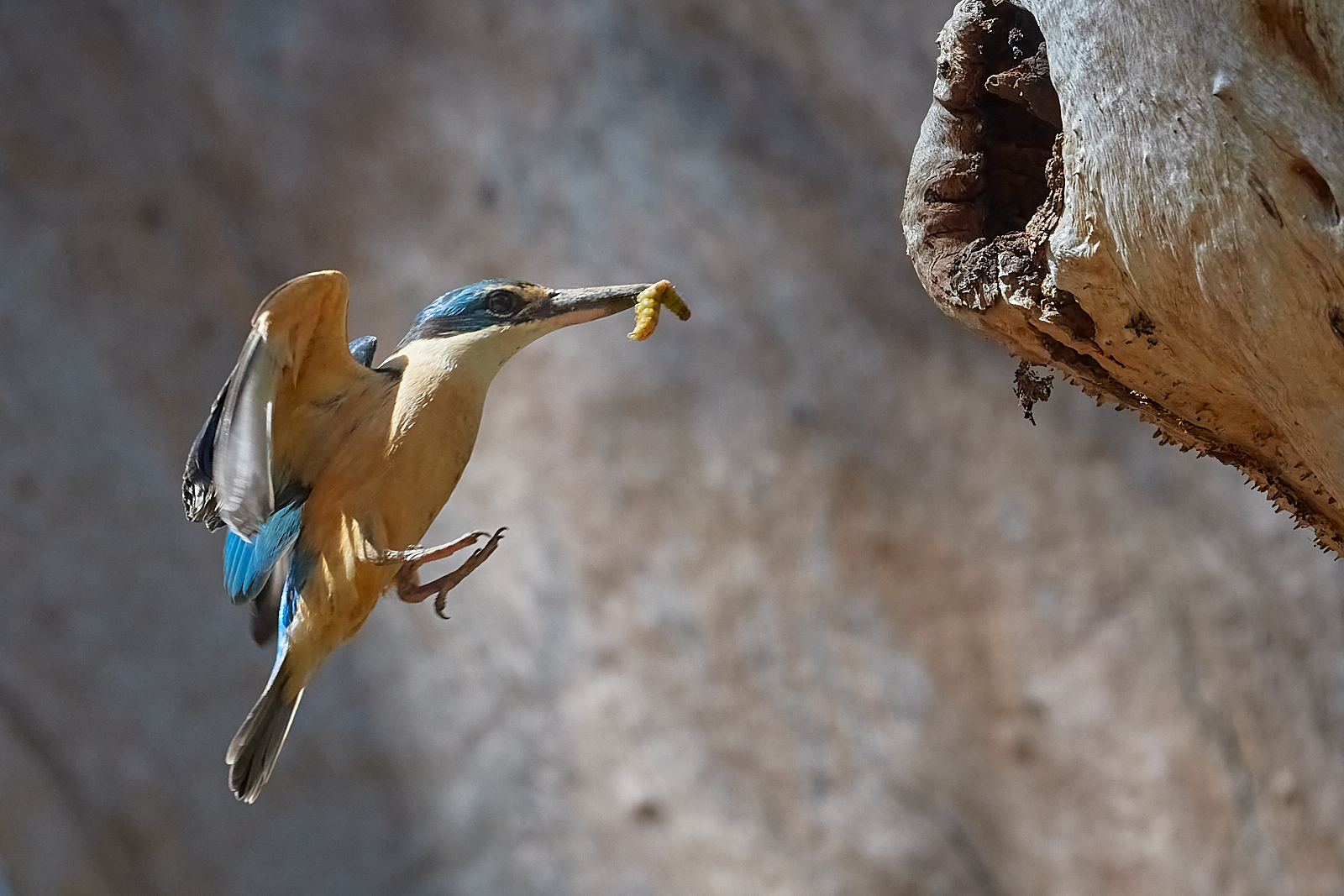
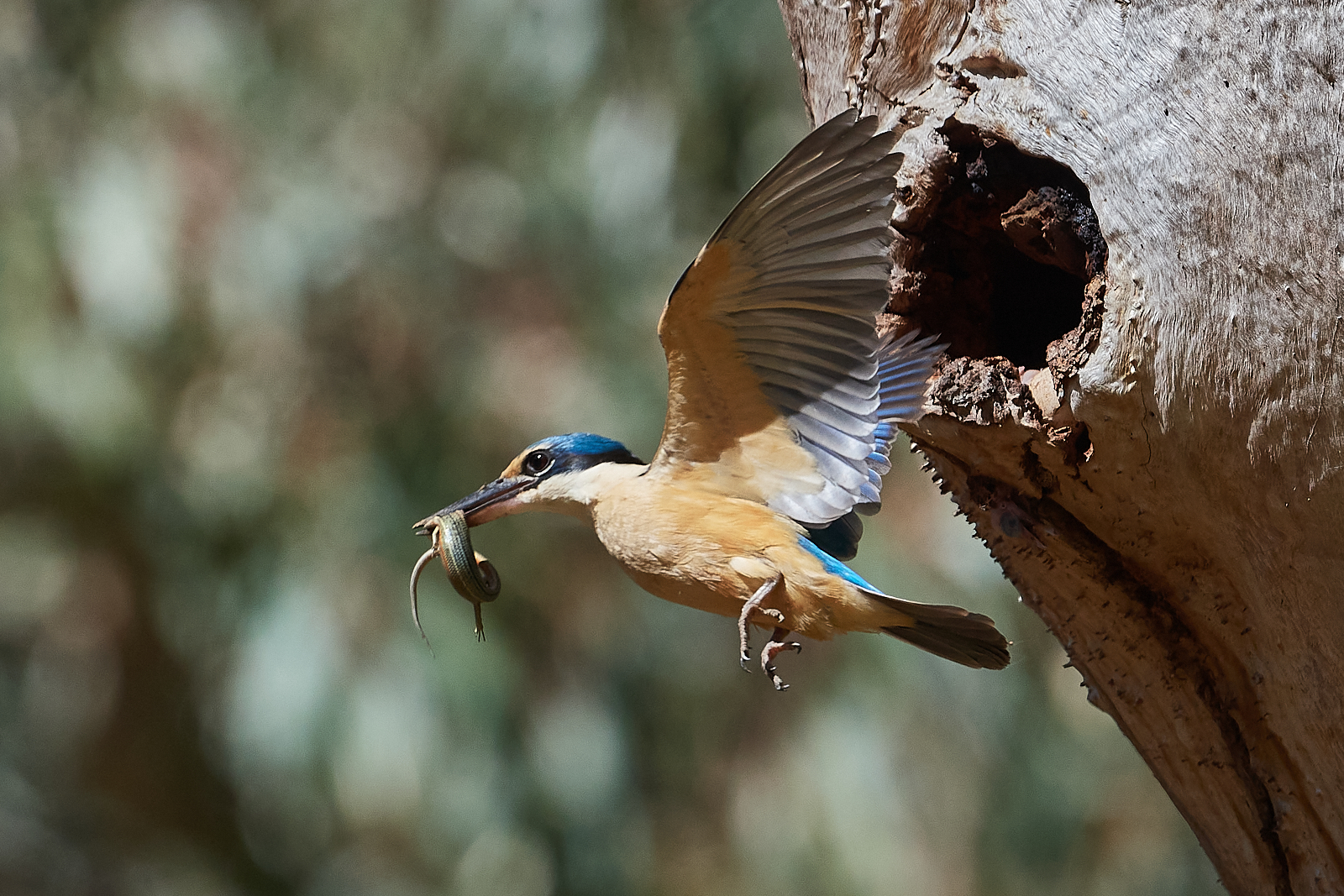
Twirling a small skink in his beak, he sat.

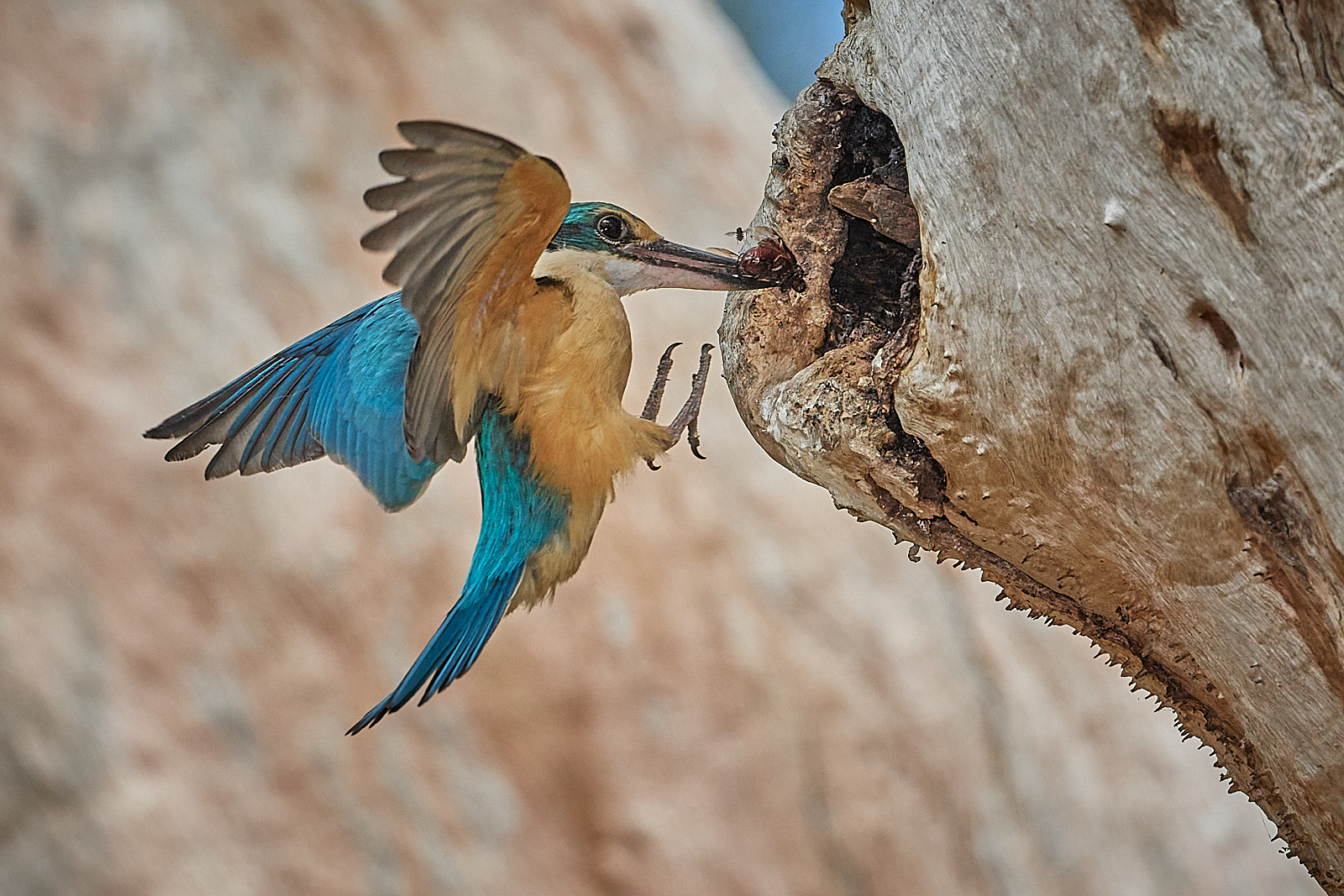
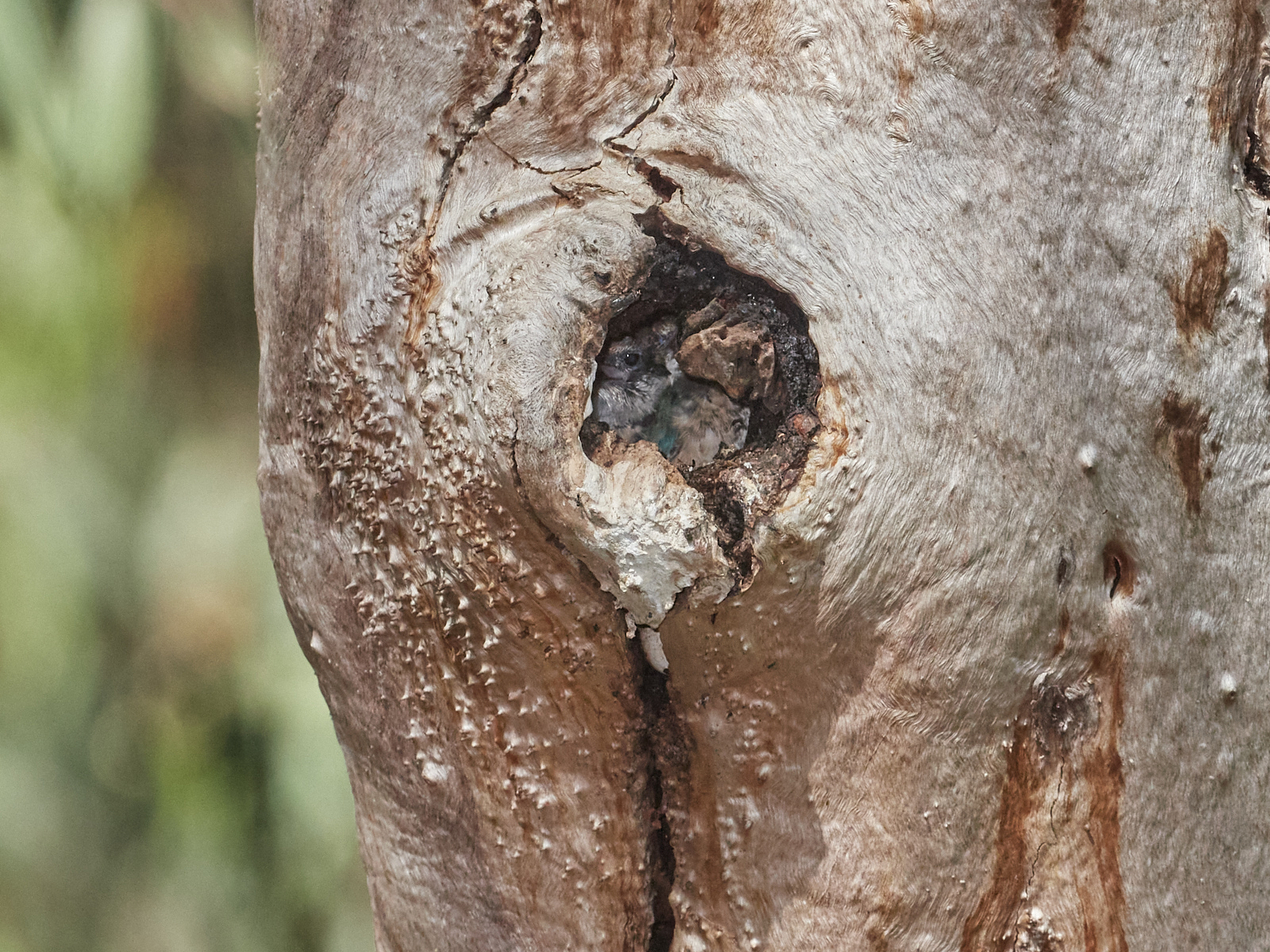
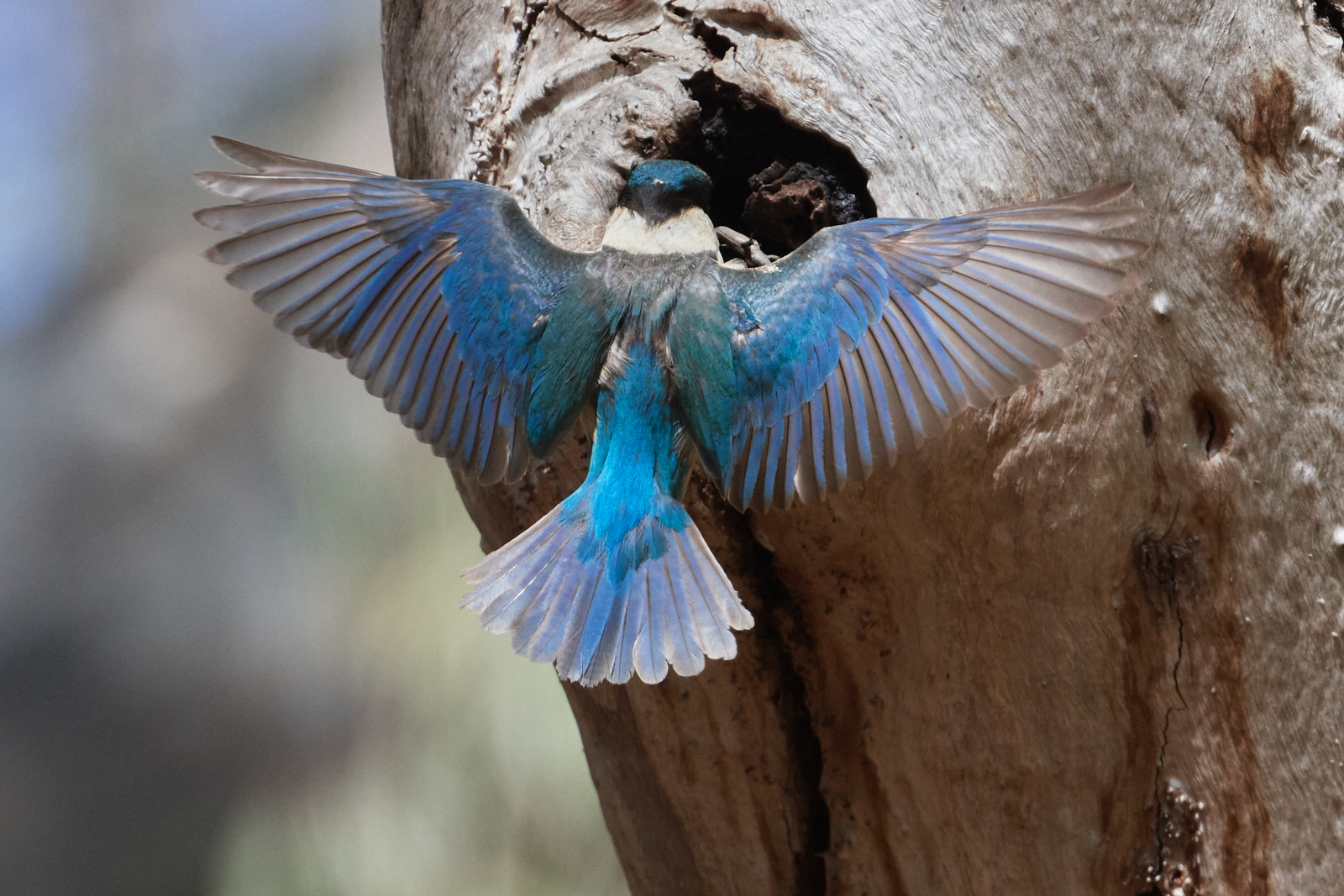
Then a few wing-flaps and he had delivered the meal to a hole in an old tree just across a small dry water course.
“Oh, there.”

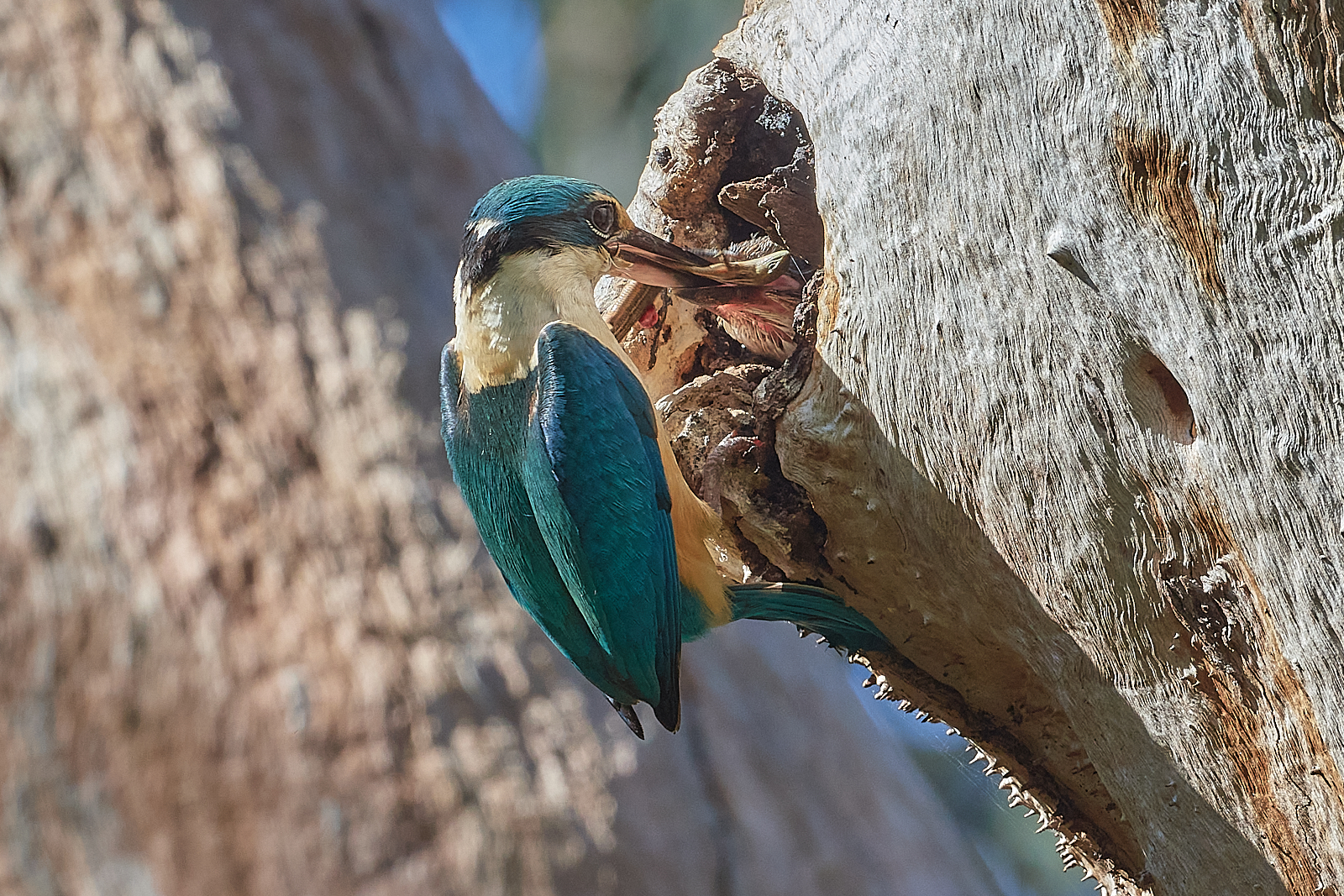
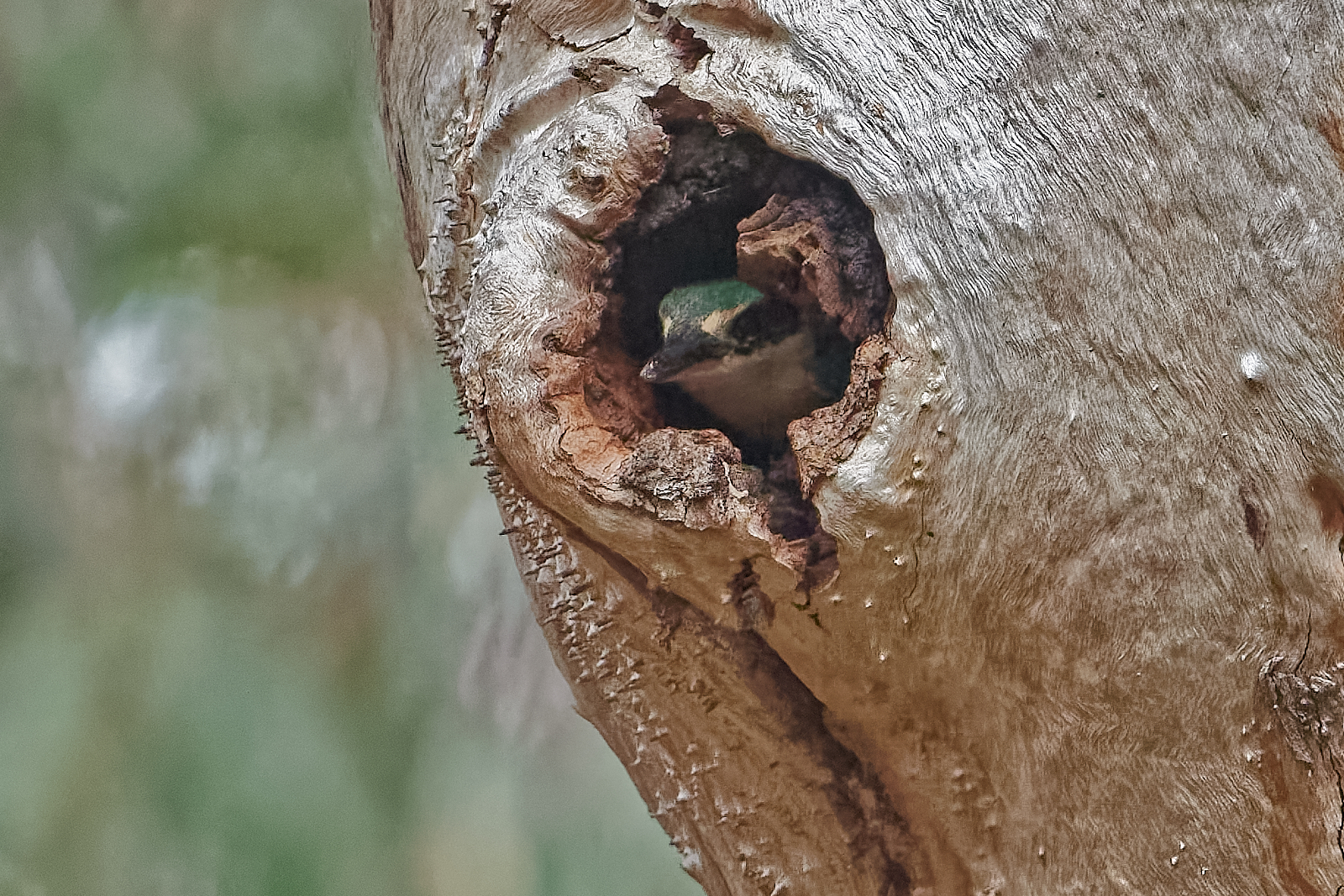
We concluded that he was feeding the good lady as she was sitting on the eggs. And perhaps an hour or so later she poked her head out, and then flew before we even had a chance to press a shutter.

Now we knew.
Time to plan a full scale Expotition as  Winnie the Pooh would say.
“Pooh tells Rabbit about the Expotition (which he says is a sort of boat, which might not be exactly right, but we shall have to wait and see.

But in the meantime we were watching it unfold.

Yawning as he contemplates going out for the next hunt, or laughing at the futile attempts to locate the nest.
Checking out the unwanted attention
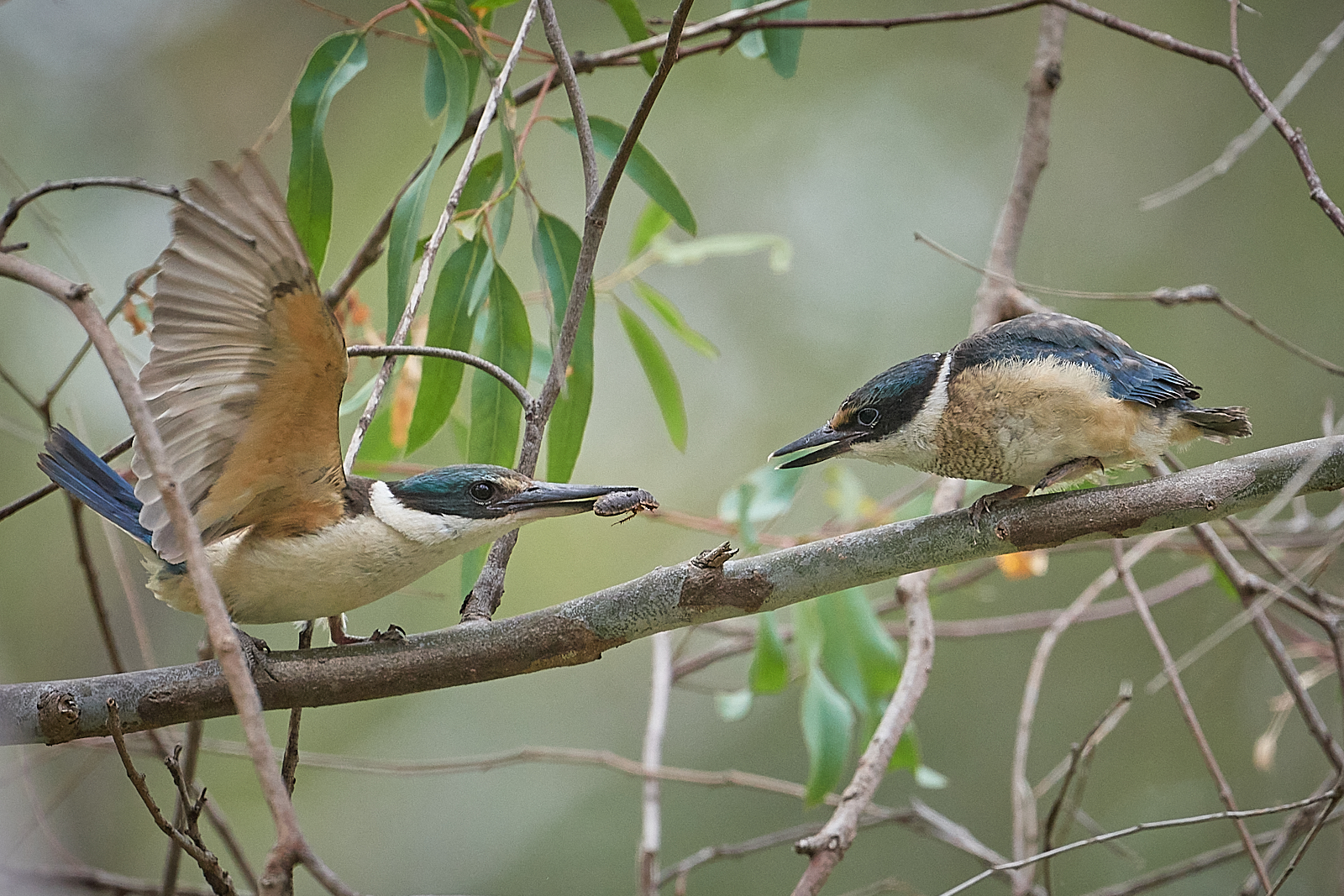
Food up. Delivering top up snacks to the female sitting on the nest. It is quite a tiny hole.
Delivered
Sometimes the transfer fails and he has to make another turn around.
All good. Time to go.
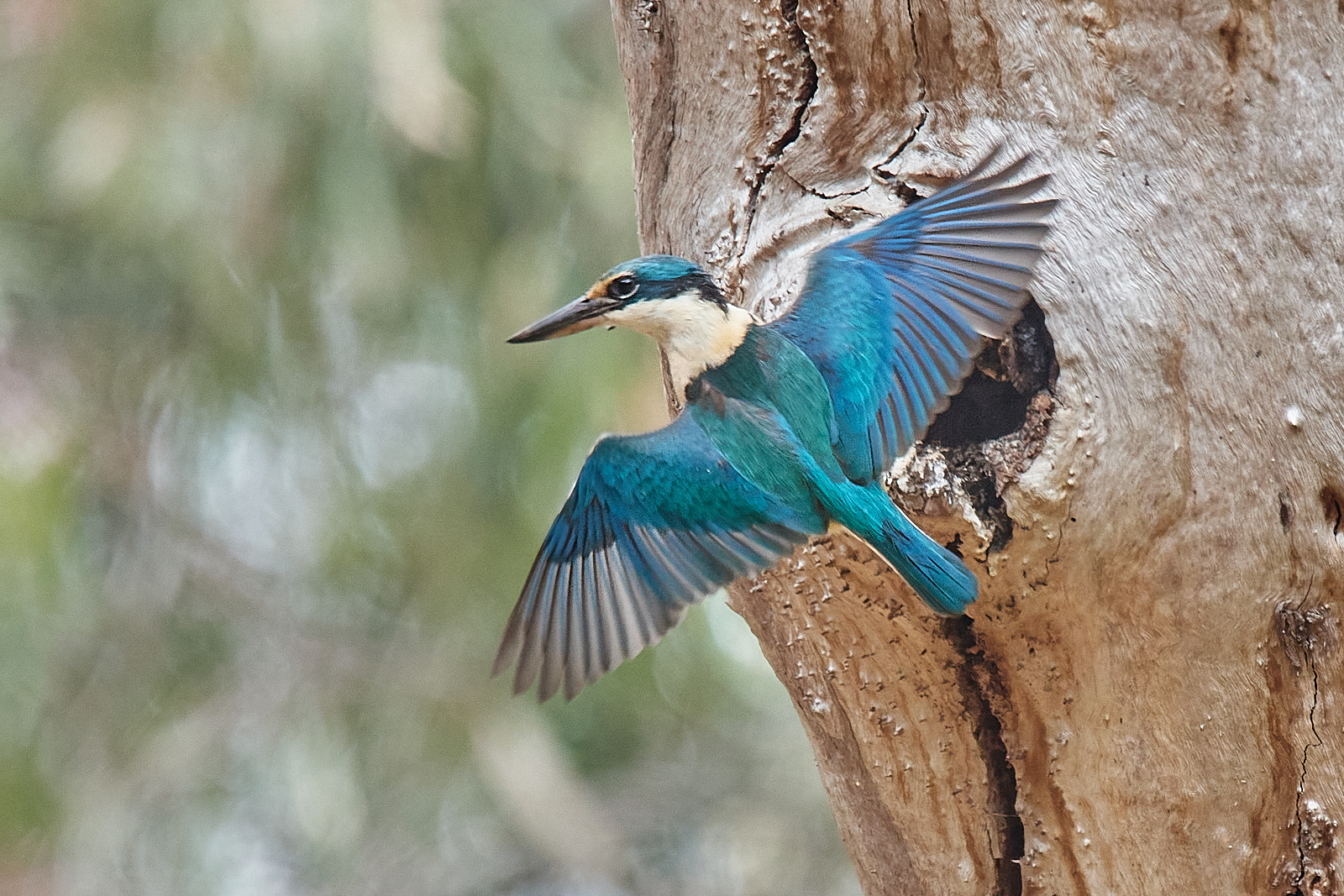
A quick peak to make sure all is clear and the like a bolt of green and blue she was out of the nest and away.

More as they say, to follow.

Saturday Night Post #123.1 Now Here’s the Ultimate Co-incidence

Arrrgh.  Nuff to make me blush.

After last night SEP #123 “It Doesn’t Matter“,  pointing out the vagaries of  believing in new gear.

Found a shot by David Hume Kennerly on Twitter.

Shot with the amazing Canon R5 and a 100-500 lens.

Humming Bird

I can’t obviously publish it here, but do take a sneak look.

Reminds me that sometimes to better check my refs.


Saturday Evening Post #123; It doesn’t Matter

David Hume Kennerly, was at one time in his career the unofficial White House photographer.  This was, it must be said, at a much more laid back time at the presidential domicile, than has been the case in the past few years.
Photographers shot filum, and a professional purchased a camera and then used it for many years. Changing perhaps lenses and accessories to meet the demands of the job at hand.  They chose a short telephoto lens for portraits, a macro lens for some studio shots, a longer lens for sports, and for the cut and thrust of news stories, a short wide angle lens to get into the heart of the action.
Swapping out a camera and lenses just because a new one was on the market was not even considered.
A studio I worked with used 120 Twin Lens Reflex cameras for everything but commercial studio shots and had done so for many years, one of the Rollies was at least twenty years old.

David Hume Kennerly was at that stage the ‘unofficial’ photographer, because, perhaps security and press requirements were far easier than the complexity that press photographers currently face.

He was once asked, the story is told, by a student, in a carpark as it is also told, “Mr Kennerly, what camera do you shoot with?”

“It doesn’t matter,” he repeated emphatically, “it doesn’t matter.” That’s the way the majority of photographers in those day felt about it. It was actually actively uncool to care too much about gear.
What mattered was what you did with it.
Source: TOP Mike Johnston

Just recently a photographic acquaintance has purchased a shiny new Canon R5 and a few lenses.
He told me, “It’s a Game Changer”, but to be honest I didn’t quite understand what the ‘game’ was.
For those that who not hardware aficionados, among its many attributes the R5 sports, “Eye Recognition Auto Focus”, which enables it to lock on to an eye and hold focus. And especially bird’s eyes.
See a bird in a tree, camera locks focus on the eye. There’s a pelican flying past, the camera unerringly grabs focus on the eye.
How cool is that. (Except the coolness requires as I read the instructions about 4 or 5 major setting changes, and a button press (or two) to get it to begin to work its magic.
Let it be known that Canon is not the only black box with such amazing “Eye Recognition” Now I haven’t had time to read all the psuedo-expert sites that extol the virtues of the magic so can’t or won’t comment further.

Just to have full disclosure, I’m not an equipment luddite, still clinging to my 3 megapixel handfone to spite the changes in hardware going on apace.

But, what I do note, having seen some results, is, “It doesn’t Matter!”  What matters is what is being done with the camera.  Are the images telling a ‘game changing’ story?
Time I suppose will tell.

I found this Reed Warbler out in the open, and quite confident about posing for a moment or two.
I couldn’t help but ponder, how much better a ‘game changer’ piece of equipment would have been. Would it have taken the photo while I looked the other way?  If it was put it on a motorised trolley, would it tenaciously track down the Reed Warbler and get that prize winning shot?

Or perhaps it might just take the fun out of finding, and working with the bird to get the best pose and with a single spot Autofocus (on my old antiquated D500), just about getting the best eye focus I could.

David Hume Kennerly might well be right, “It doesn’t Matter!”


From the Field-Notes Book: Turn the Page

By the end of 2020, the young birds were for all intents and purposes self-sufficient.

We hadn’t seen either of the adults for at least two weeks, and the young were now skilled at finding their own food.  Hunting on the ground for insects, raiding the nearby orchard for tasty morsels on the fruit trees, or helping themselves to the young recently-fledged Fairy Martins.

And then all too soon so it seems, the trees became quiet.  The loud calls of success with each catch was stilled, and they were on their way from home into the wide world around.

An end to a fascinating few weeks of learning from the birds just that little more about the lives of Hobbys.
As Mr An Onymous said to me today, on a slightly different subject, “It is one of the great mysteries of bird photography that you never get to repeat an event.  Once the birds have moved on, you’ll have plenty of shots, and memories, but it most unlikely that you’ll ever again be able to replicate that season.”

Perhaps one of his many (un)proved theories, but I did get the drift.

So, we come, as Bob Seger sings, to “Turn the Page”.

And there is the back cover of the Field Notes. The close of the book.

Enjoy

I arrived in the paddock to hear one of them calling, but I just couldn’t pinpoint where it was located, so started to scout around.
Suddenly the head popped up from behind some blanket weed on the ground. It must have been hunting in the open spaces.
I stopped and crouched down, then kneeled and finally sat. The bird went back to its business.
After gaining its fill, or perhaps it had depleted the pantry, it was time to go.
I found this one helping itself to the small insects that were on the fruittree leaves growing through the bird net covering.
Another time it was more interested in the food opportunities than my presence.
And another close fly by as it departed.
Sweeping through the sky hunting insects, such as dragonflys.
It may only be a small catch, but made with a minimum of energy, and quickly consumed so it could stretch out for more
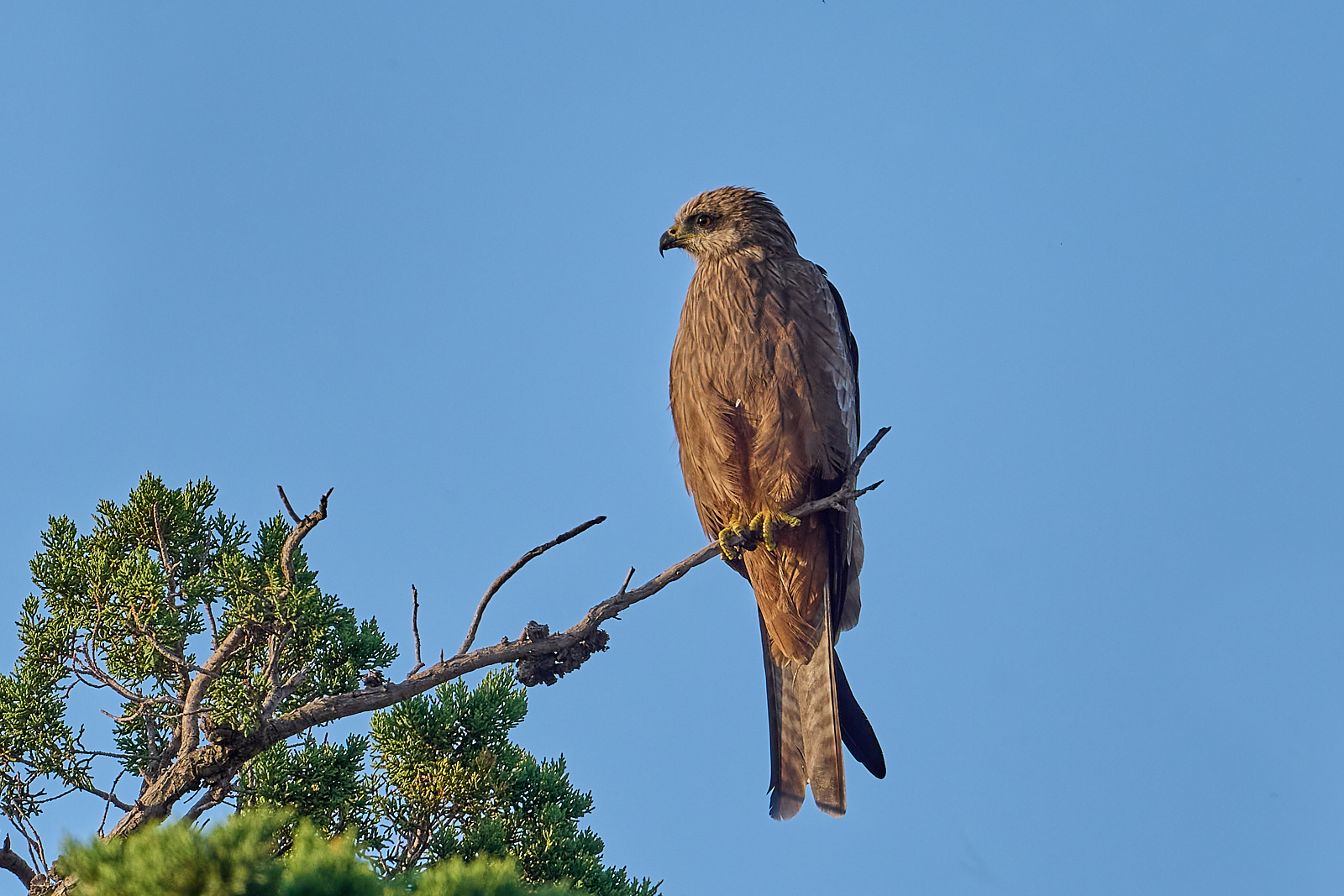
Early morning, scanning for possibilities.


a quick flight out of the tree and another Fairy Martin is the prize


Saturday Evening Post #122: Simplicity

A funny place to start, but Ernest Hemingway, the great writer, once said of his craft, “Write all the story, take out the good bits, and see if it still makes works.” His crafted stories are strong, alive and engaging.
It has been said by those who know about writing critique, that his stories always left a little unanswered question or two. The magic that allowed the reader to participate.

When I was but a young lad, the world of Television was more a mystical dream, than a reality. Rather we’d gather round the radio with Serials, Entertainment, Humour, Dramas, and short fillers of all sorts of interesting topics.
The blog is too short to mention them, but my Mum waited to the mid afternoon for “Blue Hills”, after dinner it was “Dad and Dave”, the kids were enthralled by “Biggles” and all the spin offs.
The one thing, that I learned so much later in life was that as a listener, I became involved in the show, because I needed to add, “Imagination”.  The theatre of the mind.

Any two people listening to the voices and story would conjure up quite different settings for the action. Such is the wonderful power of imagination.

Photographs, and by guilt-by-association, photographers, can often be simple records of the moment, and little involvement either by the maker, or the viewer.
Other times, the Hemingway moment is there and all the ‘good bits’ have been removed, either at the camera stage or in post, and what remains ‘still works’.

Magic that sings and dances a story into our brain, straight into the ‘theatre of the mind’. We see, feel, experience and add to the photo at an emotional level.

Sometimes a photo is a bit like a present. All wrapped up.  And the excitement is as much in the unwrapping as it is in the beholding. Not knowing what is beneath.

It’s about not telling all, but rather letting the viewer decide.

The art of saying More with Less.

Keep takin’ Photos. We do.


From the Field-Notes Book: Hobby Air Practice

Welcome back from Lockdown.
While others have found all sorts of things to complain about, and decry the efforts of those in charge, I on the other hand, have gratitude and awe, not only for the people whose job it has been to try to contain the outbreak, but the general feeling of most Victorians to simply work in their own little way to help stop the spread.
That nearly 40,000 people lined up to be tested yesterday says something about the confidence we have.

As Dan said, “I am proud of all Victorian who have done their bit”.  Seriously think we should be concentrating on the good things that have come out of the lockdown and stop nit picking over ‘he said, she said’.
Nuff said

How quickly Hobbies grow.
Just a few weeks out of the nest, and they had developed great strength and wing control.  They were also hunting for themselves.  And I didn’t see the adults in the area again. They might well have made visits, but certainly not like the first few weeks.

The nesting location is on a large river bank cliff and falls away to the Werribee Open Range Zoo on one side, and the old Heritage Orchard along the river flats.
Ideal training grounds for the young Hobbies, who were now flying rapidly almost out of sight over the Zoo, or disappearing into the trees way down river at the end of the Orchard. And.  Just as quickly reappearing.

Early on, they were still playing aerial games together, but very quickly learned to hunt in the trees lining the river banks and much too hard for photography.  Each success though was loud and sustained.

This fine looking bird was hunting on the ground among the blanket weed. Seemed unperturbed by my presence
A Wing Flap, and it’s gone.
The young birds spent many hours playing simple chase me games. How quickly the wing co-ordination developed
This was the only one were I nearly managed them all in frame
All feathers spread out hard at work
So characteristically Hobby in flight

Think I have one more page in the Field-Notes left.

Enjoy

Saturday Evening Post #121: Learning

“Learning is the only thing the mind never exhausts, never fears, and never regrets” – Leonardo da Vinci

Greetings from the Doona Hermit Worldwide HQ.
Once again we find ourselves in a lockdown.
I suspect that most of us were hoping it would not happen again, but at the same time dreading that the inevitable would surface  like a rogue submarine to waste havoc on our best plans.

The quote from Leonardo was sent to me by my new friend, William, at Wacom Customer Support.
William and I have been busy the past week or so, trying to get the Driver installed for my new Wacom Pen/Tablet.
At first I was a bit bemused, but as each day, and each attempt only made things more exasperating, my mood, I have to confess changed.
The long story is Mac’s Catalina and above Operating System will really only recognise software downloaded from the Temple of All Things Apple,(TATA) and only it it has been blessed or approved by the Apple High Priest of Software Accreditation. (AHPSA)

So give William his credit, like some heretic without a cause, he kept feeding bits of ‘code’ that eventually cracked open the door to the Vault of Software Consciousness (VSC).  That is after more restarts of the machine than its had in the 3 years I’ve owned it.
Reminded of a universe so far away and an Apple Macintosh SE, that required deleting something called plist every-time a new device was attached. 🙂

So now my sparkling new Red Wacom tablet and its attendant pen ‘talk’ to the computer and my days of ‘mousing’ around might be entering their own Twilight Zone.

All this because my current photo management software, (Capture One 21) has such a cool interface with pen/tablets, but that as they say is another story.

Just before Dan Stalin introduced his sweeping Lockdown Rules and unleashed his “Fine ’em at any cost’ Troopers, we had made an early morning run to see the Great Crested Grebe family.

Out of Five eggs, it seems that one didn’t hatch, and the family is down to three young. Perhaps the fourth one was too weak to survive.  After all they can only look after so many, and the strong will take preference.

So back to the Doona.

Good luck to all my fellow detainees.

(and PS,  I think Dan has made the right call just in case I get branded as a dissident and I find burning crosses on the front lawn.)

Field-Notes Book: Meet the Neighbours

When new neighbours arrive, birds are as inquisitive as the next one.

However it didn’t always go well for the young Hobbies as some of the neighbours have a distinct dislike for raptors, small, large, young or old.

A constant source of interaction was with the Galahs in the area.

Here is one such event.

Ahh, new kid on the block. I don’t like you.
Wing flaps and crest raising begin the confrontation
Slowly but surely the Galah moves closer, crowding the young bird to another branch
In the end, the little Hobby departs

Next in line, several more turn up and chase the young Hobby about the sky.  The little dudes still don’t have real flying skills, so it’s a pretty much one way competition.
Here the galahs have outpaced and out-turned the Hobby, but give the impression of being chased.  Not so.

Just because they could.

The two Galahs thought it would be fun to harass one of the recently fledged Hobbys. 
The pair were ready to hunt it off its perch and then chase it about the sky. 
Just for fun, they let the young bird chase them once in a while as well. 

A week or so later with the young Hobby experienced enough to clip along at over 100kph, it would have been a much more dangerous game.

Early morning and one of the young was having some quiet time in the sunshine when a pair of Rainbow Lorikeets dropped by for a looksee.  Much more robust in their attack, and working as a team, the young Hobby in the end had to abandon its rest spot.


They will never forget you ’til somebody new comes along :-  The Eagles.

   Young Hobby still having trouble coming to an understanding with the local Lorikeets.
It has much to learn, they have determination on their side.


Close to the last pages in the field notes.
The Hobbies quickly gain flight experience and then were off to explore the world around the nesting location.  A week on and they could disappear almost at the blink of an eye, and quickly reappear breaking all records in a sharp dive descent.

Their next adventure was learning to hunt along the tree-line nearby, but for a photographer there was not chance of keeping up with the action.

Saturday Evening Post #120.1: Followup: The Love Heart Grebe.

Did a bit of research since I wrote last night.

Guess what?

The mark is a visual clue to the adults that the little tacker is hungry.

Thanks to Ashley over at https://aussiebirder.com for giving me a hint about what it all might mean.  See his comment on the post last night.
https://birdsaspoetry.com/2021/02/06/saturday-evening-post-120-that-little-touch-of-love/

Here is a link to a good site explaining it

https://wildnatureblog.wordpress.com/2014/06/16/great-crested-grebes-and-the-red-spot/comment-page-1/#comment-3978

And a little clip of the info, thanks to David Craven.

>>So, what is this? A deformity? Some parasite? A magical third eye? A literature search was required. Wading through various papers there were lots of theories. The patch was natural, and present in nearly all grebe chicks. Some thought it helped control the chicks temperature while tucked on the parent’s back. Some thought it deterred predators. Others thought it was used in signalling parents.

It took a 1985 paper by Gary Nuechterlein to settle it. Hand-rearing some Western Grebe chicks, he used a series of experiments to determine that it was allied to begging for food. The more the bird begged, the brighter red the crown patch. Once fed, it faded to a lighter pink.

There we have it. Next time you spot grebe chicks, keep an eye out for the red patch!<<

Thanks David.

Saturday Evening Post #120 :That Little touch of Love

It’s been a pretty quiet week at BirdsasPoetry Worldwide HQ.
We’ve not made any financial Take-over Offers, nor it seems have we been the subject of a Reddit share raid.

The weather has also been suitably unkind to those of us who ‘commit photography’, so it’s been home under the doona a couple more days.  Given our experience during the long lockdown because of the ‘c’ word, it hasn’t been too onerous.

It also seems that the majority of the birds we have been working with, have finalised their nesting cycles and are also settling into preparing the winter stretch.  Our local backyard Blackbird is already showing the signs of shedding her worn feathers and her mate has a strange bald patch above his beak and across his head, which I take to mean he too is getting ready to dress to impress as the cooler days come by.

One of the exceptions to this trend are the local White-plumed Honeyeaters, and we did discover quite a number of them during the week collecting cobweb for a fine new house among the leaves.

I called Mr An Onymous, and he informed me the Jawbone Great Crested Grebes had hatched, and so with his medical appointments and mine coinciding with a small blank space in both diaries, we locked into go looksee.

The two adults, one sitting on the nest, with still one egg to hatch, and the second one in the water feeding the infants with tiny fish and other assorted tiny water creatures, all looked good like very relaxed and adapted caring parents.

When I had a good look at the photos afterward, you know, ‘blowed up big on the screen to pixel-peep (I jest— insert smile and laughs here), I noted a small bald patch on the young as they peeked out from under the adults wing-feathers,

Closer inspection showed how much it looks like a “Love Heart”.  I presume its because the upper feathers fold down over the spot sufficiently to create the shape.

Interestingly Andew T. (follower of present blog) also sent around a note to the interested noting the same markings.

For the fanciful among us, perhaps it’s a special “Love” bond  between the parents and their tiny offspring.

Field-Notes Book: Sharing a Meal

The young Hobbies were well established but still needed to be feed by the female.
In this sequence she divides up the catch among two of the young. The other would not miss out, as another meal was certainly on the way.

Mum is still carefully tearing off small pieces for the young,
Only a few days out of the nest, it is happy to patiently wait for each morsel
A big moment. “Can I choose a piece?”
It hurries off to a quiet spot on the brach to settle into both enjoying and learning
Number two arrives with much wing flap and calling to ensure that some of the goodies are still available
After a bit of juggling for position, it takes charge of the offering
So typical of a raptor, mantling over the prey with spread wings.
And it too takes off to begin its own feeding routine.

Satuday Evening Post #119: Feeling the Magic (Part #3)

I was rummaging through a box of books in the garage, you know, hoping I’d not thrown out the very book I now wanted, when I turned over a copy of “The Joy of Photography”, from Eastman Kodak Company. For those that have never heard of them, they used to make a product called, ‘filum’, back just at the beginning of the Jurassic Period. 🙂

I know that a number of the dear readers of this sometimes monotonous blog, were probably not ever born when the book first rolled from the presses. Kodak, among many of its tentacles, had a publishing arm, that specialised in ‘how-to’ books to help budding photographers learn some of the skills of the craft.  This of course was way back in the days before social media platforms spewed out erroneous, badly researched and often downright inaccurate information from keyboard experts who never actually ventured beyond their monitors to take, well, real, photos.
But,
I digress.

A quote in the introduction from noted photographer, Ernst Haas,“Art is Aristocratic—photography is its democratic voice.”, sets the scene or tenure of the book. (Please don’t tear off to ebay and buy a copy, much of it has to do with that aforementioned, ‘filum’ and the hardware and techniques to craft a photo back in the olden days.)

Based on the recent drift of my Saturday evening discourses, the opening page had a quote I thought worth repeating here. Hoping of course that the copyright of the text is beyond the statute of limitations or what ever controls text reuse these days.
Under the heading of “The Vision: The joy of photography is learning to see” the authors say:

“The world of photography is a personal one. We take pictures to express our feelings about people, nature, and the world around us. And as in any other art of communication, be it writing, music or art, we experience great pleasure when the results of our efforts communicate what we set out to say.”

There— couldn’t have said it better meself.
Sneaky little quote because the book is then divided into techniques for photographing:
People,
Nature,
The world around us.  🙂

It rambles on from there about ‘visually  articulate’, but if I have to look up words in a dictionary, I usually skip over them 🙂

We had the good fortune, and a little help from a few friends, to come upon pair of Great Crested Grebe at the Jawbone Reserve, in the middle of a nesting.
They had just exchanged sitting duties, and this one really needed to stretch out, bathe and relax. Once suitably damped, it needed to dry out the feathers.


En-Joy

Field Notes Book: On the Wing

Had this ready to go and then got side-tracked last night and overlooked the Publish button.

The young Hobbies had flown. Three hungry mouths on the wing.
It is interesting to observe them in the nest. Too big to just settle down, too young to actually be out and about.
After lots of wing practice, hanging on to the nest, and exploring the close branches, they seem to have full knowledge of what is required, but the connection between flapping and letting go is not made.
Then, it’s seems, almost on a whim, they turn, flap, and are aerial.  Not that it’s great flying, mind you,  straight lines mostly, and of course the challenge of slowing down enough to grab onto a branch for security.

Presumably they were airborne the day before we arrived, as they seemed to have settled to the jobs at hand.  Dad was still bringing in food, Mum organising it and distibuting in an even manner.
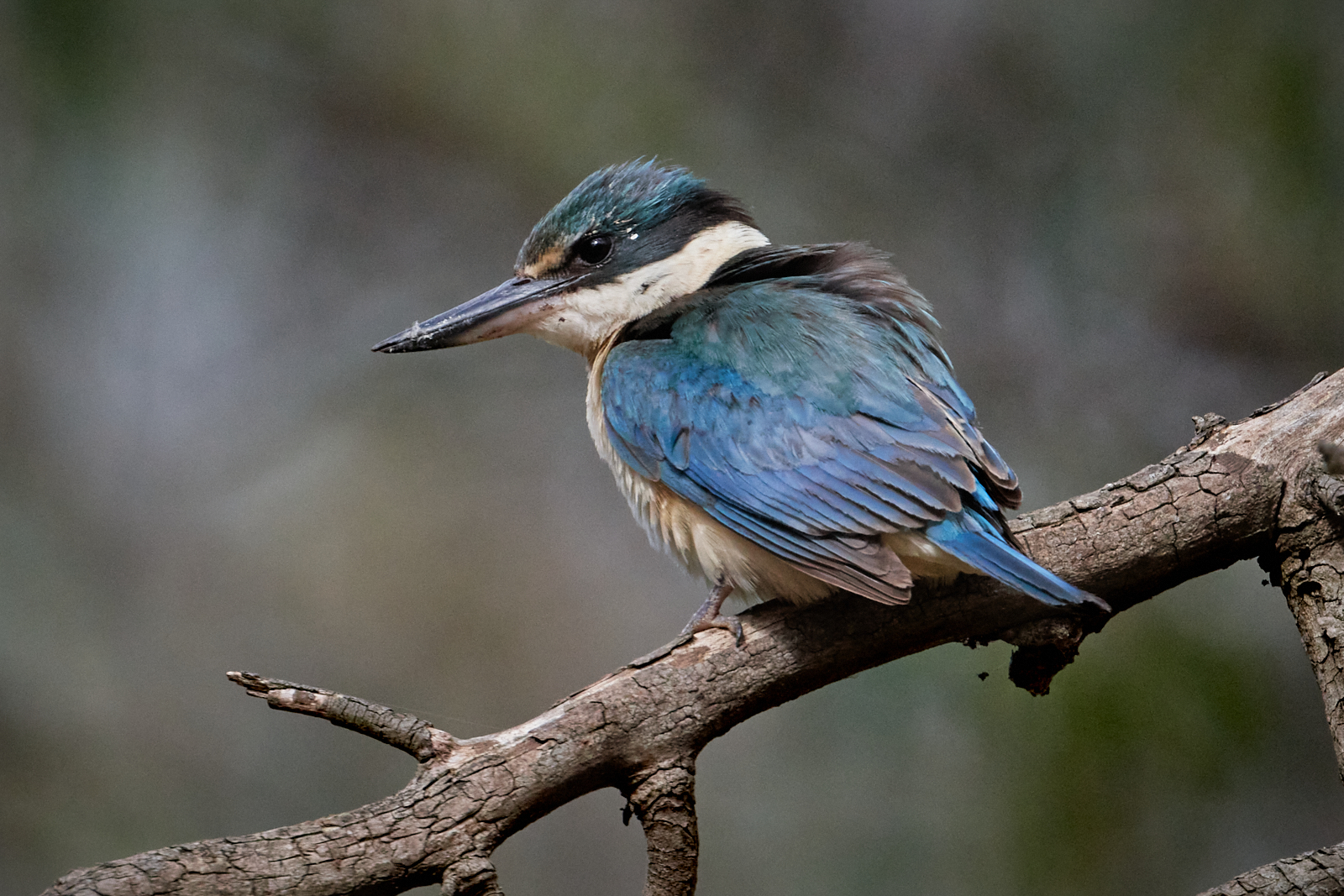
Three perfect little carbon copies.

Two sitting in the open in the early morning sunshine
Although now free of the nest, they still have a close bond and peck and preen each other
Looks like food is on the way, and it might be first in best fed.
Working hard at getting the wings digging in to the air and righting the balance
Food attached, time to seek a quiet spot to enoy it.
Pfffh feathers. Now they have to prepare their own repast.
With all the skills ahead yet to learn, they still are able to turn on an impressive speed when required.