Saturday Evening Post: Street-wise or Road-smart

We had been travelling up to the family acres.
A good part of the journey is on a two-lane freeway.
The speed limit is a ‘suggested’ 110kph. I’m sure it’s suggested as most of the outside lane didn’t see it as a suggestion, rather as a lower limit.

The inside lane was mostly travelling at more modest, say, 90kph.
That is normally the lane I sit in, as I’m as much interested in the journey than the desire to get there before anyone else.
The 110+ lane was a constant snaking line of vehicles: Buses, Trucks,-small and large and B-doubles, cars, and Prado’s towing caravans.

Travelling in the “slow” lane does provide a chance to enjoy the around of the scenery, and of course to check the skies for any birds in-flight.

We managed to catch up with the end of the next slow lane parade, about 10-12 vehicles, and tucked in behind at a suitably safe distance. Meanwhile the steady stream of the fast lane streamed by.

Then one of those jaw-dropping moments. “You’d never believe it.” That can’t be right, No, Never.

Standing on the white-line between said, fast and slow moving traffic snakes was…

A Little Raven.

As the fast lane rushed by and the slow lane meandered along, the gap between the two lanes would not have been more than about 1.5 metres.

And there.

Walking along, like it was out for promenade, was a Little Raven. Seemingly oblivious to the rushing vehicles.
There was no room for it to move between either line of vehicles, and we were about 8-10 cars back when I first noticed it. Still with wings tucked in, and a determined look on its face, it walked the narrow space between the vehicles.

Yajusthaddabethere!

We watched with heart in mouth as we approached it and quickly sped by. Thankfully we were the last in the line, and the Raven taking the opportunity lifted off after we had passed and dropped onto the side of the road.
It’s cool, calm approach probably saved its life, and we were left to ponder if it had been caught out unexpectedly, or was it something it had done before.

Yet another lesson in the adaptability of some birds, and an opportunity to once again be amazed by the intelligence of these impressive creatures.

Of course I didn’t make a photo of that bird. Let’s face it, it certainly took me by suprise.
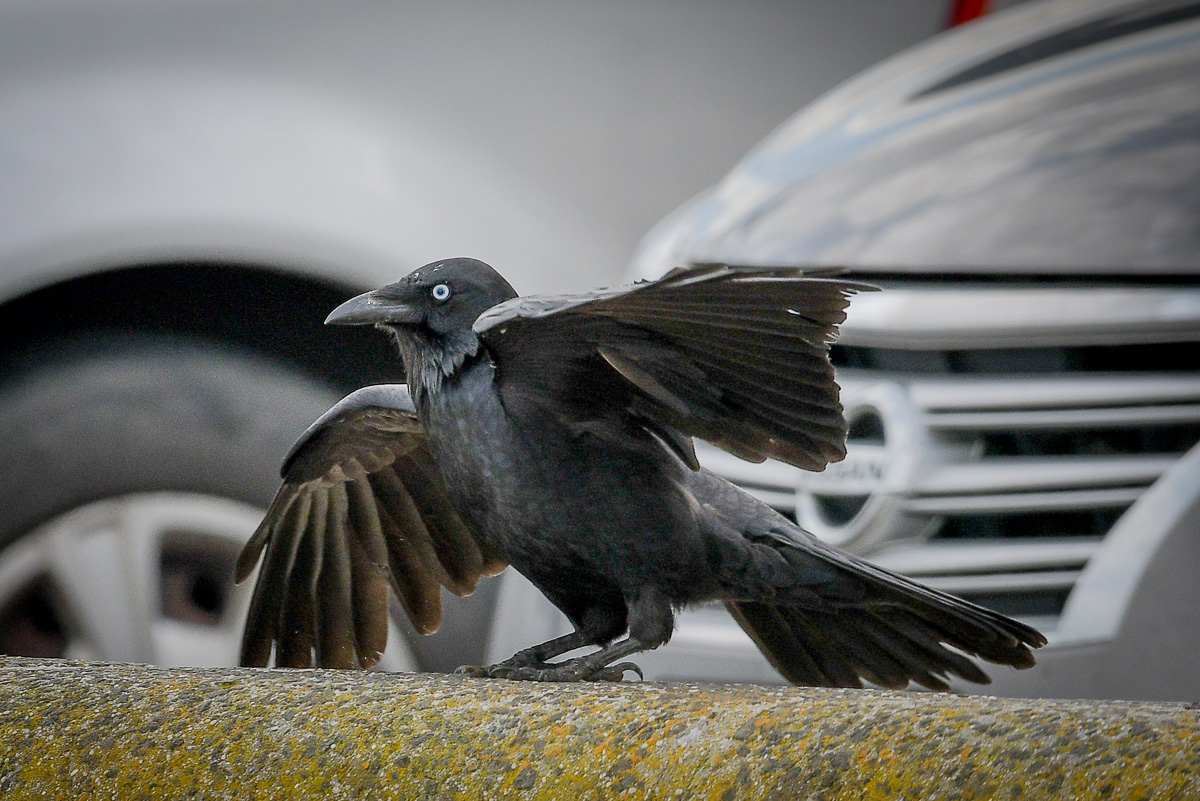
So here is one I made in a carpark on another occassion.

Enjoy.
Saturday Evening Post: Disputed

Just about anyone who has been out and about even casually observing birds will have come across the Australian Magpie. (We have two variations in Australia, a White-backed, and a Black-backed) In my southern location the White-backed in domicile.

Maggie won “Bird of the Year” in 2017, and with good reason. They have been able to adapt to the human condition, and thrive. Many streets and parks will have a family, and at present in our street one is sitting on eggs.

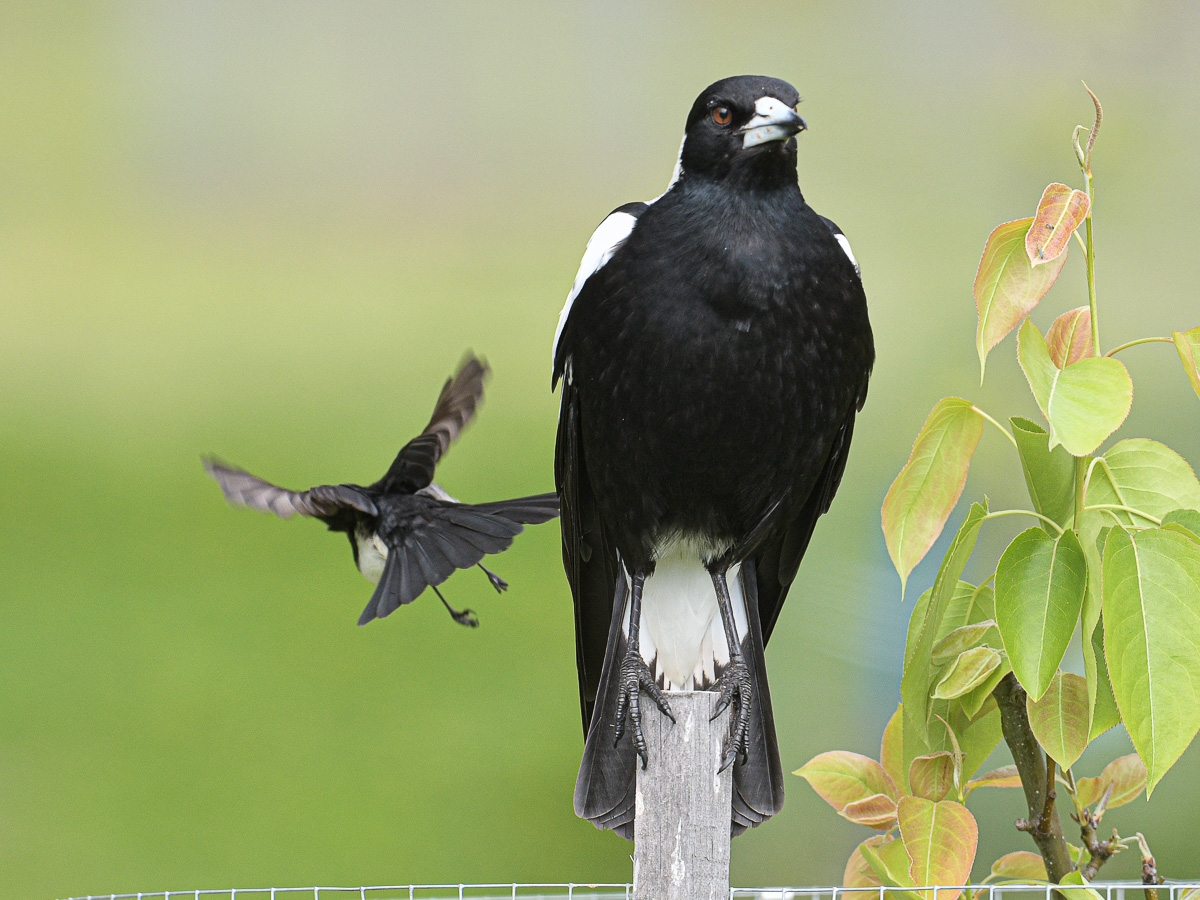
And casually observing will inevitably come across a Willie Wagtail that takes exception to the Magpie’s presence and a battle royale will begin. The brave little Wagtail seems intent with constant chittering and bumping into the Maggie to move it on. And no doubt with good reason. Most Wagtail nests are in the open, or at least in minimal leaf protection and the young make a fine meal for Maggie to feed to her young.

We were walking in a local orchard and Willie came out to see what we were doing. I know this pair from previous years and no doubt they have a nest or are planning to begin soon.

Willie posed well for me on a single garden stake, and I moved in a little closer for a better shot.
At the same time four sets of large wings flashed between me and the garden stake.
The local Magpie Family dropped down on the grass in front of me. The female and two younger ones, (one I take it to be from last year’s crop), began to feed in the grass, while the male forced WIllie from its pedestal and sat surveying the area.

Of course it doesn’t take your average Wagtail too long to regain its composure, and immediately it began to fly at the back of the the Magpie, eventually grabbing tiny claws full of feathers and sliding down it’s back.

I’m sure Magpies aren’t all that fussed by the harassment, they just take it as the cost of doing business.
In the end the larger bird dropped to the ground to join the family, and Willie took its rightful place back on the garden stake.
Such are the daily conflicts.

Saturday Evening Post: Sitting Pretty

We’ve been up the family acres this past week.
Had the chance to go and have a peek at a pair of Peregrine Falcon that have taken up residence in a creek-line escarpment

After the usual bumpy ride in along the old track, we were able to see the splashes on the rockface that showed their presence.
The face they have chosen, catches the early morning sunshine, and because of the angle of the cliff, the light quickly goes off the face and leaves the nest in shadow.
We had planned for an early start, but, as families, are, this had to be done, then that, and a discussion or two on other things, so it was a late start.
By the time we arrived, early morning feeding of the sitting bird had been accomplished and it (presumably the female) settled down and occasionally poked its head over the stone battlement. The other bird didn’t return in the nearly two hours we had available.

I noted the rockface on our side of the creek was a little lower than the main bluff, so looked to find a way to get up a little higher. Rock climbing on a grade 27 (Ewbank) face is not something I was equipped for nor had a desire to free climb.
I did find what could probably be a goat track, if there were goats in the area, (no pun intended) and it was no longer used, perhaps the ethereal goat met its doom there.
After a little bit of struggle, I managed to get the old body carefully, and that is very carefully, upward on the loose rocks, and slippery wet grass. Not to mention assorted blackberry and prickly wattle and some sticky myrtle.
That work gave me a view into the nest site. It’s a great site for such a nest, perhaps a large boulder dislodged a long time ago and left a sizeable hole which the bird could settle down into, and it would be protected from all but the worst eastern driven rain. (A rain we rarely get).

Once atop of the escarpment, I waited, hoping (she) might move in the nest, or the other bird might return for some flight shots, but time, as they say, ran out.
I walked back along the edge as I’d seen a sloping area further around that was close to where the parked IamGrey waited patiently, and would be an easy descent.
Great idea. Foiled by thick blackberry bushes and bracken. Not being able to see through the bracken as to what might be underneath lead me back to the aforementioned “goat” track, and looking down, it seemed even more precarious than going up. Once in a lifetime years ago, I would have tackled it and not even thought about it, now, each step was carefully considered and eventually without too much drama, except for those pesky blackberry and prickly wattle spots, I was back on ‘level’ ground.

One last look at the nest site, and it was time to return to family festivities.

Enjoy

Saturday Evening Post: Sky Dancing

Was doing a google search t’other day and as usual managed to get lots of info, most of it—irrelevant to my original enquiry. That I should have been surprised.

It was a simple question about how far can you see to the horizon. I live on the Western Victorian Lava Plains. The plains extend 350 km east-west. So I was wondering as I stand in the open paddock on flat ground, how far can I see in all directions. Seems the general consensus is around 5km. Mind my ophthalmologist will tell you at that distance most of what I see would be pretty blurry.

Why, no doubt you are wondering, and what bought this inquisitiveness on?

Sky Dancing

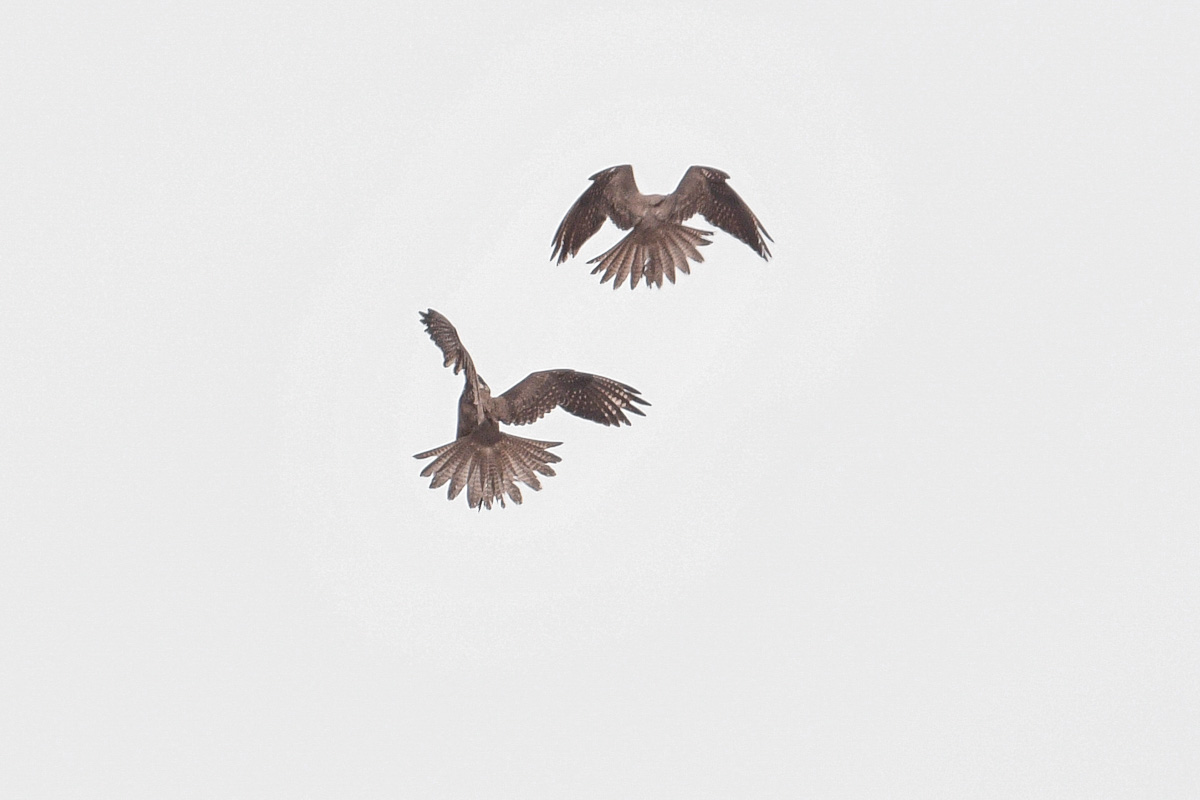
The area in which I was standing is part of the territory of a pair of Brown Falcon. As she prepares for a nesting season, they tend to spend a lot of time sky dancing. Pursing one another across the sky with much calling and aerial displays.

This pair are mostly human intolerant (Me too!) so getting close is no easy matter.

The winds have been high for the past couple of weeks, and on this day there were gusts of 50kph or more. The strong winds seems to give the birds an extra enthusiasm. Standing in the open paddock it was easy to see them scoot across the sky, from horizon to horizon.
If you’ve never seen or heard a pair of Brown Falcons pair-bonding, I’d hope one day you can. It is accomplished with lots of aerial antics and much raucous calling.

From where we stood we are able to see them sweep across the entire sky. So quickly and so far that sometimes they disappeared from sight. It was humbling to see these birds flash back and forth covering several kilometres either side of where I stood in mere seconds. It would take me 15 minutes to walk back to IamGrey in the carpark.

They also were working quite high up, so any photos I made really are at a distance. These may not be the most useful pics I’ve made, but worth sharing.

Lots of flying close together, quite a few times one or the other was flipped upside down or even one on top of the other with only metres seperation. They were so fast on the wind, and so high that the normal harassment by Magpies and others just couldn’t get started. Even if a Maggie had made her best vertical ascent, the Falcons would have been a kilometre or more away by the time she got anywhere near to the height.

In the end they disappeared to a tree-line way down the range, and perhaps that is where this year’s clutch will take place. Time, will tell


Saturday Evening Post: I’ve Got This!!

The past couple of weeks have been anything but a birders paradise in terms of weather. Even the birds know it!

The beach at Point Cook where we currently are frequenting, has been beaten upon by wind and wave, and the sands have been moved from one location to another. It’s quite interesting to see part of the rock formations now standing boldy in the water, and further along the beach new sloped, almost perfectly sculpted, sands that would be prized in any tourist location.

From the early settlement days there is remnant of a pier that now stands, just a bit forlornly, a shadow of its former self. It has long been a resting place for the local cormorants and gulls, and now because many of the foreshore rocks are covered by sand, it is even busier that previously.

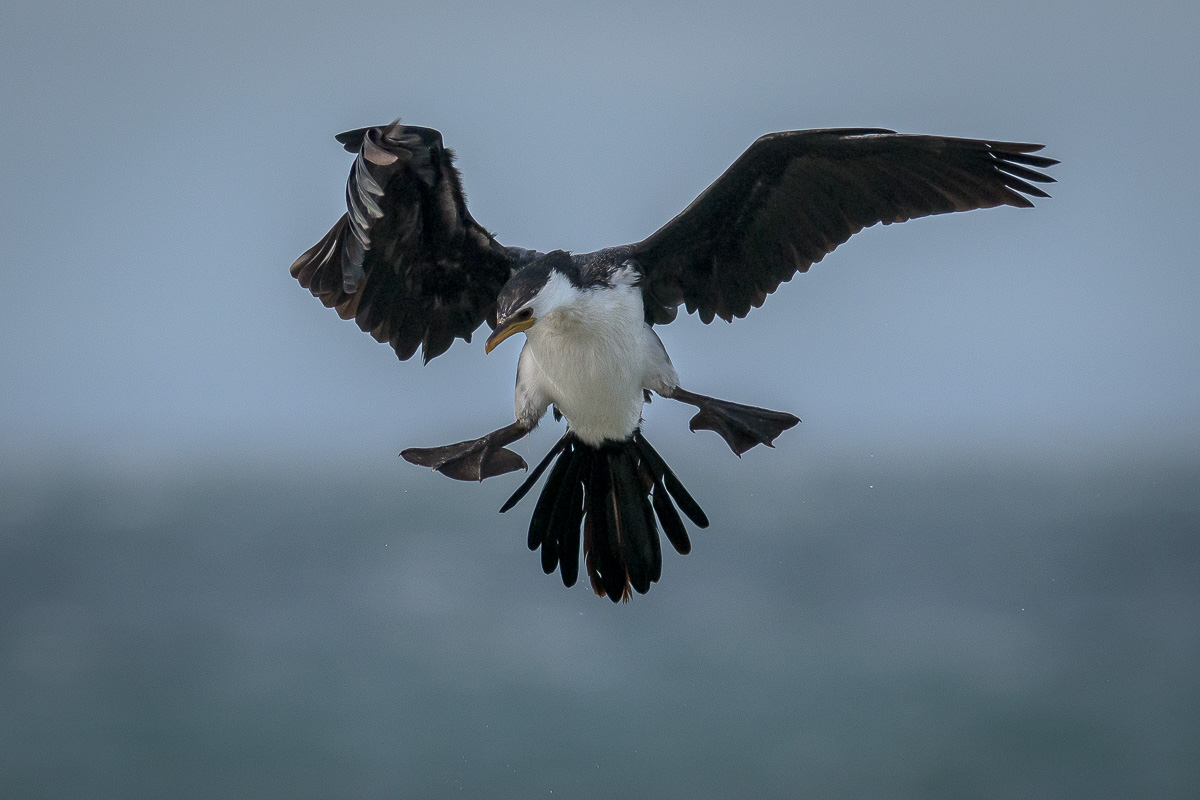
One of the birds that regularly come to rest and dry out are Little Pied Cormorants.
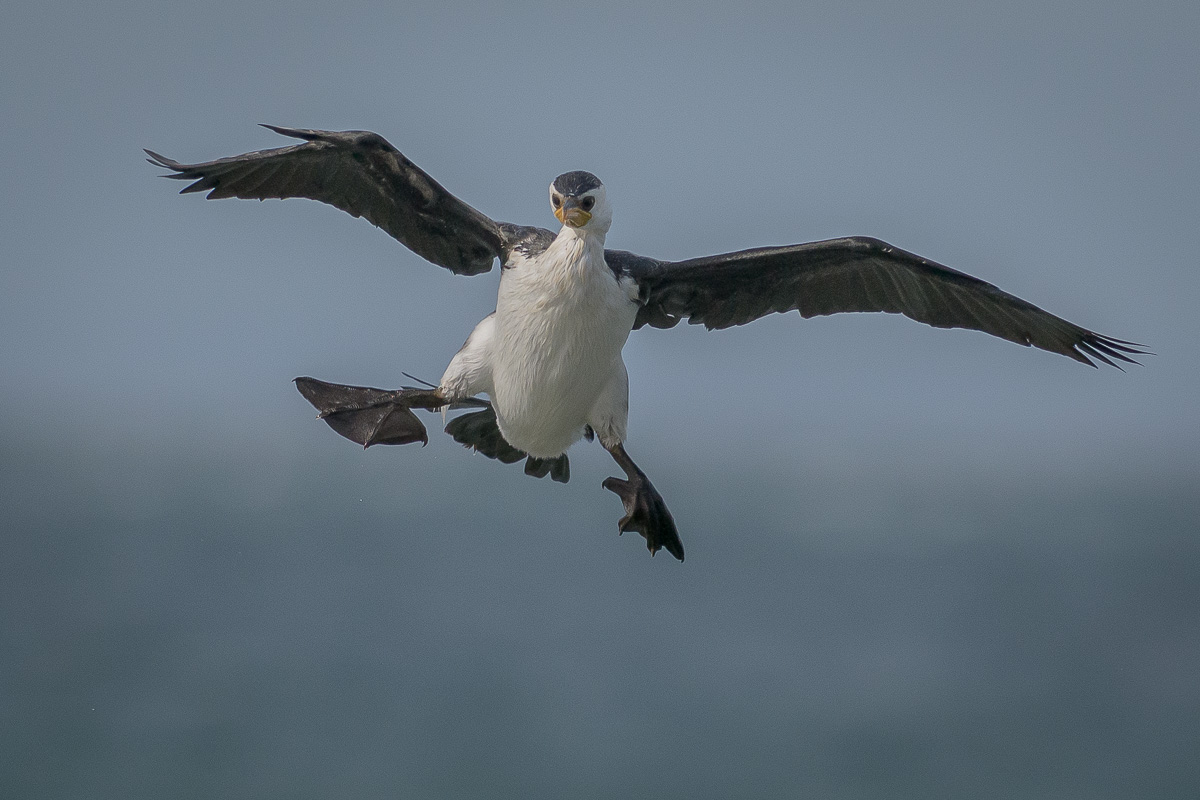
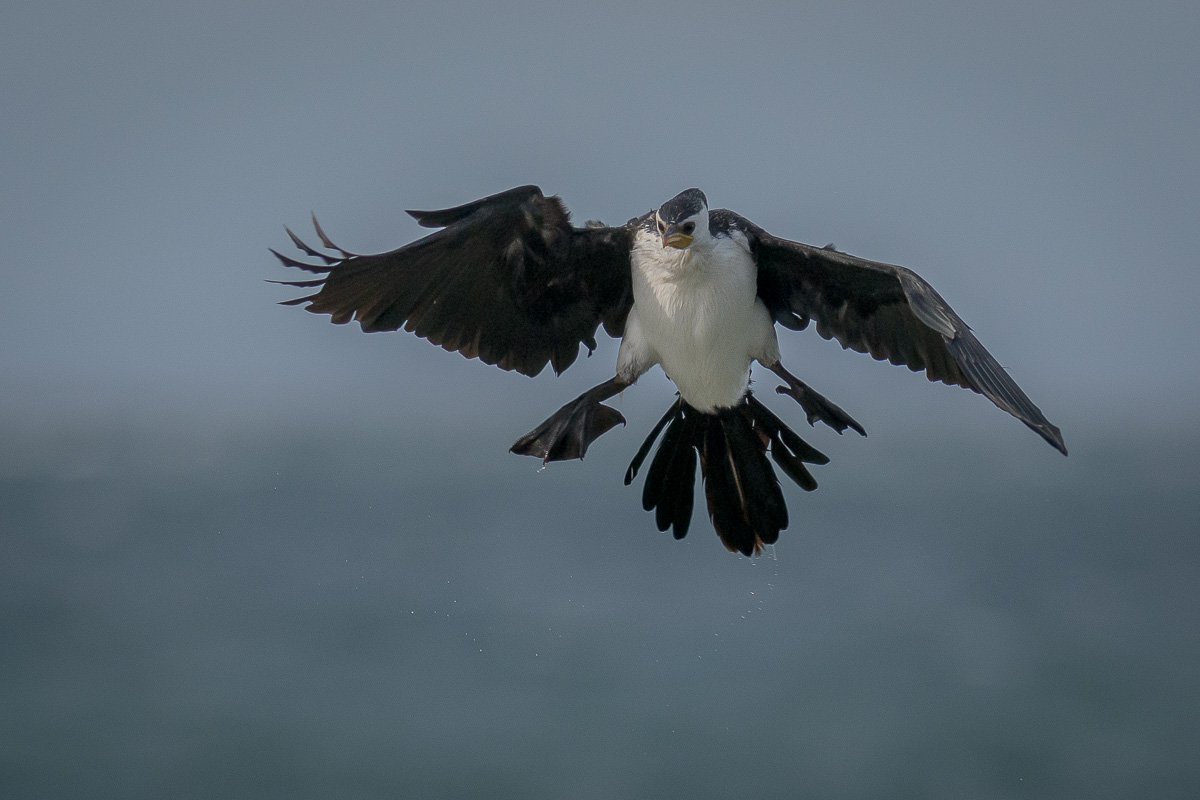
For some reason, they seem to have a habit of a most ungainly landing technique and no two ever seem to be the same.
So it’s rather fascinating to see them slip in across the water, all sleek and wings held out, to lift up and suddenly their confidence seems to change, and body, wings, and feet all seem to go in wildly different directions.

I’m sure there is method to it all, but it does provide for some interesting observations.
Add to the normal challenges, this one was landing into about a 40kph+, with a few bursts that would have been much higher.

Still, persistence pays off.

Saturday Evening Post: Stop Press

Spring, as they say has Sprung.

Or

The arrival of Demeter and Persephone
To the ancient Greeks, spring and summer signified the six months when Persephone returned from the Underworld, and her mother Demeter made the earth bloom and grow bountiful after her absence.

Now, of course this was written for the more northern climes, so for us mere southerners, perhaps Demi and Seph get two goes at coming around. Facts should never get in the way of a good yarn.

Now a good rollikin’ Greek legend has many a twist and turn
The good Bard used a variation of the story in his play, “A Winter’s Tale”, with the basic structure recalling the myth of Persephone, a beautiful young girl abducted by Hades, the god of the underworld, from a flowering field where she was playing. Allowed to return six months of every year to the earth’s surface, Persephone’s comings and goings explain the cycle of winter and summer.
Demeter, of course, is the one that negotiates the release of her daughter, and so every year as Spring rolls around mother and daughter are reunited and the earth,—because of Demeter’s happiness, blossoms and new life develops .
The Bard, in his way, used a tad or more of poetic licence on the basics of the story.

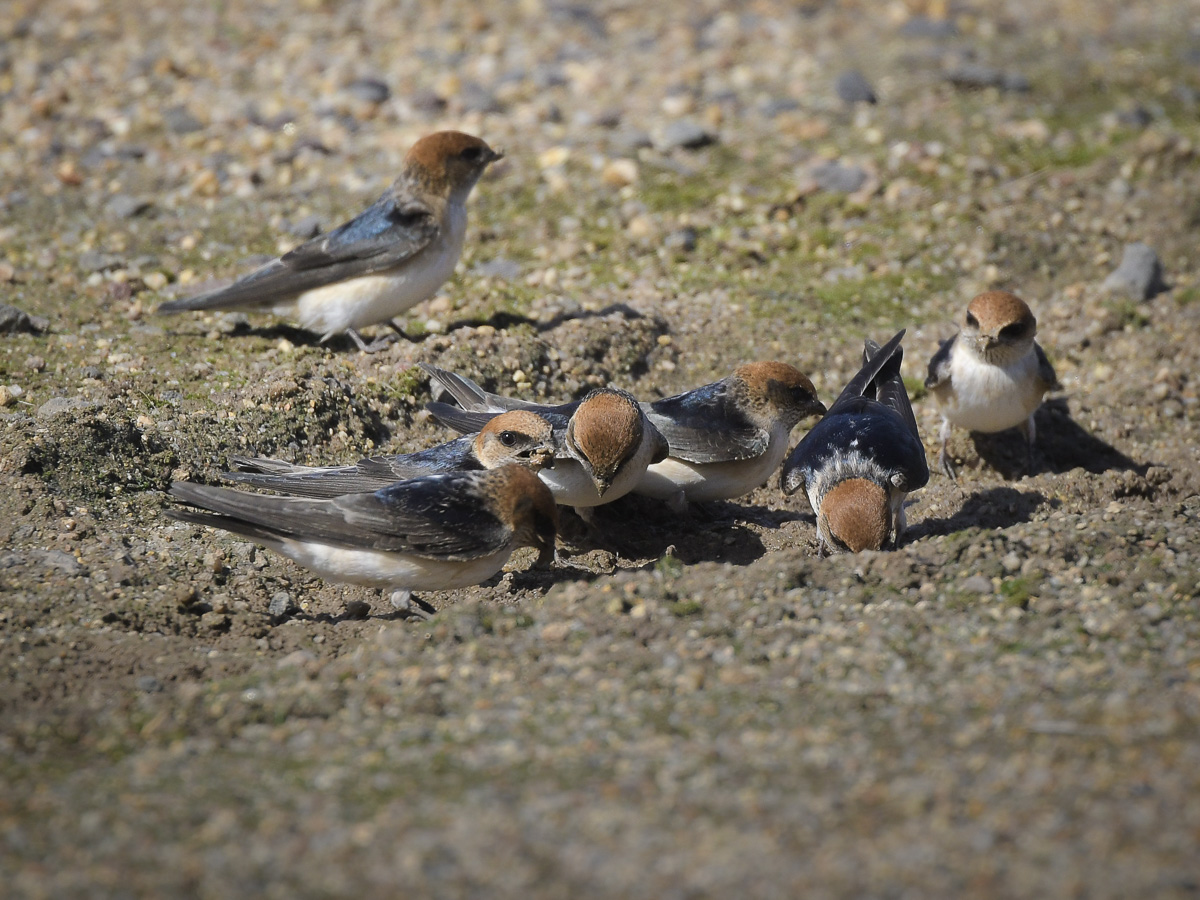
Fascinating, I’m sure, but I’m also sure that the flocks of Welcome Swallows, and Fairy Martins are driven by more than a whimsical legend or an English poet/playwright.

We had decided that as the sun was shining and the wind wasn’t howling, that a trip down to Werribee South Marina,(and coffee shop) would be a pleasant way to spend the morning in the sunshine.
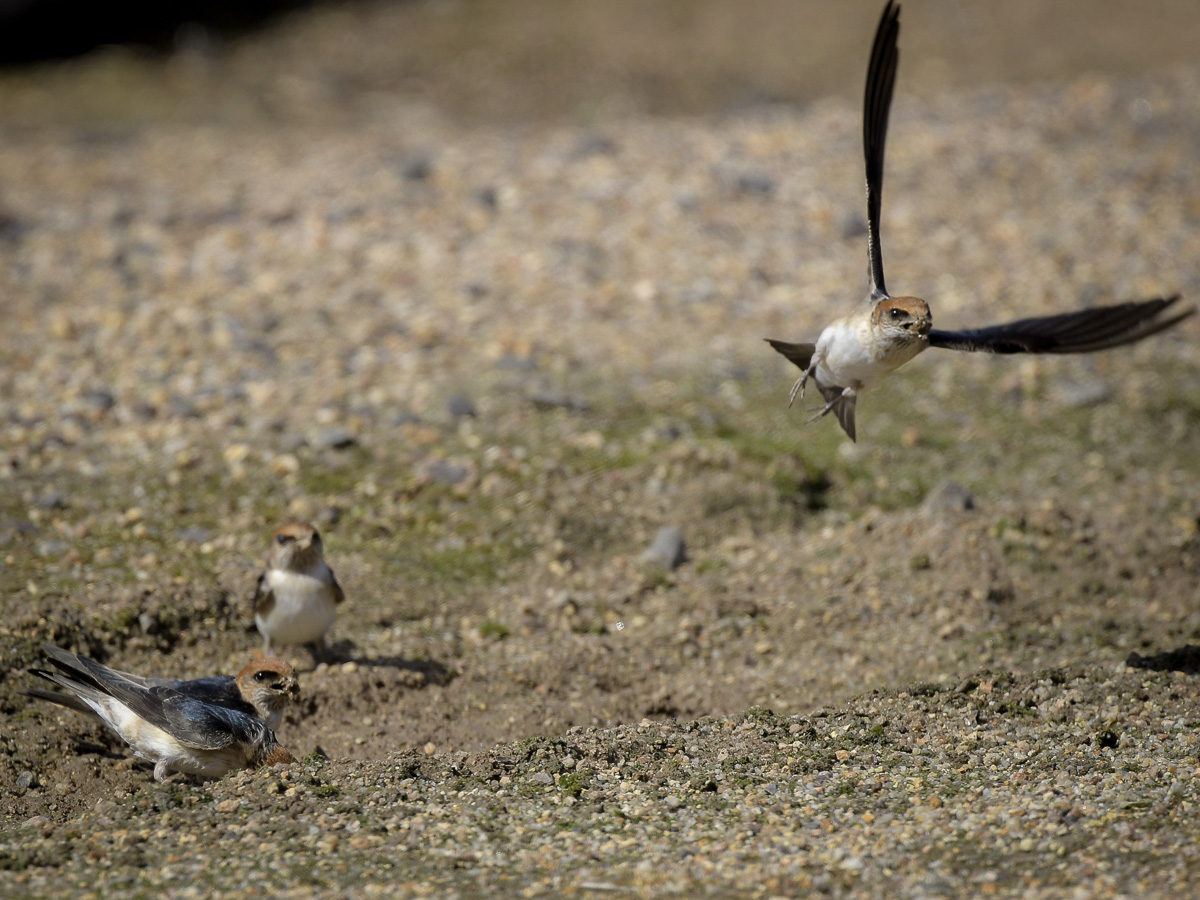
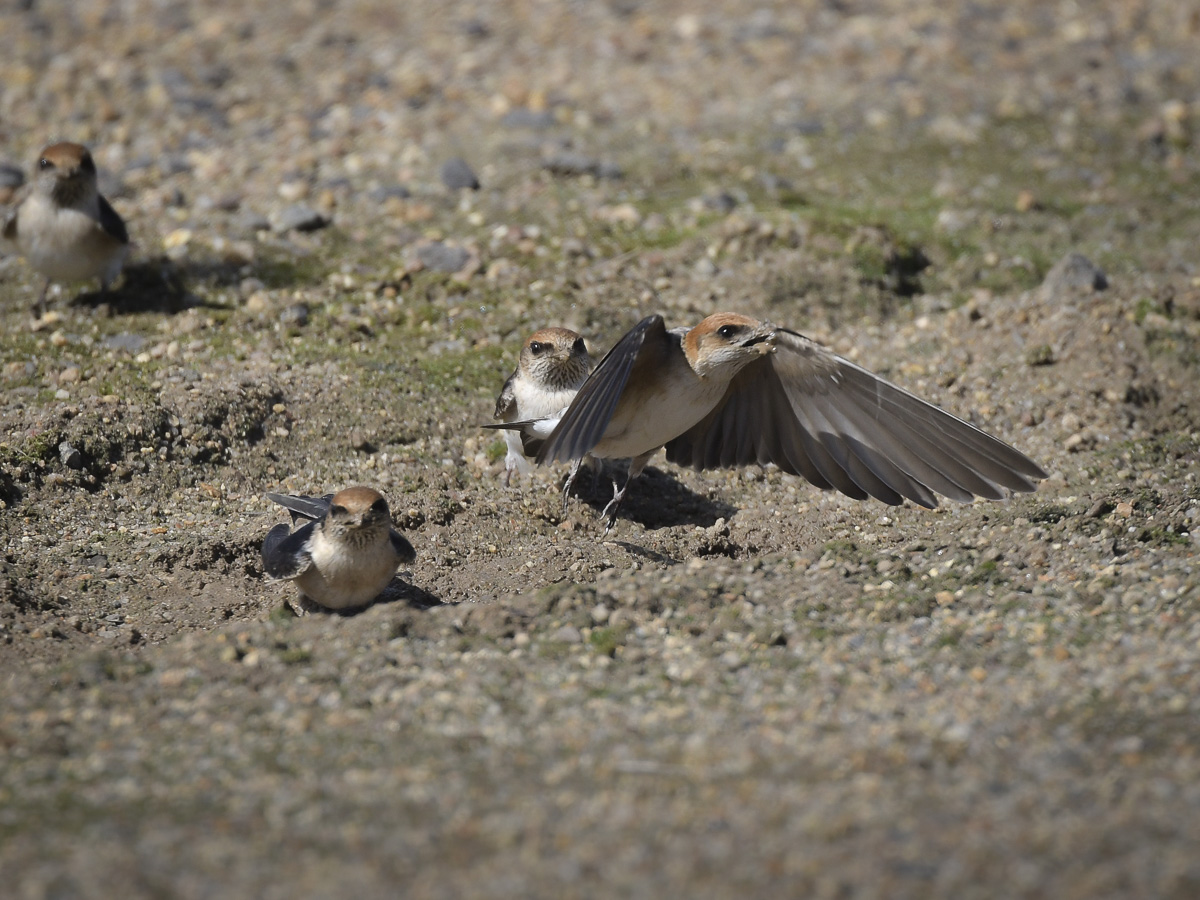
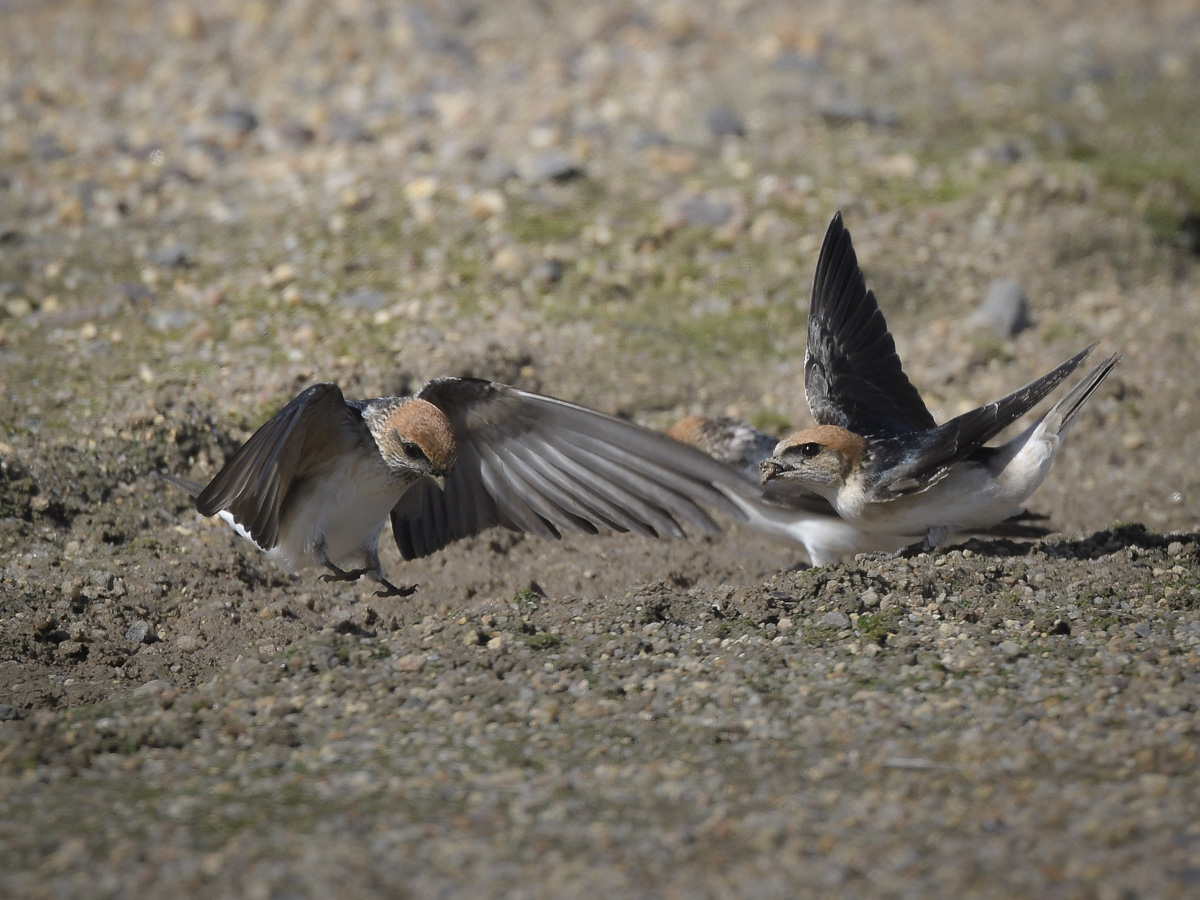
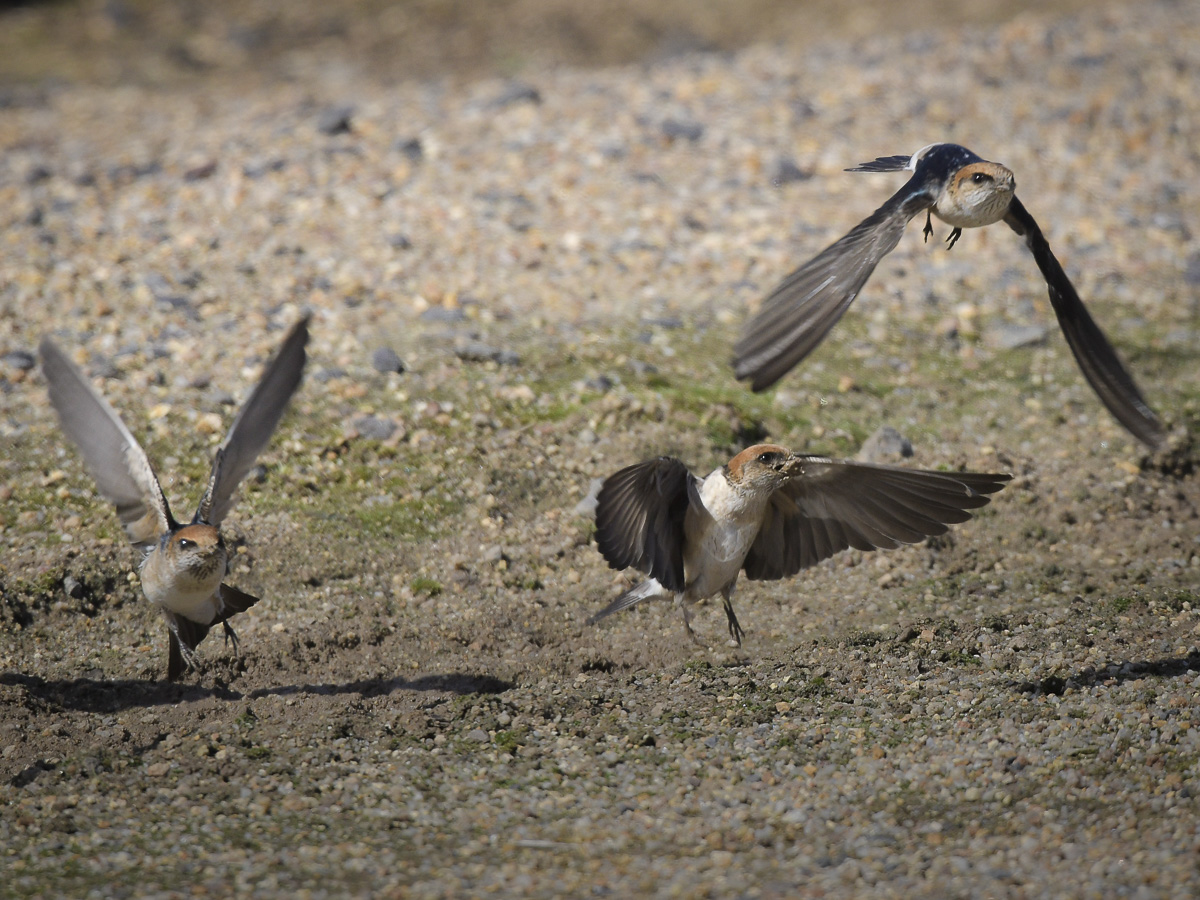
Close by to the waters edge, there were still few tiny puddles of water, and some mud. For the next 30 minutes or so the Fairy Martins and Welcome Swallows swept in to collect material for their little nesting projects. Wouldn’t it interesting to know how many trips they each made, but they must have had a site quite local, as no sooner did they seem to depart than they were back for another load.
The small area of mud was alongside a busy footpath. (The sunshine bought out not only Demi and Seph but all the locals for their dog-walk and coffee fix) The little birds seem to pay it all no attention, lifting off if disturbed, to circle about and re-land.
Such is dedication. Demeter would be proud
And such was the action that a pair of Magpie-larks joined in as well. However I missed seeing their mud collecting.

On the way home we stopped for a few minutes as there is a family of Magpies on the corner of a close street. How close? Well between EE and I we walk past the tree several times a week, in the early first light of morn.

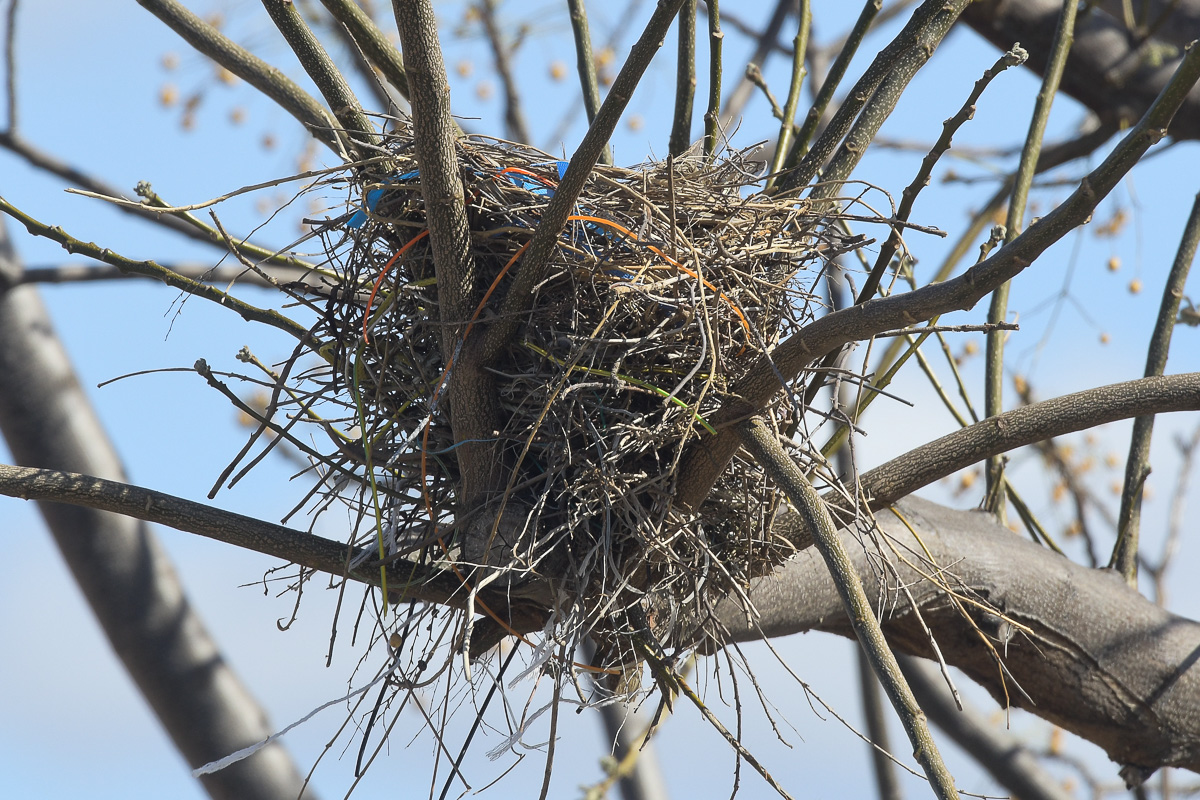
I went by earlier in the week and didn’t notice anything unusual, but Mrs Maggie has been very busy and has in just a few days constructed a very secure, if somewhat open planning nest. Suitably festooned with discarded building site materials. Colour Coordination is obviously important to throughly modern roadside Magpies. I’m thinking I might name her Persephone.

As I can easily see the nest from the footpath, I do hope to keep a track of the comings and goings as the season progresses.

Enjoy


Saturday Evening Post: The Bleeding Edge

It’s probably well known, that I have a love/hate relationship with Adobe. Well, not all Adobe, just Lightroom in particular. It’s a product that I love to hate.
And to be fair, it has managed my library for the past 10 years or more, so perhaps it should be a more of a tolerant relationship.
And no, I’m not going to highlight each of the niggles that I have. Just I’m always on the lookout for a better library manager. But recent changes to the suite has caused me to perhaps reconsider my position.
I’ve never been enamoured by their raw converter, much preferring Capture One, Raw Power, or DXO and even Nikon Capture/Studio (in no particular order) to deal with my NEF file conversion.

However some recent changes seem to me to have finally given me the result I was looking for at import. All good.

I’ve often said about the enhancement of images, (these days euphemistically called ‘post-processing’) that I’d happy with a copy of Photoshop 5.5 with its clever—then released—Masking Layers, Brushes and Curves tool for just about all the changes I need to make. (ps. I try not to spend hours in front of screen, pulling first this or then that slider, hoping to produce a prize-winner out of something that I’d normally send to the Trashbin.)

When I was travelling extensively PS5.5 running on a little Libretto Toshiba notebook did all of the heavy lifting for me. And given the size of the Libretto (it was only just a little larger in size to an Iphone 15 Max) just fitted in one palm, it wasn’t a bad effort. (How times change)
And I was much happier to move to the first Macbook Air with a decent size keyboard.

But… Back to Adobe
Lightroom in particular.

To keep up with the latest and greatest, of course, Adobe have introduced several AI components into the Lr suite. One of which is the Generative AI Removal tool. Swipe over the ‘offending’ intrusion into the perfect composition, hit the “Apply Button” pause to take a breath, and there before your very eyes like some magician’s trick, ‘it’s’ Gone… And just to be sure, new buttons offer three. (Count them. 3 ) choices of result.

Wannaseehowitworks? Well I did too.

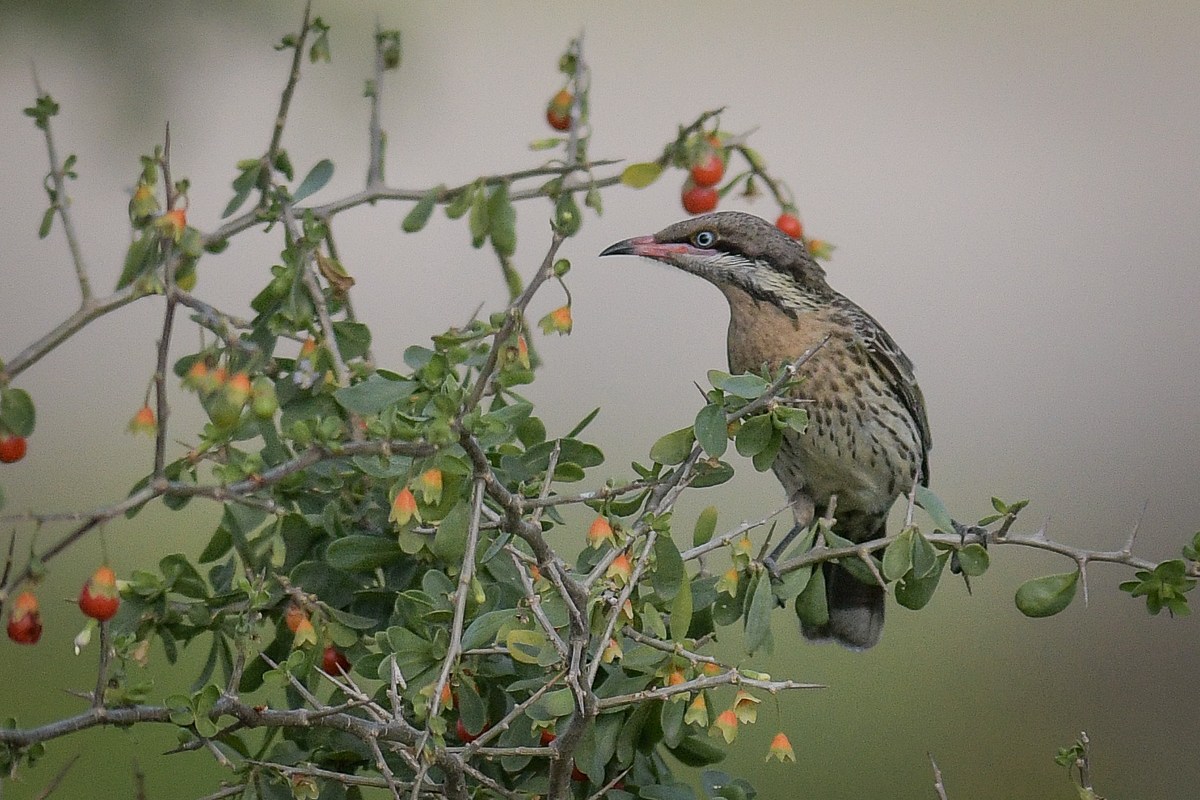
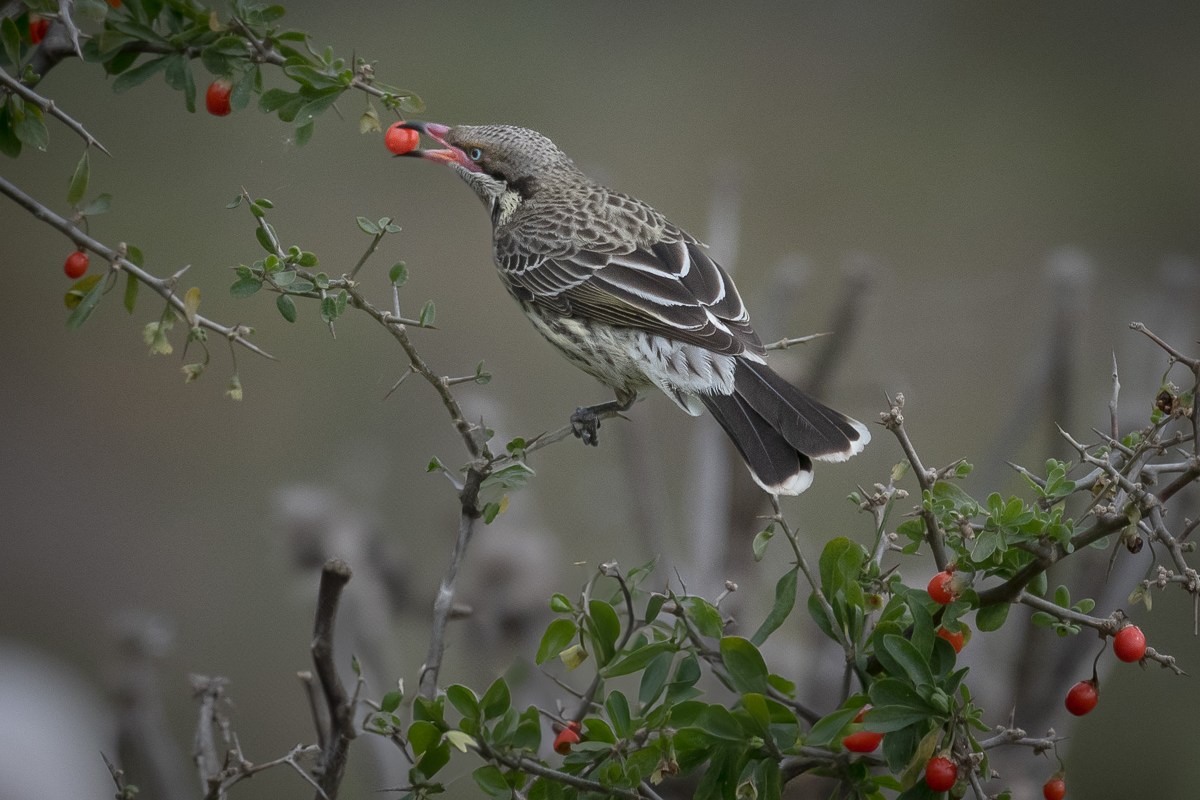
As it turned out while I was working with some Spiny-cheeked Honeyeaters on boxthorn (see last week’s post) a clever little Sparrow landed on the bush just in front of my moment.
Yep, I could have cropped around it, and neither you or I would have had to wade all the way down here, But I thought. Why not?
Why not indeed, so.
I did.

With and Without Sparrow. Version #1 with some space under the bird and a clever addition to the branch

Version #2 filling in the space. Version #3 creating a nice branch that can support the bird.
You can click on the pics to get a full size view of each pair.

I know. Scary.
And of course no one is every going to believe anything else I post again. 🙂
Some, suspicious that we are, might even be wondering. Did he actually paste the Sparrow in from another shot? 🙂

Like many of the ‘new’ features using AI, personally I don’t find the need compelling. But for those days when the wind is howling outside, the rain is pitching down and I’ve crawled out from under the doona long enough to make a cup of the Earl of Grey, it does while away a bit of time.

Here’s to some warm sunny Spring days soon.

Saturday Evening Post: Incongruity

South African Boxthorn is a highly invasive plant, imported into Australia, around the 1880s. The purpose was to provide hedgerows for land demarkaction.
The plant, however, because of it’s evasive properties, had other ideas, and quickly spread out beyond the intended purpose.

Like many of the ‘imports’ into Australia, such as rabbits, foxes, prickly pear, cats, deer and a host of other unmentionables, (including land-lice—first nations word for sheep), and South African Boneseed, whatever the intended and seemingly harmless (insert profit here) reason, the pests became feral and are now for all intents and purposes beyond complete eradication.

Boxthorn has a fruit that starts out green but ripens to a rich red/orange. Each fruit can contain as many as 70 or more seeds, each capable of germination. Given a two metre high plant can contain thousands of the little red invaders, it’s not hard to see how it was able to get away from control. Add to that, it is quite capable of sprouting from a broken, or cut twig, or branch, and the problem simply gets larger.
Early attempts to simply plough them back into the ground, just gave them the space needed to spread even further.

Poisons work, as does cutting them down, stacking them to air dry, and treating the roots. All of which adds up to hard work, and while effective, like dealing with another feral, like Boneseed, needs constant attention.
So in lots of places, by the roadside, in open bush land and forest, the plant just carries on its merry way.

Nearby to us is a small abandoned piece of roadway and some open paddock. It has several stands of boxthorn. At present the plants are in fruit, and a number of local birds have added the berries to their diet. Cockatoos, some parrots and honeyeaters make the most of the offering, and of course, either drop the seeds, or carry them to be deposited when they excrete else where.
Two birds I’ve never seen on boxthorn before are Black-faced Cuckoo-shrikes, and Spiny-cheeked Honeyeaters. However for some reason, the nomad honeyeaters and the Cuckoo-shrikes have been very busy in the small area, and over a matter of a week or so have practically stripped the plants of fruit.

Round one to the Boxthorn.

Saturday Evening Post: Leftie

For some reason, and I don’t know why, most cockatoos tend to be ‘left-footed’.

There is some evidence that the young will experiment with both right and left, but in the end, perhaps because of peer pressure, (I jest), they settle on using the left foot to handle food.

I’ve only ever seen one Sulphur Crested that appeared to be ambidextrous.

Three Little Corellas swept in over the top of a feeding flock of Galahs. I don’t think one of the Galahs even lifted up to see their arrival. The rich shoots of the short grasses must indeed have been sweet and the trio settled in to savouring the feast.

Here is an article that talks to the footedness of parrots

All three of these birds were Lefties.

This photo shows it with the foot up, but each time I moved round to get a view of it eating, it continued to turn its head and body so I only managed a slight view of it putting the food in its mouth.
Then it would turn around again with the foot up. I’m almost sure it did it deliberately to stop me getting a clear shot of the feeding process. 🙂 (Yes, I’m parrot paranoid)

Enjoy

Saturday Evening Post: A Hint of Spring

We have, to say the least, had some very cold days, (and nights) the past few weeks.

It’s made venturing out in the field a little less desirable, and being able to turnover, and pull the doona up bit without a conscience possible.

And besides my 500mm PF lens has been in hospital, and I’ve been doing make-shift with a variety of other lenses. Good side to that too. I’ve become reacquainted with the 300mm f/2.8. Yes, its heavy, yes, tis hard to work with in the field, but oh, oh oh, those dreamy smooth backgrounds and crisp sharp details. Nothing there to complain about.

The 500mm PF has been in the capable hands of the team at Digicam in Adelaide
They have been keeping me updated with progress reports, including the news that the parts needed were coming from overseas, and a bit of a delay might be expected.
So it was pretty exciting to get a note saying the parts would be available and the repair expedited.
Then advice with a delivery note from StarTrek,
Sing Ho for the Life of a Bear,
I don’t mind much if it rains or snows,”
and a text message to say “Delivery Today”, and…
It was.
Can’t ask more than that.

Sadly the next couple of days were cloudy, damp and not conducive to really in-depth lens testing.
Not that I was going to line-up lens charts, software and the like.
No. Just shoot the comms disk on the tower across the road, and look at the result. So I plugged the lens on to our spare D500—the main camera now had the 300 f/2.8— and out I went. Took a bit of fiddling to get the right lens correction dialled in and in the end I swapped out the cameras and the old workhorse needed about a minus 8 correction. (-8)
Happy with that, the following day was one of those out of the box days that End–of-Winter/Almost-Spring can deliver. Delivery Sunshine. No wind. Crisp on the Grass.
All I needed to do now was to find some birds.

The beach was empty. Devoid. Vacant. Still. Alone. Bereft. Not a feather to be seen.
A pair of nesting Ravens, and little else.
No beginner’s luck here.

We walked back to IamGrey and as we did, way across the open bracken field, I saw a lone shape in the air.
A Brown Falcon. (I hope my ophthalmologist reads this) I reckon at about 600m
And closing across the field.
It was the male of the local pair. He swung a few loops over our heads in the sunshine and it gave me a chance to really see what the lens could do.
Result. Thanks to Digicam, it’s back to normal, and working as expected on the D500. That is—It’s sharp.

Sitting in IamGrey having a quick cuppa of the Grey of Earl, a number of Fairywrens came out to dance about the dried grass stalks.
And I was able to get some closeups that showed that smooth creamy background that long lenses can produce. Not quite the dreamy soft of the f2.8. But we takes what we can. 🙂

Big shout out to Digicam for the fast and efficient service and for StarTrek for an on-time delivery.

He was making a wide circling turn. Perhaps looking for a thermal. It gave me a wonderful view of that spread on the tail-feathers
Mr Handsome showing off his new Spring Dress to impress the ladies.
Even the PF can produce soft backgrounds

And the Header Image is another Falcon I found late in the afternoon. It didn’t want to sit for portraits.

Enjoy.
Saturday Evening Post: Hey, What’s Down There!

Thought you might enjoy a smile.

On one of the paddocks at the park, the rabbits have been digging holes to get to either the fresh shoots of the grass or the mushroom mycelium.

A large flock of Galahs also work over the same grass taking out the sweet (well I suppose it is to them) fresh grass.
If it was a golf-course there would be an outcry.

I was watching them fly in, work over an area and then take to wing to see what was available a few metres further on.
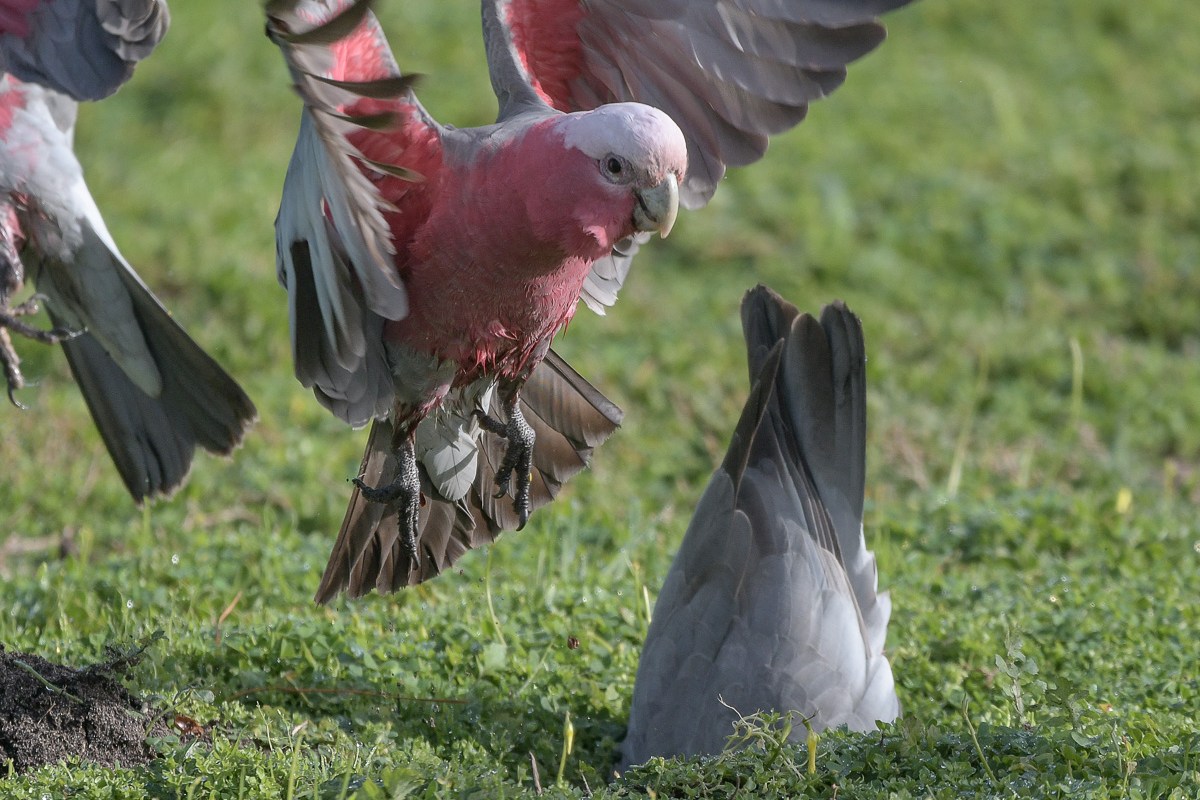
One had managed to find a deep divot, and was working away at the bottom, when its mate flew in to see what it had found.

Saturday Evening Post: On Slender Wings

I do spend a lot of time watching large birds in the air.
Mostly Kites and Falcons.
Each has its own special flight pattern, its own use of the air, wind, and terrain.
The concept of flight has been a fascination of human history, and not without a little envy of these creatures that can spread out their wings and move seemingly effortlessly through the air.

One bird that I find not only fascinating, but truly mesmerising is watching a Gannet working over the water on a strong breeze. Its movements are not just about wingflaps, or wing angle.
They seem to be able to make the most minute of adjustments depending on the wind, one moment skimming close to the water, the next raising high, or rolling over into a near vertical dive.

We occasionally have have them come up to the northern end of Port Phillip.

If there is a low(ish) tide, and the fish run over the sandy reef, and there is strong offshore, northerly wind blowing, we might even, on a good day, get them close enough to watch every detail of their flight. On a really, really good day, we might even get some sunshine for photographs. (Although of late, such a chance is more dreamed than achieved in reality)

The long thin wings seem to be scythe through the air, yet carry the bird’s torpedo shaped body in the right direction. A little tail flick, a weight distribution, one wing pulled in, the other extended, and the bird carries out its magic dance against the strength of the wind, the roll of the waves and the constant search for a meal.

Mesmerising.

Saturday Evening Post: Mantra

This edition of the blog took very little effort to write, you could say it kind of wrote itself.

Unless you’ve been hiding under a rock this past week, you will at least have noted a reference to an assassination attempt on a US presidential candidate.
I’m not going to begin to explore the rights, wrongs, or political implication of that event.

No doubt also you’ll have seen some photos from that afternoon. Or you may have been doomscrolling to find all the wide-eyed conspiracy theories that suddenly sprung up.

One photo caught my interest. And is the subject of the remainder of the blog.

It is on the cover of TIme Magazine. It was taken by photographer Evan Vucci.

I managed to hear an interview on radio with Mr Vucci, and try as I might I haven’t been able to locate that interview online.
The part that caught me up, was the interviewer asked “Was it a ‘lucky’ shot?”
And he replied…

….“I started thinking, OK, what’s going to happen next? Where is he going to go? Where do I need to be? Where do I need to stand? What is going to happen?”
“The job is all about anticipation,” Vucci says.

“It was a situation where that vast experience absolutely does [prepare you]. To have that experience behind you sort of allows you to remain calm. It wasn’t the first time I was in that situation. So I was able to keep my head, I was able to think. I was able to compose pictures. I think all of us were there and we just stayed in the moment, stayed on the story. In my head, I just kept saying to myself, ‘slow down, slow down. Compose, compose.’ Okay, what’s gonna happen next? What’s going on here? What’s going on there? Just trying to get every angle on it.’

“In the moment it’s weird because your brain is basically shut off. You’re just thinking about, ‘Okay, what’s my composition, or where’s light coming from? Is my exposure good?’ Do I need to move to the right? Do I need to move to the left?’ Because you got to be able to see his face. So when he started pumping his fist, I was surprised. And then I saw the blood on his face. And then I knew once I saw that, I knew I had at least a news storytelling image. I knew I had something. So I felt good. At least something was in the bag.”

“I work for AP. You know, we have a long history of photojournalism. And so I think when you’re at this level, and something like this happens to you, you’re able to react a certain way and expect[ed] to produce. I was just thankful that I was able to hold that standard.”

No doubt you can find many links to the story. Here’s the Time Magazine Cover and some of his other quotes.

Please be aware there are many pictures on the site, and I don’t want to add to the horror.

But hidden in there is the mantra.

  • The Mantra.
    • Know your composition
    • Where is the light coming from
    • Is my Exposure good
    • Do I need to move left or right
    • Slow down
    • Keep your head
    • Think. What’s going to happen next.

Something to think about next time I’m out in the field and a great photo opportunity presents itself. Will I be ready?

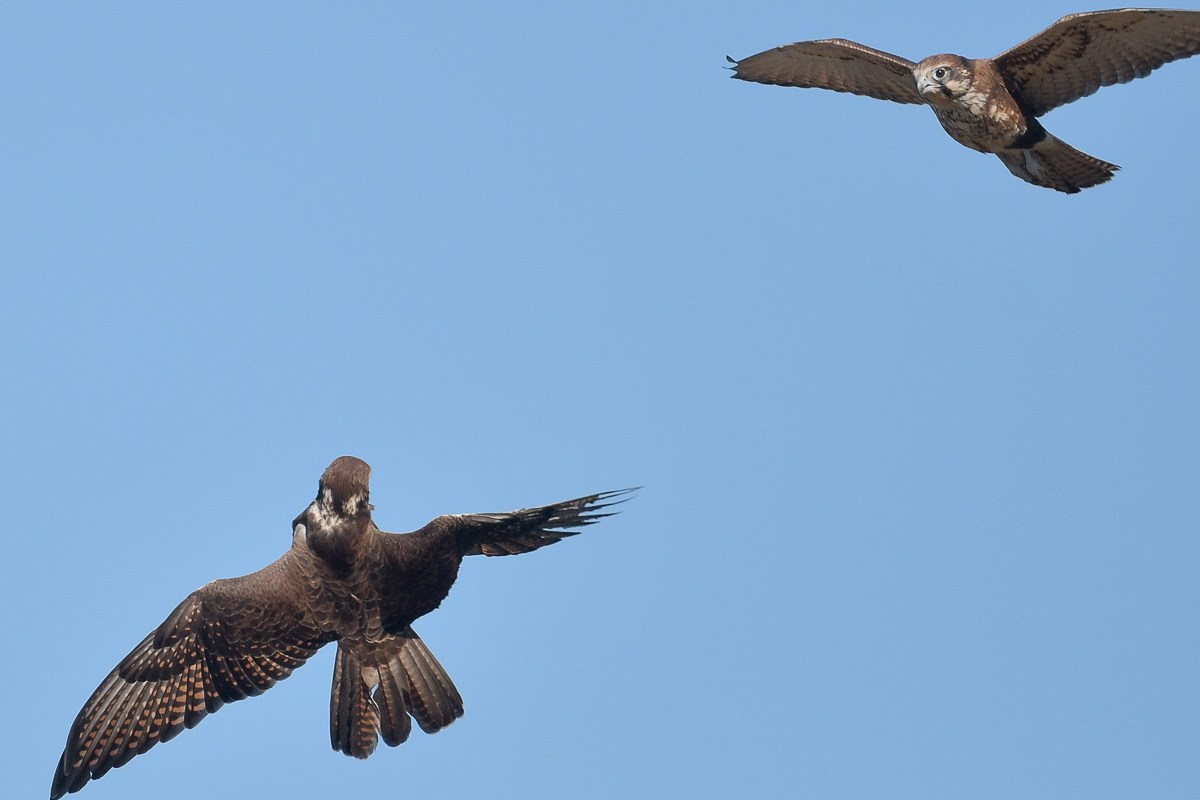
Now, two Brown Falcons at play rebuilding their pair bond, might never make it to Time magazine. Nor will it fit into the same hall of fame as Evan Vucci. But some of the principles from the Mantra were at work when I made the shot.

The two birds are back together again preparing for next summer’s nesting.
I’d seen them working along the beach, and they had disappeared, when suddenly the raucous call of the female went up, I turned and raced back along the beach to an opening among the trees and she came over the tops of the trees, just as he plummeted down from a display flight.
But if she was happy to see him, I was glad to get one shot of the joyous moment.

Enjoy.


Saturday Evening Post: Lenless and Weatherless

Lens update: No return date yet specified.
Weather update: Cold, likelyhood of a week of rain and poor light.

Now it’s not that I don’t have other lenses to go out with. But, I can’t do much about the weather.

Fortunately, we don’ t have any birds on nest at present, so they don’t have to put up with keeping the eggs/young dry as well as survive.

Nature Photographer, Laurie Campbell, in the book, “Guide to Bird and Nature Photography”, published by the RSBP (Royal Society for the Protection of Birds) published in 1990—Yep, back in the days of pre-digital!, has a chapter entitled, —Coping with Adverse Weather Conditions

Laurie works in Scotland, and in some of the most difficult weather. Some of his work is from hides, and he’ll use a carcass to bring in a subject. His most recent work is here
There is a photo of a Golden Eagle on a carcass in the pouring rain. The recent work is a compilation slide set, so you’ll have to click few a few times to find the eagle, or go to it from the thumbnails. 4 Rows down on the rhs of the set.

His Guide book features a lot of photos taken, all on filum, using a lens I mentioned last week, the incomparable Nikkor 600mm f/5.6 manual focus. Now before you jump to conclusions, I had the lens, before I purchased the book.

I was, I must admit, tempted to buy a Benro Tripod as used in the book, but already had more than a fair share of camera supports.

The couple of pages he devotes to dealing with Adverse Weather includes info on snow and sleet.
Days, I put down to ‘Doona Days’, and stay home.
“Yet, by using a little imagination , and taking the trouble to solve the practical difficulites, even the worst conditions can usually be put to good use, ” say Laurie.
I guess I don’t have that much imagination 🙂

While I don’t have to deal with snow, strong windy conditions, either in hot, normal or cold conditions is my number one challenge. And particularly on the wide unprotected ponds at the Western Treatment Plant.
Getting the door opened or closed in IamGrey is always a challenge, and a number of times, a hand or foot has been jammed as a door wildly swings closed.

Just recently it seemed to work to our advantage, at a pond colloquially called, “The Crake Pond”, the wind seemed to have allowed the birds to wander out into the open spaces without worry.
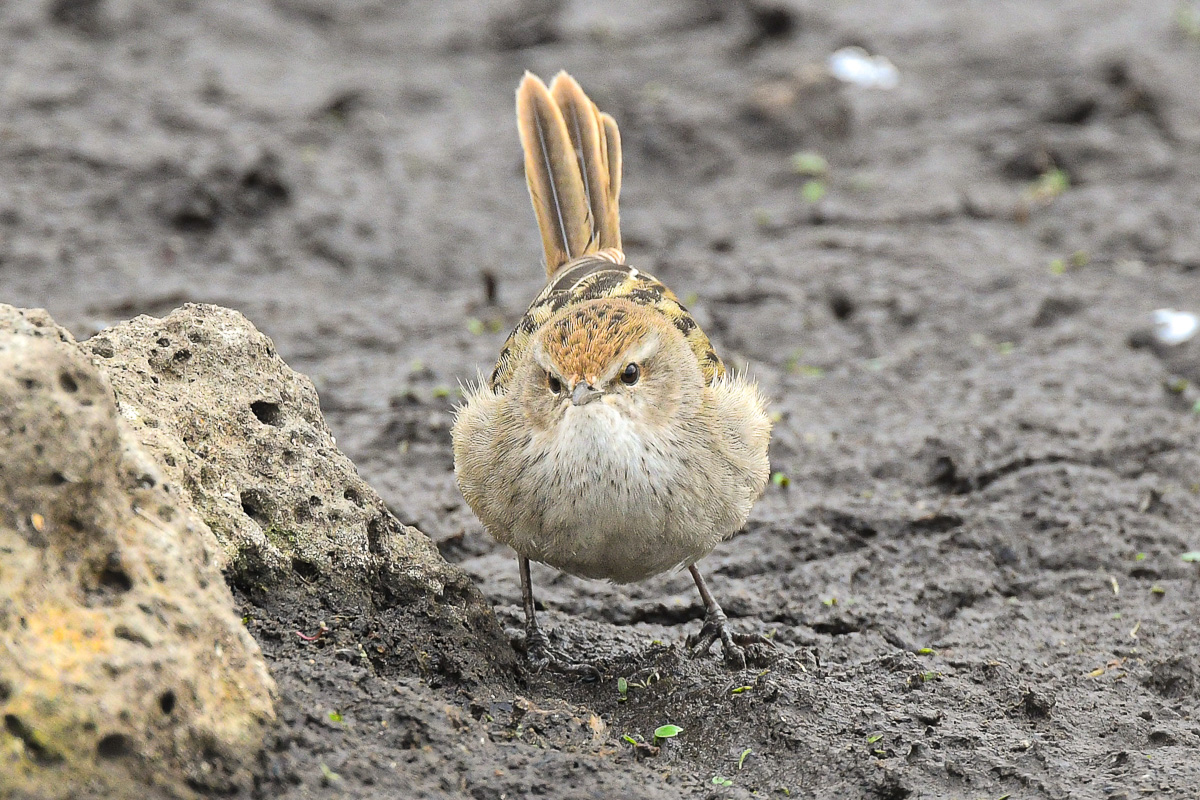
Among the many that were feeding in quite close as we sat quietly, were several Little Grassbirds.
Normally only heard among the reeds, or glimpsed as they dash across and open area, in the wlindy conditions they were out in the open.

And I didn’t need the old 600mm f/5.6
Enjoy