For some reason, and I don’t know why, most cockatoos tend to be ‘left-footed’.
There is some evidence that the young will experiment with both right and left, but in the end, perhaps because of peer pressure, (I jest), they settle on using the left foot to handle food.
I’ve only ever seen one Sulphur Crested that appeared to be ambidextrous.
Three Little Corellas swept in over the top of a feeding flock of Galahs. I don’t think one of the Galahs even lifted up to see their arrival. The rich shoots of the short grasses must indeed have been sweet and the trio settled in to savouring the feast.
This photo shows it with the foot up, but each time I moved round to get a view of it eating, it continued to turn its head and body so I only managed a slight view of it putting the food in its mouth. Then it would turn around again with the foot up. I’m almost sure it did it deliberately to stop me getting a clear shot of the feeding process. 🙂 (Yes, I’m parrot paranoid)
We have, to say the least, had some very cold days, (and nights) the past few weeks.
It’s made venturing out in the field a little less desirable, and being able to turnover, and pull the doona up bit without a conscience possible.
And besides my 500mm PF lens has been in hospital, and I’ve been doing make-shift with a variety of other lenses. Good side to that too. I’ve become reacquainted with the 300mm f/2.8. Yes, its heavy, yes, tis hard to work with in the field, but oh, oh oh, those dreamy smooth backgrounds and crisp sharp details. Nothing there to complain about.
The 500mm PF has been in the capable hands of the team at Digicam in Adelaide They have been keeping me updated with progress reports, including the news that the parts needed were coming from overseas, and a bit of a delay might be expected. So it was pretty exciting to get a note saying the parts would be available and the repair expedited. Then advice with a delivery note from StarTrek, “Sing Ho for the Life of a Bear, Sing Ho for the Life of a Bear, I don’t mind much if it rains or snows,” and a text message to say “Delivery Today”, and… It was. Can’t ask more than that.
Sadly the next couple of days were cloudy, damp and not conducive to really in-depth lens testing. Not that I was going to line-up lens charts, software and the like. No. Just shoot the comms disk on the tower across the road, and look at the result. So I plugged the lens on to our spare D500—the main camera now had the 300 f/2.8— and out I went. Took a bit of fiddling to get the right lens correction dialled in and in the end I swapped out the cameras and the old workhorse needed about a minus 8 correction. (-8) Happy with that, the following day was one of those out of the box days that End–of-Winter/Almost-Spring can deliver. Delivery Sunshine. No wind. Crisp on the Grass. All I needed to do now was to find some birds.
The beach was empty. Devoid. Vacant. Still. Alone. Bereft. Not a feather to be seen. A pair of nesting Ravens, and little else. No beginner’s luck here.
We walked back to IamGrey and as we did, way across the open bracken field, I saw a lone shape in the air. A Brown Falcon. (I hope my ophthalmologist reads this) I reckon at about 600m And closing across the field. It was the male of the local pair. He swung a few loops over our heads in the sunshine and it gave me a chance to really see what the lens could do. Result. Thanks to Digicam, it’s back to normal, and working as expected on the D500. That is—It’s sharp.
Sitting in IamGrey having a quick cuppa of the Grey of Earl, a number of Fairywrens came out to dance about the dried grass stalks. And I was able to get some closeups that showed that smooth creamy background that long lenses can produce. Not quite the dreamy soft of the f2.8. But we takes what we can. 🙂
Big shout out to Digicam for the fast and efficient service and for StarTrek for an on-time delivery.
He was making a wide circling turn. Perhaps looking for a thermal. It gave me a wonderful view of that spread on the tail-feathersMr Handsome showing off his new Spring Dress to impress the ladies. Even the PF can produce soft backgrounds
And the Header Image is another Falcon I found late in the afternoon. It didn’t want to sit for portraits.
On one of the paddocks at the park, the rabbits have been digging holes to get to either the fresh shoots of the grass or the mushroom mycelium.
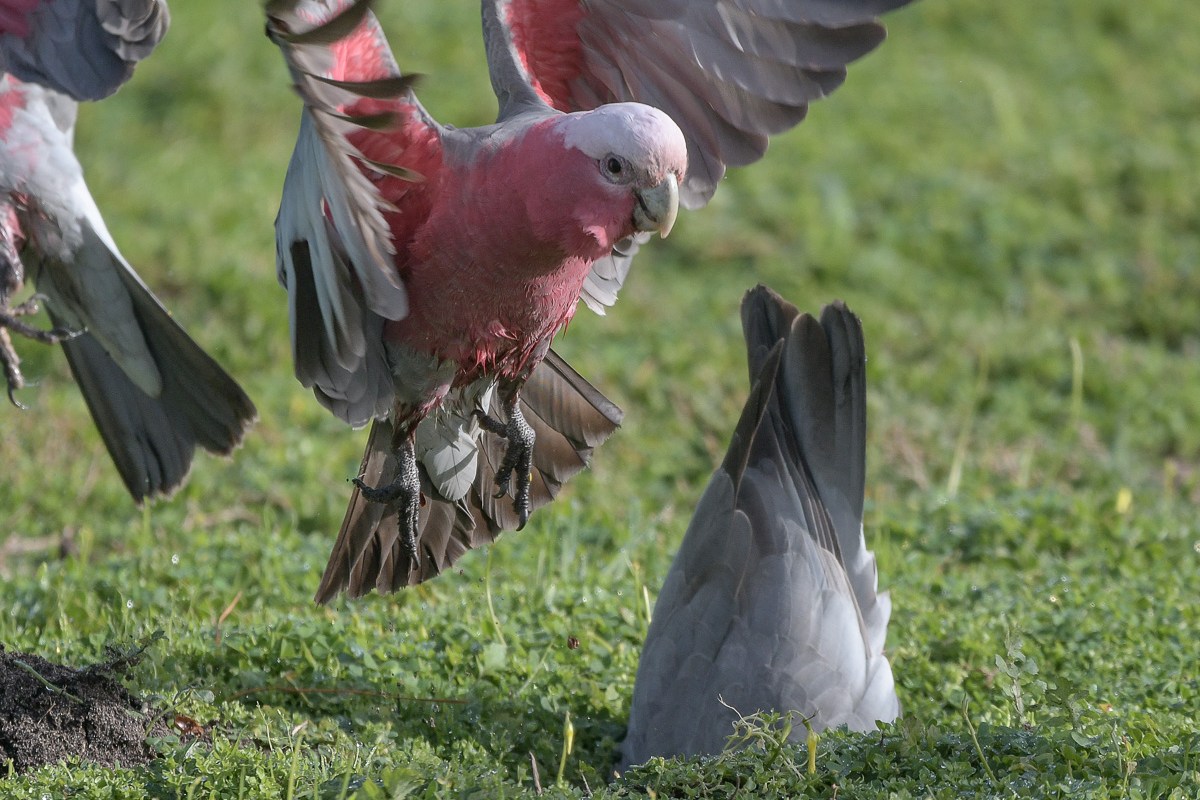
A large flock of Galahs also work over the same grass taking out the sweet (well I suppose it is to them) fresh grass. If it was a golf-course there would be an outcry.
I was watching them fly in, work over an area and then take to wing to see what was available a few metres further on. One had managed to find a deep divot, and was working away at the bottom, when its mate flew in to see what it had found.
I do spend a lot of time watching large birds in the air. Mostly Kites and Falcons. Each has its own special flight pattern, its own use of the air, wind, and terrain. The concept of flight has been a fascination of human history, and not without a little envy of these creatures that can spread out their wings and move seemingly effortlessly through the air.
One bird that I find not only fascinating, but truly mesmerising is watching a Gannet working over the water on a strong breeze. Its movements are not just about wingflaps, or wing angle. They seem to be able to make the most minute of adjustments depending on the wind, one moment skimming close to the water, the next raising high, or rolling over into a near vertical dive.
We occasionally have have them come up to the northern end of Port Phillip.
If there is a low(ish) tide, and the fish run over the sandy reef, and there is strong offshore, northerly wind blowing, we might even, on a good day, get them close enough to watch every detail of their flight. On a really, really good day, we might even get some sunshine for photographs. (Although of late, such a chance is more dreamed than achieved in reality)
The long thin wings seem to be scythe through the air, yet carry the bird’s torpedo shaped body in the right direction. A little tail flick, a weight distribution, one wing pulled in, the other extended, and the bird carries out its magic dance against the strength of the wind, the roll of the waves and the constant search for a meal.
This edition of the blog took very little effort to write, you could say it kind of wrote itself.
Unless you’ve been hiding under a rock this past week, you will at least have noted a reference to an assassination attempt on a US presidential candidate. I’m not going to begin to explore the rights, wrongs, or political implication of that event.
No doubt also you’ll have seen some photos from that afternoon. Or you may have been doomscrolling to find all the wide-eyed conspiracy theories that suddenly sprung up.
One photo caught my interest. And is the subject of the remainder of the blog.
It is on the cover of TIme Magazine. It was taken by photographer Evan Vucci.
I managed to hear an interview on radio with Mr Vucci, and try as I might I haven’t been able to locate that interview online. The part that caught me up, was the interviewer asked “Was it a ‘lucky’ shot?” And he replied…
….“I started thinking, OK, what’s going to happen next? Where is he going to go? Where do I need to be? Where do I need to stand? What is going to happen?” “The job is all about anticipation,” Vucci says.
“It was a situation where that vast experience absolutely does [prepare you]. To have that experience behind you sort of allows you to remain calm. It wasn’t the first time I was in that situation. So I was able to keep my head, I was able to think. I was able to compose pictures. I think all of us were there and we just stayed in the moment, stayed on the story. In my head, I just kept saying to myself, ‘slow down, slow down. Compose, compose.’ Okay, what’s gonna happen next? What’s going on here? What’s going on there? Just trying to get every angle on it.’
“In the moment it’s weird because your brain is basically shut off. You’re just thinking about, ‘Okay, what’s my composition, or where’s light coming from? Is my exposure good?’ Do I need to move to the right? Do I need to move to the left?’ Because you got to be able to see his face. So when he started pumping his fist, I was surprised. And then I saw the blood on his face. And then I knew once I saw that, I knew I had at least a news storytelling image. I knew I had something. So I felt good. At least something was in the bag.”
“I work for AP. You know, we have a long history of photojournalism. And so I think when you’re at this level, and something like this happens to you, you’re able to react a certain way and expect[ed] to produce. I was just thankful that I was able to hold that standard.”
Please be aware there are many pictures on the site, and I don’t want to add to the horror.
But hidden in there is the mantra.
The Mantra.
Know your composition
Where is the light coming from
Is my Exposure good
Do I need to move left or right
Slow down
Keep your head
Think. What’s going to happen next.
Something to think about next time I’m out in the field and a great photo opportunity presents itself. Will I be ready?
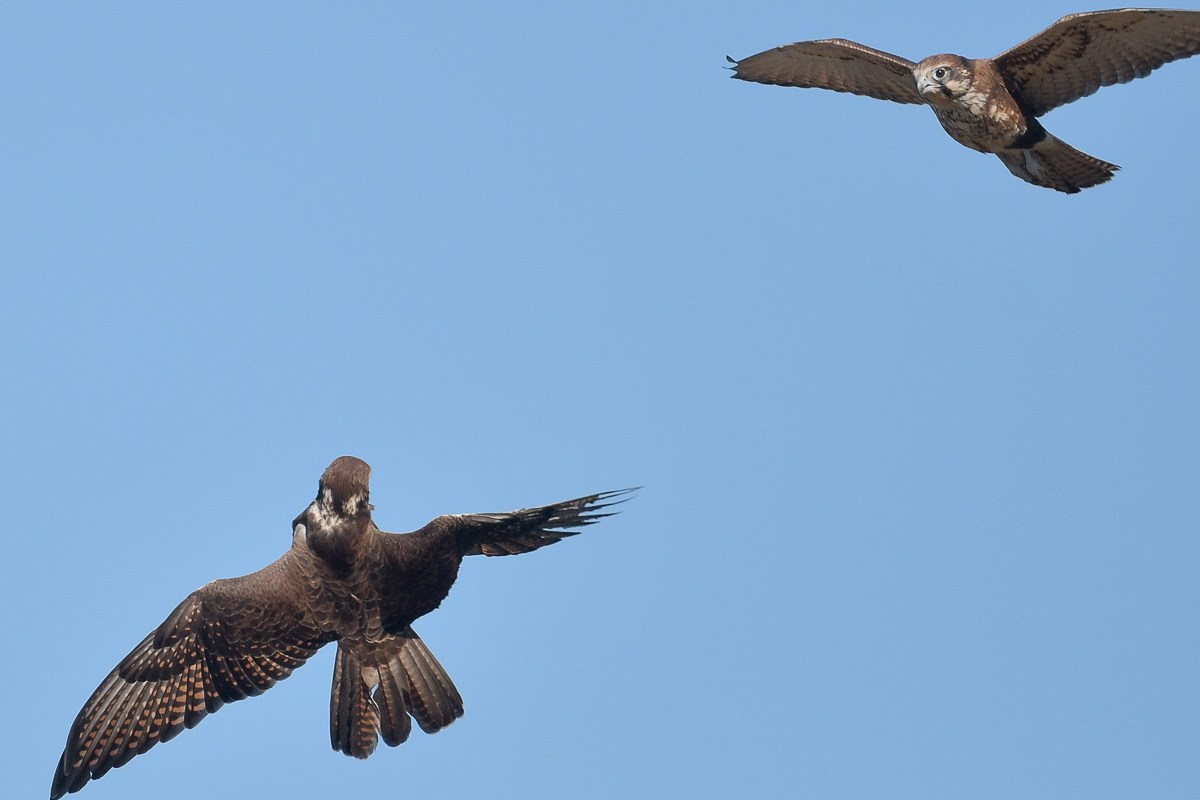
Now, two Brown Falcons at play rebuilding their pair bond, might never make it to Time magazine. Nor will it fit into the same hall of fame as Evan Vucci. But some of the principles from the Mantra were at work when I made the shot.
The two birds are back together again preparing for next summer’s nesting. I’d seen them working along the beach, and they had disappeared, when suddenly the raucous call of the female went up, I turned and raced back along the beach to an opening among the trees and she came over the tops of the trees, just as he plummeted down from a display flight. But if she was happy to see him, I was glad to get one shot of the joyous moment.
Lens update: No return date yet specified. Weather update: Cold, likelyhood of a week of rain and poor light.
Now it’s not that I don’t have other lenses to go out with. But, I can’t do much about the weather.
Fortunately, we don’ t have any birds on nest at present, so they don’t have to put up with keeping the eggs/young dry as well as survive.
Nature Photographer, Laurie Campbell, in the book, “Guide to Bird and Nature Photography”, published by the RSBP (Royal Society for the Protection of Birds) published in 1990—Yep, back in the days of pre-digital!, has a chapter entitled, —Coping with Adverse Weather Conditions
Laurie works in Scotland, and in some of the most difficult weather. Some of his work is from hides, and he’ll use a carcass to bring in a subject. His most recent work is here There is a photo of a Golden Eagle on a carcass in the pouring rain. The recent work is a compilation slide set, so you’ll have to click few a few times to find the eagle, or go to it from the thumbnails. 4 Rows down on the rhs of the set.
His Guide book features a lot of photos taken, all on filum, using a lens I mentioned last week, the incomparable Nikkor 600mm f/5.6 manual focus. Now before you jump to conclusions, I had the lens, before I purchased the book.
I was, I must admit, tempted to buy a Benro Tripod as used in the book, but already had more than a fair share of camera supports.
The couple of pages he devotes to dealing with Adverse Weather includes info on snow and sleet. Days, I put down to ‘Doona Days’, and stay home. “Yet, by using a little imagination , and taking the trouble to solve the practical difficulites, even the worst conditions can usually be put to good use, ” say Laurie. I guess I don’t have that much imagination 🙂
While I don’t have to deal with snow, strong windy conditions, either in hot, normal or cold conditions is my number one challenge. And particularly on the wide unprotected ponds at the Western Treatment Plant. Getting the door opened or closed in IamGrey is always a challenge, and a number of times, a hand or foot has been jammed as a door wildly swings closed.
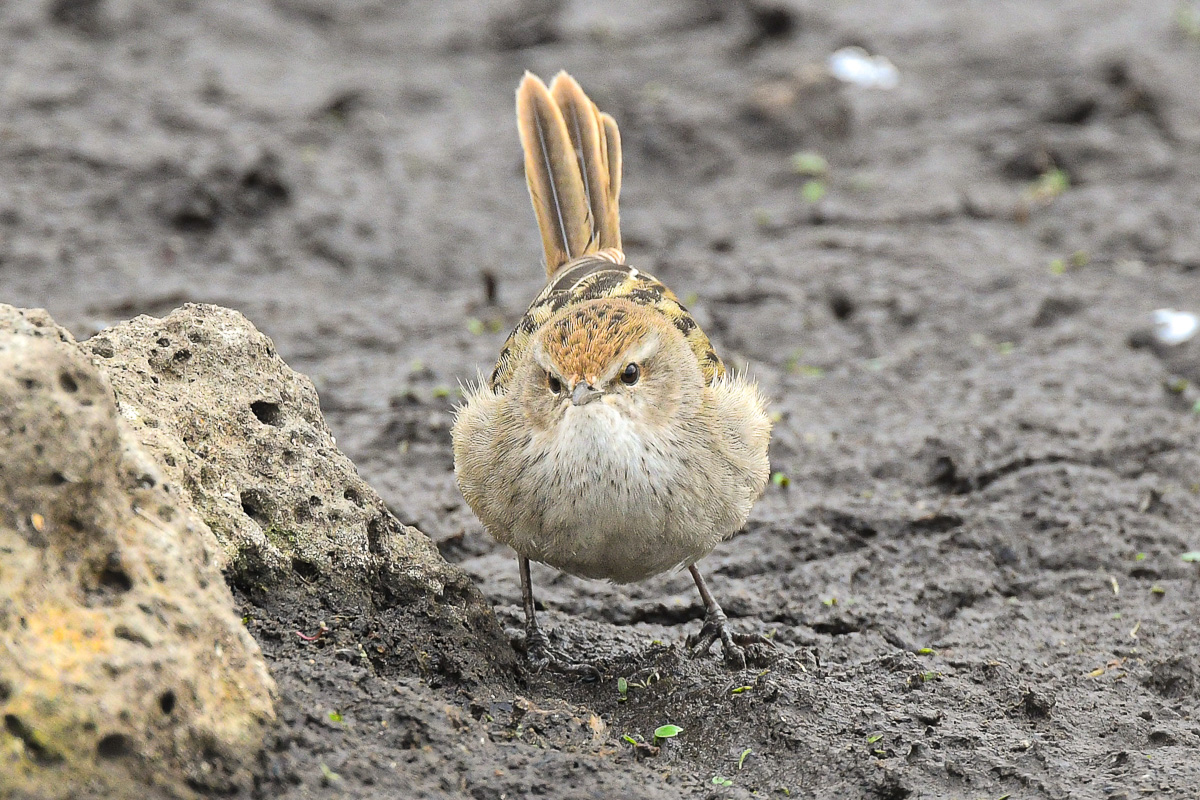
Just recently it seemed to work to our advantage, at a pond colloquially called, “The Crake Pond”, the wind seemed to have allowed the birds to wander out into the open spaces without worry. Among the many that were feeding in quite close as we sat quietly, were several Little Grassbirds. Normally only heard among the reeds, or glimpsed as they dash across and open area, in the wlindy conditions they were out in the open.
Year ago, I had the chance to work with a Canadian, who, among other things, in the days before the worldwide web, and social media, used to create and present training programmes. One such, carried the title, “Len’s Love” As his name was, Len, it seemed appropriate. But, of course, his real intent was on the use of lenses and their impact on the photographic process and result. Fascinating, as he treated the photo journey as one of his great loves.
I have over the years owned, used and had access to a wide range of lenses. Some, and if you want a list, the Nikkor 43-86mm f/3.5 would be at the top of the very ordinary, bordering on not particularly good. Funnily enough, my dear Dad, had a fondness for that particular lens and its ‘soft’ peculiarities. ( I acquired one, some years back, simply for sentimental reasons)
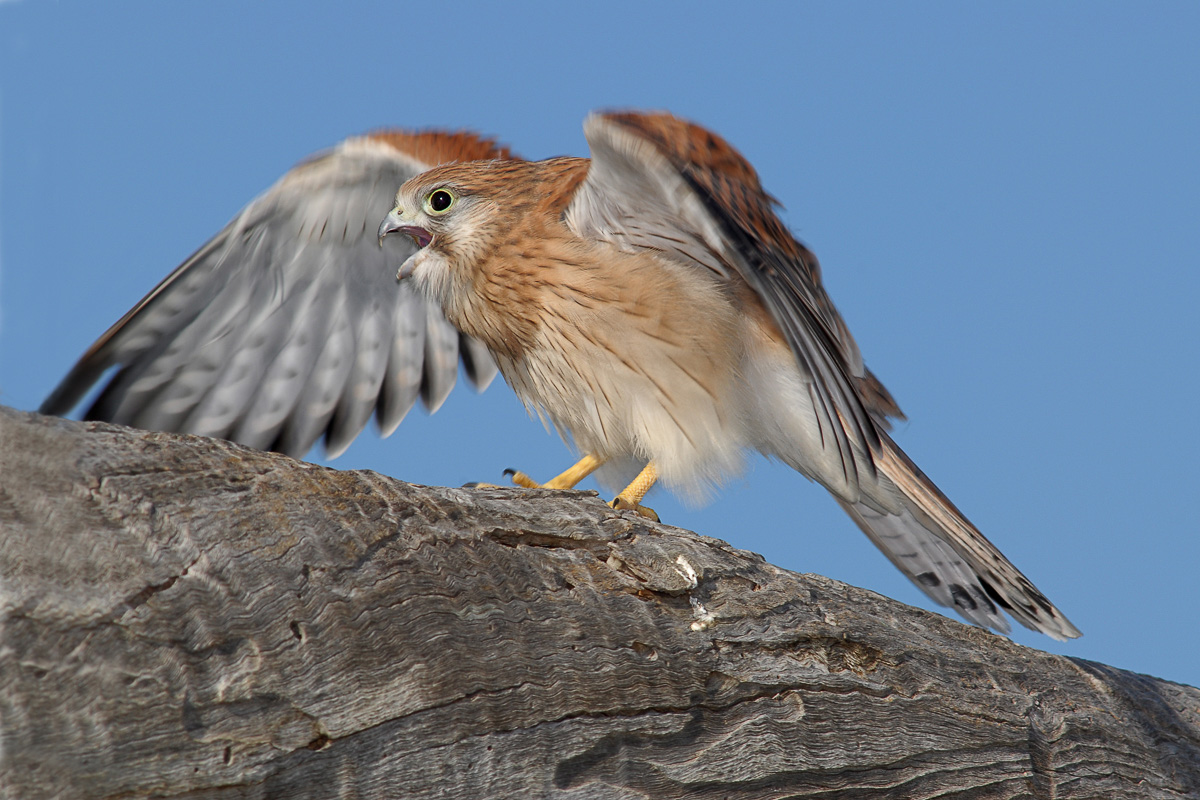
When I began bird photography seriously, I did manage to track down and purchase, a Nikkor 600mm f/5.6 manual focus lens. This lens was sharp. Well balanced and although manual focus, such a pleasure to use. I made a whole Nankeen Kestrel nesting series with that lens. Another lens that I’d like to refind. Just for sentimental reasons. Here’s one from that series with the lens. (Camera for the interested was a Nikon D200)
And all was going well until the other day, when for some reason, the lens began to have focusing problems. It would work ok on closeups like Robins on a post, but could not focus at more distant subject. (Manually it did work, so I struggled through the day) I’ve owned the lens since 2019, and as it has been used, hard, a couple of times a week, and has worn out a D810 and a D500, I guess it has had a good run. Can’t tell how many 100s of thousands of frames, but my boy-scout math would suggest between 200,500 to 300,000.
So I guess it does deserve a bit of a break. The kind lens doctors at Digicam in Adelaide took it into their lens hospital, and I look forward to its return. The report was the lens was in excellent condition, other than the need to replace a couple of electrical components that had failed. Just gotta wait for parts.
Gave me a chance to immerse myself in the wide world of mirrorless cameras and lenses. However the end result of that is I’ll be looking forward to the return of the 500 PF as it’s rapid focus on the D500 is not matched in my experience by the mirrorless system. Perhaps I’m just biased.
Here are several of my fav images from the Lens. Chosen because they were all ‘grab’ shots, where I pointed the lens and hoped for the best. The speed of focus, and the D500 ‘terrier-like’ af did the rest.
Enjoy.
White-bellied Sea eagle. The bird has just flown over the tops of the trees and was about to disappear behind another.We were facing the other way, when a ruckus behind made me turn around to see the young Pacific Gull trying to steal a meal. The Pink Robin, landed on the branch, turned and then dropped to the ground.
In early July 2021, my friend Nina had been at the WTP and found a family of Brolga playing with a tennis ball. Nina kindly let me put the story and the pictures on this blog and here is a link Tennis Stars Be Prepared to be Amazed It was just at the start of the Wimbledon Tennis.
+D4 turned up yesterday, and EE and I decided a trip to the WTP would be as good a location as we’d not been down for awile.
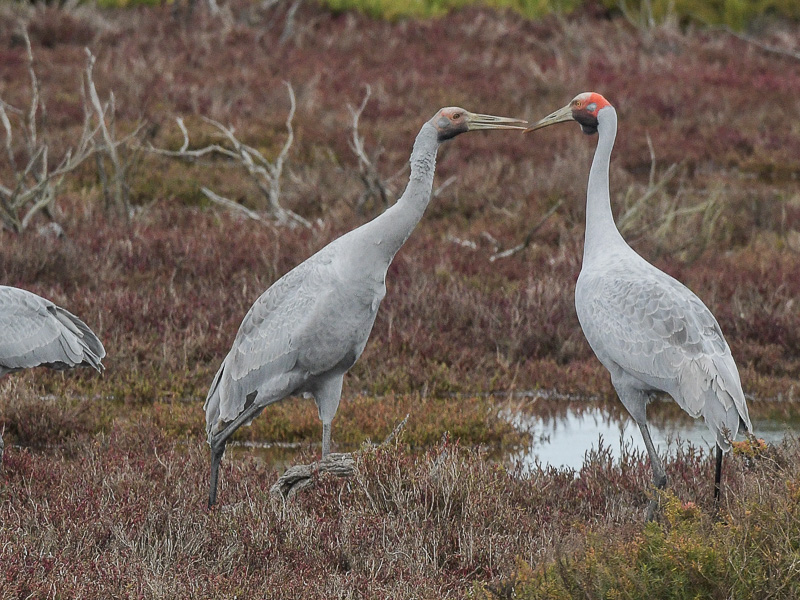
As we moved through the Western Lagoon area, we spotted a small number of Brogla opposite a pond on some lower ground.
And.
They were playing with a Tennis Ball Coincidence. And Wimbledon started this week. Coincidence?
The universe is far too complicated for me to understand. The question is, “Is it the same tennis ball from 2021?” Or do the Brolga have Amazon ship in fresh ones each year?
And here’s how the game progressed. In the end, as two of them seemed to argue, a third one came in and picked up the ball. “It’s my ball, and I’m taking it home.”
Enjoy
You need a good playing surface for tennisAre you sure you dropped it hereIt’s not your turn, it’s mineA great shotPerhaps the coach was offering adviceOh, great forehandNow you’re getting good distanceA free throwThings get heated in close games.That was definitely Out!And while the two argued another came, picked up the ball and took it home
Sometimes photographing birds is a bit of a hit or miss opportunity.
Methinks I’ve written on that subject a few times before. We have over the past few weeks, on occasions, spotted a Spotted Harrier. It is most likely one that was in our area about 3 years ago. It has a distinctive ‘notch’ out of one wing. Spotted Harriers master huge territories. So it’s not unusual to go for sometime without sighting them. Several years ago, a pair was in residence behind the Avalon Airport and were among a number of birds, Falcons, Black-shouldered Kites and Kestrels that worked the surrounding paddocks. Dr Hollands in his revised book on Australian Raptors has both good information and photos from the time.
Currently this bird seems to be working over many of the paddocks that stretch along the western side of Port Phillip. We’ve been able to find it in places as much as 20km apart (It’s distinctive wing notch is helpful in id)
The other morning as we were settling in to look at a new pair of Kites that also have recently turned up. Off in the distance, an large shape flicked and dived across the field. It was a very windy morning, and we’d already had qualms about being out in a forested area in case one of the trees should tumble or shed a large branch. We thought at first by the colouring it was a Brown Falcon, but then as it worked along a fence line, the unmistakeable shape, led to EE calling, “Spotted Harrier” Too far for photos, but simply amazing to watch the huge wings carry the bird at speed against the prevailing wind.
We then ventured along a track through the trees away from IamGrey, and way across the paddock through the gaps in the treeline, we saw it heading in our general direction. Too many trees, too much undergrowth, it was going to be hard to get it cutting across the field. And now with the wind behind, the speed had ramped up too. Suddenly it was through the first line of the trees, out across the paddock around some bushes, that lifting, falling, sliding flight giving it full view of anything on the ground. Then it turned back toward our area, and like a magician with a rabbit in a hat, it disappeared.
“It had to have gone down into the grass”, was the cry.
How do you sneak up on a Spotted Harrier? Not a lot of books, or websites or social media posts overflowing with good answers to that question. (I wonder why?)
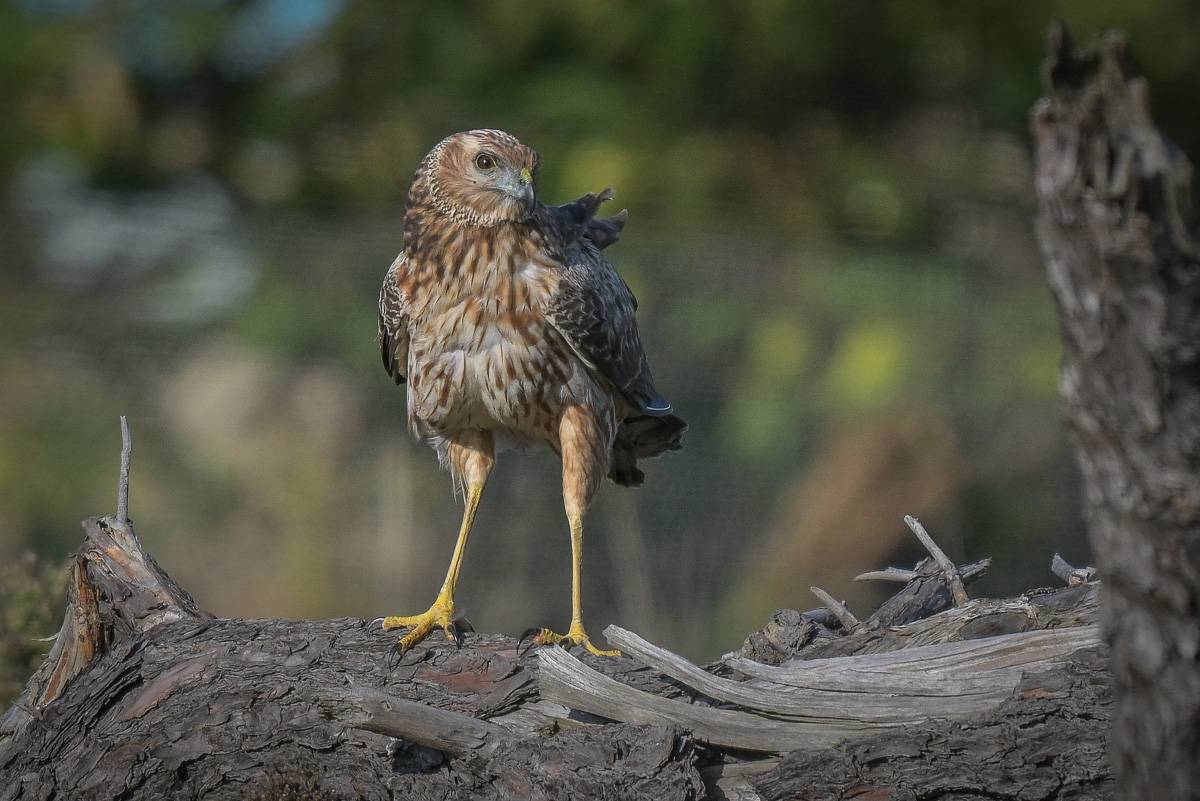
Abandoning our somewhat inactive Kites, we ‘crept’ through the treeline, realising as soon as we saw the bird, it would be gone. But, as they say. We spotted it, on a old downed tree. A murder of rather annoyed and raucous Ravens, must have caused it to stop for safety sake. We edged past another downed tree, and had a clearer view. No point in trying to ‘get closer’ as a fence was in the way. Still, the bird, to its credit, stood its ground. The sunlight cascaded across the scene and behind the old tree, it was safe from Ravens, humans and the strong wind.
It sat for around 5 minutes or so. To the hardly breathing photographers, it seemed more like 5 hours. Then those big wings, lifted, and as I’d put the camera down because my arms were aching, I could only watch as it sailed back into the breeze, across the paddock and was gone.
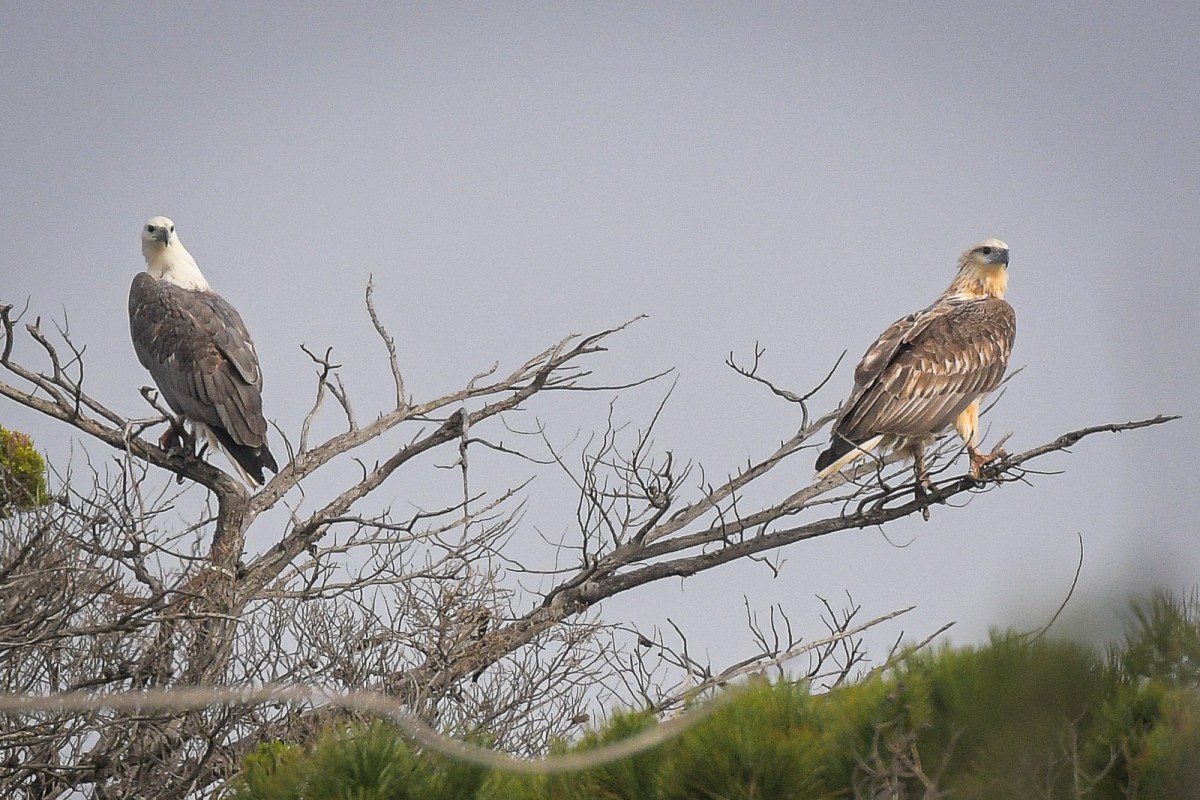
Over the past few weeks, an adult White-bellied Sea-eagle has occasionally been patrolling along the beach area on the top end of Port Phillip along the western shores. Almost always with a young bird tagging along. There is a good chance, as chances go, that this is the pair that we saw preparing to nest in the Western Treatment Plant last year.
There are a number of Umbrella Pines that surround the old (first) homestead of the Chirnsides. The old trees must provide a wonderful view over the surrounding bay and beaches.
We had been working our way along the beach, on what was a particularly quiet day on the water. Only a handful of ducks and a few swans, with some cormorants snoozing away on the old pier and rocks.
We turned a corner on the bay, and there was the unmissable shape of a Sea-eagle in one of the pines.
So the challenge. Do we work along the beach, out of sight of the birds, to get to a spot where if they flew—and flew in our direction—we’d have some close views. Or. Do we work our way inland through the trees to get a closer, and clearer view.
And then with a turn of wing, the bird launched and slipped through the trees further away from the beach.
With absolute precise timing, every bird—cormorant, duck, oystercatcher and the like, took to wing in a flurry of feathers and the loud sound of wings beating the air. The swans.—they continued as if nothing had happened.
Our challenge was now doubled at least. The beach option seemed the most likely, I’m sure being able to ‘sneak up’ on a Sea-eagle, would be as difficult as approaching a Swamp Harrier, so we decided to see if we could get line-of-sight further along the beach.
As it happened both birds were sitting on an old dead pine, and we managed a clear view. But it was a case of so near. Yet. So far.
We were about to continue on along the beach, when, both birds took to wing, and were gone from view. We discovered a few minutes later that some photographer friends, had been near the tree and had moved to get a closer look.
So near…
A view through the trees. The concerned look on the adult bird is apparent.
I know I said there would be an Exposed Part 02. But not this post.
Had the good fortune the other evening to venture into the wilds of Melbourne’s night life to attend the opening of a photo-exhibition.
This was a range of work from first year students at a photo college. Lots of interesting views of how the world is perceived through ‘new’ eyes. Armed with the catalogue it was interesting to look at the eclectic mixture of images and to see how each photographer’s style was noticeable once I’d seen several from their work on display.
And how they were each dealing with the ‘Language of Images”. Like learning a new language, the grammar, if you will, of the visual vocabulary is not always a simple process. Some grasp it easily, while others are more interested in the feel or the mood of the moment.
It reminded me of the way we explored things when very young. The open pots and pans cupboard in the kitchen made for many a happy hour, both experimenting with the items, and the noises they made as they were clanked and banged together.
Yet after a time, as we grew older, they became, well, boring.
As photographers we can bring that sort of viewing into our pictures. Photographing only what appeals to our habit of casual seeing. Photographing things we thought should be photographed as we’d seen such pictures in magazines or posters.
Dissatisfied with the results, these days we turn to yet another tweak of the sliders, or download the 2,507th “Preset” from some hawker of such things on the internet. This one guaranteed to ” Give an unique style with just a few clicks”, and “save time and effort” ((And of course save the necessary step of getting it right in the first place ))
And yet, as someone once told me, “A photograph succeeds for one reason. It was well seen.” (John Harris in conversation)
This morning in my email, I received from Heron Dance Art Studio, a quote that has had me thinking most of the day, and it seemed helpful in pondering the “Art of Seeing’.
Here tis
The sound of the waters is audible to every ear, but there is other music in these hills, by no means audible to all. To hear even a few notes of it you must first live here for a long time, and you must know the speech of hills and rivers. … Then you may hear it –- a vast pulsing harmony –- its score inscribed on a thousand hills, its notes the lives and deaths of plants and animals, its rhythms spanning the seconds and the centuries. – Aldo Leopold, Sand Country Almanac
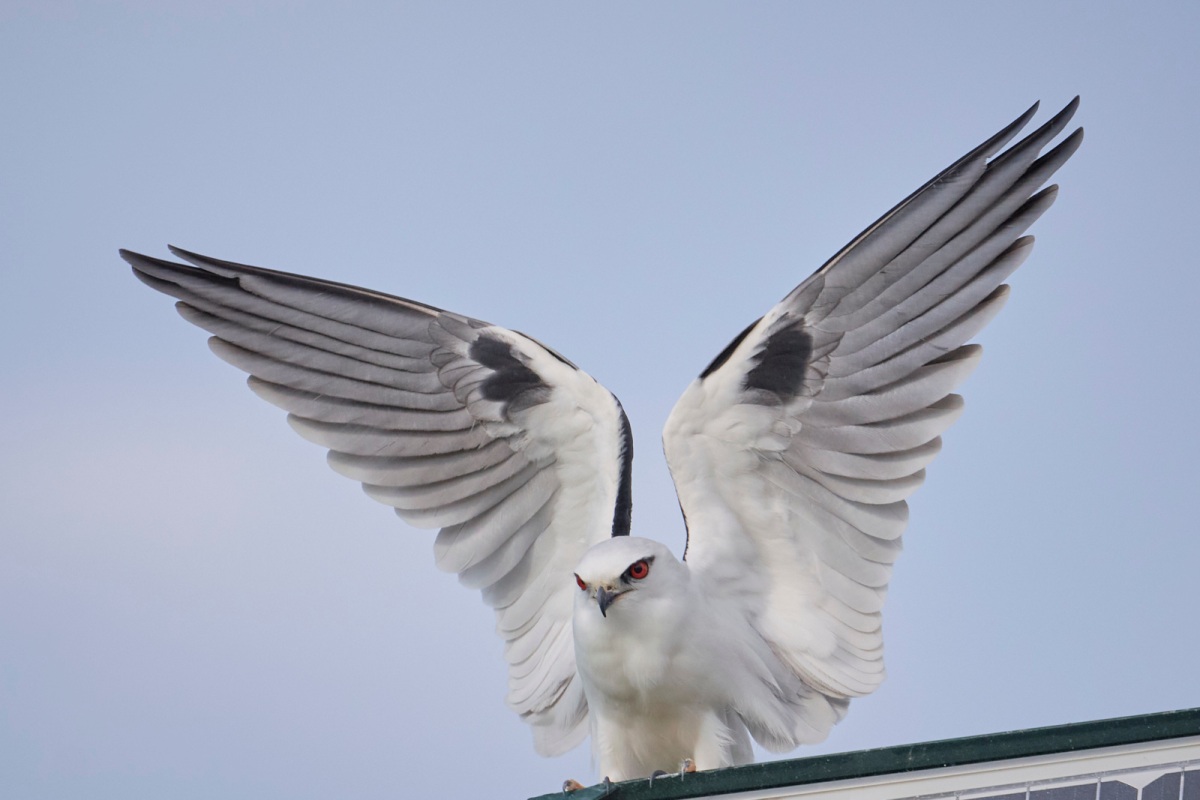
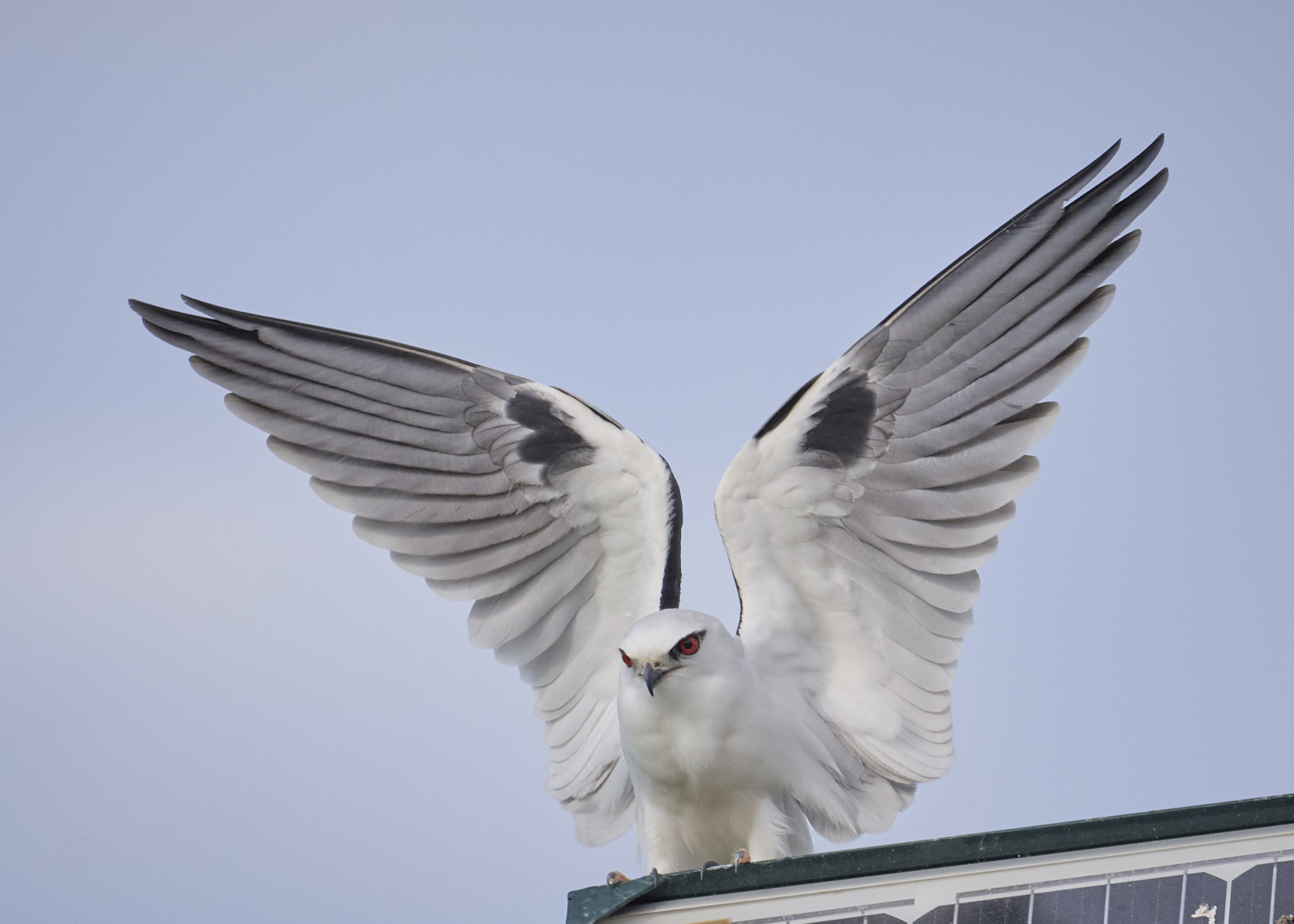
We have been a little spoilt and grateful of late as we have several territories of Black-shouldered Kites to work in. One pair are mere juveniles, still finding their way. One is a long term bonded pair, readying perhaps to nest when the conditions are right. Several others are, I suspect, just wintering over because the food sources are plentiful.
This one has claimed a roadside solar panel set as its perching preference.
Enjoy, and keep Seeing. There is so much to see. 🙂
Sounds ominous doesn’t it. (Part #01). What started off as a quick small post, rapidly grew to be a treatise, and despite the best editing efforts, it still seemed to loom somewhere between “Romeo and Juliet” and “War and Peace”.
Easy squeezy. We’ll have a couple of them.
Ever since the days when Nicéphore Niépce made the first photograph, back in 1826, (and as it turns there is all sorts of disputes about who, when, where, but—Nicéphore is still my man!) exposure has been a hot topic for photographers. Poor old Nicéphore had to expose his image for about 8 Hours. (no record that I can find tells of the f/stop used). Here is an interesting link to view the result. I guess the one thing he didn’t have trouble with was getting shadow detail, as the sun moved over the buildings the shadows were bathed in sunlight at some point. How easy is that. It should also be noted, and I’m sure it’s obvious, Nicéphore did not make bird inflight his first experiment. 🙂
Since then the conversations have always been, “So what exposure settings do you use?” In the forlorn hope of finding just the right way to make every exposure perfect.
A couple of emails from a blog I follow, by Tony Whitehead from New Zealand touched on the subject in some detail, so I’l not clutter up the web by repeating it.
For those that follow the “Expose to the Right” ETTR model, Tony’s explanations are about as succinct as you can get.
The concept of ETTR was first brought to light (pun intended) by Thomas Knoll, (he of the creator of Photoshop and Camera Raw decoder), and Michael Reichmann (the creator/owner of Luminous Landscapers website) while they were on a photo-tour of Iceland in 2003 Interested? See here. The concept as Tony outlines is that about half of the exposure detail is in the brightest stop on the righthand side of the histogram —Please bear in mind that when Thomas and Michael built this model, most digital cameras had at best about a 5 stop dynamic range.
Fast forward to the present, and we find people making images that seem almost to the point of overexposed and then sliding sliders in the White, and Highlight ares of their chosen software package to bring back the details in those white areas of the subject. In my case, the bird.
And now that AI is being built into products such as Topaz Photo AI and DXO Photolab and their PureRaw, and more recently from Gentleman Coders, Nitro. the need for ‘correct exposure’ is going to become a very “Fuzzy” (computer speak there), term.
The one thing that does, however need to be remembered is no matter how clever the software, no matter how many sliders, or layers are used, nor how the exposure was determined, the one constant in all this,
Is, How much light was falling on the subject at the time of the exposure. As Engineer Scotty, says to Captain Kirk of the Enterprise, in the TV series, “Starwars”, “Ye cannae change the laws of physics Jim!”
Which seems like a good time to move on to the photo of the week. 🙂
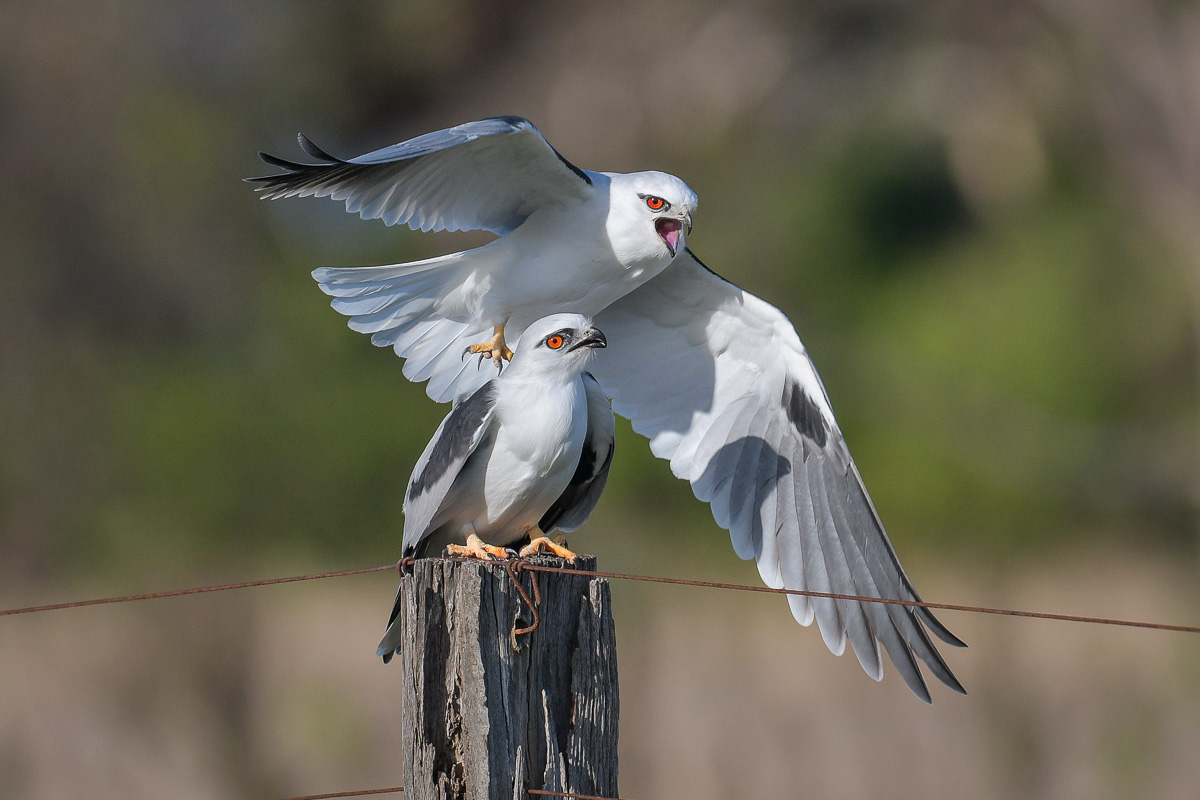
This pair are back together again. He had been waiting patiently for about 6 weeks or more, as she had disappeared from the paddock. I was almost convinced she had moved on to a new territory as normally she only takes a few weeks break after the young fledge. He had resolutely stayed.
When I saw this happening, I initially thought she had encouraged him to mate, but she didn’t react—note her tail tucked securely against the fence post So I think, he might have been hoping she would move off the post, and he could pick up any scraps that were left over from her previous meal. She had caught and consumed a rat (ratus ratus). A much larger meal than the usual mouse and at one point I though she might choke getting it down. She didn’t accept his proposal, nor did she lift off to give him access to the post. Marital bliss in Black-shouldered Kite land.
1/3000th of a second, f/6.7 at ISO 400. Nicéphore would be impressed
“Life,” said Helen Keller, “is either a daring adventure, or it is nothing.”
Picasso is reported to have said, when asked if he knew what his painting would look like before he even put paint on the canvas, replied, “No, of course not. If I knew, then I wouldn’t bother doing it.”
David DuChemin, recently wrote, “You don’t have to photograph bears, or climb mountains, or hang out of helicopters. You don’t have to go, “On on an adventure”, to make great photographs. But, I think, making great photographs should be an adventure.”
Winnie the Pooh says, “Going on an Expotition?” said Pooh eagerly. “I don’t think I’ve ever been on one of those. Where are we going to on this Expotition?” and
Sing Ho! for the life of a Bear!
Sing Ho! for the life of a Bear!
I don't much mind if it rains or snows
Tis a known fact this blog does not do, ‘Tips and Tricks’, ‘How-to tutorials’, attention grabbing product reviews, nor influencer opinions for more hits and ‘followers’.
We just do photography, and the enjoyment of both birds and the act of photographing them. The journey is never-ending and nor would I, and I’m guessing, you, want it to be. If you’re battling with shutter or aperture priority, or should I use manual (wait for next week’s blog) or what is Auto ISO, or does EV really do anything, then join in with the rest of us. We all struggle with Light, with Composition, with Camera Settings and with finding the right bird—or subject— just to show I’m not biased :-).
Did you ever walk out and say, “Oh, Wow, this light is so nice!” It takes more than appreciation to be able to understand what you like about it. The angle, the intensity, the direction, the overall quality, and how it might add, or not to the subject. I might lament on the days when the sky is porridge and the exposure drops by 5 stops to normal days, and the grey birds become lost in the grey surrounds, but, by looking, experimenting and exploring, there may be a mood to capture.
A word that has come up recently to be a catchall for those varying elements is “Amplify”. The mood, the choices we make for camera, angle and framing all bring their own special character to our photos.
We don’t want people to view the end result, and think about what ISO, Shutter, Aperture, Focal length, or camera brand we used. Nor to spend time interpreting the way the light works, the emphasis on texture, or tone, or shape, or any of the other language of light principles. Nor do we want them pondering the hours spent in the Digital Darkroom enhancing the pixel values. Hopefully, they see the result and connect with the subject.
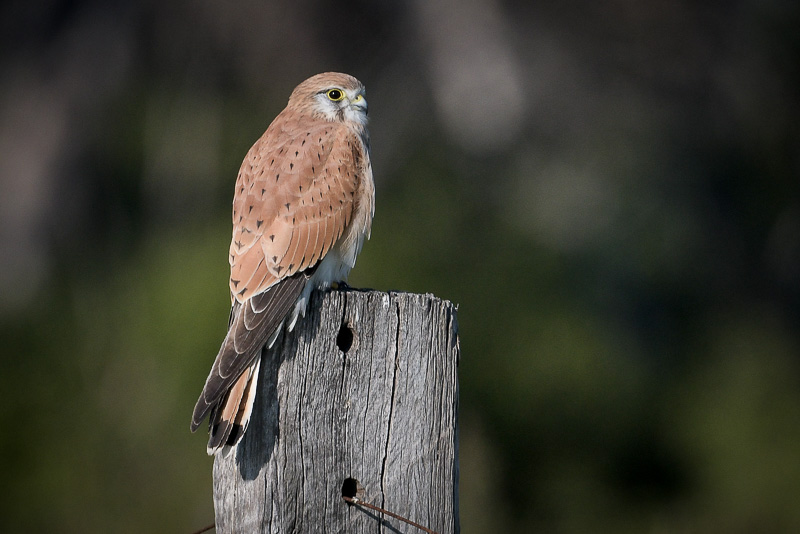
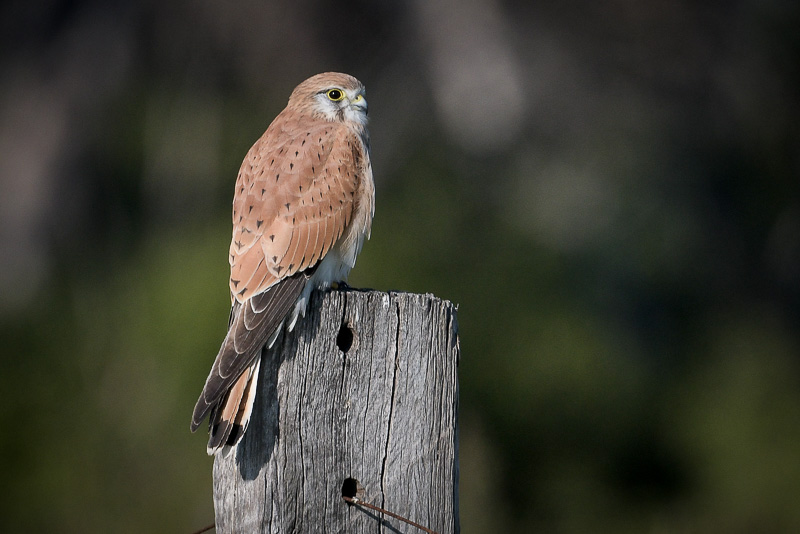
I love Kestrels. Of all the raptors, Kestrels are my heart-tugging favourite. They seem to have such ‘sweet faces’ compared to other raptors. We are photographers of the open paddocks and plains. We rarely venture these days into the amazing rich forests, to explore and search among the myriad bushes, ferns and overhanging branches. And Because of that, we see many of the great birds of the wide open areas. Kestrels, Kites, Harriers, Eagles, Goshawks, and occasionally on the beach areas, Sea-eagles.
But of all of them, my heart is set on Kestrels. So it was a great delight to drive down a farm paddock track, and find this lass sitting enjoying the morning sunshine. She was in no hurry to leave and nor was I. Lost were the technicalities of photography. Found was the enjoyment of experiencing a small moment in this bird’s life.
A couple of my (now diminishing) group of working photographers was sitting round a table the other day, as we occasionally do. Discussions rarely move away from something photographic, as you’d expect. One question that always comes up. “Whatchaworknon”? It used to be the catch-cry many years ago, but sadly, I think, we have pretty much accepted status quo, and just work away at what we are familiar with. The cool part of the “What” is ideas often cross-pollinate, or someone has been trying out this or that technique and their insights perhaps help problem solve.
Anyway, as it turned out, the big topic of the day was High Key portraits and Food photography -or product photography, in general.
High Key gives that ‘breathless ‘ feel of bright, light and energetic. It is at one level, a particularly challenging mode. The whites have to stay white, the mid-tones need to go to the lighter end, the shadows need to have a lovely pliable mellowness to them, bordering on the translucent. Or as someone once said, “Diaphanous” Bet that sent you to Uncle google.
And. It’s all about the light, and for us studio/product photographers with a grand studio, plenty of available light (as in every light available) it can be wonderful to work against one of those curved, endless horizon Cyclorama walls, or (cheaper) white fabric or backdrop. I used to know a photographer who specialised in promo work for vehicle manufacturers. He converted an old warehouse into a huge Cyc wall so that even a prime-mover could fit in through the roller door, directly on to the set. As an aside, he had to repaint the floor after each shoot to remove the tire tracks.:-)
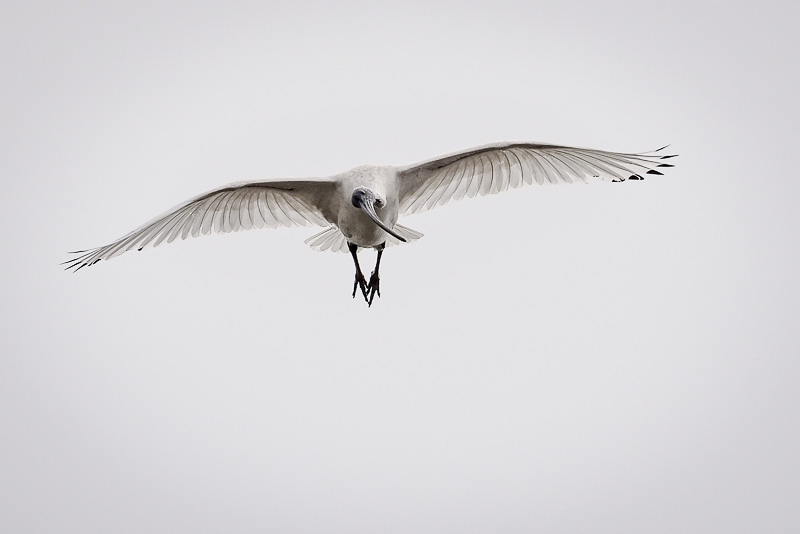
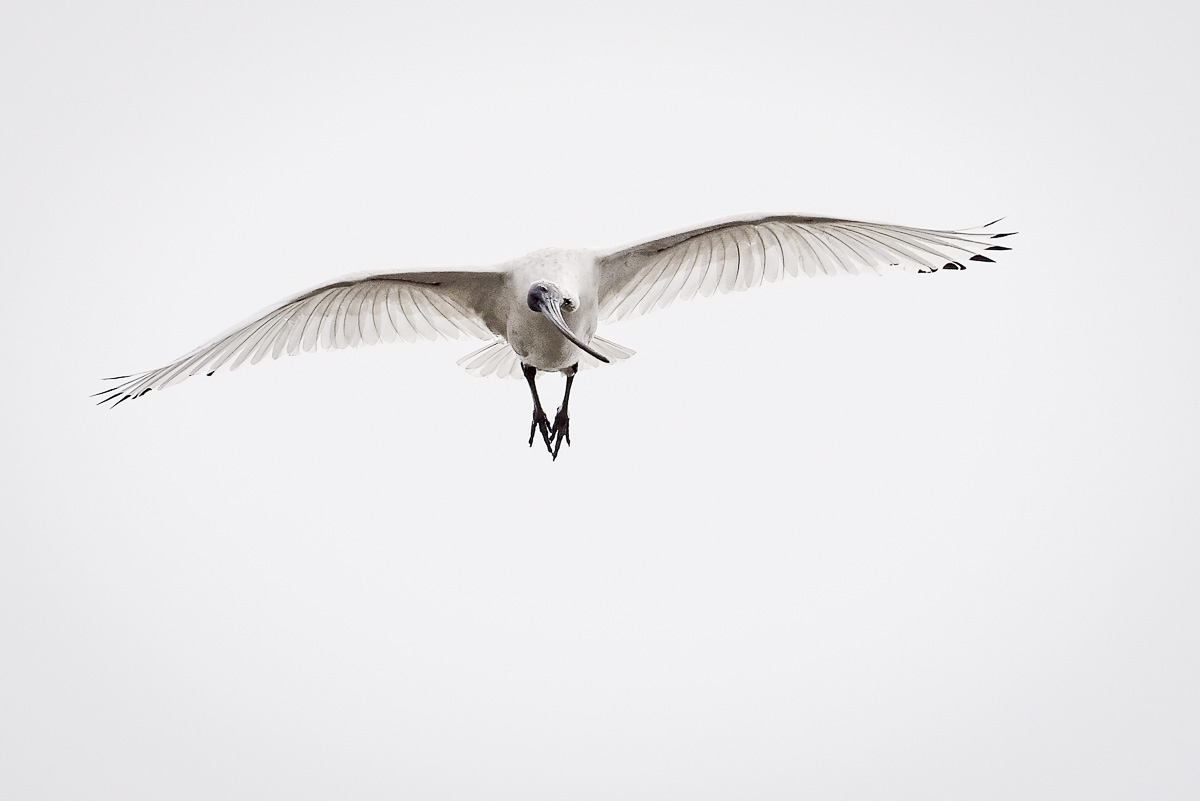
But, for birds, well, we get it for free. Just ask anyone who’s been out lately in the foggy overcast atmospherics, that we euphemistically call, ‘weather’. Now the challenge is white bird on white backdrop. Hard to get the right exposure, and even harder to keep just enough form, shape and texture detail to prevent the feathers disappearing into the backdrop. Easier to sit around a table, with a coffee at Gerry’s and talk about highkey.
I love Ibis. I know they get a bad rap from the press. But as a young kid roaming the irrigation channels of the river country, Ibis were everywhere, and never seemed to be a problem in the town. Perhaps the human condition of disposing of everything unwanted has been the real cause and not the bird’s need to find a meal.
This one swept into a small pondage where we were looking for Grebes. It’s hard to explain the whiffling motion as they work out the suitable landing spot.
This one really wanted to get the best view of the pond.













 Birds as Poetry —— Just because I WANDER doesn't mean I'm LOST