Goschen Diary Day #2

My mate, Mr An Onymous and his family had also travelled up for the week and we met up and chatted over a few cold sherbets as to a plan for the following day.

Seeing as there were a few pressing family events that needed attention, and because it was going to be a hot day, we decided an early morning start at  Goschen would be the go.  By 6:30am the car was loaded, with drinks, cameras and bodies.  We set off.  The simplest run, is to follow the sealed roads, but we opted, (well I was driving) to go out past the Airport and then pick up one of the backroads to Goschen.   From yesterday, you’ll recall that we travelled that way often on pushbikes in the sweet savour of youth.

Besides from previous years, we’d had a bit of raptor success out near out mate Steve’s place and nothing ventured…

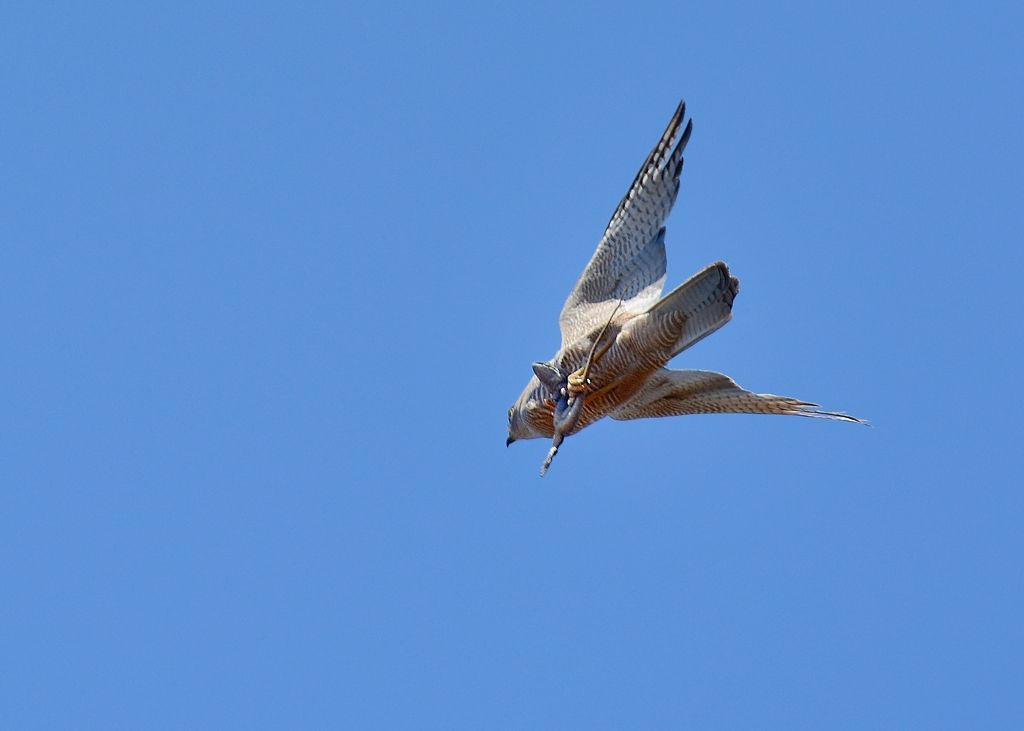
We had just turned past the airport when I spotted an Australian Kestrel, in the early morning sunshine. At this stage the sunlight was running horizontal with the ground.  “Fishfryer” lighting for the studio buffs.  Hadn’t realised, we parked on the major highway to somewhere, as the amount of cars going by was a bit awkward both from parking and photographing points of view.  Mr An, got busy, while I tried to park the car off the roadway.  No mean feat on a  tiny country road, built for tractors and harvesting toys.

I’d also been ‘clever’ enough to attach a TC1.7 to the 300mm to ‘save’ time, and now was having trouble handholding the 500mm resultant lens.  In the end, either because of boredom with the game, or because it saw prey, the Kestrel departed, and we moved on to Goschen.

Mostly the pictures tell the rest of the story.  A huge flowering gum near the old tennis court played host to a variety of honeyeaters, and we spent quite  a bit of time just enjoying their antics.

Then back on to the main road and a detour to the Little Murray Weir.  Another of my childhood pastimes.  Last year we’d been lucky and got some great shots  of a Sacred Kingfisher on a wire here, and to both our surprises, as we stopped the car, a blue flash went by and there on the wire was.   A Sacred Kingfisher.  How do you account for that bit of co-incidence.

On the way back to the main road, I saw a number of small birds dive into a box-thorn bush, and slowed, then stopped. Look as I might, I couldn’t see any, and Mr An was getting coffeitis by then, until.  Out from the tree behind the bush, rose a beautiful Wedge-tailed Eagle, before I could say, “Did you see the Wedget…..”  He was out of the car and had the first 6 shots off.   It took a circuit round the paddock, located a thermal, and before you could say, “It’s found a thermal’, the black and brown bird had  risen on those wonderful wings to an amazing height.
Suitably impressed we retired for coffee.

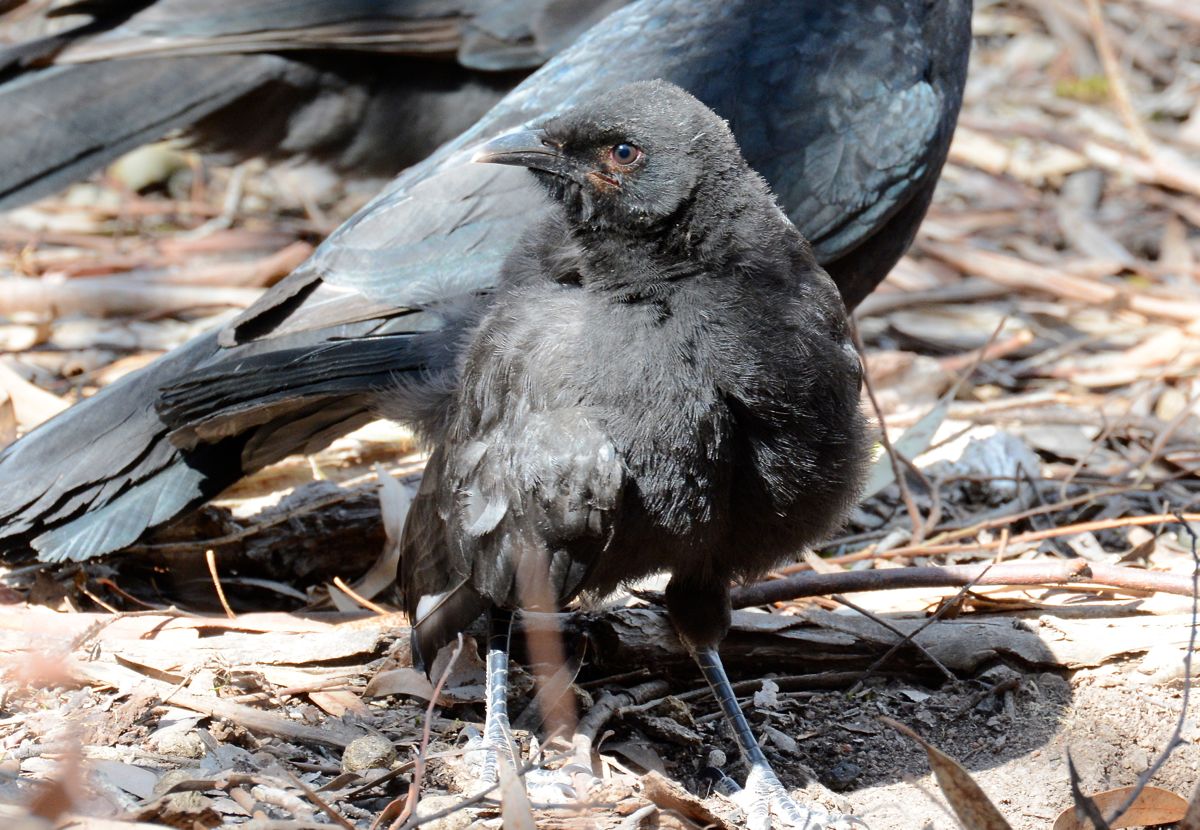
Every one gets up early.  Australian Kestrel, female, in the first shafts of morning light.
Every one gets up early. Australian Kestrel, female, in the first shafts of morning light.
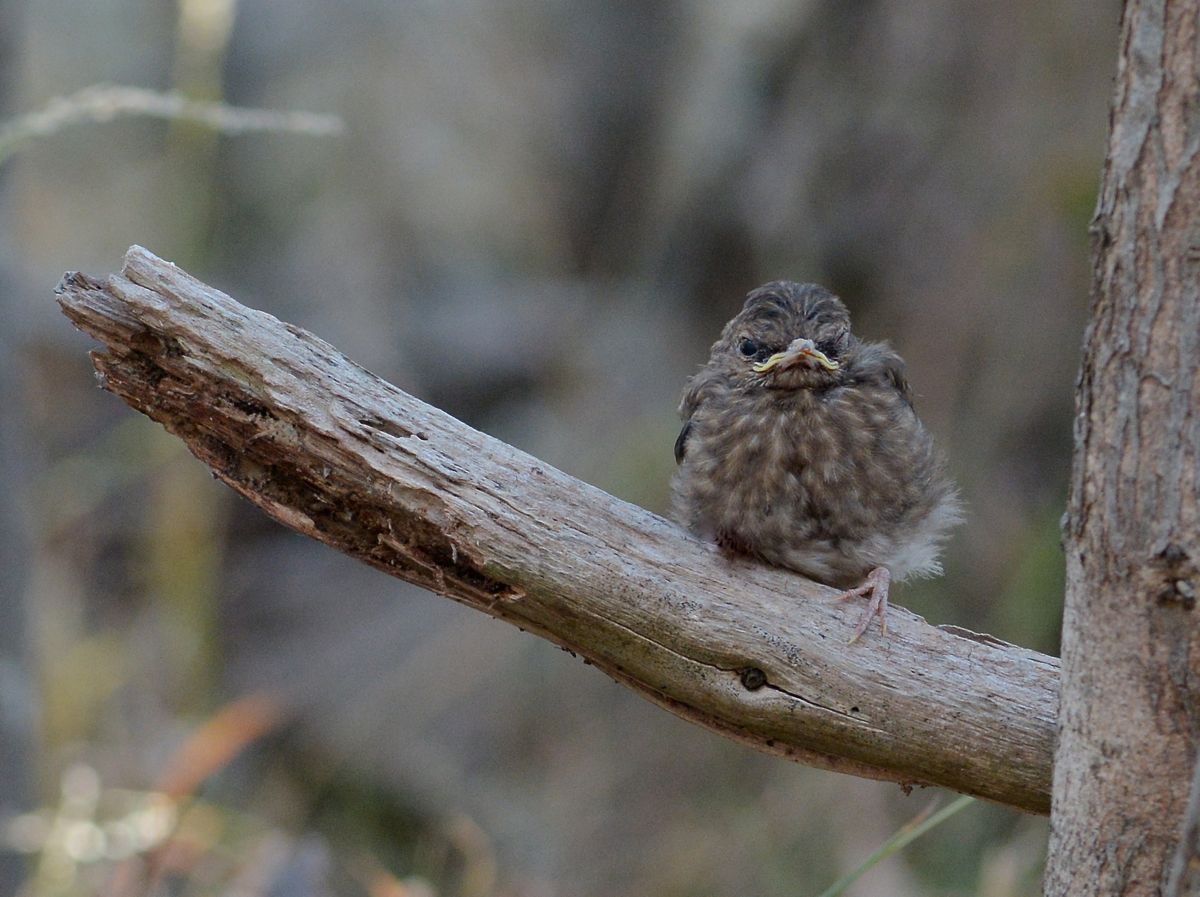
Juvenile Black Honeyeater
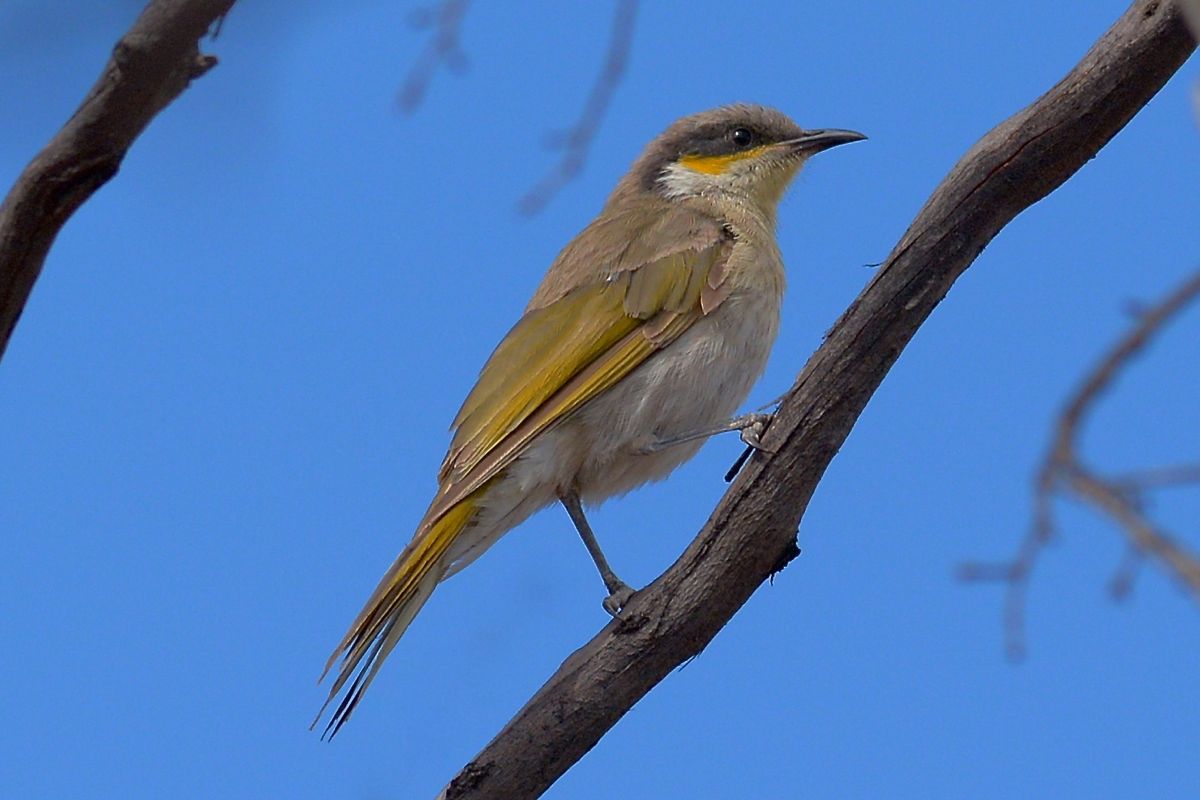
Singing Honeyeater. Another Zorro Bird
Singing Honeyeater.
Another Zorro Bird
Tiny red wattle behind the eye on a White-fronted Honeyeater.  Most limey a nomad to the area.
Tiny red wattle behind the eye on a White-fronted Honeyeater. Most likely a nomad to the area.
A Red-rumped Parrot in flight.
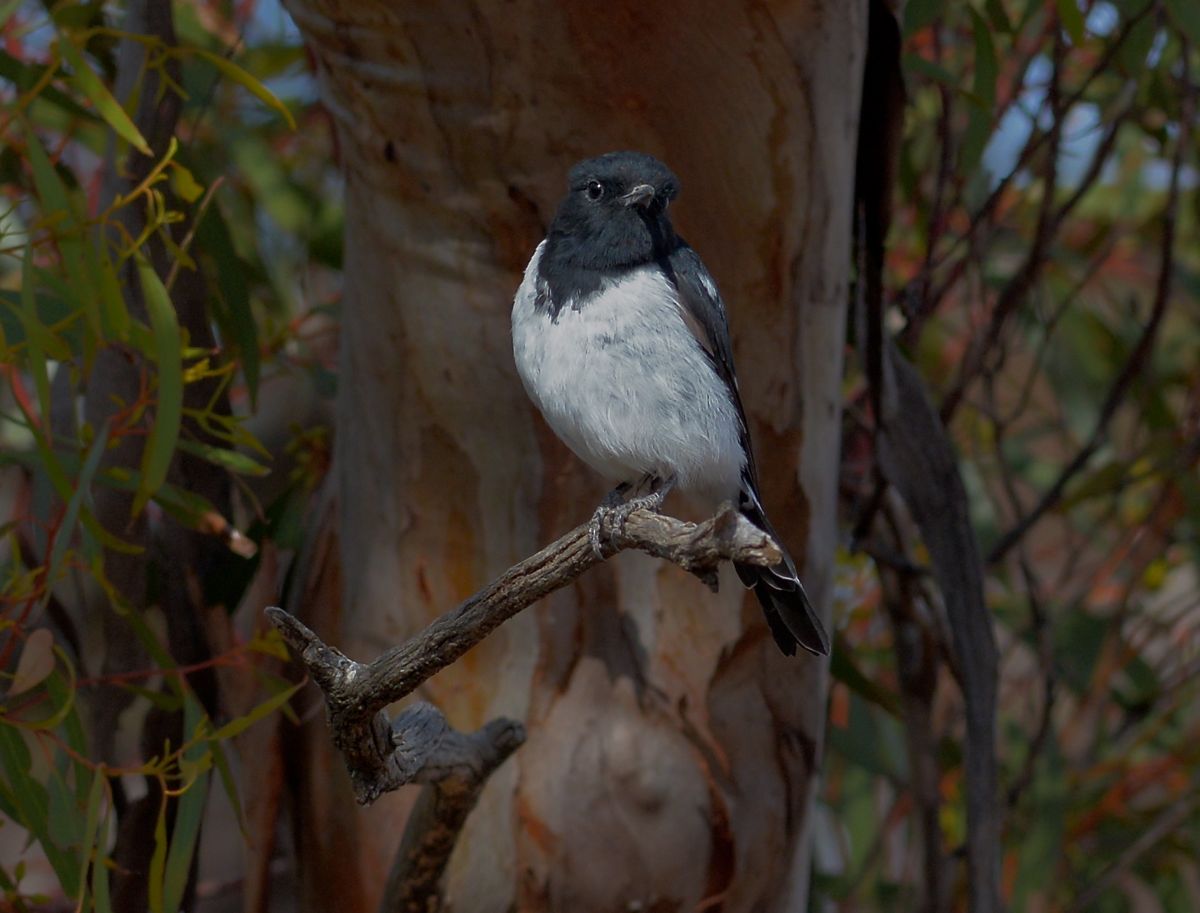
Mr Hooded Robin. A pleasure to photograph
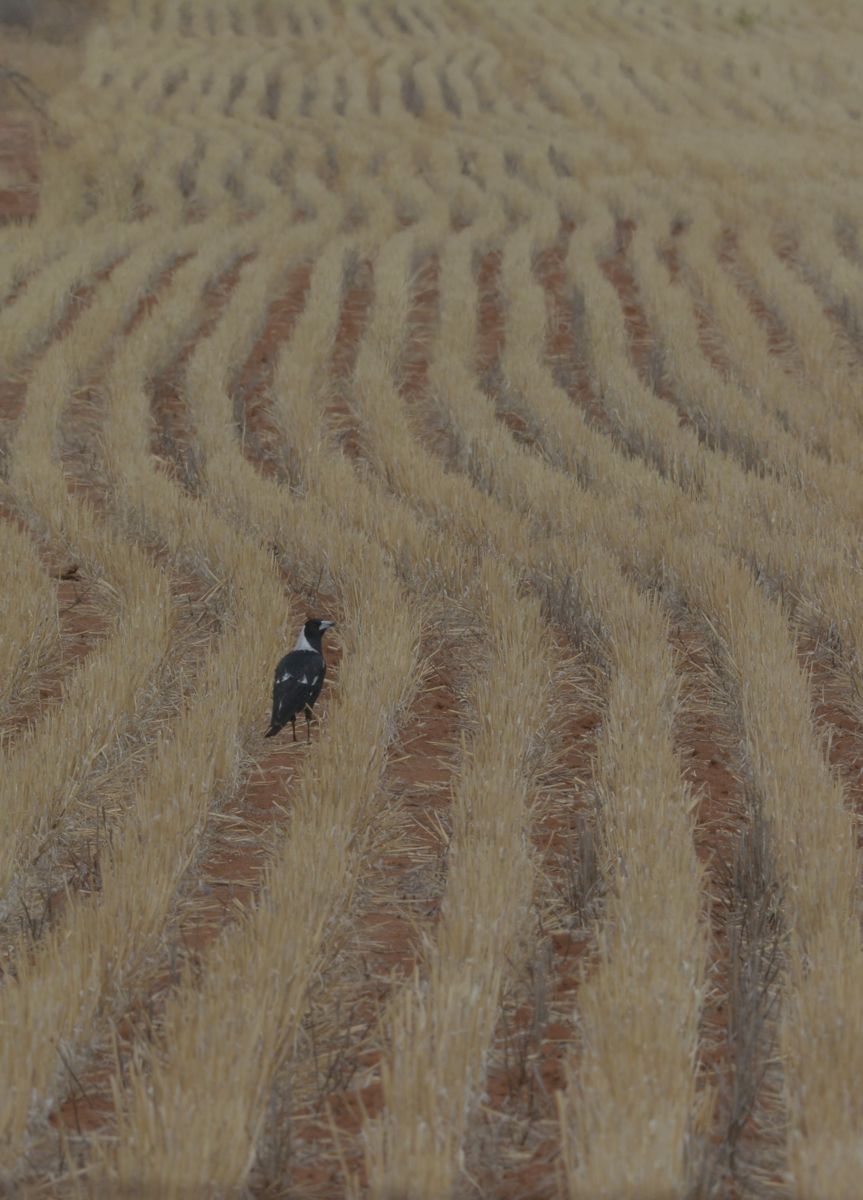
Long rows of harvested wheat leave interesting patterns. Only a Magpie can work them out.
One year, two year.  Same bird, same wire, same photographer.
One year, two year. Same bird, same wire, same photographer.
Wedge-tailed Eagle looking for a thermal.

Counting at Mt Rothwell

One of the nice new pleasures we get from being in the area is to catch up with the Werribee Wagtails birding group.
They have a number of projects for bird counting and one them is at Mt Rothwell.

So we followed the roads out the back of Little River and met up with the eager bird counters.
Mt Rothwell is near the excellent You Yangs and is a fully enclosed area so there are some heavy duty gates to get through before the serious counting begins.

On this day, however there was a wonderful strong breeze at work, and it was the first really cool day after the heat so the big birds were up in numbers all looking to catchup on their dietary requirements.

The area also has a very strong educational programme and there are some great walking tracks covering the area which is mostly light scrub, trees and some great rolling hills with lots of boulders and rocky outcrops.

So we set off. I got side tracked by a Striated Pardalote, and spent about 10 minutes photographing it, and by the time I’d gotten back on the track. Well, the count and counters had moved on.  Easy enough, just go along the track thought I.  Till I came to a Y in the road.  Always take the ‘right’ one is the advice I’ve worked with over the years.  Not always good advice and in this case dead wrong.  After about 10 minutes I came to an open field and looking along the track not a counter to be seen. Wrong track I thought. So a bit of bush bashing got me across to the ‘right’ left track, and no sign of said counters.
After a bit of scouting about, I found that Arthur had left an “Arrow” of sticks at the next junction, and from there it was walk fast until I caught up.  But, the track swept around to the right, and I figured the track had to sweep back again. Remember its a fenced off area.  Easy said I.  Over the top of the rise in front of me, stand on the top of a rock and they should be visible.  So saying I did.  And.  Yep, there they were way over there.  More scrub work.

Needless to say EE was not to happy with my tardiness, and I think I got a black mark on my name from the walk leader who was getting a bit concerned about having to ‘find’ said missing dude.

No more Pardalotes for me for the rest of the day.

With the strong wind running the raptors, which include, Whistling Kites, Black Kites, Brown Falcons, Little Eagles and Australian Kestrels, were in their element.  Such a great site to see so many soaring birds.  And I didn’t have to get misplaced to see them.

In the afternoon we walked the opposite side of the park and came to a large open field.  “Hmm,” said I, “I’ve been here already once earlier today!”

Hopefully I’ll be allowed back next time.

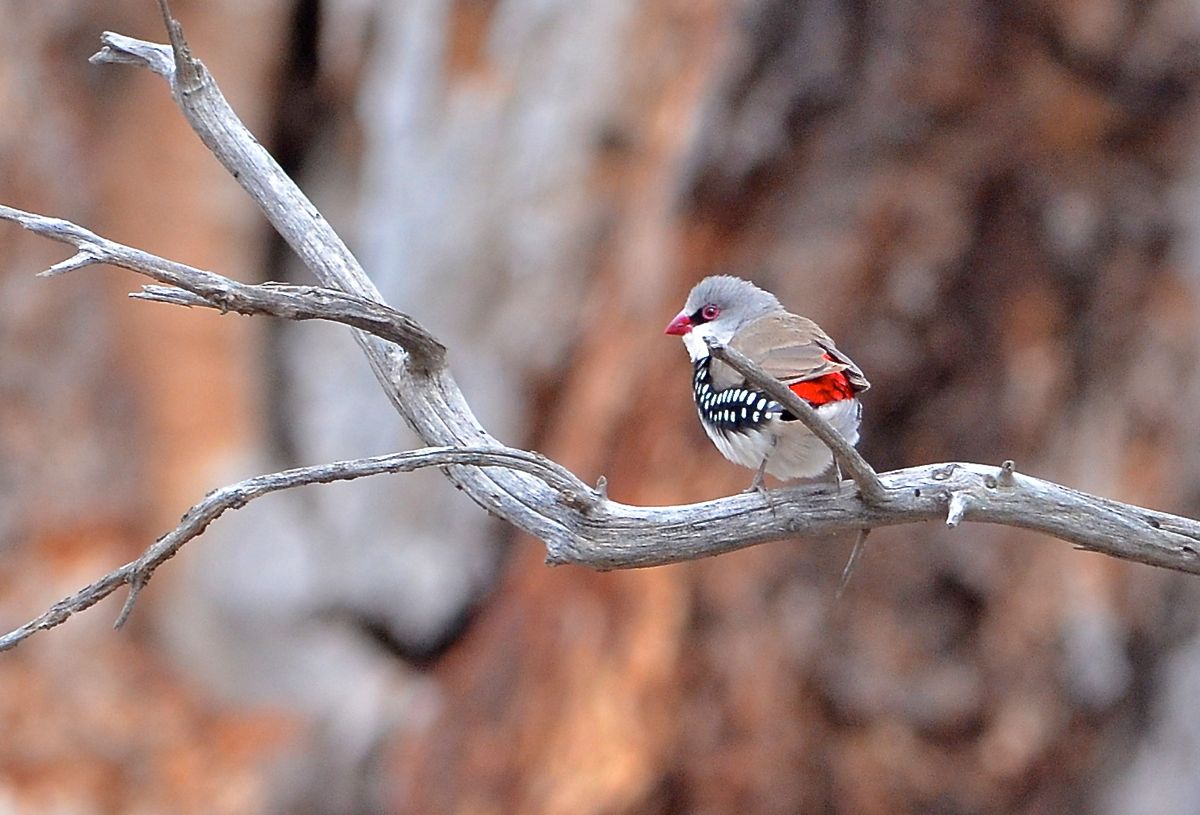
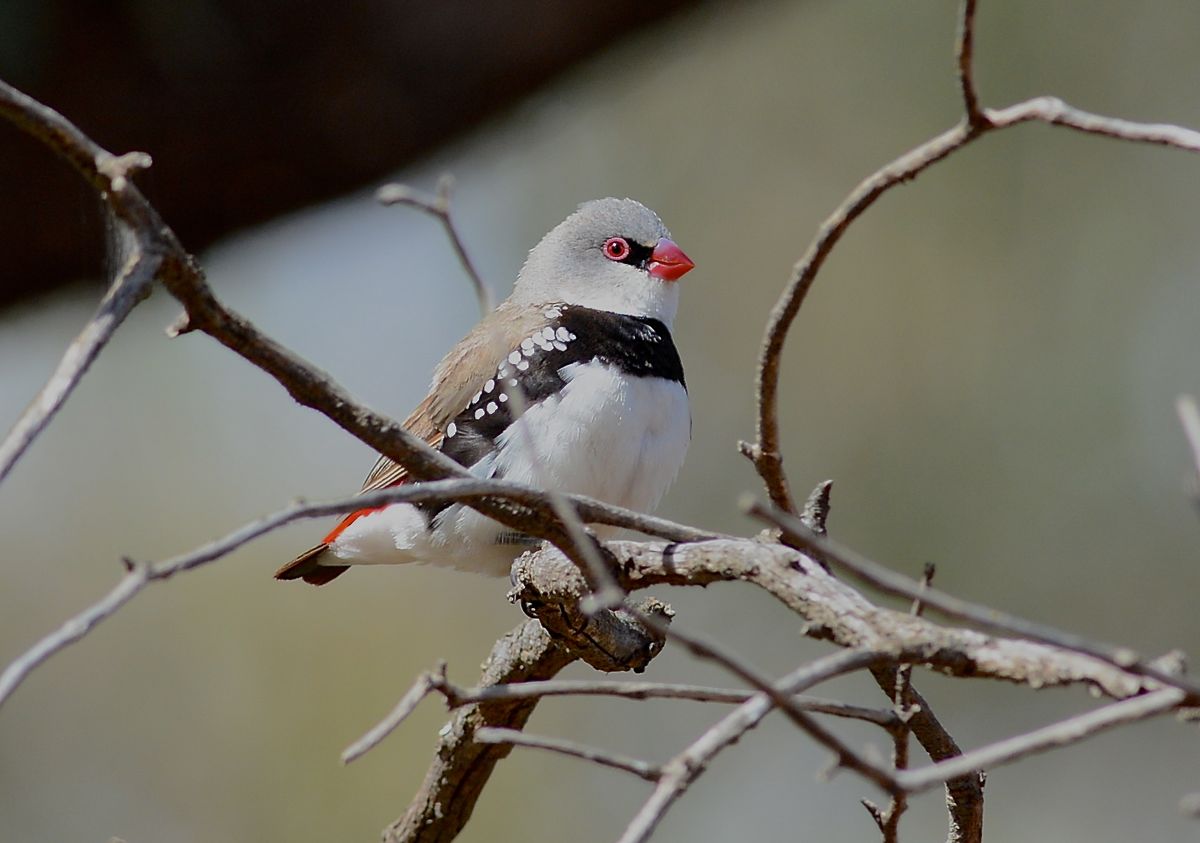
Diamond Firetail on display.
This is why they are called Diamond "Firetails"
This is why they are called Diamond “Firetails”
A Striated Pardalote. Probably at the last one I'll photograph.
A Striated Pardalote. Probably at the last one I’ll photograph.
Juvenile Red-browed Finch at a small waterhole.
How to tell the difference between a Tree Martin and two Welcome Swallows.
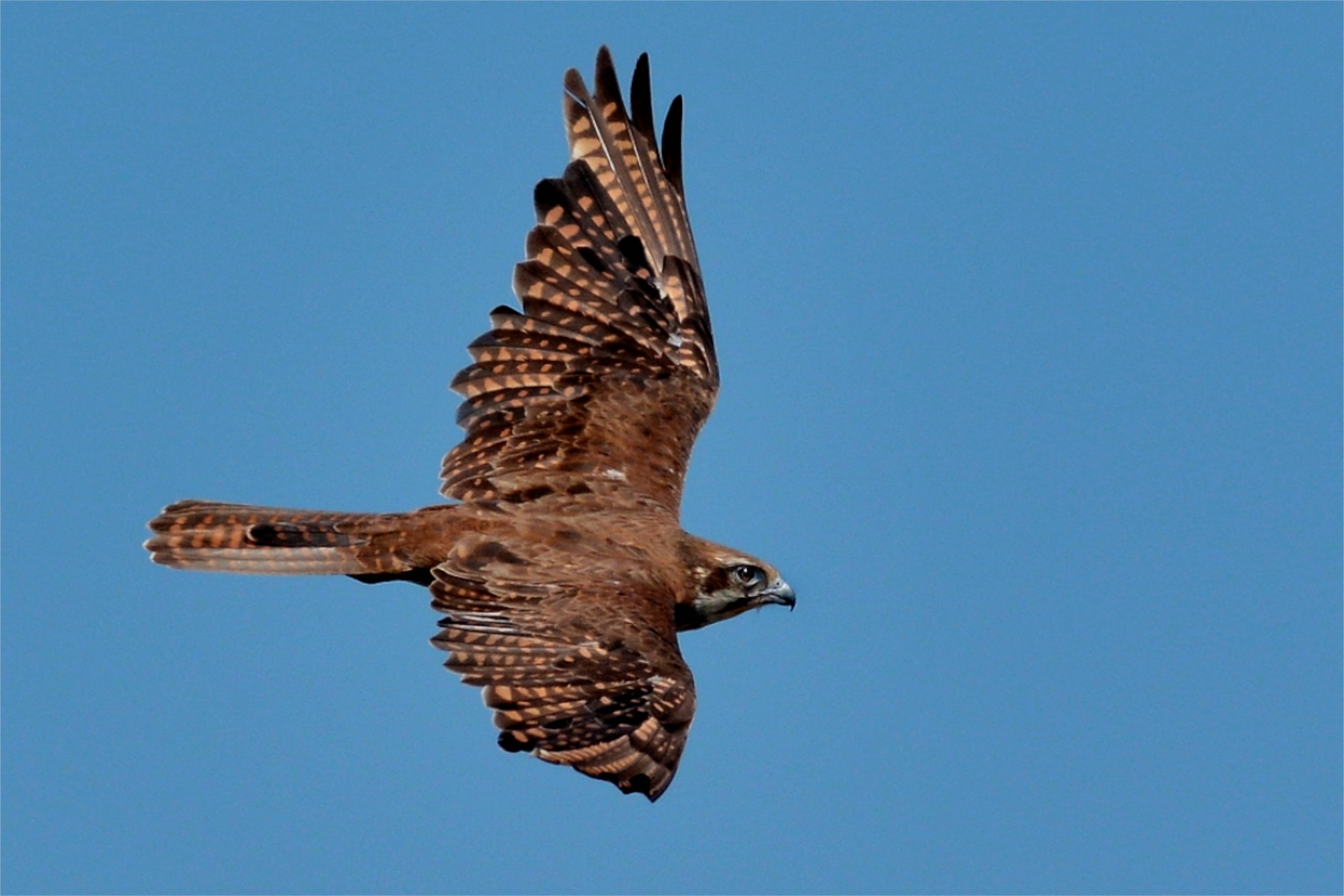
Over the tree tops at a great rate. This Brown Falcon was no doubt enjoying the strong winds
In coming
In coming
Brown Falcon on active duty

A day out with the Werribee Wagtails Group

Now that we’ve made the move, some things get a bit easier.

The Werribee Wagtails are an informal group of birders amalgamated with Birdlife Australia.  They have a monthly day out and about, and we’ve taken to tagging along.

This particular day was Jan 7th.   And the area covered included the mouth of the Werribee River at Werribee South.  Very cold in the morning with icy winds blowing over the water.  Still we managed a good range of water birds including a Red-capped Plover scampering back and forth among the seaweeds.

A truly wonderful place called “The Cliffs” at a right angle bend in K Road, opened up to wonderful vistas across the river, and a range of beautiful birds.

From there a trip to a special carpark at Werribee Mansion, and a lovely walk down to the river flats and back through the vegetable and fruit gardens on the flats.  And we found about 8-10 young Whistling Kites and a similar number of Black Kites who were working along the river.

I’d go back again just for that.

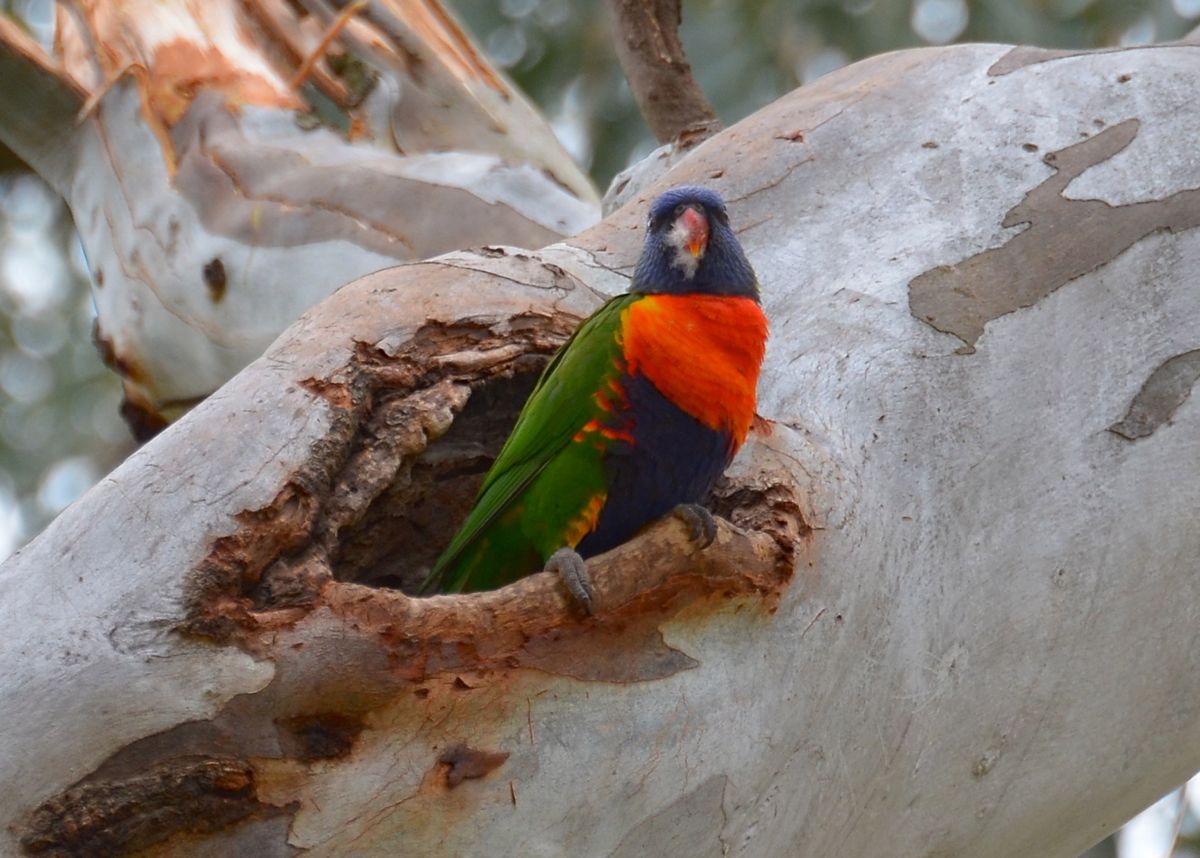
In one of the river crossing we found some Purple-headed, Musk, and Rainbow Lorikeets, one of the Rainbows appeared to have a nest.  Or was raiding someone else’s.    To top it off the “Kee, Kee Kee, kee” of a Sacred Kingfisher who sped by us with a couple of flybys.

Then on to the Cache Coffee shop and produce Store.  If you are in the area, include this great place for great food and coffee, and amazing local produce.  Another reason I’m happy we’re local.

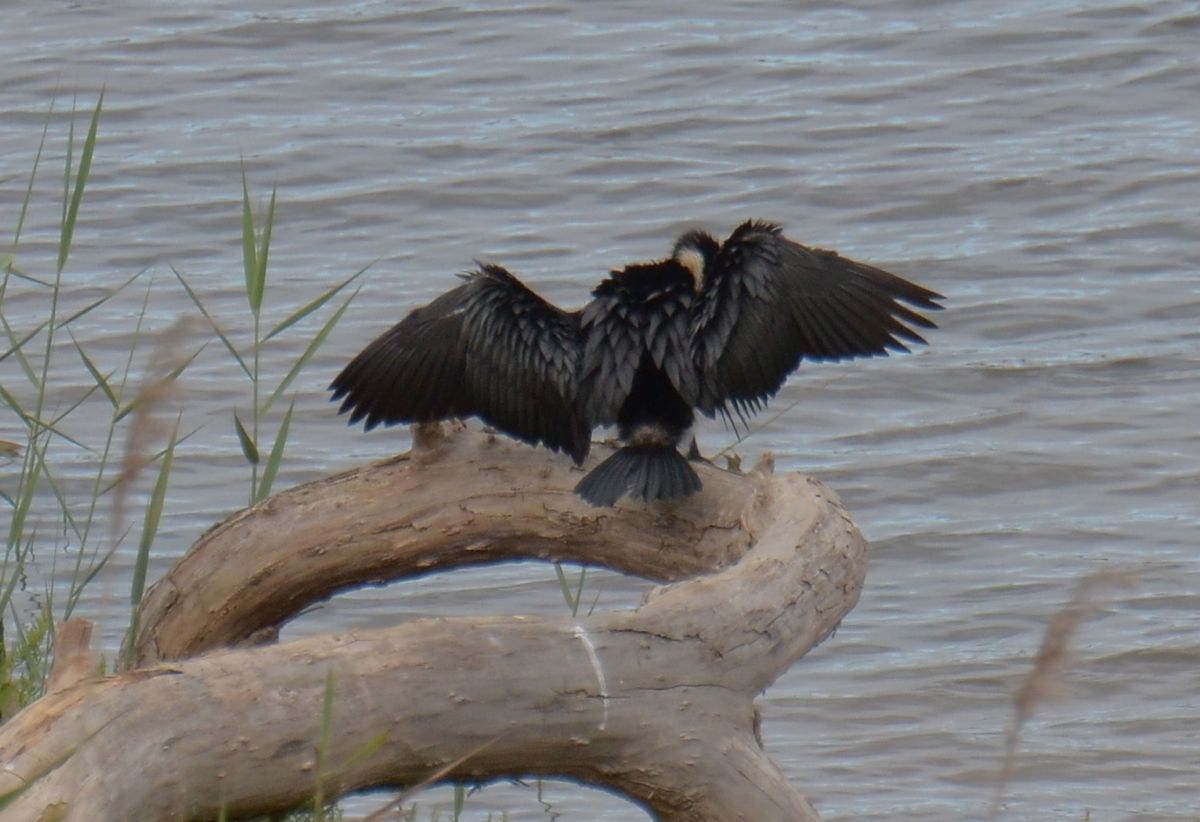
Cormorant.
Cormorant.
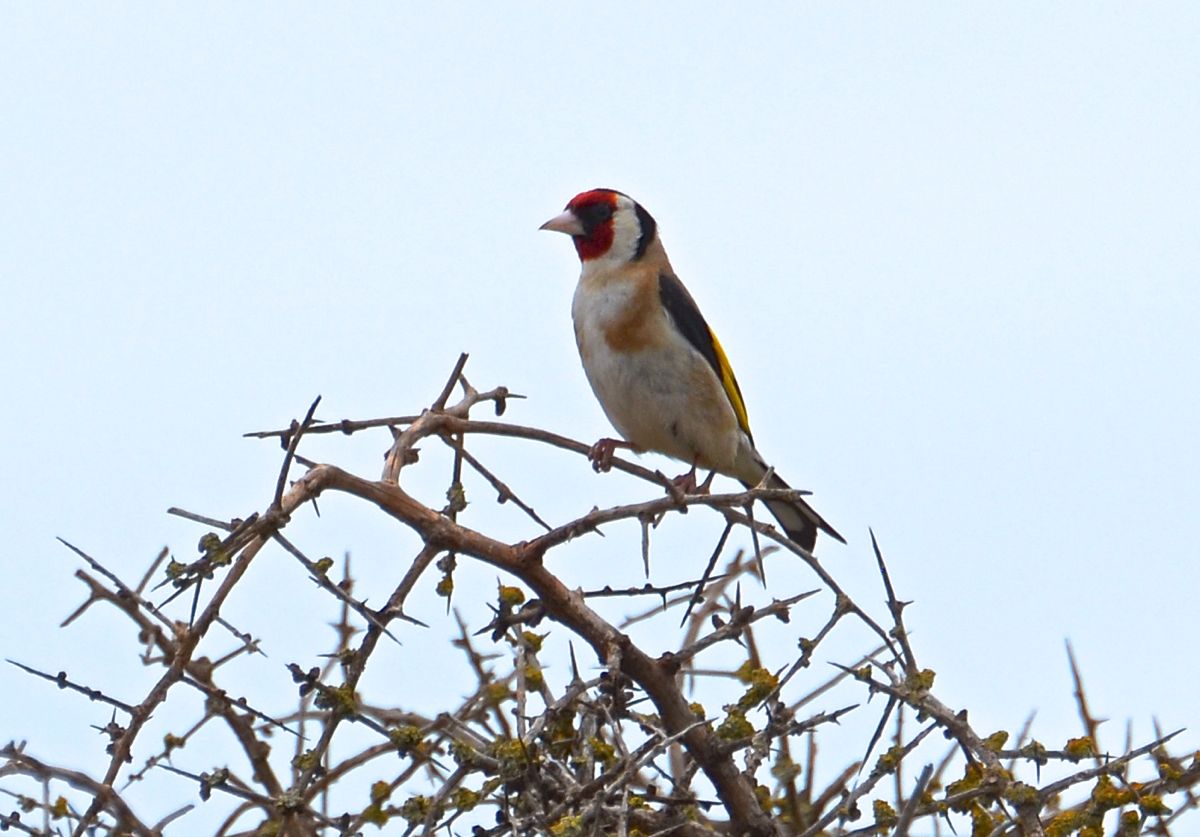
Goldfinch.
Goldfinch.
Great Eastern Egret
Great Eastern Egret
Sacred Kingfisher
Sacred Kingfisher
Rainbow Lorikeet
Rainbow Lorikeet
Black Kite
Black Kite

Raising Ginger!

Karen and Jimmy have been working hard and Ginger is making great progress.

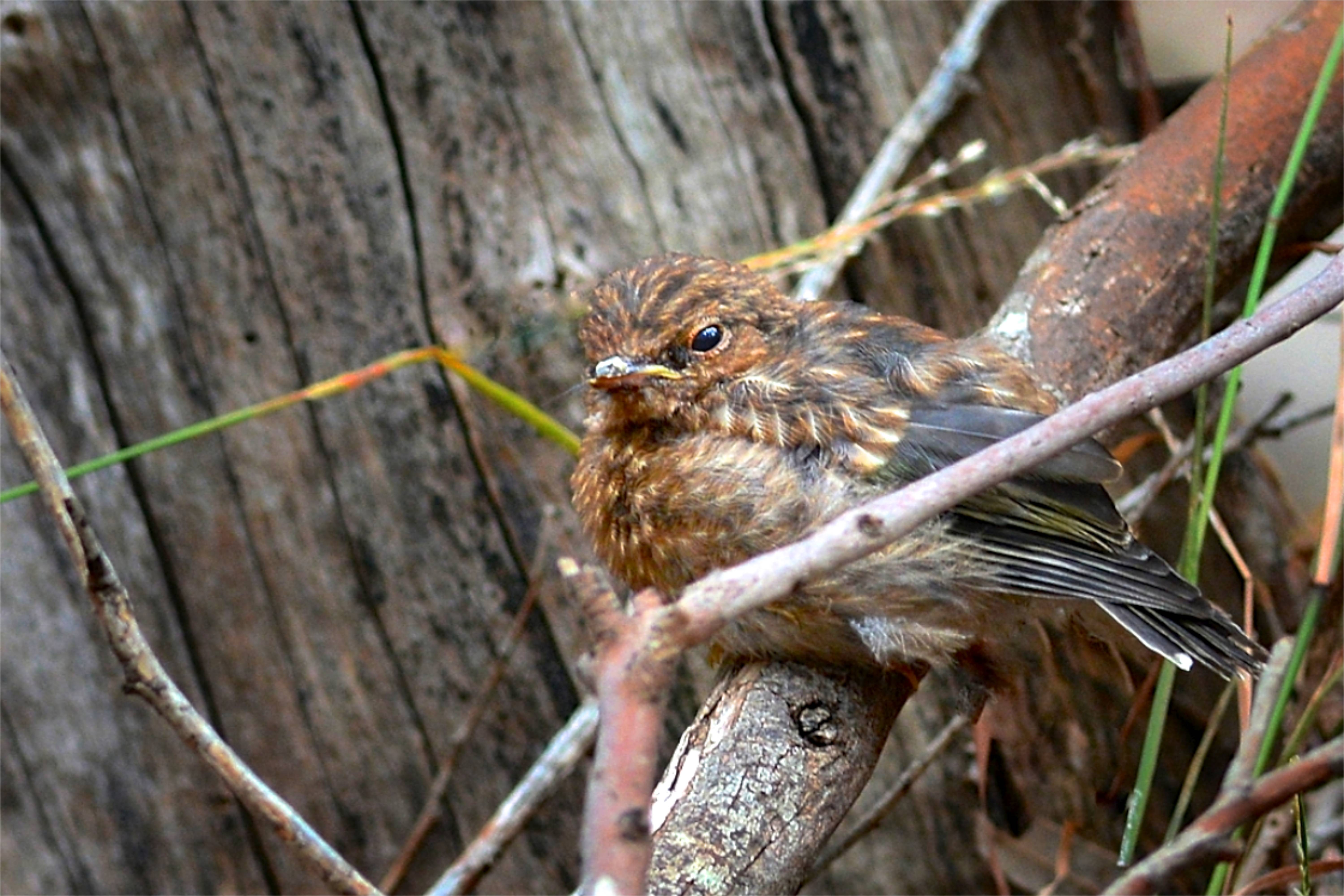
Its a bit hard to judge at what stage the little dude is, but it certainly is spending a bit more time out in the more open branches.
I spent about 10 minutes this morning, looking, knowing where it was but being unable to figure out where it was.  In the end, I noticed tucked up on a big stick, hard up on the Y of the stick and looking for all the world like it was part of the bend in the branch.

Ginger has grown a considerable tail, and is quite capable of sustained flight, and it seems to be much more on the move than previous days.  It probably zoomed across the open areas in the forest five or six times while we were there first thing today.  It doesn’t seem to do height, but not sure it needs to at this stage.

Also found it once clinging very Eastern Yellow Robin like to the side of a near vertical branch so its getting plenty of practice.

What is really exciting to see there are a number of yellow feathers making their way out under the mantle, along the tail line and under the belly. I photographed it with Jimmy today, and there is not much difference in size now.
All looking good so far.  OnyaGinger

We also haven’t seen Karen working with it for the past day or two and are pondering that another nest might be going in somewhere. She has plenty of time.
Will check next week as we’ll be up the north of the state (Think Goschen for long time readers), for the week before Oz day maaate.

Ginger is starting to colour up like an Eastern Robin.
LIttle wings that need lots of stretching.  Not the yellow colouring under the wings along the chest.
LIttle wings that need lots of stretching. Not the yellow colouring under the wings along the chest.
Jimmy and Ginger. Size comparison
Sitting pretty in the sun

Meeting Ginger

With the evening sun rapidly taking away the glorious light from the forest, I wandered over to see what was happening with Karen and Jimmy and their offspring.
With some help of general arm waving from EE, I soon located first one of the parents, and then where the little dude was holed up.

Trying ever so hard not to get to close, and yet at the same time get a reasonable view, I sat behind some small trees and waited.

And suddenly things took a turn.  Both Karen and Jimmy came down to the small bird and called in a most anxious and scolding call.  Highly vocal and active they were both trying to get the young one on the move.   I’d not seen them react like with me before, and wondered what I’d done that had bought on such nervous activity.

Casting around, I found the cause, as not only were the Robins in full cry, but so was every Wagtail, Woodswallow and Grey Shrike-thrush.
Like all good dramas, there was indeed a culprit.   A fox had wandered along the kangaroo tracks seeking no doubt an evening meal.  The birds were in full cry against it, the wagtails making a rush, and the Robins trying to get their young one to higher ground. No mean feat when it doesn’t have any flight capability, and no sense of direction and no understanding of navigation.

In the end they moved it in my direction!  So I had a few grams of brown and gold feathers jumping along sticks, bark and leaves in my general area.  Which, above  all things gave me some lovely views of the little bird in the rapidly diminishing sunlight.  And I pondered later that perhaps they saw me as a protection from said sly fox. (well its nice to dream dreams ah?)

I stood up in the end, which gave the fox a start, and then I moved toward it, and soon it was a brown blur in the distance, by the time I’d returned the young one was being encouraged to find its way up some low branches for the evening.

Now the fox would have made such short work of the little brown and gold feathers that it reminded me of the story of the Gingerbread man, and the fox tossing him in the air and “Snip Snap, went the old fox and he ate the Gingerbread Man all up”.

So I decided that “Ginger” was a good name for the little dude and that  it can indeed  grow up to fly away as fast as it can.

Plenty of feeding going on.
The late evening sunshine was just about all gone
More food.
More food.
The culprit
The culprit
Moving closer
Moving closer
Portrait time.  Good luck Ginger.
Portrait time. Good luck Ginger.

2013 in review Ah, the wonders of Blogography and statistics.

The WordPress.com stats helper monkeys prepared a 2013 annual report for this blog.

Here’s an excerpt:


The concert hall at the Sydney Opera House holds 2,700 people. This blog was viewed about 9,900 times in 2013. If it were a concert at Sydney Opera House, it would take about 4 sold-out performances for that many people to see it.

In 2013, there were 69 new posts, growing the total archive of this blog to 201 posts. There were 379pictures uploaded, taking up a total of 53 MB. That’s about a picture per day.

I also finally passed 200 blogs.  Just got to get better organised in 2014


Click here to see the complete report.

Evening run down to the Western Treatment Plant

***  Now I’ve made 200 posts in WordPress ***** Not a record, but will try to be a bit more consistent posting in 2014.

After the rain, the unpacking, the relocation, and all the attendant extra work, it was about time we had some refresh time out among the birds.

The weather people had predicted fine weather, light winds and that lovely ‘golden light’ beloved of all true landscape photographers, and the odd bird photographer or two.
Poor old Mr An Onymous had other things to attend to in the family department, so we packed up in the middle of the afternoon and headed out for the evening.  Nice now to be only a few minutes drive to the Point Wilson Road.

We went out to the Murtcaim(n) outlet along the spit.  The tide was outgoing, but there wasn’t a lot of activity.  Just two Whiskered Terns. (used to be called Marsh Terns, but after all these guys have whiskers, so Whiskered they are! – its mostly because they have white cheek feathers, so its not about whiskers at all so it seems).  They were both hunting in quite close to shore, because the tiny fish were feeding in along the outflow waters.   I soon worked out the pattern of their hunting and how they would swing down the beach about 100m and then work back to the outflow. Out, and then back down the beach again.  Set up the tripod, with the Wimberley Gimbal, and just enjoyed the antics.  The new 300mm f/2.8 works well at those distances and I soon got into a routine of the swinging and diving of the little birds.

After discovering a new found interest in Tern photography what happened next was pretty special.  Three Caspian Terns literally bolted down the beach line, crying out and looping around each other. They got to the outflow and began the most amazing performance of dance and acrobatics.  Its often easy to find them sitting basking in the sun, but the size of the wings outspread, and the speed of turn and rush at one another was just breath taking.  That it happened so close only made it all the more exhilarating.   Suddenly my interest in Tern photography skyrocketed. I’ve always appreciated the work of Rob Melone on Flickr. He has some of the best Tern pics and he seems to make it look so easy.   But now I really appreciate the work more.

See him here. http://www.flickr.com/photos/rjmelone/with/9650727418/

Next stop was the bird hide, and we found another two Whiskered Terns at work in a shallow pond.  Again once I’d figured out the pattern they seemed to repeat it, so photography was pretty exciting.

Whistling Kites and Black Kites in abundance on the road to The Borrow Pits, kept us busy as the sun began to take on its gold glow.  Looking good.

To make the day, we found a pair of White-bellied Sea-eagles down along the beach line, but they were gone before we could get close.

On the way out we found a Brown Falcon sitting in the sunshine preening and waiting.   It didn’t seem in any hurry to move on.  We were going to make a run up to Ryan’s Swamp, but stopped at the old Pumping Station.  And a Spotted Dove decided to sit on the roof ridge.  Highlighted in the golden sun against the old tiles, it was pretty much too much to ignore.  So I was working out the best way to place the bird in the frame, when it jumped.  Headed straight down the roof line in my direction.  And at the same time a Brown Falcon, claws down, came over the ridge line. It must have worked out a sneak attack strategy.  I didn’t see it coming, and EE was further around on the road way and didn’t see it coming either.  It must have low flown to get speed, then lifted straight up over the building to snatch the hapless dove.  In the case, it was a millisecond too slow, or the dove was a millisecond faster. I now had a viewfinder filled with Brown Falcon, but by the time I’d pressed the shutter, it had already raised the claws and was looking for an exit strategy.  I wonder if I’d not been there would it have pursed the dove.

Within about 15 seconds I’d regained my composure, the flacon was 100m away, and… The dove calmly landed back on the ridge line and proceeded to preen in the evening sunshine!

Not a bad way to spend a evening.

Brown Falcon in the afternoon light on The Spit.
Whiskered Tern
Whiskered Tern
Got one.   A profitable strike
Got one. A profitable strike
Three Caspian Terns out for a day's play.
Three Caspian Terns out for a day’s play.
Close enough for a closeup
Whistling Kite touchdown.
Whiskered Tern hunting on a small pool.
Too far, too dark, too late.  Still its a White-bellied Sea-eagle, with food.
Too far, too dark, too late. Still its a White-bellied Sea-eagle, with food.
Preening in the burnishing light. Brown Falcon unconcerned by our presence

Day out at the Art Centre

From time to time the Victorian National Gallery has some great photographic work on display.

Currently they are showing work from Edward Steichen.  http://www.ngv.vic.gov.au/whats-on/exhibitions/exhibitions/edward-steichen-and-art-deco-fashion

Famous for his years of work as fashion photographer for Vanity Fair and Vogue.  It might be said that he and the magazines  changed both the way fashion consumed and fashion sets the pace.  Steichen’s work certainly opened up new vistas for the up and coming dressers of the 20s, 30s and 40s.

So Mr An Onymous and I took the pilgrimage.   Now, its true that we’ve moved house recently, so I got the added adventure of a bus trip (with formula one racing driver, Sebastian Vettel in disguise) Made it to the Werribee Rail Station in what can only be described as World Record Time, and still had a couple of minutes to wait of the Early train. Good work Seb.

An was awaiting at Newport Station so we journeyed in for a day of photographic excellence.  Both armed with FZ200 Pannys.  No one can say we aren’t Individuals.

The Edward Steichen Exhibition is quite amazing.   The prints are probably contact prints from the 8 x 10 inch sheets he would have used.  There is a short video dub of an old ‘movie tone’ style news report on his work, and it shows the high Energy he pumped into a even a simple shoot.    He worked a lot with models who were movie stars of the time.  Now if you’ve watched the odd (and some of them are very odd) old pre-talkie movie, most of the actresses of the time were, well, dumpy.  Perhaps a little on the plump side,  or as might be said. “Dowdy”.    Steichen and Vogue set about to change that look.  He preferred to work with dancers. Lithe slim creatures who not only could stand around, but could drape over sets, and allow clothes to look stylish.  It becomes obvious as you sees the dates change that his styles both of work and interpretation change.  From very over elegant, opulent is the word, interiors to quite simple out door settings, boat trips, and the horse race track,  become the norm.  All places that his audience would be seen or would want to be seen.  And the clothes changed to reflect that ‘outdoor’ look.    There is also quite a large collection of dresses and clothing on display and again its possible to track how those styles change.

One of  the big leaps is the single piece bathing cossie for the swimming conscious.   No longer the baggy unsightly, but bold and streamlined.  Easily able to appeal to the fashion conscious.

While this exhibition features his work from the Fashion industry, and the images appear to be owned by the publisher of Vogue, Vanity Fair, Steichen was also in demand as a portrait photographer.  Some of these too are on display.   One famous work that is not there is the risqué bordering on sensual picture he made of dancer Therese Duncan in Greece.  http://commons.wikimedia.org/wiki/File:Steichen_-_wind_fire_-_Thérèse_Duncan_on_the_Acropolis,_1921.jpg

Therese was adopted child and pupil of the famous Isadora Duncan, and Steichen and Duncan made a series of images around the Parthenon, in 1921.

Personally I think his most famous feat and what would prove to be a great step in the march of photographic art occurred while he was Picture Editor  for “US Camera” magazine, as photo-judge, he selected for the 1943 US Camera Annual, a picture by Ansel Adams.  It is titled “Moonrise , Henandez, New Mexico.” 

This stunning landscape set the pace for landscape work for many years to come.

His other great contribution was the “Family of Man” project of the early 1950s.
Many of the images were the work of what would become household names in photographic circles.   There was a book produced to support it, and here we are 60 or more years later, and the works still hold such impact and the people immortalised in silver/gelatine are still able to speak across time.

Family of Man

If you’re in Melbourne and have several hours, a peek at Edward Steichen and his genius is time so well spent.

In the foyer of the Gallery is a rather interesting installation. It looks like a huge half sphere made from translucent buckets. The light inside the dome is simple amazing. Soft, non-directional, yet full of sparkle.  A great place for portraits. There is also a range of large mirrors with colour tones, and by careful standing various photo possibilities open up.  Two old blokes spent 1 5mins or more making some great images and forgetting the world, and being engrossed in the wonderful art that the simple process of photography can encourage.

The dome in the foyer
More of the dome
More of the dome
Bromelia inside the buckets
Closeup from the dome
Space and colour against line and shape
Detail of a huge pane of glass accidentally broken but yet to be replaced.
Photography for the self-concious.
See, never let blokes alone for too long with mirrors.

Looking around Eynesbury Grey Box forest

The sun came out!   After such a long couple of weeks with very average to almost depressing weather, the sun came out.

And so did the cameras, the themos and the car. And soon we were headed to Eynesbury.
For those who’ve missed part of the backstory, we’ve relocated to a new Villa in Tarneit, near Werribee.  Woodlands is quite the drive for us now, so won’t get anywhere near the same coverage as  when we were local.

Eynesbury is a new housing development out near Melton. Before it was a housing development it was part of a rich pastoral holdings from the late 1800s. Over the years, things have changed and eventually a development group acquired the land and among other things built a golf course in the middle of the forest and have set about developing the estate for golfing aficionados. Its working. Around 600 units have been occupied or in the process of same.

Part of the old property was  largish Grey Box stand which was left untouched as it offered a place for the sheep to shelter after sheering and dipping, etc.  The developers have tried to maintain it and there is quite an ‘environmental’ approach to forest.

Its been the home of some very interesting birds and now at least they are relatively well sheltered.   So we went to take a look.  If we can work the way we did in the Grey Box at Woodlands it might be a fair substitute, less of course the amazing Red-capped and Eastern Yellow Robins.  Still time will tell.

We didn’t have to get too far from the car to find the forest filled with White-browed Woodswallows and some Dusky’s.  Any number of Brown Treecreepers, and a pair of Little Eagles, who raised the anger of the Woodswallow who mobbed the poor eagles relentlessly.

A Brown Goshawk, crashed through the tree canopy and again the ever vigilant Woodswallows were in attack mode.  The speed of the Goshawk and the power of its attack was actually quite phenomenal.  Made me respect them even more, and there would be no escape for an unwary photographer who got in the way of one of these very powerful birds.   I thought it must have taken a hapless Woodswallow, and then thought it might have missed and taken the branch instead, but when I looked at the only image I got, it was a large skink of some sort. Chased by any number of Woodswallows, it disappeared with as much speed and agility as it had appeared.

One of the highlight birds at Eynesbury is the Diamond Firetail.  These little birds travel in small flocks, and seem to feed in the open areas under the Grey Box.   I found a couple, but they seemed very wary of me, and I didn’t get very close.

A second very important bird is the Speckled Warbler, now there is a couple at Woodlands, but they do take a bit of tracking down.    At Eynesbury, it would seem they are going to be just as elusive as I only saw one from a distance on a stump.

While I did a quick scout along a track and Kangaroo pad,  EE stayed by a pool of water on the roadway.     Of course, while I was gone she managed some great views and shots of first a number of Firetails coming in to bathe and then a few shots of a Speckled Warbler in some low wattle scrub.     Oh!!!!

So we thought as the sun got hotter, it was time to go, and down to the Golf-club Cafe we went to enjoy a late lunch and a coffee.  They have a  Lamb and Mint pie on the menu, so armed with that bit of info alone, it would be enough to entice me back.

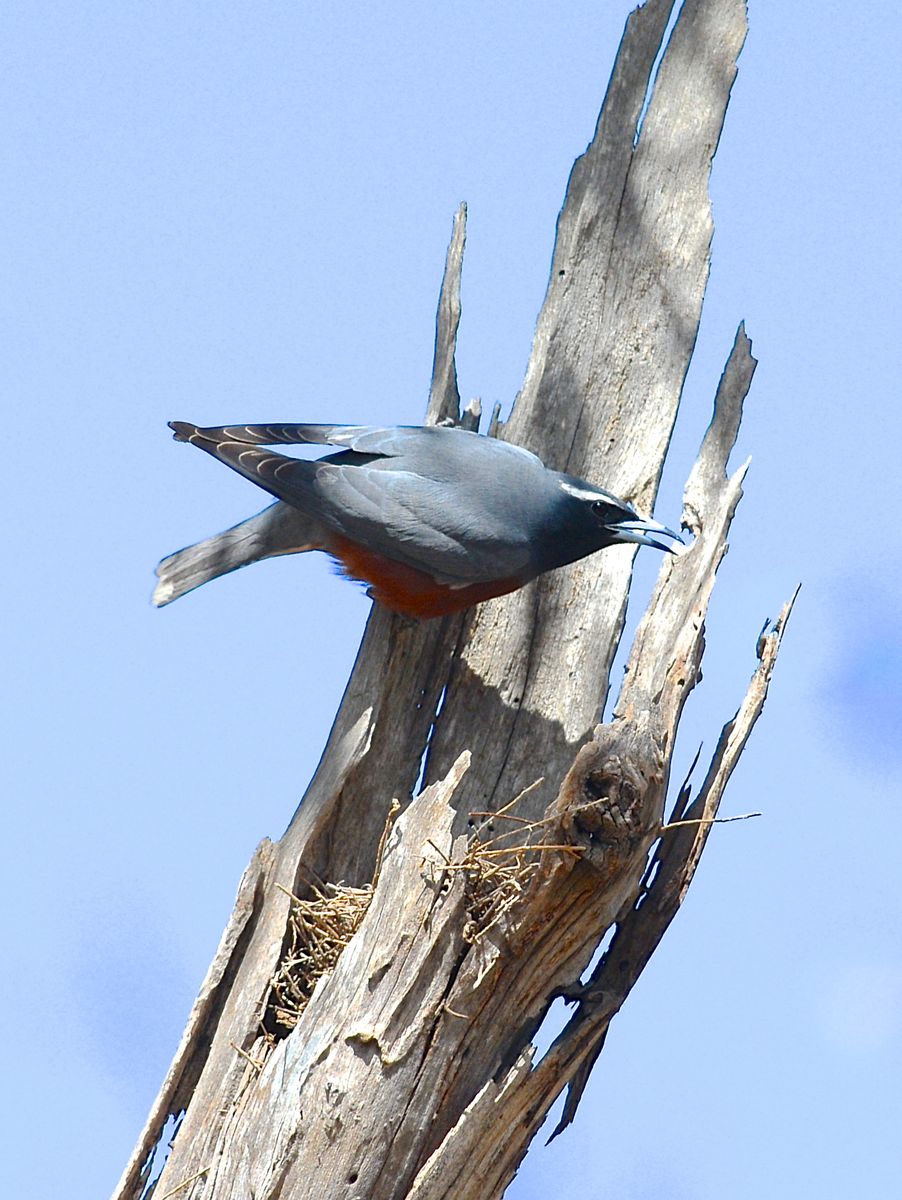
White-browed Woodswallow
Little Eagle avoiding a direct attack from Woodswallow
Diamond Firetail
Diamond Firetail
White-browed Woodswallow and very exposed nest.
Brown Treecreeper
Brown Treecreeper
Brown Goshawk beating a hasty retreat from Woodswallows in hot pursuit


Rainy Day Werribee, still a pleasure to be out

My mate Lynzwee  (Lindsay to his Aussie mates) from Singapore. (see his Flickr site for great images),  dropped me a note and said, be down your way, and how about going to the WTP.  Now, its probably common knowledge that we don’t need much of an invite, so we fixed a day in his travel plans and waited.

But the weather turned particularly nasty.   Lots of squalls, and incessant rain. Overcast as.  And not so great for photography. But give Linds his dues,  the text Message arrived, “On train to Werribee, see you soon”. So we grabbed all the wet weather gear.   Drizabone, we love you.

Great to see him again, and chat about things, and to my surprise he’d packed a “Black Rapid” camera strap. These are the Rolls Royce of camera straps, and I was very pleased indeed to attach it to the 300mm and get use out of it right away.

Try however as we might with the rain pitching down in what can only be described  as “Biblical Proportions”,  we sloshed along the road to see what was findable. Needless to say not much.  Catch of the day goes to EE (again!) for a very dejected looking Spotted Harrier hiding behind a bush from the wind.  Not the rain, as it was going through everything.   So, See bird. Stop car- without hitting anything, (cryptic joke for those who follow along), and by the time I was able to find the bird in the viewfinder, Lindsay already had 15 shots off and EE was not far behind.  I just got the lens poked past both their heads, and Spotty took to the air.

Further on, we found a couple of Black-shouldered Kites, in a state of drenchedness.  “drookit” I am reliably informed is the Scottish word that best describes the condition.  At first it was thought they were a pair, but on closer inspection one had decidedly ginger brown colours on head and chest, and would almost certainly be a juvenile.

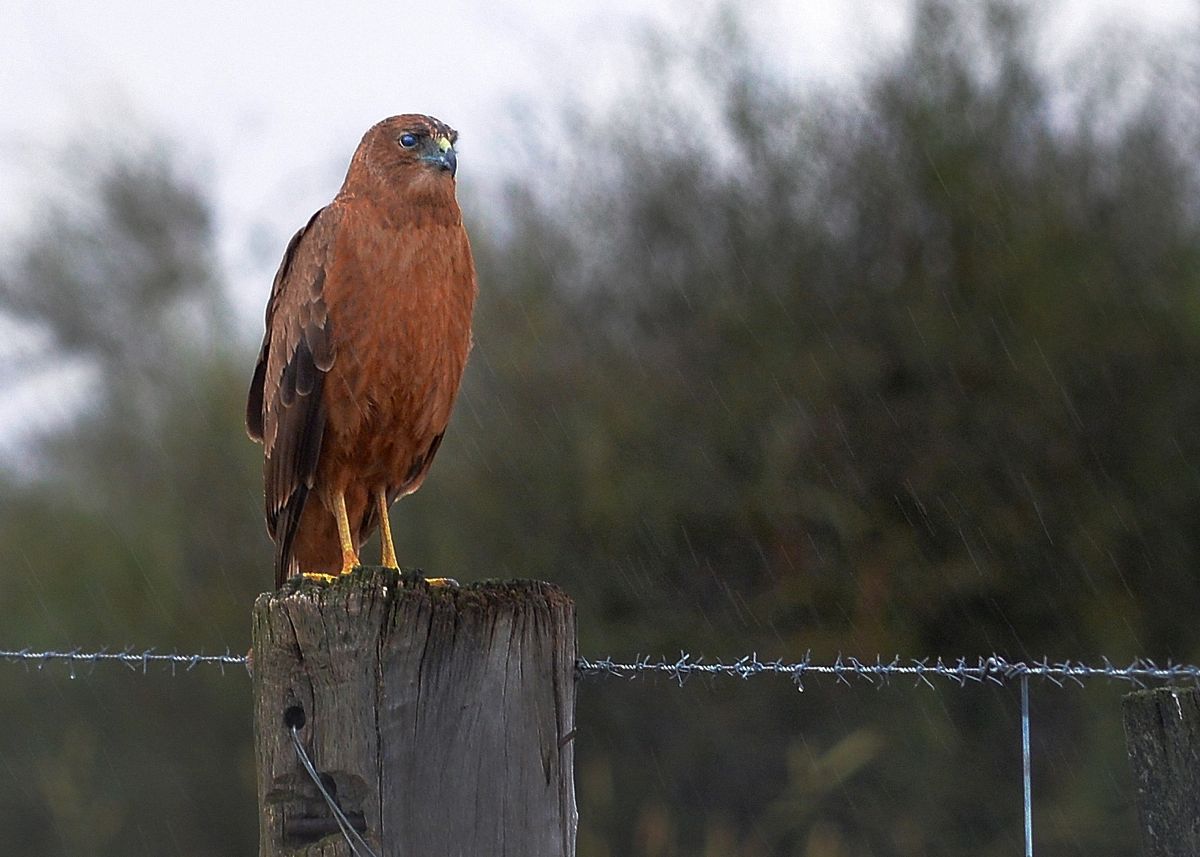
Onwards, the intrepid party sloshed.  Most waders were way out on the edge of the tide, and not seeming to notice the rain. Given off course, we had to get out of nice warm car and walk out 100m or more, we moved on.  Then it was a Swamp Harrier on a post.  I lay claim to  having spotted it first, but really in the rain, no one cared.  It was on my side of the car, so I got a couple of frames off before it too headed into the downpour.
We also located about 8 or more Ruddy Turnstones on  the road up to The Borrow Pits. And then to make Lindsay happy a pair of Whistling Kites meandered past in between showers.

With skies ‘Lowering” by the minute it was obvious, well, it seemed that way, that those dark clouds portended more biblical rain, and we took an early mark and off to the Highway Lounge to dry out, grab a bite to eat, and do what photographers do best in this situation. Talk.

Lindsay was soon on the train and we were soon home to look at the images of the day.

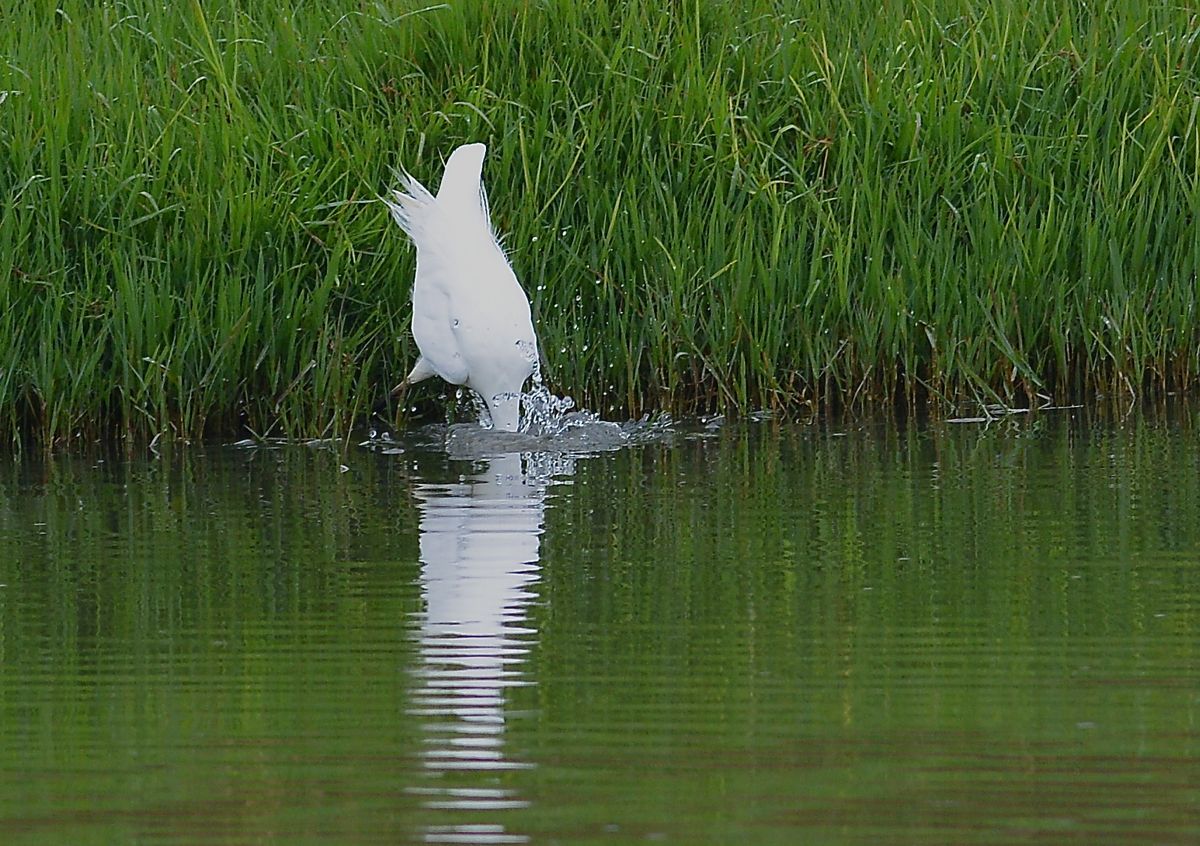
Got it,  Great Egret makes fishing look easy
Got it, Great Egret makes fishing look easy
Red-capped Plovers
Red-capped Plovers
Swamp Harrier sitting in the rain.
Golden-headed Cisticola
Sitting out of the wind. The rain penetrated anyway
Black-shoulered Kite very "drookit"
Black-shoulered Kite very “drookit”


Wandering with the Wagtails. Werribee that is

The Birdlife Australia subgroup, The Werribee Wagtails, conduct seasonal surveys in some of the small box forest remnants in the local area.

Today was such an outing and I went to along to see how it all happened.

They monitor several areas and the first we stopped at in the Pinkerton Forest on the Mt Cotterel Road.  There is no public access so this was  good opportunity to see a relatively unexplored area.

The highlight of the morning for me was a pair of Australian, (Nankeen) Kestrels, and  the male carried in a meal for the female who exploded out of the nest with the usual cries to retrieve her prize.  No time to stop and watch further, but I’d have stayed there all day if I’d have been able.

Not to be outdone, a very rich brown Brown Falcon male came in a bit later with a substantial looking rabbit in tow and he was soon overwhelmed by his female as she came out  to take the offering.

There were a number of Whistling Kites calling in the distance, but didn’t see one all day, until late in the afternoon as I was driving home.

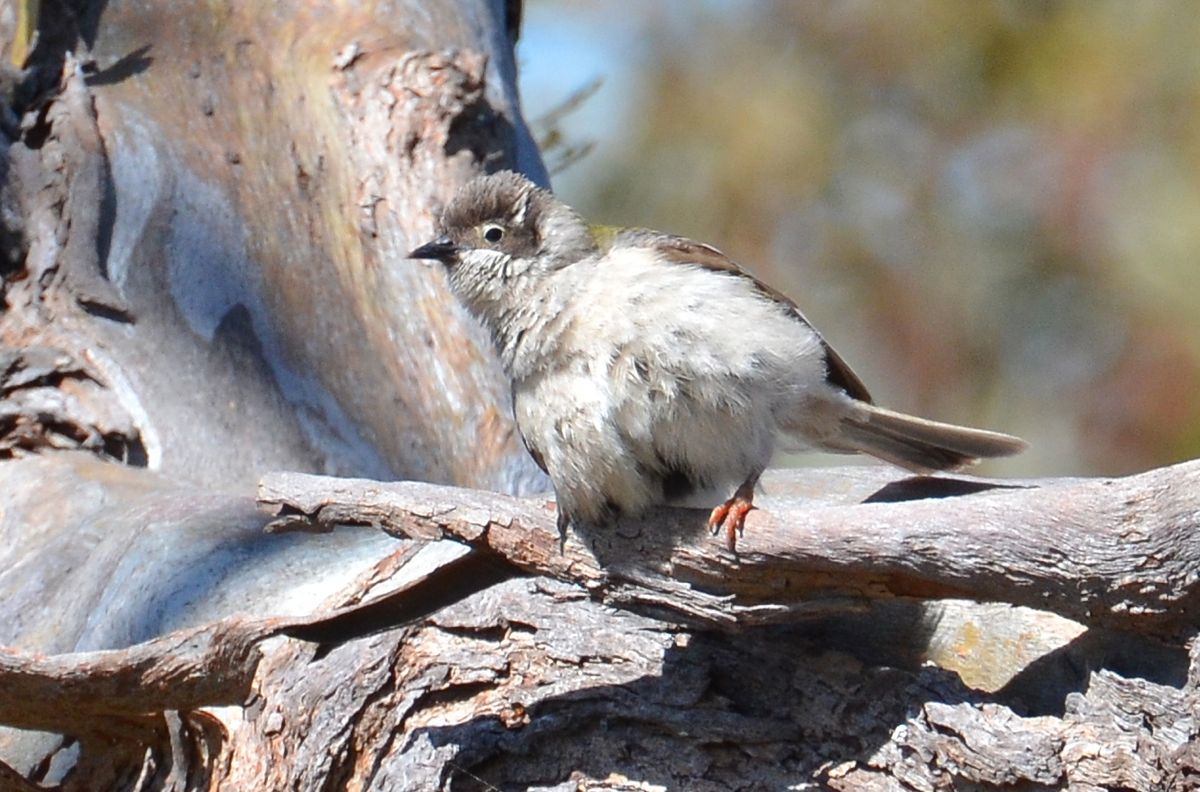
The forest offered a number  of Brown-headed Honeyeaters and one spent a bit of time sun trancing on a branch so we got a good view of it.

Over the paddock and into Bush’s Forest.  This very small area immediately began to hum with Crested Shrike-tits, Dusky and Masked Woodswallows and two very active Rufous Whistlers, among other things.

Lunch over, we moved around to the Eynesbury Grey Box forest, and here I met a family of Australian, (Maned) Wood Ducks.  The young scampered across the fairway and into the water feature and the little tiny legs looked so funny trying to keep up with the rushing bodies.

Then it was off to look for Diamond Firetails and Speckled Warblers.  Of course when you do a survey for a walk with others, the day before, the birds are everywhere and it all sounds great.  On the day.  The birds know, y’know, and they move to other parts of the forest. And this was no exception.  But we did get to see plenty of this lovely Grey Box area, and eventually found specimens of the target birds.
To top off, a Brown Goshawk circled through the trees, and we got some nice view of a very active Little Eagle.   Add any number of Brown Treecreepers, a dash of sunshine, some great company among very active and alert birders and a good day was had.  Expect to see a return visit any time soon.

Sunning Brown-headed Honeyeater


Just about to head for the water
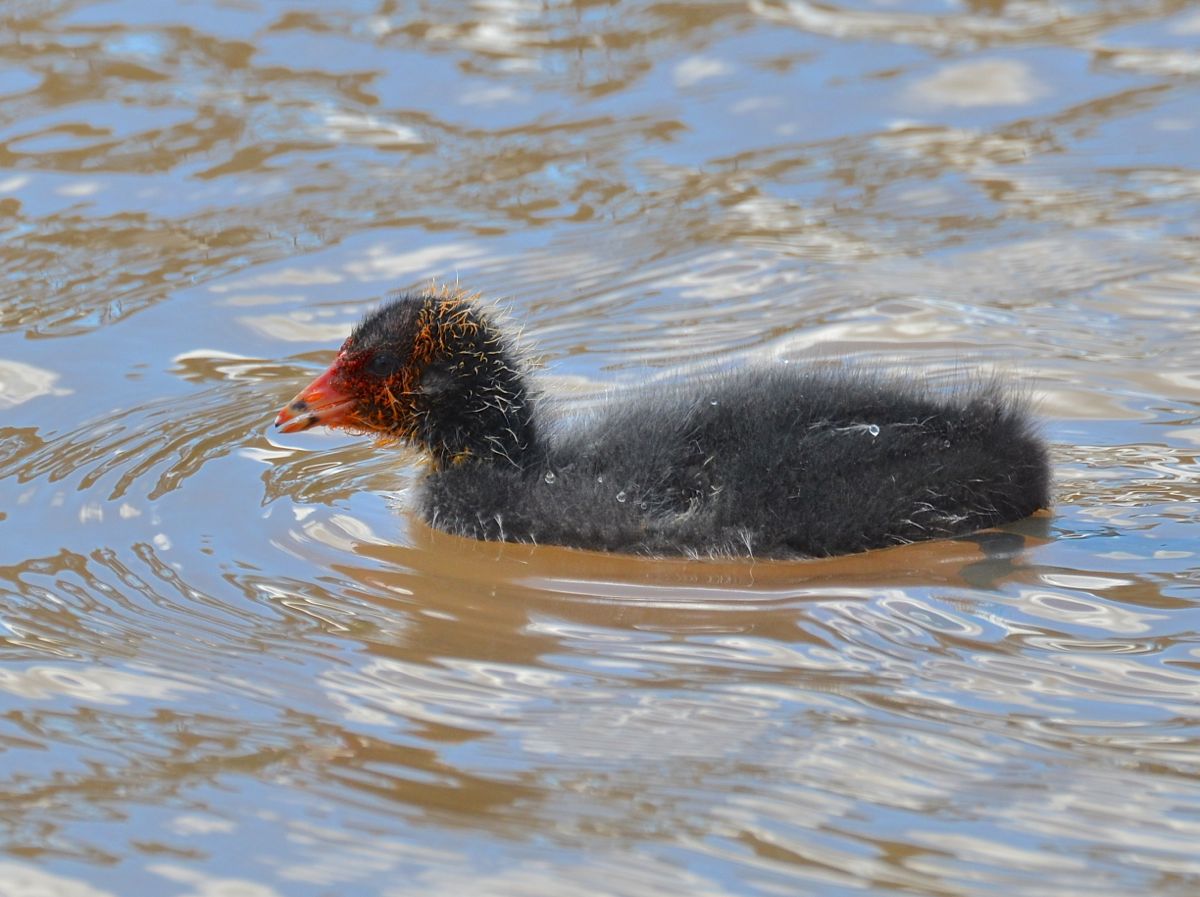
Recently hatched Eurasian Coot
Crested Shrike-tit at work.
Crested Shrike-tit
Crested Shrike-tit
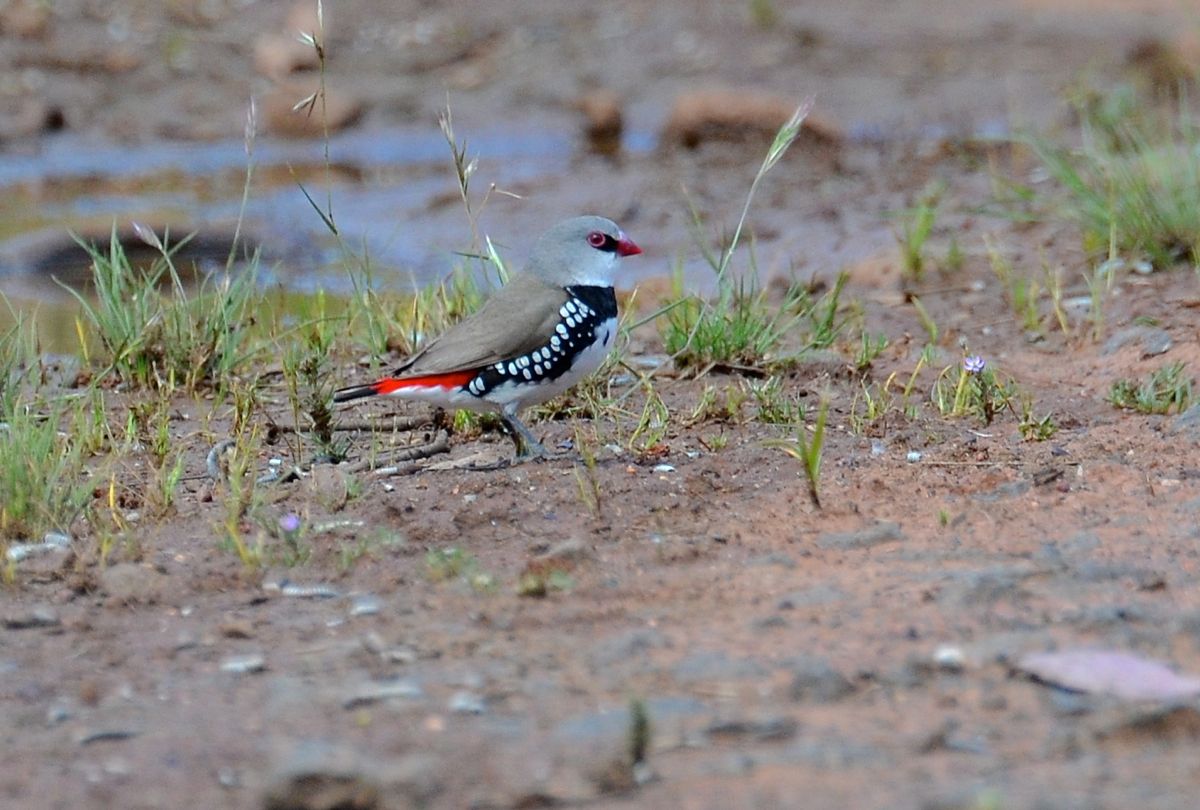
A Diamond Firetail at a distance.

Wagtail Construction Zone Update

As reported previously, all three wagtail pairs lost their nests (would have been eggs at that stage), about 2 weeks back.  Not sure how, but the number of Kookaburras, Ravens, Grey Shrike-thrush and other predators would have made short work of it all.

So the good news of course ,is you can’t keep a good wagtail down, and after a little searching in the morning we found all three hard at work and one who had really jumped the gun and had the nest, and the chicks, at least two, hatched.

Well done Mum’s.  Let’s hope for a little more compassion from your neighbours.

Just a step ahead. This one is feeding some very tiny beaks just visible.  She also took away a feces   sack
Just a step ahead. This one is feeding some very tiny beaks just visible. She also took away a feces sack
Hard at work still, but again the nest is really well stitched to the branch.
Repelling Boarders. This bird was taking no chances and would have just about been impossible to get out. No doubt the little claws are gripping very tightly inside. Not the extra strong binding to the branch on this one.
Repelling Boarders. This bird was taking no chances and would have just about been impossible to get out. No doubt the little claws are gripping very tightly inside.
Not the extra strong binding to the branch on this one.


Returning to old familiar territory

Due to weather, family, and associated activities, I’ve not had a chance to be out and about for a few days.  Nothing to do with the Garden Gnome, so let’s blame the weather.

Richard A had told of a pair of Sacred Kingfishers at the Somerton Road Carpark, and as these were among some of the very first birds I photographed, and in the area where I one morning found myself getting serious about Bird Photography, I was quite looking forward to finding a bit of time to go look see.
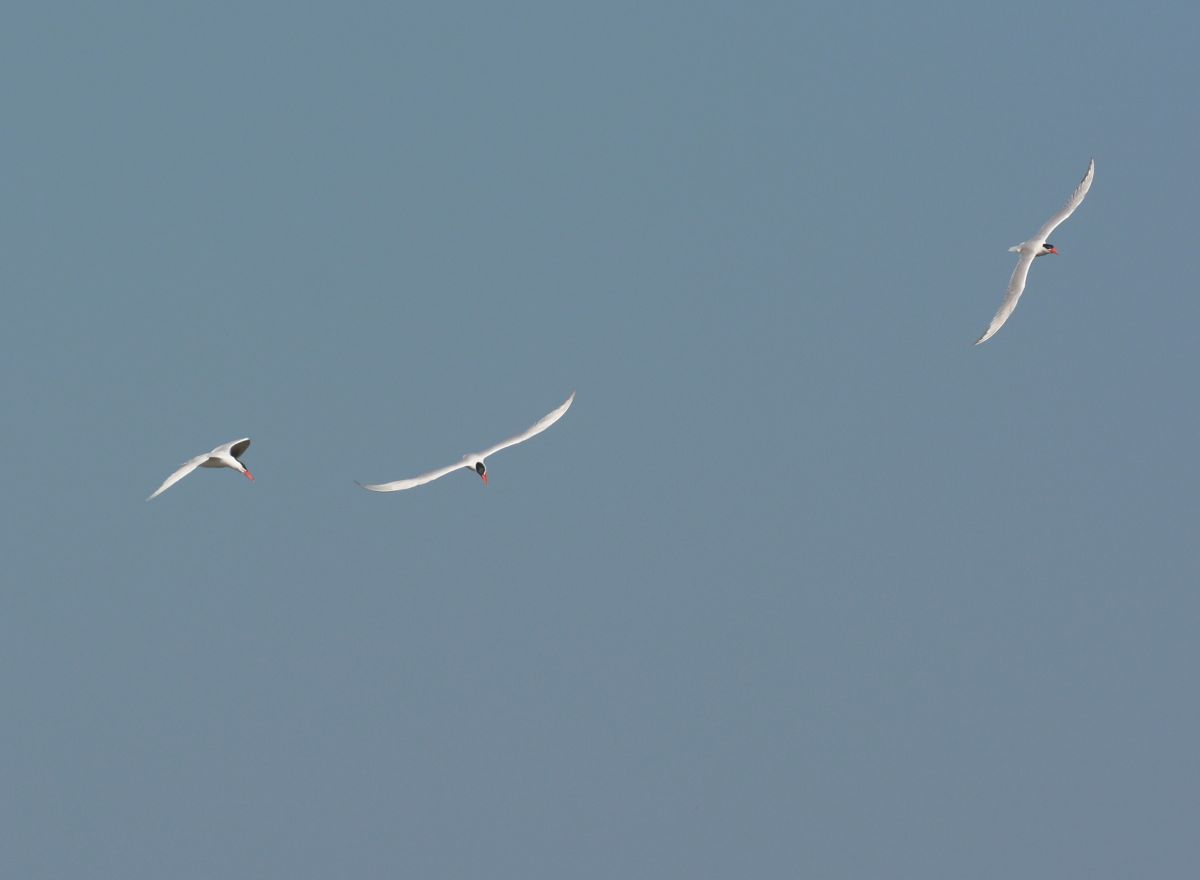
I like this area in the early morning as the sun runs  across the landscape of old River Red Gums in a really spectacular way, and the Parks Vic people have done a super job of keeping the feel, but also opening up some parts of the area for parking and picnics. The advantage is plenty of sunlight getting into the trees and making the photography just a tad easier.

I used to spend a lot of time some years back out there photographing the River Red Gums in all their glory.  Some of you may even remember filum, well that’s what I started out there with.  Black and White, as I remember (dimly).

So when the daylight started to touch the horizon this morning, and I could still see a few stars and the moon, it was going to be a clear morning with some sunlight, and so not even thinking twice, I left and was out in the park just as the early light began to caress the landscape.

At that hour of the morning the gates are locked, and so I parked outside and ventured in.  No sooner had I managed to get through the fence, than the familiar “Pee, pee pee”, of a Sacred Kingfisher welcomed me to the park.  It was sort of like stepping back in time, (only now the old bones creaked).

Took me a split second to find first one, and then the other. Pretty much where Richard had described.   They did a number of circuits of the lager trees and we three had a merry time.

I then went up the hill to the top of Woodlands Hill and looked out along the rolling green paddocks.   It does look a treat with some light on it.

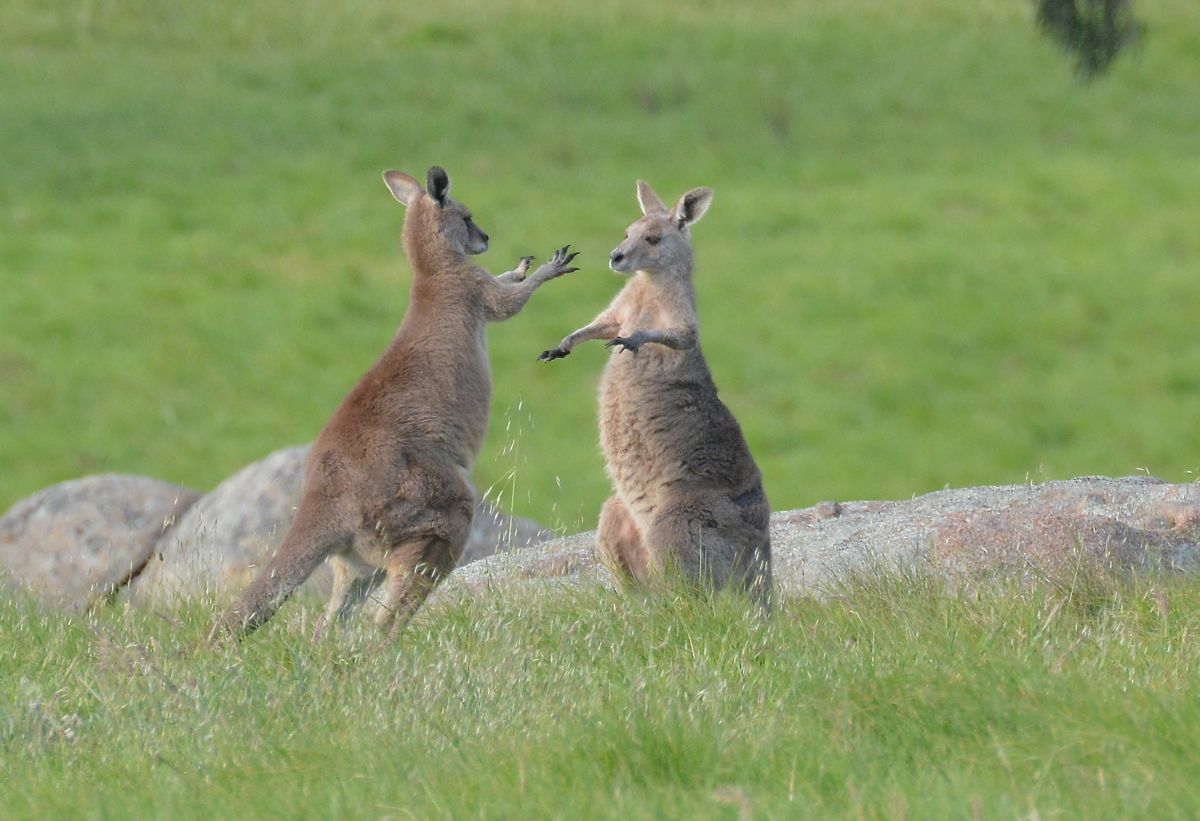
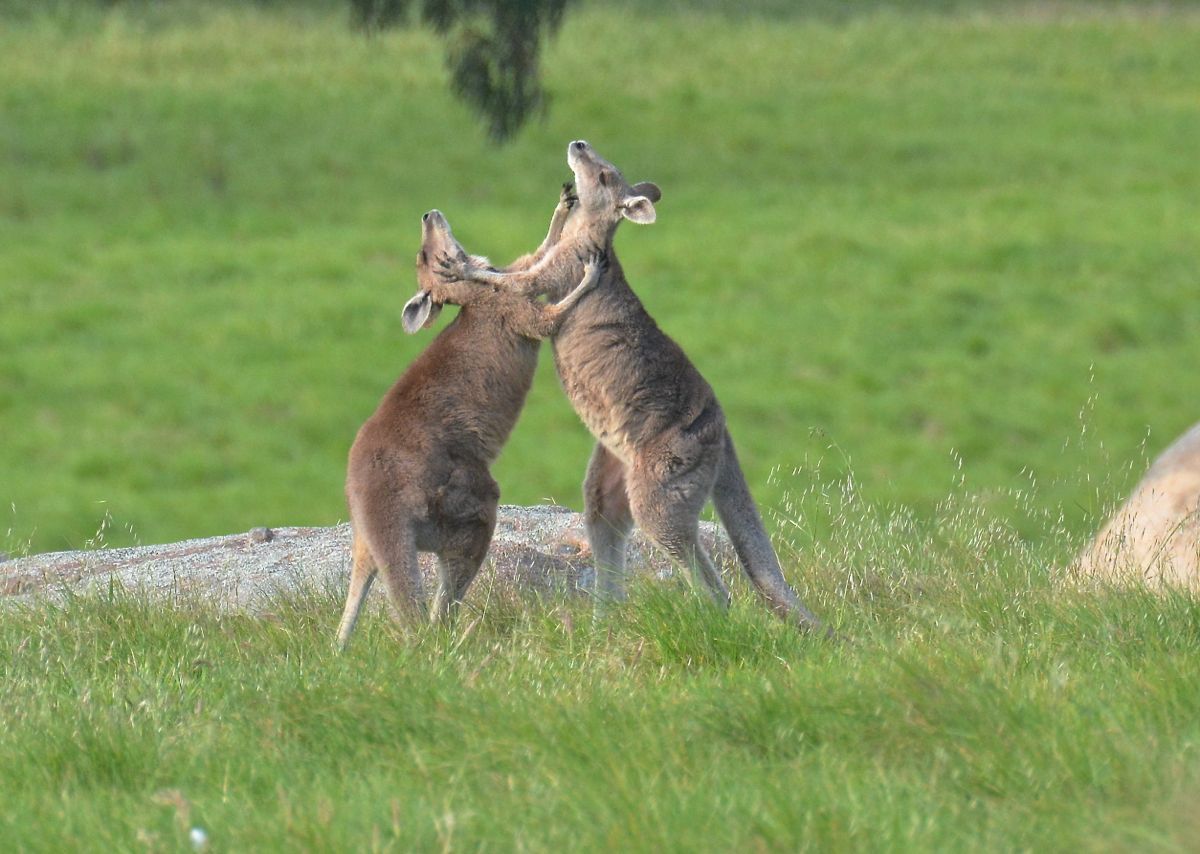
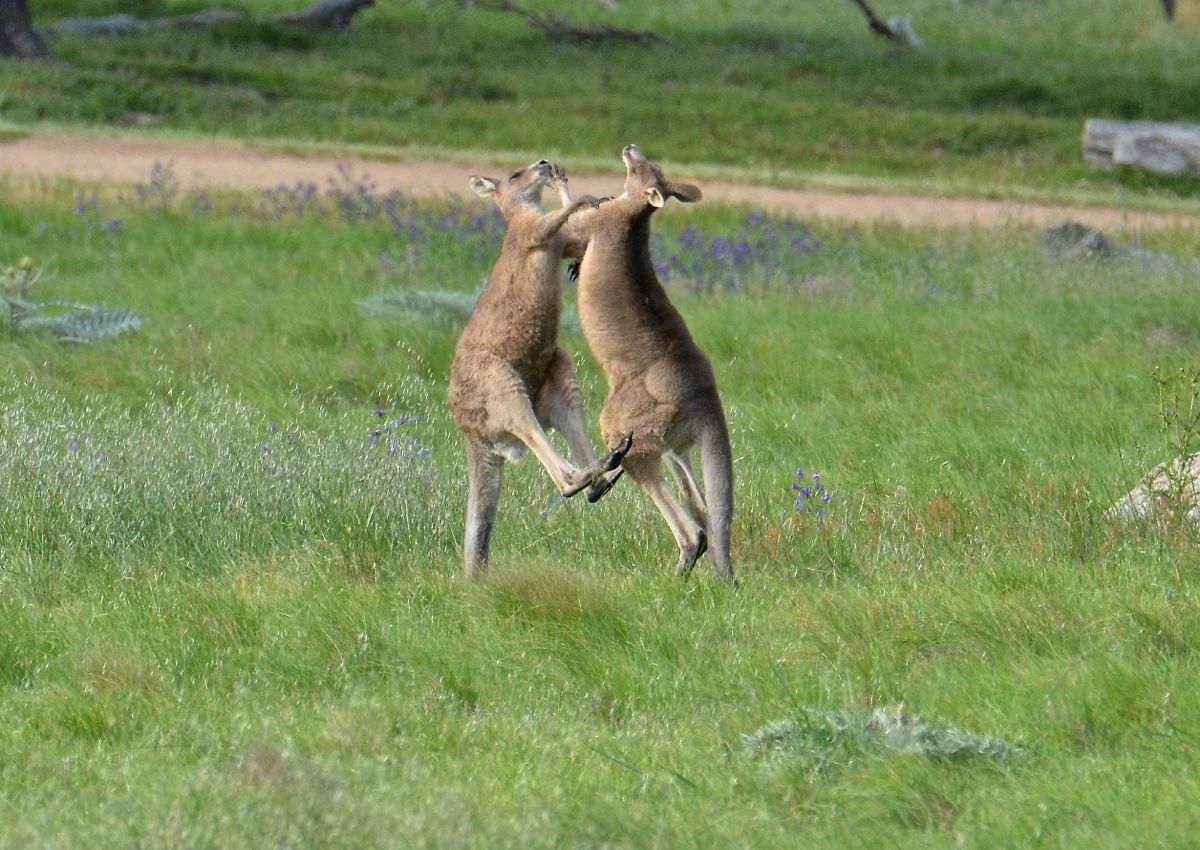
While I was breakfasting, some young Eastern Grey Kangaroo bucks decided to have a bit of fun and play at kangaroo boxing.  For the males, this can be a extremely serious business, and sometimes with deadly consequences.  The starring punch is to set back on the tail which increases the height, and then kick forward with the huge back legs. The tail then acts like a spring and propels the feet forward for a direct blow to the other one’s stomach.  With two big bruisers, the noise can be quite alarming.  The danger is also that the claws are really sharp, and a serious injury could easily be inflicted.   Its not uncommon to see the big blokes with multiple scars to show how dangerous it is.

But for the little dudes, its just play, and so nothing more than pride gets damaged.

Some Weebills and a few Yellow Thornbills among the She oaks made for some interesting subjects, just trying to get them out of the fronds on the she oak was the biggest challenge.

Back at the carpark, the Kingfishers were hunting, and some Brown-headed Honeyeaters were feeding some very hungry youngsters.

Nice to take a trip back along the old paths and see the changes.

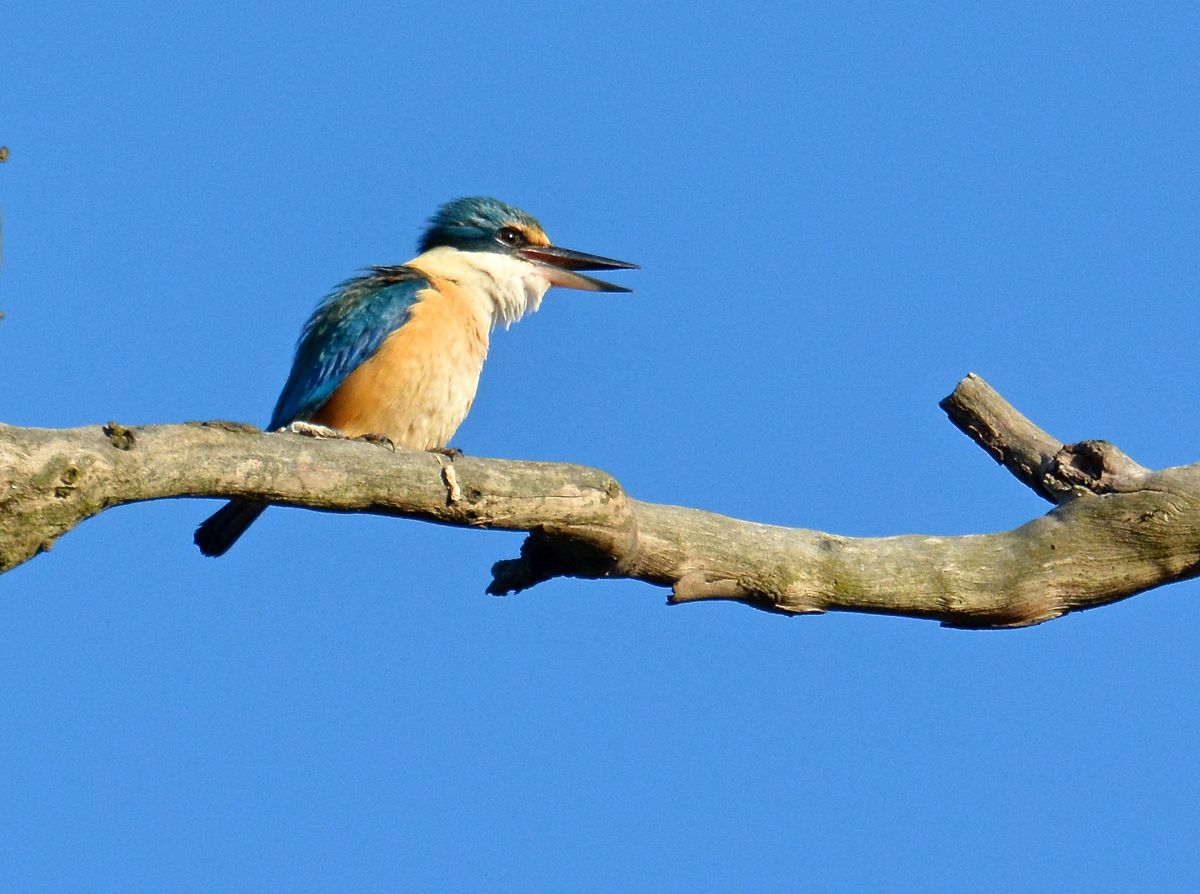
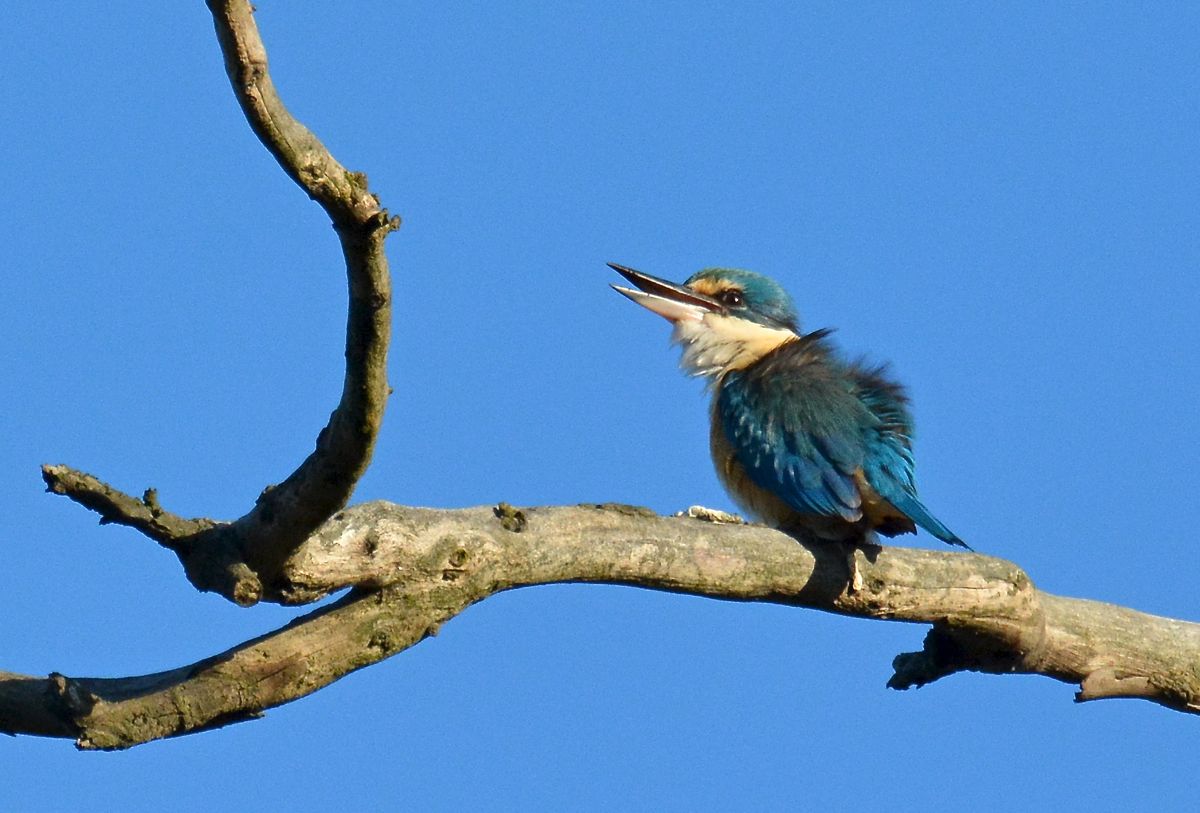
Announcing his return this Sacred Kingfisher flew from tree to tree with his loud call reverberating among the gums.
The amazing aqua colours show up well on the back view
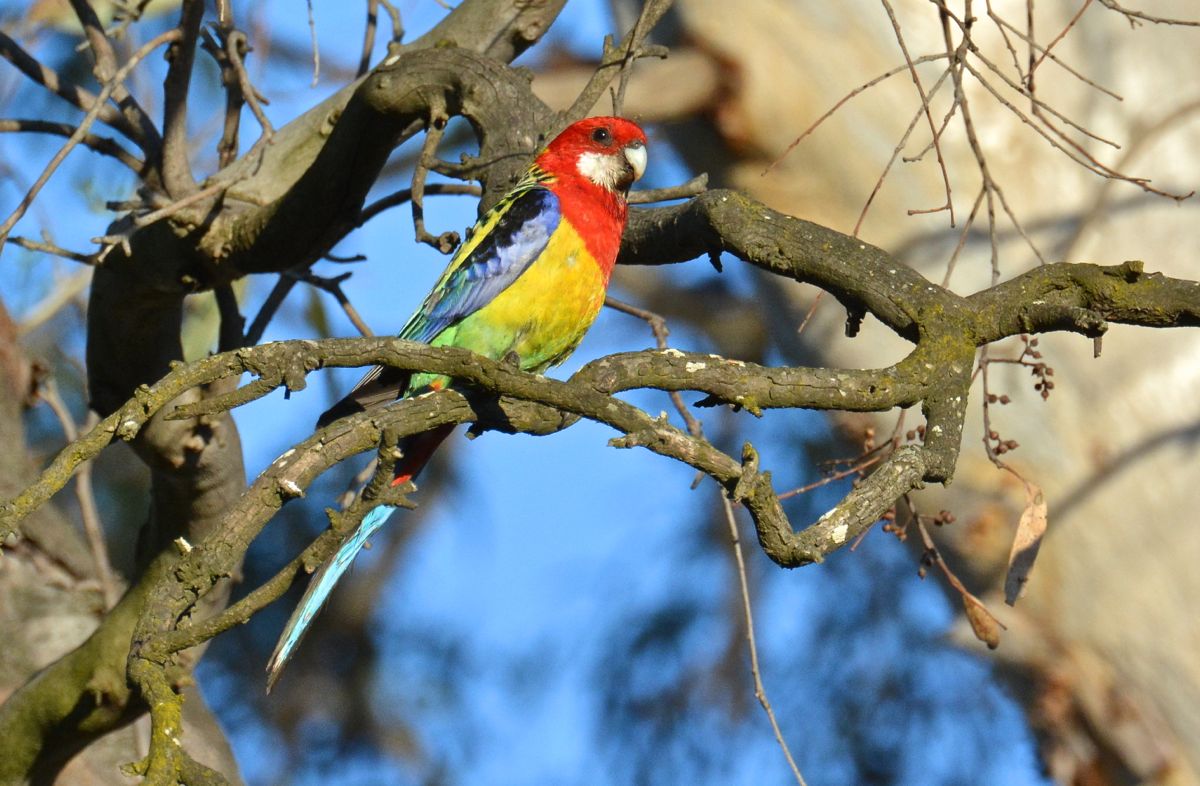
Eastern Rosella, one of many parrots for the morning.
"Let's play a nice game of Kick one another"
“Let’s play a nice game of Kick one another”
Locked together its really a matter of who gets the best position
Rearing up on that huge tail gives a wound spring that carries the legs forward with incredible power.
Yellow Thornbill among the She-oak leaflets.


Good Chough Hunting

Yesterday in spite of the high winds and the heat we ventured out to Woodlands for the morning.  We’ve taken to coming into the park through an open area and following a couple of Kangaroo pads along the redgums and sticky wattles.  Just a nice way to walk with the spring grasses in full colour.

Just crossing over from one track to another we came across, first one group of White-winged Choughs, and then a second smaller family of perhaps 7 or or so birds.  Both groups had several young and I walked back to enjoy a few moments with the larger group, and discovered their young were two recent fledglings, because they still have lots of down on their heads and backs, and one older juvenile.

The gregarious nature of these birds and the communal way they nest extends it seems to the way they nursery the young.  The young were fed by which ever bird managed to find a tidbit to attract one of the young.  And attracted they were.  The other thing that I noted was the steady stream of chatter that they put up as they hunted about, and most of it seemed directed at the younger birds.  Several adults would stand by and chatter away at the young bird as it picked its way over a log, or was scratching at the base of a tree.
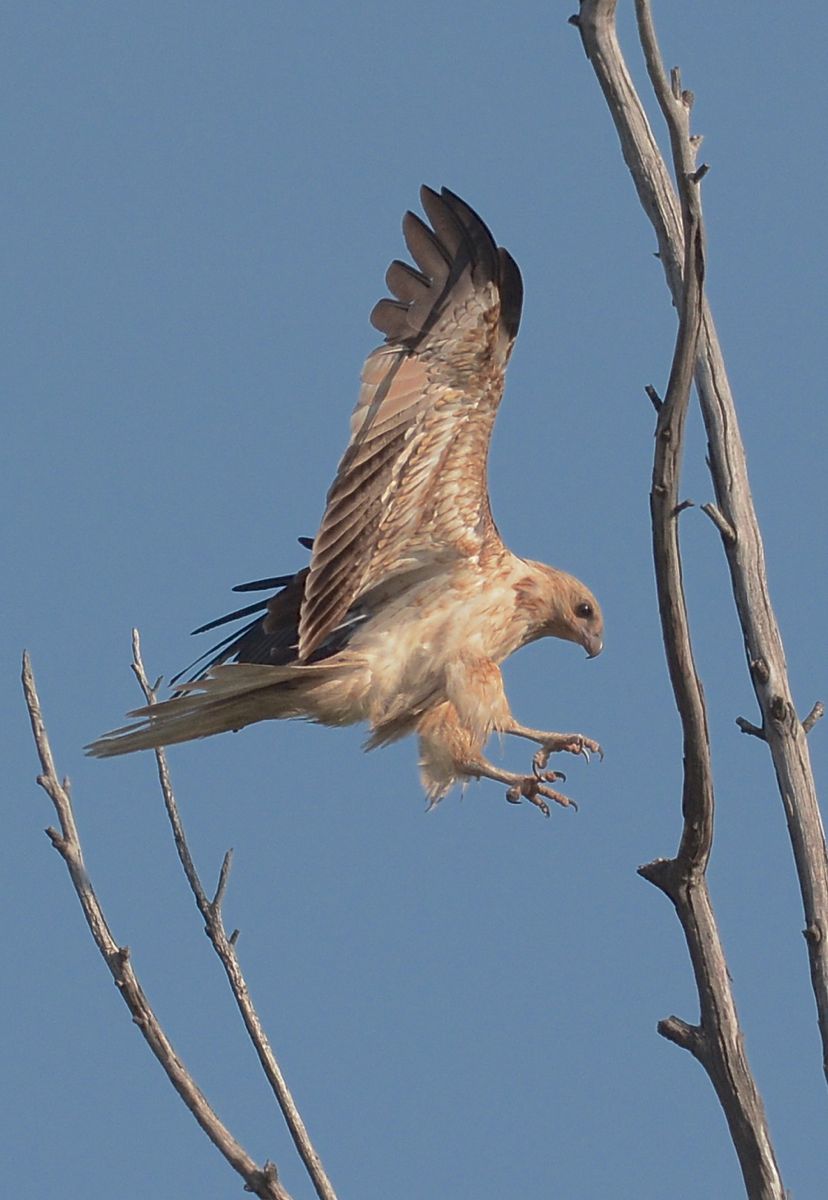
The big thing for the day for me however was that even though Choughs mainly walk or fly away if approached, these birds were unconcerned.  After a few warning calls, they simply went back to looking after the young.  I sat on a log and watched for about 10 minutes or more, and then two of the adults came over an worked around the area I was sitting.  Completely ignoring me. I took this as a hint, and as they moved, I followed.  In the end I was sort of in the middle of a Chough hunting party.  They didn’t fly or run away, and if I moved one way or the other, they would note it, and then move around me.

After about 30 minutes or so of this, they met up in an open area with the second smaller group.  They seemed run up to each other and do ‘group hugs’, with wings outstretched much shrill cooing and a kind of family reunion meet and greet.   After a few minutes of the wing waving, calling and Chough Staring, the groups moved off, and I followed the second group and again they didn’t take much notice of me.   This smaller group had two recent fledglings.

At one point a rabbit broke from the grass (that would have been my fault), and there was a huge outcry of alarm and some birds taking to the air, but it quickly settled and they dropped back down to hunt near me.  They didn’t do any alarm calls as I moved among  them.

So after about an hour of Chough hunting, I am no more familiar with the family activities, don’t understand any more of Chough language, nor behaviour, but at least they were relaxed enough to allow me to get close and make some nice portraits.

The other thing I learned about the white wing feathers is that they are black feathers with a white insert. The white is surrounded by black tips along the edges.

Much lecturing and wing spreading to get the message across. Perhaps like all kids, it wasn't getting the message.
Much lecturing and wing spreading to get the message across. Perhaps like all kids, it wasn’t getting the message.
Learning the art of finding food amongst the leaf litter
Recent fledgling with its brown eye and baby feathers.
Young bird being lectured in the finer points of Choughness.
A juvenile, still has the brown eye colour
Recent fledgling, still carrying baby down
White-winged Chough "Meet and Greet". Much wingwaving, group hugging and chatter.
White-winged Chough “Meet and Greet”. Much wingwaving, group hugging and chatter.