Saturday Evening Post #82: The Encounter

It’s interesting how as photographers we keep striving to make improvements to our vision or style. Finding a better way to approach a subject, explore new lighting options, wrestle with buying that ‘new’ lens that will give us a ‘better’ pictures or that new piece of software that will ‘uncover the hidden photograph in your collection’.

Many lightyears ago, in the days of filum, I was a member of a group of working photographers that would get together on an ad-hoc basis every other month or so, and generally we’d meet in a cafe in Lygon Street Fitzroy for a late Friday lunch, well it was a lunch that went late. Sometimes we’d bring along prints or tear-sheets for discussion. The last few times I remember taking the old iPad with a few pictures of recent making.

One of the house rules was it was a discussion on all things photography, from technique, to style, to equipment, processes, other people’s work, and future opportunities. Sometimes it was a bit like a parliamentary debate, other times more like a inspirational speakers session. Just depended on how much ‘red-ned’ was consumed during the course of the afternoon.

But one question, we all had to have an answer to was “Whatchabeendoin” What new image, vision, exploration or direction we had each been travelling in.

One of the group was oft to quote a verse from St. Matthew 6  “Behold, the birds of the air…. Consider the lilies of the field, how they grow; they toil not, neither do they spin”
Gotta love that 1611 King Jimmie English.  “Behold”.  Not just make a glancing look or a peek, but drum roll, Behold!

He’d almost always bring it up when someone was lamenting the slow down of business, the ungratefulness of clients, or the problems of marketing a new product. His point was always the same, well, at least as I remember.
Bird’s don’t go to another lecture, another seminar on how to find clients for their song, they just sing. No bird has ever had to attend a month long session with a personal trainer on the benefits of correct nest building. No bird looks at its current situation and laments not having this or that opportunity to expand its business. They just do bird things.

No flower sits worrying about should it move overseas for a better market, change its colour or its style to match the ‘current trend’, nor does a flower seek out a self-help guru to improve its image.  They just continue to make the world a brighter place to live.

It is as Mike Johnson over on TOPS says, “Viewing an expressive photograph has the potential to be an occasion”
Most people see art as a static event. You go to a gallery, the sculpture is the same week in week out, the painting remains inert, the basket-weaving or quilted piece in unchanging. Ready to be reviewed, but never “Beheld”.

Yet as Mike goes on to explain, “It can also be an encounter. The potential to be an event in the viewer’s life”
We are so bombarded these days with visuals, sometimes very graphic visuals, that it all becomes a bit old hat.
Yet for someone who works behind the camera, takes the time to work through post-processing and ponders over the variations on a theme from a photoshot, the occasion of showing a finished piece is a gifting and the viewer’s response is part of that. It is an Encounter.



Saturday Evening Post #81 : On Stranger Tides

“In the rush to return to normal,
use this time to consider
which parts of normal
are worth rushing back to.” – Dave Hollis

Greetings from, The Doona Hermit Headquarters.

Title is a take from a “Pirates of the Caribbean” movie. (Tells you I’ve had little to do with my Lock-Down time;-) )

We all sit twiddling our self-isolated thumbs awaiting our fate. 
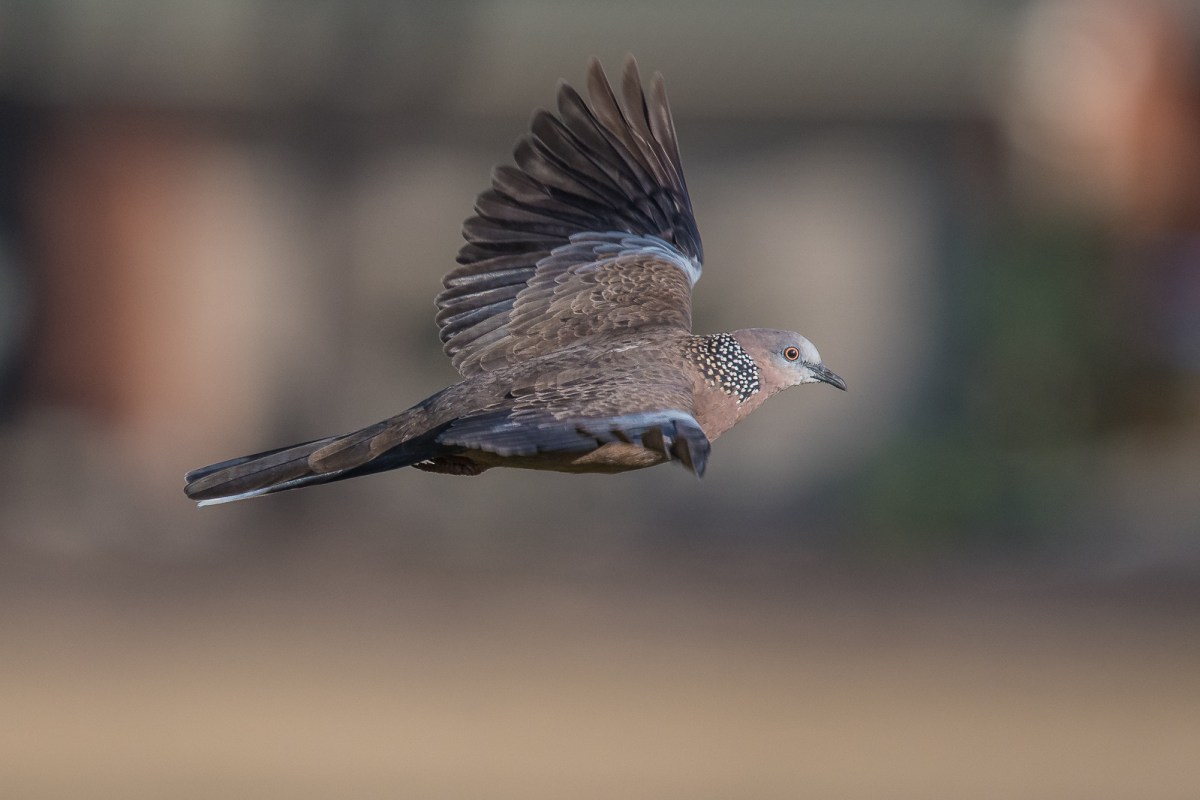
Mind, just as well today, as we literally have had about 10 seasons in the one day.  I walked early, and got wet, then the sun came out. Then it rained. And, as I write, the rain is pelting down on the patio, looks more like small hail as it scatters over the tiles. It must be bad, as Tai Chi pigeon, and friend, are sitting under the patio table to keep out of the wind and the rain.  EE and I often measure the severity of the weather by how many doves fit under the table.  “Oh, it’s a real three pigeon-under-the-table storm out there.” etc.

I have, it seems just about run out of current photos for sharing. I’m sure someone is going to say, “If I see another Black-shouldered Kite with mouse shot…”

In a bid of desperation, and to find something to do, I went on-line and purchased a new iPad Air the other week. My old, old, old, version 1 model 1 iPad hasn’t been able to keep up with the technology changes for several years, and I had sort of retired it to reading magazines, books and checking the weather.
I remember well the day, as I proudly opened the package, when it first arrived. 
I’d ordered one as soon as they were announced way back in 2010, BCV   (Before Corona Virus)
Mind, I had been sold on the idea since a keynote speech Steve Jobs had delivered nearly 10 years before, saying, :

What we want to do is we want to put an incredibly great computer in a book that you can carry around with you and learn how to use in 20 minutes … and we really want to do it with a radio link in it so you don’t have to hook up to anything and you’re in communication with all of these larger databases and other computers.” 

You’d have loved to have had the frequent flyer points my little iPad racked up.  EE used it for client presentations to magazine editors, I even wrote a few articles with it, I used it to teach at Box Hill TAFE for awhile, and it even at one stage using an app called ImageSmith, talked to the Lightroom database to access images. But, technology moved on, and without the bells and bluetooth whistles, it will now be another paperweight on an already crowded desk.
I started this blog on the new Air, and then moved back to the desktop to retrieve the Falcon shot. Haven’t had time to set it all up to sync properly yet.  More to do.

A few exciting reports have come in from people who’ve had good views of Flame and Scarlet Robins in various places, so it might be that the bush birds have indeed had a good summer breeding session and we might have some opportunities soon to get to know them.  The fine wet weather will have enriched the favoured moss beds which should be in good condition and well stocked with food I expect. Also prolific this year seems to be a small salt-bush that has rich red berries.   The insects feeding on the carotene laden fruit will no doubt provide plenty of bright red feather material for the robins.

So, we wait for what shall indeed seem “Stranger Tides”, to take us back into the field.

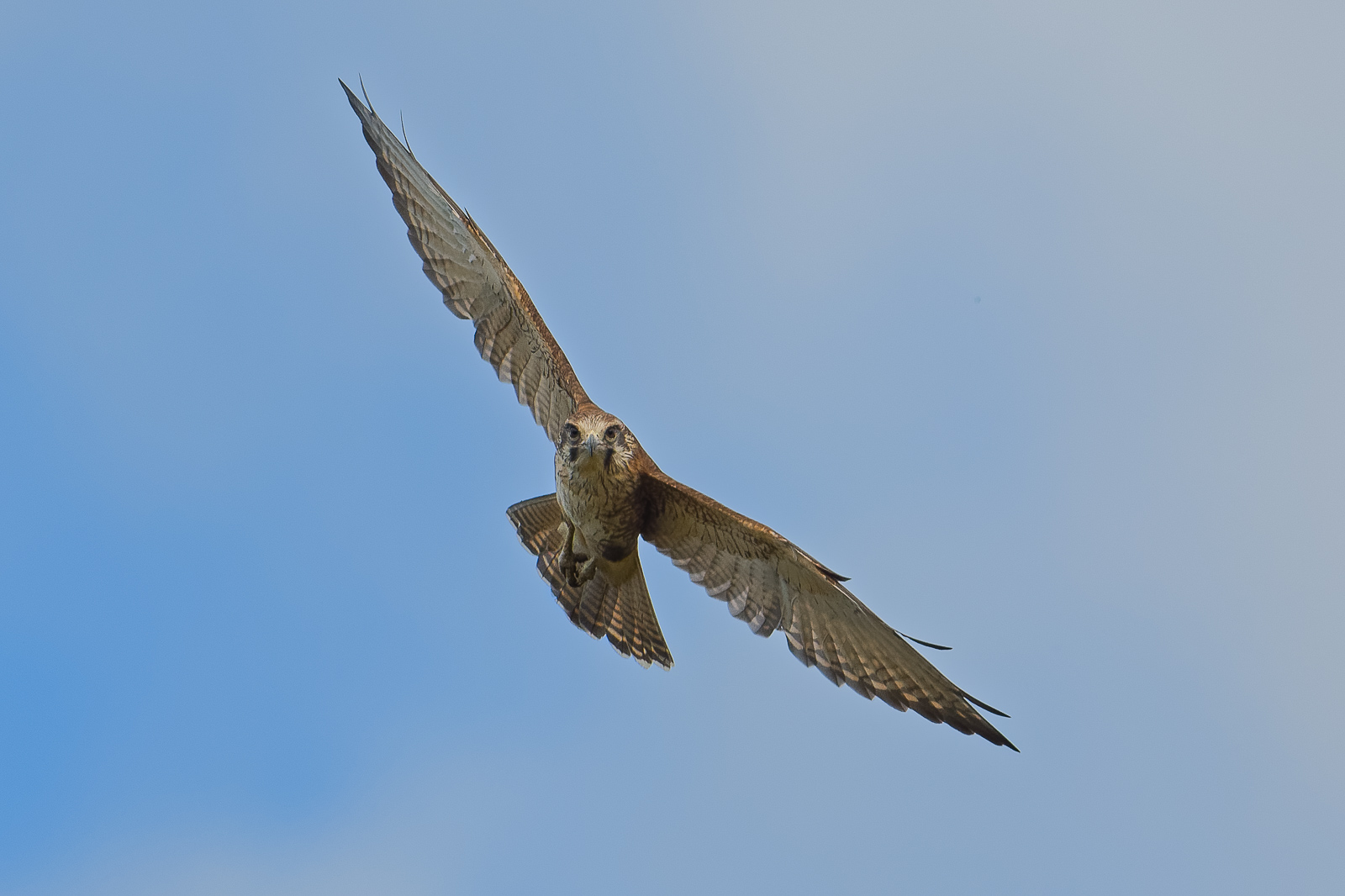
Here is one of the last views we had of the young Brown Falcon from Cassia-of Cinnamon’s clutch.
It had been sitting on the fence in the open, and flew up the fenceline among the surrounding bracken, to find a thermal that was rising from an open sandy area.—I don’t think it was an accidental discovery, I’m sure it knew exactly where the air was rising.

It swung round, picked up speed and gradually began to rise. 

This might look like a tight hardworking turn, but in reality its probably not using any energy at all, as the thermal is doing all the work over the wings.
I waited until it made the circle, and then turned in my direction, I wanted the sunlight running over the face and the body, and it straightened out just a little at the right moment.
It gained height very quickly and then sailed away across the paddock to disappear in the distance.

Time will tell if it is still hunting in the area.

I hope you’ve all been safe over the past few weeks. Also hope that the time has given you a chance to refuel the creative batteries and as D Hollis suggests, are ready to ‘rush back to things worthwhile.’

Remain

One of Scomo’s Donna Hermits.

For the technically ept, this was shot on the D500 with the Auto-Area autofocus selected. Canon—Automatic AF Point Selection. It’s the “point and shoot” mode really.  Mostly ignored by those of us with scorn for such things automatic.
I’d been messing with the setting a few times the past few trips, and find that it can indeed pick out an inflight bird against the sky first time, everytime.  Not so hot among the scrub and trees, but, I was working on that.


Saturday Evening Post #80: We Bounce

Greetings all my Fellow Scomo Doona Hermits!

Been cold, wet and utterly miserable weather here today, and probably has has some impact on my approach to life in general. Too cold to go out, and no where to go anyway. 🙂

“We Bounce”, is a term, that a mentor, David DuChemin coined after an accident sidelined him for 18 months or so back in 2011.
He was leading photo-tour in Italy, and was standing on a 12m high wall explaining the variations of light, form, tone, texture, viewpoint, lens selection and vision, when he misplaced a foot, and fell to the bottom of the wall. Legs, ankles and pelvis were broken, and required much surgery to repair, and even more to get right. As David tells, he was fortunate; as three or four people had fallen from the same wall the previous year, and all had died.

A year on, and he was able to walk, mostly with the aid of a cane. “The human spirit is a remarkable force,” he says.

We can’t all have perfect health, perfect bodies, perfect lives, and perfect photos… But we can chose to endure, to perservere, to take the courage to keep going, to sleep off the venom, (a reference to Honeybadgers—part of his post) to Bounce Back.

And, when bouncing isn’t enough, as David remarks, the truly blessed also have friends. And he then goes on to give thanks for all those who followed his trials that year.

So, this, is a post to say, “Thanks, Thank you to all who’ve been following along the ramblings of a Saturday evening, when we both could be wasting time watching tv, or out and about with family and friends.”
“Thank You, to all those who have tirelessly worked to bring us some stability in the dreadful condition we find ourselves embroilled, so many risking so much for so many.”

“Thank you” to our governement leaders for their forthright and determined decisions that have given us a glimmer of hope for some relief.  I only have to look at the world sats to see how fortunate we have been. Tough, yes, but we’ll Bounce Back.
It turned my head to realise that the United States now have lost more people in three months than battle casualites during the Vietnam Conflict. (58,220  1964-1975)

One good thing from being at home is that many tutors, trainers and artists have setup online access to some of their materials.
I’ve mentioned Jon Young and his “What the Robin Knows”, book before, and he has an hour or so long seminar Discover the Hidden World of the Animal Through Bird Language. In the webinar, Jon, Kristi, and Dan shared some truly fun stories and tips today that can help you tune into Nature through the voices of the birds.  It was 5:00am here, but a replay is much more convenient.
PS, its long and rambling as these sort of discussions are, so make sure you’ve a cup of the Earl’s finest, or whatever takes your fancy, if you settle to watch it. But the Nuggets fall quickly and are worth searching out.

You can view the webinar replay here.

And my  Wordpress Friend, Ashley, over at Aussiebirder.com, his blog is here
Ashley has just published a new Edition of his book What Birds Teach Us   so good luck with the publication.

For over six months, we had the opportunity to work with a single Grey Butcherbird, it has become quite confident at our presence. Now, I know that anyone who has Butcherbirds in their local patch will find that pretty ordinary, as Butcherbirds quickly assimilate.
However the last few sessions we had, Butch came out into our area on its own accord.  The featured two shots, are a result of the bird flying directly over my shoulder. Close encounter.
Had to do vertical, as I couldn’t fit it all in on horizontal. Just about full frame. Close.
Jon talks about such encounters as   Connection, Not Conflict     As awareness grows, so appreciation grows, so, empathy grows.

We bounce, but its usually a matter of choice, in life, in art, in photography.

Keep takin’ pictures, we do.


Remain


Davyyd.

Saturday Evening Post #79: A Day, Like No Other

Today is ANZAC Day, 2020.  Normally, at least, there would be assemblies of people around the country, honouring the memory of our fallen defense forces.

A dawn service at 6:00am is a tradition that came to the day because of its military heritage. Not unusual for whole families, grandies to grandkids, and great greats, to be gathered together in the quiet of pre-dawn.  One day a year. The clink of medals well earned, the comrades in arms catching up a few ‘hellos’ in hushed words.  The ringing of Laurence Binyon’s immortal words. “They shall grow not old, as we that are left grow old; Age shall not weary them, nor the years condemn. At the going down of the sun and in the morning. We will remember them.”

Then the trumpet call to “Reveille” and “The Last Post”. A minute of Silence.

Next, in most locations a march through the city of those that remain. More greetings, more community gatherings and more shared stories.
Twoup games, and Football.

This year, we found ourselves at the end of the driveway, in the cool of the morning, candles, and lights along the street, people hushed and reverent, and the Last Post rolling down the street from various sound systems.

I like first light. Some might be wary of it, but to me it has always been a comforting, protective time. Enveloped in the darkness, I watch as the first glimmers of light rolls up the day.

A new phase.  Deng Ming-Tao, writes, “As we enter a new phase of our lives, the parameters change. We need to revamp ourselves according to our situations. The continuing act of creativity keeps us going.
Learning is the fountain of youth,
No matter how old you are,
You mustn’t stop growing.”

I’d picked this image to follow the one of Mr. Mighty last week. I wonder if you picked why?

It’s a visual thing.  The branch this lass is perched on, is the same one Mr. Mighty was made on last week.

I think she might be the matriarch of the travelling party that season.  It’s only anecdotal, but it seems to me that a female kept the group focused and moving.  A few calls from her and the main group would move on to the next location. The males play little part in it, as they are quiet until its time to return back to the high country and take up summer territories.

The year I took this, (2011), she was looking after a flock of around 15-20. 4 males, 5-6 females and 10 or so young birds, in various stages of moulting into their new dress.

To all my fellow stay-at-homers, I hope all is well, you’re still creative, and still finding new ways of learning and acting.

Remain


Davyyd

Saturday Evening Post #77 : The Hound, the Horse and the Turtle Dove

“Hey, I was thinking about you last night!”

Steve is the barista at the nearby coffee shop, “The Global Local”.  Steve and Zoe have managed to keep their business going, but have had to layoff staff.  EE and I have made their coffee an essential part of our essential grocery shopping forays- it is essential for a number of reasons. Steve is also a pastry chef and some of his pies, muffins, banana bread and my fav a Rhubarb and Apple tart— Gluten Free of course—can turn a good morning into a great morning.

“So,” I asked, “What bought that on?”

“I was watching Chicken Run on the tv last night and thought of you trying to sneak out of the village to drop by for a coffee.”  “Have you thought about building an aeroplane?”

It’s stuff like that which builds up a feeling of community, even if in a small way.  In a similar fashion EE and I have been sticking close to the local shops and helping to keep them running.  Small it might be, but hopefully, we are as they say, “all in it together”.

The Global Local has been a regular weekend midmorning meeting place for a number of our village friends, and it would not be unusual for about a dozen or so to be enjoying, the food, the drink, and the camaraderie of joyful conversation.

So while we all do our doona-hermit thing, there are little glimpses of a life beyond the reality of the moment.

Sitting alone, sipping Steve’s best Cappuccino, I turned to another distraction.  Henry Thoreau’s account of two years living at Walden Pond, Walden

I suspect that many of the baby boomers at one time or another read or at least glanced through the book. In my notebook I came across a quote on his work, ““Walden, after all, is a kind of how-to guide, a self-help book for aspiring eremites”, I am regrettably not to sure of the source.

I also suspect that for most readers, his aspiration, he was after all one the early ‘transcendentalists” , hard line would be too much to pursue for a long time. (although, truth be told, I do/did know of a number over the years that threw an attempt at it.) And I also suspect that re-reading it over the years that only the ‘highlights’ were taken on board, and the more difficult thoughts were either misunderstood or ignored, again I speak from experience. 🙂

One quote that was underlined early in my copy is this quote:

I long ago lost a hound, a bay horse, and a turtle-dove, and am still on their trail. Many are the travelers I have spoken concerning them, describing their tracks and what calls they answered to. I have met one or two who have heard the hound, and the tramp of the horse, and even seen the dove disappear behind a cloud, and they seemed as anxious to recover them as if they had lost them themselves.

A mystical, if not metaphorical account. It seems our hounds, horses and doves have indeed flown for the moment. There is talk of what it will take to bring our world back.  Perhaps Thoreau was right, we are not the only ones searching for what seems to be lost.

Don’t blame Steve, or his coffee, I managed this all by myself on  a cold blustery day.

Good luck to all my fellow doona-hermits and may peace come on healing wings.


Saturday Evening Post #76 : The quintessence of Life

“We’re going through!” The Commander’s voice was like thin ice breaking. He wore his full-dress uniform, with the heavily braided white cap pulled down rakishly over one cold gray eye. “We can’t make it, sir. It’s spoiling for a hurricane, if you ask me.” “I’m not asking you, Lieutenant Berg,” said the Commander. “Throw on the power lights! Rev her up to 8,500! We’re going through!”

The Secret Life of Walter Mitty, James Thurber Short Story published March 18 1939 The New Yorker

It’s a fair assumption that while most will have heard of Walter Mitty, in one of the movie guises, most will not have read the original James Thurber short story.  Here is a link to  a version.

As it turns out, with time on my hands at home, I’ve watched the 2013 video version starring Ben Stiller a couple of times the past few days.

The Stiller version has Walter working for Life Magazine, just as it is about to merge, (as it did in reality). One of their photographers, played by Sean Penn sends an image for the final front cover. The story in the movie revolves around that.

I’d watched the movie at a theater some years back and have to confess I’m not a Stiller fan, so it had little impact on me.
This time however I was taken, not with the story, but with the recurring theme of the best of Life Magazine. From the amazing sweeping scenery, to the interesting (strange) characters that have small but incremental parts.  Just like reading Life.
The Director of Photography (DOP), Stuart Dryburgh, has done an amazing job of setting many of the scenes to emulate that story lines of many a great Life Magazine story. Take the drunken helicopter pilot. The kids playing football high in the Himalayas (can you be low in the Himalayas?) A volcano eruption, and miles and miles of ranging Icelandic mountain country.

The second time I watched it with the sound turned down, and fast forwarded the ‘talking bits’,

It’s no secret, to those who’ve followed the my humble Saturday Evening Posts, that magazines like Time, Life, Nat Geo and The Bulletin played a big part of my early photographic training.  While still at school I was following the work of David Duncan Douglas, Henri Cartier-Bresson, Robert Capa, W. Eugene Smith, Eve Arnold and Dorothea Lange, to mention but a few. I was fortunate that my local small town library had a grand supply of magazines and photo journalism books, and to be honest, I immersed myself.

Places and people I never heard of, nor had any idea about how they fitted in to wider world, filled my head with the joy of the story and the wonder of the photographs.

So much so, that it is fair to say, that if certain events and people had not occurred in my youth (all good, no regrets), then I might well have filled that “Walter Mitty” in me, and as John Muir said, “With a pocketful of biscuits I set off to explore the inventions of God“.  Well, with a Nikon F, and a few rolls of Tri-X perhaps 🙂

Life Magazine had a motto, “To see Life; to See the World”, in the movie it becomes, “To see the world, things dangerous to come to, to see behind walls, draw closer, to find each other and to feel. That is the purpose of life”

One of the most interesting photographic moments is when Walter finally catches up with photographer O’Connell as he is photographing a Snow Leopard. “A Ghost Cat“, say O’Connell, then decides not to take the picture, Walter asks why and O’Connell says, “Sometimes I don’t. If I like a moment, for me, personally, I don’t like to have the distraction of the camera. I just want to stay in it.

All very symbolic and adventuresome. That I guess is why I enjoyed the visuals, with the sound turned down, less distractions to the brilliant camera work of the DOP.
Which left me with one unanswered question,  Who would go to photograph a ghost cat with a Nikon F3T (titanium) and a 300mm f/2.8 Nikon lens, without a lens hood?

And to paraphrase “The Alchemist“, by Paulo Choelo, “…the thing you really need is the thing you already have, you just need to learn to take a closer look. You don’t need to travel around the world, you had what you wanted all the time.”

Best wishes to all my Fellow-Stay-at-Home-rs.  Remain safe and well, and be brave to dream big dreams.

Enjoy.

. . . He put his shoulders back and his heels together. “To hell with the handkerchief,” said Walter Mitty scornfully. He took one last drag on his cigarette and snapped it away. Then, with that faint, fleeting smile playing about his lips, he faced the firing squad; erect and motionless, proud and disdainful, Walter Mitty the Undefeated, inscrutable to the last.


Saturday Evening Post #75 : A New Beginning

Hope everyone is well, and for those in lockdown where-ever that may be, that you are keeping sane.

I’ve completely given up watching tv “Fear News”, when it was ‘Fake News”, it was a bit laughable.  Now it seems that the media want to make everyone into a skulking paranoid.
I’ve locked in the Gov and State web sites. I check them and avoid the overworn adjectives that seem to have cluttered modern reporting (having trouble labelling it journalism)

Years ago I was called “anti-social”, for not being a social butterfly, but it seems that the introverts may finally have their moment.

Mr An Onymous always dreams of being a Lighthouse Keeper.  Isolation plus.

Melbourne Water have closed all Bird Watching Areas in the Western Treatment Plant. Sadly, I think I felt more secure in the acres at the middle of a sewage treatment works, than negotiating the byways of the local shopping center. 🙂

EE has been following a pair of Black-shouldered Kites since August last year. After a bit of stopping and starting, they eventually nested and managed to fly two healthy young.  Then strangely within a few weeks, the male had hunted the young ones off, and refused to feed them, they were soon off on their own.
EE thought that the pair would move on so we only dropped by once a week or so.  Then to our surprise, he started to provide mice, and carry sticks, and conduct other more serious relationship activities, (they bonked).

It took a few trips, but eventually EE was able to locate the possible nest site. High in the very tops of a huge pine.  Not easy to see, nor to photograph. And by mid-January, it was obvious she was in a nesting cycle.
Then, the weather turned feral.  We had 10 days of miserable cold, extremely wet and very gusty weather.  No doubt the the nest and its precious cargo would not survive.
After the deluge had passed we called by and again to our surprise, she was still at work on the nest, and was conducting running repairs with a new layer of twigs and sticks.
It says much about the tenacity, and dedication and perseverance that the female had to suffer the rain and wind, and still not abandon the project.

Because of the position and height of the nest, its been next to impossible to follow the growth of the young.
We went out last Friday, figuring it might just about be the final trip we can get in before more travel restrictions catch up with us.

We’d had in previous trips seen glimpses of movement and the occasional little brown head peeking, but had not had any chance to work out their progress.

So here we are.  Climbing out on the edge of the nest, surveying the area around.   Combine that with a range of wingflap activities and no doubt the next few days will bring both young out in the open. Not sure if we’ll be able to travel out to see them, but no doubt Mum and Dad will bring them on without our help.

So while one part of the world leaves us in despair, another part is doing its best to keep a species going.

Remain.

Saturday Evening Post #74 :A New World

“A Solitary Crow
In Winter snow
Needs no jewels”
Deng Ming-Dao

As a young lad, I watched, “Disaster Movies”, or read books that one way or another predicted, or pretended the “End of the World”, the lone hero/ine stranded, alone.  “War of the Worlds”, “The Day of the Triffids, “Panic”, “On the Beach”.
But never dreaming that perhaps one day, I would, with those around me, live in times of significant social, community and national change. On a scale that is impossible to grasp.

When I was a little lad, Neville Shute’s novel, “On the Beach” carried on its dust jacket a quote from
“The Hollow Men” by T.S. Eliot.

In this last of meeting places
We grope together
And avoid speech
Gathered on this beach of the tumid river
This is the way the world ends
Not with a bang but a whimper.

It would be many years later, that I would be able to appreciate the depth of Eliot’s work.
As a country lad, our family would travel to Melbourne over the summer school holidays, and as best my young memory can recall is that somewhere or other in Frankston, or thereabouts part of the movie was filmed.  It was the talk of the dining table of our extended family at the time.  We used to swim at Frankston Beach, and explore along the cliffs toward Mount Martha.
And if I’m not stretching the memory too far, the making of the movie would have featured on the then fledgling tv news.
So much so that I recall our collection of kids, played at “Making Movies” that summer.
The female lead, Ava Gardener is  purported to have described Melbourne as “the perfect place to make a film about the end of the world.” However it seems it was an enthusiastic Sydney copywriter who made up the quote.

It’s hard then as we face, “Self-Isolation”, “Social Distancing”, our personal hell of “4 metre square”, and the impossible task of finding Toilet Paper to grasp the huge changes thrust upon us. Perhaps not the end of the world, but I hope we all manage to come out the other side, safe, secure and with minimal loss.

Which brings me back to the Crow in the Snow.

Meng writes ,”A single crow standing unconcerned in the falling snow is the very image of independence. It needs, no clothing, no wealth, nor status.”

Readers will know I have quite the affinity for White-winged Choughs.  Not the independent bird of Meng’s meditation, but rather a community dependent bird. Their feeding as a group, their closeness with their young birds, the difficulties they face keeping their young together, and not losing to the family in the next territory, and their patient purposeful feeding always bring a smile to my face whenever I get to enjoy an encounter.

This bird, I’d guess to be a female, it and half a dozen or so of its  family were working along the downed logs foraging, but not eating.  Then when it seemed all had full beaks, they turned and all flew off.
“They have a nest somewhere and are feeding young”, EE observed.  And no doubt she was right.  We might on other occasions taken the time to follow them and see, but other duties called, and we left with their calls ringing through the Grey Box Forest.

Remain


Saturday Evening Post #73: Riders of the Storm

Apologies to Jim Morrison-et al-, for changing “Riders on the Storm”.

EE and I were out and about along the local beach, with a storm offering just on the horizon.  The question of course, was how long?

We were enjoying the antics of a few beach birds, the usual suspects, Silver Gulls, a couple of loafing Pacific Gulls, and some noisy hungry young Greater Crested Terns.

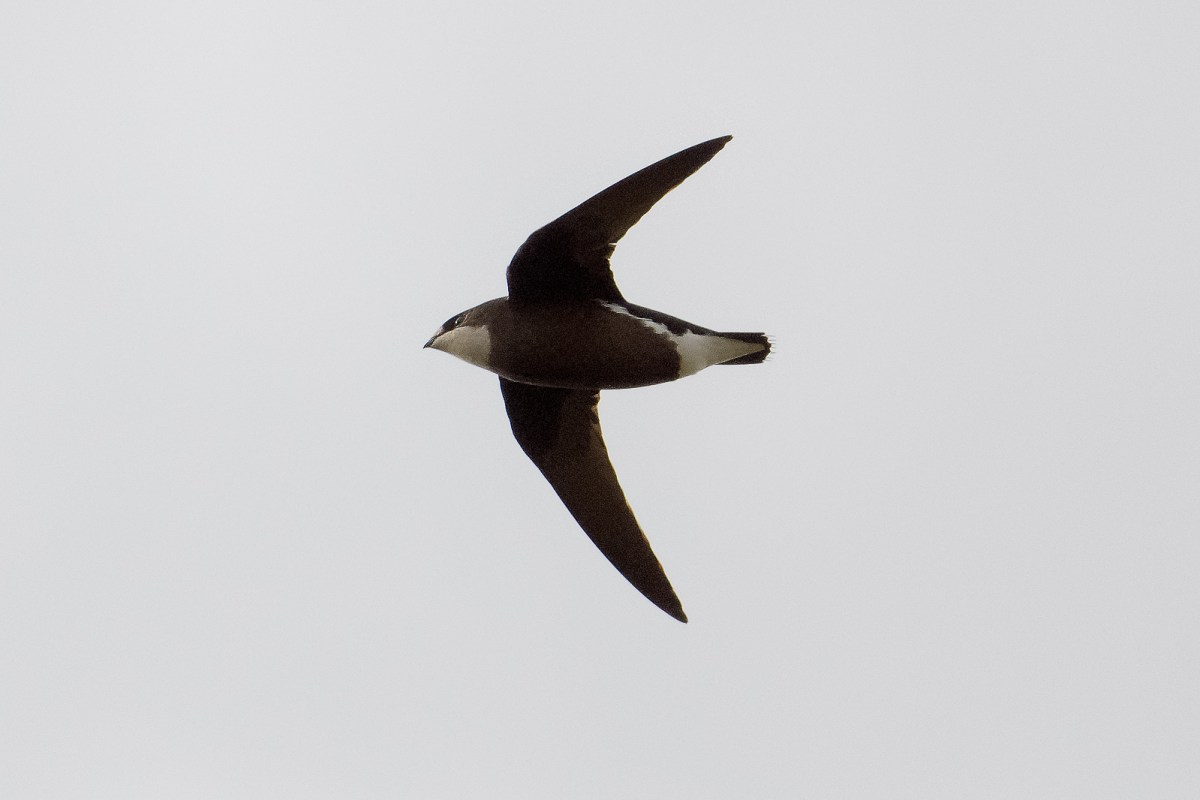
Suddenly, as in literally out of nowhere, a flock of fast moving birds, swallow-like appeared, and I have to say that was my first reaction, and I looked back at the terns. Then the first of the flock approached, must too bulky for swallows, and those long narrow knife-like wings took me back to my youth, and I called, “Swifts”, because in those days, that is what we called them.

There was little light, but still, it was an opportunity.

These days they are called ‘White-throated Needletails”. And as they sped past, the white throat and inner tail marks were obvious. First it was only one or two, but they kept coming and in the end, boyscout count, there was around 40-50 fly by. Just that  little too high up for detail, and they didn’t make any variation in their travel line.

As kids on the open Mallee plains, we would often see them flitting about ahead of an impending weather event.  A fancy name for wind, rain, and thunder.  The air could be electric.
So it was no surprise they had been riding on the edge of the incoming squall.

On checking my Morecombe Fieldguide, they are described as:

Largest swift in Australia, … one of the fastest of all birds, …often gathers over headlands in humid unsettled weather preceding thunderstorms.

That sounds about right to me.  Simpson and Day add:

Wings swept back curved, anchor-like, tips pointed.

And by the time we had checked to see if there were any more, the first ones no doubt were approaching Footscray!

We took the hint and went back to the carpark, arriving just as the first few spots of rain came down, and the road was awash on the way out.

“Into this world we’re thrown…
An actor out on loan
 Riders on the storm.”

Enjoy


Saturday Evening Post #71 Wings Out

One of the most sought after inflight poses for birds is the “Heraldic” form.

The doyen of the craft was an Englishman named Eric Hosking.  It is hard to appreciate the complexity and technical difficulties that Eric had to overcome, in this day of High ISO values, Ultra fast f/2 and f/2.8 lenses and long focal lengths, electronic flash and electronic release systems.  Yet some of his earliest and most influential work was made with a glass plate or sheet film camera.  Each darkslide had 2 exposures.
Yet, if you take the chance to view the EricHosking Gallery online or obtain a copy of some of his books, the work still is modern, fresh and extremely well detailed.

In any discussion of his work, several points will always be made.
1 His meticulous attention to detail.  His field note books contained observations and details that  advanced our understanding enormously.
2. His care for the subject he was working with. No photograph was worth endangering the bird. He went to great care to work in the bird’s world at its pleasure.
3.His endless enthusiasm for the subjects, their surrounds, the technical issues and opportunities to share his work with others.

It is so difficult to think of sitting in a hide, with just one piece of film (a glass plate of ISO less the 10) and having to prefocus where the bird ‘should’ be at the time of exposure, and then making just the right judgement to press the shutter. No burst at 16fps for Eric.

He had a most unfortunate accident early in his career with a Tawny Owl.  A hide had been built to photograph a Tawny Owl family, but late one night he had to return to the hide as he thought poachers were at work.  On entering the hide, the Tawny flew in, and and to quote from “Any Eye for a Bird”
There was not a sound, not even the whisper of a wing. But out of the silent darkness a swift and heavy blow struck my face. There was an agonising stab in my left eye.  I could see nothing. The owl, with its night vision, had dived-bombed with deadly accuracy, sinking a claw deep into the centre of my eye.”

Eric would lose the eye.

But he soon went back to work.

One of his greatest images is the heraldic owl.

This was made in 1948, and Eric describes it as a “One in a Million Pose”.

The basis of the shape of the image is the typical heraldic form of family crest.

That such a pioneer was able to give us so many fine images and be an inspiration to so many people, not just photographers, but naturalists and the general public is part of the tribute to his skills, and concern for his subjects.

I was working with a pair of Black-shouldered Kites.
The male lifted off the tree, and soon after the female took off along the track.
He was back in less than 30 seconds flat with a mouse.  And he immediately began work on devouring it. She turned up a minute or so later, carrying a freshly plucked stick, no doubt intending to do some work on a nest.
On seeing him, she changed direction, swung in, expecting I guess, to get a share of  his dinner, and wings out dropped the stick. (the header photo)
Then in a million to one moment, the wings were out in the heraldic fashion, and I heard Eric say, “Well done!”

Both shots have been through Nik Silver Efex Pro, just to keep the historic theme going.

Enjoy.

Saturday Evening Post #70 : Exposure by Cat’s Eye.

If you are like me, and let’s hope that is not in too many ways, 🙂 then no doubt you’ll have pondered from the day you first picked up a camera,
“What is Correct Exposure?”

And… haven’t there been any number of ‘friends, family, websites, blogs, books, faceblot pages, and courses to set you on the right road.

Luckily this is not going to add to the incessant chatter.

I think, “What is correct exposure?” is about as useful as asking, ‘What colour should I wear?’ Because of so many variables.

T’would be easy to offer advice, such as, “Oh for my bird shots I use the fastest shutter speed, blah, blah.”

The great New York newspaper, Wegee,  is reputed to have said, “f/8 and be there!”

So let’s go at this another way.  How to you-royal plural-determine correct exposure?

Well in this modern day and age, you point the camera, press the shutter and all is well. (most of the time, with the exceptions of the critical moments, when its wrong!)
No doubt modern camera design is at pains to get it as close for most general picture making as possible.  Else people wouldn’t buy the cameras. So hats of to the manufacturers for their great work.

All sorts of hand-held exposure meters have been used in the past, and each had their adherents. And if you think camera blog discussions get heated and verbose, you’ve never heard the disciples of one sort of meter lampooning the other less informed individuals of lesser choice meters. 🙂
When I started, the choice was pretty simple, English company Sangamo Weston had a Weston Master meter. I confess to owning several during my lifetime, and have just purchased one from ebay, as much for sentimental as much as practical reasons.

As time went on and studio requirements changes, so did my choice and Sekonic meters came (and went)

Note I’m not into, here, whether fast shutter, or large or small aperture are the creative issue.
And don’t start me on the poorly defined “Exposure Triangle”.

Just a lighthearted stroll through the thorny subject of how we determine from the light available, and our photographic intention, what settings might best bring out our intent and feel for the subject.
Simply, how to measure the amount of light off the subject. (Or just for completeness for the Incident Method die-hards, how much is going to strike the subject)

What is the average reflectance of a scene has also bought in its wake, a host of disagreements.

For the record, Kodak scientists in the early 1900s arrived that in bright sunlight about 13.4% And then based their recommended exposure settings for their filums upon that basis.
Not good enough cried Fred Picker and St. Ansel, and they  cajouled Kodak into making their measurements at 18%.
Dah Dah, enter the great Kodak 18%-90% reflectance Card. Kodak Publication No. R-27.  Cat 152 7795.  Which, distinctly says on the outside of the package.
Designed for use with and exposure meter in artificial light. For use with Kodak Ektacolor and Vericolour Films.

Makes me smile when I see the card recommended for use in daylight by some controversial exposure determining system. And also in camera reviews that say—Oh, the manufacturer has set the basic exposure wrongly as it overexposes by 1/3 stop. Sure does. It’s easy to speculate when you don’t grasp the theory.

Then there’s the Sunny Sixteen Rule. Used to be on the leaflet inside each roll of filum.
Set the shutter speed to 1/ISO and aperture to f/16 and in bright daylight you’ll get correct exposure.
And if you’ve never done this, then next time your out in bright sunshine, set the camera to Manual. Dial in 100ISO, set the shutter to 1/125 (closest to 100) dial in an aperture of f/16, and sun over-your-shoulder. Bet is so close  to acceptable as to be scary. 🙂 But who wants to shoot at f/16. Not me.

You could try the Nicéphore Niépce method:  8 hours out the back window of the house. Yep, first recorded exposure ever! And no shadows in the scene. Give you HDR folk something to ponder. 😉 Actually there is more recent research that suggests it might have been several days exposure!   Think about that the next time you choose 1/4000th.

Which brings us to Exposure by a Cat Eye.

Enter: Oscar Gustav Rejlander, the year is 1857, and he is embarking on a rather risque work called, “Two ways of Life”. Here’s a link

To quote from Rodger Cicala over at LensRentals.com,

“Rejlander’s photographic career was remarkable. It wasn’t possible to practice “street photography” in those days, so Rejlander would use models to recreate scenes he observed of the poor in Britain at that time, producing haunting photographs that are collected in museums around the world today.
 He was also the first to use a light meter— sort of, anyway. He would bring his cat into the studio: if the cat’s eye’s were like slits he used a short exposure, if more open a long exposure, and if the cat’s pupils were wide open he knew there wasn’t enough light to photograph!”

So there you are.  The next time you struggle with “Should I add or subtract EV for this shot?” Just remember there is a long history of incorrect exposures littering the photographic biosphere.
And take heart, I’m responsible for a good many of them 🙂

Here’s a visiting Black Kite, just back to re-establish its breeding territory I think.
Guess which exposure method I used?  Oh, and to help, I don’t own or have access to a cat;-)
Enjoy


Saturday Evening Post #68 : Sight and Vision

A lot these days in photo circles is talked about Vision. What they are wrestling with is; why I photograph birds, someone else photographs cars, while another does street, and yet another is ‘creative’ and someone else is  ‘general purpose’. No matter, the issue is the same.  Is the way I photograph the subject an expression of ‘me’.  And to a lesser extent, “Oh, and what I think if the subject”.  And if it gets me more “likes’ on spaceblock, then I know I’ve arrived.

And the discussions go off the rails as defining ‘me’ is not so much about photographic topics, but rather about becoming a ‘fulfilled’ person.

The thing that seems ‘obvious’ to me in going down that maze, is we begin to lose the benefit of the right language to find ways to extend the photographic vision.

People, say, “Oh, I’m not a creative person.” ” I don’t have much imagination”. But its not so much I think being ‘creative’ as having insight into the subject.  What do you want to say, how should it look, what is the right approach.

Sight is such a precious gift, so is in-sight. If I close my eyes and think of something, I’ll say, “Oh, I see.”  When I’m out and about with fellow photographers, I’m often conscious that they are too involved in their immediate ‘around’, and are at the mercy of impulses.  Point something out, and the response is, almost always, “Oh, I didn’t see that!”.

Others are hungry, and point things out that I miss
Part of that I think is the lack of language to identify ‘the photographic possibilities’ in front of us.
Form, Tone, Texture, Shape, Pattern, and all the rest are the building blocks of our creativity.

Had Jane Austen written “Pride and Prejudice” without a knowledge of word flow, sentence structure, grammar and description, we might have ended up with:-

Want acknowledged  is a man truth  , that a possession single good in  wife of a  universally fortune    ,  must be in of a it.  —Sorry Jane  I apologise profusely.

A client steps into the the studio to have their new whizz-bangery product photographed for a brochure.  A full brief is provided, Simple Set, Highlight the Product, bring out the best features. Make it appealing.
The photographer makes the shot, then says, “Oh, that is not creative enough, it doesn’t say anything about me, and my skill and my vision”
Next step, into Photoshop, download some Preset, turn the subject into HDR, blur out the company logo, make a drop shadow around the product name, give an ‘artistic’ wash to the final result.
Client says, “That is not what I asked for”
Photographer says, “No, but look how creative I’ve been”.
Client says, “I’ll look for another photographer.

or.

Client comes in with new  whizz-bangery product.
“I need a photograph for our new brochure.”
Photographer, “Sure, what is it about the product you want to emphasise. What kind of feel do you want to give it. How should the final look”
Client, “Oh, I don’t know. But. I’ll know it when I see it.”
Photographer, “Sorry, Look for another photographer!  If you can’t see it, I can’t photograph it.”

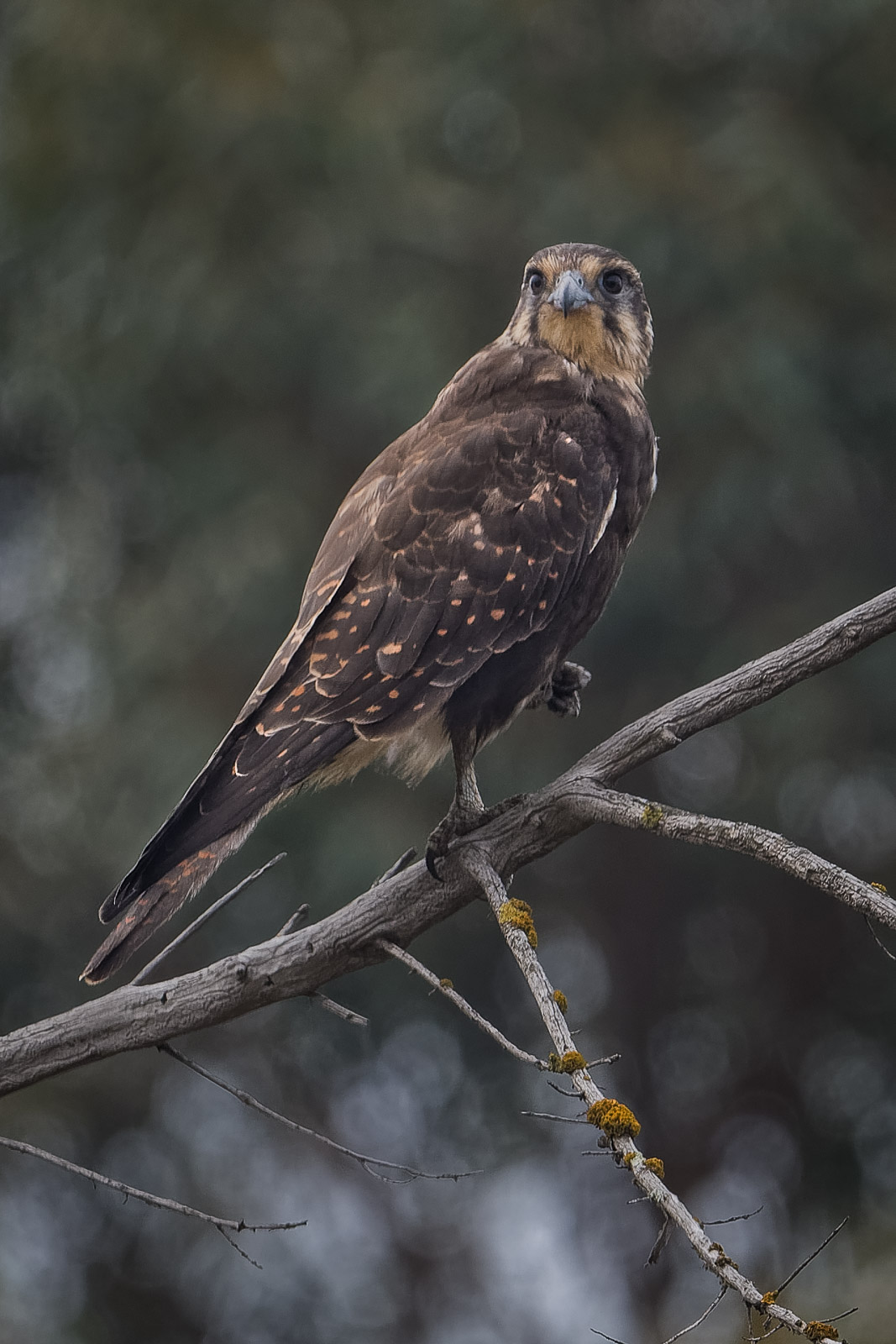
EE and I were searching for the young Brown Falcons. They are near full grown, so it was not going to be easy, and so we strolled along a track looking for a table for morning tea.  When there on the tree in front, sat, Brown. The weather was foggy, 100% humidity, and smokey still from the bushfires. The light was impossible. First shot is black shape on a black shape tree. Hardly inspiring. So I moved into the scrub a bit, and eventually managed the bird against a distant pine tree, but with so many light patches coming through the branches, it was not that much better.
Re-assess. I told EE I was going to backtrack about 50m, head across the road and hook around in a “U” to be opposite the bird on the other side of the road, at least it would be against a supportive background.
Brown, was in no particular hurry. Patience is their watchword. After a few minutes I was in position, and while not perfect at least I could see the bird.
And we entered Brown Falcon Time. Twenty minutes or so of preening, watching, changing leg positions, preening, watching.  Perhaps the fog and smoke gave it little option.
I’m nailed to the viewfinder.  After a suitable look around, the bird became active, stretched, preened out the wing feathers and was probably getting ready to leave.  Should be a good inflight I’m convinced.

But.

What I didn’t realise, from my position just off the track,  was that two people were walking down toward us. Then ‘crack’—a broken stick, and I made the absolute beginner’s mistake, I looked away. Milliseconds at most. Brown had dropped and was away. One wing flap-just about got it in viewfinder, second wing flap-on target, but out of focus, third wing flap-focus locked,— here’s a Flickr Link,  fourth wing flap-angle of bird is now away from me, and tail feathers aren’t that exciting.
“Expletive deleted”.
“Oh’, said the passersby, “Nature Photographers.  Sorry, hope we didn’t spoil your shot.”
“I’ve had better days,” I snap.
Both went on mumbling about rude nature photographers…

Here is the perched shot.
Again I’m going to show it vertical as that is how I envisioned it.

This young Brown is beginning to moult out of of juvenile colours, the rich orange is now being replaced by the more normal creamy colours. The tail has three long new feathers and on each edge of the tail, short growing new feathers, they grow fast so it should be good  in a week or so.


Saturday Evening Post #67 : From Studio Werkz

Studio Werkz was a proposed name for a photo studio/business in another universe. Mooted by an eclectic group of photographers, we had the idea of being able to offer a wide range of photo services, but in the morning, after the coffee kicked in, we managed to drift in our own directions.

Still I’ve often retained it for some bird portraits that have a ‘studio quality’ about them.

This is usually a clever mix of bird character, the right location and an interesting lighting set.

As my earliest mentor was oft to say when assembling a lighting order for a product or portrait, “We don’t keep adding light, we work to remove the shadows until the subject expresses itself.” Which means in commercial product photography that no two lighting problems are alike, and the difference of a few millimetres up or down, left or right of lights, reflectors, camera angle, lens choice could result in an entirely different rendition.

Which, still holds true in this day an age of bulk-flat light, the environmental feel, or the harshness of poorly balanced lighting and an over abundance of post-processing.

So Studio Werkz images try to emulate those great lighting arrays, without the benefit of controlled studio.

The other morning I looked out the front door to see what all the noise in the garden was about. New Holland Honeyeaters at corroboree. Each sitting on a branch and crying out at all its relatives.

And then one landed on the agapanthus plant in the garden.
The early morning light stuck hard lines across the bird, separated it from the background, incidentally my neighbour over the road’s garage door in shade.

“Right”.

Scramble to get the camera, grabbed the one with the 500mm lens, and opened the door.

Gone.

But the noise carried on and they flicked back and forward of the agapanthus, and I waited.

The trick of course is to get the best light on the bird, and to keep shadow detail, so there were only ever going to be some angles that would work.
Until Mr Clever turned up.

“Would you like me to pose upside down?” it seemed to say.

Adjust the exposure to hold the highlights, and the job was done.  In a studio of course, it would have been easier to add a light or two to open up the shadows, or at least put up a reflector to push some light into the shadows.  These days, we just slide up the ‘fill-light’ in software and job is done.

We each have our own way of making that work, and my favourite for many years was a Nikon Software, Capture NX(2). Its major claim to fame was some clever Nik Software, (different company) “Control Points” They measured the lightness and colour values of an area (think L*A*B* Color space), and then applied it to all similar values in a given area. Making it easy to open up shadows or make subtle changes to colour and tone. Sort of like Photoshop Layer Masks and a Brush.
Nik eventually marketed its own versions, and Google bought them out, and the series languished until DxO Labs purchased the technology and have incorporated it into their very clever Optics Pro software, now called DxO PhotoLab.

Pop the Adjustment Tool into the shadow areas on the bird’s chest, slide up the ‘shadows’ controller. Simples.
Dean Collins couldn’t have done any better with “Available Light”. — For new readers, there is a photographic joke in there—you’d need to read back on my Dean Collins series.

I have to say, I really wanted to show this as a vertical, so I’ve done a header image horizontal, as that is what WordPress demands, but here is the way I saw it.


Saturday Evening Post #66: Down the Rabbit Hole

“When did you go down the Rabbit Hole,” he asked.

I was chatting with a mentor, and the question of how we got into photography came up.

Long term reader(s), (Thank you), will recall I’ve discussed my early photographic exploits.  So I’ll not bore you further with daring exploits of a 13 and 14 year old boy armed with a Magic Carpet, “Super Balda 120 Folding Camera”.

But it got me to thinking about how Alice, in her adventures met all sorts of different situations. Together with some fascinating characters, and some great, thanks to Lewis Carrol’s unfettered imagination, and his superb way with words, that bring tears of joy and delight, along with a helping of drama, and the delicate balance of—will things turn out alright.

And no two rabbit holes are the same. For some it’s a technical exercise, for others a range of creative pursuits. For others the need to document the good, or the bad about the world around. Causes, events, happenings, occasions, quiet moments, even introspection are all part and parcel of the photo pursuit. These days an added facet is the unending webbased discussions that seem to fill each moment of the day with an ever increasing complexity. This camera, that lens, have you tried the best software, my vision, my pov, my set of rules or even my blindness to other’s view of their world.  All the while it seems it stops us from making those great images.

(I was nearly going to write, and where for all these waffling experts are their stunning photos to prove their position,. But not wishing to offend anyone, I won’t 🙂 )

I think a better question, is ‘Now that I’m down the Rabbit Hole what direction do I take?”  To mess with the Cheshire Cat? To follow the time poor Bunny, or to trade swords with the Queen of Hearts?  Or to try to escape from the White Rabbit’s house?

There is, as William Neale, points out, a delicate balance between working more with the same subject for better angles, better light, more mood, or simply moving on for another subject.
These days, I’m committed to Bird Photography, so add the additional “Wonderland’ moment of how the subject interacts in its world.

Sometimes I stay for hours, hoping for a new look at the old subject, sometimes coming back many days in a row, looking for that telling moment. Sometimes I find such exciting subjects and I just need to slow down and have the patience and the concentration  to wait for the right moment. The one that captures the right nuance of the subject.

Raucous, loud and bullying are all words that tell of “Sulphur-crested Cockatoos.” Amazing aeronauts, masters of the air and skilled artisans of the wind, also are part of their character.
We were in a paddock waiting for for the appearance of some small bush birds.  All around the Cockys were putting on Royal Command Performances.
It might have been a distraction.  But once down the Rabbit Hole, all sorts of worlds open up if you have the Key, the Potion, and the Cake. 🙂