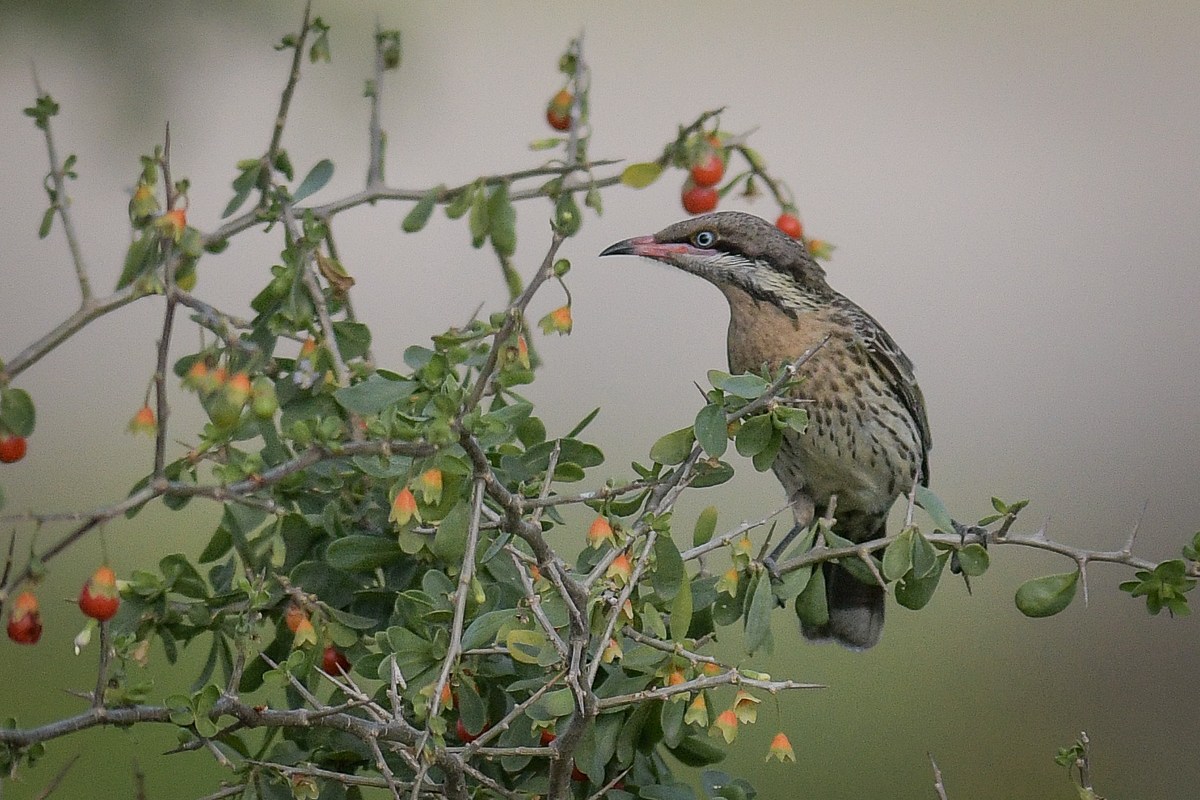
South African Boxthorn is a highly invasive plant, imported into Australia, around the 1880s. The purpose was to provide hedgerows for land demarkaction.
The plant, however, because of it’s evasive properties, had other ideas, and quickly spread out beyond the intended purpose.
Like many of the ‘imports’ into Australia, such as rabbits, foxes, prickly pear, cats, deer and a host of other unmentionables, (including land-lice—first nations word for sheep), and South African Boneseed, whatever the intended and seemingly harmless (insert profit here) reason, the pests became feral and are now for all intents and purposes beyond complete eradication.
Boxthorn has a fruit that starts out green but ripens to a rich red/orange. Each fruit can contain as many as 70 or more seeds, each capable of germination. Given a two metre high plant can contain thousands of the little red invaders, it’s not hard to see how it was able to get away from control. Add to that, it is quite capable of sprouting from a broken, or cut twig, or branch, and the problem simply gets larger.
Early attempts to simply plough them back into the ground, just gave them the space needed to spread even further.
Poisons work, as does cutting them down, stacking them to air dry, and treating the roots. All of which adds up to hard work, and while effective, like dealing with another feral, like Boneseed, needs constant attention.
So in lots of places, by the roadside, in open bush land and forest, the plant just carries on its merry way.
Nearby to us is a small abandoned piece of roadway and some open paddock. It has several stands of boxthorn. At present the plants are in fruit, and a number of local birds have added the berries to their diet. Cockatoos, some parrots and honeyeaters make the most of the offering, and of course, either drop the seeds, or carry them to be deposited when they excrete else where.
Two birds I’ve never seen on boxthorn before are Black-faced Cuckoo-shrikes, and Spiny-cheeked Honeyeaters. However for some reason, the nomad honeyeaters and the Cuckoo-shrikes have been very busy in the small area, and over a matter of a week or so have practically stripped the plants of fruit.
Round one to the Boxthorn.


Great to see the Spiny-cheeked, David!
A rare visitor to the area!
Interesting that the Cuckoo-shrikes are feeding on the Boxthorn too!
Fine images to view!
LikeLiked by 1 person
Hi Dave, and amazing how quickly just a handful of birds can strip the plants. But the winner is The Boxthorn.
LikeLike
These birds are certainly helping spread the seeds, which is an important function of our birds, but not for this species. What a great find David to see the Spiny cheeked so close the east coast. Lovely captures
LikeLiked by 1 person
HI Ashley, I grew up in the Mallee, the Spiny-cheeked were relatively common there most of the year. It’s a bit of a thrill to see one down south, but they must have had a bit of the travel bug about them this season as we’ve seen good numbers in several locations
Some local conservation groups and the council environmental departments do great work slowing the spread and re-vegetating,
The bush also provides habitat for wrens and thornbills and the like, so simply cutting them back without some replanting is also environmentally dangerous.
LikeLiked by 1 person
Great story Dave, as usual awesome images
LikeLike
HI Andrew, Probably the bane of our existence. Still, hard work at keeping it under control takes time, but with revegetation you guys have done some pretty good work.
About 30-40 birds have been at work on these bushes and they are pretty much stripped clean. No idea where the droppings are going to end up.
Seeya
LikeLike
as long as the droppings dont end up in hobsons bay 🤣🤣
LikeLike
Beautiful images as usual David, and yes, the Boxthorn is definitely the winner.
LikeLike