Mr An Onymous dropped me an email, saying he had booked for a Wetlands Birds and Port Phillip bay Seminar complete with field trips. The event was for 10 Satuday mornings and trips to local areas to look for birds and the features of the seminar topic for that day.
So I booked. Thought I’d take the train down to the location as the talkfest was at a library quite near the station, and Mr An had offered to provide Uber support to get to the trip locations.
Fascinating few sessions that covered the history and development of the geology, geography, water systems and the like. Helped get a good picture of why some waders and migrants visit some spots and not otherr. The area around the top end of the Bay has undergone signifcant housing and manufacturing development, and has to put it just blunty, been not very kind to the vast network of wetlands, swamps and backwaters in the area. Also fascinating has been some of the attempts to overdevelop the beach areas. Credit also has to be given to the council and community groups and the research projects that have been conducted. Even if at times it seems that each group has both a different goal and plan to achieve their outcomes.
So with lots of numbers and ideas along with data about the areas flying around in my brain, we set off to visit the trip areas. Of course, not before, the necessary cuppa and bikkie to sustain us for the “Expotition” (Winnie the Pooh)
In all we visited 10 locations—didn’t find the North Pole .One was opposite Mr An’s house and the last one was at Point Cook Coastal Park which is beginning to become our new ‘office’.
Here’s a sampling of the days outings. Oh, and I did enjoy the clickyclack on the railway track as I’ve not been train bound for a number of years.
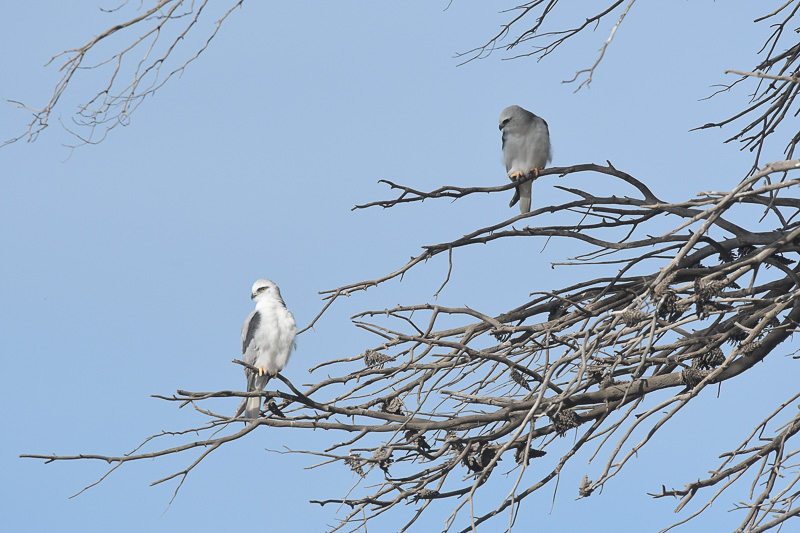
On a fine sunny morning, we made a trip out to see how the Happy Couple from my last post were progressing.
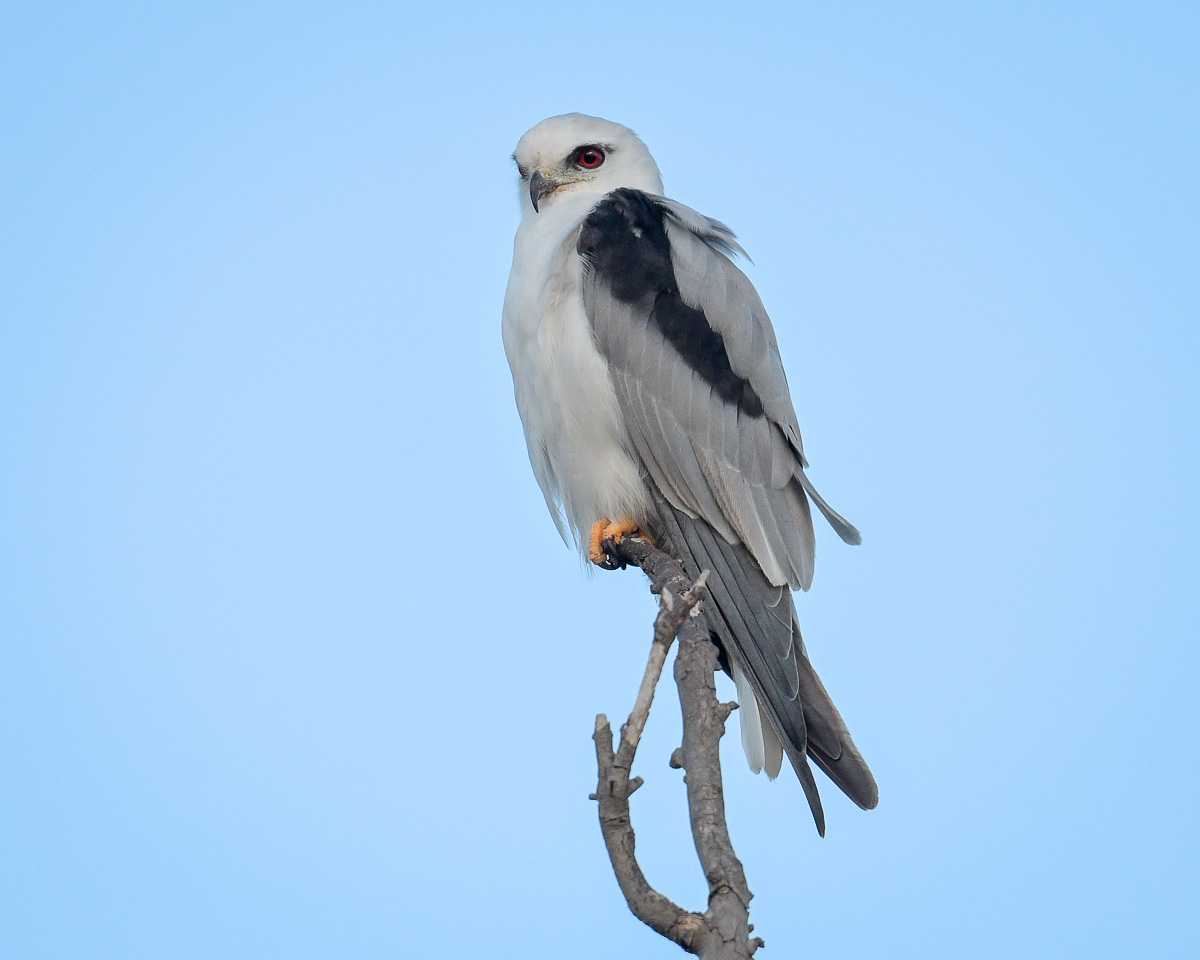
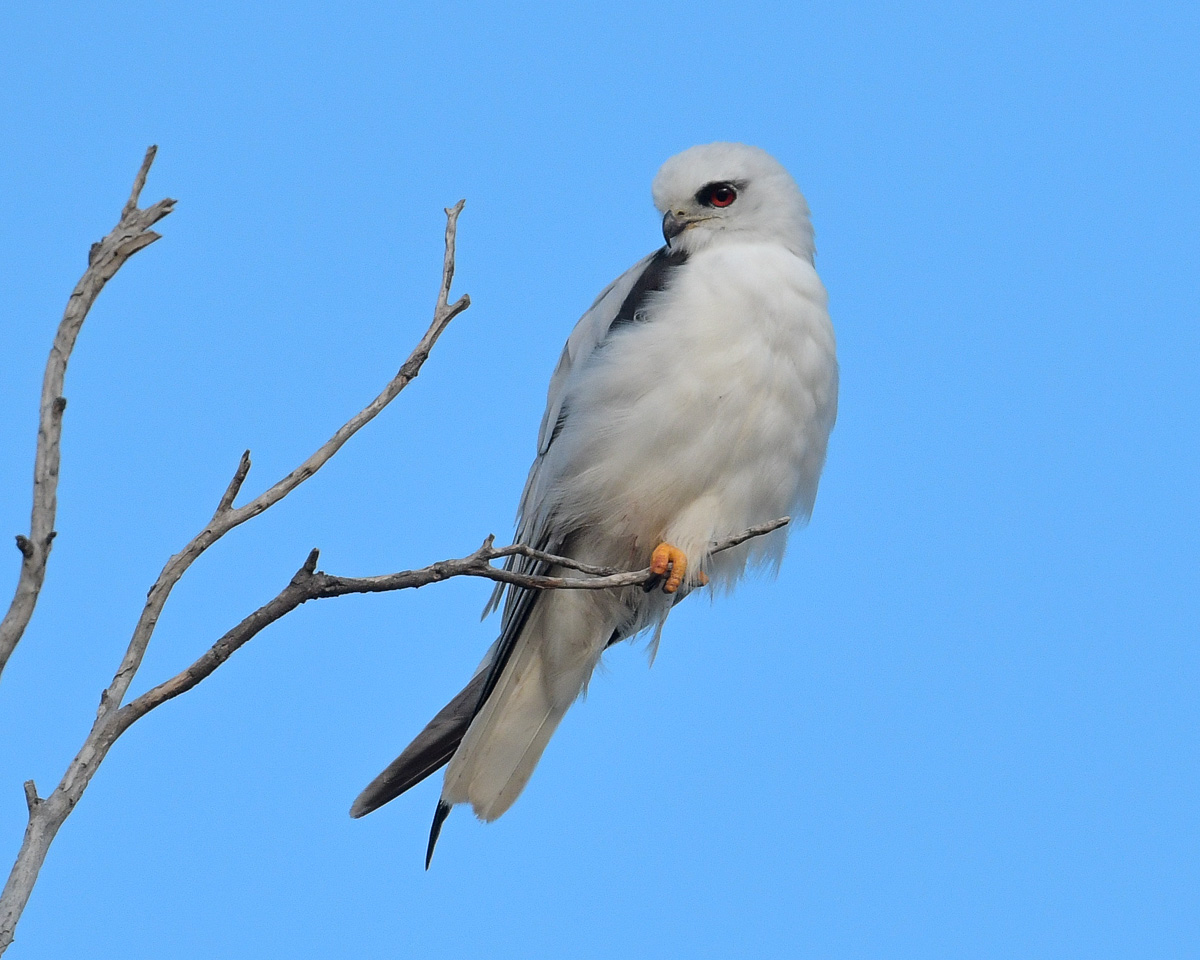
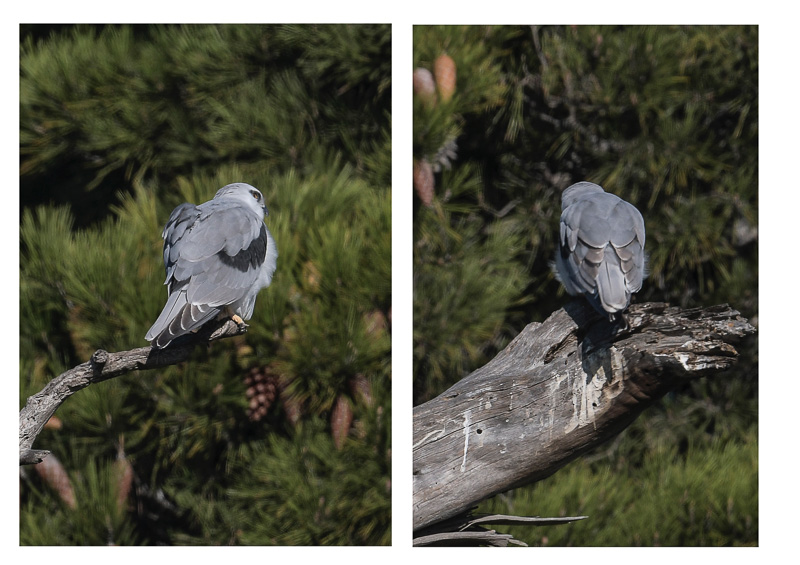
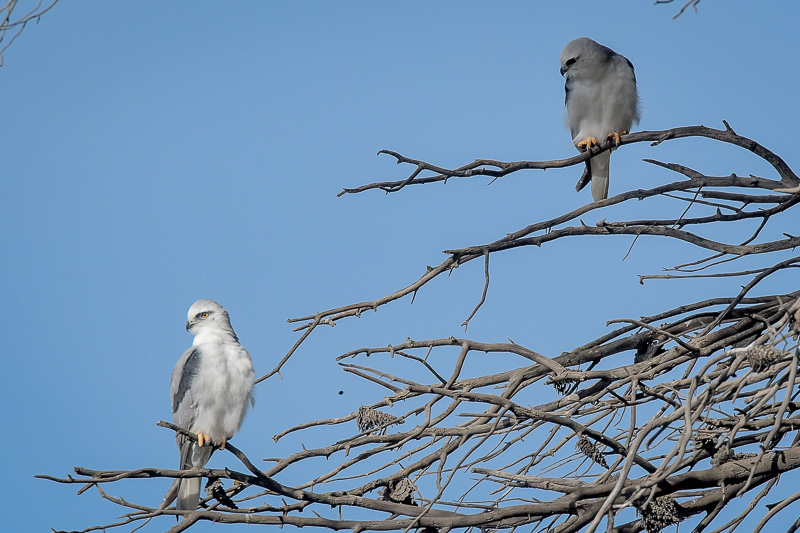
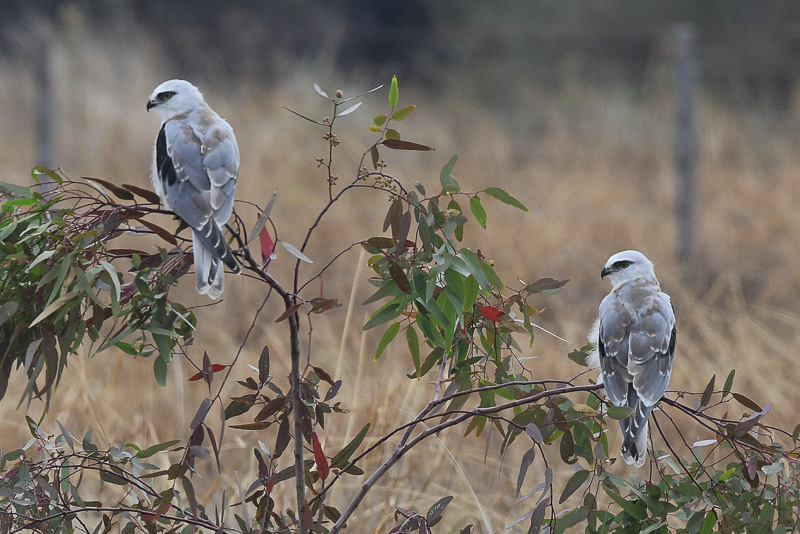
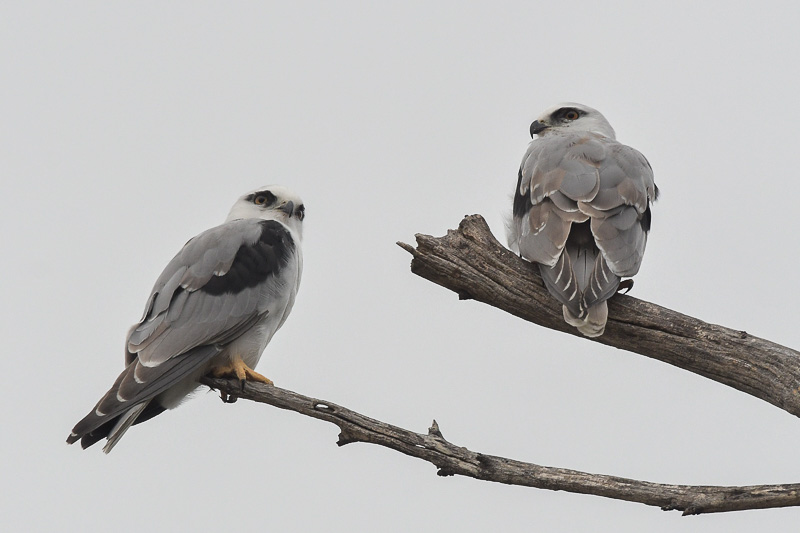
They were both on a roost tree and preening in the sunshine. It was a great opportunity to see some slight differences in their colouring. The male (?) seems to now have lost his former brown tan colours. Both of them still have a shade of brown for the eye colouring.
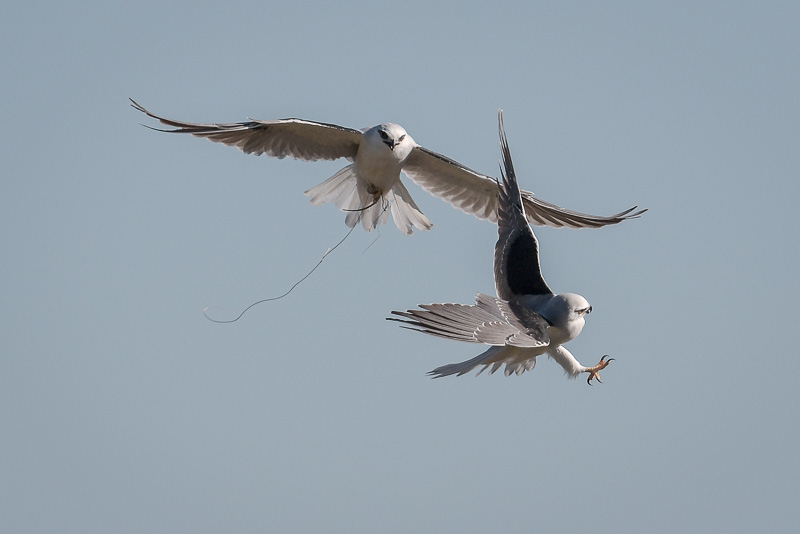
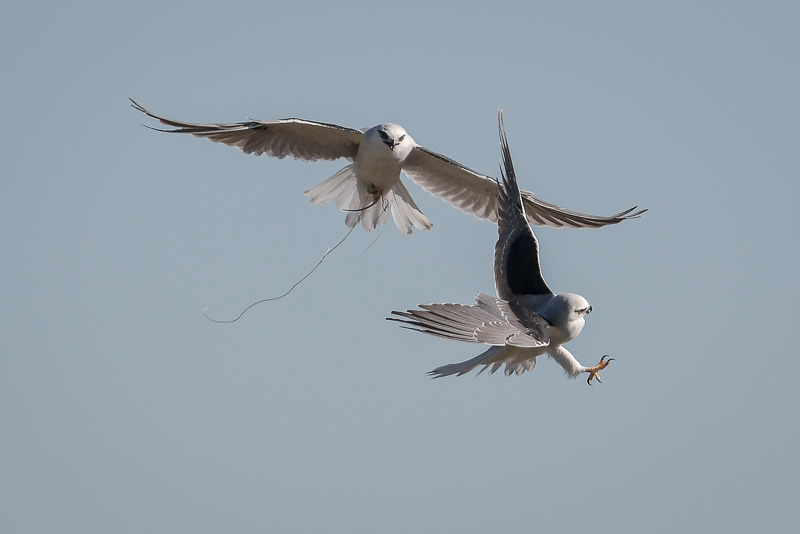
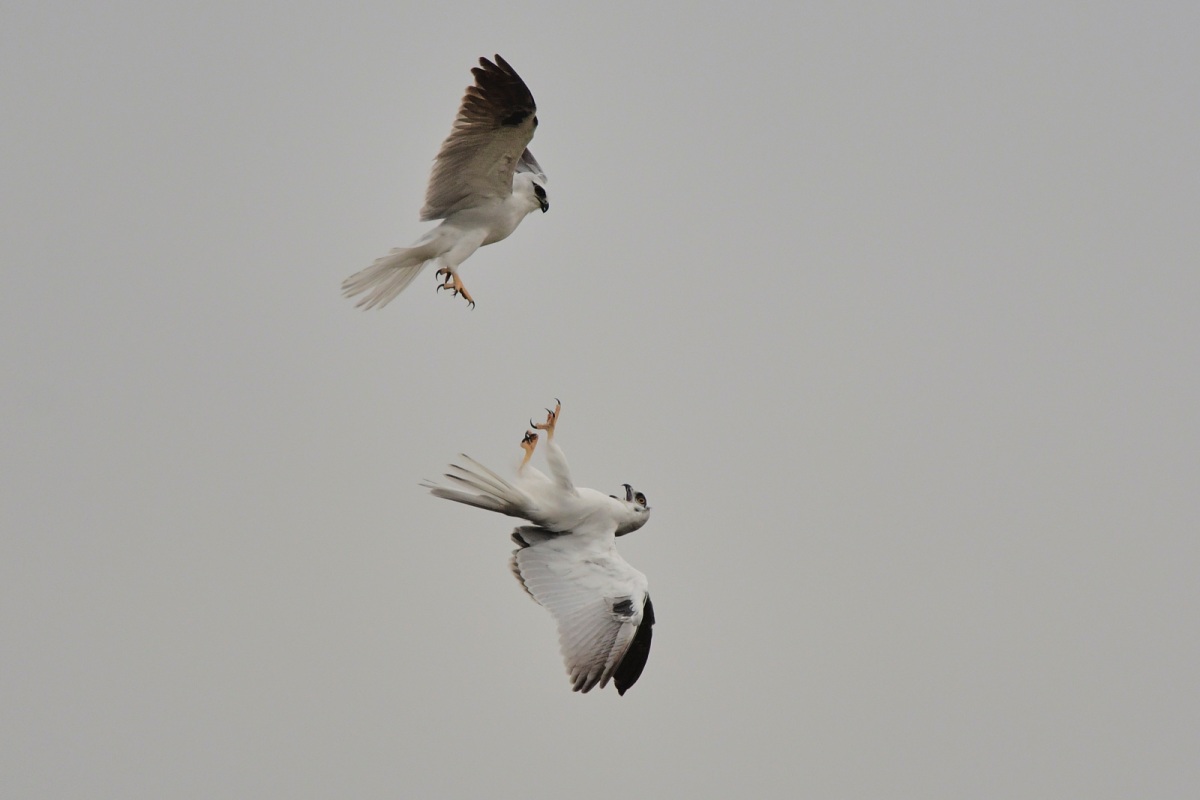
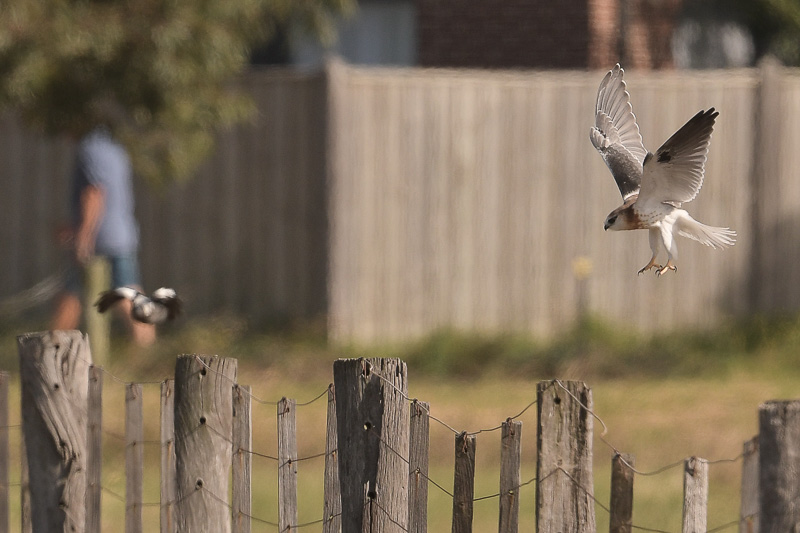
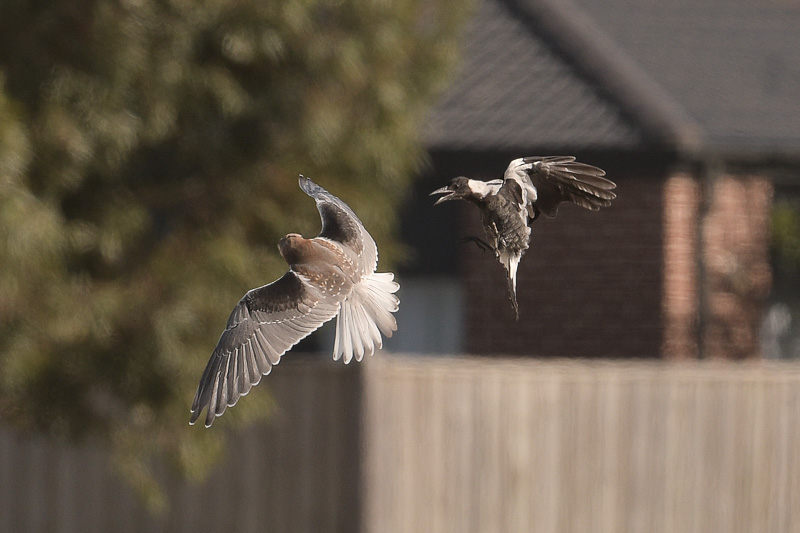
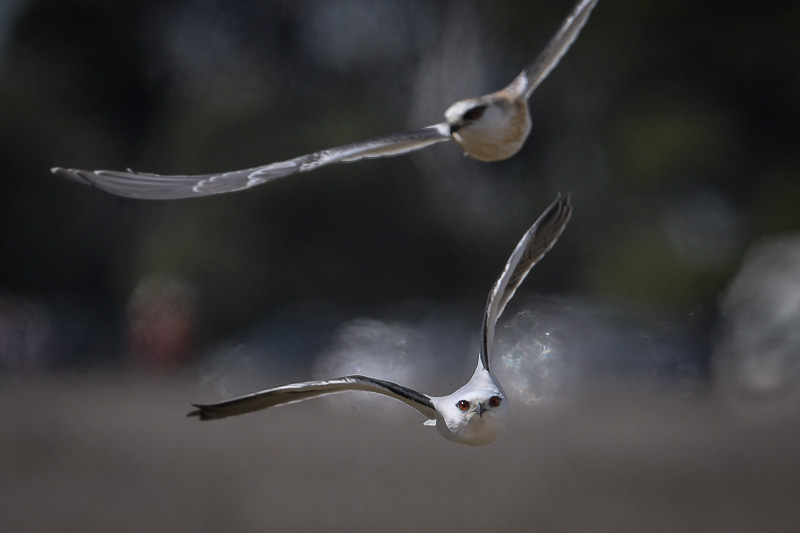
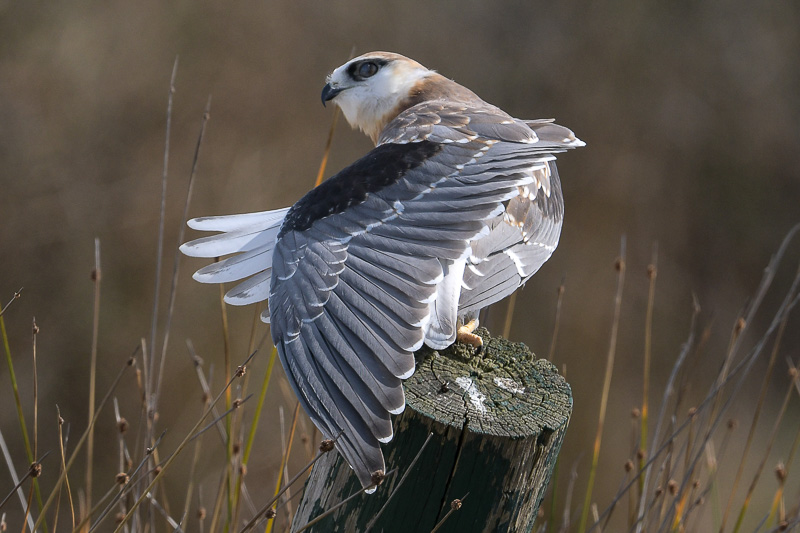
We’ve been guessing about how old they might be, but at best they were from the January clutches, so we are looking at birds around 5-6 months old at best. She (?) still carries some tinges of juvenile colour in her wing feathers, and that can be seen in the diptych below. They both seem to hunt together, and there is occasionally a bit of an aerial battle with talons up, and lots of hoarse calling. But they both return to perch and seem to be at ease wth one another.
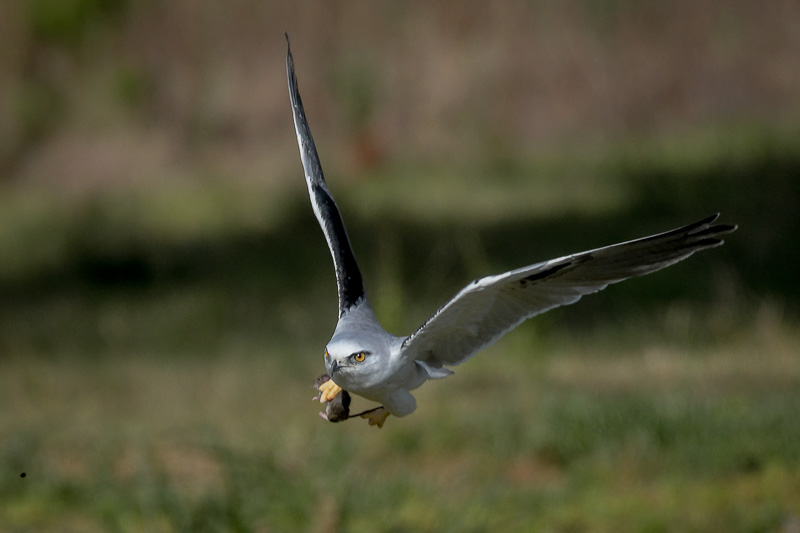
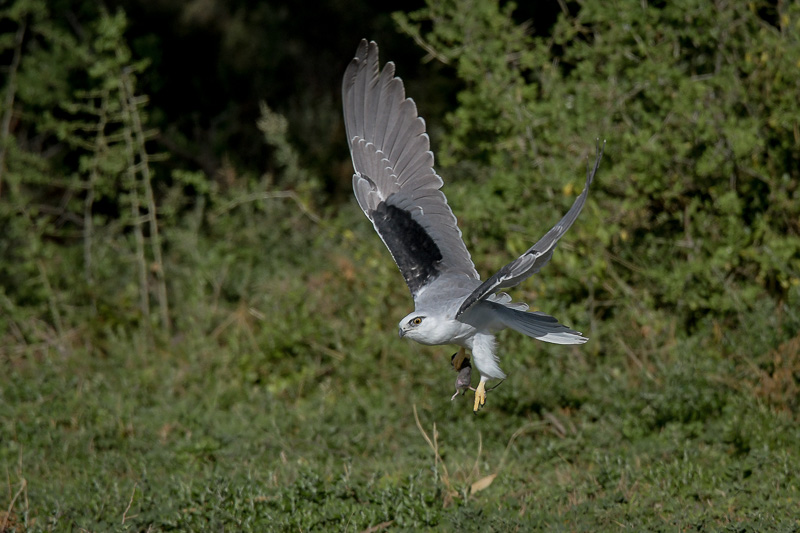
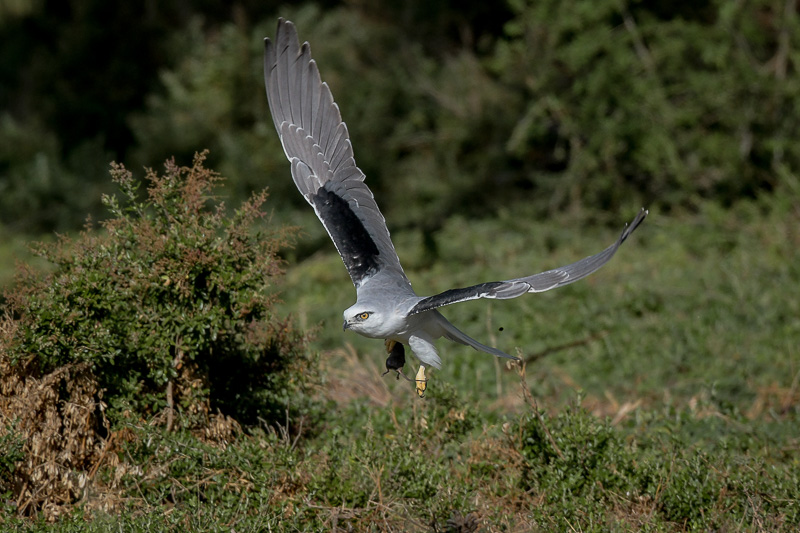
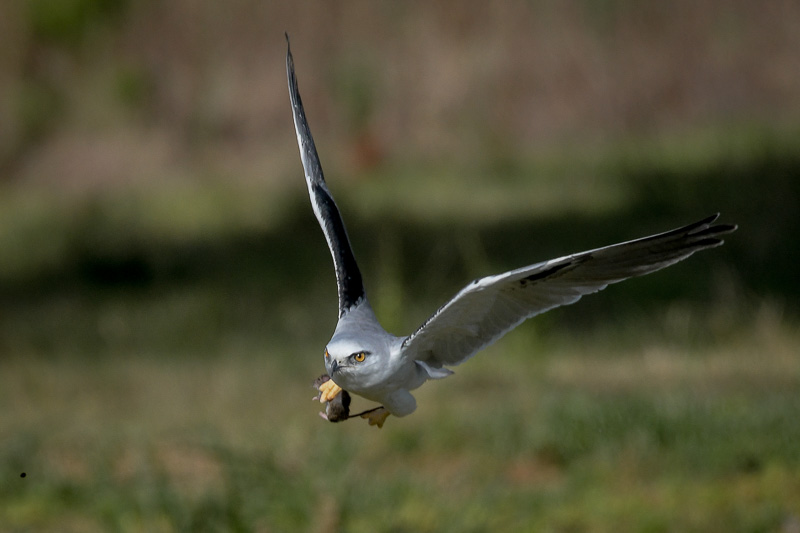
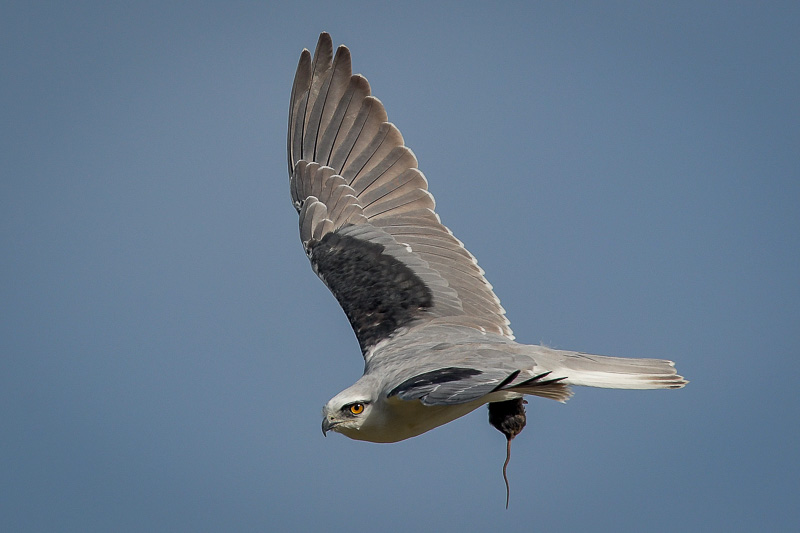
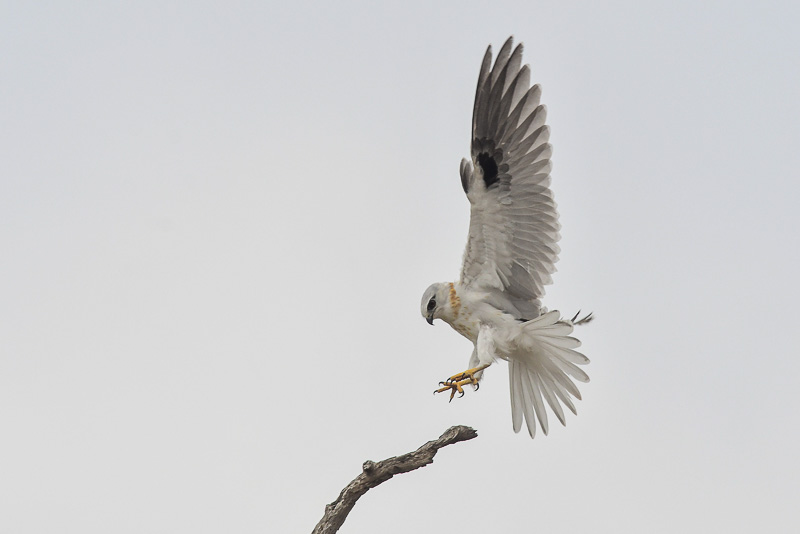
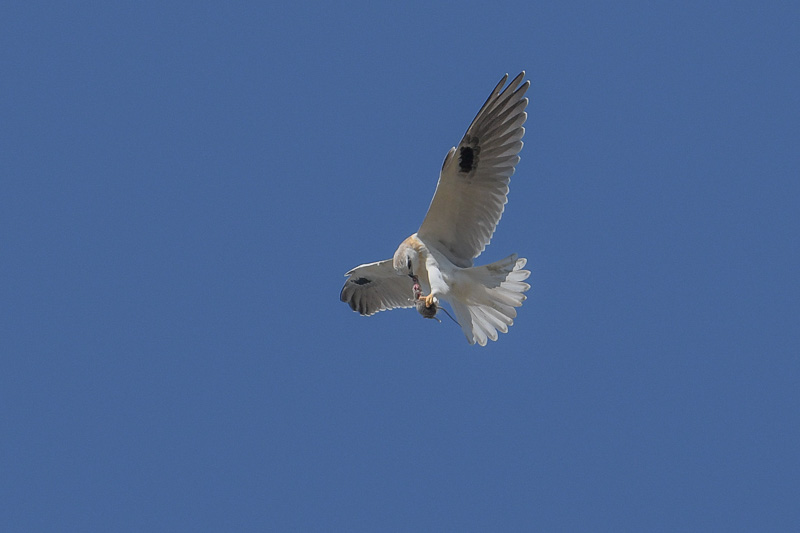
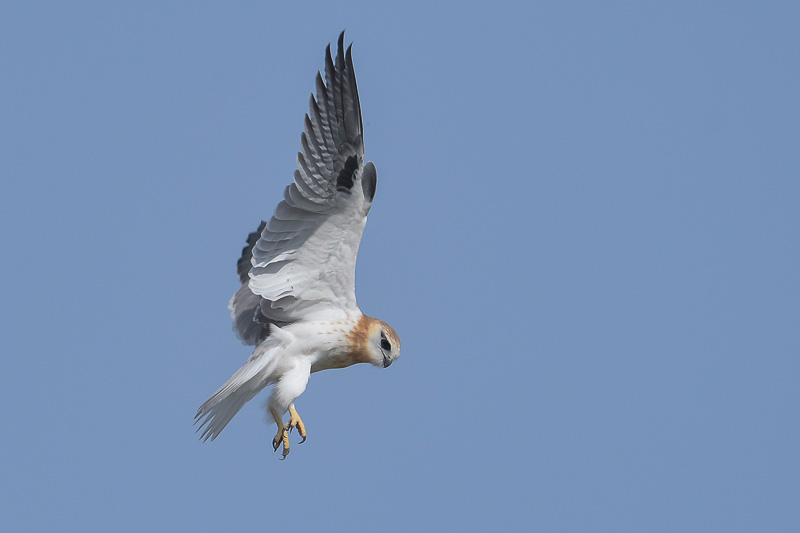
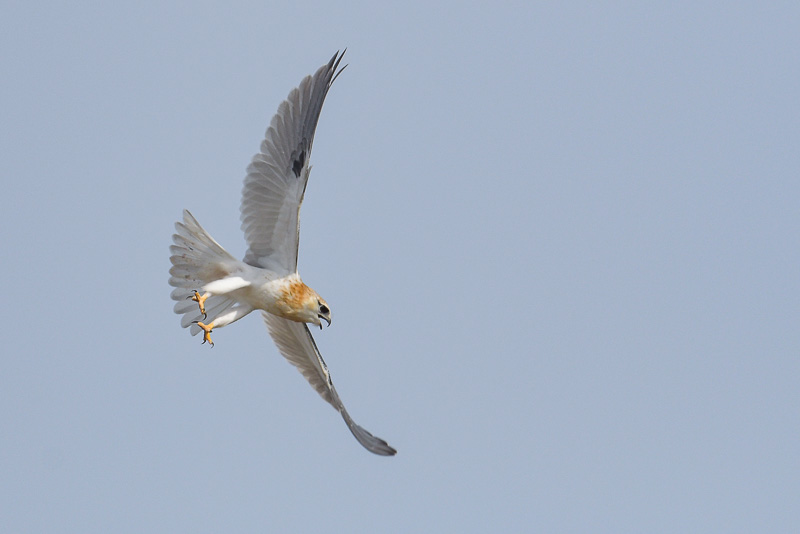
Until. And this is where anthropomorphology takes over for a little. He caught a mouse, and was seemingly intent on bringing it to enjoy his meal. She on the other hand, made a decision that the mouse was in fact for her and a heated chase began across the paddock.
Two conclusions were possible. She might be far enough advanced to want him to begin to feed her for a possible clutch, (even if its not going to happen, she might have the idea, that he should be feeding) He, for his part is still a young bird and the gene pool has yet to release the necessary action needed for him to understand that for the relationship, he needs to provide for her while she sits eggs.
Either way. He had no intention of giving up the mouse and in the end ducked into a very thick tree where she decided not to follow. He didn’t come out again with the mouse, so no doubt polished it off at his leisure.
No doubt there are other Black-shouldered Kite explanations that could account for all this. In the meantime we’ll sit and enjoy their antics.
One of many passes she made to get him to release the mouse. For his part he just stopped in mid-air and she shot past.
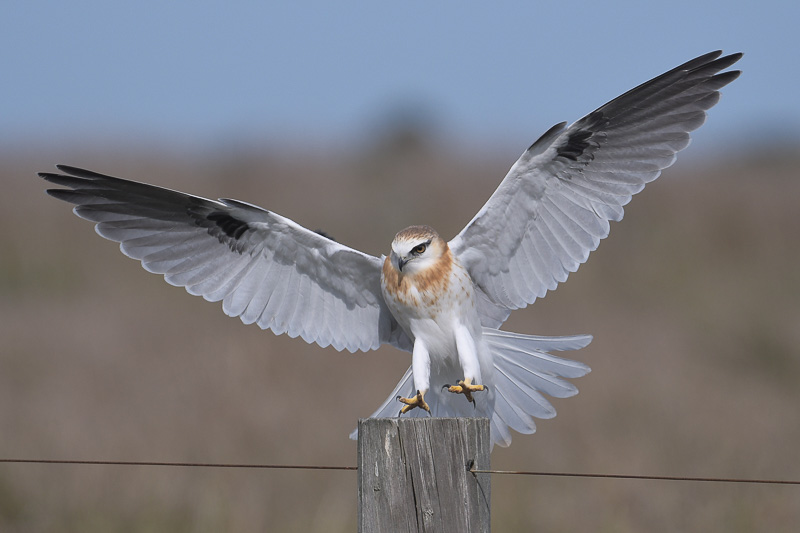
As you know, we’ve been following a young pair of Black-shouldered Kites for the past few weeks.
Earlier this year, a number of pairs nested in the same genera area, about the same time. Probably more like a three to four week span. One pair in what we shall call the ‘home territory’ were in the later shift, and managed to raise and fly two young. At about the same time, the birds from the surrounding areas, moved into the home territory to feed and train their young. With four set of parents and their various offspring the paddocks had as many as 16 birds in the air hunting. Fortunately the mice seemed to have had their own population explosion and there was plenty of food to go round.
But as time went on, as things go with Kites, the young began to disperse and the adults moved on for a well deserved rest. In the end, the home territory male was still in residence, and two young kites that we concluded must be the young from his recent clutch.
Young siblings are happy to sit and hunt together and this couple seemed to be happy with their company. As the days went on, and the young orange feathers began to fade away, it became clear this pair were not moving on at all. And perhaps slowly it became even clearer that they were not siblings, but a young pair. No doubt with all the birds in the feeding frenzy, this pair had made an interesting selection. Too early yet to know if they will stay and nest, but they certainly seem to have established several roost trees as their own.
Pair bonding with Kites is both a high activity and loud process. We found them practicing the techniques they will need for food exchange should they settle on a clutch. It looks pretty aggressive and serious, but they each seemed to know the part they have to play. And a little later I found them sitting together on the nearby track, hunting crickets on the ground.
Hopefully there will be more to share of this story.
Enjoy
Quite relaxed together as they hunt crickets in the grass.
If you’ve been following along a blog or two just recently you’ll know we have a young pair of Black-shouldered Kites that have mated up.
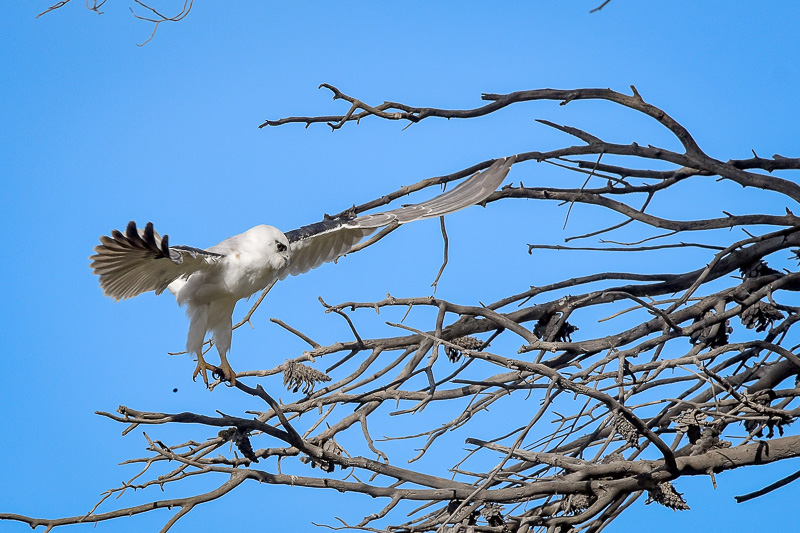
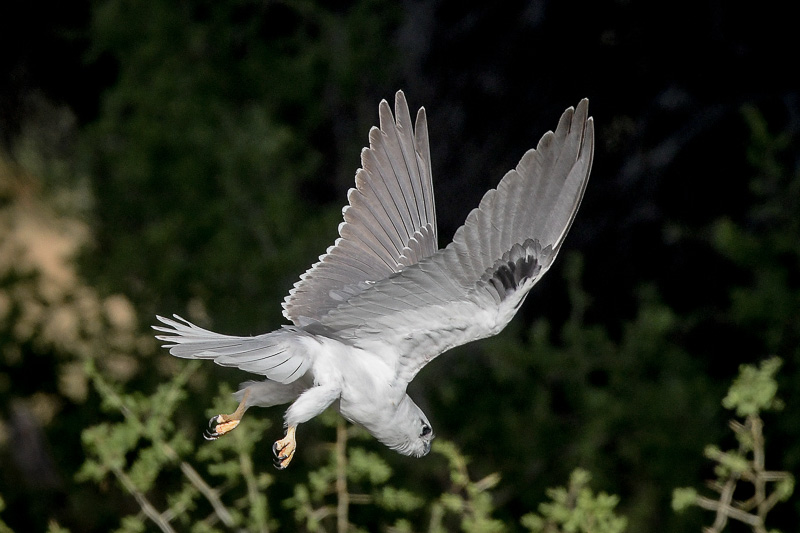
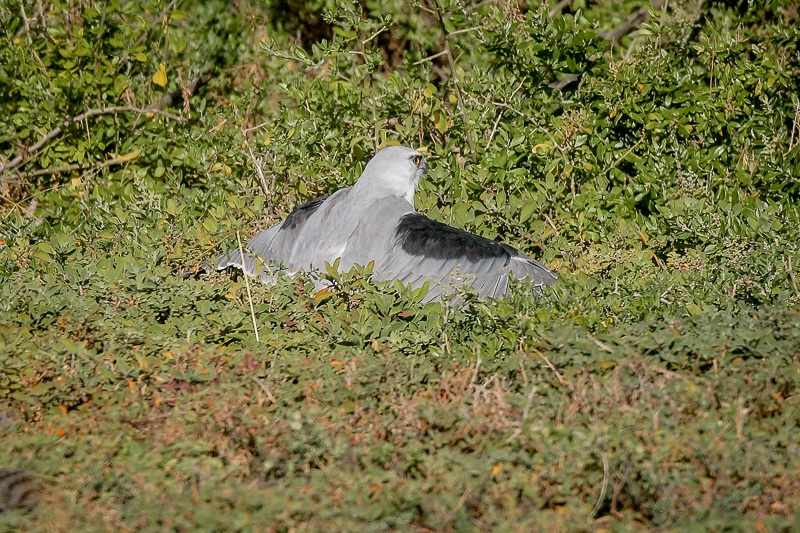
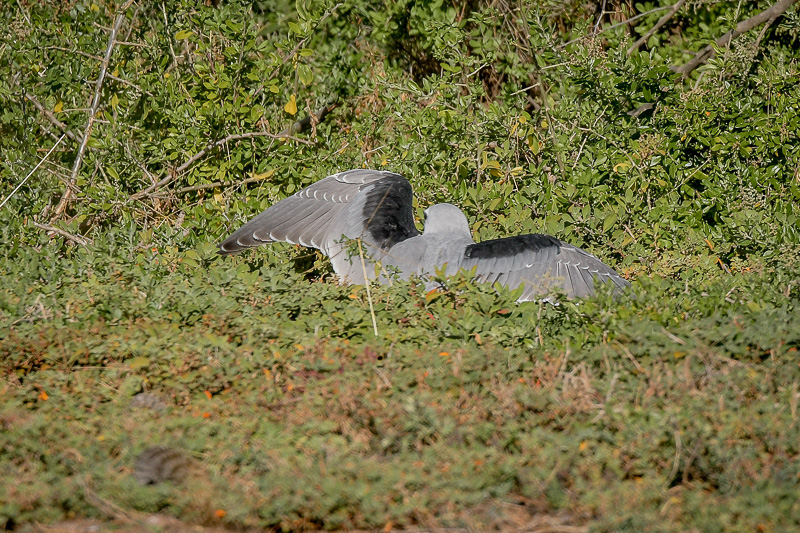
It’s been interesting to watch as they move from being young independent teenagers to a pair. Not yet ready for breeding, but none-the-less a couple. They have several roosting locations and we found them on one the other morning. They had been cleaning and the usual chirping going on between them. They were both scanning the blanket weed and grasses below the tree carefully. The male made a half-hearted dash out over the field, but returned empty. The female took an intense interest in the patch just in front of me, and then wings out she rose from the perch and dropped straight down into the grass to mantle over a catch, then turn and fly back to her perch, mouse breakfast attached.
Enjoy
Here’s how the action occurred.
A early morning restNow what is that I sawHello BreakfastNo time or space for clever hovering, this is a straight diveLegs down for the final momentMantled over the preyWings extended for pre-flightYoiks and Away. (Daffy Duck aficionados will understand)Easy lift offSwinging out past me and gaining heightAll set for a fine meal.
Very early this year, about five families of Black-shouldered Kites fledged their young over about a three week period. The mice seemed also to have had a little population explosion of their own in one of the near-by fields and the families moved in to both train their young and feed them. Some of the more advanced young were quite capable of hunting on their own, but it didn’t stop them trying to score a meal from a harassed father as he flew in with a mouse for one of his young. For a week or so there would as many as 16 Kites all airborne or sitting on fence posts consuming a meal.
But, as it works out, as the young grew stronger and the free feeding ceased and no doubt the mice went on a well deserved holiday, the young Kites began to disperse. The adults that had flown in to supervise, also moved back to their own territory. The female of the home pair also took off, not unusual to see that happen as she needs to build up her strength after 8 weeks or more of sitting on eggs and young. The male continued to stay around and watch over the territory.
Two young juvenile Kites continued to roost together down at one end of the paddock, and as they both had a fair cover of juvenile colouring for several weeks we concluded they were from a clutch and hadn’t yet felt the need to move on.
However as time went on, and the juvenile feathers began to fade and the body language changed, it became clear what we were looking at was in fact a new pair. No doubt they had met up during the paddock mouse madness days, and well, like nature taking its course they became a couple. Now that their juvenile has mostly faded, and their eye colour is still a rich brown, it’s probably to early to conclude they are going to nest anytime in the future. But it is rather charming to see them sitting happily together. Ahh, those teen-age years.
Enjoy
They have quickly established a spot at the end of the treeline as their own territory.This is the day we began to wonder if they were more than just occasional friends. They spent the morning moving about the paddock, and sitting and hunting together.Plenty of colour was on display for both of themBack at home a week later and the colours are beginning ot change. Still tinged with apricot on the grey back and wing feathersOnly just a few flecks on the chest and the female is starting to look larger. Another favourite spot, and by now most of the colour is gone.This is the female, she had dropped from the roost tree and took a mouse in front of me.The end of March and the feather colours are gone, but the eye colour still is a brown.
The interesting part to me is toward the end and titled Mental Mappers. I can’t provide a direct link, and it’s a long scroll down. It refers to “….the specific skills that are hallmarks of good navigators These include the ability to estimate how far you’ve traveled, to read and remember maps (both printed and mental), to learn routes based on a sequence of landmarks and to understand where points are relative to one another.” ” Two of those skill are ‘Route Following’ and …and what’s often termed ‘survey knowledge,’ the ability to build and consult a mental map of a place.”
When my Mother-in-Law was getting on in years the family pointed out she was unable to move around on her own as, “She didn’t know where she was.” Now, I had to take exception to that as I’d travelled about with her quite extensively and was more than confident in her ability to go from home, to the shops, pick up a bottle of milk and return safely. And to venture in and out of several stores along the route. I discovered that they were judging her lack of ability because they had taken her to a shopping centre she’d never been to before and she had asked, “So, how do you get out of here?” I’m certain I’d have done the same. New place, new location, no mind-map.
As a young tacker, I grew up with a highly respected bushman. He could wander about for hours and still know where he was, where the start point might be, or the next spot to go visit. His simple secret was he named locations as he went along. Easy to remember names, like places, “The Eiffel Tower”, “The Burnt Log”, “Wombat’s Home”, and others. The landmarks would be no more than 200-500meters apart. So if he was somewhere, all he had to do was find one of his landscape features and follow back from there. When I walk the Eynesbury Forest, or the Woodlands Historic Park, I still use that system.
I’ve sat for an hour so so with so many Brown Falcon’s and watched them watching. Then when they fly, it’s a deliberate run at almost ground level, to swoop on something, or onto the next chosen perch. As they slip past a bush here, around a plant there, through an opening in the grass, it’s hard not to be impressed at their mapping ability.
And just in case you never leave home without GPS, here is a conclusion from the study.
…A follow-up with 13 of the volunteers three years later revealed that those who had used GPS the most during the intervening period experienced greater declines in their ability to navigate without GPS, strongly suggesting that GPS reliance causes diminished skills, rather than poor skills leading to greater GPS use.
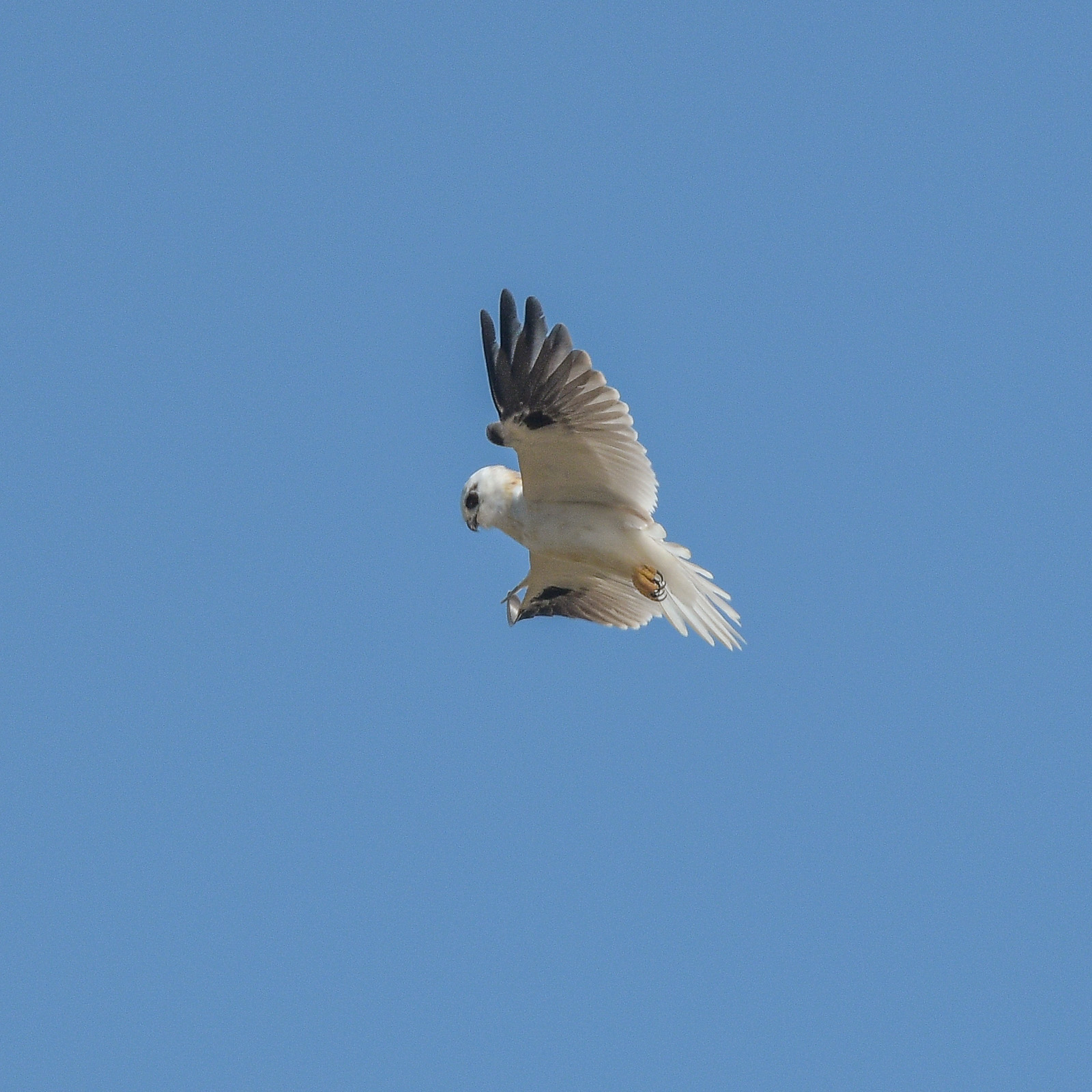
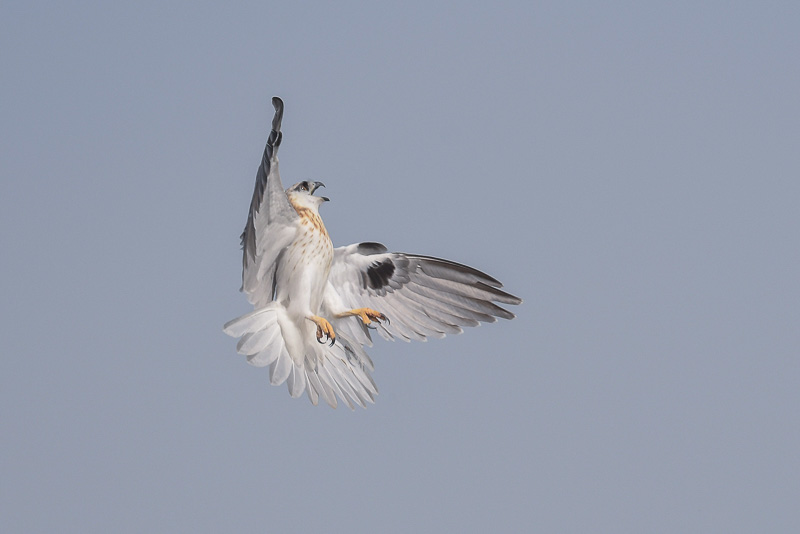
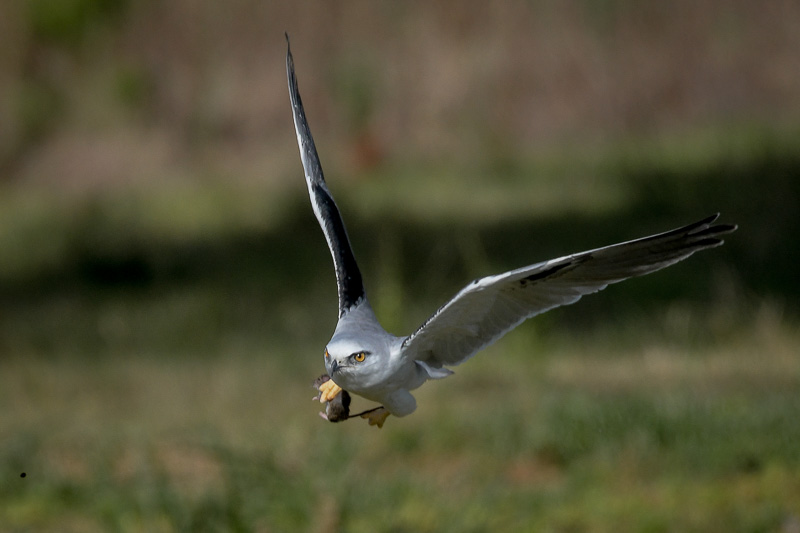
We’ve also been following a pair of Black-shouldered Kites. They fledged two young about two months ago, and the young, as normal have now moved away. As soon as her young fledge, the female usually hands responsibility of their care and feeding to the male. She then takes a few weeks extended leave, and goes off to replenish her system from the 8 weeks or so of sitting on the nest. For some reason this female had not returned for about two months. Her male kept station and I was beginning to think he was on his own. However the other day, we found them both hunting in the paddock. The picture on this page is of her sweeping in with a catch. Not sure if she took the mouse, or if he’d passed it on to her. Will have to wait to see what, if anything develops.
I’ve lamented in a few places the past couple of weeks, that we have been a bit bird depleted. Many of the areas where we normally work, seem to be quiet to a point.
Over the past few months most of the Black-shouldered Kites, that we have followed for a number of years, have finished nesting and have departed along with their fledged young to places far-flung. Hard to understand what has changed. The food seems plentiful, the weather I have to admit is anything but helpful, and perhaps as autumn is around the corner, the birds know things that we are not privy to.
At Point Cook, one pair has had around 5 clutches over the past couple of years. But they too have fledged the young and the trees and paddocks are empty. The female normally would leave the nest area as soon as the young are ready to fledge and bulk up and return a couple of weeks later and begin to plan the next clutch. This time she doesn’t seem to have returned. Perhaps, she has grown a bit tired of this nesting business and is looking for a break.
The male, to his credit, has maintained his station in the area. But each time we pass by, I wonder if he will still around.
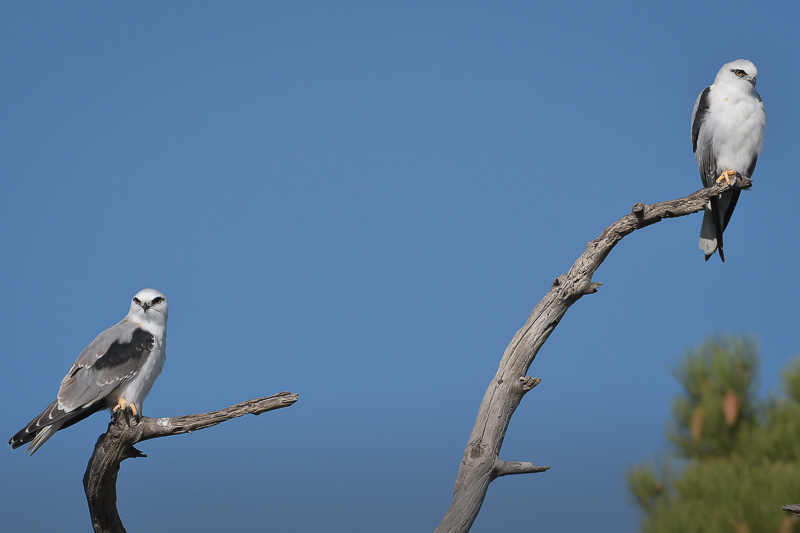
We were travelling a local back road the other day, and spied a lone white shape high up on an old tree. EE cried, Black-shouldered Kite. We didn’t have time to explore, but were going the same way a couple of days later and stopped for a looksee. And there we found a pair resting in the same general area. She was quite vocal and in the end he got the message and took off down the paddock, presumably to collect an offering for her.
The morning was very overcast and now I was left with light-grey and white birds on a milky grey backdrop. I had been thinking of setting the camera to Black and White mode so decided to see what would happen. This one was shot with the “Red Filter” setting—makes the red eye of the bird a little lighter grey.
Be interesting to go back again, particularly after this bout of hot weather, to see if they have intent to nest,or if it was just a nomadic rest spot.
Interesting to see how much larger the female is than the male.Time to go.
We’ve had two young Black-shouldered Kites fledge just recently. They are still learning the Black-shouldered Kite Play Book and being fed by the male.
However they have developed all the skills to successfully hunt for mice and spend quite a bit of time over the paddocks, holding a position hovering, learning to parachute down with wings held high, and how to drop the legs as they enter the grasses. Just at this stage they weren’t quite mastering the take-away food skill.
This young one had been out in the paddock polishing up its hovering skills, and little wings get a bit tired and it decided to take a break by landing on the fence-line.
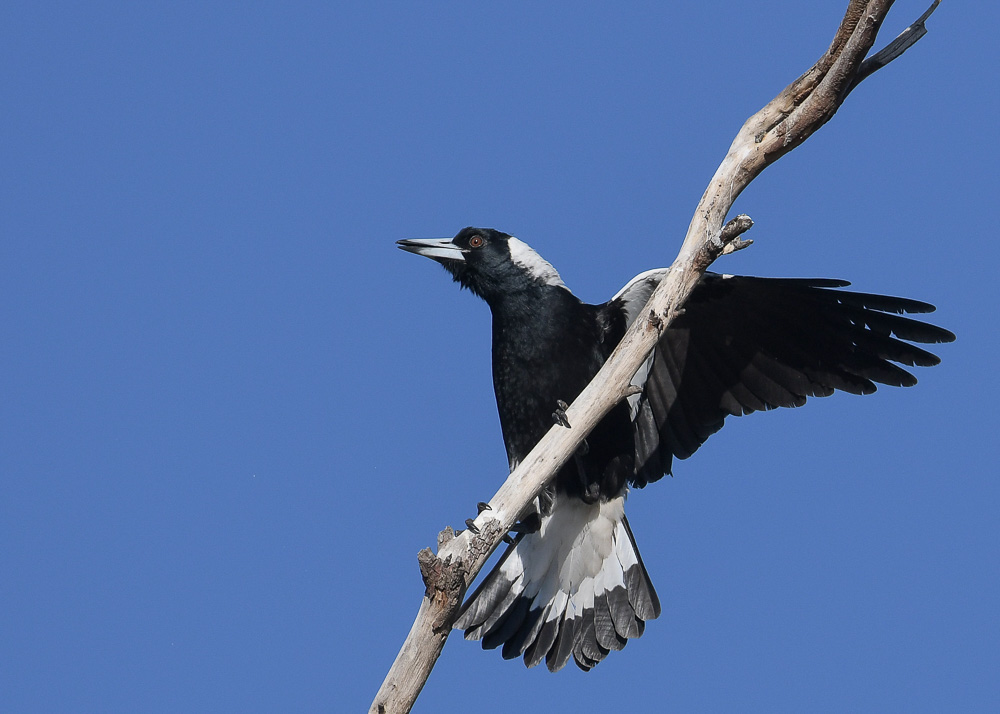
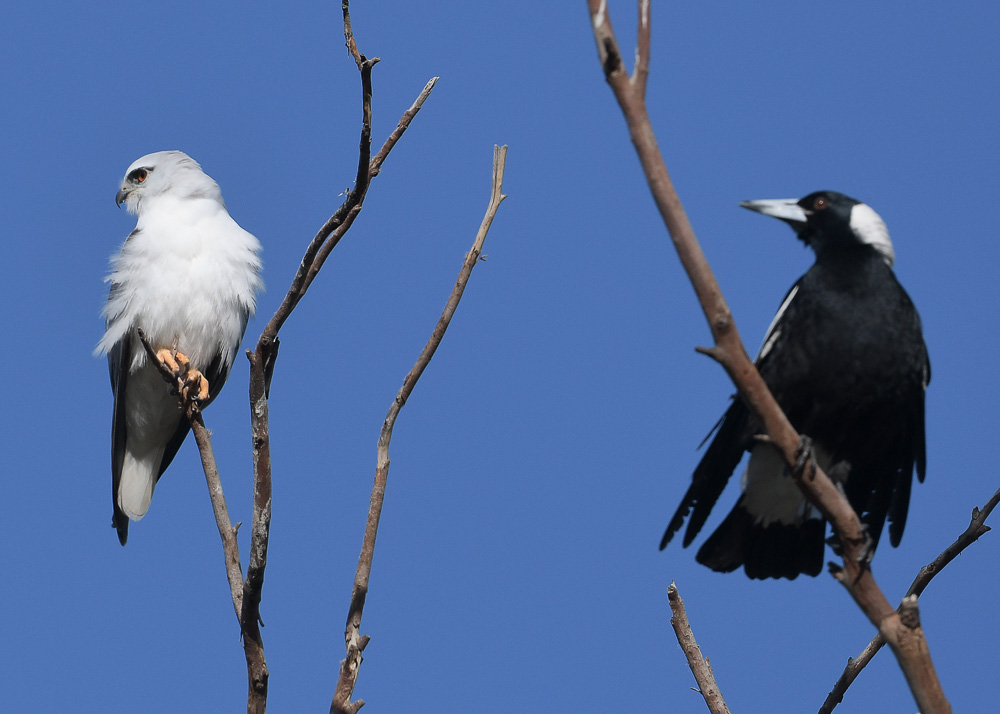
Time to turn to page 122 in the Play Book and learn that you don’t land in a Australian Magpie territory, where they too are schooling up their young in the fine arts of finding their own food and territory defence against all comers.
The little Kite was so intent on finding a fine, safe, secure post to rest on that it didn’t at first note the stealth-hunter rising from the grass in full cry.
In the end it crossed the road and rested on the neutral territory of the gate.
We were at the Western Treatment Plant and the weather had clouded over. Best to head for home was the vote from both EE and Mr An Onymous. As we were at the southern end of the plant we decided (well I had the steering wheel) to take the longer, not so well used, track around the Austin Road extention.
This track circuits the far eastern side of the plant and has a long treeline running next to the fence, and can be on occassions worthwhile. Most times however its just a drive between the treeline and the open paddocks. Which is why many don’t make that trip and the track is mostly used by the farm folk and whatever livestock is in the area.
I missed the Black-shouldered Kite sitting on the old gate rail, but decided to stop just in case it was in the area.
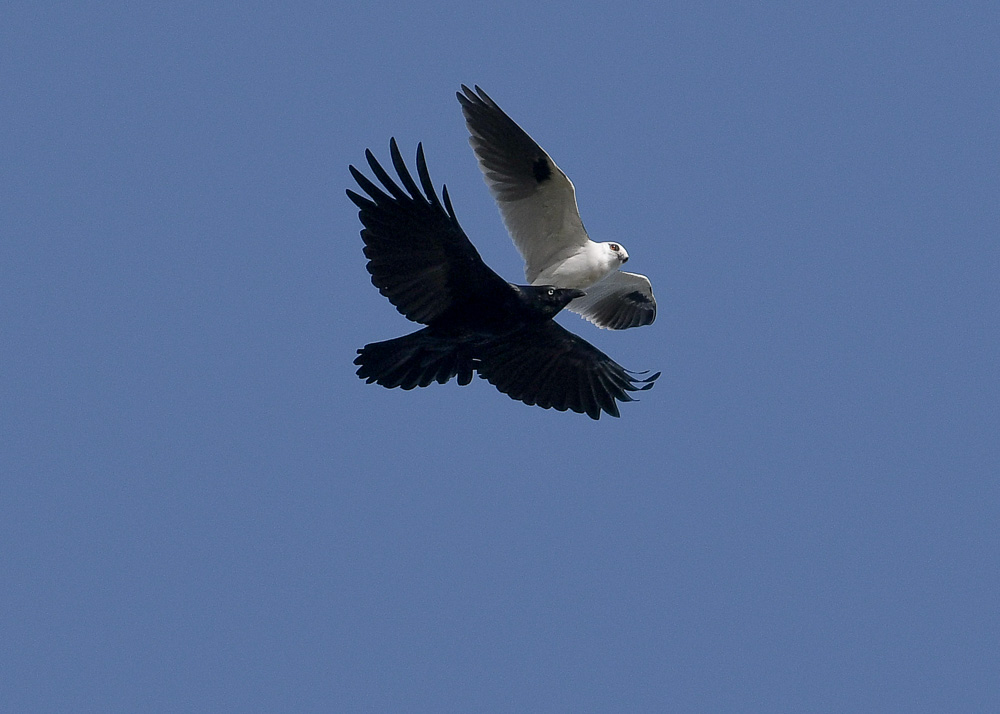
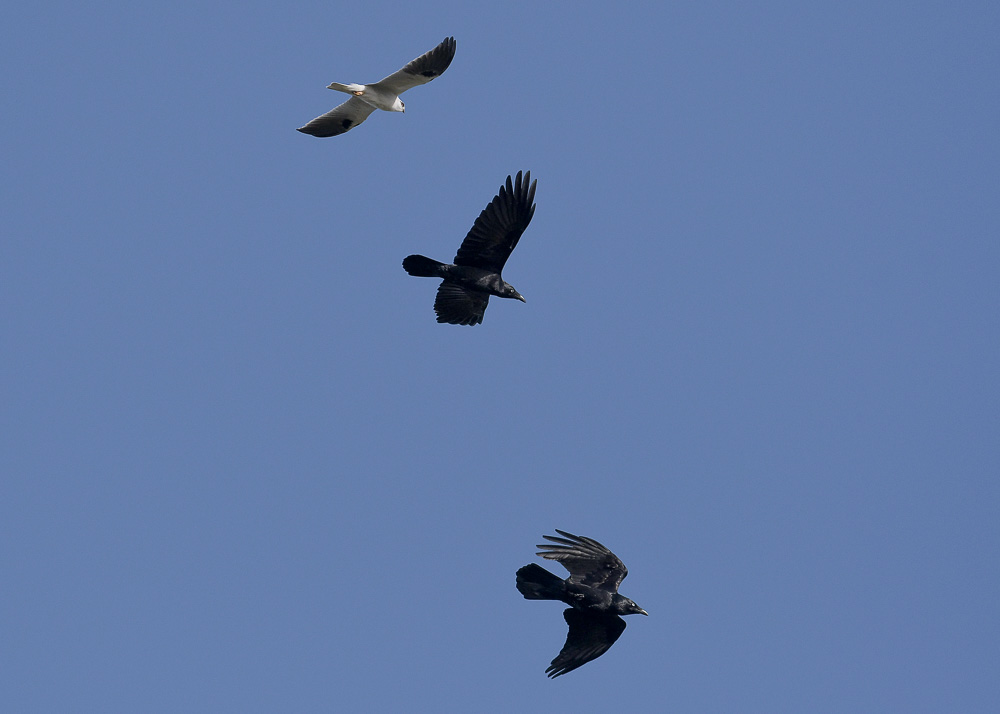
We’d only just got out of said IamGrey and were looking about when an ominous black shape headed toward us across the field, pursued by an equally intent Black-shouldered Kite. Camera up, frames released, and then it was obvious we had found a Black Falcon with a Kite in hot pursuit. This is pretty unusual as normally the Falcon would have no qualms about relieving the little Kite of any prey it might have caught. Perhaps the pair had a nest in one of the nearby trees and they were in no mood for the Falcon to give them grief.
Black Falcons are not resident at the WTP, they tend to come in over the summer and we might only have one or two sightings each season. The Falcon is much faster than the Kite and more like its Peregrine and Hobby cousins than to the Browns.
It swept across the paddock with the Kite stooping on it several times, no contact, but enough to move the bigger bird on. It turned behind the treeline and was gone. The Kite returned to rest on the old gate post.
Our most recent outings have all been in the one location at Point Cook Coastal Park. At least three families of young Black-shoudered Kites have been working in the area. As best we’ve been able to count there have been nine young Kites, with at least two of their supervising male adults, one semi-resident male, who has a second clutch on the go and is busy feeding Madeline, and perhaps two or three late juveniles that have started to lose their apricot colouring and take on the rich red eye colour.
Intruiging to walk down a roadway with up to eight or more of them sitting on fence posts all calling and tail-wagging in territorial poses. While in the air around them several others are applying their skills for a feed.
But with finite amounts of mice, and so many kites a few squabbles were inevitable. And Mike was not happy about having so many extra mouths to feed when he has the new clutch growing.
As I said to someone the other day, it’s the stuff to fill memory cards on. And I’ve wondered how many feeding Kite pictures does a blog need. Still I don’t know. So here are the dramas from a few days.
Enjoy!
This one seemed to me to be an adult the way it was hunting, and I was suprised to see when I looked closely it was a juvenile.
They pull out of the headlong dive just before the ground and the feet are swung in to land on the prey-mouse.
I’ve been near them from time to time and they hit the ground with quite a distinct, “THUD”If you can’t catch a mouse, then it’s fair game to stop the next bird in their hunting efforts, which always results in a few circles of the paddock as they sort out the differences.
Now this I’ve never seen before. This bird is eating the mouse on the wing. It’s a bit to dangerous to land on a post to have a leisurely meal as one or other other the others will make a pass and try to relieve you of your catch. They fly quite high to do this action, and then hover-fall as they reach down and take pieces, until it can be swallowed whole. This is one of the older two or three that have lately come to the paddock. It has easily secured a meal and is keeping it quite hidden from everybody elseOld enough to defend itself, it was lining up for a fence post landingA large tail-flick is a warning to all that is prepared to claim territory. It has also dropped the wings to ‘mantle’ over the mouse.And here the tail is covering any sign of its possession.Meanwhile Mike is running off any birds that try to hunt in his area.I’m not sure where the boundary was, but the young were continually hunted over the far side of the roadway. The young were quite capable of squabbling amonst themselves for the best positions. I came to the conclusion from the way they each returned to a specific area, that the mice were in that location.Another successful strike. And now to find a place to enjoy the meal.Ths is the same bird and its easy to see that it has the mouse very tightly tucked up to keep safe from the others. It spiralled up to gain height to eat it on the wingHere, it is enjoying the fruits of its labour. As it lazily difted down in a slow descent.
No doubt by this week, the fields will be pretty bare as the young will begin to move further down the coast or inland to find their own hunting grounds.
With a welcome change in the weather for a sunny morning without wind, we went to check on the young carpark Kite of Madeline and Mike.
They are now old enough to fend for themselves, so we didn’t expect to see them in the old hometree.
A little searching found them in the air about 700m down the paddock. So we trudged on down. Trudged of course is a euphemism for went with high expectations and we weren’t disappointed.
As we began to count Kites in the air and on the fence posts, it became apparent that there were two families of Kites working in the paddock as we could see at any one time, six young either sitting or flying about. There was also just one adult, and its likely that this one was not Mike and he is now kept busy further afield suppling the incubating Madeline.
The six seemed to get on together pretty well, and it gave them plenty of chances for hunting as well as mock aerial battles. The young fence sitters seemed to do a lot of tail-lifting, which is a sign of territory ownership, so each one was aware of the presence of the others.
Unsure where the other three would have come from as suitable trees are a bit of a rarity in the long paddocks.
They were all happy to work from the fence posts, and allow either close approaches, or fly in close on their own. A main access track and walking trail is about a chain (about 20m) from the fences on both sides and the track are well used by walker and bicycle riders so the young were quite human tolerant.
And in the warm sunshine, with plenty of action, time just drifted by and two hours later we did trudged back to IamGrey for a spot of the Earl’s best.
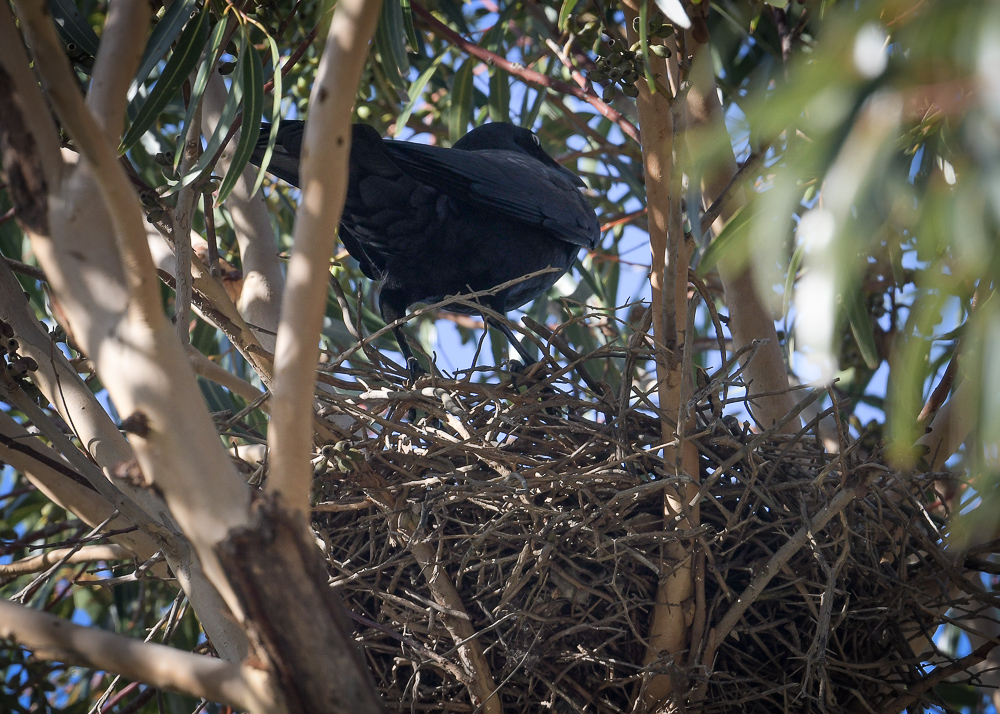
We had on a chance stopped by to see if infact Madeline the Black-shouldered Kite had any prospects of a full nest. Whatever is going on is worth defending as she cleared out a murder of Ravens, a lone Black-faced Cuckooshrike, the two Falcons, Cassia, of Cinnamon and Alistair, and confronted the home team neighborhood watch Magpies.
The Ravens have a nest about 3 trees down from her nest, and it’s going to be an ongoing battle. In the end, she pursed the Falcons to about a radius of 600-700 metres. It was a very busy morning for a very aggressive and angry bird.
As it Happened.
The Raven was hoping it was going to be safe under the tree to work on the nest.
Maddie had other ideas, and it was time for it to move on.
The alpha female Magpie came, perhaps to negotiate, but that wasn’t going to happen
Look out. Here I come
Wisely the Maggie left the branch.
But returned and tried to look as intimidating as possible.
A more frontal attack was launched
In the end, they both landed and decided on their next tactic.
The victor, after 6 rounds. (at least). Maggie moved on. Madeline was already eyeing off the passing Falcons.
Been pondering of late about the future of Birdsaspoetry Blog. Maintaining a full library of images and keeping up with adding new posts, amid all the other things that happens in a life is certainly a challenge.
Had a quick ponder and think I’ll be publishing less of the ‘complete’ photo-journalist stories and concentrate on just one, perhaps two moments that we’ve been seeing. Fewer pictures per post, so that might be an advantage in this ‘immediacty’ age. 🙂
Have been working at making project albums on another site and am trying to figure a way to link directly to here, but. More on that another time.
Madeline and Mike at Point Cook have been working on a second clutch for the year. Progress seems to be slow and it’s hard to determine at what, if any, stage the clutch, if indeed she has layed, is progressing. The tree area is also favoured by the local Magpie clan, and a number of Little Raven pairs. (They are now busy carrying sticks and settling in). So, tree and air space are becoming a little crowed for Madeline and perhaps her progeny.
She is not having anyone put their nest in any proximity to her chosen site so a battle royal was in progress. The nifty little kite had two advantages, she can soar without using any energy—the ravens have to keep a constant wing -beat to stay up. And she has some speed advantage stooping from on high. The ravens have two advantages. Sheer numbers. There were about 12-15, and sheer cunning. While they allowed the kite to attack one or two, the others would group up for a sneak attack while she was distracted. After about 10 minutes, it all calmed down as the ravens needed to land and refresh.
Mike came sailing over the paddock with a fresh mouse, as if nothing unusual was going on.
Let Battle BeginThe little Kite did, early on, get harassedHer abilty to stoop from on high meant she could keep them moving along, herding them away from her nesting areaSpeed comes to the rescueBut she could also be ambushed by one of the many support groupWhen it was all over, Mike came in unconcerned and delivering a meal.
Regular followers will know that not too far from home, in a quiet roadside reserve, we have over the years been following the nesting activities of a pair of Black-shouldered Kites, named, Belle and Bronson.
If the boy scout arithmetic is close to correct, (and a lot of covid-lockdown not withstanding), it’s likely the that pair over about 4 years had as many as 10 successful clutches and two that were abandoned for various reasons.
Each clutch on average was 3 young birds, with two being just 2 young. All seemed to survive to leaving home, so its possible between them they flew at least 28 young birds to add to the population.
There is some anecdotal evidence that Belle had a least two Bronsons. Which would make her quite an old bird in Black-shoulded Kite years.
In September 2022, they again flew in sticks and mated and she settled in to the job of her 11th clutch. But. The weather turned dreadful not long after she had layed the eggs, and we had over a week of incessant rain and extreme high winds. We had watched the branch carrying its precious cargo being tossed about like a leaf.
After about a week, Belle disappeared. The nesting was over. We’ve seen her do this before and usually after bulking up for 2-3 weeks, she’d return. Time, as they say went by, and no sign of return.
Bronson was still home-schooling his previous two young. They were pretty much full grown and self-sufficient, but they stayed around the home tree, and he sat with them for a couple more weeks, eventually they too left and the paddock and small treeline was bare of Kites.
All through October and November, we kept checking, but in the end it was obvious. This party was over.
We did make occassional visits, but all through till March there was no further activity. I had been following a second pair of Kites about a kilometre down the road, so a drop in wasn’t too hard. In early April, we heard familiar sounds of a Kite short squeaking call. All excited, perhaps the pair were back. However we only found one and it certainly wasn’t from the missing pair. A few days later a second one was visible. This one certainly was a much younger bird and we wondered if they were a pair. Hard to tell, initially. They certainly didn’t behave like the originals and they had some unusual habits. Including not using any of the more familiar perches and spending time at the far end of the little plantation. Also it soon became clear that they did not engage in aerial transfer of food. And to be honest, watching them try to transfer on a branch showed how clumsy either, one, or both of them were. Eventually they settled on using the large street lights over the freeway as a level table to pass the mouse across. Strange.
The upside was the work, began, a site was settled on, and settled into. Stick carrying, and mating were the order of the day. Inspite of their clumsy food transfering, the mating seemed to go quite well, thank you.
I’ve delayed writing about it, and showing some pictures as it’s been very much an on-again off-again process. We think of them as ‘new age’ birds that have a new set of rules. 🙂
Meet the new CoupleDiscussions about nesting materialsPlenty of building material going inShe seemed unsure how to take the mouseEventually persistance paid offAnother complex food transferSettling into the nesting areaYet another complicated food transfer. But it is getting smoother.The alternate food transfer location.From a roadway that is near the nest site, its just possible to make out the nest. Here Belle is beginning to beak feed her hatched young.