
Seeing is a miracle.
Recently, on occasions, I’ve risen early in the morning while it’s still dark, and gone for a walk. Street lights abound in the area that I walk, but nothing is quite like the slow, steady, change from darkness to daylight as the sun begins to make its presence felt on the eastern horizon.
Lines and shapes slowly become clearer, colours that were muted begin to take on their own richness. The natural wonders of the world around me begin to stretch and open toward the light.
I meet a pair of Magpies on the corner, near a football oval. I greet them, and they always respond with a long carolling season. Just t’other day, I didn’t see them on a fence post as I walked by—it was dark— and they were quick and loud in the call, to perhaps cajole me for passing by without acknowledgement.
Yet is spite of all these little visual miracles, the vast population around me drive past in trucks, cars, buses and bikes. All blinded to the wonders that are right there. Peering through their windscreens.
Not that I’m totally aware of all that happens. Something will grab my attention, but in between, I am also struck by a disease of visual decline.
Marcel Proust said, “The real voyage of discovery is not in seeing new landscapes, but in having new eyes.”
A wonderment with the world.
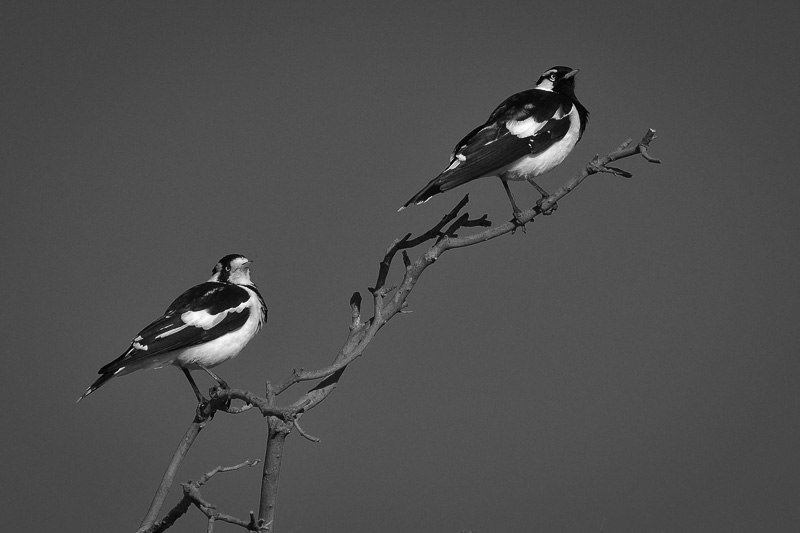
It is one of my great photo goals to make an image of a pair of Magpie-larks landing on a perch and doing their wing and call display.
I saw this pair approaching a tree and hurried to have a clear view, but.
By the time they landed, there was a leafy branch between me and the pair, and I missed the moment.
Looking at them, I turned the camera setting to monochrome, and dialled in some extra red filtration to darken the sky.
The result really shows the difference in the facial markings of the female in white, and the male in black.
As they now say in the best journalistic truth telling. “Digitally Modifed at the Source.”
 Birds as Poetry —— Just because I WANDER doesn't mean I'm LOST