
The four D’s had set out at Truganina Park on a lovely sunny day—which would rapidly turn into a cold, windy and squally morning—but who would know!
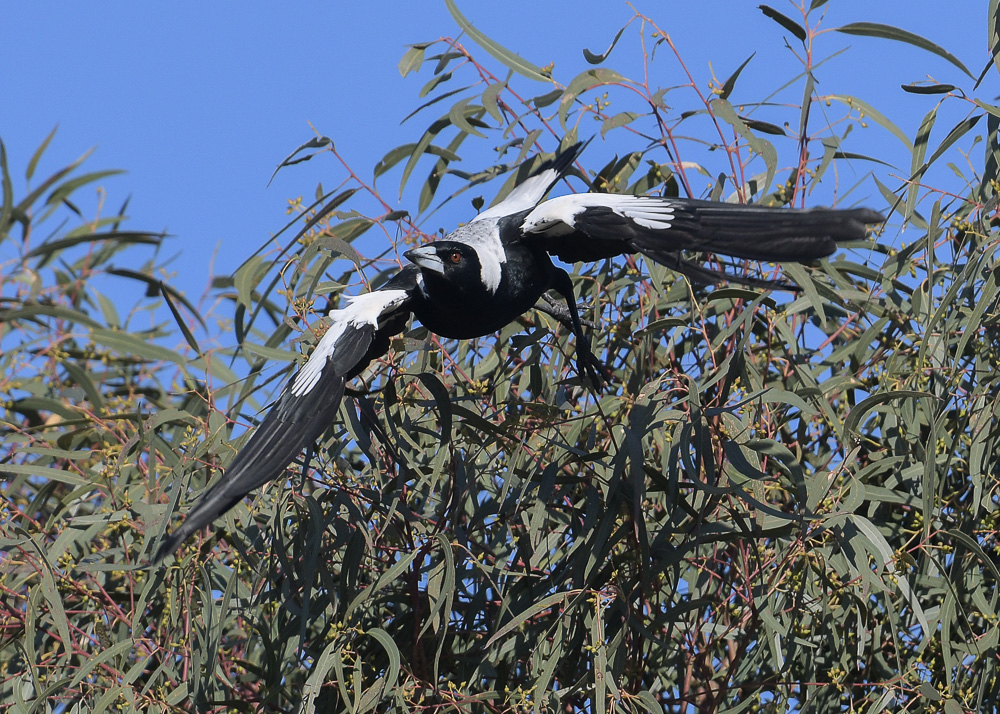
No sooner had we entered the park than a black and white streak sped past and landed in a tree just above the picnic shelter.
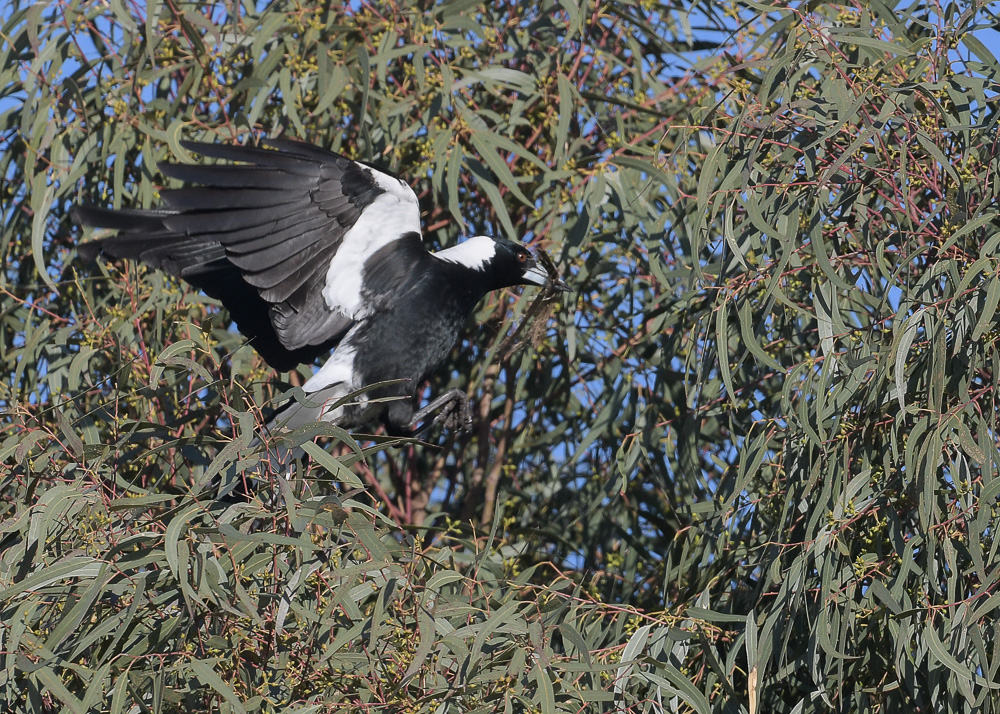
At least two loud exclamations from the D’s “There’s a New Nest Going in Up There”. And we all looked. Sure enough a lot of twitching and shaking in the leaves, and the resident Austalian Magpie was hard at work.
In the space of about 15 minutes she made 5 more trips into the tree. She was loaded with sticks and grasses and by midmorning must have been well pleased with her work.
There is a cleverness to the location, as we found out later as we sat in the shelter enjoying a cuppa of the Earl’s finest—wise move given the weather.
For her high position she has great views and it gives ready access to any handouts that might be forthcoming from humans and their messy eating habits when outdoors.
Very quickly both the female, and then gliding in from a long way out, the male, arrived to see what we had to offer. These are no first time birds and have been in the area for at least 10 years or so, perhaps even more. They know all the best spots to get that handout, and she won’t have to fly far for something for her growing young.
As it happened



Enjoy
 Birds as Poetry —— Just because I WANDER doesn't mean I'm LOST
It sounds like a prime location. Let’s hope all goes well with the young when they emerge in due course. Lovely shots of her hard at work.
LikeLiked by 1 person
Hello Eleanor, Hard not to be impressed that she would work so close to the picnic area, but I guess they have been freeloading for years and see no need to change.
I know everyone seems to get upset about the feeding of them, and the food that doesn’t suit, but I suspect that this family have worked out a diet balance.
LikeLiked by 1 person
I know that fine Lady!
And yes a prime piece of real estate for the family!
A fine series of images, David!
Hoping the weather improves soon!
LikeLiked by 1 person
Yes, they have been ensconsed in the area for about as long as ever we’ve been going there. They always seem to fly in to see what offerings are on show when they see any picnic activity
LikeLike
These Maggie’s are making an early start for the season. They do make a good nest, but it is sad they have learned to bludge off humans for unhealthy foods. Great flight captures David! I have noticed our resident Crested Pigeon family in our Bottlebrush tree very active and the male doing regular courting displays. The Cockies and Rainbows are nesting also. We are concerned that the Lyrebird’s have gone quite at a time of year when they perform and display. It won’t be too long and swooping will be back in early spring, when your Maggie’s get nesting. It must be a challenge going out birding in winter there, but the birds you see make it all worth while. Observation of nesting has been a large part of your field studies and your photos beautifully portray them. Enjoy your week. I took my grandson birding yesterday in rainforest and we hardly heard or saw a bird. Thankfully the faithful Yellow Robin came and looked us over, and we got a few seconds glimpse of a male lyrebird.
LikeLiked by 1 person
Hello Ashley,
Despite the cold, it seems that the early starters are well on the way with nesting. here’s a funny one that you might enjoy.
https://www.abc.net.au/news/2023-07-21/bird-droppings-driving-customers-away-in-east-perth/102621984
We have had quite a few days of very quiet days in the bush, I’m not sure what is causing the silence in the scrub. Good to have a fine look at Eastern Yellow Robins.
We used to have several locations that were Eastern Yellow Robin rich, but several years ago, a program of banding to ‘enhance the bird’s lives’, was introduced and most of the birds were captured a number of times, banded and then recaptured and measured, etc, etc. A year later in three locations the Robins had abandonded the areas, never to return. So that didn’t work.
Hope that some of the average weather changes so we can get out without being rugged up like a polar expedition. 🙂
LikeLiked by 1 person
David we are experiencing similar experiences in our forests this winter with an eerie quietness and absence of particular birds. For us it is the Lyrebird, they are usually performing and quite vocal at this time but can not be seen or heard anywhere. We think the recent upgrading and extensive repair of the road with heavy machines may be responsible, but not sure, as it has also affected the deeper rainforest.
I see what you mean in Perth, I remember my son taking me to that place, how terrible for the cafes along there.
LikeLike
Birds never cease to amaze me. They build the most intricate and warm cozy nests, have no hands with which to shove this and that into place, and seem to have no trouble finding just the right sticks or the right grasses or mosses. They are amazing engineers…! With a series of amazing photos, you’ve given us a brief insight into the work that this particular “Maggie” has had to undertake to build a home for herself, her mate and her youngsters… Somewhere in the midst of your last three Blogs, you’ve mentioned that high winds have caused a number of nests to topple from their branches. I can only imagine how devastating this must be for the Owners – or at the very least, how frustrating – yet they don’t sit around and feel sorry for themselves. They just get on and start the rebuilding process…! Humans could learn a lot from this apparent ability to bounce back after apparent disaster…!
Once again, a beautiful presentation David, and thank you (again) for the effort you put into these Blogs. Be assured: they are appreciated…!
Have a pleasant evening, keep warm (NZ’s capitol has a bitterly cold Southerly coming in straight from Antarctica!!!), and I look forward to your next ‘publication’…!
Cheers,
Lance
LikeLiked by 1 person
Hi Lance,
Some of the nests get resused by others, the Brown Falcons we follow don’t build, but take over a used Magpie’s nest So its good use of the materials.
We work on the Western Grasslands area. It was, a long time ago a lava plain, and has since grown mostly grasses, and some stands of trees. Lots of damage to the area since “The Invasion”, but the plains suits the raptors such as Black-shouldered Kites, Nankeen Kestrels, Hobbys, and Brown Falcon. We also get a lot of ‘grey nomad’ birds such as Black and Whistling Kites that flow through and then move on.
The damaged nests were generally washed and blown out, any young would not have been able to cope.
Interesting as you say, they just regain their composure and begin to start again.
Time will tell what happens the next few weeks.
Seeya
LikeLike